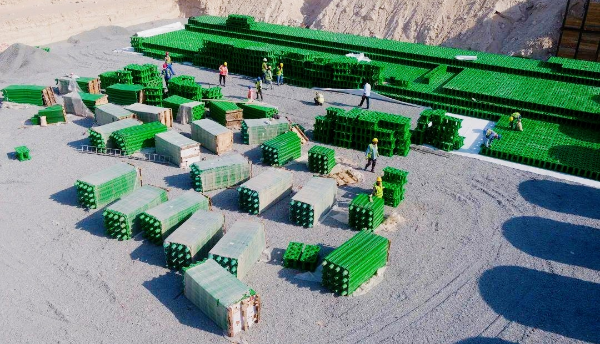
Geocellular Stormwater Solutions

Subsurface Stormwater Management Systems

Underground stormwater storage systems become easier to procure when the water route, storage brief, product family, material interfaces and document gaps are visible before quotation.
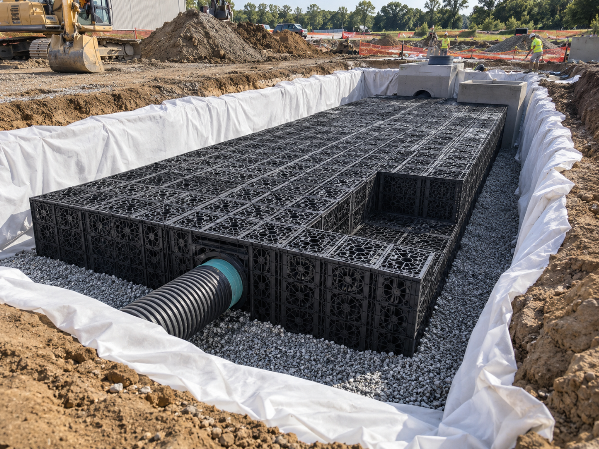
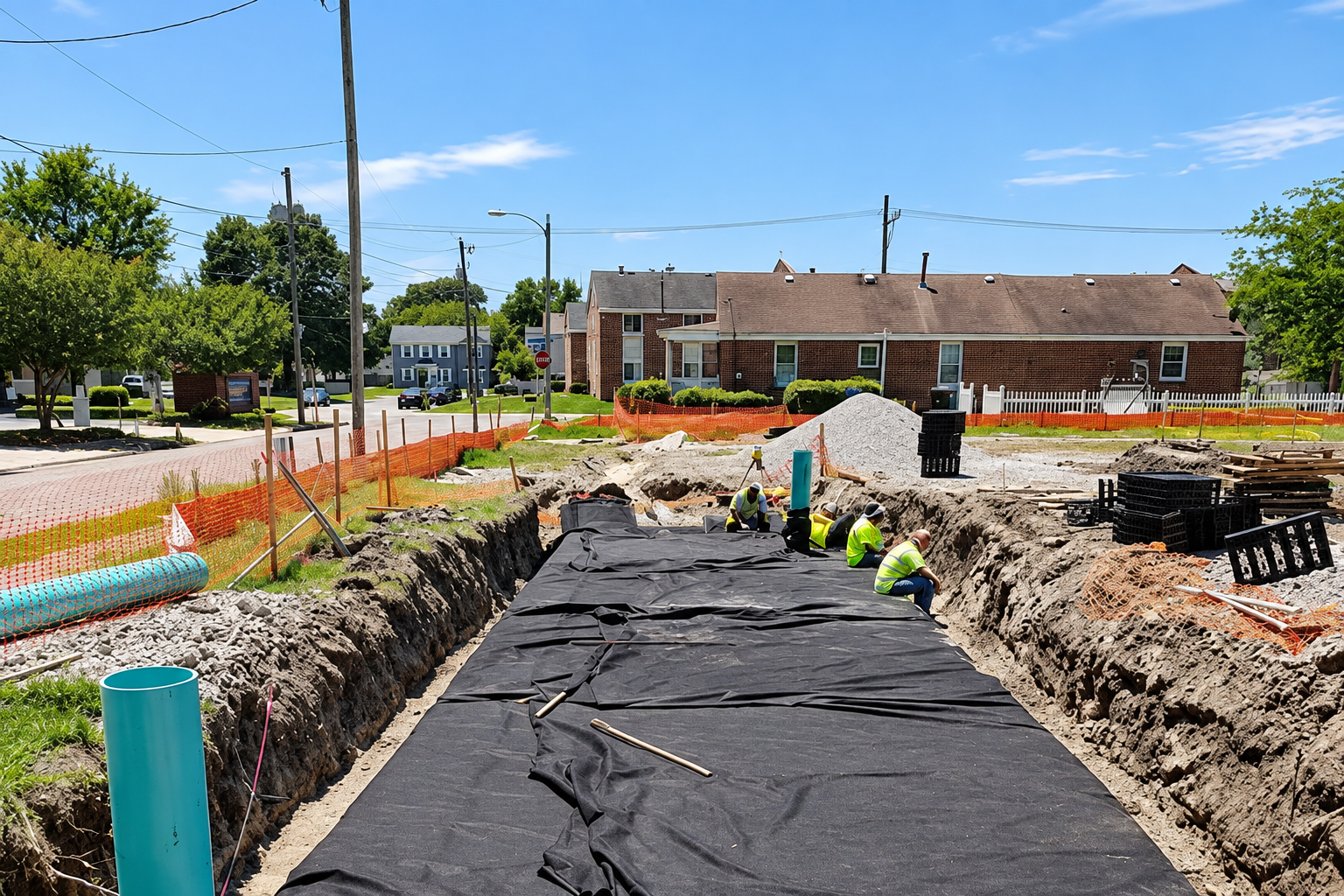
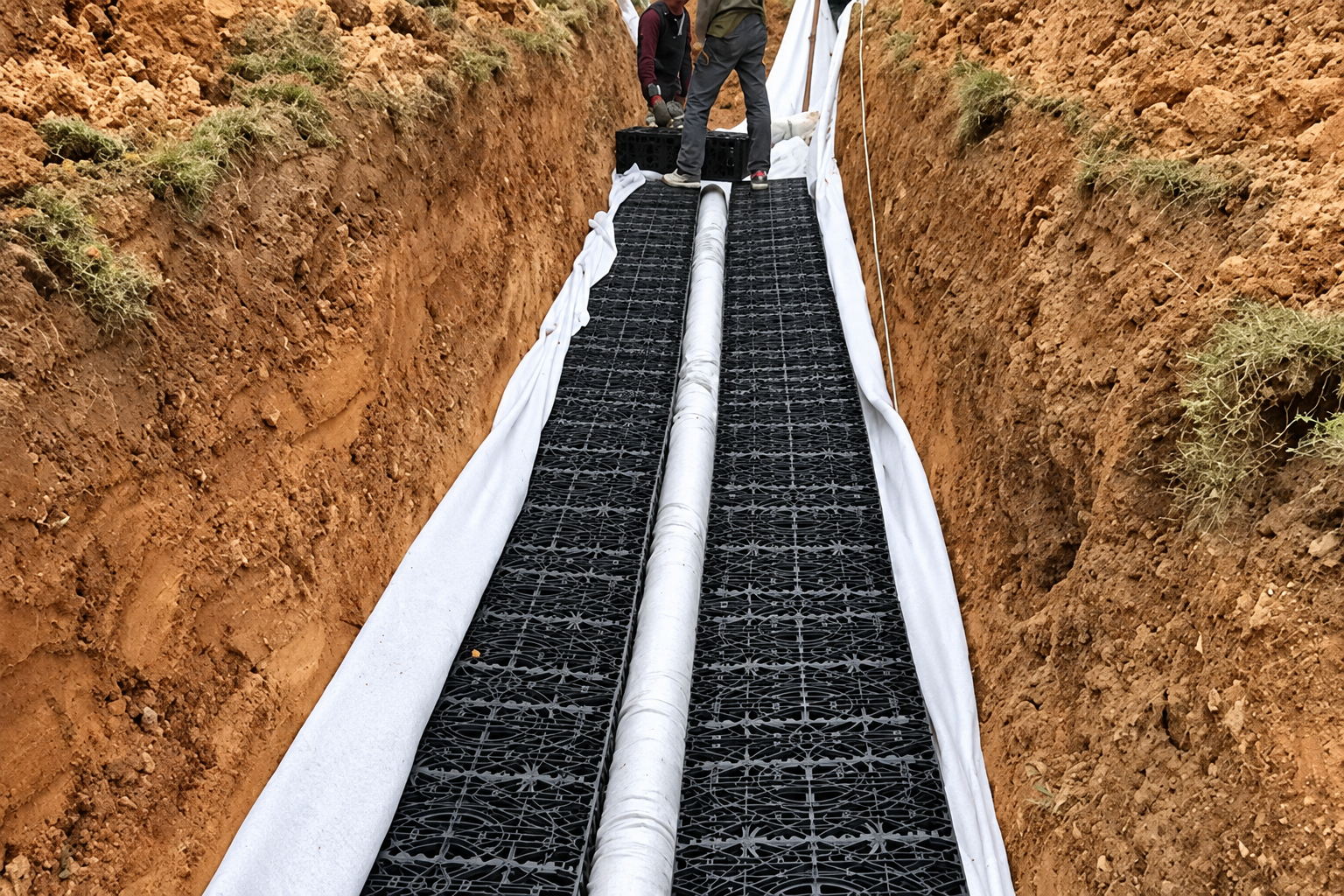
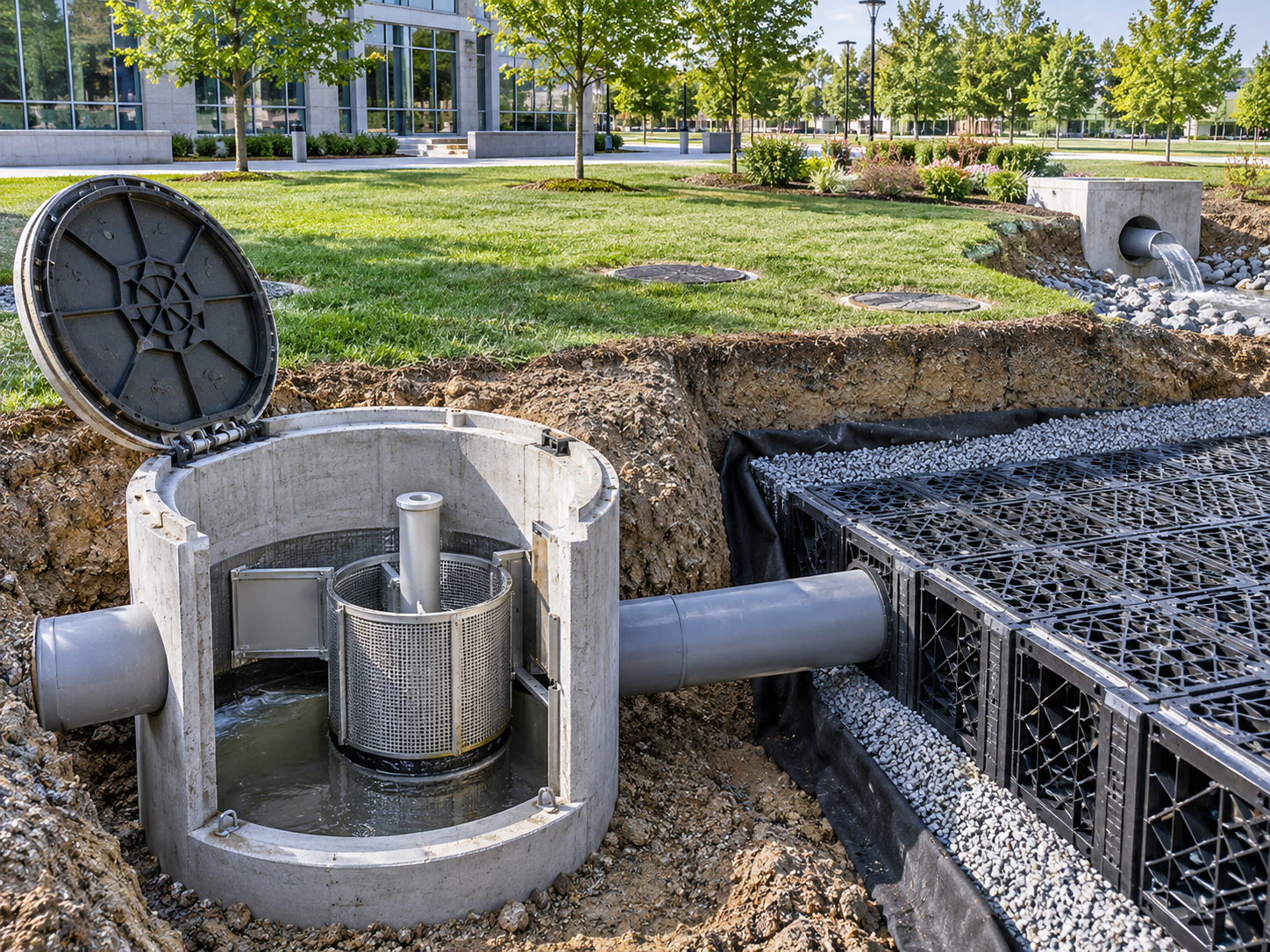
Subsurface Stormwater Management System Structure

Supply route, not turnkey construction

  • 01 Tank, Module and Shallow family shortlist
  • 02 Geotextile and geomembrane interface schedule
  • 03 Order-specific BOM, documents and packing direction
  • 04 Remote guidance, loading supervision and product support by arrangement

Start With the Water Route

Before selecting a storage product, choose detention, infiltration, or lined storage/reuse. AQUA provides products, supporting materials and product-related documentation. The project team does the approvals, design, and installation.

Detention - Control and release process diagram
Control and release

Detention

  • Confirm volume, outlet and overflow basis.
  • Review footprint, cover/loading, groundwater and inspection access.
  • Use a project-defined lining route where containment is required.
Infiltration - Ground suitability testing and setup
Move water into suitable ground

Infiltration

  • Bring soil/infiltration and seasonal-groundwater evidence.
  • Set pretreatment and sediment-control inputs. Source
  • Lock the project-specified geotextile interface.
Lined storage and reuse systems diagram
Retain water in a defined enclosure

Lined storage / reuse

  • Specify water-use, liner and protection requirements.
  • Keep treatment, pumps and controls in their own scope.
  • Review liner buoyancy where groundwater may act on the system.

Shortlist boundary: a published vertical compression grade is one product datum, not proof of project fit. Lateral loads, cover, traffic, groundwater, flotation, temperature, deformation, support, backfill and interface details still belong in the design review.

Underground Detention and Infiltration Application Language

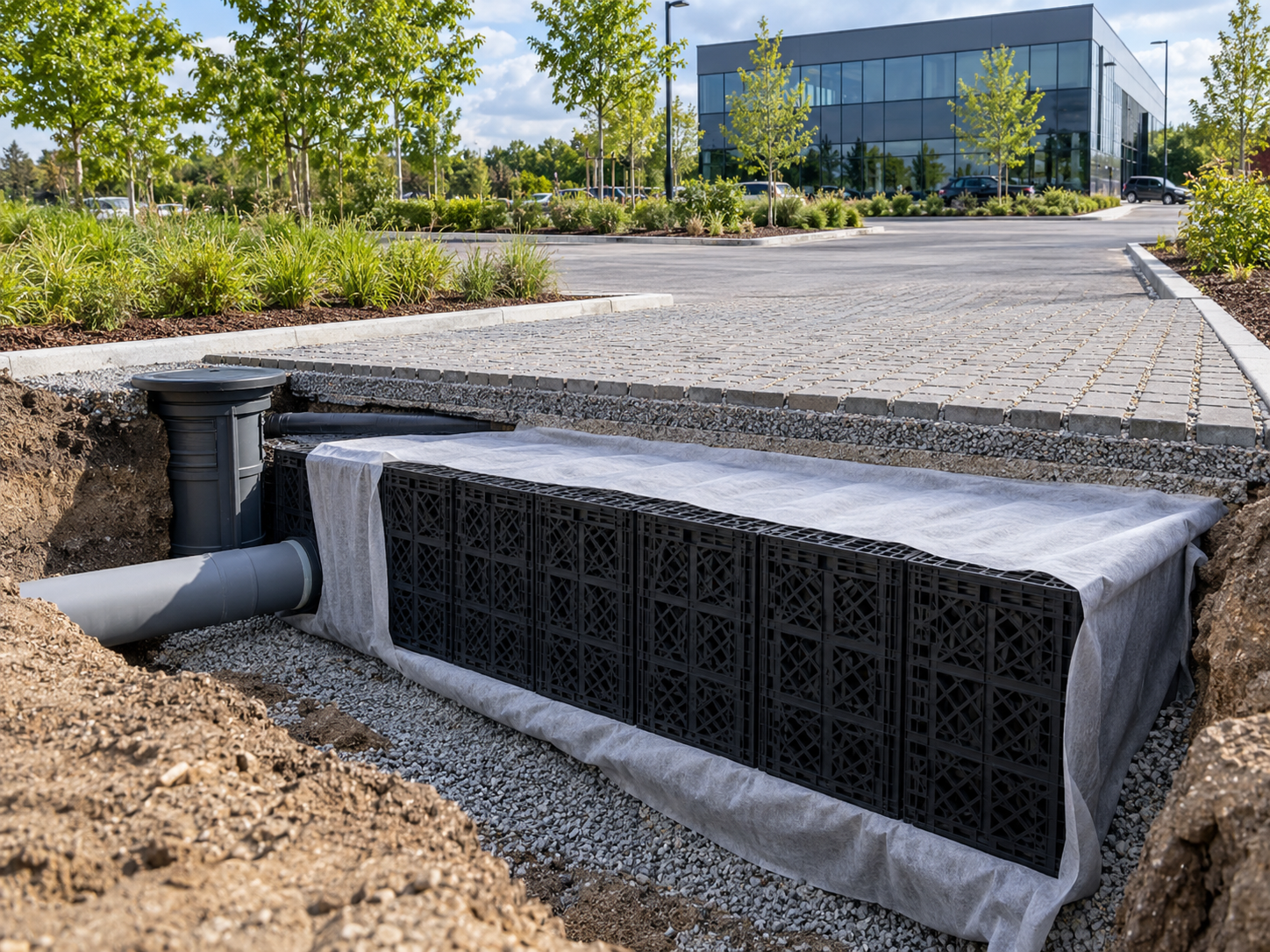
An underground detention system stores stormwater runoff below grade and releases it through a defined outlet; the same stormwater detention system should not be treated as a detention basin without checking the hydraulic and maintenance basis.

source: Underground detention, stormwater detention and water storage describe functions, while the supplied product still needs an order-specific configuration.
  • Parking lots and other on-site surfaces still require project-defined cover, loading and access.
  • Inspection and maintenance inputs include pretreatment, sediment removal and cleanout access.
  • Pollutant removal is a separate treatment question; underground storage does not provide it automatically.
  • Outlet and overflow design can affect downstream erosion and the receiving drainage system.
  • Storage tanks can store water for detention or a lined rainwater harvesting route, but treatment remains separate.
  • Attenuation tank, geocellular attenuation and geocellular attenuation tank may describe related modular storage searches.
  • Crate and soakaway are also used in some markets; AQUA keeps the selected product family and interface scope explicit.
  • SuDS and sustainable drainage language does not replace local authority, soil, groundwater or structural review.
Underground Detention and Infiltration Application Layout

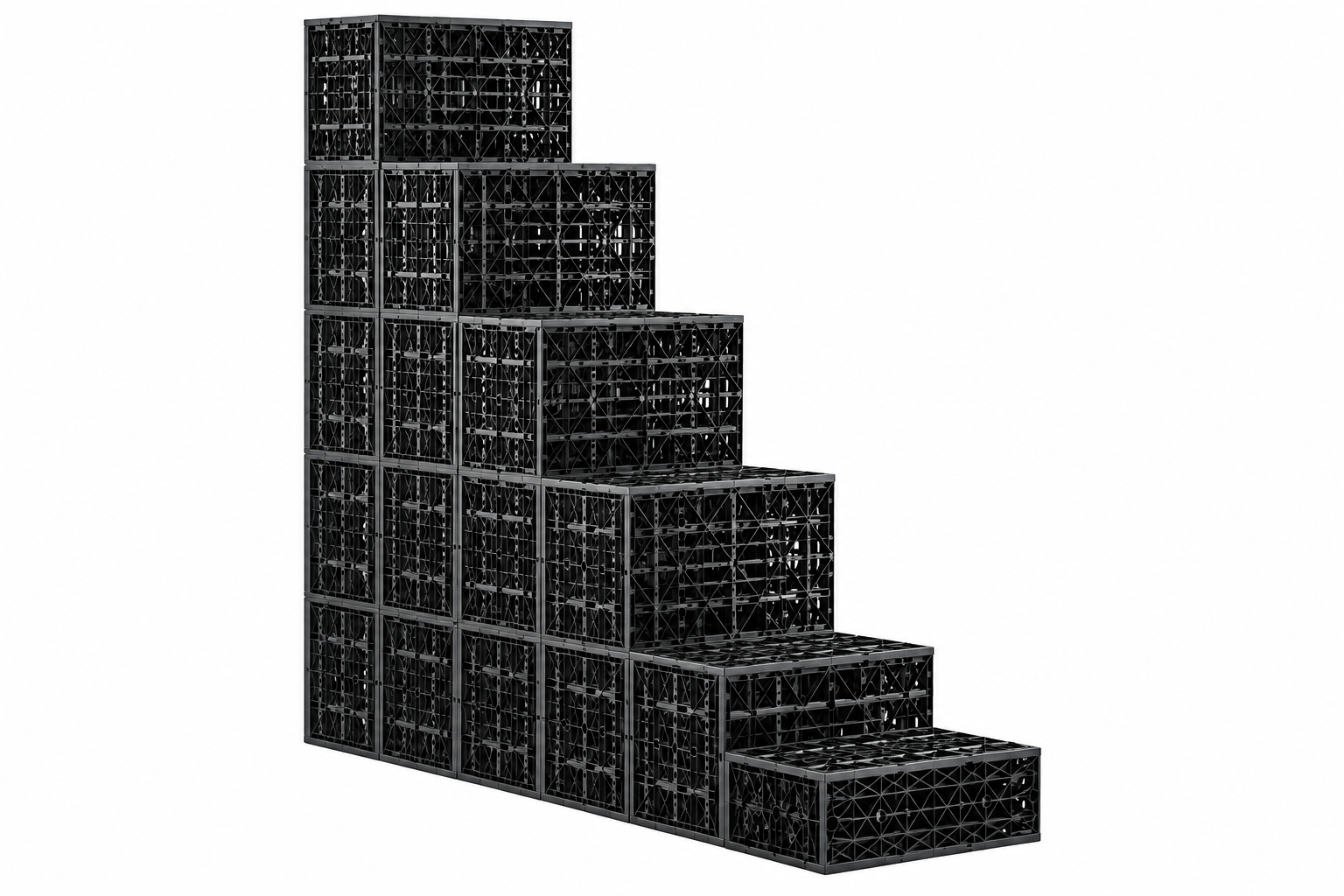
Tank, Module and Shallow Product Routes

Vertical grading introduces configuration risk as unit height, storage, layout and interfaces affect the elements of the supplied system. In these comparisons, AQUA considers the family against the given specification and captures assumptions, unresolved inputs, interface, the BOM, relevant documentation and packing instructions.

A published vertical grade is not a substitute for full configuration review. Tank and Module routes are not interchangeable, and the trade-off changes with depth, footprint, loading, groundwater and access; confirm against the project inputs before freezing the shortlist. For underground storage generally, FHWA identifies vehicle loading, pretreatment, inspection and sediment removal as design considerations. source

Tank, Module and Shallow Product Routes
Series Unit size Void / usable storage Published selection data
ARW-1050-30 1,000 × 500 × 500 mm; 400 mm optional height 95%; 237.5 L standard / 190 L low height 30 t/m² owner-confirmed vertical grade; recycled PP
ARW-1050-40 1,000 × 500 × 500 mm; 400 mm optional height 95%; 237.5 L standard / 190 L low height 40 t/m² owner-confirmed vertical grade; recycled PP
ARW-1050-45 1,000 × 500 × 500 mm; 400 mm optional height 95%; 237.5 L standard / 190 L low height 45 t/m² owner-confirmed vertical grade; recycled PP
ARW-1050-60 1,000 × 500 × 500 mm; 400 mm optional height 95%; 237.5 L standard / 190 L low height 60 t/m² owner-confirmed vertical grade; virgin PP
ARW-8053 800 × 490 × 530 mm 95%; approximately 197 L 22 or 30 t/m² published vertical grades
ARW-8025 800 × 490 × 250 mm 94%; approximately 92 L 38 or 50 t/m² published vertical grades
ARW-6841 680 × 410 × 450 mm 95%; approximately 119.2 L Loading basis requires order-specific confirmation
ARW-SA-85 1,000 × 500 × 85 mm 95%; 40.375 L Shallow route; connection detail is project-specific
ARW-SA-150 1,000 × 500 × 150 mm 95%; 71.25 L Shallow route; connection detail is project-specific
ARW-SA-200 1,000 × 500 × 200 mm 95%; 95 L Shallow route; connection detail is project-specific
ARW-SA-250 1,000 × 500 × 250 mm 95%; 118.75 L Shallow route; connection detail is project-specific
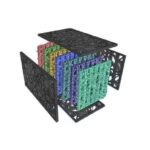
Product and interface layout illustration of ARW series

ARW-1050 order configuration

  • A standard unit BOM uses 2 bodies, 6 side plates, a top cover and clips.
  • Side pipe accessories cover DN200–DN315; larger inlet/outlet options cover DN600–DN800.
  • For the applicable arrangement, an optional top inspection accessory at DN800 is available.
  • The order-specific BOM confirms grade, height, openings, quantity and connector count.

Whole-System Cost and Packing Direction

The risk with a unit price comparison is that it conceals the cost of excavation, interfaces and access. Before considering any item a potential deciding factor, one should evaluate the volume of storage, cover, liner/protection build-up, freight and the cost of maintenance.

Inputs that move the comparison
  • 01Required storage, footprint and excavation constraints
  • 02Cover, loading, groundwater and containment requirements
  • 03Geosynthetic, accessories and interface scope
  • 04Access, pretreatment, sediment removal and maintenance plan
  • 05Packing, container mix, destination and schedule
Logistics & Schedule
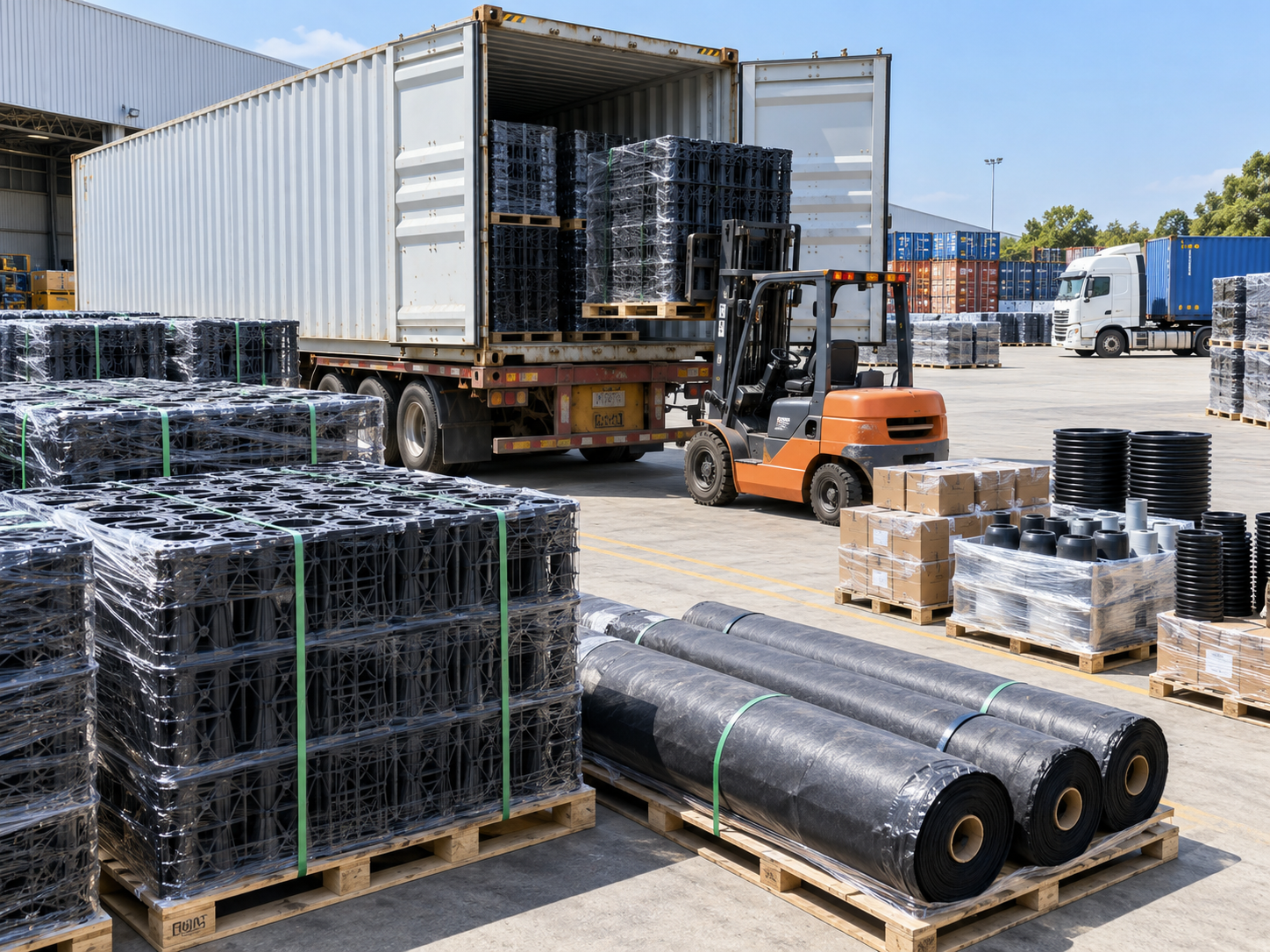
  • 01Our core module bodies and side panels are normally palletised.
  • 02Our smaller accessories, flange covers and clips may be shipped in bags or wooden cases.
  • 03Full-container shipment is preferred for main modular products; suitable smaller or mixed orders can be reviewed for consolidated shipment.
  • 04One 40HQ of the core module range is produced in approximately 2–3 days and can take up to about 7 days, excluding raw-material preparation.
  • 05Mixed-product warning: a shallow tank, geomembrane or geotextile order does not inherit a core-module timing statement. Final timing is confirmed for the model, material, order mix and season.
Whole-System Cost and Packing Direction Overview

Quality Assurance, Batch and Document Scope

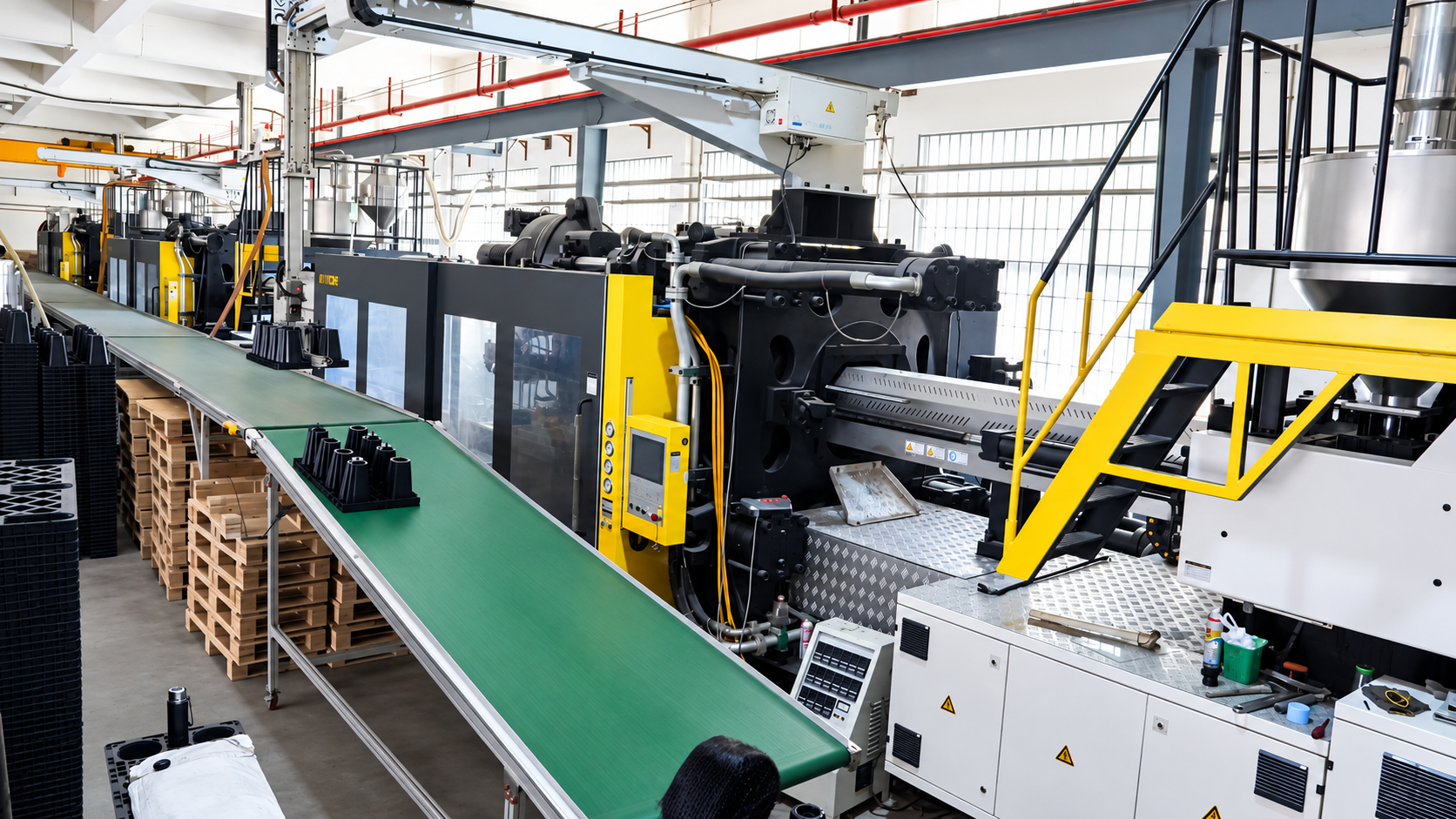
The risk is document overreach because batch records, submitted-sample reports and project design values have different scopes. AQUA Rain Water’s core molded-product operation incorporates injection molding, batch inspection and in-house compression tests.

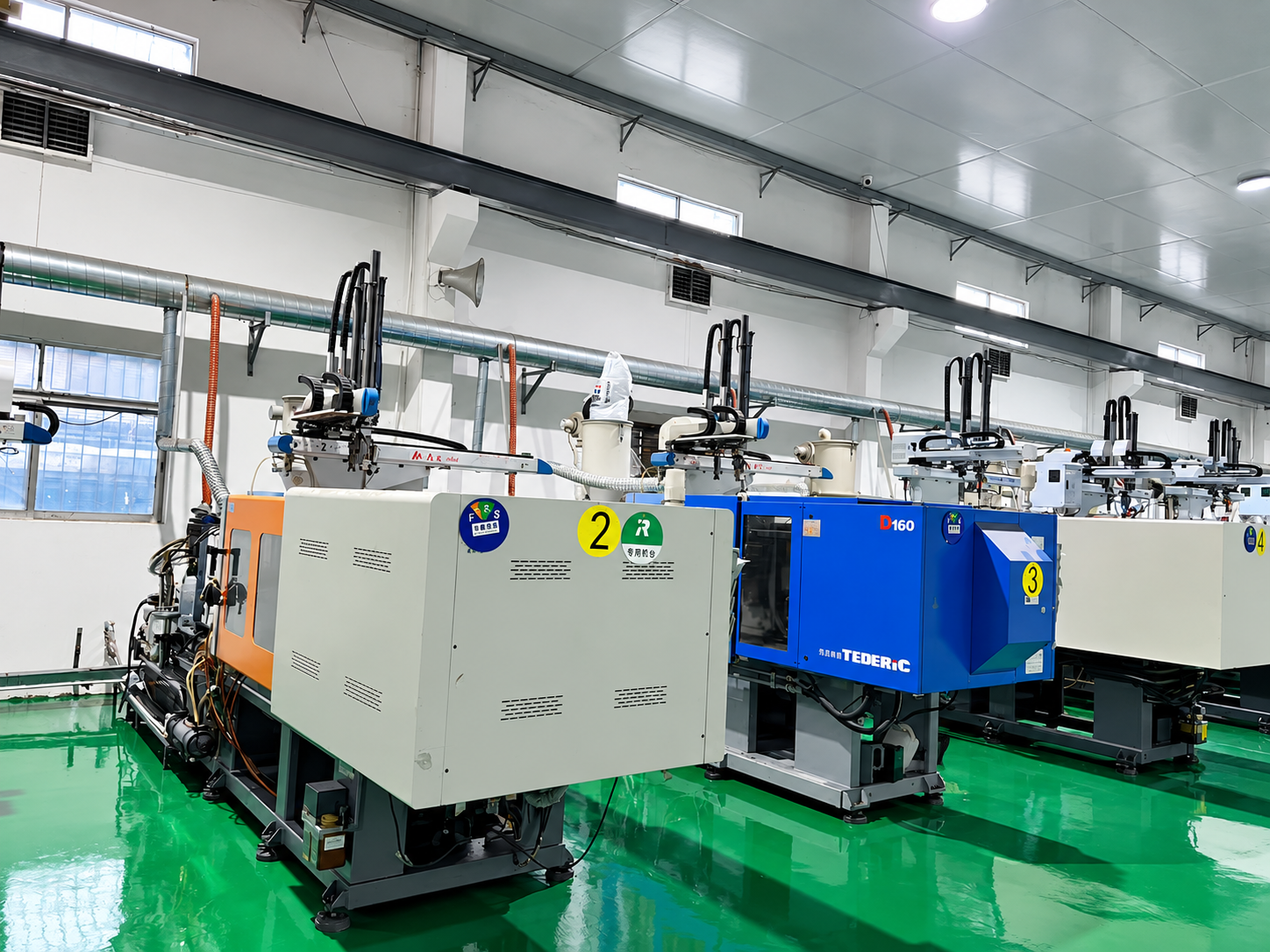
Core moulded-product workshop view; product and order documents remain configuration-specific.
Core moulded-product workshop view

Current core operation

  • Our factory was established in 2009.
  • Our core moulded-product operation uses 82 injection-moulding machines across two shifts.
  • Our owner-confirmed working capacity is approximately 100,000 m³/month for the core module range.
  • Our annual export volume is approximately 1,000,000 m³/year, subject to model, material, order mix and season.

Order review sequence

  • We confirm the ordered model, material, grade and configuration.
  • We use the owner-confirmed approximately 2% sampling workflow for moulded-product dimensions, colour, appearance and compression.
  • We arrange internal or agreed witness testing where required.
  • We review inspection status, packing and loading before shipment.

Supporting procured materials

Geotextile and geomembrane are supporting procured products coordinated through AQUA’s supply process, not products made on the injection-moulding line.

  • Geotextile: PET or PP, woven or nonwoven, 100–800 g/m², 1–6 m widths.
  • Geomembrane: HDPE or LLDPE, 0.3–3.0 mm, 1–6 m widths.

For each order, the product determines construction, mass or thickness, applicable standard and seam route.

Document / evidence Scope before it is relied upon

Document / evidence Scope before it is relied upon
Batch inspection and compression-test records We can supply applicable records for core moulded products according to the ordered product and batch scope.
Submitted-sample third-party reports These are evidence for submitted samples, not blanket product certification or a project design value.
Geotextile / geomembrane records We record the ordered construction/material, mass or thickness, standard and applicable qualification route.
Shipment documents The applicable product configuration, inspection status, packing record and selected third-party product test reports or company certificates can be supplied according to the product and order.

How We Work: Brief-to-BOM Supply Process

  • Send the inputs.
  • Classify the route.
  • Compare the families.
  • Resolve the interfaces.
  • Issue the package.
  • Receive an order-specific shortlist, BOM, quotation, document scope and packing direction.
  • Confirm the handoff.
  • Production, inspection, packing, loading supervision and export handoff follow the agreed order scope.
Supply Scope

AQUA scope

  • Products, supporting materials and product-related documentation
  • Product shortlist, interface and BOM review
  • Arranged remote guidance, loading supervision or technical support
Site Scope

Project-team scope

  • Authority approvals and hydraulic, geotechnical and structural design
  • Excavation, foundation, drainage, liner installation, backfill and construction
  • Pumps, treatment, controls, field seams and installed-system performance

Supply Package and Interface Schedule

The order-specific BOM differentiates what AQUA can provide from details that need to be confirmed and activities that need to be done by others. This avoids leaving pipe openings, access, pretreatment or overflow as an unowned gap. Philadelphia Water Department guidance treats pretreatment, sediment removal and unobstructed maintenance access as site-specific inputs. source

  • Define pretreatment, sediment route, inspection/cleanout access and operating responsibility in the project brief.
  • Underground storage is not automatically a water-quality treatment device.
  • Unobstructed access and sediment removal should be addressed before a buried-grid layout is procured.
Supply Package and Interface Schedule
BOM group Included / available from AQUA Order-specific or by others
Moulded storage units Tank bodies, side plates, covers, module or shallow panels/supports as ordered. Series, height, grade, layout, unit quantity and connector count.
Connectors and closures Clips, interlocks, flange covers and applicable accessories. Layout, tiers, edges and closure requirements.
Inlet, outlet and access ARW-1050 accessory range includes DN200–DN315 side inlet and DN600–DN800 larger inlet/outlet options; a DN800 top inspection accessory is available. Pipe sizes/elevations, opening detail, inspection route and site interface.
Geosynthetics Engineering geotextile; geomembrane and protection material where specified. Construction, material, mass/thickness, standard, roll/panel format and seam scope.
Construction Product-related support only. Excavation, bedding, backfill, drainage design, treatment, pumps, controls and installation.
Selection Risks and Document Gaps Background

Selection Risks and Document Gaps

  • Missing item
    Why it matters
    Safe next route
  • Undefined water route or storage volume
    A product can be placed against the wrong function.
    Confirm detention, infiltration or lined storage/reuse and the required volume.
  • Groundwater or soil evidence missing
    Infiltration and buoyancy assumptions may be wrong.
    Use project geotechnical/hydraulic review; do not infer fit from a similar system.
  • Cover/load or support/backfill missing
    A vertical grade alone cannot establish the configuration.
    Issue the structural input register before selecting grade and layout.
  • Pipe, opening or access detail missing
    BOM and maintenance interfaces can be incomplete.
    Confirm elevations, opening detail, inspection route and pretreatment before freeze. Philadelphia Water Department guidance separately identifies pretreatment, sediment removal and unobstructed maintenance access as site-specific inputs.source
  • Liner/protection qualification missing
    Module evidence does not qualify materials or field seams.
    Set membrane/geotextile requirements, seam route and installer responsibility.

Subsurface Stormwater Management Engineering Tools

Access our professional engineering utilities to estimate storage quantities, define material interfaces, and prepare your project specifications.

Explore all module planning tools →

Underground Stormwater Storage FAQs

What is an underground stormwater storage system?

This is a below-ground storage arrangement used for a defined detention, infiltration or lined-storage/reuse route.source Storage volume, water quality treatment and infiltration should be considered as separate project functions.

Does detention, infiltration or reuse change the wrap?

Yes. Detention controls and releases stored runoff, infiltration starts from a project-supported soil and groundwater basis, and lined storage/reuse retains water behind a specified enclosure.

Can I choose a module from a vertical load grade alone?

No. Grade data needs cover, vertical and lateral loads, groundwater/flotation, temperature, deformation, support, backfill and connection conditions before project fit can be reviewed.

When is geotextile used around a geocellular system?

The geotextile used for drainage or infiltration routes will be the type indicated for the project. Lock the construction, material, mass, width and filter criteria to the project requirements. Details for bottom placement and wrap will vary depending on the respective jurisdiction, system, and project requirements.

When is a geomembrane and protection geotextile needed?

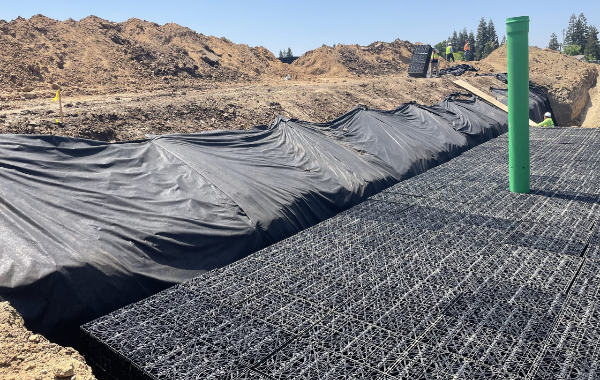
Lined attenuation or storage/reuse routes will use geomembrane plus protection geotextile as indicated on the project. Material, thickness, standard, penetrations, seams, field checks and buoyancy will be defined on a project basis.

Who defines pipe openings, access, pretreatment and overflow?

The project team defines elevations, hydraulic route, access for maintenance and design details. AQUA will enter the confirmed accessory and material scope on the order-specific BOM. The rest of the work, including excavation, drainage design, liner installation, backfill, treatment, pumps and controls will be done by others.

How will sediment be removed from a buried grid?

Procurement requires definition of pretreatment, inspection access, cleanout route and operating responsibility prior to procurement. AQUA can provide a product and interface assessment for these inputs.

Which report applies to the model and batch I order?

Applicable configuration, inspection status, packing record and selected product test reports or company certificates can be supplied according to the product and order. Internal compression testing is not presented as third-party certification.

Can mixed products share one lead-time promise?

No single core-module timing statement should be extended to a mixed package. The container and schedule plan depends on the ordered products, destination, material preparation and consolidation requirements.

What should an RFQ include?

Include the route, required volume, footprint/depth, cover/load, groundwater, pipe elevations, pretreatment/access, geosynthetic route, destination, schedule and document request. The RFQ checklist tool groups these fields before the supply review.