Get in touch with AQUA Company
EPDM Pond Liners: Installation, Inspection and Handover Guide
September 2026 · AQUA Rain Water Installation, Inspection and Handover Guide
EPDM pond liners are components within an overall liner system. A sound decision also depends on the contained water, substrate, underlay, groundwater, gas pressure, panel layout, seams, penetrations, exposed edges and the evidence collected before the membrane is covered. Liner thickness is only one concern. However, it doesn’t compensate for a defective foundation or uncontrolled detail of the installation.
The short answer
System rule: treat thickness, subgrade, underlay, drainage, seams, penetrations, edge restraint and no-cover evidence as one decision chain.
- The intended use of the pond and the liquid to be contained must be determined prior to the EPDM rubber product comparison.
- Ensure that documentation of pond use or aquatic use is specified for the membrane ordered, as “EPDM” isn’t adequate documentation.
- Treat 45mil and 60mil as reference points, not as an automatic answer for every site.
- Prepare a firm and smooth subgrade and use the required protection where needed.
- Seams, penetrations and edges must be marked on a drawing along with the required inspection or test evidence.
- Stop for a no-cover sign-off before stonework, cover layers or water hide the finished membrane.
This guide has a different function from AQUA’s EPDM pond liner product and configuration page. The catalogue and configuration of orders, together with associated product documents, packaging and quotations, are the responsibility of the commercial page. This article addresses educational decisions around use classification, system sizing, construction handoffs and handover, together with inspection, maintenance and request preparation.
EPDM Pond Liner Basics and the Meaning of “Pond Grade”
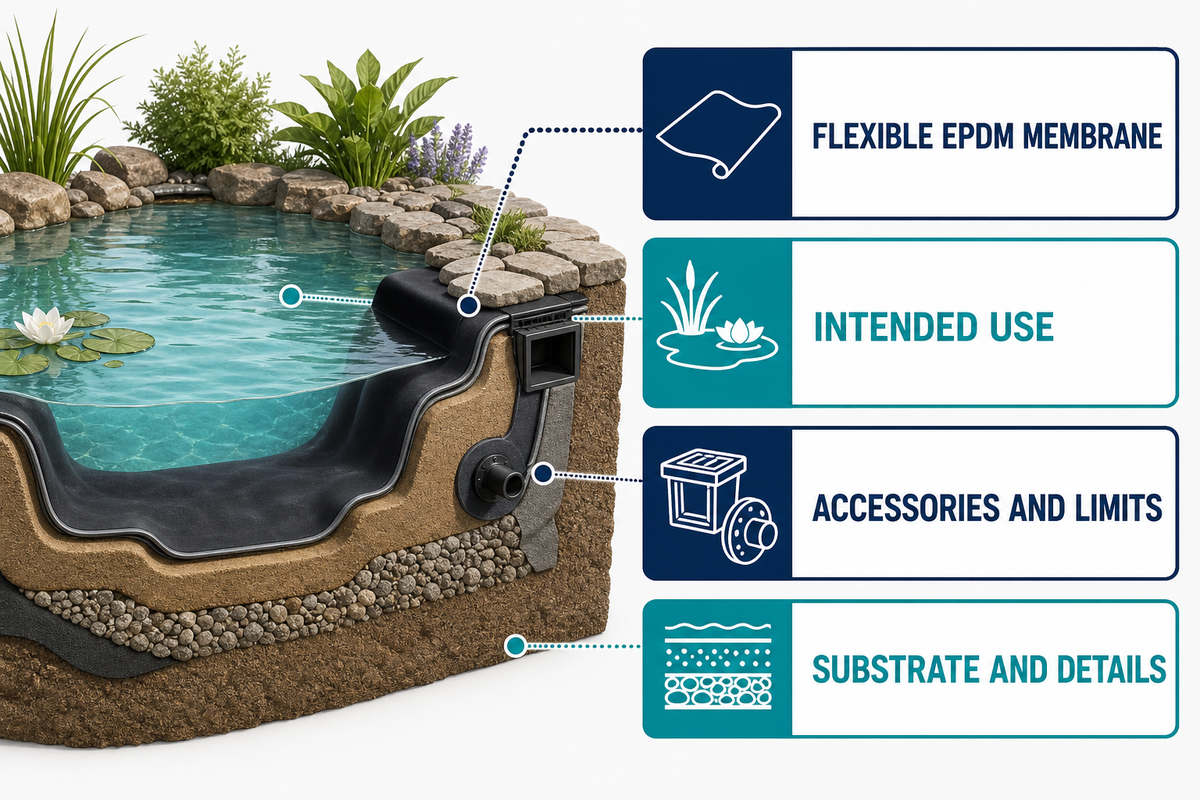
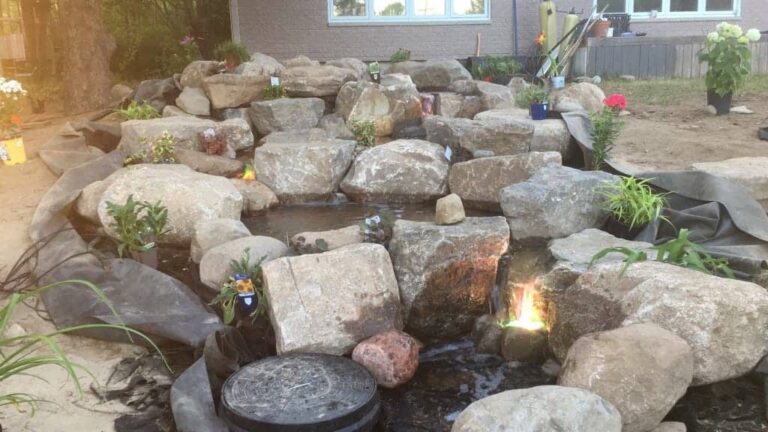
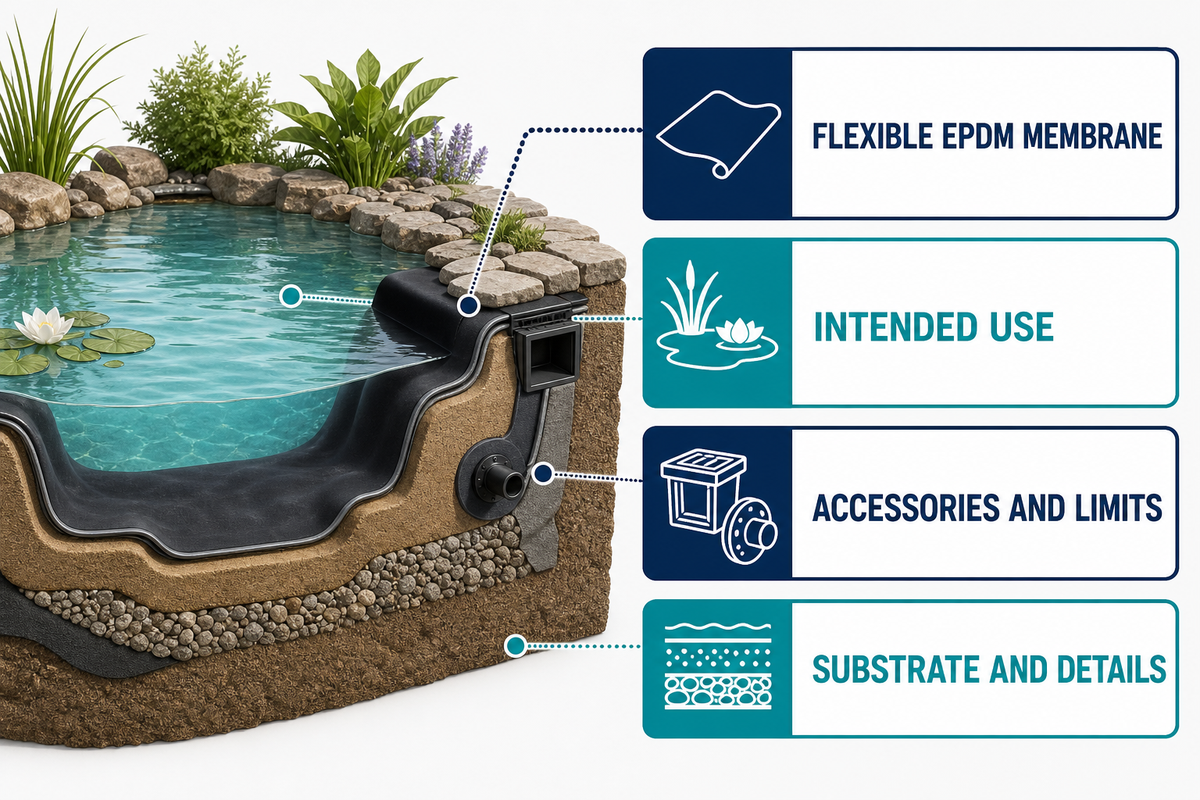
EPDM is a flexible synthetic rubber membrane used in lining applications; a durable result depends on product selection and installation. Its flexibility supports irregular pond shapes, shelves, curves and water features. EPDM allows curves and irregular water features that challenge rigid shells. An EPDM flexible rubber membrane is supplied as a sheet, but one sheet may have different declared uses and limitations from another. Because of that, roofing sheet, industrial geomembrane and aquatic membrane may have different formulations, declarations, accessories and limitations.
For commercial ponds, fish ponds, koi ponds or planted water gardens, ask whether the ordered EPDM rubber pond liner is documented as fish and plant safe for the intended duty. For irrigation, livestock water, aquatic production, wastewater or another controlled duty, record the contained liquid and ask who confirms compatibility. Don’t consider a reseller badge, a search snippet or a material-family description as a certification.
The practical meaning of “pond grade” is that it’s documented: the material, the intended use, the thickness, accessories and limitations can be traced to the product. In the absence of such evidence, note it as “suitability pending confirmation.” It shouldn’t be assumed that all EPDM pond liners are safe for fish or intended for the same use.
Start by Classifying the Pond Use
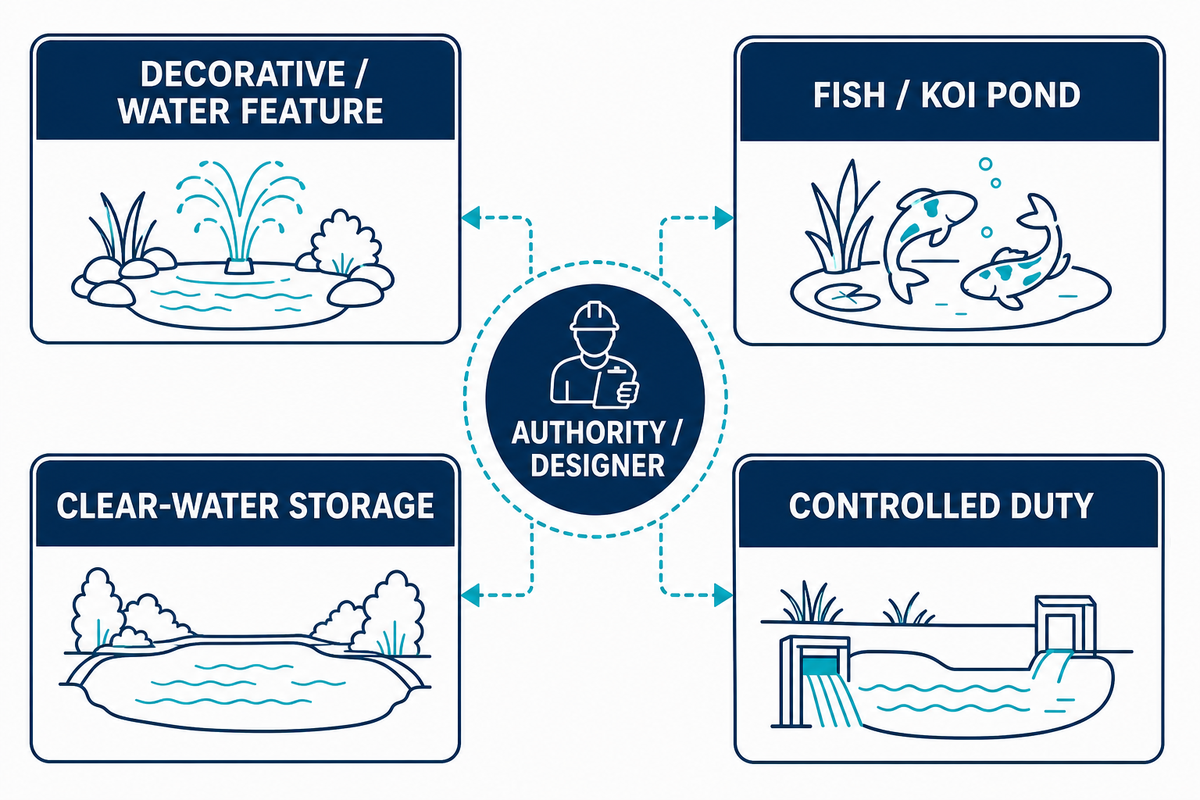
A decorative garden pond and a wastewater impoundment are both ponds, but they don’t create the same design question. Before selecting a material, put the project in a use class and name the authority, owner or designer who can confirm it.
| Use class | Questions to close | Do not infer |
|---|---|---|
| Ornamental pond or water garden | Aquatic-use documentation, planting zones, stonework, cleaning and exposed edges | That any roofing membrane is suitable |
| Fish or aquatic-production pond | Species, water chemistry, product declaration, drains, aeration equipment and repair materials | That a generic “non-toxic” statement covers the ordered system |
| Irrigation or clear-water storage | Water source, exposure, drawdown, access, groundwater and governing project requirements | That a national example directly designs the project |
| Livestock water | Animal access, escape, hoof damage, water quality and perimeter controls | That ornamental-pond instructions cover livestock safety |
| Aquaculture or production pond | Species, stocking operations, drains, cleaning, aeration and product compatibility | That a hobby-pond label covers production duty |
| Wastewater or animal-waste pond | Compatibility, leakage consequence, monitoring, venting, drainage and regulatory review | That pond-use marketing proves wastewater suitability |
| Industrial or contaminated liquid | Chemical exposure, temperature, leakage detection, containment and specialist review | That generic EPDM properties prove compatibility |
| Stream, waterfall or fountain | Moving water, transitions, splash zone, pump plumbing, edge loss and stone protection | That the main basin detail covers every water feature |
The current US NRCS national Conservation Practice Standard 521 is useful for seeing how a defined practice separates clear-water and wastewater conditions, subgrade, protection, drainage, gas venting and safety. The NRCS page also states that the national standard should not be used directly to plan, design or install a project; the applicable local technical guide is required. This may be used as a control reference for risk, but local design is a must.
Is EPDM the Right Route Compared with PVC, RPE or a Rigid Liner?
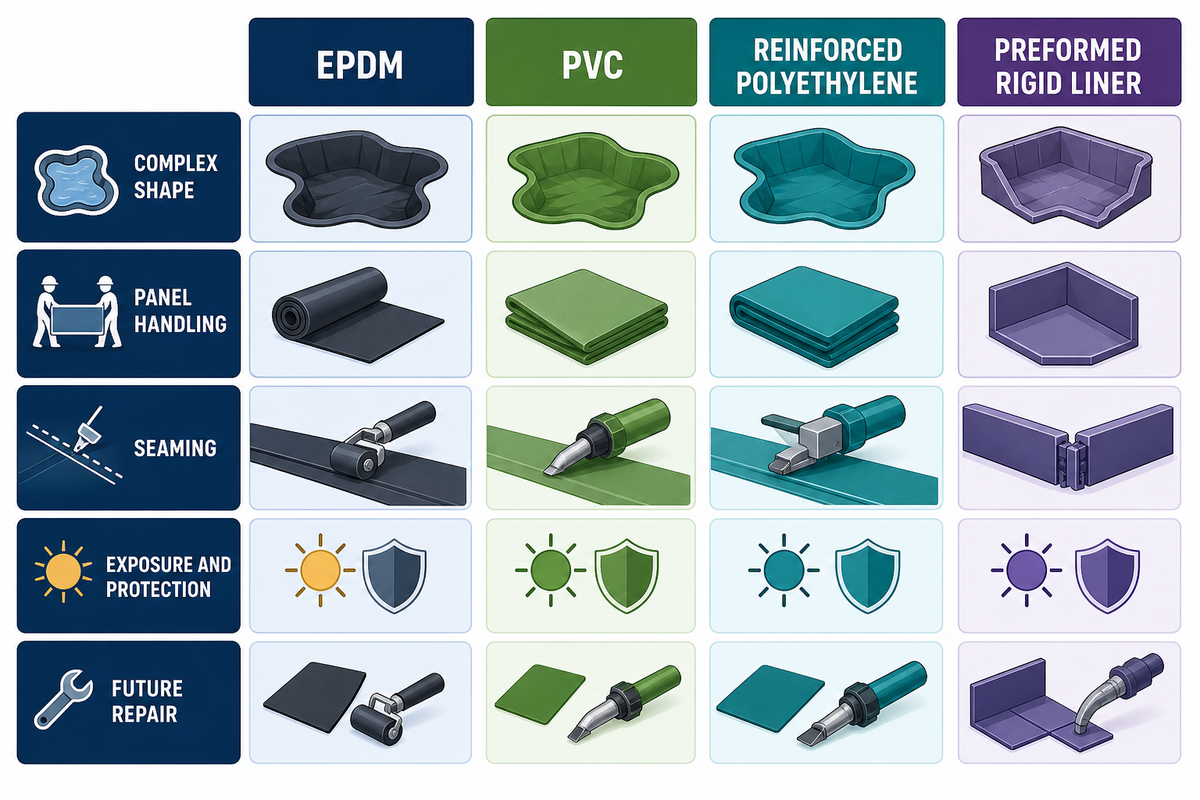
The decision process for material selection begins with consideration of liner geometry and installation method. EPDM rubber has a high degree of flexibility, allowing it to conform to most curvilinear forms, and is thus useful for irregular garden ponds and streams. PVC liners can be lighter, while reinforced polyethylene products can suit projects where panel weight, fabrication method or puncture resistance drives the choice. A preformed pond liner removes field folding, but decreases the range of possible sizes and shapes.
| Decision factor | EPDM route | Question for alternatives |
|---|---|---|
| Complex shape | Flexible around shelves, curves and irregular transitions | Will a stiffer or rigid system require more fabrication or joints? |
| Panel handling | Large sheets reduce joints but can be heavy and difficult to position | Can the site lift, stage and unfold the selected panel safely? |
| Seaming | Taped or specified compatible seam systems may be used | Which joining method, qualification and acceptance evidence apply? |
| Exposure and protection | Requires a project decision on UV exposure, cover, traffic and edge restraint | Does the alternative change protection, repair or access requirements? |
| Future repair | Compatible patch systems may allow local repair after diagnosis | Can damage be located and the surface reached without dismantling the pond? |
Avoid creating a single “best” liner ranking. Strength, flexibility, puncture resistance, joint method, chemical resistance, and repairability all describe different forms of liner failure. The best selection will be the system that’s demonstrated to address, in the field, the actual pond.
Material naming is important. PVC is polyvinyl chloride. Reinforced polyethylene is not automatically the same product as high-density polyethylene or low-density polyethylene. Natural rubber isn’t EPDM. A coating, a preformed shell and a textile-based geotextile layer are separate system choices, not alternative names for an EPDM liner. Ask for product-specific evidence covering durability across extreme temperatures, UV resistant performance where the sheet remains exposed, compatibility with the selected seam tape or adhesive, and whether the complete system is chemically resistant to the intended liquid.
Choose Thickness with a Subgrade-to-Operation Risk Check
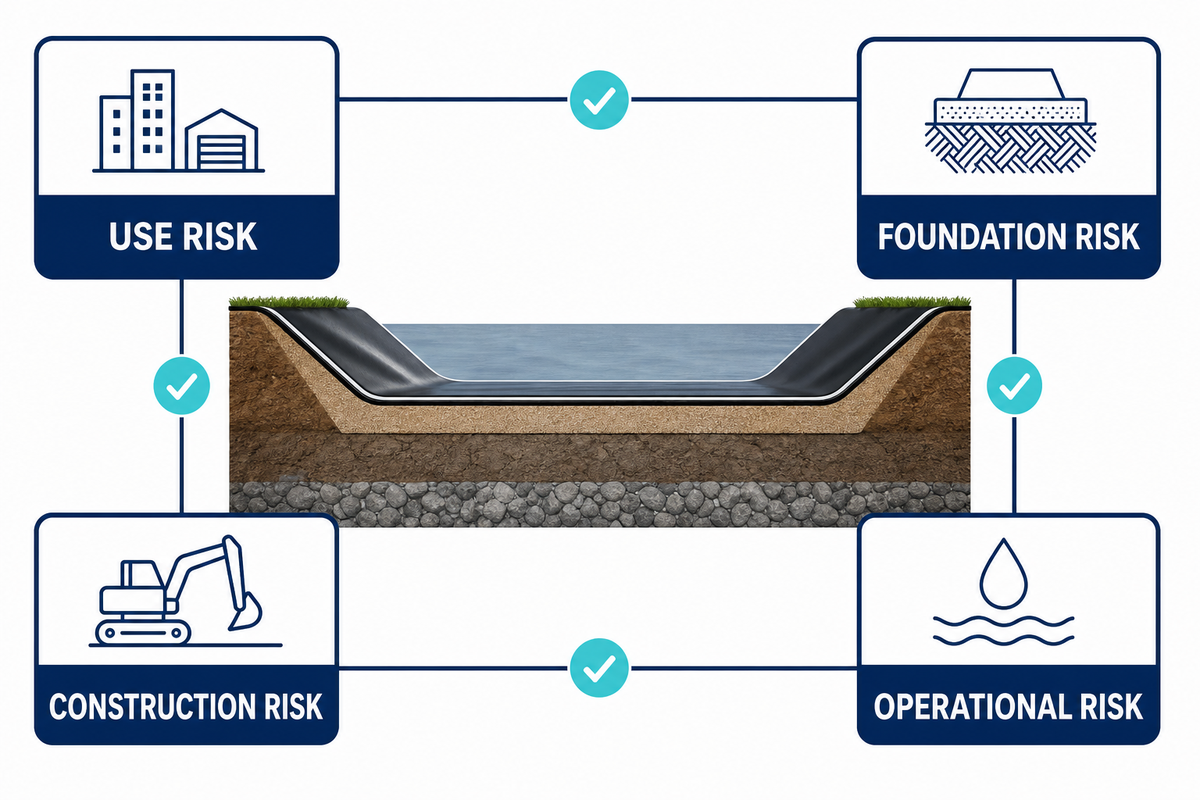
A 45 mil EPDM pond liner is about 1.14 mm thick, and 60 mil EPDM material is about 1.52 mm thick. Those conversions describe nominal thickness; they aren’t a substitute for a project specification. The current national CPS 521 lists 45 mil EPDM within that practice’s own table, while separately addressing mechanical damage, groundwater uplift, gas pressure and additional protection. Its scope warning still applies.
- Use risk: contained liquid, aquatic life, exposure, leakage consequence and governing documents.
- Foundation risk: angular stone, roots, voids, settlement, soft zones, slopes and transitions.
- Construction risk: panel mass, access, dragging, footwear, tools, folds, weather, seams and penetrations.
- Operational risk: cleaning, animal traffic, pumps, aeration equipment, stone placement, drawdown and future access.
If a risk screen is incomplete, a thicker membrane can create a false sense of security. A concentrated stone, an unsupported penetration or liner flotation can still damage a durable sheet. Ask the project designer or responsible engineer to resolve those mechanisms, then confirm which thickness and protection system satisfy the governing documents. The appropriate membrane thickness and protection system must also match the applicable governing documents.
Size the Pond Liner from a Marked-Up Drawing
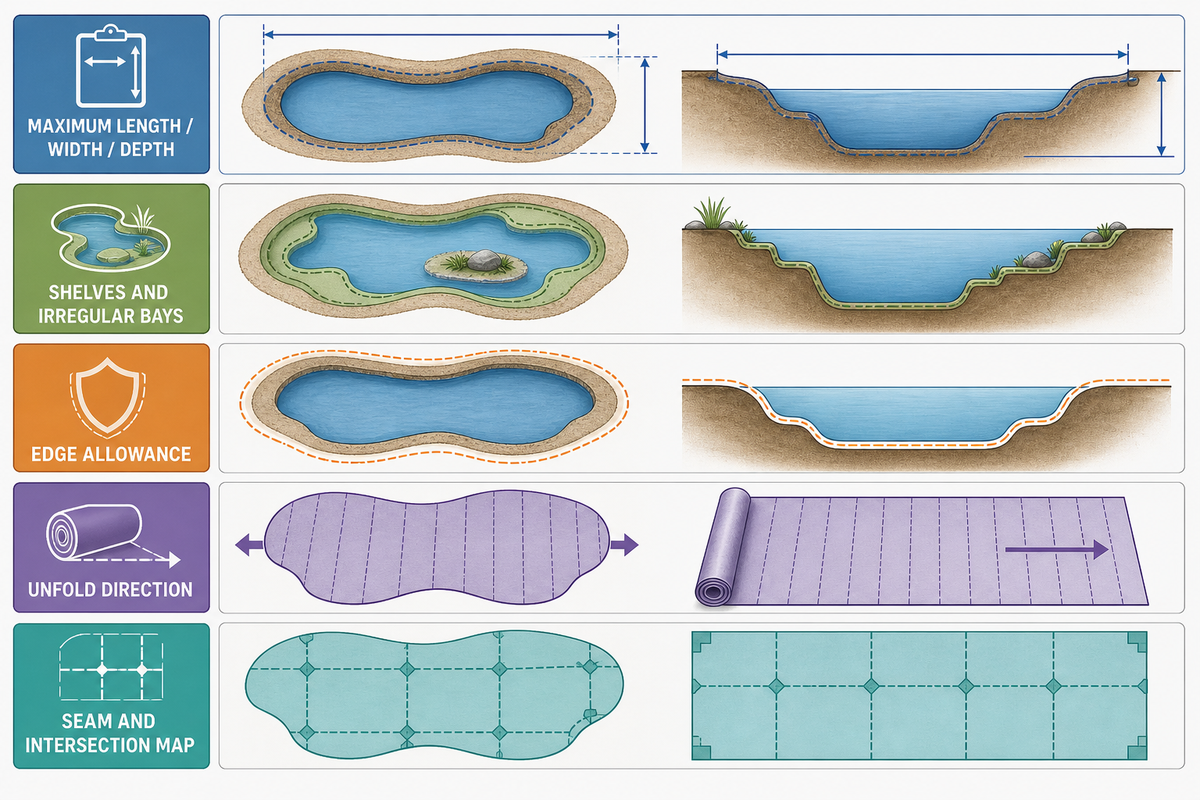
Pond volume alone does not define sheet size; treating volume as the shortcut creates a sizing risk, so record the shape and depth on the marked-up drawing before planning the panel. A size calculator can support an early check, but it should not replace the marked-up panel plan. Begin with maximum length, maximum width and maximum depth, then show shelves, vertical faces, irregular bays, streams, waterfalls, anchor details and edge allowance. A planning check for a rectangular pond starts with a drawing of the liner with length equal to the pond length plus twice the maximum depth plus edge allowance, then repeats the logic for the width. This is a planning check, not a final cutting instruction for a complex shape.
For example only, a 10 m by 6 m rectangle with a 1.5 m maximum depth and 0.5 m edge allowance on both sides gives a preliminary flat-sheet check of 14 m by 10 m. There can be vertical folds and variations such as construction tolerances, shelving, slopes, and anchor details, all of which can affect the ordered size, so a drawing is still the most authoritative reference for sizing.
Mark the direction in which a roll will be unfolded. Identify lifting and staging space, temporary access, likely fold zones and the point from which the membrane can be adjusted without dragging it over the substrate. For a joined panel, place each seam and intersection on the drawing before ordering.
Do not trim the edge as soon as water enters the pond. The allowance required may change due to edge restraint, settlement, final water level, and adjacent work. The installer or project designer should define when trimming is permitted and how the perimeter is anchored or protected.
Prepare the Substrate, Underlay and Subsurface Conditions
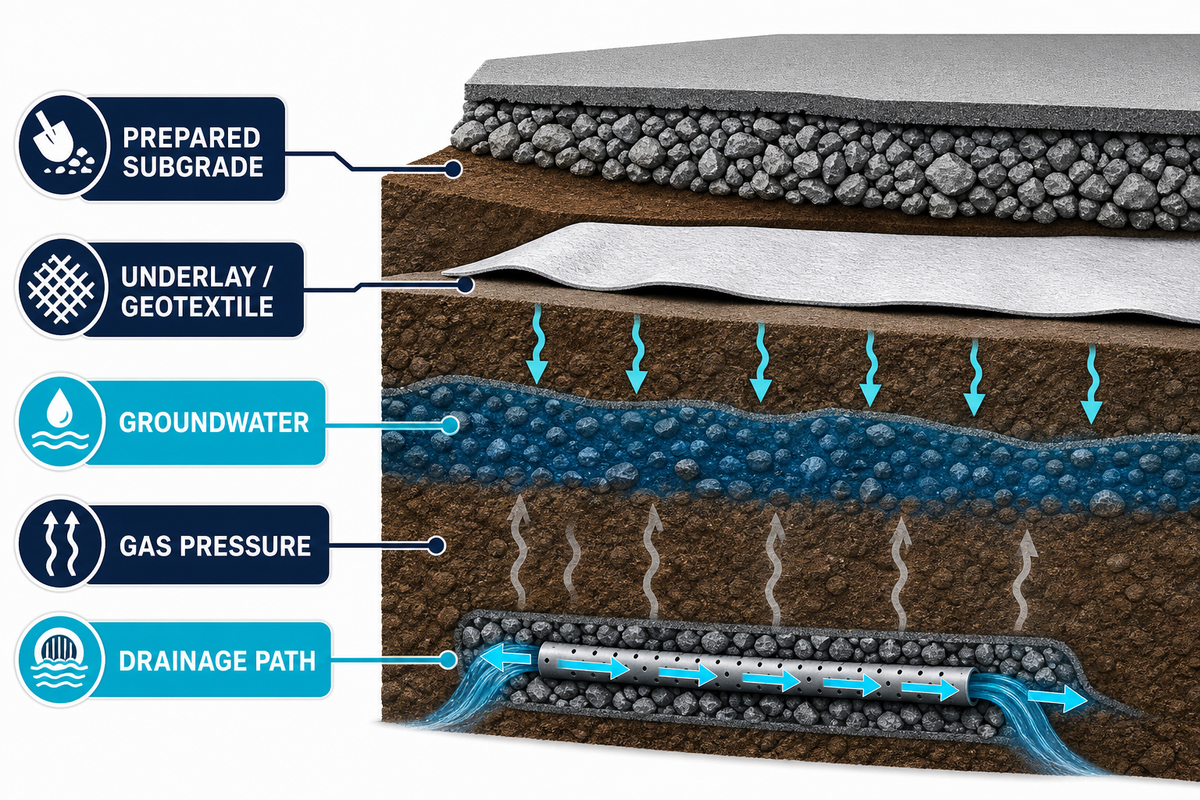
Before installing the sheet, prepare the pond formation and specify a geotextile underlayment where it is needed to cushion the liner; this underlay can reduce stress on the pond lining, but it doesn’t correct poor excavation. Remove sharp objects, roots, and other debris. Repair voids and soft spots. Smooth abrupt changes in elevation. Remove or correct standing water. Confirm that the prepared surface is firm, smooth and continuous enough for the selected system.
Substrate release questions
- Are sharp stones, roots, construction debris and oversized particles removed?
- Are soft areas, settlement zones and transitions repaired and compacted as specified?
- Is the type and amount (overlap) of underlayment shown, and additional protection under stonework or equipment?
- Can groundwater lift the membrane when the pond is empty or partly full?
- Can organic soils or other site conditions create gas pressure or ballooning?
- Who can release the formation before the membrane is unfolded?
Groundwater drainage and gas relief are design considerations, not field adjustments. If the investigation shows uplift or gas potential, obtain a designed response that matches the soil, water levels, liner system and manufacturer guidance. A surface photo doesn’t verify the relief of hidden pressure.
Control Receiving, Unfolding and Installation Handoffs
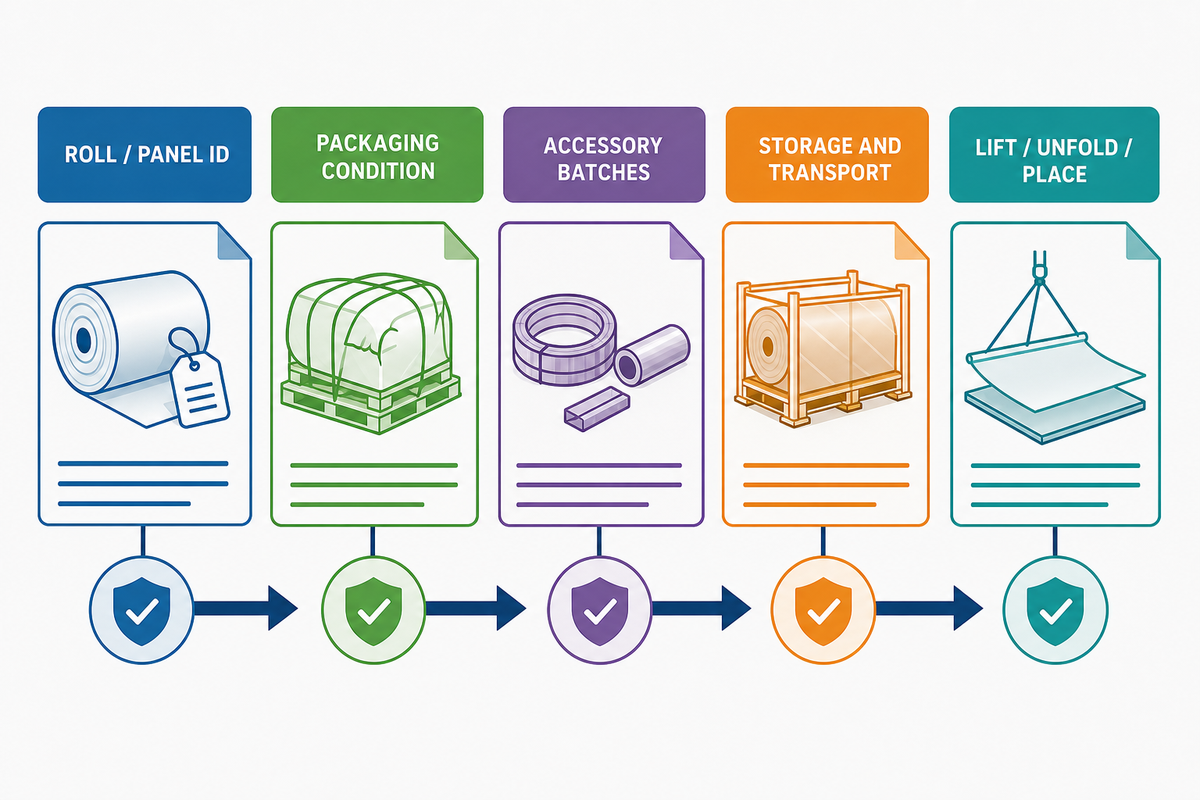
Receiving inspection should connect the delivery to the order. Note the roll or panel ID, packaging condition, damage that can be seen, accessory batches, and the record/documents provided. Follow the product instructions for storage and transport of the membrane. Do not assume that a waterproof sheet can be dragged, folded sharply or left exposed without consequence. Waterproof sheets must still be stored and transported with the product’s approved methods.
Before unfolding, hold a short installation briefing. Verify the current drawing, formation release, underlay status, weather limits, lifting route, controls on footwear and tools, seam team, penetration details and stop-work conditions. Name who can accept a repair and who can authorize covering the liner.
This doesn’t mean the supplier takes responsibility for the installer’s work or the designer’s decisions for the project. Make sure the handoff is documented so delivery inspection is not mistaken for acceptance of the installed pond.
Record Seams, Penetrations and Edge Details
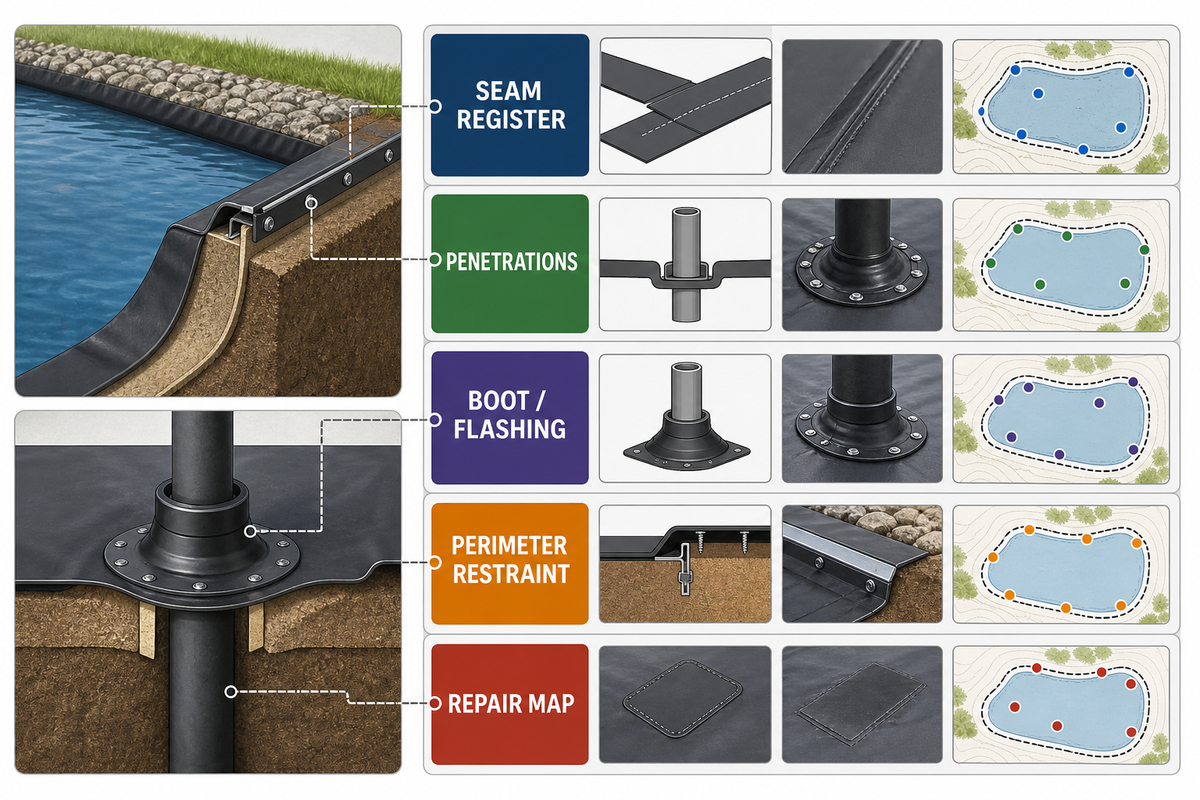
Field seams concentrate preparation, compatibility and workmanship risk. Assign seams with unique identifiers on the drawing. Record the membrane and accessory products, surface preparation, environmental conditions where required, installer, date, repair locations and the inspection or test result specified by the project quality documents.
ASTM D7272 describes destructive peel and shear procedures for geomembranes joined by pre-manufactured tape. It also states that acceptance criteria follow the site-specific plans, specifications and quality documents. This matters because a clean-looking seam or a photograph is not the same as seam-performance evidence. Do not establish a universal pass value or claim that all ponds require the same test.
Penetrations should be minimized and detailed before work reaches them. Detail type of pipe/structure, movement, support, compatible boot or flashing system, termination and inspection access. At the perimeter, show how the liner is restrained, protected from traffic and connected to stonework or landscaping without creating a hidden puncture point. Avoid hidden penetrations.
Use a No-Cover Sign-Off, Without Mistaking Photos for Test Evidence
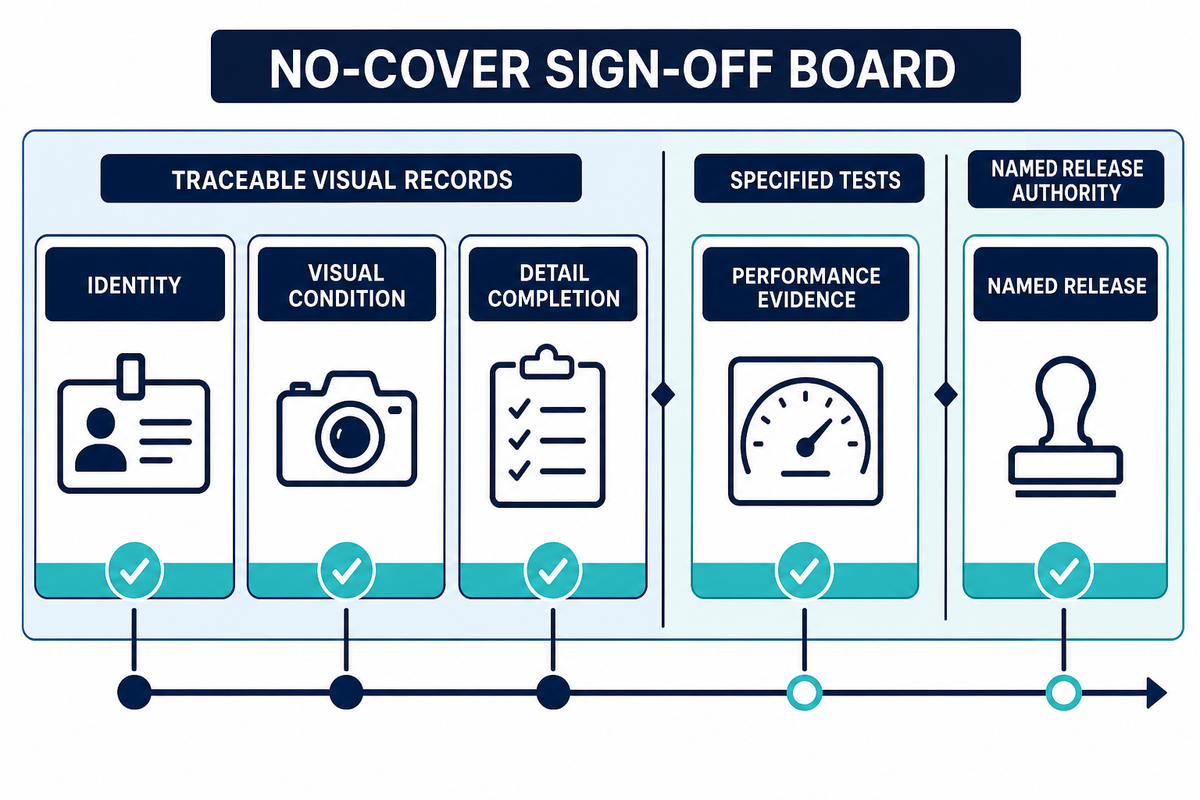
The no-cover sign-off is a documentary hold point before protection layers, gravel, rockwork or water hide the membrane. This allows the owner to correlate visible conditions with the drawing and locate future changes. This isn’t a certificate and doesn’t replace any seam tests, leak surveys or specialist inspections required for the project.
| Evidence layer | Record | What it cannot prove alone |
|---|---|---|
| Identity | Roll/panel IDs, accessory batches, drawing revision and location | Installed workmanship |
| Visual condition | Dated overview and close-up photos, damage and repair register | Hidden substrate or quantified seam strength |
| Detail completion | Seam, penetration, edge and protection checklist with responsible person | Compliance with an unnamed specification |
| Performance evidence | Specified seam tests, leak checks or specialist survey with acceptance basis | Future protection from damage after release |
| Release | Named approval to proceed with cover or filling | A warranty beyond the ordered product and contract |
| Formation | Signed substrate and underlay release against the drawing | Hidden groundwater or gas-control performance |
| Protection | Protective layer, placement method and completed interface photos | Damage introduced after handover |
| Continuity | Water-level observation or specified diagnostic result with dates | An exact defect location without the appropriate test |
| Handover | As-built drawing, open-item register and named acceptance authority | Final acceptance when unresolved items remain |
If an essential result isn’t present, leave the hold point open. “Photo attached” and “test passed” have different meanings. Capturing this difference leads to a more effective handover file and avoids documentation from reporting things that were actually not verified.
Plan Exposed-Slope Safety and Protection After Installation
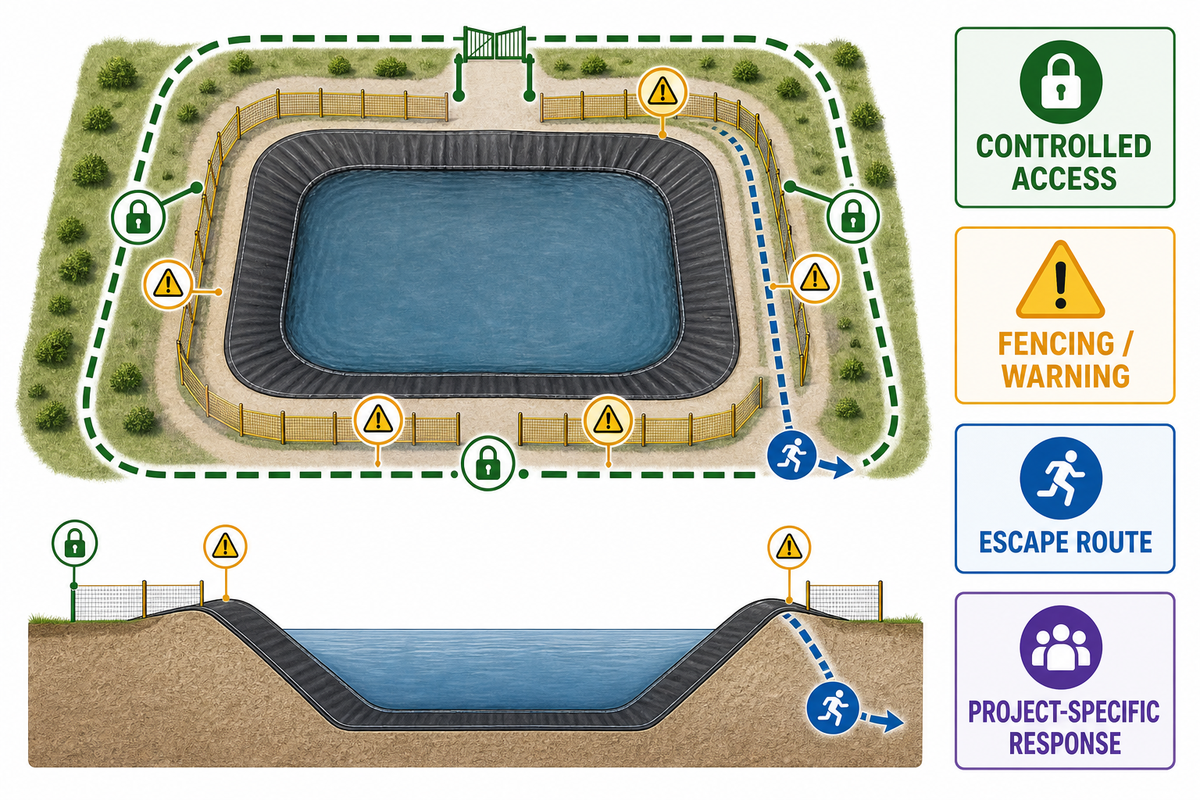
An exposed flexible liner creates access, escape, wildlife and livestock risks, especially on steep or slippery slopes. Safety measures may include controlled access, fencing, warning signs, ladders, textured escape routes or other project-designed features. The correct response depends on the pond use, geometry, local requirements and who can enter the area.
Operational protection deserves the same attention as installation. Locate pumps, aerators, cleaning equipment, stone placement and maintenance routes so that they do not abrade or puncture the membrane. Where gravel or rock is to be placed directly on the liner, define the protective layer and the method of positioning. Dropping stone directly onto EPDM can defeat careful substrate preparation.
Maintain a record of as-built construction detail of liner edges and penetrations. Future users should be aware of the area where digging, stakes and anchors, or heavy equipment could harm the system. A durable membrane still needs a controlled site after the pond opens.
Diagnose Water Loss Before Repairing an EPDM Liner
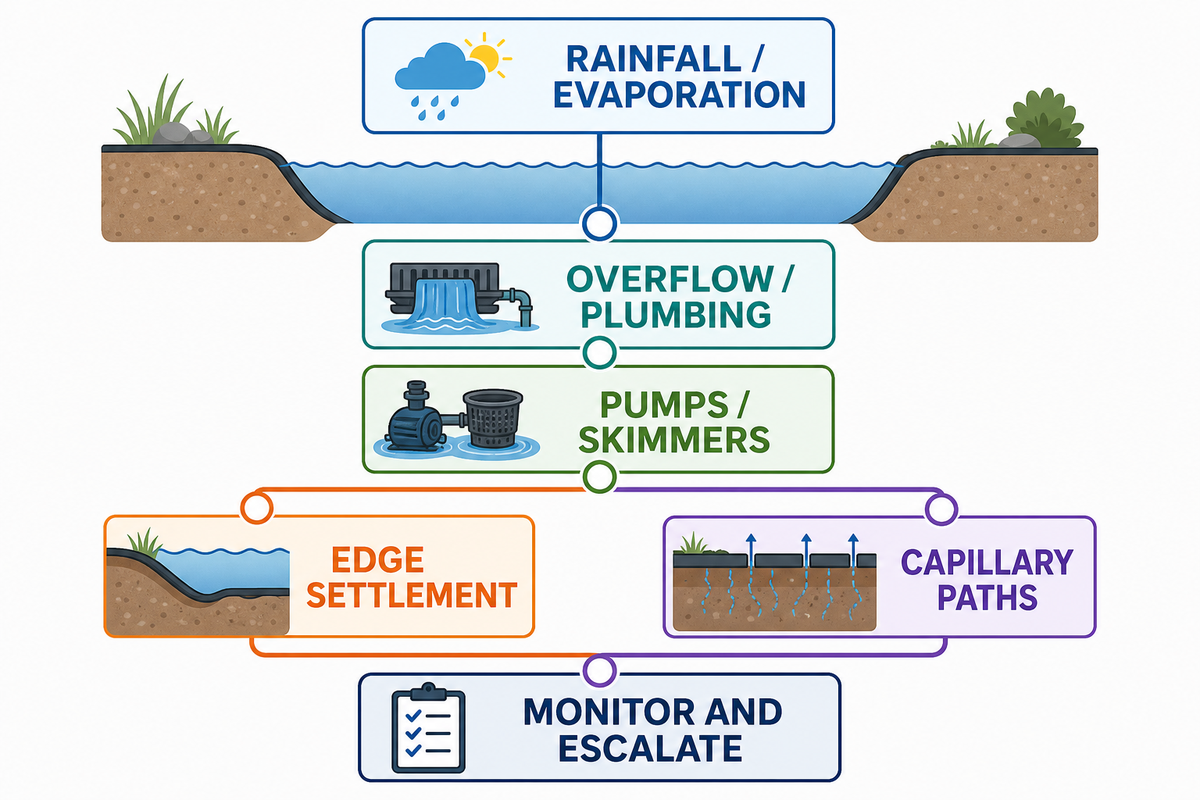
Just because there’s a drop in the water level doesn’t mean that the floor has a puncture. When taped-seam history is relevant, use ASTM D7272 only within its stated test scope and the project’s acceptance criteria. Check rainfall and evaporation context, overflow, streams and waterfalls, plumbing, pumps, skimmers, edge settlement, capillary paths and recently disturbed details. Check pump and skimmer operation, pond-edge settlement and capillary-rise paths against that record. Isolate components where the operating plan permits it and monitor the water level against time.
- Confirm the symptom and rule out normal operating changes.
- Diagnose the system before draining the pond; check edges, plumbing and equipment first.
- Use the seam, penetration and repair register to focus the search.
- Escalate based on uncertainty of location, controlled liquid, large pond, or repair of critical detail.
- Use compatible repair materials, document surface preparation, patch limits and post-repair checks.
Do not promise universal service life or long-lasting performance, or assume that every old membrane should be replaced. Exposure, support, protection, workmanship, maintenance and damage history change the answer. Diagnose the system first, then decide whether a local patch, detail rebuild or broader replacement is justified.
Build a Supplier-Ready RFQ Package
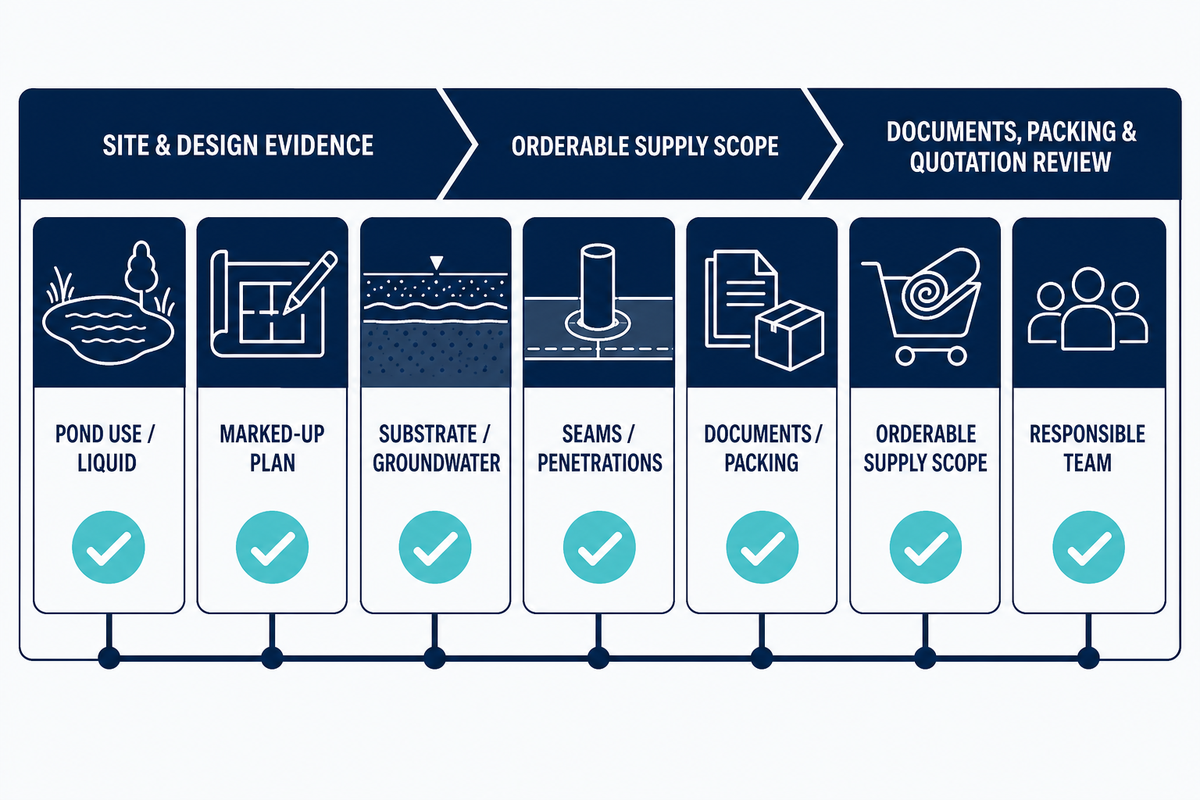
A detailed Request for Quotation (RFQ) allows a supplier to state the ordered configuration without having to design the project. If NRCS Practice 521 applies, identify the applicable Field Office Technical Guide and responsible designer in the request. Include:
- pond use, contained liquid, aquatic-life requirements and governing documents;
- marked-up plan and sections with maximum dimensions, depths, shelves, edges and allowances;
- substrate, groundwater, gas, slope, exposure and mechanical-protection conditions;
- panel strategy, seam register, penetrations, edge details and required accessories;
- product declarations, test reports or order documents that must be supplied;
- packing, lifting, unloading, storage, installation schedule and destination assumptions; and
- the responsible designer, installer, inspector and person authorized to release hold points.
AQUA coordinates EPDM as a supporting procured product; it is not made on AQUA’s injection-moulding lines. The owner-confirmed approximately 2% sampling and compression workflow applies to specified moulded-product batches, not automatically to every EPDM order. For an EPDM project, agree the applicable product documents, batch review, packing and loading evidence separately.
AQUA can coordinate product selection, document review, export packing, loading supervision and product-related technical support. Upstream supplier-factory or remote inspections can be arranged upon request. Use the completed brief to confirm the orderable supply scope, available documents, packing requirements and quotation on AQUA’s product page. AQUA does not present itself as the project installation contractor, and internal or witnessed checks are not described as third-party certification unless the named document and issuer support that statement.
Have a marked-up pond drawing ready?
Share the intended use, dimensions, substrate conditions, plan for the panels, documents, and the assumptions made about the delivery. AQUA can evaluate the supply boundary and indicate what’s yet to be defined by the designer or installer.
References & Sources
These references support the educational risk and evidence framework. They do not certify an AQUA product or replace the governing project documents.
- USDA NRCS practice page: national-standard scope notice and local-guide requirement.
- NRCS Conservation Practice Standard 521 (August 2023R): subgrade, protection, drainage, gas venting, seams and safety within the document’s scope.
- ASTM D7272 integrity testing for geomembrane seams joined by pre-manufactured taped methods.
- Geosynthetic Institute specifications index GM21 for EPDM geomembranes and GT12(a) for nonwoven geotextile protection/cushioning.
- Firestone GEOGARD EPDM Geomembrane Design and Installation Guide (manufacturer guide hosted by Ferguson Waterworks): product-system interfaces, handling, protection, seams and penetrations.
Byline: Grayden Du · Category: Epdm Pond Liners Product Blogs · Brand: AQUA RainWater Solutions
About the author

Grayden Du
Export Director · AQUA RainWater Solutions
Grayden Du is Export Director at AQUA RainWater Solutions. His work spans geocellular detention systems, underground stormwater storage and subsurface water management. Drawing on more than 16 years of hands-on experience across over 30 country markets, he explains technical principles, system choices and practical project requirements.
About AQUA RainWater Solutions
AQUA RainWater Solutions coordinates the supply of geomembranes, geotextiles and EPDM pond liners. We support specification selection, procurement coordination, product documentation, export packing and delivery arrangements.