Get in touch with AQUA Company


STORMWATER MANAGEMENT SYSTEMS — GEOCELLULAR TANKS, SHALLOW TANKS, GROUND GRID AND LINERS FROM THE AQUA RAINWATER FACTORY
Stormwater management systems store, infiltrate or release rainfall after it runs off a hard surface. Underground geocellular tanks are the storage part of the system: modular polypropylene cells buried below a car park, road or landscaped area. AQUA RainWater Solutions moulds these cells on our own injection lines, and exports them to contractors, distributors and project owners all around the world.
- 01 Engineer-checked quotes in 24 hours
- 02 7–15 days ex-works by product line
- 03 FOB or CIF to your nearest port
Your drawings remain with the people working on your assignment.
AQUA RainWater Solutions Stormwater Supply at a Glance
The product
- Void ratio 95–96% for ARW-1050 configurations
- ARW-1050 vertical load-grade options: 30 / 40 / 45 / 60 t/m²; configurations can be tailored to your project requirements
- Modules from 680 × 410 × 450 mm to 1000 × 500 × 500 mm
- Ground grid panels 500 × 500 × 38 / 50 mm
Starting an order
- No fixed minimum on ground grid or geotextile
- One small container for geomembrane; full-container loading preferred for modules
- A free A4 geotextile sample and one free geomembrane sample; you prepay the freight
- Geotextile, geomembrane and EPDM in rolls 1–8 m wide
The commercial terms
- Quote in 24 hours, engineer-checked
- 7–15 days ex-works, by product line
- FOB or CIF; part-container orders accepted
- Five-year product warranty on the geocellular tank, agreed in your contract
- Ten shipped project references
Underground Stormwater Detention, Infiltration and Retention Systems We Manufacture
Underground storage systems are classified according to what happens to the water after it has reached the sub-surface. Detention is a system that stores water and releases it slowly to a sewer or a watercourse at a controlled rate. Infiltration allows stored water to be absorbed by the soil, while retention keeps a permanent volume for reuse or amenity.
System type
What the tank does with the water
What it usually connects to
AQUA line supplied
Detention (attenuation)
Stores the peak and releases it at a controlled rate
Flow control device, then a sewer or watercourse
ARW-1050 tank, ARW-8053 / 8025 / 6841 modules, shallow tank
Infiltration
Stores, then lets the water soak into the surrounding soil
Wrapped in geotextile, open base, no liner
Same modules, geotextile-wrapped instead of lined
Retention / reuse
Keeps a standing volume
For irrigation or washdown
Geomembrane liner, pump chamber, filtration
Lined tank plus HDPE geomembrane
Why projects put storage underground in the first place
Rainfall that lands on impervious surfaces — roofs, car parks, roads — leaves the site faster and in greater volume than it did before development. Regulatory agencies cap the discharge rate a site may release, which is why so many schemes need a storage volume. Where land has been allocated to parking or buildings, this volume usually goes below ground.
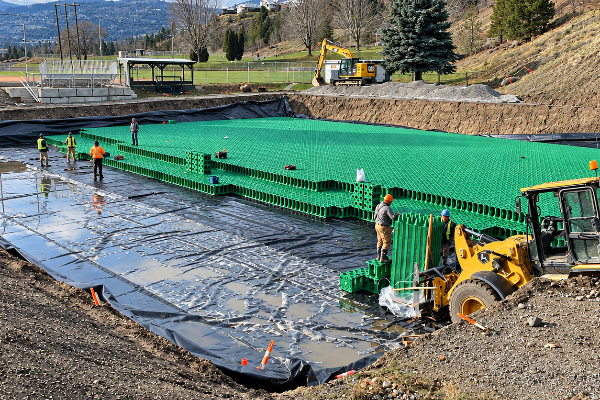
Peak flow control drives the requirement on commercial sites; storage buys the time a restricted outfall needs.
Municipal separate storm sewer system (MS4) programmes push sediment, hydrocarbon and nutrient loads onto the developer, and those loads are addressed by pre-treatment upstream of a storage tank, not by the tank itself.
Infiltration schemes return water to the ground where soils and the water table allow it.
Bioretention areas, rain gardens and permeable paving are surface practices; subsurface storage is what gets used when the surface is already spoken for.
Storage volume is a hydraulic quantity, not a pollutant-removal figure, and we do not present our capacity or void ratio as a water-quality performance claim. The Philadelphia Water Department's own guidance is explicit that subsurface systems must follow the manufacturer's recommendations and that their maintenance needs are not easily visible — which is a design and operations question, not a marketing one.
How Subsurface Storage Sits Alongside Surface Practices
Most sites manage stormwater with a mix of measures rather than one device. Surface best management practices work in daylight and lean on natural processes; subsurface detention and retention carries whatever volume is left once the surface is committed to parking lots, buildings and access roads.
A shallow vegetated channel that slows and conveys flow across a verge — cheap where there is width to give it, unavailable where there is not.
Planting and soil media do the work, so these need surface area and a maintenance regime that keeps the vegetation alive.
These reduce runoff at the point it is generated, which is the cheapest place to manage it, though the structural and build-up implications land early in the design.
Takes the residual volume below a car park or yard, connects to the existing storm drains, and holds it there until a flow control device releases it.
A detention tank is supplied by the storm drainage network only; inflow from a sanitary sewer, or from any combined connection, is a different design problem with different approvals. At sites that have both systems, ensure that separation is maintained on the drawing that your contractor builds from.
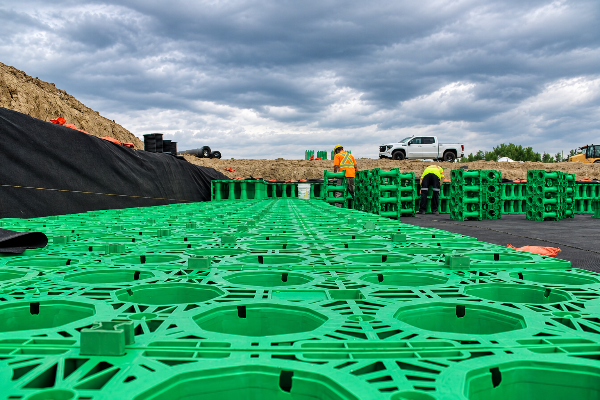
Solutions we supply into
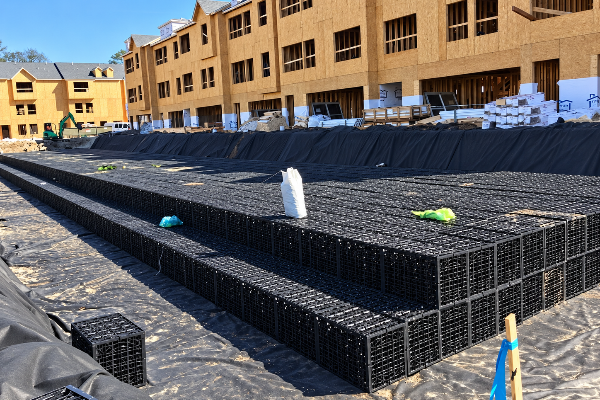
Subsurface stormwater management systems
Full below-ground storage build-ups: tank body, geotextile or liner, inlet and outlet connections, inspection access.
Subsurface Stormwater Management Systems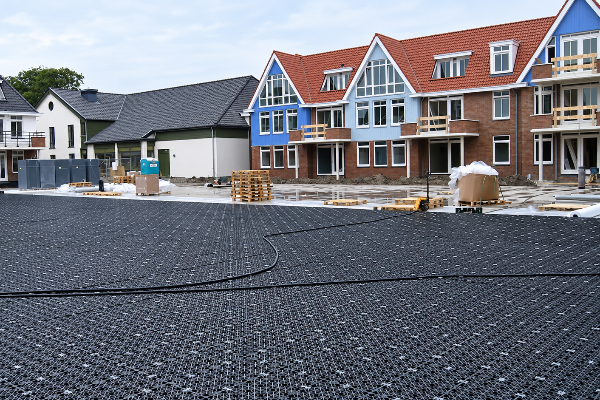
Attenuation tanks for the Gulf region
High-temperature logistics, night-shift installation windows and container-led scheduling for UAE, Dubai and Abu Dhabi projects.
Stormwater Attenuation Tanks for the UAE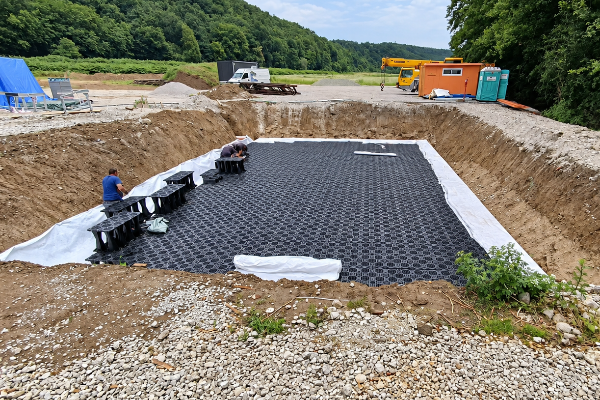
Shallow geocellular drainage
Where cover depth is tight — verges, light-traffic yards, landscaped areas — the ARW-SA footprint at two units per square metre.
Shallow Geocellular Drainage System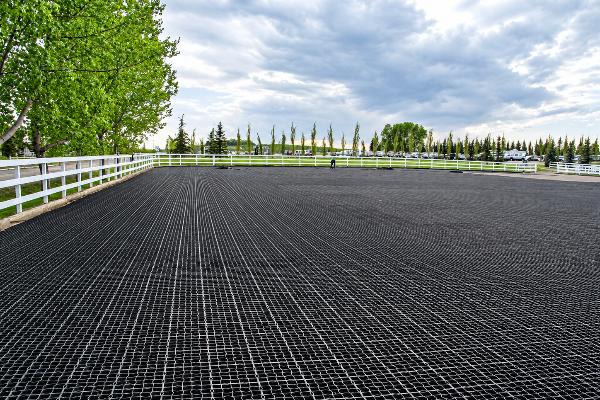
Ground grid applications
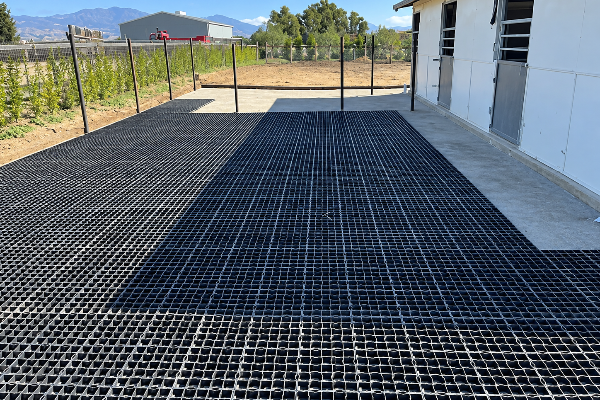
Permeable paddocks, access tracks and overflow parking where the surface must stay pervious and still carry a wheel load.
Ground Grid ApplicationsWhat We Mould and What We Procure
Buyers get burned when a supplier lets every line on the quotation look like factory output. We draw the line in public, so your submittal package says the same thing our shipping documents do.
Supply route
Product lines
What that means for your paperwork
Moulded on our own injection lines
Geocellular stormwater tank (ARW-1050), geocellular modules (ARW-8053 / 8025 / 6841), shallow attenuation tank (ARW-SA), ground grid (ARW-GR)
Batch inspection and compression-test records come from our own production run
Procured supporting materials
Geotextile, geomembrane, EPDM pond liner
Supplied as procured materials, not moulded on our injection lines; material documentation is passed through by product and by order
One further boundary, stated once and honoured everywhere on this page: we are a manufacturer and supplier, not your installation contractor. What we owe you is product, documentation and technical support — a division of labour we set out step by step in the supply route below.
Stormwater Product Lines: Geocellular Tanks, Shallow Tanks, Ground Grid and Geotextiles
Four lines cover the underground storage and ground-reinforcement aspect of a given scheme. Every figure below comes from our own production records, and each is reproduced in the specification table so that your engineer can verify the data in one place.
HOLO // SYSTEM
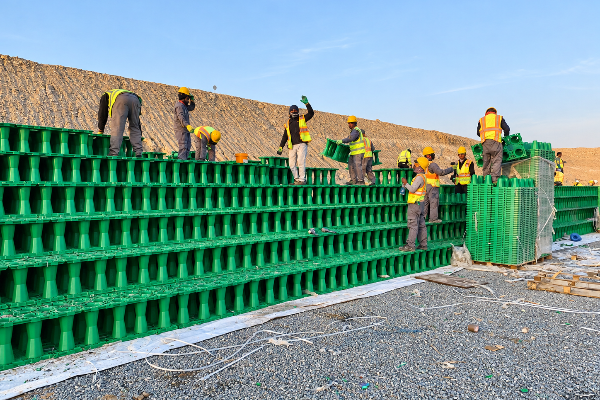
Geocellular stormwater tanks and modules
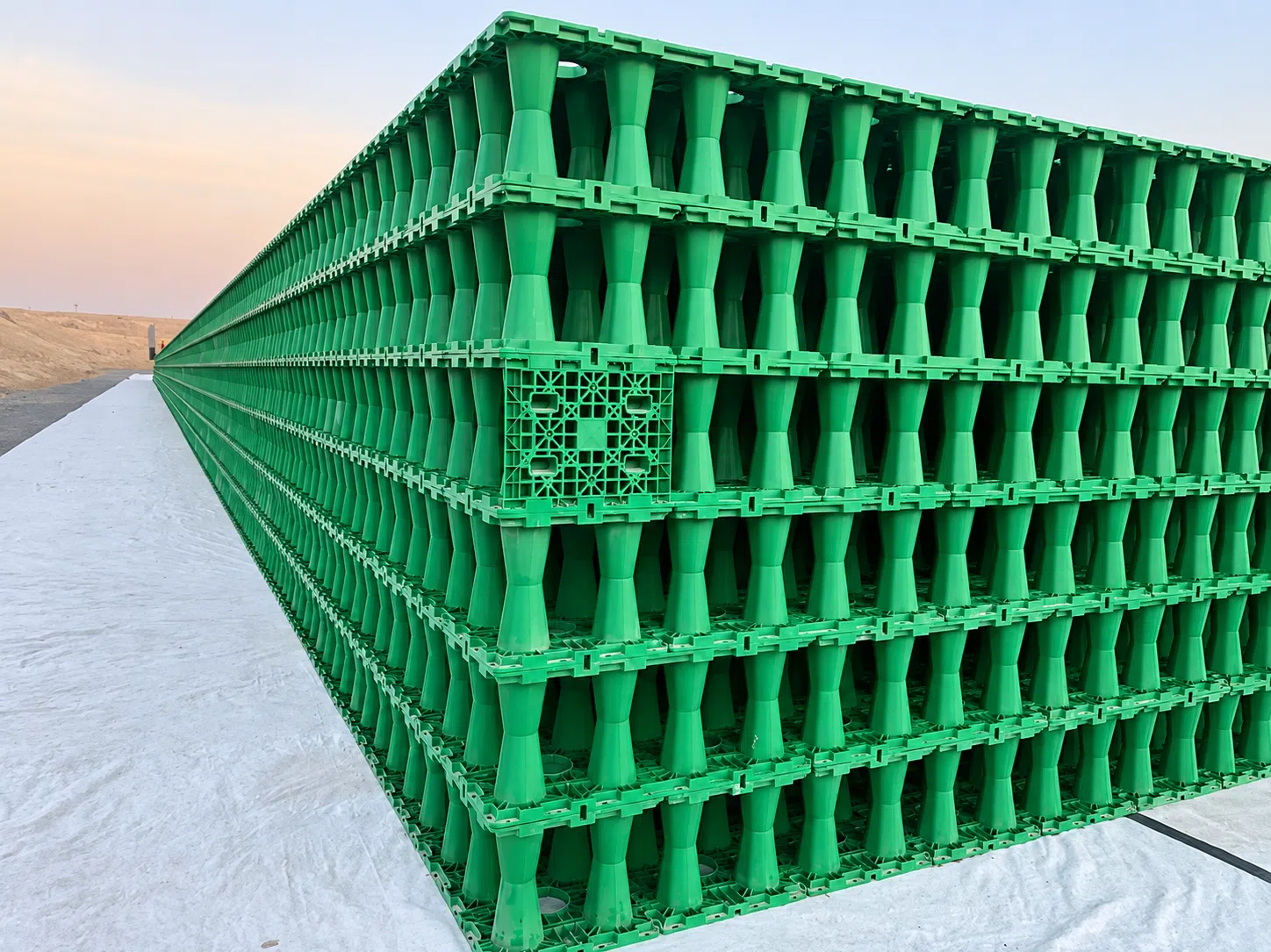
The main storage body: interlocking polypropylene cells stacked to the depth your scheme requires, geotextile enclosed for infiltration or lined for detention and reuse.
Models covered
ARW-1050-30 / -40 / -45 / -60
ARW-8053 · ARW-8025 · ARW-6841
ARW-8053 · ARW-8025 · ARW-6841
Key specifications
- ARW-1050: 1000 × 500 × 500 mm (39.4 × 19.7 × 19.7 in), 400 mm height optional
- ARW-1050: 95% void reference configuration; 237.5 L (62.7 US gal) nominal storage per 500 mm unit; 190 L (50.2 US gal) for the 400 mm version.
- 9.8 kg (21.6 lb) per complete unit, shipped as two 4.9 kg halves
- Vertical load-grade options: 30 / 40 / 45 / 60 t/m²; configurations can be tailored to your project requirements — short-term test basis, see the table below
- Side inlets DN200–DN315, large inlet/outlet DN600–DN800, DN800 inspection opening
- PP material options: recycled, blended, virgin and modified PP. Material formulation and load grade can be tailored to your project requirements.
Shallow attenuation tank
For build-ups where cover depth, services or a high water table rule out a full-height tank. Two units cover one square metre of footprint.
Models covered
ARW-SA-85 / -150 / -200 / -250
Key specifications
- 1000 × 500 mm (39.4 × 19.7 in) footprint, 2 units per m²
- 95% void
- 40.375 / 71.25 / 95 / 118.75 L per unit (10.7 / 18.8 / 25.1 / 31.4 US gal)
- Owner-supplied vertical load test results, reported in kN/m² only — we publish no t/m² grade for this line
- About 15 days production time
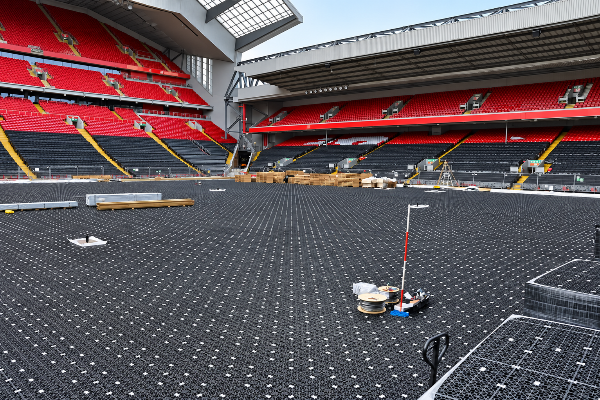
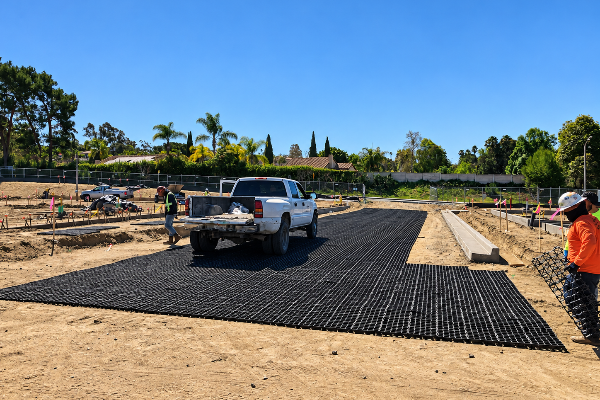
Ground grid
Surface load spreading where the ground must stay permeable: grass or gravel paddocks, access tracks, overflow parking and fire-tender routes.
Models covered
ARW-GR-38 · ARW-GR-50
Key specifications
- 500 × 500 × 38 mm and 500 × 500 × 50 mm (19.7 × 19.7 × 1.5 / 2.0 in)
- 1.5 kg and 2.0 kg per panel (3.3 / 4.4 lb); 4 panels per m²
- 6.0 and 8.0 kg per m² (1.23 / 1.64 lb per ft²)
- Unfilled body 500 kPa; filled 200 t/m² (GR-38) and 500 t/m² (GR-50)
- No fixed minimum order quantity
Geotextiles
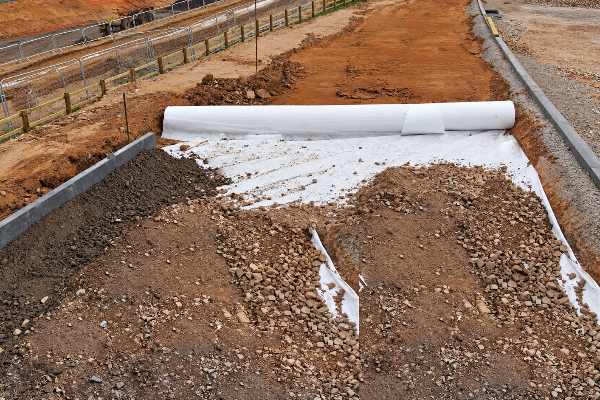
The wrap and separation layer that keeps fines out of the storage void. Weight is chosen by the job the fabric is doing, not by habit.
Models covered
ARW-GT-NW (non-woven) · ARW-GT-W (woven)
Key specifications
- 100–800 g/m²; 150, 200 and 300 g/m² are the common stock weights
- Width 1–6 m; rolls of 50 m or 100 m, no core, woven-bag packed
- Free A4 sample — you prepay the freight only
- Supplied as a procured material, not moulded on our injection lines
COMPLIANCE and TRACEABILITY NOTE //
How public agencies expect a manufactured product to be identified: New York State DOT's approved-materials list for polyethylene and polypropylene pipe names, for each entry, the manufacturer and plant location, the supplier, the product and joint type, the size range in both inches and millimetres, and a dated approval document — and it requires the finished goods to carry a physical mark. This list only covers pipe, and since it doesn't mention any module product, and we make no DOT approval or compliance claim of any kind, there is no evidence, implied or otherwise, that any module product is or could be on this list. We publish the same class of information as what a reviewer is set up to read: model, plant of origin, dimensions in both the metric and imperial systems, and dated records.
Liner and Geotextile Options Supplied with a Stormwater Tank
A storage void on its own rarely fulfills the order. Whether the tank detains, infiltrates or retains depends almost entirely on what you wrap or line it with — and geotextile, geomembrane and EPDM all reach you as a procured supporting supply, not as injection-moulded output.
Geomembrane — the lined option
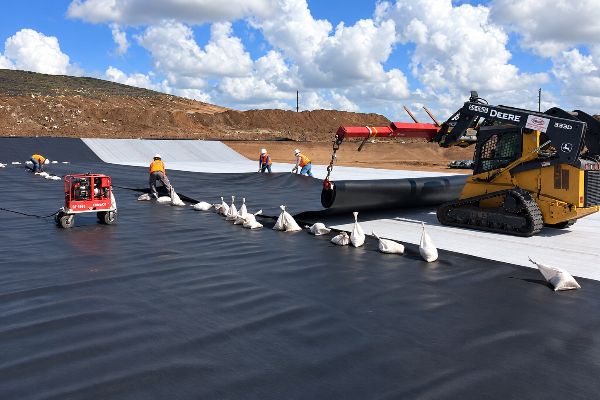
- ARW-GM-HDPE and ARW-GM-LLDPE; HDPE is the primary line, LLDPE is available
- 0.3–3.0 mm thickness; 0.5 / 0.75 / 1.0 / 1.5 / 2.0 / 2.5 / 3.0 mm are the gauges we quote
- Width 1–6 m; pre-welded panels available to reduce site seaming
- Produced to GB/T 17643-2025; GRI-GM13 (HDPE) or GRI-GM17 (LLDPE) to order
- Minimum order one small container; about 7 days production time
- Supplied as a procured material, not moulded on our injection lines
Ordering to a named product standard is not the same thing as holding a certification, and we do not present it as one. The standard tells the mill what to make. Any third-party test report we send concerns the samples that were submitted, and nothing beyond them.
EPDM flexible liner
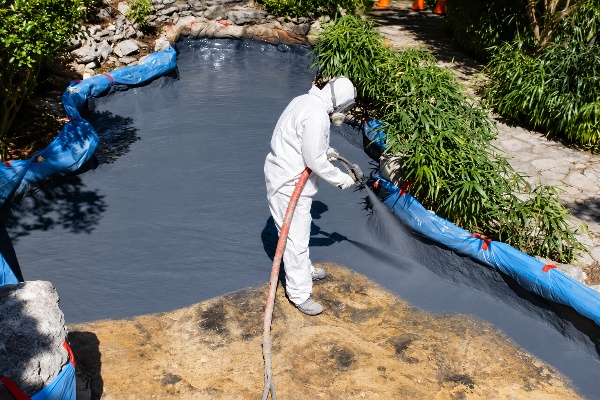
- ARW-EPDM-35 / 40 / 45 / 60 MIL — 0.889 / 1.016 / 1.143 / 1.524 mm
- Roll width 1–8 m; lengths 20 / 30 / 40 / 50 m, up to about 100 m continuous
- Joined panels to roughly 16 m wide
- 200–300 g/m² protection geotextile recommended beneath and above
- Supplied as a procured material, not moulded on our injection lines
Geotextile selection — by the job, not by the roll
Weight
What it is for
Where it sits in the build-up
150–200 g/m²
Tank wrap for infiltration
Directly around the cell block, overlapped at the seams
200–300 g/m²
Separation
Between granular surround and native soil
400–600 g/m²
Membrane protection
Either side of a geomembrane or EPDM liner
Model Specifications, Void Ratio and Vertical Load Grades
One table, each moulded line, both systems of units. Dimensions and volumes are production figures; the load column requires the scope note beneath before you use any number in it.
TECHNICAL SPECIFICATIONS
| Model | Dimensions mm (in) | Void | Volume L (US gal) | Weight kg (lb) | Vertical load — short-term test basis | Per container | Lead time |
|---|---|---|---|---|---|---|---|
| ARW-1050-30 | 1000 × 500 × 500 (39.4 × 19.7 × 19.7) | 95% | 237.5 L (62.7 US gal) | 9.8 (21.6) | 30 t/m² (294 kN/m²) | ≈1,240 units / 40 ft | 7–15 days |
| ARW-1050-40 | 1000 × 500 × 500 (39.4 × 19.7 × 19.7) | 95% | 237.5 L (62.7 US gal) | 9.8 (21.6) | 40 t/m² (392 kN/m²) | ≈1,240 units / 40 ft | 7–15 days |
| ARW-1050-45 | 1000 × 500 × 500 (39.4 × 19.7 × 19.7) | 95% | 237.5 L (62.7 US gal) | 9.8 (21.6) | 45 t/m² (441 kN/m²) | ≈1,240 units / 40 ft | 7–15 days |
| ARW-1050-60 | 1000 × 500 × 500 (39.4 × 19.7 × 19.7) | 95% | 237.5 L (62.7 US gal) | 9.8 (21.6) | 60 t/m² (588 kN/m²) | ≈1,240 units / 40 ft | 7–15 days |
| ARW-1050 (400 mm) | 1000 × 500 × 400 (39.4 × 19.7 × 15.7) | 95% | 190 L (50.2 US gal) | — | as per grade selected | ≈260 m³ assembled exterior volume | 7–15 days |
| ARW-8053 | 800 × 490 × 530 (31.5 × 19.3 × 20.9) | 95% | ≈197 (52.0) | 11.9 | 32 (26.3) 22–30 t/m² (216–294 kN/m²) | ≈1,200 sets, 249 m³ (8,793 cf) | 7–15 days |
| ARW-8025 | 800 × 490 × 250 (31.5 × 19.3 × 9.8) | 94% | ≈92 (24.3) | ≈7.9 (17.4) | 38–50 t/m² (373–490 kN/m²) | ≈2,050 sets, 201 m³ (7,098 cf) | 7–15 days |
| ARW-6841 | 680 × 410 × 450 (26.8 × 16.1 × 17.7) | 95% | ≈119.2 (31.5) | 8.0 | 28 (17.7) 22–28 t/m² (216–275 kN/m²) | ≈1,680 sets, 210.8 m³ (7,444 cf) | 7–15 days |
| ARW-SA-85 | 1000 × 500 footprint, 2 per m² | 95% | 40.375 (10.7) | — | Owner-supplied test 1,000.012 kN/m² | quoted by order | ≈15 days |
| ARW-SA-150 | 1000 × 500 footprint, 2 per m² | 95% | 71.25 (18.8) | — | Owner-supplied test 954.480 kN/m² | quoted by order | ≈15 days |
| ARW-SA-200 | 1000 × 500 footprint, 2 per m² | 95% | 95 (25.1) | — | Owner-supplied test 1,000.206 kN/m² | quoted by order | ≈15 days |
| ARW-SA-250 | 1000 × 500 footprint, 2 per m² | 95% | 118.75 (31.4) | — | Owner-supplied test 969.606 kN/m² | quoted by order | ≈15 days |
| ARW-GR-38 | 500 × 500 × 38, 4 per m² | — | — | 1.5 (3.3) per panel; 6.0 kg/m² | Unfilled body 500 kPa; filled 200 t/m² | quoted by order | 7–15 days |
| ARW-GR-50 | 500 × 500 × 50, 4 per m² | — | — | 2.0 (4.4) per panel; 8.0 kg/m² | Unfilled body 500 kPa; filled 500 t/m² | quoted by order | 7–15 days |
LOAD SCOPE NOTE
Read the load column this way
Every t/m² and kN/m² figure above is a short-term compression test value. Polypropylene loses compressive capacity when subjected to a sustained load, so a short-term test number and a design number are distinct values.
- It is not a long-term creep rating for these product grades. Historical creep displacement tests on separately submitted samples are summarized in our public data with their own conditions; they do not establish a project design stress.
- It is not a buckling resistance
- It is not a design strength for a fifty-year service life, and no service life can be inferred from this column
- Where a fifty-year basis appears in our documentation, it is stated as subject to project design, as an input to your engineer’s assessment
- The ARW-SA rows have owner-supplied test values in kN/m² — we purposely publish no t/m² grade for that line
Storage Volume to Container Load Crosswalk
This table uses ARW-1050 at 500 mm height: 237.5 L nominal storage per complete unit and approximately 1,240 units per 40 ft container. Units = ceil(required storage ÷ 0.2375 m³); containers = ceil(units ÷ 1,240). The 310 m³ reference is assembled exterior volume, equivalent to 294.5 m³ nominal void storage. Final packing and shipping arrangements require order-specific confirmation.
- These are two different quantities, separated intentionally. The left column is the storage volume you have calculated for the completed, installed tank. The right columns are a purchasing and logistics count — how many units and containers it takes to bring that storage.
- Shipped quantity excludes the site-assembly allowance and any other constraint your layout imposes
- Installed storage volume is not the same measurement as cargo volume within the shipping container.
- Any weight we cite is cargo net weight; a verified gross mass is stated separately, since a VGM includes cargo, packaging, dunnage and the container weight.
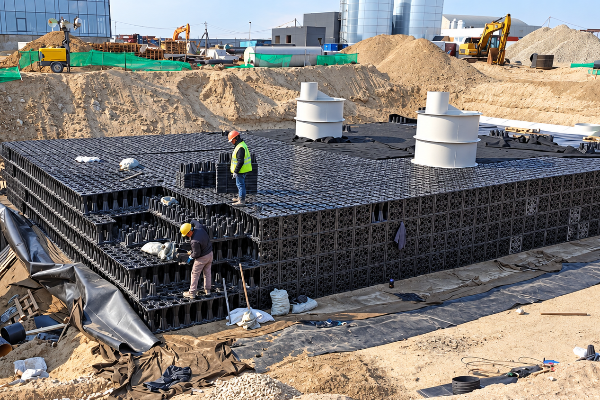
LOGISTICS CALCULATION
| Required storage volume | Units (approx.) | 40 ft containers |
|---|---|---|
| 100 m³ (3,531 cf) | 422 | 1 |
| 250 m³ (8,829 cf) | 1,053 | 1 |
| 335 m³ (11,830 cf) | 1,411 | 2 |
| 500 m³ (17,657 cf) | 2,106 | 2 |
| 1,000 m³ (35,315 cf) | 4,211 | 4 |
| 2,000 m³ (70,629 cf) | 8,422 | 7 |
| 5,000 m³ (176,573 cf) | 21,053 | 17 |
Quotation Basis, Lead Times and Shipping Terms
We refrain from publishing unit prices because the price of a stormwater tank that would make any sense whatsoever would depend on all of five factors occurring together. What we can publish is exactly which five, so you can see where your own number will come from.
01
Product line and model — a shallow tank and a 60-grade tank are different mouldings, not a discount apart.
02
Required storage volume — the biggest factor in unit and container count
03
Load grade — cover depth and traffic define the grade which determines the moulding.
04
Supporting materials — geotextile wrap, geomembrane or EPDM liner, connection fittings
05
Shipping basis — FOB versus CIF, container count, and whether part-container loading is allowed
Commercial terms, stated in public
Term
What we commit to
Quotation response
Within 24 hours on business days
Production lead time
7–15 days ex-works by product line, confirmed with your quotation
Minimum order
Flexible and project-based: no fixed minimum for ground grid or geotextile, one small container for geomembrane, full-container loading preferred for modules with part-container orders accepted
Samples
A free A4 geotextile sample with freight prepaid by you, and one free geomembrane sample
Payment
A deposit with the balance settled before shipment, against our proforma invoice, by wire transfer
Incoterms
FOB or CIF, with CIF to your nearest port as the usual basis; other Incoterms on request
Confidentiality
Your drawings are handled as confidential; customer and project identities are never shared with other buyers, and your project data stays with the people working on your enquiry
What we need from you
Four inputs are adequate for a serious quotation rather than a placeholder.
- Catchment area
- Required storage volume
- Traffic loading over the tank
- Site constraints — cover depth over the tank, water table, buried services, delivery access
Publishing a lead time is unusual in this category: the three North American suppliers a specifier is most likely to compare us against publish none. We would rather be measured against a number we printed than be trusted on a general assurance.
Why the schedule question deserves a real answer:
substitution windows are short, and they are written into procurement rules. The City of Los Angeles Bureau of Engineering gives a contractor 30 calendar days after Notice to Proceed to submit an "or equal" proposal; submittals after that window are considered "not equal" and processed as a substitution instead, which can pull in adjacent work, put the design cost on the contractor and require a change order. That is the reason our 7–15 day ex-works window exists.
Inspection Records, Test Data and Warranty Scope
The quality section that is actually honest names what the evidence is, who provided it and what is covered. Ours splits into three: our own production records, third-party reports on submitted samples, and the contractual warranty.
| Evidence | Who produced it | What it covers |
|---|---|---|
| Batch inspection records | Our factory | The production batch your order was moulded in — approximately 2% batch sampling |
| Compression-test records | Our factory | Short-term compressive performance of sampled units from that batch |
| Third-party test reports and material certificates | External laboratories for the test reports, material suppliers for the certificates, supplied by product and by order | The submitted samples only — never the whole product line, and never described as a company certification |
| Five-year product warranty on the geocellular tank | AQUA RainWater Solutions, agreed in your contract | The product as supplied; installation is outside its scope |
In project documents, a fifty-year design-life basis appears only as subject to project design. This should be noted as an input for your engineer in assessing the conditions for cover, loading and ground; it is not a guarantee of performance that we can provide from the factory floor.
Why Evidence Gets Misread on a Submittal
The recurring problem on a submittal is a sample test report read as though it covered the whole product line. That happens because a laboratory reports on what was delivered to it, while a specifier needs assurance about what will be delivered to site, and the gap between those two populations is where disputes start. Reports on submitted samples and certification of a product line are in no way equivalent, and we will not let a quotation blur them.
The information a manufacturer is supposed to hand over
ASTM F3754-25, the active Standard Specification for Polypropylene (PP) Crate Stormwater Storage System, places the duty to supply installation information — soil classifications, required compaction densities, minimum embedment zones and any special construction procedures and restrictions — on the manufacturer. We treat that as the scope of what ships with your order. We make no claim that our products comply with, are tested to, or are certified against that standard; we are describing the category of information a manufacturer owes a project and providing it.
What that standard explicitly does not cover
The same standard states in its own scope that it does not attempt to resolve water quality issues or hydraulic performance requirements, and this is the reason why our storage and production data are never presented as pollutant-removal data.
"Our inspection team works to one rule on evidence: a record covers the batch it was written for. When a buyer asks whether a compression-test report applies to the pallets on their container, we answer from the batch number on that record, not from the product name printed above it."
From Enquiry to Shipment: The Six-Step Supply Route
Six steps, and the numbers attached to them are the same numbers that appear on your quotation: a 24-hour quotation response, a 7–15 day ex-works window, approximately 2% batch sampling, and a five-year product warranty on the geocellular tank.
Phase 01 • 01
Enquiry
You send four inputs — catchment area, required storage volume, traffic loading and site constraints.
Phase 02 • 02
Selection review
Our project supply team reviews the model, load grade (30, 40, 45 or 60 t/m² on the ARW-1050), unit count and the wrap or liner build-up relative to what you have provided.
Phase 03 • 03
Quotation & Proforma
Returned within 24 hours on business days, with the lead time and Incoterm on the face of it.
Phase 04 • 04
Production & Inspection
Your order is moulded in a dated batch within the 7–15 day ex-works window, sampled at approximately 2%, with compression tests recorded.
Phase 05 • 05
Loading & Documentation
Container loading is supervised; batch inspection and compression-test records travel with the goods, along with third-party reports and material certificates where they apply by product and by order.
Phase 06 • 06
After arrival
Remote guidance and technical support for the installing team, under the five-year product warranty agreed in your contract.
Where our responsibility ends — and what we hand over instead
We are not the installation contractor on your project, and we do not price, programme or warrant site works. Saying only that would be passing the risk along, so here is the other half: the information the installer needs is ours to supply, and it ships with the goods.
Bedding and backfill requirements for the model supplied
Compaction and wrapping instructions for the build-up you ordered
Construction limitations, including the plant that can track over the tank during the works and the plant that cannot
Connection schedule — side inlets DN200–DN315, large inlet and outlet DN600–DN800, DN800 inspection opening
Batch inspection and compression-test records for your batch
Pre-welded geomembrane panel layout where panels were ordered
Shipped Projects, Applications and Factory Records
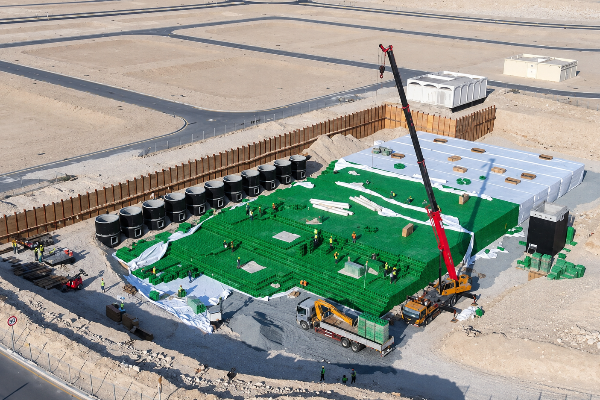
Ten shipped references, stated the only way we can state them honestly: by capacity, region and application. No client names, no distributor names, and no claim that we designed or installed any of them.
#
Capacity
Region
Application
01
20,000 m³
Gulf region (UAE)
Infiltration tank, installed on a night-work programme
02
17,500 m³
South China
Rainwater storage and reuse system
03
8,500 m³
United States (Athens, Georgia)
Residential-community infiltration system
04
1,220 m³
Western Canada (West Kelowna, BC)
Road-corridor detention tank
05
1,100 m³
Western United States
Modular infiltration tank supply
06
-
Canada (Brantford, Ontario)
Community park scheme, Underground stormwater tank beneath public open space
07
-
North America (Seattle region)
Equestrian facility, Permeable paddock ground grid
08
-
Australia and New Zealand
Multi-site residential, Residential soakaway installations
09
-
Canada
Residential landscape, Landscape pond and rainwater storage
10
-
Southern California (Murrieta)
Residential retrofit, Adaptable residential stormwater tank
What sits behind those shipments
- A factory established in 2009, with about 15 years of export experience to the Middle East, Europe, the Americas and Australia
- 82 injection-moulding machines, with recycled, blended, virgin and modified polypropylene options
- Approximately 100,000 m³ per month of core stormwater-module production capacity and around 1,000,000 m³ per year in annual exports
- Loading supervision, remote guidance and technical support for the installing team
- The factory, workshop and project images on this page are our own
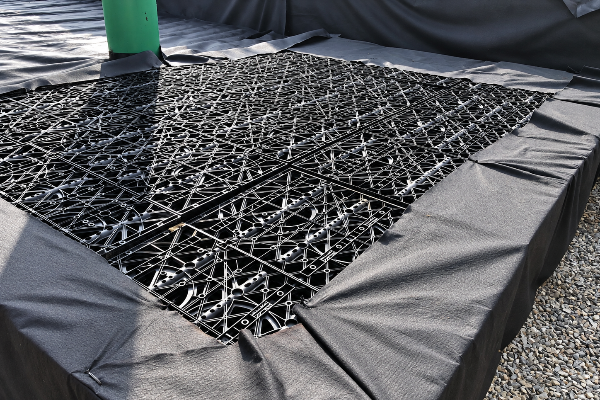
Two further projects circulate in this market that we deliberately leave off this list: one is publicly claimed as a supply by another manufacturer, and one rests on owner-supplied images we cannot verify. They are industry reference points, not our references, and we will not count them as ours.
See the Gulf-region attenuation tank route →
Where a Modular Geocellular Tank Is Not the Right Call
An underground tank is one component in a wider drainage strategy, not the strategy itself. Philadelphia's guidance lists subsurface detention alongside surface practices such as bioretention, and is candid that it can be more costly and more difficult to install and maintain than those alternatives. Five cases where it is better for us to disclose the information now, rather than to defend it later:
Loading or cover depth beyond the grades we publish
Why it works against you
Our grades are short-term test values on specific mouldings; outside them there is nothing to extrapolate from.
What to do instead
Specify a different structural solution, or have your engineer set the requirement and come back to us with it.
The site needs water-quality treatment
Why it works against you
Storage volume removes no pollutants; a tank is not a treatment device and is not a substitute for one.
What to do instead
Put pre-treatment upstream of the tank and size it on its own terms.
You need one warranty covering product and installation
Why it works against you
Ours is a product warranty; that and an installation warranty are not interchangeable — we are not the installing contractor and cannot underwrite site work.
What to do instead
Place the installation warranty with your contractor and keep the two scopes separate in the contract.
Very small quantity with no container economics
Why it works against you
Sea freight is charged by container, so a small volume carries a disproportionate share of the shipping cost.
What to do instead
Consolidate with other materials, buy locally, or accept part-container terms with eyes open.
Infiltration on a United States site
Why it works against you
A subsurface infiltration device may be classified as a Class V stormwater drainage well under the federal Underground Injection Control programme, depending on the design and the state, which can bring registration or inventory obligations.
What to do instead
Confirm applicability with your state permitting authority before you fix the model — this is a heads-up from a manufacturer, not legal advice.
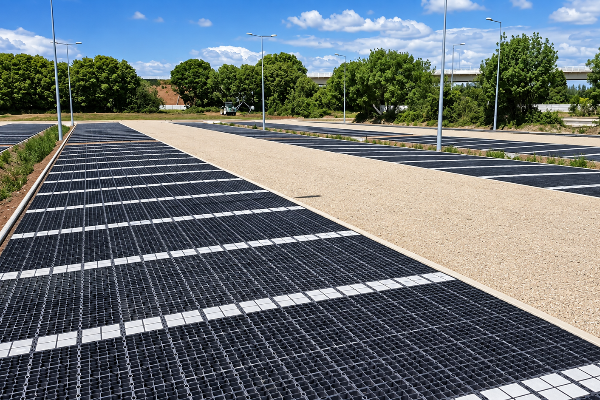
The distinction that actually decides the fifth row: EPA's self-identification questions are about where the water goes and not the brand of the product. A system that detains and discharges to a sewer or watercourse sits outside the programme; a system that infiltrates below ground and stays there is the one that can fall inside it. Same modules, different route — so the question belongs in your design review, and it should be settled as early as possible.
Alternatives we would point you to
Infiltration chambers, precast vaults and stone storage all remain valid options in the right conditions, and we would rather lose an order than have our grades used outside their permitted basis.
Read Water-Quality Specifications
Stormwater pollution is regulated at the discharge point, so an MS4 consent sets a standard for what reaches the receiving water bodies, not a specification for the tank under your car park. Environmental protection agencies treat that as a water management duty met through pre-treatment, source control and site design — all of which sit upstream of anything we ship. Settle which device in the train carries the sediment and hydrocarbon load before you size the storage, because that answer changes the tank inlet detail and not the tank volume.
None of that is what a storage tank does. Our modules hold a volume and release it at a rate; they do not improve water quality, and they do not reduce the pollution load reaching a waterway. No figure on this page — void ratio, storage volume, production capacity — should be read as a treatment performance claim, and where your consent sets a quality standard, that duty belongs to the treatment train your engineer specifies upstream of us.
Stormwater System Calculation & Planning Tools
-
storage quantity estimator
Calculate the exact crate volume and module count required for your stormwater retention tanks based on specific site parameters.
-
arw1050 load-grade comparison
Compare structural load-bearing capacities of ARW1050 modules to meet rigorous traffic and deep backfill engineering requirements.
-
container loading estimator
Optimize international shipping logistics by precisely calculating the container space needed for bulk underground storage components.
-
underground storage rfq checklist
Review crucial project parameters and site specifications necessary to generate an accurate technical request for quotation.
Send Your Storage Volume and Site Constraints
One number gets the conversation started: your required storage volume. We come back with model, unit count, container count and a lead time — engineer-checked, within 24 hours on business days. Include the rest of this list and the first reply is a quotation rather than a question:
Run the RFQ checklist before you write to anyone
Request a Quote- 01 Catchment area
- 02 Required storage volume, in m³ or cubic feet
- 03 Pedestrian, Car Park, and HGV Traffic
- 04 Site constraints — cover depth, water table, buried services, and access for a 40HQ delivery
- 05 A drawing or a site plan, if you have one, helps speed up the load-grade check
Your drawings are handled as confidential. Customer and project identities are never shared with other buyers, and your project data stays with the people working on your enquiry. Prefer to talk it through first — contact our engineering team.
Stormwater System Supply: Common Buyer Questions
Stormwater management systems are the combined structures and controls that manage rainfall running off a developed surface — conveyance, storage, flow control, infiltration and treatment. Underground geocellular tanks provide the storage element of that system. They do not, on their own, constitute a complete drainage design.
It is a buried void that fills during a storm and empties slowly afterwards through a flow control device. Built from geocellular modules, the void is created by interlocking plastic cells at 95–96% void ratio for ARW-1050 configurations rather than by stone at roughly 35–40%. The cells are wrapped or lined depending on whether the water is meant to soak away or be released.
- Detention — temporary. The tank empties after each storm; the design target is the outflow rate.
- Retention — permanent. A standing volume is kept for reuse, irrigation or amenity, which means a liner and usually a pump.
- Infiltration — a third case, where the stored water leaves through the soil rather than through a pipe.
Detention means holding a volume of runoff back temporarily so that the rate leaving your site does not exceed what the receiving system can take. This volume is set by your local rainfall and your discharge limits. That calculation belongs to your engineer; we supply the storage that delivers it.
The tank fills when runoff enters faster than the outlet can remove it. A flow control device on the outlet meters the discharge at the permitted rate, and the tank drains down over the hours that follow. As an example, Philadelphia's manual requires subsurface systems to drain within 72 hours of a 24-hour rain event — a local rule, cited here to illustrate how drain-down criteria are written, and not as guidance to your site.
MS4 stands for Municipal Separate Storm Sewer System. It is the regulatory framework that makes the operator — and by extension the developer discharging into it — responsible for what leaves a site, in both rate and quality. Storage addresses the rate; pollutant loads are a separate matter for pre-treatment upstream.
Impervious surfaces change both the volume and the timing of runoff: more water arrives, and it arrives faster. That combination drives downstream flooding, channel erosion and the transport of sediment and pollutants into receiving waters. Underground storage tackles the volume-and-timing half of the problem, which is why treatment sits upstream of it.
For infiltration, a non-woven geotextile wrap keeps surrounding fines out of the void while letting water pass. Weight is chosen by function.
| Function | Typical weight |
|---|---|
| Tank wrap for infiltration | 150–200 g/m² |
| Separation from native soil | 200–300 g/m² |
| Protection either side of a membrane | 400–600 g/m² |
“Geomembrane” names the material class — an engineered, impermeable sheet, usually HDPE or LLDPE, supplied to a product standard and typically welded. “Pond liner” names an application, and in practice usually means a flexible EPDM sheet chosen for conformability rather than chemical resistance. A geomembrane can be a pond liner; not every pond liner is specified as a geomembrane.
A non-woven geotextile achieves better filtration and permeability; therefore, for wrapping infiltration tanks, it is the usual choice.
The woven equivalent has higher tensile strength at lower flow, so it is employed where separation and reinforcement matter more than drainage.
Neither is universally superior. The wrong choice results in clogging or tearing, which is why function dictates selection.
An HDPE or LLDPE geomembrane sheet is effectively impermeable across its face. Whether the installed lining system is watertight depends on the seams, penetrations and the protection layers on either side of it. That is why we recommend a 200–300 g/m² protection geotextile and offer pre-welded panels to cut down site seaming.
We do not publish prices, and any figure quoted without your inputs is a guess dressed up as a number. Send the four inputs below and you get a real quotation within 24 hours on business days.
- Catchment area
- Required storage volume
- Traffic loading over the tank
- Site constraints — cover depth, water table, and anything buried that limits the footprint
It depends on what the system does with the water and on your state. A device designed to infiltrate runoff below the surface may be classified as a Class V stormwater drainage well under the federal Underground Injection Control programme, which can carry registration or inventory requirements; a system that detains and discharges to a sewer or watercourse generally falls outside it. States with programme primacy can impose more stringent rules, so verify with your state permitting authority before construction — we identify the problem, we do not answer for your jurisdiction.
Through the access you specify before it goes in the ground: our ARW-1050 takes a DN800 inspection opening, and the layout of those openings decides what a jetting nozzle or camera can reach later. A buried modular tank is not an airtight vessel but it is an enclosed one, so entry is governed by your national confined-space rules — in the United States OSHA runs a general industry rule and a separate construction rule, and under either one the duty falls on the employer whose people go in, with whoever controls the site owing them the hazard information it holds, never on us as the manufacturer. Relocating a non-metallic tank below a car park at a later date is very difficult, which explains why the opening positions and the as-built drawings deserve more consideration than they usually receive at the design stage.
AQUA PUBLIC DATA FOR YOUR PROJECT / 01–03SOURCE-LINKED · JSON + MARKDOWN
Better questions.
Clearer project answers.
Give your AI a way to check published product specifications, selected historical test results and buying information. Website records link to their pages; test summaries identify the samples and conditions behind the figures.
Public product data · No API key required
FROM QUESTION TO RECORDPUBLIC ACCESS / AQUA
- 01Ask a project question
Search for attenuation, H400 dimensions or the evidence behind a tested value.
- 02Follow the record
Read a source page or its JSON or Markdown record, including relevant test conditions.
- 03Bring us your requirements
We review the actual site, loading, material and supply scope before quoting.
01 / PRODUCT DATACompare published specifications 02 / TEST EVIDENCERead results with conditions 03 / PROJECT SUPPLYReview customization & buying
Use these records to compare options, then share your project requirements with the AQUA project team.
FOR YOUR PROJECT AND AI
Match AQUA to your project.
Copy this task into your AI. It will compare your project with AQUA’s published products and prepare an inquiry.
Help me assess AQUA RainWater as a supplier for my stormwater management project. Use the details I provide and ask only for missing inputs: project location and intended use; required storage volume (or catchment area if volume has not yet been calculated); available installation depth and footprint; loads expected above the system (such as traffic and soil cover); material requirements; and delivery destination. Compare AQUA product configurations against these inputs. Review AQUA's published products, solutions, test evidence, customization options, and buying terms at https://aquarainwater.com/ai-data/. The public data directory is https://aquarainwater.com/wp-json/aqua/v1/map. For a specific question, use https://aquarainwater.com/wp-json/aqua/v1/query with q set to the question and lang=en; follow the relevant product pages and source links. Give me a shortlist of suitable products or configurations, explain how each matches my project, compare key specifications and relevant test results under their stated conditions, and list what to confirm with AQUA. Then draft a concise RFQ I can review and send, with links to the AQUA sources you used.