Get in touch with AQUA Company
AQUA Rain Water · Modular project supply
Geocellular Stormwater Modules
Geocellular Stormwater Modules Product Range for Project Storage Systems
The AQUA geocellular stormwater modules product range offers drainage designers and international buyers three controlled module formats for underground detention, infiltration and rainwater harvesting systems. Weigh them, compare their options and check the dimensions before requesting a project quotation.
- Three ARW module series
- Approximately 92 to 197 L per unit
- 94% to approximately 95% void ratio
- 20GP, 40GP and 40HQ planning
3 current models
ARW-8053, ARW-8025 and ARW-6841
92–197 L
Approximate nominal usable storage per standard unit
95–96%
ARW-1050 configurations; other module models have their own published values
Approx. 2% sampling
Owner-confirmed workflow for moulded-product batches
20GP to 40HQ
Model-specific full-container planning available
Witness options
Factory-witnessed compression tests or agreed test video
Project, customer and distributor information is handled confidentially and published only with specific approval.
Modular Stormwater Storage for Constrained Sites
AQUA modules create high-void underground stormwater storage beneath sites that must keep usable space above. In a stormwater system, the modular format allows the project team to build an attenuation tank, infiltration system or lined storage system around the available footprint instead of having to use one fixed vessel shape. This gives the appointed team a configurable water management element, not a replacement for the project’s hydraulic and structural design; see the susDrain geocellular storage overview for category context.
Footprint-led layouts
Use the 800 × 490 mm or 680 × 410 mm footprint to position a geocellular tank around boundaries, structures, access routes and inlet or outlet pipework.
Height-led layouts
Select from 250, 450 or 530 mm first-tier heights, then review the approved stacking plan. Shallower modules are available where cover, services, excavation depth or the water table limit the drainage scheme.
Export-led supply
Module shells and side panels are normally palletised. Clips, flange covers and smaller components can be packed separately in wooden cases or bags, ready for controlled container loading.
Project outcomes the module range supports
- Temporary stormwater storage before controlled discharge through a flow regulator and outlet pipe.
- Stormwater infiltration through a permeable system where soil, groundwater and local authority considerations permit percolation.
- Rainwater harvesting and reuse within a lined system with a separate treatment and end-use plan.
- Versatile storage capacity for commercial, residential, industrial, transportation and public-space sustainable drainage projects.
- Multiple-tier underground storage systems where the project’s structural arrangement, interlock and connector detail have been approved.
Selection starts with the site envelope. Send required storage volume, maximum footprint, available depth, cover, traffic condition, soil and groundwater context, inlet/outlet needs, access concept and delivery destination. Those inputs are more useful than requesting a crate by capacity alone.
Send Project DataAqua ARW Module Range and Selection Matrix
Though the three formats each have a common black, open-cell polypropylene core, they have different design and procurement impacts. The table summarises the module dimensions, approximate water volume, void ratio, standard panel-set mass and approximate loading plan in a single decision overview. For category context, EN 17152-1 covers PP and PVC-U stormwater boxes used in infiltration, attenuation and storage systems.1
| Model | Nominal size | Void ratio | Approx. usable storage | Standard weight* | Vertical strength options | Best starting point |
|---|---|---|---|---|---|---|
| ARW-8053 | 800 × 490 × 530 mm | Approx. 95% | Approx. 197 L | 11.932 kg | 22 / 30 t/m² | Primary promoted series; higher unit volume and 530 mm first-tier height |
| ARW-8025 | 800 × 490 × 250 mm | 94% | Approx. 92 L | Approx. 7.9 kg | 38 / 50 t/m² | Shallow first tier and fine height adjustment in stacked layouts |
| ARW-6841 | 680 × 410 × 450 mm | 95% | Approx. 119.2 L | 8.028 kg | 22 / 28 t/m² | Smaller plan dimensions for tighter module grids |
Note: Standard panel-set weight excludes connectors. Strength figures are current AQUA product data for the stated vertical strength options; they are not allowable installed-system loads.
| Stacking concept | Listed assembled height | Selection use |
|---|---|---|
| 1 × ARW-8025 | 250 mm | Shallow storage layer |
| 2 × ARW-8025 | 480 mm | Intermediate shallow layout |
| 1 × ARW-8053 | 530 mm | Higher nominal volume per unit footprint |
| 1 × ARW-8025 + 1 × ARW-8053 | 760 mm | Mixed-height concept for project review |
| 2 × ARW-8025 + 1 × ARW-8053 | 990 mm | Deeper mixed-height concept |
| 1 × ARW-8025 + 2 × ARW-8053 | 1270 mm | Multi-tier concept where approved |
Any installation of mixed panel heights must use an approved structural layout and connector detail. The table assists in defining an enquiry geometry, but is not a construction drawing.
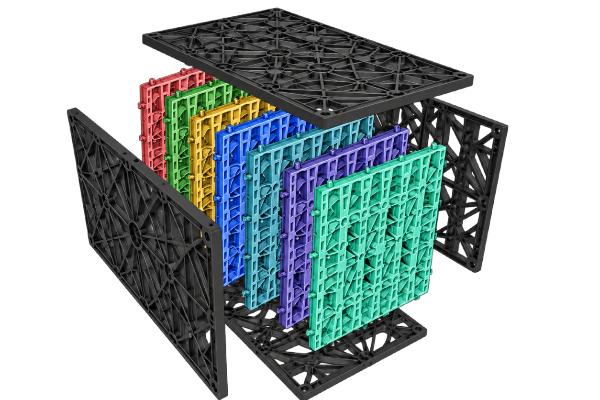
The standard bill-of-materials comprises six smaller/internal panels and four large panels. Its approximately 197 L nominal unit volume reduces the number of individual units needed for a given gross storage target compared with the smaller formats, but overall tank design still depends on the approved layout.
Configuration Boundary
HS-20-tested configuration evidence is available for specified model/configuration scope. It does not convert the product into blanket HS-25 or HL-93 compliance.
The standard build uses two large, two side and six centre panels. A 250 mm first tier and 230 mm addition per further tier give 250, 480, 710 and 940 mm listed stacked heights.
Configuration Boundary
Use the approved configuration and applicable report wording for load-related enquiries. Do not transfer evidence from another model simply because both products share an 800 × 490 mm plan.
Standard configuration comprises four large and six small/internal panels. Its 680 × 410 mm plan and approximately 119.2 L nominal usable storage offer another grid option where boundaries or pipework make the 800 mm format less convenient.
Configuration Boundary
HS-20-tested configuration evidence is available within its documented scope. Project traffic suitability still requires the complete buried system to be checked.
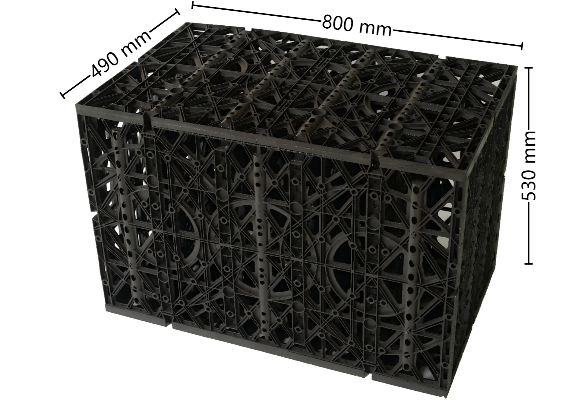
Any installation of mixed panel heights must use an approved structural layout and connector detail. The table assists in defining an enquiry geometry, but is not a construction drawing.
Send Your Storage EnvelopeDetention, Infiltration, and Harvesting Configurations
An attenuation crate, soakaway crate and rainwater harvesting module may each use a similar open-cell geometry, but the surrounding water route and containment detail establish the system role. Specify the water route, wrap or liner, pretreatment, connections, inspection access and responsible designer before choosing the module configuration.
| System duty | Water path | Surrounding components to define | Project decisions before release |
|---|---|---|---|
| Attenuation / detention | Rainfall runoff enters the attenuation tank, remains in temporary storage and leaves at a controlled flow rate. | Impermeable liner, protective geotextile, inlet, outlet pipe, flow control, venting and inspection access. | Design rainfall, required storage volume, permitted peak flow, liner detailing, cover, loading and discharge approval. |
| Infiltration / soakaway | Stored surface water passes through a permeable interface into suitable surrounding soil. | Permeable geotextile, granular surround, inlet, sediment controls, inspection access and an approved infiltration system layout. | Percolation testing, groundwater clearance, pollution risk, soil stability, water table, setbacks and authority requirements. |
| Rainwater harvesting | Captured rainwater remains available for planned reuse rather than immediate discharge or groundwater recharge. | Impermeable containment, pretreatment, pump/control equipment, first-flush or equivalent controls, treatment where needed and separate reuse pipework. | End use, required water quality, testing/treatment, maintenance, overflow and physical separation from potable pipework. |
Attenuation is a controlled-release duty
A stormwater attenuation system must combine capacity with an outlet strategy. The void ratio of an attenuation crate does not set the discharge rate; the project hydraulic design links rainfall, catchment flow, permitted release, upstream drainage and storm overflow control.
Infiltration is a ground-and-authority duty
A geocellular module array only provides subsurface storage. Soil infiltration, groundwater protection and local approval determine whether a soakaway is appropriate and how the permeable system is detailed.
United States infiltration screen: the U.S. Environmental Protection Agency states that some subsurface piping and commercially manufactured stormwater infiltration devices may fall within Class V stormwater drainage-well requirements.3 The responsible project party should determine applicability with the relevant authority before construction.
Harvesting requires a separate water-quality plan
Stored water is not automatically suitable for every reuse. The U.S. Centers for Disease Control and Prevention notes that collected rainwater may contain germs and chemicals; quality must match its use, with suitable testing, treatment, maintenance and separation from treated piped water.4
AQUA supplies modules and coordinated supporting materials. Water-treatment performance, potable suitability and cross-connection design are not properties established by module storage volume.
Controlled Module Specifications
Use the table below to compare current AQUA product data, then request the relevant model/configuration documentation for your project review. Storage volume, mass and short-term vertical strength data can provide procurement inputs, but whole-system structural adequacy is a separate design decision.
| Specification | ARW-8053 | ARW-8025 | ARW-6841 |
|---|---|---|---|
| Nominal dimensions | 800 × 490 × 530 mm(31.50 × 19.29 × 20.87 in) | 800 × 490 × 250 mm(31.50 × 19.29 × 9.84 in) | 680 × 410 × 450 mm(26.77 × 16.14 × 17.72 in) |
| Void ratio | Approx. 95% | 94% | Approx. 95% |
| Nominal usable storage | Approx. 197 L | Approx. 92 L | Approx. 119.2 L |
| Standard panel-set weight, excluding connectors | 11.932 kg | Approx. 7.9 kg | 8.028 kg |
| Vertical strength options | 22 / 30 t/m² | 38 / 50 t/m² | 22 / 28 t/m² |
| Standard panel build | 4 large + 6 small/internal | 2 large + 2 side + 6 centre | 4 large + 6 small/internal |
| First-tier height | 530 mm | 250 mm | 450 mm |
| Further-tier increment | 510 mm | 230 mm | Project layout dependent |
| Standard material | 100% recycled PP | 100% recycled PP | 100% recycled PP |
| Standard colour | Black | Black | Black |
| Traffic evidence wording | HS-20-tested configuration | Use approved configuration/report wording | HS-20-tested configuration available |
Four levels of structural evidence
- 1 · Product identityModel, material, dimensions, standard bill of materials and nominal unit storage.
- 2 · Unit dataMass and vertical strength option with the applicable specimen, direction, test method and report scope.
- 3 · Tested configurationEvidence tied to the named model, build, load case and configuration, such as the supported HS-20 wording.
- 4 · Installed-system designLong-term creep, cyclic effects, cover, pavement, soil, groundwater, backfill, settlement, installation and project safety factors.
Connection and layout inputs
- Supply pipe outside diameter, material, position, invert level, number of inlets, outlets and any flange or cover requirement.
- Do not interpret a safe site-cut opening from the full panel size. The maximum safe opening for a pipe connection is not specified in the current product record and should be checked before selecting the panel and connection detail.
- Specify module orientation, tier quantity, connector orientation, edge panels, inspection access and penetrations before the packing list is issued.
- For variable-height stacks, include the structural layout and connector method in the project review, rather than assuming the sum of heights is project approval.
Request model-specific documentation and compliance records for your active engineering project review.
Request Model-Specific EvidencePricing Inputs and Production Planning
Crate price is assembled from model, strength option, configuration, number of panels, connectors, support materials, quantity ordered, packing and destination. A valid quotation also requires the project loading and system duty inputs, because the crate’s lowest price may deliver a poorer container, excavation or storage outcome.
Cost and schedule drivers
| Driver | What changes | What to send |
|---|---|---|
| Model and strength option | Panel build, mass, nominal storage and relevant evidence package | Shortlisted ARW model or site envelope for recommendation |
| Required storage volume | Unit count, array size, packing plan and accessory quantities | Hydraulic storage target and any allowance already applied |
| Tank geometry | Tier count, module orientation, side panels and connector detail | Maximum footprint, depth, cover and obstruction drawing |
| System duty | Geotextile, impermeable liner, connection, flow control and water-quality scope | Attenuation, infiltration, harvesting or combined duty |
| Access and pretreatment | Silt traps, manholes, pipework, inspection and cleaning provisions | Operations concept and responsible maintenance party |
| Export logistics | Pallets, accessory cases/bags, container selection and consolidation | Destination, requested shipment mode and required date |
Approximate full-container planning
| Model | 20GP | 40GP | 40HQ | Planning note |
|---|---|---|---|---|
| ARW-8025 | Approx. 860 sets | Approx. 1,800 sets | Approx. 2,050 sets | Final count follows panel configuration and packing plan. |
| ARW-8053 | Approx. 520 sets | Approx. 1,050 sets | Approx. 1,200 sets | Primary promoted series; confirm accessories and order mix. |
| ARW-6841 | Estimated 730 sets | Estimated 1,470 sets | Estimated 1,680 sets | Estimate is based on flat-panel volume ratio; final loading requires a packing plan. |
Bronze commercial decision card
No universal installation-saving percentage or payback period is used for this product. Groundworks, lining, access, pretreatment, installation labour and freight can dominate a low crate price, so compare the total project scope rather than one item.
Owner-confirmed production context
Working capacity for the core moulded stormwater module range is approximately 100,000 m³ per month, with annual export volume around 1,000,000 m³. A core-module quantity equivalent to one 40HQ is produced in approximately 2–3 days and may take up to about 7 days, excluding raw-material preparation.
These figures describe production context, not delivery time. Actual scheduling depends on model, material preparation, order mix and season; packing, inspection, container booking, transport and destination follow their own confirmed schedule.
Batch Inspection And Available Order Documents
Our moulded-product workflow links the ordered model and load grade to batch checks, packing review and loading control. The goal is a shipment that matches the agreed configuration and carries the documents specified for that order.
[SYS.01]
Configuration Review
The order is checked against model, panel build, strength option, colour, quantity, connector and accessory requirements.
Batch Sampling
Owner-confirmed sampling is approximately 2% for moulded-product batches, covering dimensions, colour, appearance and compression.
Compression Testing
The factory compression testing machine supports internal batch control and agreed witness or video arrangements.
Packing Review
Module bodies, side panels, clips, flange covers and smaller accessories are checked against the packing list before loading.
Loading Control
Product appearance, selected dimensions, packing, container securing, sealing and photographic reporting can be included in agreed loading supervision.
[DOC.REF]
Documents To Specify With The Order
- Current model data sheet and approved configuration record
- Batch inspection or test records within agreed scope
- Selected third-party product test reports where applicable to the model/order
- Applicable company certificates requested for supplier review
- Packing list and loading photographs or report when agreed
[AUDIT.REF]
Witness And Audit Options
- Factory-witnessed testing by prior arrangement
- Test video for the agreed sample and method
- Customer or third-party factory audit by appointment
- Remote video factory inspection
- One- or two-day loading supervision according to schedule
From Project Data to Shipment
AQUA brings product selection, batch inspection, export packing, loading supervision and technical communication into a single supply process. Your appointed designer, authority and installer retain the project-specific hydraulic, structural, permitting and construction decisions.
01
Submit the project brief.
Forward storage duty, volume, footprint, depth, cover, traffic condition, ground context, pipework, access requirements, destination and schedule.
02
Assess module compatibility.
We compare ARW-8053, ARW-8025 and ARW-6841 by unit volume, height, strength option and packing efficiency.
03
Define the supply scope.
Confirm modules, side panels, connectors, flange covers, geotextile, geomembrane and other ordered supporting materials.
04
Confirm evidence scope.
Identify data sheets, available test reports, witness arrangements, inspection needs and certificate copies required before release.
05
Issue quotation and schedule.
The written offer fixes the selected configuration, quantity, packing basis and order-specific production plan.
06
Produce and inspect.
Core moulded products run through the agreed production and approximately 2% batch-sampling workflow.
07
Pack, load and report.
Palletised panels and separately packed accessories are checked against the order before the container is secured and sealed.
System Access and Maintenance Inputs
Geocellular storage does not provide water-quality treatment by itself, and a buried crate system becomes harder to recover if sediment and access are ignored. Build pretreatment, inspection and cleaning into the system design while the module grid and pipework can still be changed.
Maintenance input
Decision before quotation or layout freeze
Why it matters
01 Upstream pretreatment
Decision before quotation or layout freeze
Define catchpit, silt trap, filter or other sediment-control device and its design owner.
Why it matters
Reduces solids entering the underground storage array.
02 Inlet and outlet access
Decision before quotation or layout freeze
Locate accessible manholes and pipework inspection points.
Why it matters
Allows blockages, sediment and flow-control components to be inspected.
03 Array inspection route
Decision before quotation or layout freeze
Identify access columns, inspection points and safe operating method.
Why it matters
Prevents the module layout from closing off the intended inspection path.
04 Cleaning approach
Decision before quotation or layout freeze
Agree how captured sediment will be removed and where wash water or removed material will go.
Why it matters
Avoids specifying access that cannot support the maintenance equipment.
05 Inspection triggers
Decision before quotation or layout freeze
Set frequency and trigger levels from the site maintenance plan.
Why it matters
Turns maintenance into an owned task instead of an assumption.
06 Responsible party
Decision before quotation or layout freeze
Name the owner/operator, service provider and record-keeping requirement.
Why it matters
Keeps inspection, cleaning and corrective action active after handover.
Reference Note
susDrain notes that geocellular systems can be difficult to monitor and maintain, and identifies silt traps, manholes, pipework and pretreatment devices as inspection points. Use those practical inputs to shape the surrounding drainage system rather than describing the array as maintenance-free.
Get Instant Quote →Product and Installation Image Gallery
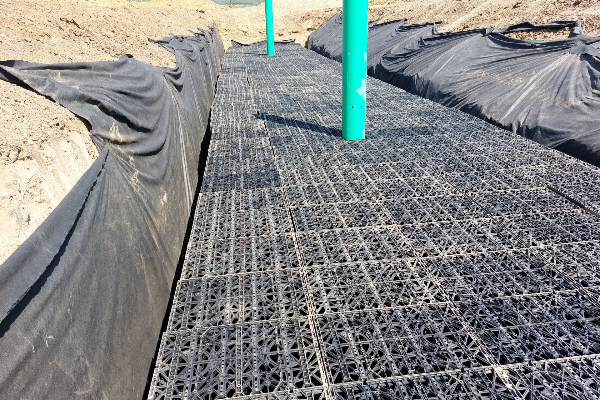
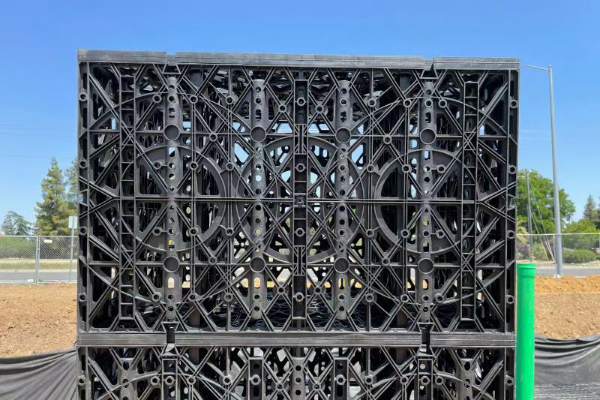
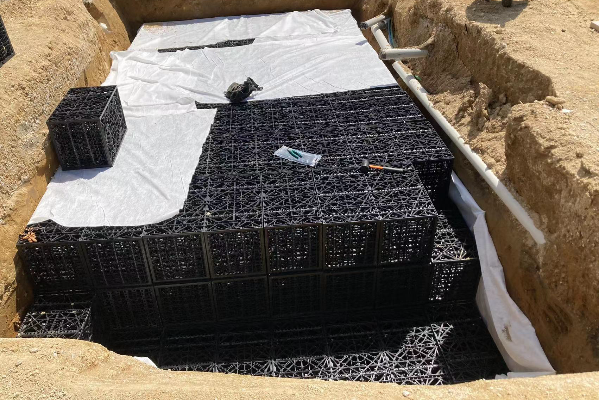
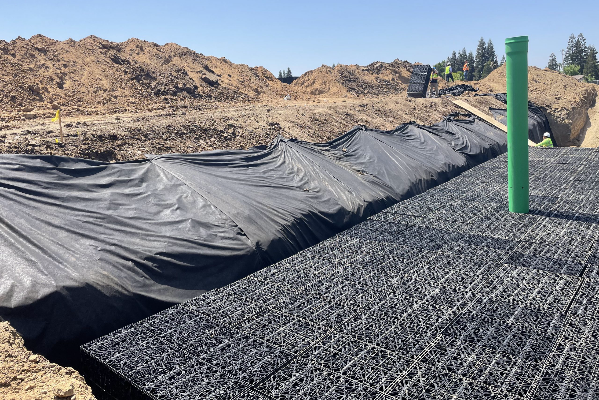
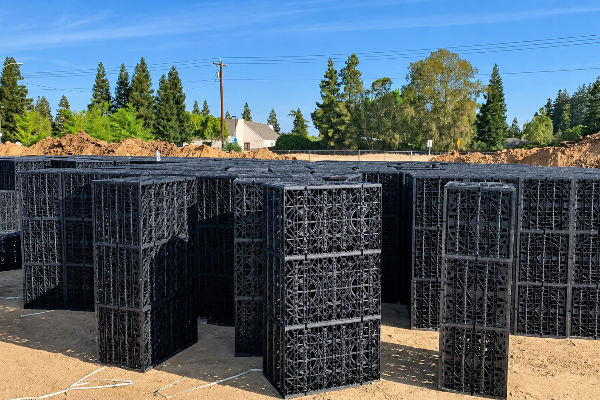
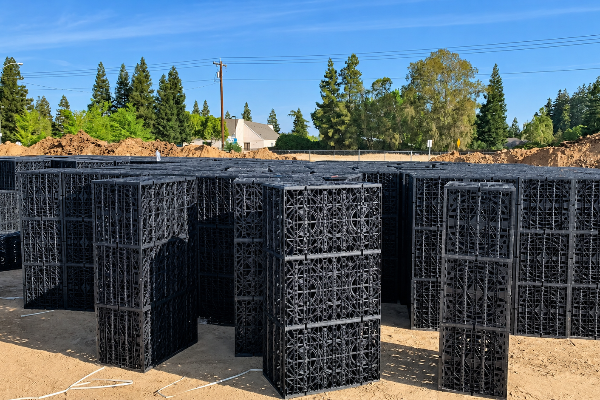
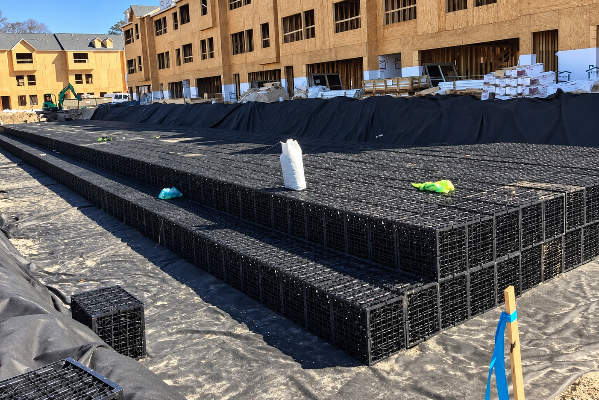
These customer-supplied images show the module form, stacked geometry and observable installation context. Their captions stay with what is visible and do not attach an unverified customer, location, date, model, machine count or installed performance result.
FIG. 01
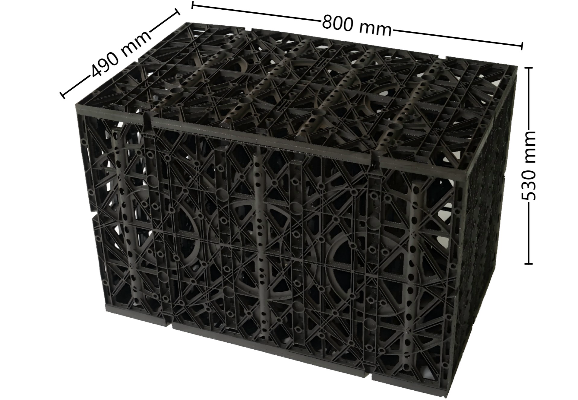
FIG. 02
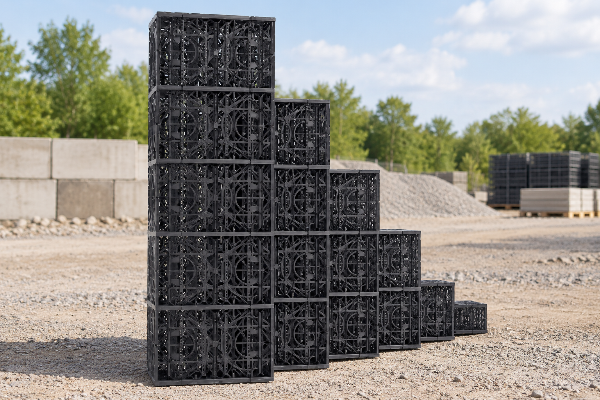
FIG. 03
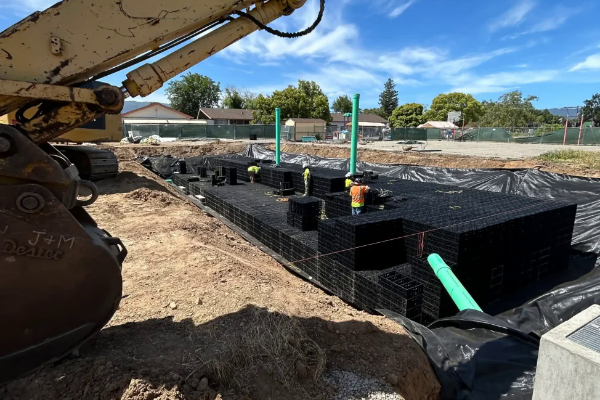
FIG. 04
Selection Limits And Engineering Boundaries
A modular attenuation system is most cost effective when the product format, surrounding ground, hydraulic duty and maintenance plan are designed as a package. The table identifies the conditions that require a further decision before the module order can be released.
- The cheapest crate is not always the best project choice.
- Unit strength is not necessarily an installed-system rating.
- Storage capacity is not always a water-quality or permitting answer.
Aqua Project Review Rule
01. Traffic Area Without A Whole-System Structural Review
Why The Module Data Is Not Enough
Short-term unit strength and HS-20 configuration evidence do not include every cover, pavement, soil, groundwater, backfill, cyclic, creep or settlement condition.
Project Response
Obtain a project-specific structural check and approve the exact model, configuration and installation build-up.
02. Infiltration Proposed Without Ground Evidence
Why The Module Data Is Not Enough
A soakaway crate cannot establish percolation rate, water-table clearance, pollution risk, setbacks or regulatory applicability.
Project Response
Complete site investigation, infiltration testing and authority review; use attenuation if infiltration is unsuitable.
03. Harvesting Proposed Without An End-Use Plan
Why The Module Data Is Not Enough
Storage capacity does not establish water quality, treatment, potable suitability or safe connection to building pipework.
Project Response
Define end use, testing, treatment, overflow, maintenance and cross-connection protection with qualified specialists.
04. No Pretreatment Or Maintenance Access
Why The Module Data Is Not Enough
The array provides storage, not inherent sediment treatment, and buried storage can be difficult to monitor or clean.
Project Response
Add upstream sediment controls, accessible manholes, inspection points, cleaning provisions and a named operator.
05. Turnkey Installation Responsibility Expected From Aqua
Why The Module Data Is Not Enough
A product supply quotation is not a hydraulic design appointment, project approval or construction contract.
Project Response
Use AQUA for product, supporting materials, documentation and arranged technical support; appoint the responsible designer and installer separately.
06. Exact Pipe Opening Requested Without Panel Review
Why The Module Data Is Not Enough
The full panel dimensions do not define a safe cut-out or reinforcement detail.
Project Response
Submit pipe diameter, position and connection concept for model-specific review before cutting.
Practical Release Rule
Do not release a module because one number looks favourable. Release the order when the model, configuration, evidence scope, ground and loading inputs, hydraulic duty, access plan, connection detail, packing list and project responsibility matrix agree.
Geocellular Stormwater System Planning Tools
Module Quantity Estimator
Calculate the precise number of geocellular modules needed based on your required stormwater catchment volume and excavation dimensions.
Three Model Comparison
Evaluate load-bearing capacities, void ratios, and structural dimensions side-by-side to select the optimal module for your project traffic conditions.
Container Reference Planner
Optimize international shipping logistics by accurately forecasting 40HQ container utilization and bulk pallet arrangements.
Prepare Your Module Quotation
Send sufficient project detail for a model and supply review. Use the Module Quantity Estimator, Three-Model Comparison and Container Reference Planner to prepare the enquiry. AQUA will use the information to compare the ARW range, identify the supporting-material and document scope, and prepare an order-specific quotation and production plan.
Send Project Data
Customer, distributor and project names remain confidential unless specifically approved for publication.
RFQ Readiness Checklist
- 01Detention, infiltration or harvesting duty
- 02Required storage volume
- 03Maximum footprint and available depth
- 04Cover and surface traffic condition
- 05Soil, groundwater and water-table context
- 06Inlet, outlet and pipe positions
- 07Pretreatment and maintenance access
- 08Model or strength option preference
- 09Quantity and supporting materials
- 10Destination and required schedule
FAQ: Geocellular Stormwater Modules
What is the difference between attenuation and infiltration modules?
Choose attenuation when the approved drainage scheme must store runoff behind an impermeable liner and release it through a controlled outlet. Choose infiltration when the approved system can release water through a permeable interface into suitable ground.
How many attenuation crates are needed for a project?
Start with the engineered storage requirement, then map it into the selected module’s nominal usable storage and approved array. AQUA values are approximately 197 L for ARW-8053, 92 L for ARW-8025 and 119.2 L for ARW-6841, but the arithmetic alone does not fix the order quantity.
The project designer should account for the approved geometry, connection zones, inspection access, hydraulic allowance, wrap or liner, and any volume displaced by internal or surrounding components before the final bill of materials is released.
Why does void ratio matter?
Void ratio describes how much of the module envelope is available for water storage. The current range provides 94% to approximately 95% void space, but final system volume also depends on model geometry, the approved array and connected components.
Can AQUA modules be used below trafficked areas?
Traffic use requires an engineer-approved complete system. ARW-8053 and ARW-6841 include model/configuration-specific HS-20 evidence wording, but HS-20 is not a blanket HS-25 or HL-93 claim and the current 22–50 t/m² vertical strength options are not automatic allowable installed loads.
What material and colour are standard?
The standard is 100% recycled polypropylene in black. Project-specific formulations require quotation review.
What stacking heights are available?
ARW-8025 starts at 250 mm and adds 230 mm per further tier, giving typical heights of 250, 480, 710 and 940 mm. ARW-8053 starts at 530 mm and adds 510 mm, giving 530, 1040 and 1550 mm examples.
Mixed combinations include 760 mm for one ARW-8025 plus one ARW-8053, 990 mm for two ARW-8025 units plus one ARW-8053, and 1270 mm for one ARW-8025 plus two ARW-8053 units. Every mixed-height layout still needs an approved structural arrangement and connector detail.
What project data is required for a quotation?
Send storage duty and volume, maximum footprint and depth, cover, traffic condition, soil and groundwater context, inlet/outlet details, access and maintenance concept, module preference, quantity, destination and requested date. A plan or section drawing allows us to compare the 250, 450 and 530 mm first-tier options.
How are moulded batches inspected?
The owner-confirmed workflow samples approximately 2% of moulded-product batches for dimensions, colour, appearance and compression. Factory-witnessed testing or an agreed test video can be arranged, while third-party reports remain separate model/order-specific documents.
How quickly can one 40HQ quantity be produced?
Core-module production equivalent to one 40HQ is approximately 2–3 days and may take up to about 7 days excluding raw-material preparation. This is production context rather than delivery time; model, order mix, season, inspection, packing, booking and destination affect the final schedule.
Does AQUA install the complete stormwater system?
AQUA supplies products, supporting materials and product-related documents, with remote guidance, loading supervision and on-site technical support available by agreement. The appointed project parties own the hydraulic and structural design, approvals and all installation construction.
Can stored rainwater be used as drinking water?
Module storage volume does not establish drinking-water safety. CDC guidance states that rainwater may contain organisms and chemicals, and sensitive uses require appropriate testing, treatment, maintenance and separation from treated piped water in accordance with local requirements.
![Ground Grid Applications & Ground Reinforcement [Guide]](https://aquarainwater.com/wp-content/uploads/2026/09/ground-grid-applications-ground-reinforcement-blog-featured-150x150.png)