Get in touch with AQUA Company
Geomembrane Liner Guide: 7 Project Inputs from Selection to Handover
Updated September 2026 · Educational project guide from AQUA Rain Water
A geomembrane liner is the low-permeability barrier in a larger lining system. Installed liner performance is affected by facility classification, contained media, subgrade, interfaces, slopes, seams, penetrations, protection and the evidence retained before cover-up.
Short answer
- Determine whether a regulation, permit or owner specification has already specified the liner system.
- Complete the Seven-Input Liner Brief prior to selecting a polymer, surface, or thickness.
- Treat a smooth or textured surface as an interface decision, not a stand-alone stability decision.
- Release the subgrade and details before panels are deployed.
- Link every field seam, test, defect, and repair to a particular location.
- Don’t cover the liner until the named approval authority has the required evidence.
- Continue operational monitoring records when the governing plan requires them.
This guide has a different function than the AQUA commercial solution page. With this guide, you can screen project inputs, coordinate installation interfaces, and inspect and evaluate the work performed, and make a constructive request for quotation. Product configuration, ordered specifications, approval documents, delivery terms and quotations remain the responsibility of the commercial solution page. This separation provides a learning tool for buyers, without creating a duplicate conversion page for the same keyword.
What a Geomembrane Liner Does, and Cannot Do Alone
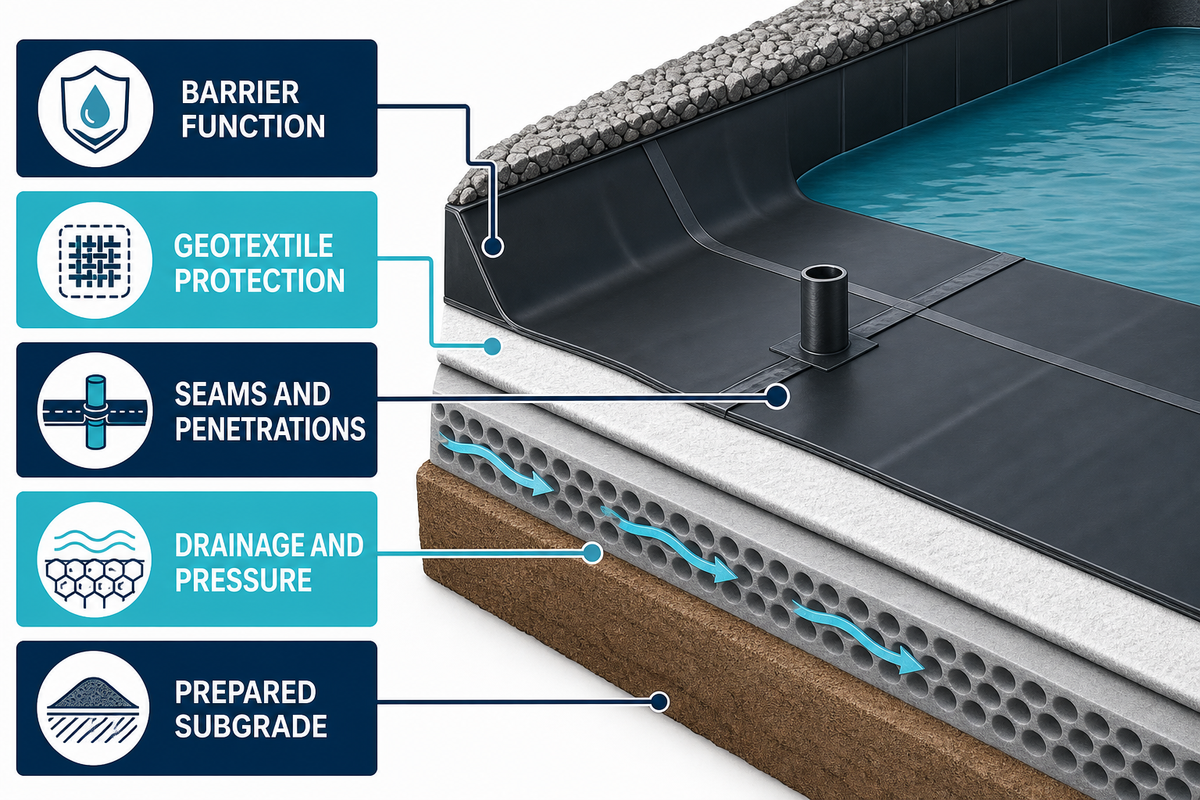
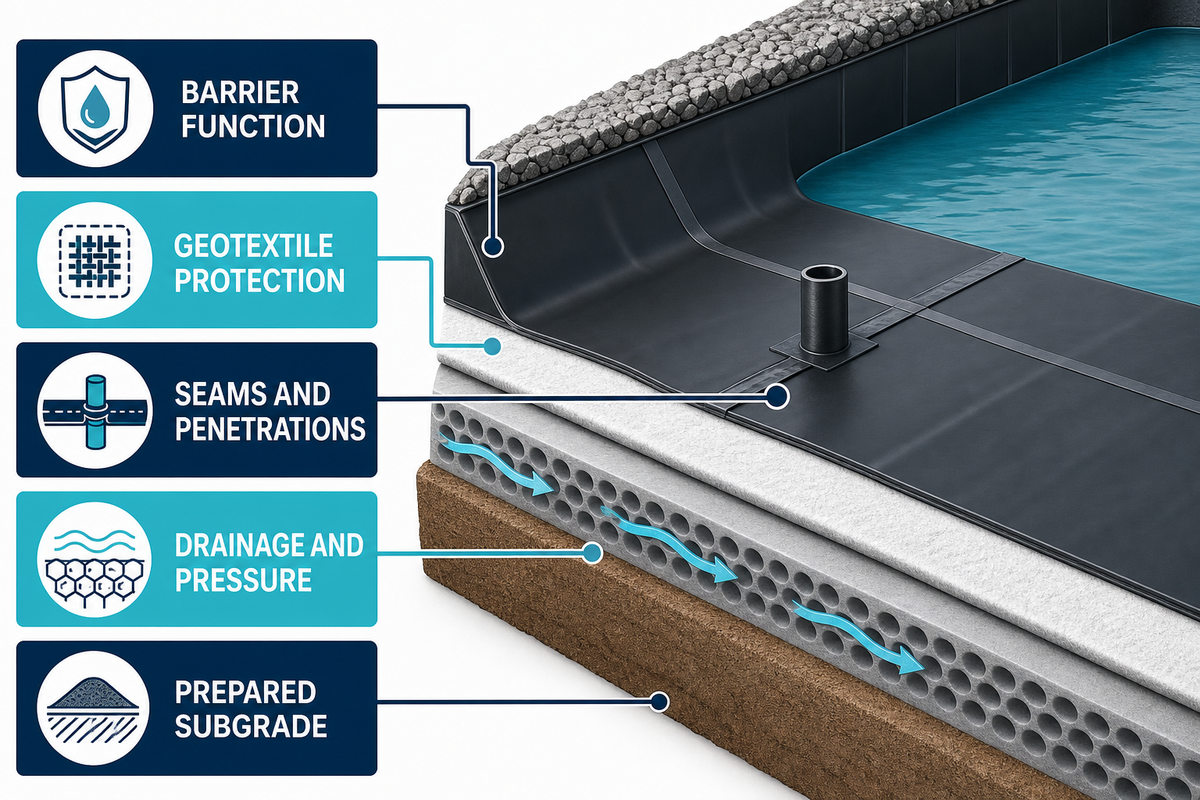
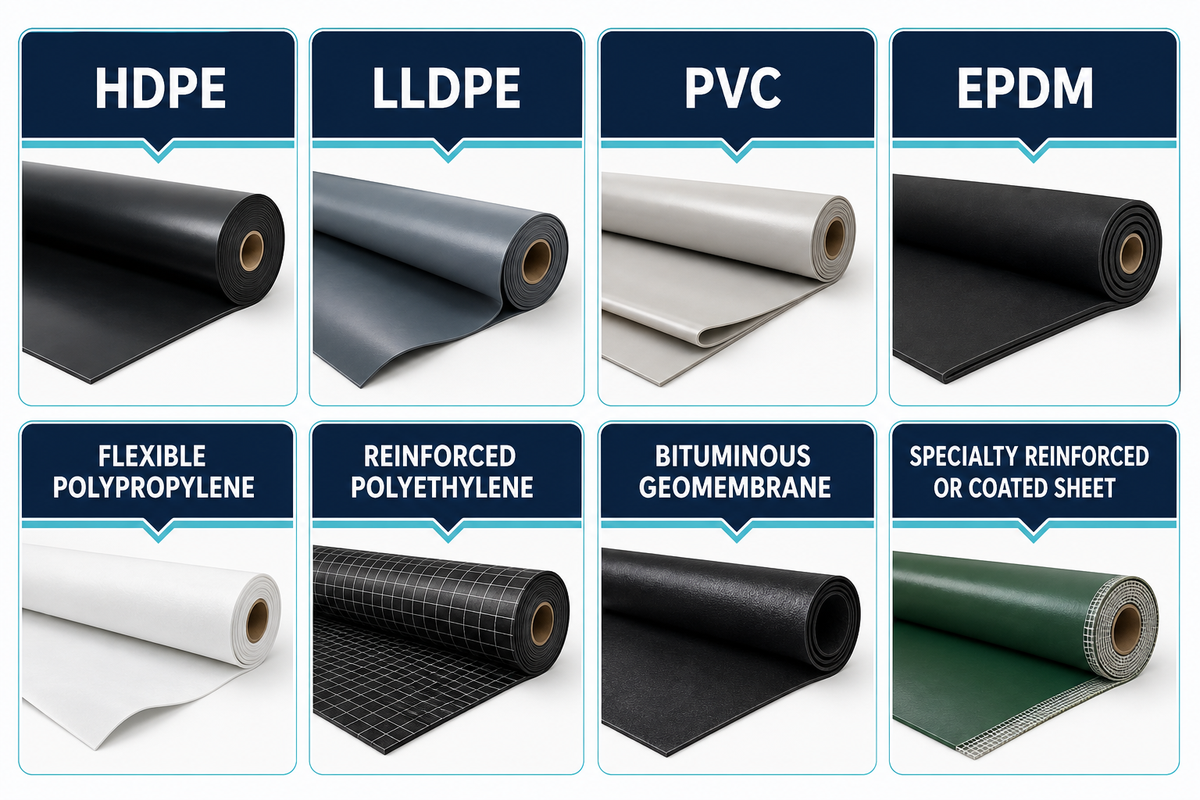
A geomembrane is a manufactured sheet that’s used to control flow of fluid. Some common materials of geomembranes are high-density polyethylene (HDPE), linear low-density polyethylene (LLDPE), polyvinyl chloride (PVC) and ethylene propylene diene monomer (EPDM). Within the lining system, the geomembrane liner supplies the barrier function; a geotextile may provide separation, filtration, drainage or cushioning.
Low permeability does not establish that every installed detail has no leak path. Field seams, rigid connections, penetrations, wrinkles, construction damage and unprotected cover placement can change the result. Low permeability in the installed system does not eliminate seam and detail inspection. Drainage and pressure conditions beneath the liner matter as well. Product certificates simply identify the supplied material; they don’t certify the field workmanship. This distinction matters because a low-permeability product cannot by itself resolve the risk created by an unprepared subgrade, damaged seam or unsupported penetration. The U.S. Bureau of Reclamation geomembrane guidance treats material, subgrade, seams, interfaces and protection as connected design and construction considerations.
A buried liner is only as auditable as the evidence preserved before it is covered.
Useful specifications distinguish material requirements from installation and acceptance requirements. Governing documents and the responsible designer decide which controls apply. Suppliers can help confirm an orderable product configuration, but cannot replace that project authority.
Start with the Seven-Input Liner Brief
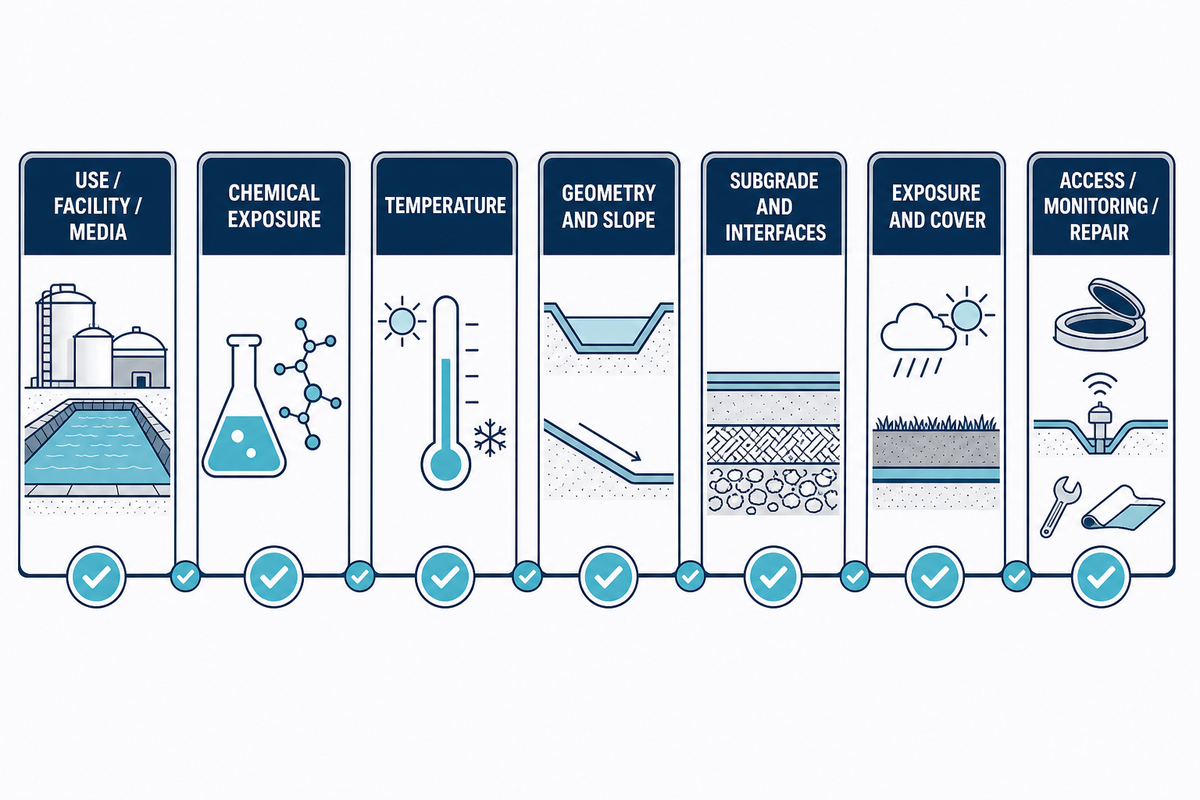
Please don’t ask “What thickness should I buy?”. Please provide a one page brief that captures the following information:
| Input | Questions to close | Evidence to attach |
|---|---|---|
| 1. Use, facility class and media | What is contained? Does a permit or rule set a composite liner, minimum property or monitoring system? | Design basis, liquid description, jurisdiction and owner requirements |
| 2. Chemical exposure | Which chemicals, concentrations, mixtures and cleaning agents can contact the liner? | Compatibility review for the ordered formulation |
| 3. Temperature | What are liquid, ambient, storage and installation temperature ranges? | Project range and product limitations |
| 4. Geometry and slope | What are dimensions, gradients, corners, benches, anchors and rigid connections? | Marked drawing and interface locations |
| 5. Subgrade and interfaces | What lies above and below? Are settlement, sharp objects, drainage, uplift or gas possible? | Formation criteria, adjacent-layer details and stability review |
| 6. Exposure and cover | Will the liner remain exposed or receive soil, aggregate, concrete or another protection layer? | Protection design and placement method |
| 7. Access, monitoring and repair | Can the membrane be inspected later? What is the consequence of leakage and how will it be detected? | Access plan, monitoring duty and repair strategy |
There are regulated applications where there’s no open selection pathway. Landfill cells and wastewater impoundments may have site-specific liner-system criteria. These examples shouldn’t be used to generalize to a pond, canal, or a project outside the country. These examples provide reason to classify before considering a product. Classification reduces approval risk because 40 CFR 258.40 sets liner-system criteria within its defined landfill scope; those criteria are not a universal pond rule.
Compare Material Families Without Choosing a Universal Winner
Method of joining depends on polymer, component construction, detail type and relevant specification. Durable panels do not fix unsupported pipe connections or unsuitable seams. Use the information provided to form a conclusion on the appropriateness of the material, not to approve it. Common applications for an HDPE geomembrane or PVC geomembranes include waste containment, landfill liners, water containment, wastewater treatment, stormwater management and other environmental containment applications. This material acts as a synthetic membrane liner or impermeable barrier, but the liner installation and installation process must still control fluid migration rather than assume every sheet is universally impermeable.
| Material type | Practical character | Questions for the brief |
|---|---|---|
| HDPE | Relatively stiff; field welding and thermal movement need planned control | Geometry, welding access, wrinkles, chemical evidence and cover placement |
| LLDPE | More flexible and able to conform to some settlement or complex shapes | Deformation, exposure, puncture, welding and required specification |
| PVC | Flexible and often factory fabricated into panels; formulation matters | Chemical compatibility, exposure, joining route, handling and product documentation |
| EPDM | Flexible rubber membrane used in selected water and lining applications | Declared use, compatible seams and accessories, exposure and detail movement |
| Flexible polypropylene | Flexible thermoplastic route with product-specific construction and joining requirements | Formulation, reinforcement, exposure, seam method and governing product specification |
| Reinforced polyethylene | Composite sheet whose reinforcement changes handling and tear behaviour | Coating, scrim, field joining, abrasion, fold limits and repair access |
| Bituminous geomembrane | Heavy composite route with different transport, overlap and substrate considerations | Mass, slope handling, joint system, temperature and project approval basis |
| Specialty reinforced or coated sheet | Application-specific construction selected for a defined chemical or mechanical duty | Exact product identity, compatibility evidence, fabrication, field details and limitations |
Chemical resistance isn’t a guarantee for every formulation and every mixture. Require evidence specific to your order for product, concentration, temperature, and contact duration. If the evidence does not match, record suitability as unresolved. Product mismatch remains a project risk because GRI-GM13 is scoped to HDPE geomembranes; it should not be transferred to PVC, EPDM or other families without a relevant specification.
Mining containment, landfill cells, stormwater basins, and wastewater systems can create various contamination and engineering issues. Bentonite-based geosynthetic clay liners can also form an essential interface. These examples belong in project classification; they are not reasons to generalize one material choice across industries.
Smooth or Textured? Treat Friction as an Interface Question
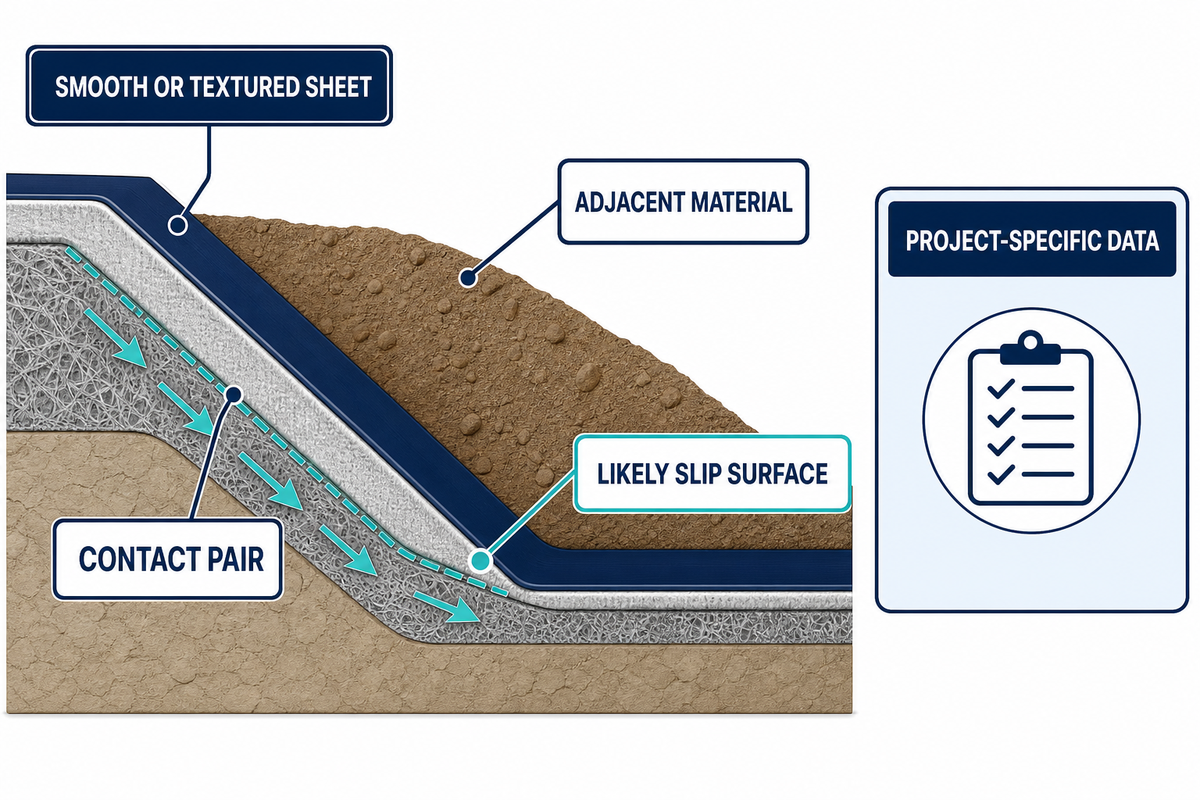
When slope stability or interface shear resistance is a concern, textured geomembrane is one of the choices. However, the interface is comprised of a geomembrane and a geotextile, soil, geocomposite, clay liner, or other material. Other material families require their own relevant basis. In this context, textured doesn’t refer to an interface test. Where compacted clay liners or a non-woven geotextile form adjacent layers, project-specific interface friction remains part of the stability review.
Each of the critical interfaces on the sections must be listed. It’s important to identify the material in contact with the membrane, and where the likely slip surface can occur. If stability is critical, the engineer on the project must decide what additional project-specific data or tests are required. Interface instability remains a design risk because shear behavior belongs to the complete contact pair, not to the textured sheet in isolation; project-specific test data may therefore be required. The U.S. Bureau of Reclamation design standard provides authority context for evaluating geomembrane interfaces within a complete lining system.
Choose Thickness and Protection as One Risk Decision
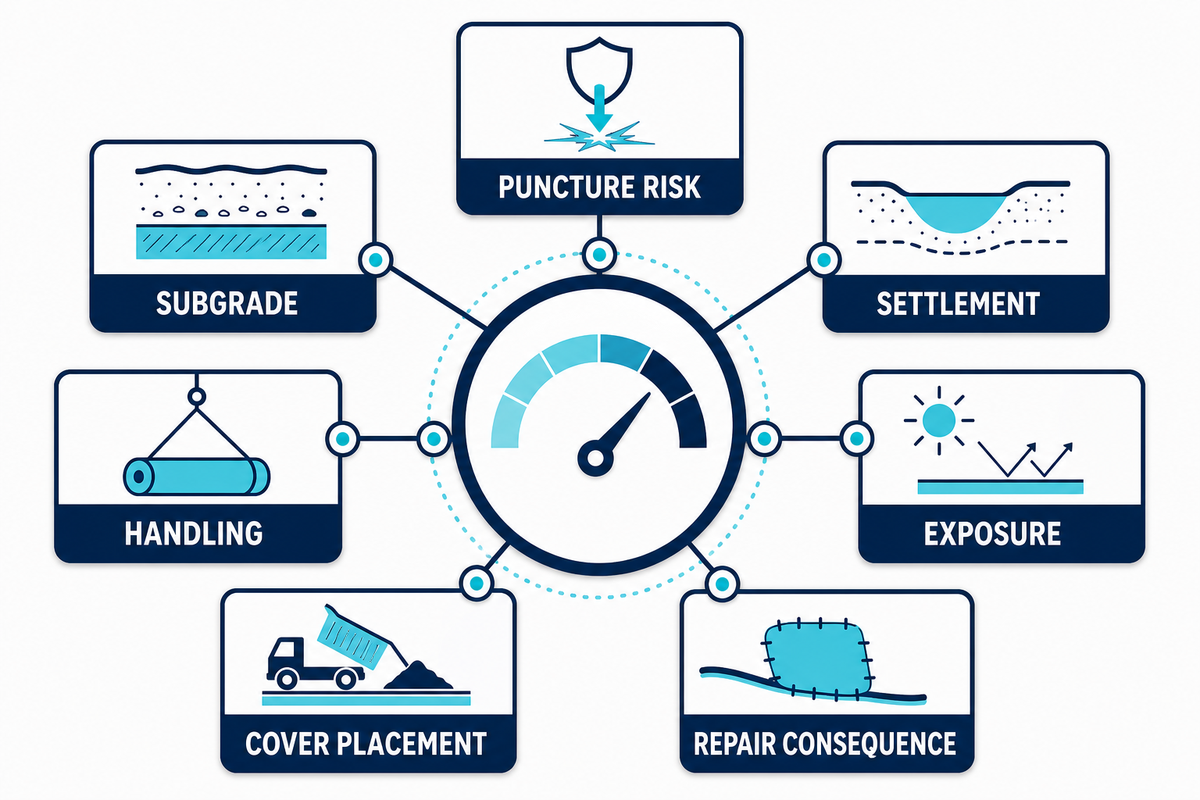
Classification, permitting or owner requirements for a minimum material or liner system may dictate the first consideration. Where the design choice remains open, thickness should be reviewed beside puncture risk, subgrade, handling, settlement, exposure, cover placement and the consequence of repair.
Thickness of a geosynthetic liner can be a protective system control; however, it isn’t a substitute for the protective system.
- Sharp objects can puncture a geosynthetic liner regardless of liner thickness, so the project still needs suitable protection and detail design. Durable panels do not fix unsupported pipe connections or unsuitable seams.
- Protection geotextiles cannot stabilize an unprepared or moving foundation.
- Cover material can damage the membrane if it is dropped or pushed incorrectly.
- Durable panels don’t resolve problems caused by unsupported pipe connections or inadequate seams.
Specify the relevant thickness tolerance and test method in the applicable product specification, rather than the nominal sales description. For HDPE projects referencing GRI-GM13, indicate the revision and confirm if the document provided addresses that revision. Other material families must specify their own basis.
Release the Subgrade and Details Before Deployment
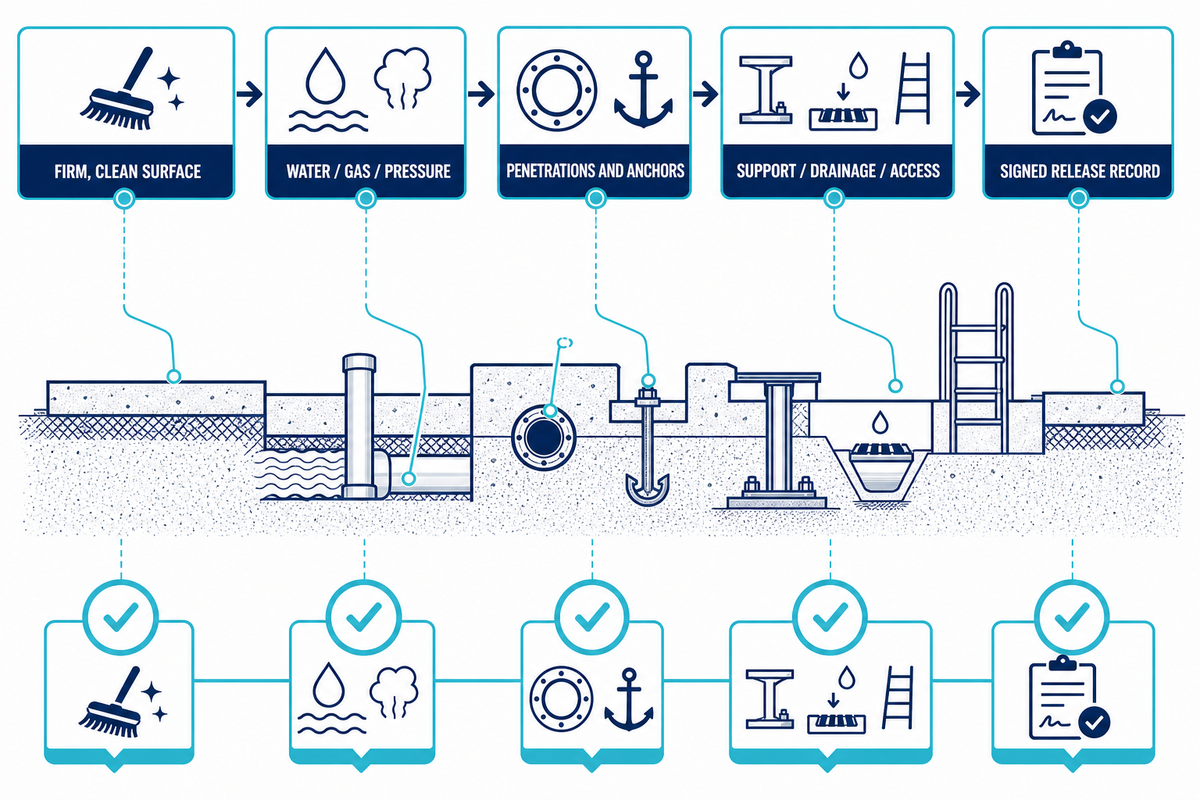
The surface should be firm and free of sharp or rough debris and should meet the specified requirements. Store and lift the rolls according to product instructions, with controlled access and a clean staging area. Standing water, uncontrolled ground water, gas and other pressure, settlement, or undermined or unstable edges are design problems and shouldn’t be addressed after rolls of material arrive.
Penetrations, anchor trenches and rigid connections should be drawn before they’re installed. Show in the drawing movement allowance, support, boots or end terminations, drainage, and access for inspection. Details kept only in an installer’s memory are difficult to price, inspect and hand over.
Make a subgrade-release record with the date, location, drawing revision, unresolved items, and signature of the individual who will accept the surface. If a geotextile underlay is specified, note its identity, overlaps and additional protection at transitions. Specified underlay supports the liner; it doesn’t replace a poor grade foundation.
Control Delivery, Storage, Deployment and Panel Layout
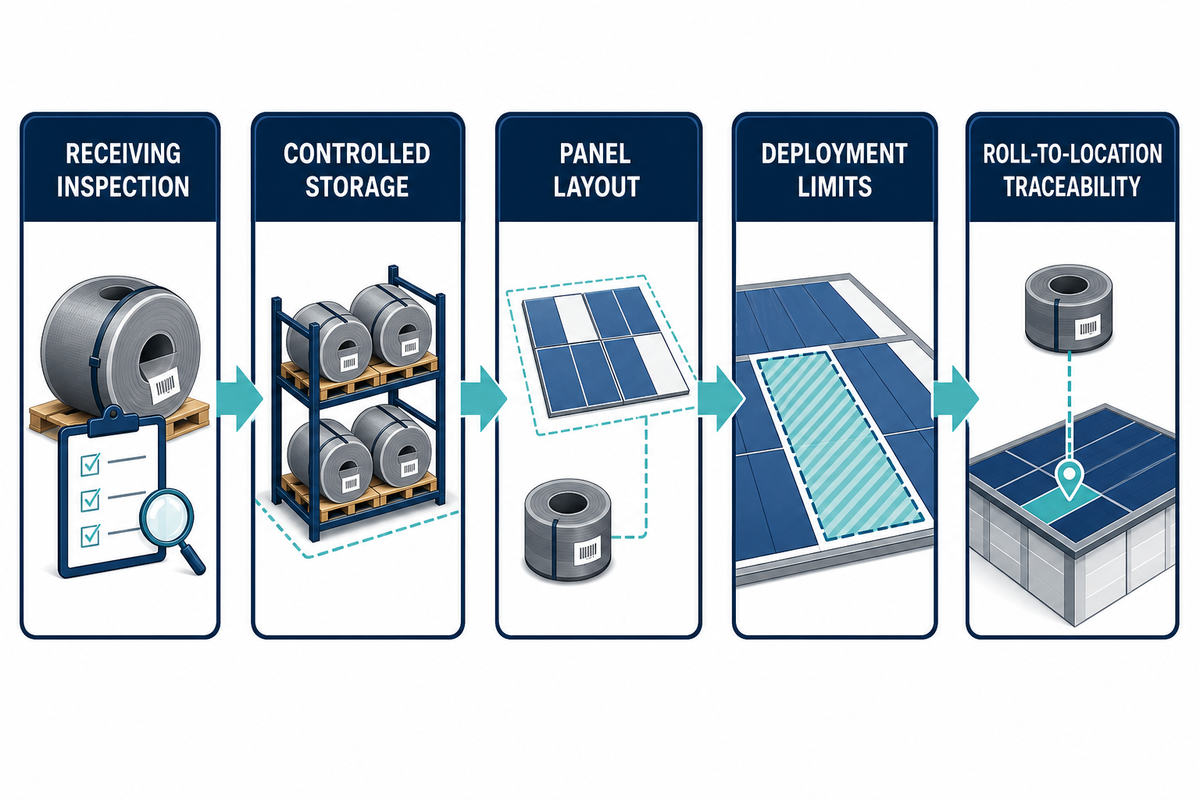
Receiving inspection connects delivered material to the approved order. Note all labels on rolls, lot or panel identifiers, dimensions for roll-area planning, packaging condition, visible transport damage and provided documents. Store rolls and lift them according to the product instructions, with controlled access and clean staging area.
Approve the panel layout and sequence prior to deployment. Show seam numbers, intersections, penetrations, anchors, and constraints to access repair. Establish limits for weather, temporary ballast, dragging, vehicle, foot, and tool traffic. Management of wrinkles should center on the planned application of cover materials and temperature rather than by uncontrolled trimming. Traceability reduces substitution and damage risk because roll labels, receiving records and panel maps connect the delivered material to its installed location.
AQUA may coordinate product selection, product-related documents, export packing, loading supervision and technical support when agreed. Geomembrane is a supporting procured product in the AQUA product range and is not produced on the injection-moulding line. AQUA’s approximately 2% sampling and compression workflow for owner-confirmed moulded-product batches does not transfer to geomembrane.
Control Field Seaming Without Treating One Method as Universal
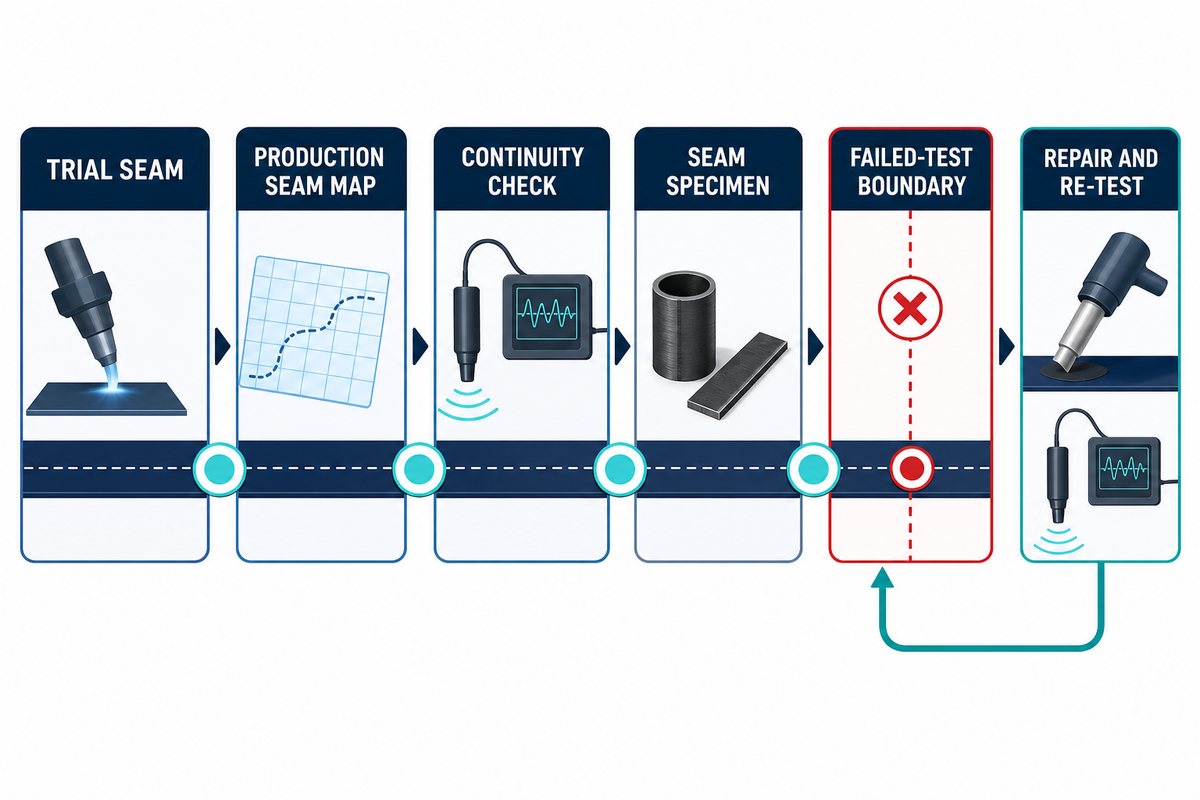
Method of joining depends on polymer, component construction, detail type and relevant specification. Use the comparison below to form questions, not to approve material. Using another material’s welding temperature and acceptance value isn’t appropriate.
Before starting production, trial seams confirm equipment, operator, and current conditions can create the specified results. Record time, location, equipment, settings, and conditions. Before deployment, approve the panel layout and sequence. Record the result. Indicate the production seam on the panel map for reference.
Non-destructive methods analyze seams for continuity; destructive samples analyze seam specimens using the project method. They address dissimilar questions. Project specifications should state test type, frequency, acceptance basis, failed-test boundary, repair method and re-test requirement. This guide intentionally doesn’t provide any definitive numbers. The U.S. EPA field-seam inspection guide places seam checks and acceptance within project-defined inspection and quality-assurance controls.
Inspect Seams, Defects and Repairs Before Cover-Up
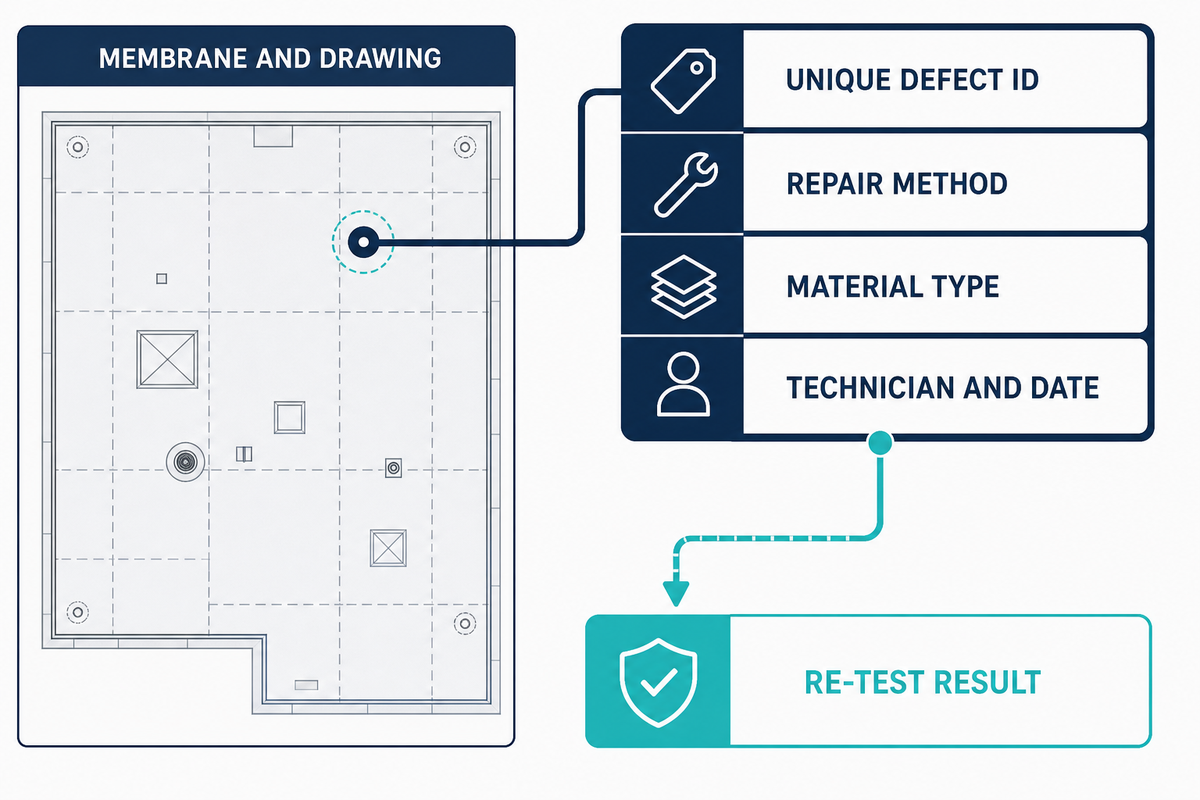
Begin inspection with a review of panels, seams, intersections, penetrations, anchors, waves, seams, and other areas of the membrane that are exposed to tools or traffic. Identify defects with a unique ID on a membrane and the drawing. Indicate the repair method, material type, technician, date of repair, and re-test result.
Separate construction quality control from construction quality assurance. According to installer records, production checks were performed. For cases where the contract calls for assurance to be independent, an authorized party other than the contractor reviews the evidence and decides to either accept the work as completed or to reject the work. Large record packs don’t automatically make the assurance independent.
If an electrical leak survey is to be performed, consider this a system requirement. Technique selection should be based on liner exposure, surrounding materials, access, and electrical and safety conditions. ASTM D6747-25 addresses selection of electrical leak-location techniques; it is not a replacement for seam-specific testing or a promise that every installed system can be surveyed the same way.
Build the Liner Evidence-to-Handover Chain
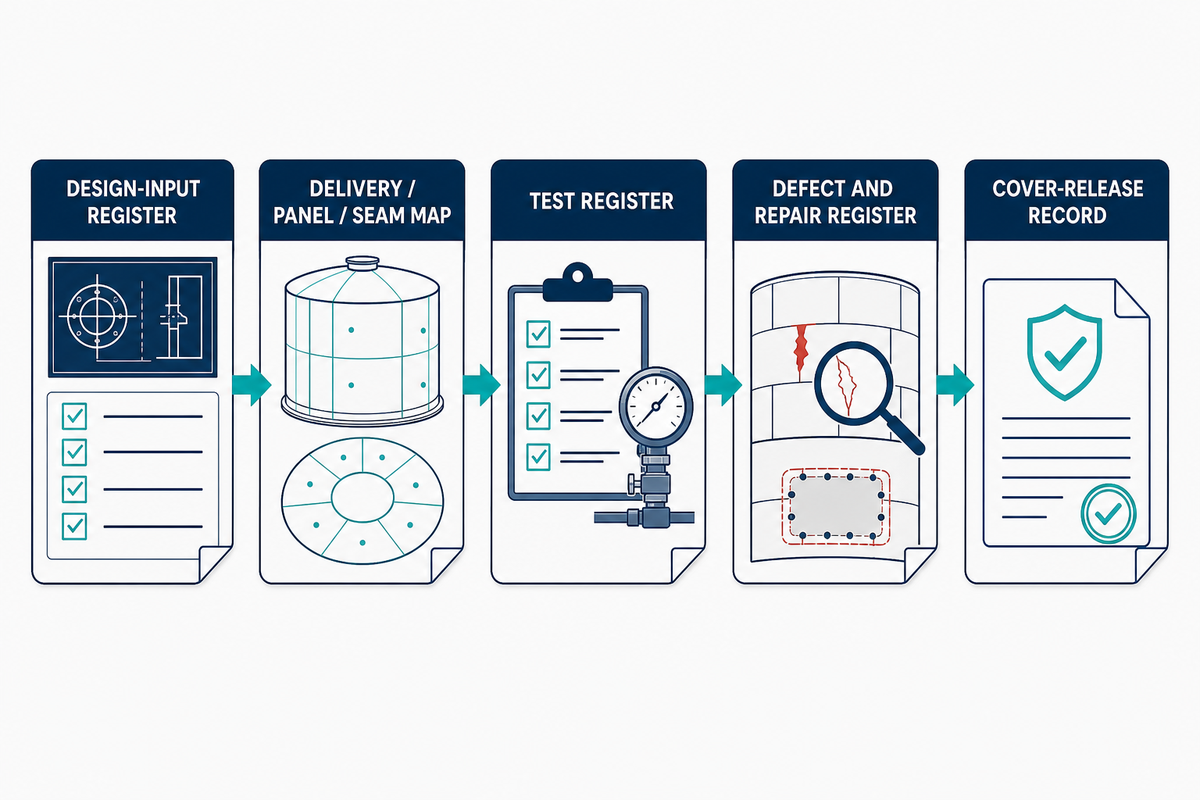
Five linked records make acceptance evidence retrievable:
- Design-input register: Seven-Input Liner Brief, governing documents and approved revisions – design-input register.
- Delivery, panel and seam map: The delivery, panel and seam map summarizes roll identity, panel locations, seams, details and field changes.
- Test register: trial seams, continuity checks, samples or surveys required by the plan.
- Defect and repair register: location, action, material, re-test and closure status.
- Cover-release record: open items, photographs, required results and the named approval authority.
It is possible for a covered liner to be inaccessible; therefore, the permit or operating plan can request indirect evidence such as leakage, sump, hydraulic or trend logs. Identify the operational owner, inspection frequency and response threshold in the governing documents. Do not allow a monitoring obligation to end because of silent construction completion. As a bounded regulatory example, 40 CFR 264.226 connects construction inspection with continuing operating records for covered surface impoundments.
Maintain and Troubleshoot the Lining System
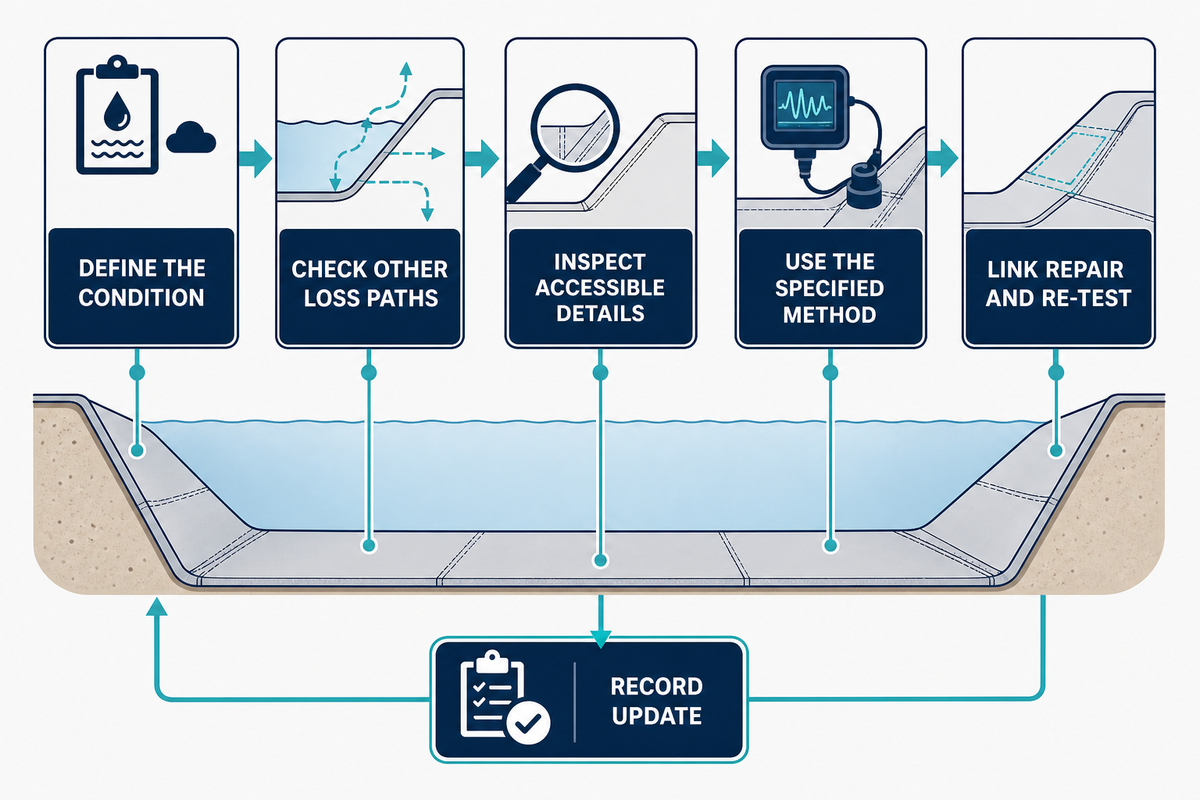
Don’t assume the membrane is at fault when you suspect water or liquid loss. Consider measurement error, evaporation, plumbing, drains, valves, overflow, surface runoff, and changes in operation. Compare your findings to the panel map and monitor data.
- Define the observed condition, start date and operating conditions.
- Separate accessible components where the operating plan permits.
- Inspect exposed edges, penetrations, seams and recent work.
- In cases where the defect isn’t visible, use the detection method or specialized survey as indicated.
- Results should be linked to the seam map, failed areas, repairs and re-tests.
The history of inspections and analysis of the product, along with the factors just described, provide a better basis for expectations than simply using a generic number presented as a warranty. The continuing record duties in 40 CFR 264.226 illustrate why troubleshooting evidence can extend beyond construction within that rule’s limited scope.
Prepare a Supplier-Ready Request for Quotation
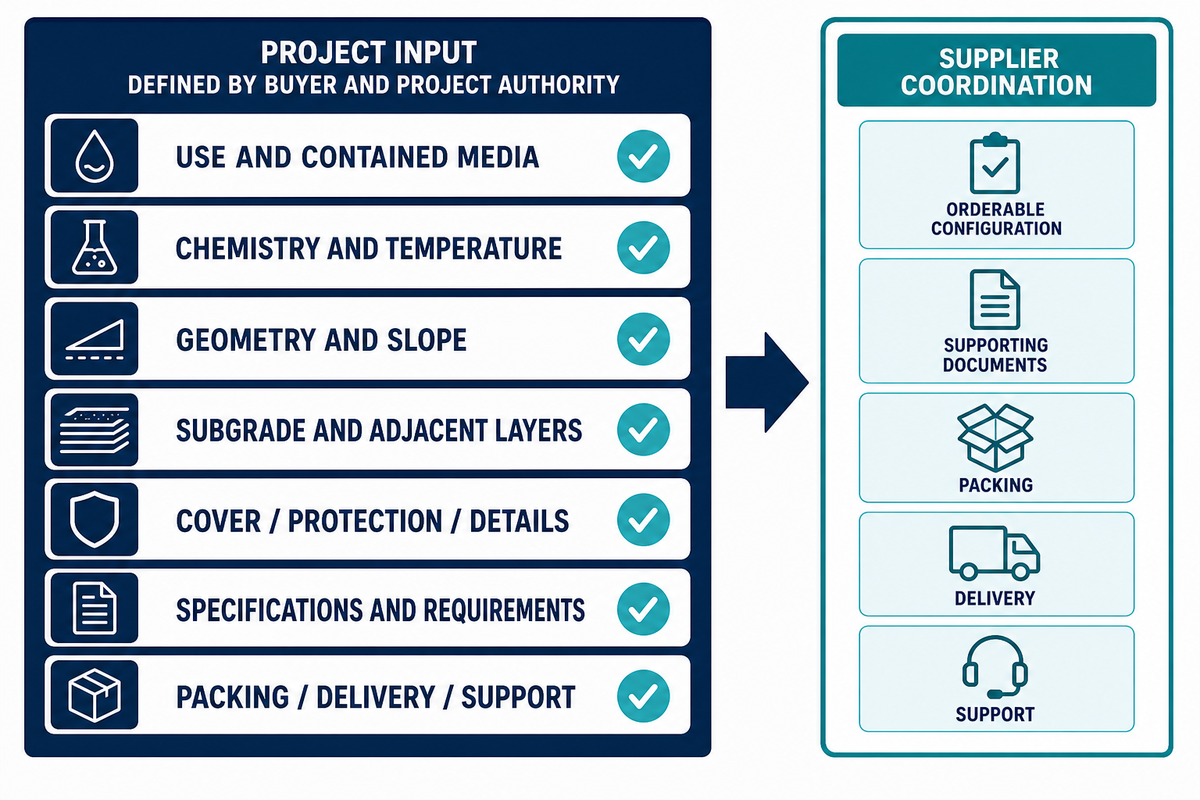
Specifically, provide the intended use of the facility, the type of media to be contained, the chemical and temperature conditions, the dimensions, the slope, the subgrade and adjacent layers, the type and extent of coverage and protection, penetrations, anchors, proposed panel placement, the applicable specifications, the requirements, and clear communication regarding your expectations. Add packing, delivery sequence and support expectations.
Explicitly define which decisions will be fixed and which decisions will remain flexible. If a specification requires a composite liner or minimum property, then state that. If the engineer is still evaluating interface stability and/or compatibility, state that as pending rather than asking the supplier to speculate.
Use the AQUA geomembrane product and configuration page to discuss an orderable configuration once the briefing is finalized. AQUA can help coordinate an orderable product configuration and supporting documents within the stated supply boundary. AQUA supplies products, supporting materials and product-related documentation; remote guidance, loading supervision and on-site technical support may be arranged. AQUA doesn’t represent that it will perform the installation of the works described.
Frequently Asked Questions
What is geomembrane lining?
Geomembrane lining uses a manufactured low-permeability sheet as the barrier component of a containment system. The system may also include prepared subgrade, geotextile cushioning, drainage, anchors, seams, penetrations and cover. Selection starts with facility class and contained media. Temperature, chemistry and geometry also matter. The joining method follows the material, seam type and project specification. A material certificate alone does not accept field workmanship. Inspection records and acceptance criteria remain separate evidence because product identity does not prove installation quality.
Is a geomembrane completely waterproof?
Leakage can occur at damage, seams, penetrations or connections. The complete system can also include prepared subgrade, geotextile cushioning, drainage, anchors, seams, penetrations and protective cover. Installation records must still confirm that identified leak paths were inspected before cover-up and accepted under the project plan.
What is the difference between a geotextile and a geomembrane?
A geomembrane performs a barrier function. A geotextile is generally permeable and may provide separation, filtration, drainage or cushioning. A protective geotextile may limit local damage, but it can’t replace proper subgrade preparation, assessment of stability, or an appropriate method for covering. For a slope, the geotextile-geomembrane interface may require a shear analysis specific to the project. Each layer should be designed for its intended role and product names shouldn’t be treated as the performance of the installed system.
How do I choose between HDPE and LLDPE geomembrane?
Compare facility class, media, chemistry, geometry, settlement, joining, exposure and repair access. HDPE and LLDPE stiffness and flexibility differences do not establish product approval. HDPE is stiffer and LLDPE more flexible, but neither observation approves a product. The governing specification and ordered-product evidence control.
How are geomembrane seams tested?
The method relies on the project specifications, seam type and the material. A quality plan may include trial seams, visual checks, non-destructive continuity testing and destructive samples at specified locations. Results should be linked to the seam map, failed areas, repairs and re-tests. Pass/fail values and sample locations must follow the project specification, because no universal pass/fail value or sampling frequency applies to every geomembrane project. The geomembrane project record should identify the specified test frequency and pass value used.
How long does a geomembrane liner last?
Polymer formulation, thickness, exposure, temperature, chemistry, stress, seams, installation quality, protection and operating conditions all matter to geomembrane durability. Repair methods must be compatible with the existing material. Document each re-test. Product-specific durability evidence should be relevant to the project. Preserve acceptance records and maintain the inspection or monitoring plan. A generic estimate should not be offered as a warranty. Consequently, service-life expectations should remain project-specific and should never replace inspection, maintenance or monitoring duties in the governing plan.
Turn the Seven Inputs into a Reviewable Supply Brief
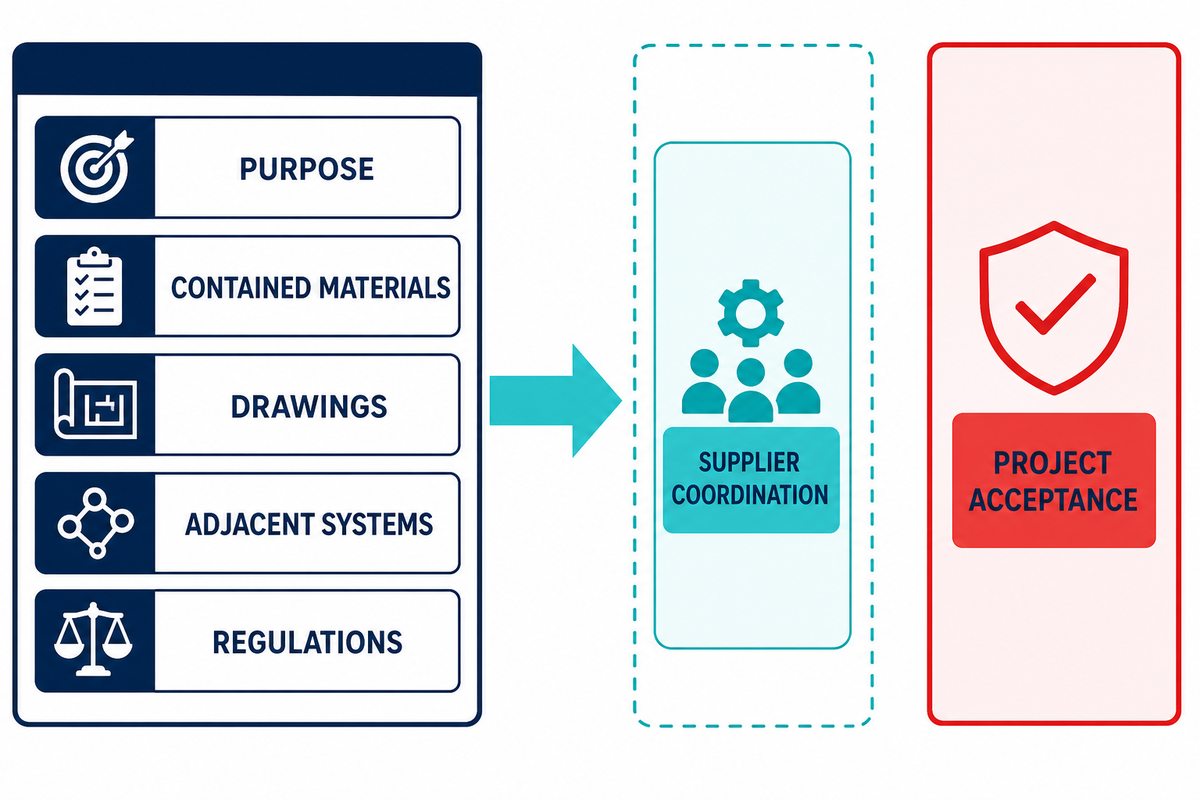
Please provide the purpose of the geomembrane, contained materials, drawings, adjacent systems, regulations and any other pertinent information. AQUA can assist with geomembrane product coordination within the stated supply boundary, while project requirements control acceptance. The geomembrane provides the barrier function within the wider lining system.
State which decisions are fixed and which remain open. For an authority checklist, review USBR Design Standards No. 13, Chapter 20 before turning project inputs into a supplier brief.
References & Sources
- U.S. Bureau of Reclamation, Design Standards No. 13, Chapter 20: Geomembranes, system-design, material, interface, construction and inspection context within its stated scope.
- U.S. EPA, Inspection Techniques for the Fabrication of Geomembrane Field Seams, field-seam inspection and quality-assurance context.
- Geosynthetic Institute, GRI-GM13 Revision 19, current revision evidence within its defined HDPE scope. The scope is limited to HDPE geomembrane products.
- 40 CFR 258.40 bounded example of facility-specific defined liner-system criteria.
- 40 CFR 264.226
- ASTM D6747-25 scope reference for selecting electrical leak-location techniques.
The applicable requirements, permit, project specification, responsible engineer and ordered-product documents control a specific project.
About the author

Grayden Du
Export Director · AQUA RainWater Solutions
Grayden Du is Export Director at AQUA RainWater Solutions. His work spans geocellular detention systems, underground stormwater storage and subsurface water management. Drawing on more than 16 years of hands-on experience across over 30 country markets, he explains technical principles, system choices and practical project requirements.
About AQUA RainWater Solutions
AQUA RainWater Solutions coordinates the supply of geomembranes, geotextiles and EPDM pond liners. We support specification selection, procurement coordination, product documentation, export packing and delivery arrangements.