Get in touch with AQUA Company

Ground Grid Installation Inspection, Fault Diagnosis and Handover

A ground grid product is a component that can retain gravel or support a planted surface, but the panel is only one part of the finished construction. The subgrade, drainage, separation, base preparation, edge restraint, infill and maintenance can impact what happens after the area is open to traffic.
This guide offers contractors, buyers and site managers a user-friendly inspection and handover method. This guide does not replace project design, local approvals, a geotechnical investigation or a responsible professional’s vehicle-load assessment.
Identify the Ground Grid Before You Inspect It
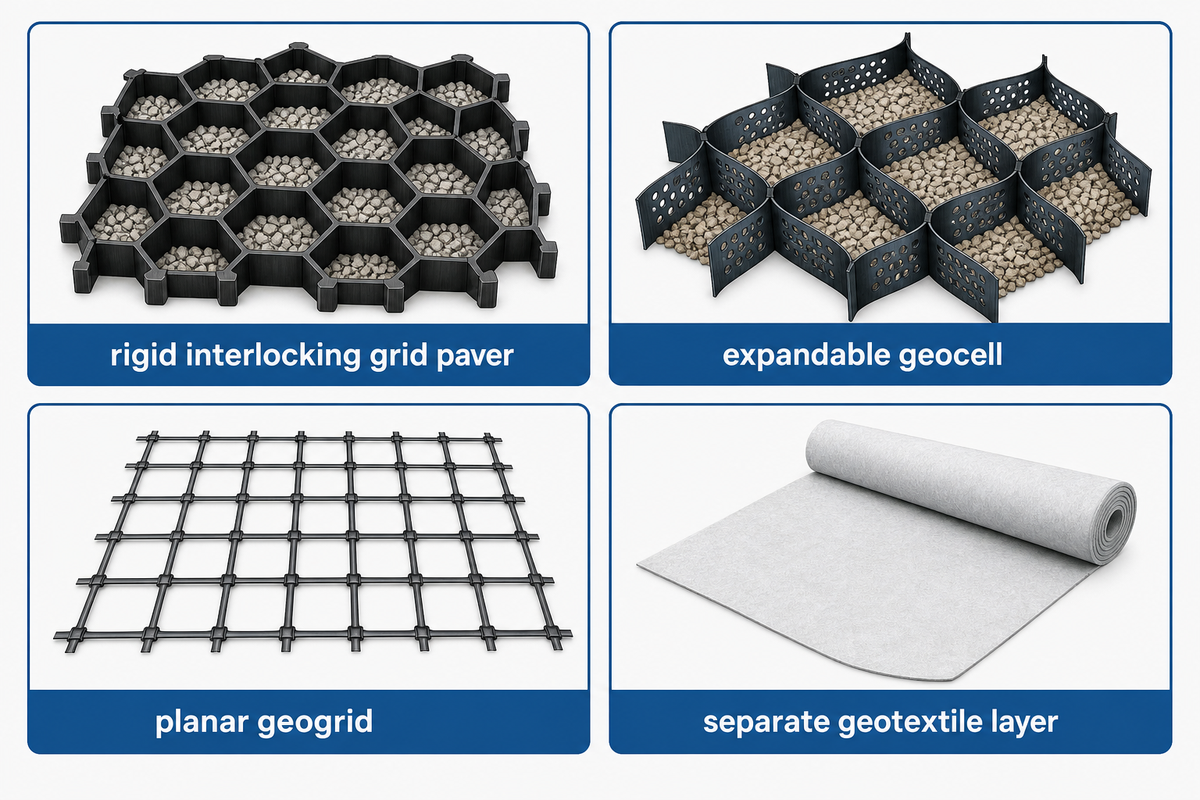
“Ground grid” refers to a general market term. It may describe rigid interlocking grid pavers, an expandable geocell ground grid, a planar geogrid used inside a base, or a geotextile fabric used as a separate separation or filter layer with a grid system. Geotextile is not a ground-grid product family. These products occupy different positions in a pavement build-up and do not share one installation sequence.
Identify the product by name and not by appearance. Record the manufacturer, model, dimensions as delivered, material, panel depth, connectors and intended fill. Refer to these to confirm what was approved and what was delivered. If a foldable geo grid or a cellular confinement system was installed and the drawing shows rigid panels, stop and resolve that substitution before it’s covered.
| Term encountered | Typical form | What the inspector must not assume |
|---|---|---|
| Rigid grid paver | Interlocking cellular panel | That geocell anchor and expansion instructions apply |
| Expandable geocell | Folded strips opened into cells | That panel connector details apply |
| Planar geogrid | Flat reinforcement mesh | That it is a finished gravel-retainer surface |
| Geotextile fabric | Woven or nonwoven sheet | That mass alone proves filtration or strength |
For an AQUA-supplied ground-grid order, compare the delivery label and current product document with the approved submittal. The records kept by AQUA should not be considered as a universal load rating, base thickness, or instruction to use the base thickness on all sites.
Review units and numbers. A cell depth in millimetres, a panel plan dimension and a compressive value all refer to different measures of value. Procurement records must retain the original unit with each value and avoid converting a test result into a vehicle class. If a vendor provides only a marketplace title or a cropped graphic, ask for the current product specifications and a report that identifies the tested specimen.
Delivery inspection is the first useful hold point. Set aside cracked, distorted or ultraviolet-damaged pieces; count connectors and accessories; and compare the lot with the sample approved for the work. Temperature and storage conditions can affect handling; record any visible distortion before filling.
Document the Subgrade and Geotextile Fabric
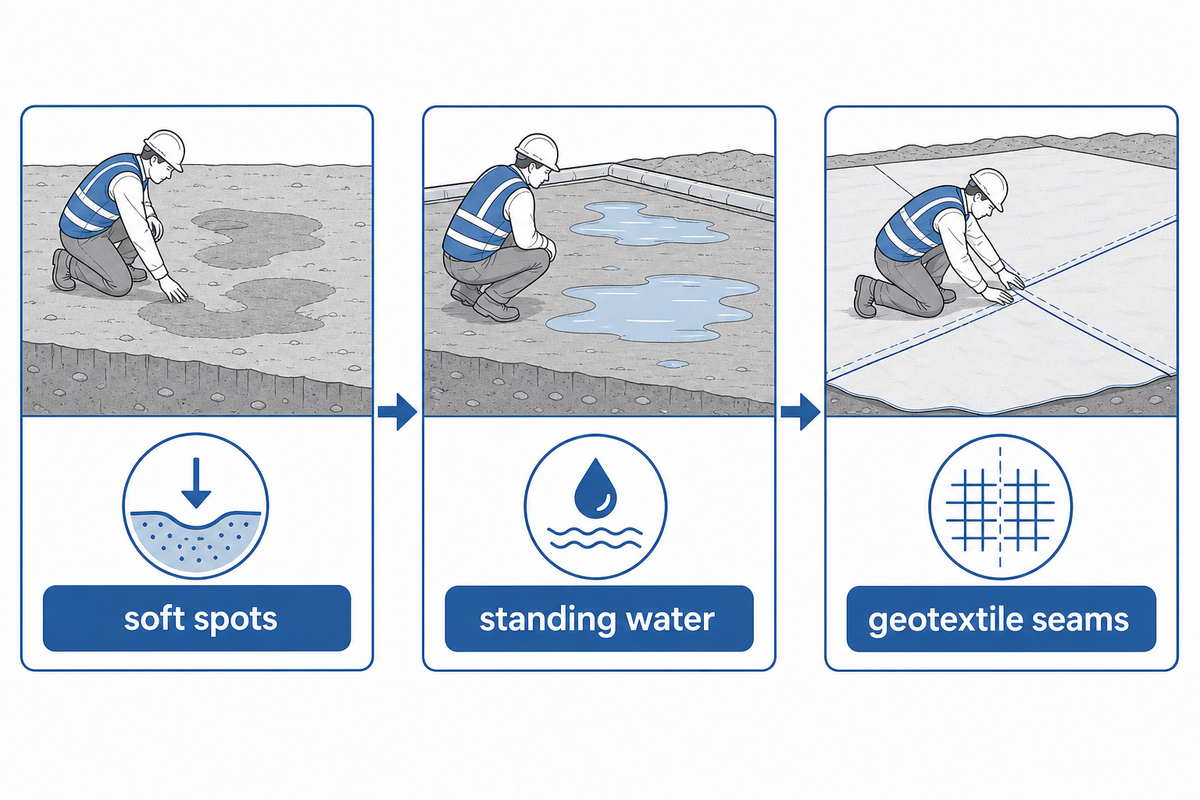
No stabilization grid can make every weak, wet or variable subgrade suitable. Before excavation is hidden, record pumping, standing water, organic soil, uncontrolled fill, soft spots, abrupt level changes and evidence of previous repairs. The location of each observation should be marked on a simple plan, so a later rut can be compared with the original condition.
Who specified the excavation depth, base material and compaction requirements should be confirmed. While a product brochure describes a typical build-up, it does not perform a bearing calculation for the project. Heavy vehicles, turning traffic, access roads and occasional heavy equipment place different demands on a residential walkway compared to a grass parking overflow area.
Document product identity, roll direction, overlaps, wrinkles, tears and contamination of geotextile when specified. The FHWA distinguishes separation and filtration functions from installation survivability requirements. That distinction is important because “add fabric” isn’t a complete design instruction.
The base preparation also requires the same specific evidence. Document the type of aggregate, the sequencing of lifts, the levels, and the test method indicated on the project. A photograph of a roller doesn’t show the density, moisture state or acceptability of the surface; it only indicates that the equipment was on site. For the specified testing, document the result and provide the station, elevation, and date.
- Take fixed-station photographs of the uncovered formation.
- Map repaired areas and name the replacement material.
- Connect density or field-test records to an exact location.
- Explain any approved omission or change to the specified geotextile.
- Retain delivery labels and batch references in the handover file.
Trace Water Through the Whole Driveway
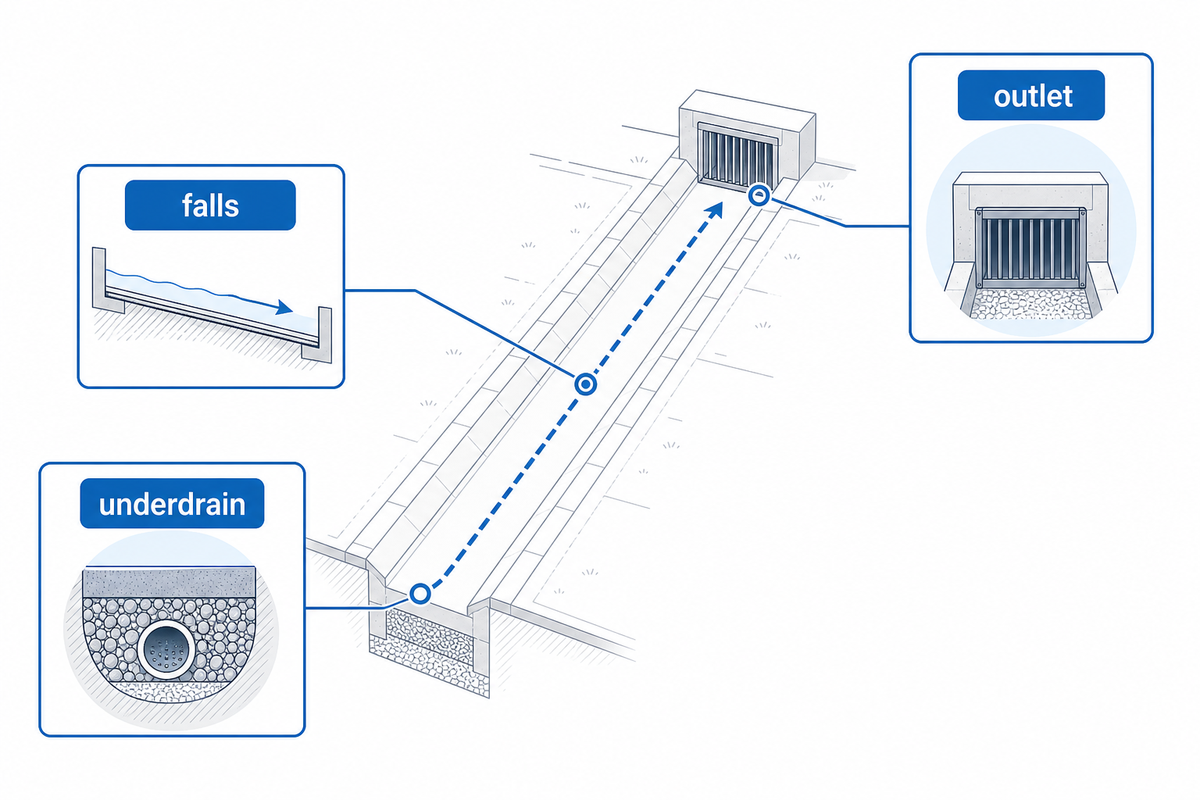
Permeable grid surfacing is not automatically a functioning drainage system. Water must pass through the surface, and then be able to travel through or across the sub-layers and drop into an acceptable infiltration zone, a subsurface underdrain or an outlet. Blocked transitions or saturated subgrade can leave standing water above an otherwise open grid.
Draw the expected water route before the surface is completed. Questions such as “how to install gravel grids” or “can you lay gravel grids on soil” still require a site-specific answer: inspect the subgrade and drainage route before choosing the build-up. For an inspector, the immediate risk is approving the surface before that hidden water route is documented. Show high and low points, roof or yard inflows, edge transitions, underdrains, inspection points and the final discharge. Take photos of outlets before they’re hard to access. Also for a sloping driveway or erosion-control area, note where concentrated flow can leave the protected surface.
University of Florida guidance treats structural and hydrologic requirements as connected design questions, while the EPA’s permeable-pavement work stresses that soil, climate and site conditions change performance. Neither source is an AQUA product test, so this guide uses them only to define the whole-system boundary.
A perforated panel creates a possible water path. It does not prove that the layers below or the outlet can accept that water.
Before filling the grid, contradictions must be resolved, such as a drawn underdrain that doesn’t exist in the trench, an outlet that’s built above the base, or fine sediment that has washed onto an open-graded surface. Record the person responsible and the drawing or instruction that provided justification.
Note where water enters and where it exits the structure after a controlled wetting event or even natural rain event. This captures preliminary observations for a construction site; it isn’t a substitute for formal infiltration or acceptance testing. Weather, antecedent moisture and incomplete adjacent work should stay in the note so a later reader does not treat one photograph as a permanent performance rating.
Build the 6-Point Ground Grid Photo Record
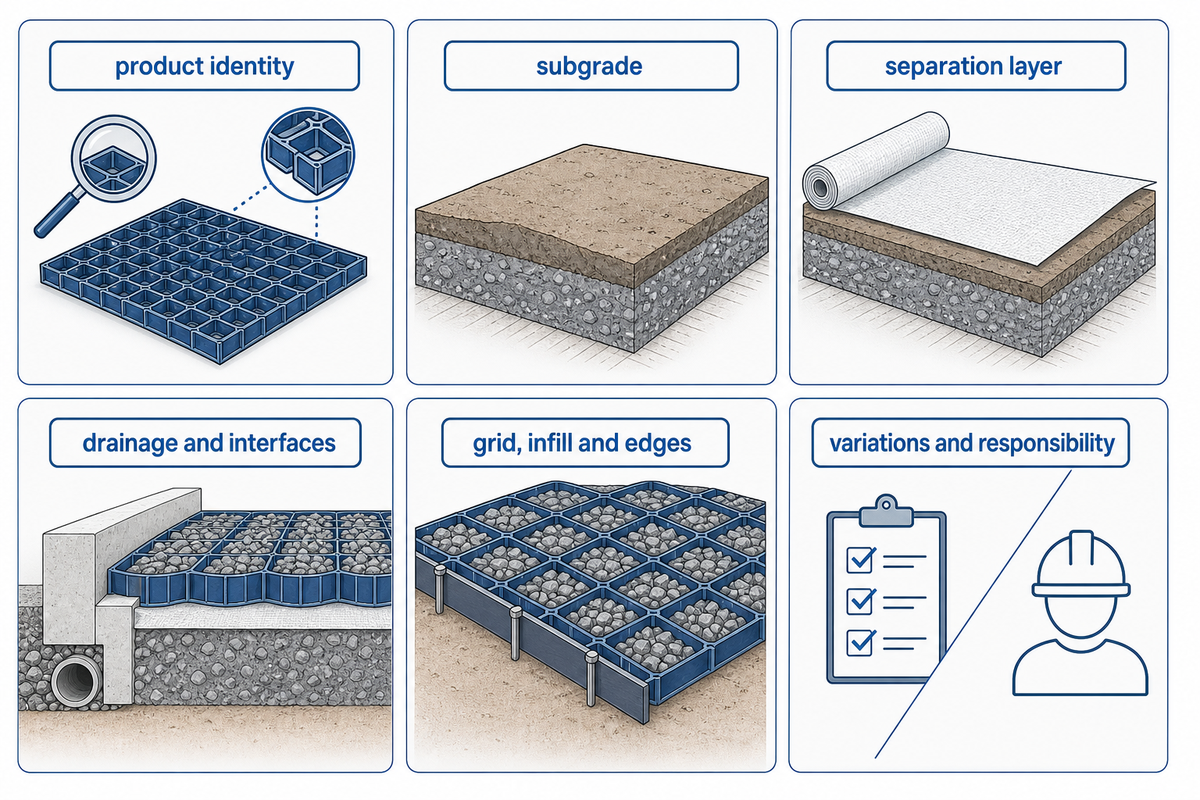
The 6-Point Ground Grid Photo Record is a handover structure created for this guide. It is not a template or requirement for certification. Its purpose is to preserve evidence that will otherwise disappear beneath aggregate, grass or traffic.
- Product identity: This records the identity of the product, the quantity, the packaging, the label, the model and approved substitutions.
- Subgrade: uncovered formation, soft-spot repairs, levels and visible water.
- For the separation layer, record the identity and details such as seams, wrinkles, overlaps or damage and repairs.
- Show details of the falls, outlets, transitions, restraints and drainage.
- Show details of alignment, connections, cuts, methods of placement, infill source and compaction for the grid and fill.
- Show incomplete works, accepted variations, access limitations and the responsible contact.
Give every photograph a date, station, direction and short observation. For example, “Panel edge lifted 8 mm at station D4 before refill” is more useful than “installation problem.” Separate what the image shows from an inferred cause. If a dimension matters, include a scale and retain the original image rather than relying on a compressed messaging-app copy.
Files can make records searchable. Incorporate name, area, station, layer and date, then keep a brief index to connect each image to the inspection note. Don’t rename only the selected “good” photos. A complete sequence should retain nonconformities, corrective work and the accepted condition so the handover doesn’t remove how a given issue was resolved.
What should a gravel grid installation record contain?
At minimum, it should connect the delivered product to the approved document, show every hidden layer before covering, record drainage and edge interfaces, identify the fill, and state who accepted variations. Add test locations, delivery records and provide a plan to ensure each of the photos is locatable. Similar separation of inspection, corrective maintenance, documentation and responsibility is evident in Minnesota’s official permeable-pavement maintenance guidance.
Record Gravel Infill, Grass and Edge Details
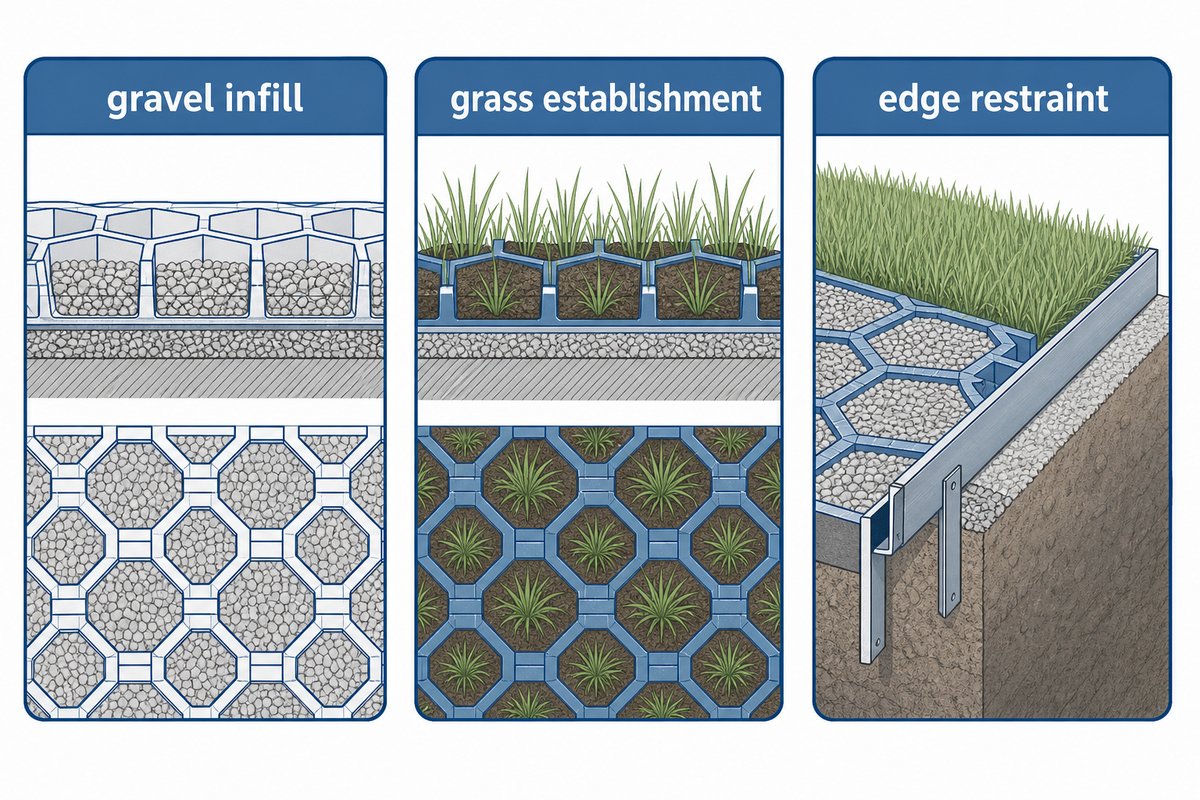
The appearance of the completed infill isn’t sufficient to confirm if the infill matches the grid. Capture the aggregate supplier, aggregate description and delivery reference. Capture any loose surface allowance, finished surface level, and any material displaced due to compaction. Don’t copy a compacting-gravel, rounded-fill or pea-gravel rule from another brand without evidence that the selected product document permits it.
To inspect a gravel grid for use on driveway, inspect the transitions between where tires turn, brake and/or cross onto a different surface. Edges deserve their own photographs because loss of confinement can resemble a panel failure. At gates, drains and service covers, show how the grid terminates and how loose gravel is contained.
Check fill placement in stages rather than waiting until it’s complete. Cells shouldn’t be exposed to traffic if the selected instructions don’t allow for this. Also, don’t operate a loader or compactor in a way that disturbs unfilled panels. Keep a record of the equipment and sequence. The same completed photograph could document very different construction processes.
Grass parking areas require another record. Include the growing medium, if seeding, the type of seed or if using turf, the type of turf. Describe the irrigation responsibility. Record the state the area must be in before routine traffic can be allowed. A 2025 trade article linked to a grid supplier recommends controlling traffic during establishment and checking whether aeration equipment can damage the grid. This is supplier-context evidence, not an independent waiting-period rule for every system.
For vegetated areas, separate plant establishment from structural acceptance. Healthy cover does not guarantee base or drainage is acceptable, while sparse growth may represent irrigation, shade, soil or traffic rather than grid. The handover should assign those responsibilities in order to not leave all later symptoms with the panel supplier.
Use the Symptom-to-Layer Check for Gravel Grid Problems
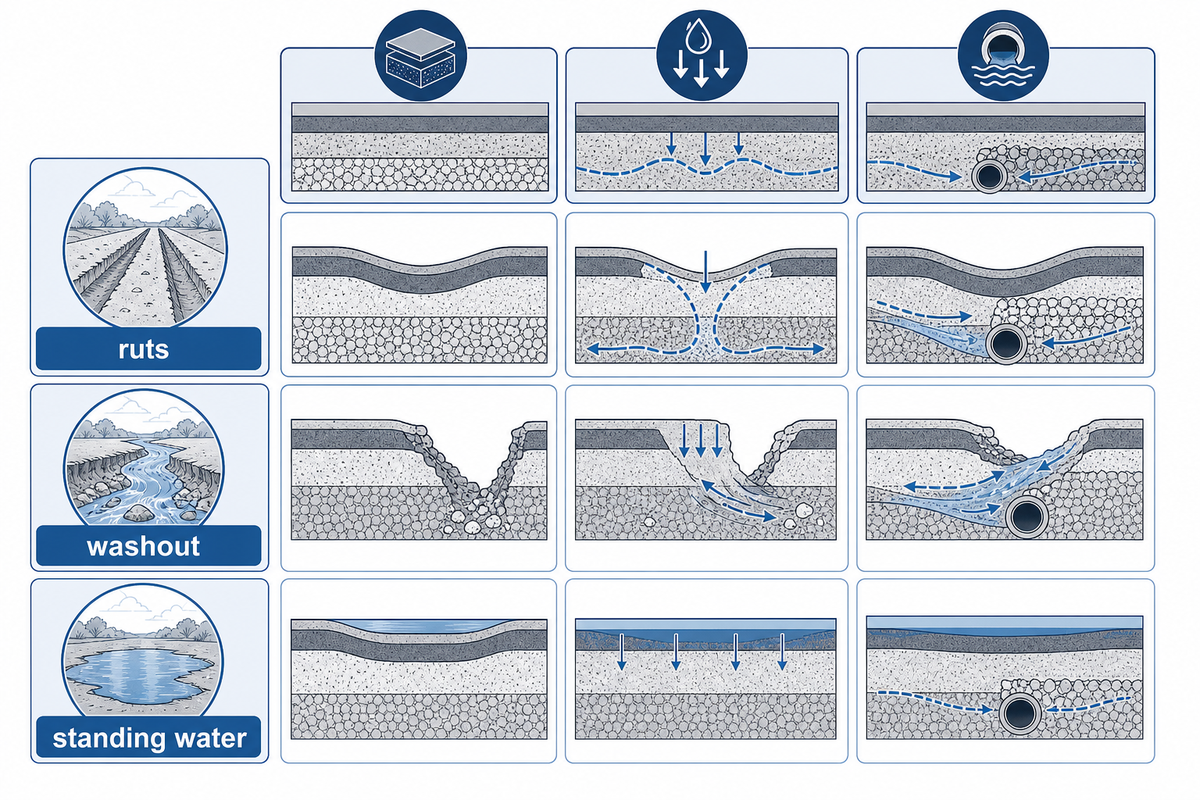
The Symptom-to-Layer Check aims to prevent treating a surface symptom as a diagnosis. Record the symptom and identify the first hidden layer or interface to review, and decide who’s authorized to investigate. Don’t increase a claimed load capacity, or change the base or remove drainage components only from a photograph.
| Observed symptom | First evidence to review | What it does not prove | Next owner |
|---|---|---|---|
| Ruts in a wheel path | Traffic record, subgrade, base and confinement photos | That the panel alone is too weak | Designer or responsible installer |
| Aggregate migration | Fill grading, edge restraint and turning locations | That adding more gravel will cure the cause | Installer and supplier |
| Standing water | Falls, outlet, underdrain and rainfall notes | That the grid is impermeable | Drainage designer |
| Panel movement | Connections, cuts, edges and placement sequence | That a higher laboratory compression value fixes it | Installer and supplier |
| Soft ground after rain | Subgrade record and water route | That geotextile was unnecessary or defective | Geotechnical or civil professional |
| Grass wear | Establishment, traffic and maintenance records | That the cells cannot support vegetation | Landscape and site manager |
| Edge washout | Concentrated flow and transition detail | That surface refill is a permanent repair | Drainage and civil team |
| Clogged surface | Runoff sediment source and maintenance history | That every vacuum method is suitable | Site manager and supplier |
| Open connector | Panel identity and installation photos | That all connector systems behave alike | Installer |
Anonymous forum posts can reveal some issues, for example, whether the gravel contractor has defined the sub-base or if the tyres are carrying the gravel away. These posts don’t provide failure rates or engineering causes. Use these posts to generate more focused inspection questions. After that, use the project documents and a qualified review to answer the questions.
Diagnosis is best done in a sequential manner. First, the area needs to be made safe and the existing condition needs to be documented. The construction history and the recent traffic and weather need to be documented. Only then open a layer or commission testing under an agreed investigation plan; uncontrolled excavation can disturb the evidence needed to separate installation, design, material and maintenance causes.
Recurring symptoms deserve trend records rather than isolated repairs. Mark the same stations on each inspection, use comparable camera directions and note whether the affected area is growing. A repair that looks good for a week may be masking a continuing loss at an edge or an outlet.
Read Heavy-Duty Ground Stabilization and Drainage Reports in Context
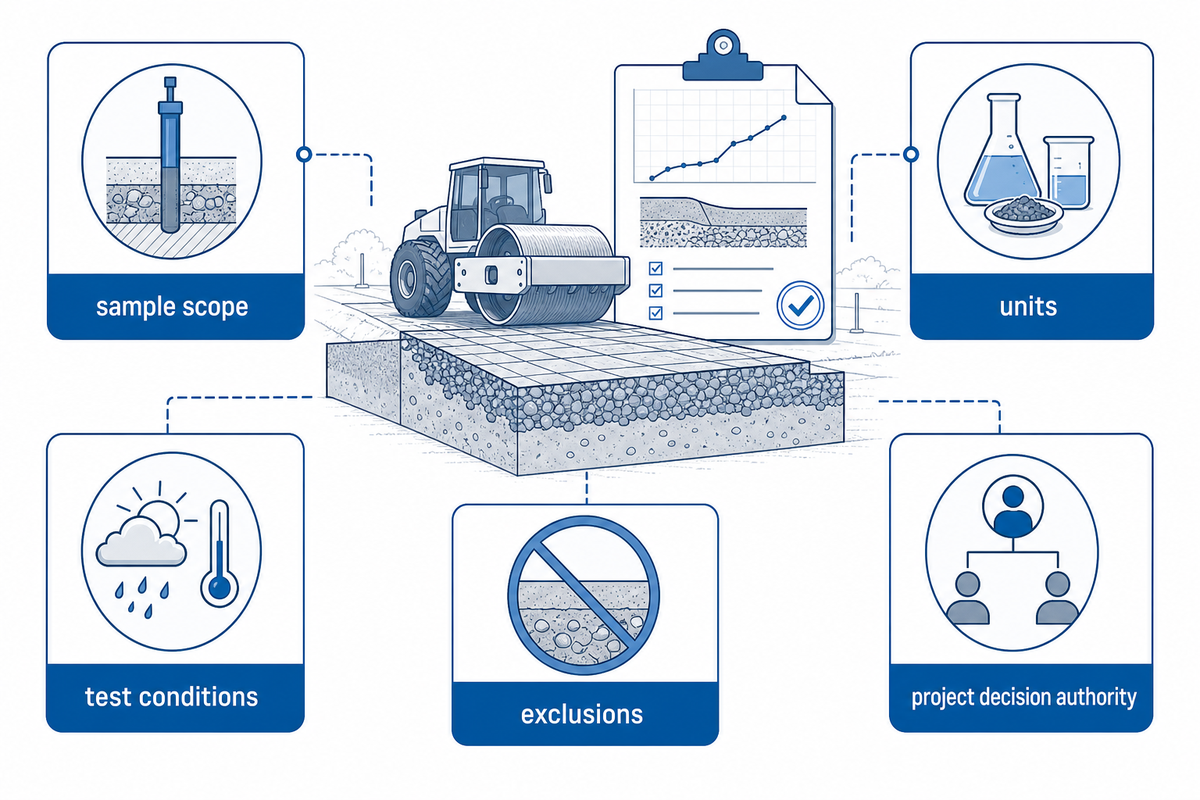
“Heavy duty ground grid” is an advertising line until the supporting evidence is clear. Ask whether the provided value pertains to an empty panel, a filled sample, a single cell, a complete panel or a fully loaded system. Record the resin, specimen preparation, fill, support, loading direction, rate, unit, and failure criteria.
Laboratory compression results cannot be converted directly into an allowable vehicle weight. Contact pressure, turning and braking, repeated loading, low support, edge conditions, and damage from installations are other factors. Results from a gravel grid stabilizer using expandable geocells cannot be used with a rigid grid stabilizer, which also uses cells. The same caution applies when a parking-lot claim is reused for a walkway or a heavy-equipment area.
ASTM C1781/C1781M-21 is active in the public ASTM catalogue, but its published scope names solid interlocking concrete paving units, concrete grid paving units and clay paving brick. Grids made of plastic are not in that public scope. Do not label a plastic ground grid “ASTM C1781 certified” without evidence that explains the method’s applicability and the acceptance authority.
- Request the complete report instead of a cropped result.
- Match its sample description against the supplied model.
- Verify units and whether each value is average, minimum or individual.
- Note exclusions, test dates and the laboratory identity.
- Name the professional who converts evidence into the project decision.
Drainage reports rely on discipline. Confirm tested surface area, conditioning, head/rainfall method, units, and maintenance. To assume a laboratory-determined rate means a field surface will retain that rate after sediment loading is unfounded. If the project has an acceptance threshold, put down the field method and the locations tested.
When making a comparison of suppliers, create an evidence table with a claim in each row. Leave the identity of the product, method, specimen, result, date and limitation in the respective columns. Rather than filling in empty cells by making assumptions, leave the cells empty to make your submission easier to evaluate.
Why Long-Term Drainage Depends on a Maintenance Handover
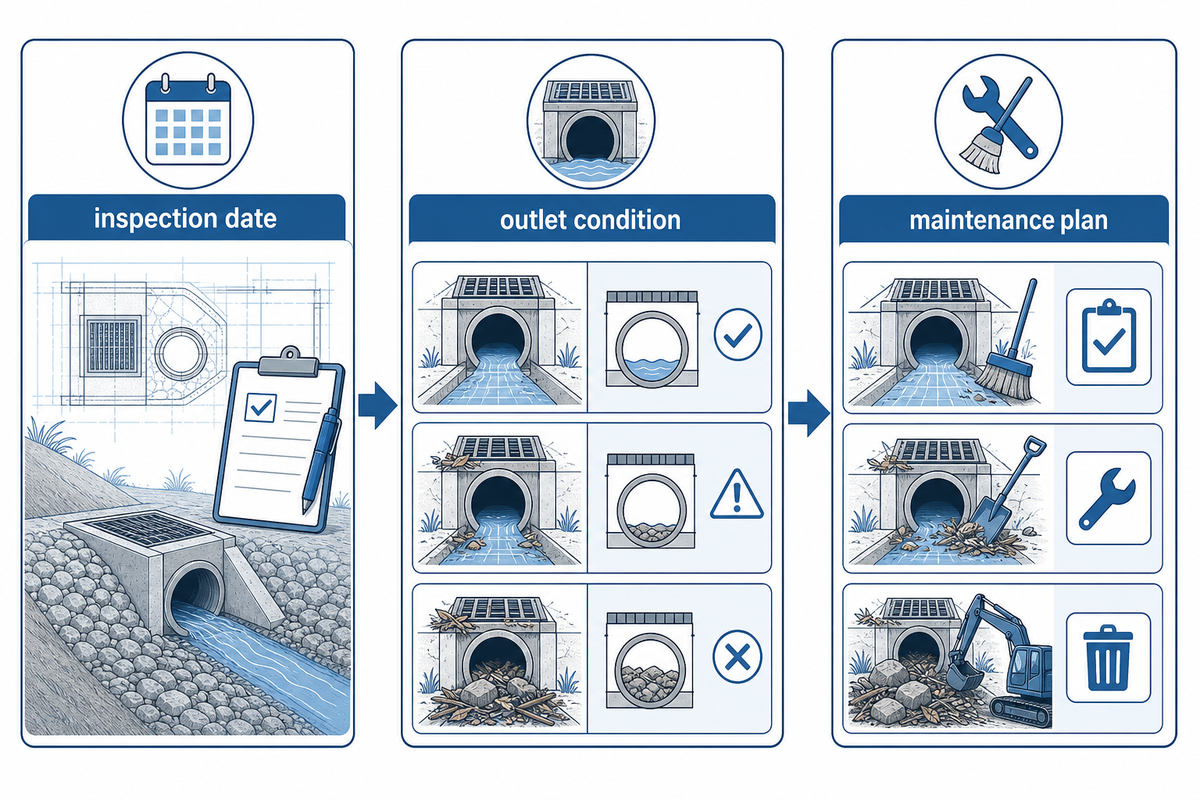
Permeable gravel and planted grids can lose function when sediment enters from adjacent ground, outlets block, fill moves or maintenance equipment removes material. A description of the water route, inspection points, acceptable maintenance, and the trigger for professional review should be included in the handover.
NC State University notes that maintenance requirements vary by permeable pavement type; machine sweeping can remove joint material from permeable interlocking concrete pavers that must then be replaced. That does not create a universal sweeping schedule for plastic grids. Follow the selected product, surface type and the project maintenance plan.
Set inspection frequency from site exposure and the approved plan, then adjust it when evidence changes. Closely monitor areas with construction sediment, landscaped slopes, winter treatment, frequent turns, and unsealed areas. Write the trigger in measurable terms—such as recurring ponding at a named station or loss of fill that exposes cell walls—rather than “maintain as needed.”
What belongs in a gravel driveway maintenance record?
Record the inspection date, weather, traffic changes, sediment source, outlet condition, loose or missing infill, vegetation condition, edge movement and completed work. Attach before-and-after images and note whether removed material was replaced. Define who may reopen a traffic area after movement, washout or recurring ponding.
Escalate settlement, exposed sharp edges, unsafe transitions or unexplained movement. Maintenance is not a substitute for investigating a continuing structural or drainage problem.
Budget for the Whole Installed System
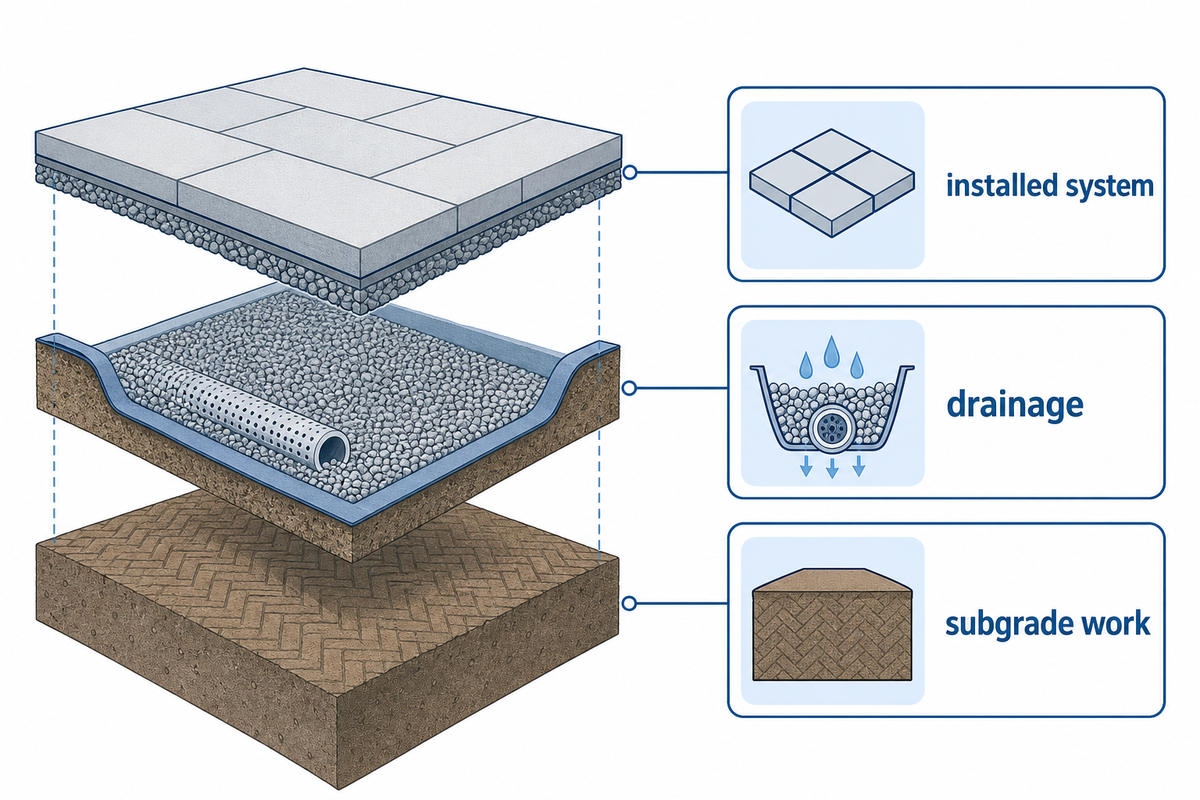
Quoted panel prices aren’t a measure of the installed system. Distinguish line items for survey and design, excavation and disposal, subgrade work, geotextile and base aggregate, and drainage, edge restraint, grid, supply and delivery, cutting, infill, compaction, planting, traffic control, and inspection. This scope is more appropriate than estimating a price per square foot from another region or construction type.
Request each bidder to supply the area, waste allowance, delivered quantities, excluded interfaces, assumed access and responsibility for hidden-condition changes. Use the Ground Grid product page for specification and quotation support. Use the relevant application route for site-fit questions rather than treating a product-page load statement as project approval.
Put all bids on the same basis before creating a total. A bid may address base aggregate and spoil disposal while another bid may only address panels and fill. Detail taxes, freight, minimum order quantity (MOQ), testing, mobilization and seasonal impacts. Leave contingency as is and don’t include it with the known scope of work. A low bid for panels may mask a bid with a significantly lower completed works allowance.
Whole-life comparison must also indicate potential inspection and maintenance access. A surface that can be locally removed may have a different maintenance profile than a surface that has difficult to access interfaces. Don’t create a service-life guess: request product warranties, their exclusions and the project-related maintenance assumptions. Keep these documents as separate evidence.
Frequently Asked Questions
What is a ground grid used for?
The ground grid can retain gravel, support a planted surface or form part of a ground-reinforcement system; its intended function depends on the product family, surrounding construction and approved installation documents.
The ground grid can retain gravel, support a planted surface or form part of a ground-reinforcement system. Its exact function will depend on both the product family and the surrounding construction. Rigid panels, expandable geocells, planar geogrid and geotextile shouldn’t be confused with one another even if some merchants use the same terminology.
Before the installation instructions are used, verify that the model provided aligns with the approved documentation and confirm if it’s a final surface, a confinement layer, a reinforcement layer or a separator.
Are driveway grids worth it?
Driveway grids can help create a controlled gravel or grass surface when supporting construction, drainage and maintenance suit the site; their value depends on the installed scope and expected traffic, not panel price alone.
When the supporting construction, drainage and maintenance plan are appropriate, they may help create a controlled gravel or grass surface. Panel price can’t be the basis of comparison for value. Compare excavation, base, drainage, edges, fill, installation, documentation, maintenance and repair responsibility, then evaluate whether those provisions fit the site and expected traffic.
How much does a geogrid driveway cost?
Geogrid driveway costs have no universal price: compare the same product family, with excavation, base, drainage, edges, fill, delivery, installation and maintenance included, and ask bidders to state quantities and assumptions.
There is no universal price. Compare the same product family and include excavation, base, drainage, edges, fill, delivery, installation and maintenance.
Can a grid repair an existing drainage problem?
The grid cannot resolve an existing drainage problem on its own: the water route must be defined, and the base, subgrade, underdrain or outlet must be able to accept the water.
Not on its own. The causal water path must be known and defined before the intended use can be considered. A perforated surface is designed to allow upper layer water to pass through to the lower layer, but it can’t ensure that the base, subgrade, underdrain or outlet will accept that water. Correction of existing inflows and sediment may also be required.
When should traffic be kept off a newly installed grid?
Traffic release depends on the selected system’s requirements and project acceptance criteria; keep vehicles away while edges are unsafe, movement is unresolved, infill is incomplete or grass establishment requirements remain unmet.
Follow the selected system’s release requirements and project acceptance criteria. Keep traffic away while edges are unsafe, movement remains unresolved, infill is incomplete or grass establishment requirements have not been met. The release may be different for a gravel grid that’s filled, and a grid that’s planted but still needs establishment. Document who authorized opening, the condition they inspected, recent weather and any temporary restriction on vehicle type, route, speed or turning.
If traffic causes movement during a controlled opening, close the affected area and preserve the evidence for review.
References and Evidence Boundaries
References & Sources
This manual incorporates public materials from the Federal Highway Administration, US Environmental Protection Agency, University of Florida, Minnesota Pollution Control Agency, ASTM and NC State along with supplier materials limited to product-specific context. It does not consider marketplace listings, historical prices, anonymous posts or supplier performance claims as independent certifications.
Public sources: FHWA pavement geotechnical guidance; EPA permeable-pavement research; University of Florida technical considerations; Minnesota operation and maintenance guidance; ASTM C1781 public scope; NC State permeable-pavement guidance.
About the author

Grayden Du
Export Director · AQUA RainWater Solutions
Grayden Du is Export Director at AQUA RainWater Solutions. His work spans geocellular detention systems, underground stormwater storage and subsurface water management. Drawing on more than 16 years of hands-on experience across over 30 country markets, he explains technical principles, system choices and practical project requirements.
About AQUA RainWater Solutions
AQUA RainWater Solutions manufactures geocellular stormwater modules, shallow attenuation systems and ground-reinforcement grids. We support product configuration, batch inspection, export packing, loading supervision and product-related documentation.
![Ground Grid Applications & Ground Reinforcement [Guide]](https://aquarainwater.com/wp-content/uploads/2026/09/ground-grid-applications-ground-reinforcement-blog-featured-768x512.png)