Get in touch with AQUA Company
Stormwater Management Solutions: A Practical Planning Guide for Runoff, Compliance and Long-Term Operations

September 2026 · Aqua Rain Water Educational Guide
Stormwater management solutions are a coordinated system, not a single tank, drain, or landscape feature. They’re an integration of all of the following factors: the source of runoff, what runoff may contain, potential runoff pathways, peak flow management, relevant regulations, and the expected post-construction asset inspection responsibility. This tool assists product specifiers, civil engineers, contractors, and project owners in assessing the various routes prior to product specification.
The short answer
- Review a product catalogue after you’ve written both the runoff duty, and discharge pathway.
- Compare green, grey, and hybrid measures in relation to soil, groundwater, loading, space, and access for maintenance.
- As with a treatment train, keeping safe storage volume alone isn’t adequate to control pollutants.
- Each permit, test, certificate, and drawing must be input as an evidence-register row with a named scope.
- Before anything is buried, define inspection triggers, records, owners, and access.
- Instead of requesting “best system,” please be specific and detail your requirements in a duty-and-evidence brief for a quote.
The commercial stormwater solutions page is the place to review product configurations and request a project discussion. This article has a different job: it gives you a defensible way to select a route, challenge weak assumptions, prepare evidence, and hand the operating responsibility to the right person.
What counts as a stormwater management solution?
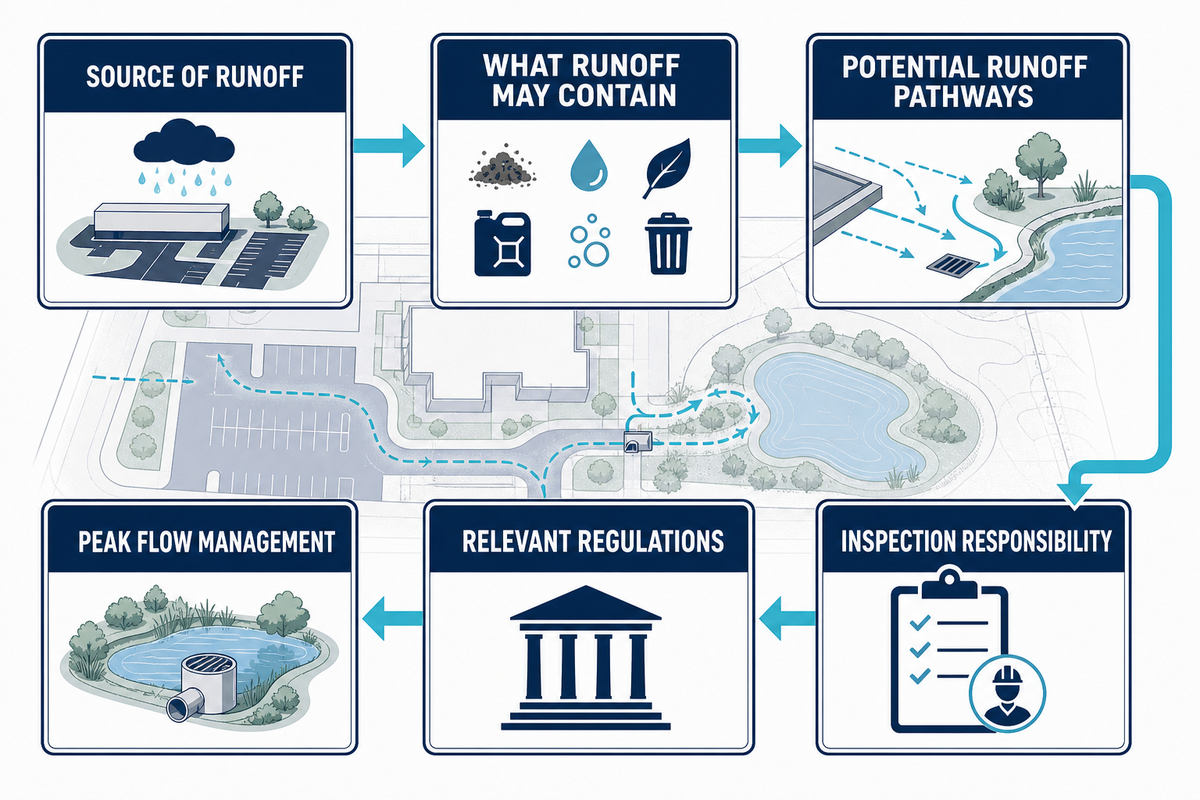
One useful solution brings together four elements: quantity, quality, pathway, and operations. Quantity addresses how much runoff and peak flow needing management are concerned. Quality refers to the potential sediment, hydrocarbons, nutrients, trash, and other pollutants entering the system and where pollutant control happens. Pathway refers to whether water will infiltrate, be used again, be detained and released, and/or be conveyed to an authorized outfall. Operations involves how a person will check, clean, test, document, and repair the asset.
The US Environmental Protection Agency’s stormwater BMP menu shows that combining practices is common, which is useful to keep in mind. For example, an inlet control, a vegetated area, a filter, a swale, detention, and an outlet control all have their own unique function. Calling one practice, “the solution,” incorrectly simplifies the interactive segments of most designs that tend to create the greatest failures.
Begin by using a one page responsibility map. Label each duty one row at a time by including design input, evidence required, owner, and handover record. If a row has no owner, then that duty isn’t a controlled part of the solution.
Start with the site’s runoff story, not the product catalogue
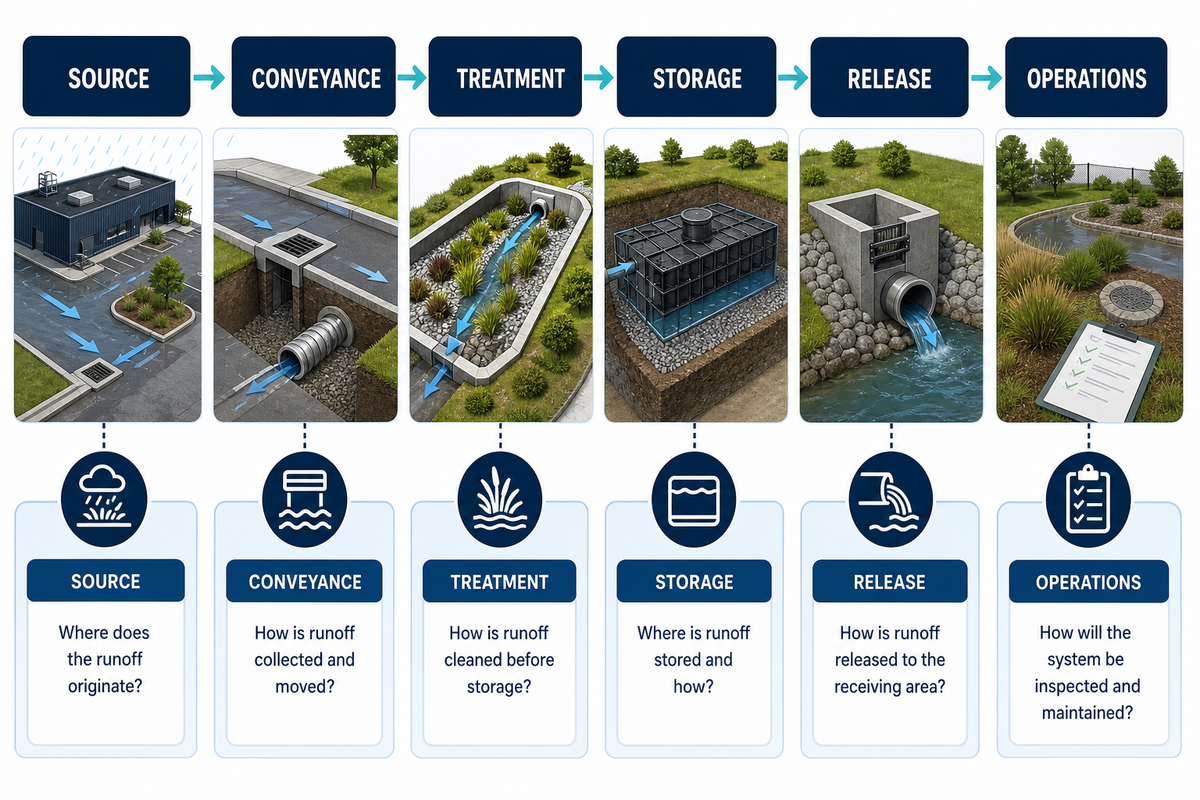
To start the design process, describe the site as a water story. Indicate the catchment boundaries, impervious areas, topography, anticipated rainfall, existing drainage, point out permitted outfalls and other water sensitivities, groundwater, possible contaminants, existing utilities, anticipated traffic and heavy loads, and space for future access.
In the brief, use a consistent measurement legend for area in m2, level and cover in mm or m, flow in L/s, storage in m3, load in kN, pressure in kPa, temperature in °C, and response time in h. These labels don’t provide design value, but rather prevent the loss of a number’s meaning as the number moves from a survey to a calculation, quote, drawing, or record of handover.
For example, a review record might show a 10 mm level observation, a 1 m cover note, a 5 L/s outlet assumption, a 20 m3 storage entry, a 50 kN load case, a 100 kPa pressure note, a 20 °C material condition, a 24 h response target, or a 2% sample. Those example values illustrate the format only; the project team must replace them with approved measurements and limits.
A comparison sheet can hold other bounded entries like 0 mm observed sediment, 2 m access depth, 5 m3 temporary storage, 20 L/s bypass flow, 50 L/s design flow, 200 kN construction load, 200 kPa ground pressure and 48 h close-out time. The entered data are traceable fields, and not default design criteria.
Time fields can be explicit as well. e.g., 1 day for loading visit, 2 days for factory audit, 3 days for review cycle, 4 years for document recheck, 5 months for seasonal record, 6 hr for response window, 7 min for field reading and 8 sec for a sample of sensor data. The real time intervals are set by the approving authority and the project owner.
Logistics has the same principle in place: a 40HQ container, a 2–3 day production time, a 7 day raw material time, a 30-machine operation, and a 15-year export time are all bounded facts with a known source. Keep the qualifier beside the number when it appears in a brief.
An example of a model like EPA’s Storm Water Management Model can assist with scenario analysis, but a model output won’t substitute for a permit and guarantee field input verification. Note which rainfall sequence, roughness and infiltration assumptions, boundary conditions, and discharge control assumptions were applied. Assume different value inputs can change the best route, and the inventory of goods offered, without changing the assumptions.
| Runoff question | Evidence to request | Decision it affects |
|---|---|---|
| Where does water enter? | Catchment plan, levels, inlets, flow paths | Pretreatment and conveyance layout |
| Where can it leave? | Outfall approval, invert, allowable discharge | Detention, throttling, reuse, or infiltration route |
| What is below and above it? | Soil, groundwater, utilities, traffic and construction loads | Depth, structure, access, and protection measures |
| Who owns the next action? | Inspection plan, trigger, record template, responsible party | Whether the design can be maintained after burial |
Compare green, grey, and hybrid stormwater routes
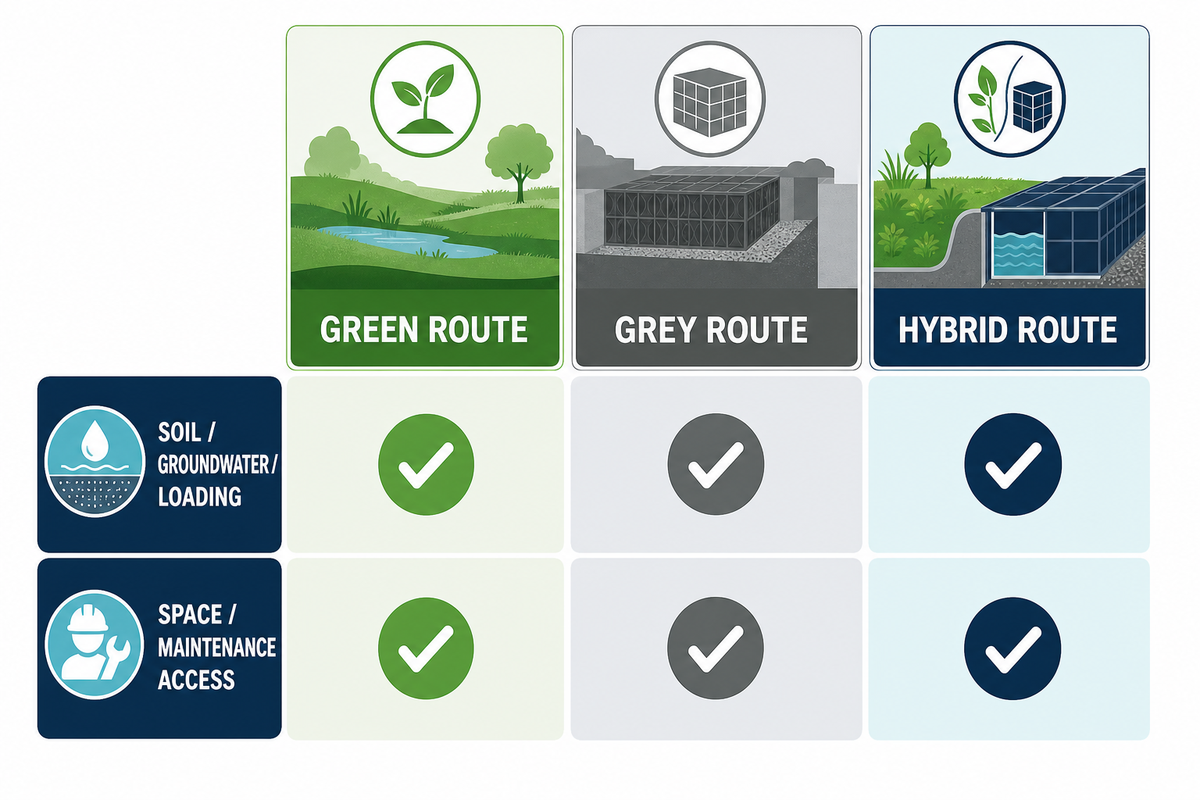
“Green versus grey” differentiates, but isn’t intended to rank. Green infrastructure can reduce, slow, infiltrate, filter, or evapotranspire water. Grey infrastructure can transport, store, distribute, or defend a flow path. Staged schemes let each element perform the function it’s best suited for.
Grass measures should include a realistic scenario regarding soil and groundwater and levels of contamination, vegetation, and maintenance. They aren’t necessarily low-maintenance. Grass measures should include a realistic structural and hydraulic scenario, as well as access for inspection and the need to replace elements. Both aren’t maintenance-free because they’re underground. Hybrid schemes can improve resilience, but they can also create interfaces. An upstream filter can become clogged, an outlet can be blocked, or a later landscape change can conceal an access point.
Runoff-to-Responsibility Matrix
- Source control: prevent sediment and contaminants from entering the flow.
- Green layer: slow, infiltrate, or filter, where soil and regulatory conditions allow.
- Grey layer: provide controlled storage or discharge, where the function is engineered.
- Interface: show how an overflow, bypass, or blockage is an indication of overload.
- Owner: assign an individual or organization to each inspection and response.
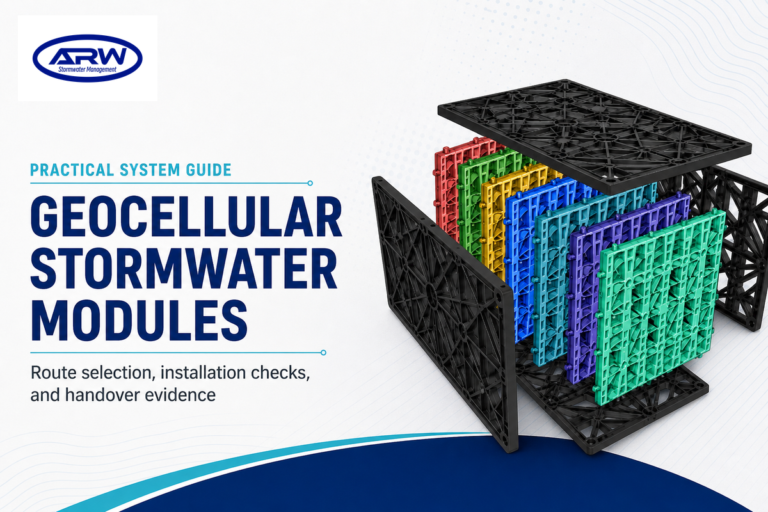
For under ground water storage and control, geocellular tanks or modules are one component of a grey layer. The choice of product is still site specific, and is guided by the site’s loading, cover, geometry, connections, and access. Don’t deduce the value of a project where a generic name is given to a product.
Build a six-layer attenuation brief before you compare quotations
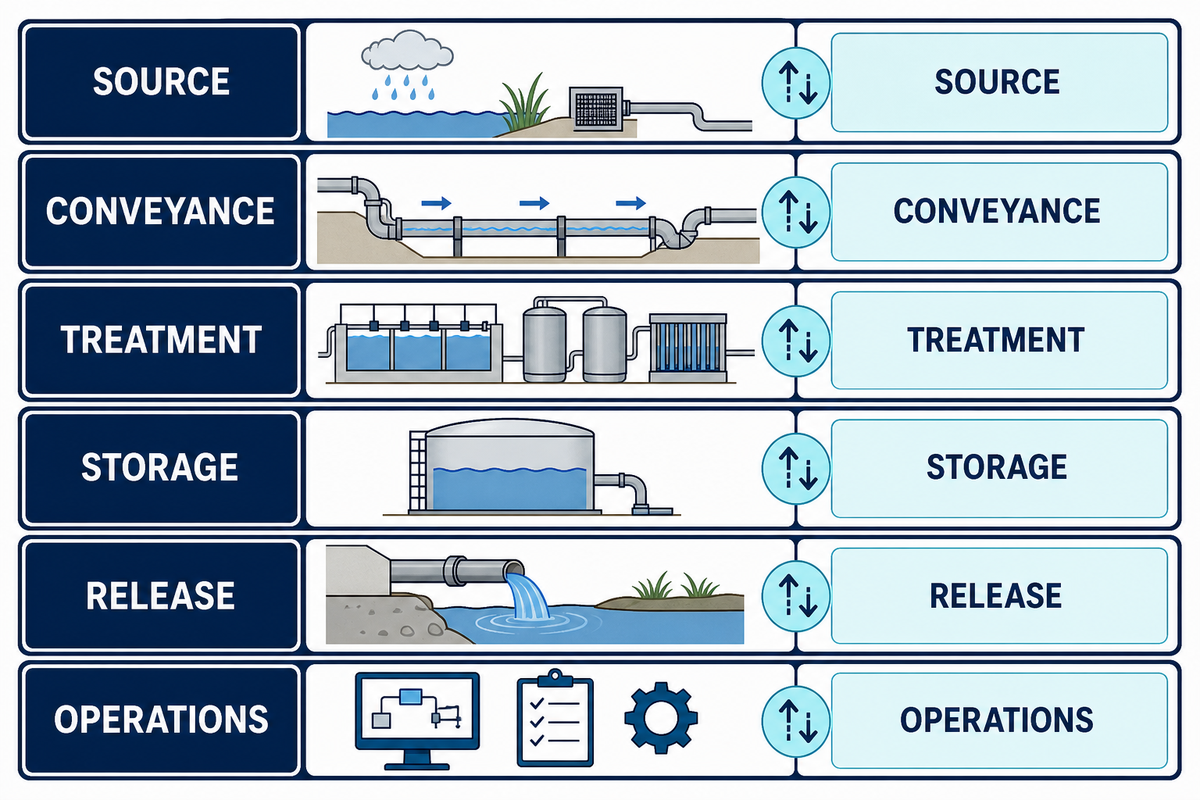
Each participant receives the same six-layer brief: source, conveyance, pollutant control, storage, release, and operations. The brief outlines layers to aid communication and isn’t a substitute for working hydraulics. The layers allow the project team to identify some omitted interfaces before a price or product schedule makes the omissions costly.
Specify the units and assumptions in the approved calculation. Approximately, a catchment can be defined in square meters (m²), while a storage duty can be defined in cubic meters (m³). An outlet can be defined in liters per second (L/s), a level can be defined in millimeters (mm) or centimeters (cm), a cover depth in meters (m) and an inspection response in hours (h). The objective isn’t to develop a catch-all. It’s to enable the supplier to clarify the basis of comparison and prevent the supplier from changing the basis.
| Type / layer | Record to issue | Release check | Owner |
|---|---|---|---|
| 1. Source | Roof, pavement, yard, process, and construction sources | Contamination and sediment assumptions recorded | Site / environmental lead |
| 2. Conveyance | Inlets, pipes, channels, slopes, and overflow path | Levels and tie-in points checked in mm or m | Civil designer |
| 3. Pollutant control | Source control, pretreatment, filter, swale, or other practice | Pollutant duty and maintenance trigger named | Water-quality lead |
| 4. Storage | Attenuation or detention volume and configuration | Load, cover, groundwater, and buoyancy assumptions signed | Structural / civil designer |
| 5. Release | Orifice, control chamber, pump, infiltration, reuse, or approved outfall | Discharge duty in L/s or the approved unit | Hydraulic designer |
| 6. Access | Covers, chambers, clean-outs, safe working clearance | Access remains available after landscaping and traffic changes | Owner / facilities lead |
| 7. Inspection | Trigger, observation, measurement, photo, and response route | Record template tested before handover | Operations owner |
| 8. Evidence | Drawings, calculations, named tests, certificates, and approvals | Product, date, method, and jurisdiction scope match | Document controller |
| 9. Handover | As-built pack, loading photographs, training, and open actions | Named close-out reviewer accepts the pack | Project manager |
This ledger simplifies discussions around scope. The supplier fills out the rows that pertain to selection of the product to be supplied. The designer maintains ownership of the calculations and approvals. The installation contractor owns the construction records. The owner or facilities team owns the operation. Where a single row spans across two roles, write the interface and don’t leave the resolution to later.
Build water-quality control into the treatment train
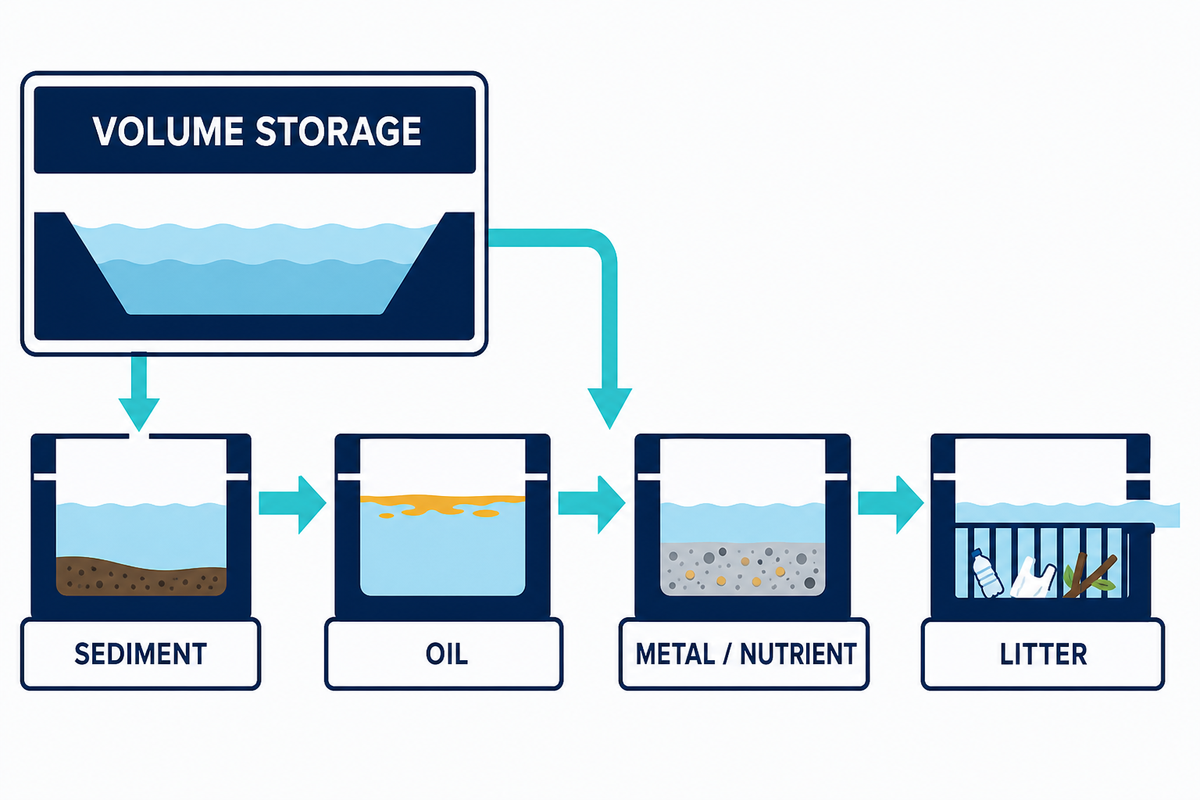
Water-quality control and the storage of volume address different issues. One volumetric calculation indicates the amount of water stored or released under a defined scenario. By itself, a volumetric calculation indicates nothing about the sediment, oil, metal, nutrient, litter, and other pollutants that can be present in the water. Show the water-quality control train and the operational plan.
Start upstream. Are there any solutions like housekeeping, source control, covered storage, or construction controls to lessen the pollutant load? Next, identify the capture and pollutant-control steps, the bypass condition, and the maintenance trigger. An upstream pretreatment device may require inspection prior to the storage asset. One filter may require a log to document when the filter was replaced. One vegetated feature may require establishment and a maintenance plan. The sequence the approving authority will accept and the owner will be able to operate is the correct sequence.
Philadelphia’s public subsurface-detention guidance is a helpful model illustrating that some examples of thinking in a straight line is useful to illustrate that some form of underground storage may require pretreatment and may not fulfill all water-quality obligations. Use that thinking model internationally as a method and not as a local rule. The project jurisdiction makes the call on the pollutant-control duty, performance evidence, and the necessary inspection program.
Check structural, hydraulic, and groundwater constraints together
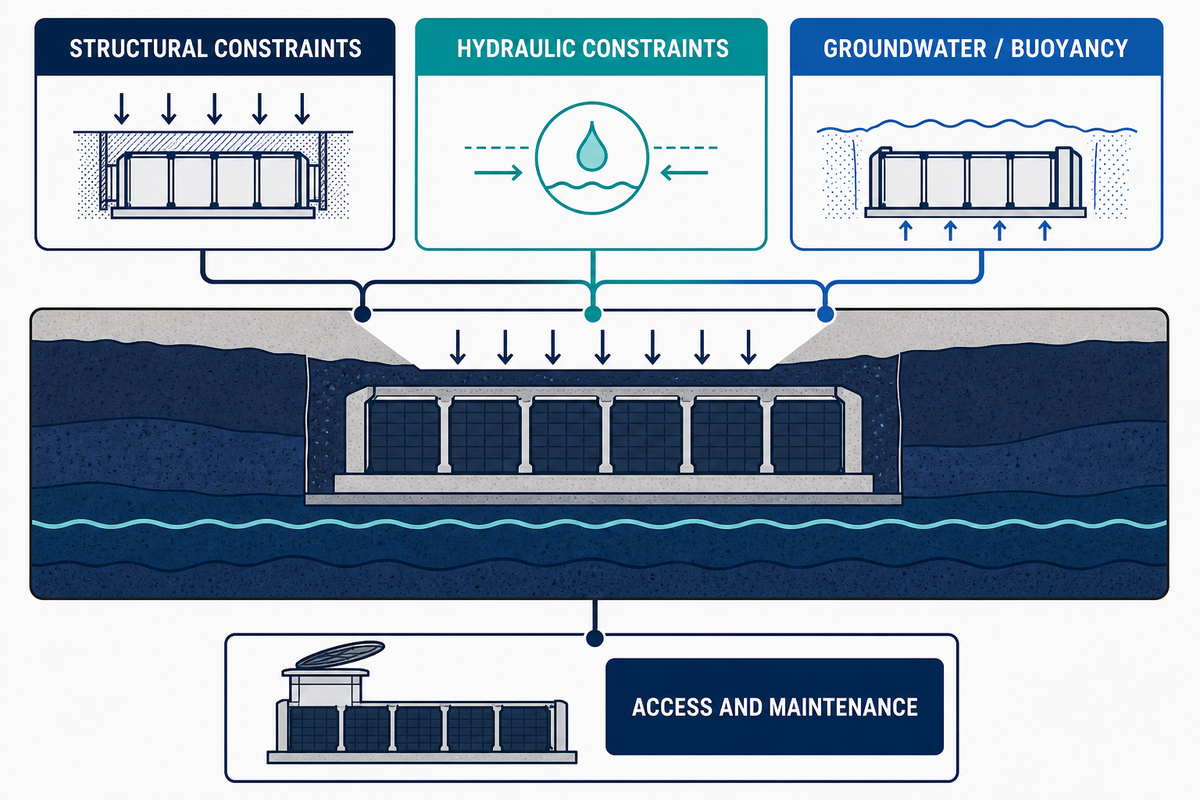
The stormwater component is chosen among loads and boundary conditions. Check vertical loads, lateral earth pressure, cover, buoyancy, groundwater, settlement, construction sequence, vehicle access, temperature, connection movement, and the consequences of an outlet restriction. The design question isn’t ‘What’s the tank capacity?’. The design question is ‘What solution will be most appropriate for the given task with the constraints the site presents?’
Hydraulics need a boundary too. Distinguish between design storms, inflow hydrographs, allowable discharge, overflow routing, infiltration tests, and downstream constraints. If a supplier gives a test or compression result, note the product, specimen, method, date, and load condition. Don’t let an internal batch check be taken as third-party certification, or even site approval.
For Aqua’s core moulded products, the factory record describes injection moulding, a two-shift operation, a compression-testing machine, and a 2% batch sampling regime covering dimensions, colour, appearance, and compression. These are factory facts for the moulded range and don’t attempt to suggest that every geotextile, geomembrane, or EPDM batch is similarly subject to the described regime. They also don’t try to take the place of the project engineer’s verification of the structural and hydraulic systems.
Use failure signatures to improve the design review
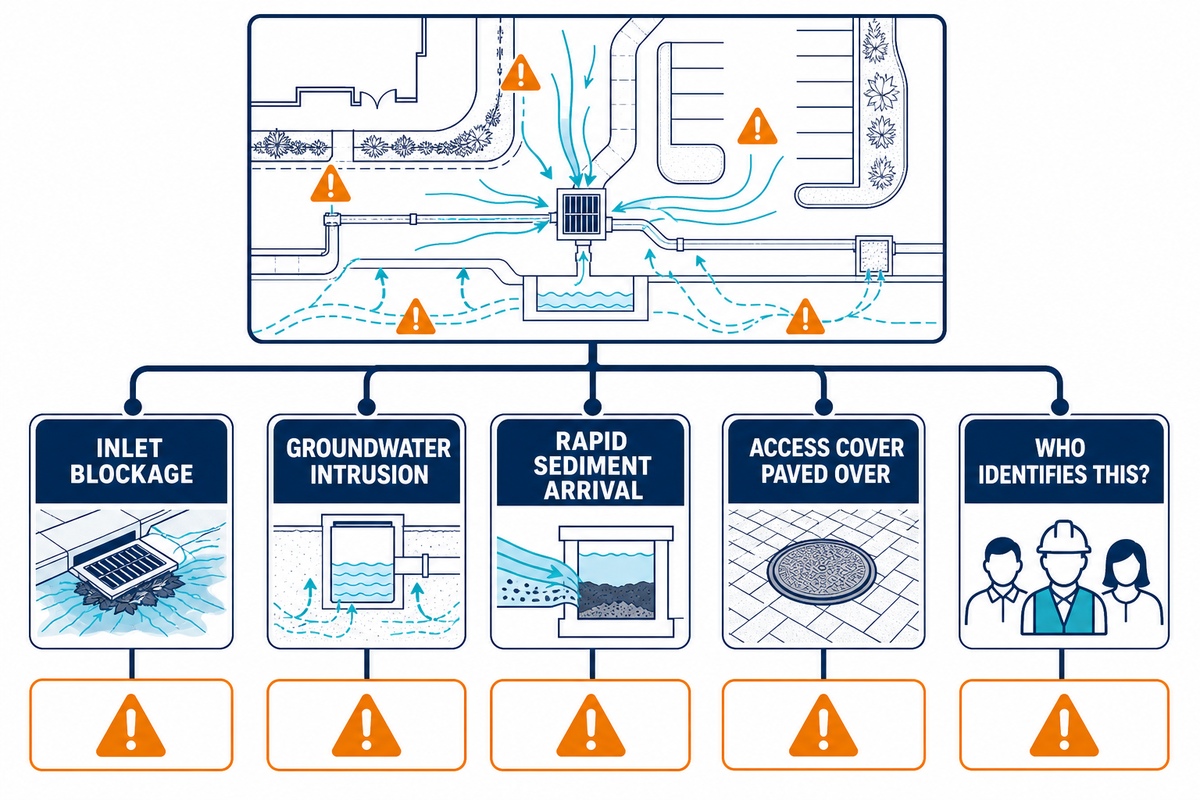
This review examines what would happen if an assumption was incorrect. If there’s a blockage in the inlet, where will water first appear? If there’s an intrusion of groundwater, what will resist buoyancy and keep the structure stable? If sediment arrives quicker than expected, which upstream asset is inspected? If an access cover is paved over, who identifies this and what’s the remediation action? These questions hold much more value than having an overused claim of “high performance”.
Keep the failure signature next to the response. “Surcharge at the upstream inlet” might signify a blocked screen, a closed valve, or a storm larger than the design event; these are all different actions. “Poor water quality at the outfall” calls for checking source control, pretreatment, bypass, sampling, or a receiving-water assumption. “Settlement at grade” might signify earthworks, cover, compaction, groundwater, and a structural configuration. A clear signature stops a team from so much product rework to check the system.
These scenarios should be retained in the handover log. Add the drawing reference, the location of the photo, the unit of measurement, the trigger, and the escalation owner. If the project has a 24-hour promise for a service, record the person to whom the promise was made, under what access or weather condition, and don’t allow a generic service promise to become an unmet requirement.
A simple test is to read the review aloud using units and actors: “The 50 mm level rise is recorded by the facilities lead within 24 h; the designer checks the L/s discharge assumption; the contractor confirms the access cover and the owner closes the work order.” The numbers in that example are a reporting format, not a design recommendation. The value is that the reviewer is able to see the measurement, the time period, the responsible individual and the decision following.
Turn permits and standards into an evidence register
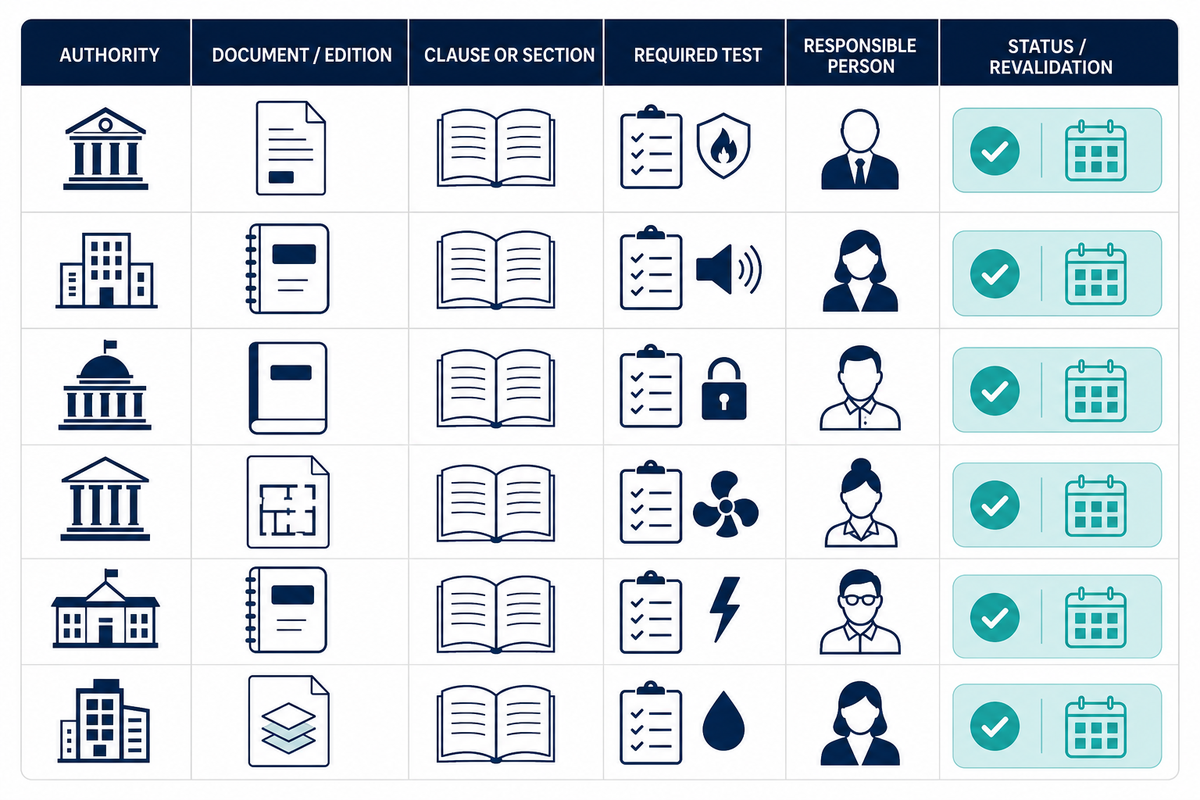
When auditing a permit package, each requirement should have a row. Use columns for authority, document title, edition or date, clause or section, applicable product or system, required test, responsible person, submission status, and expiry or revalidation date. Link the drawing, calculation, inspection photo, test report, or approval letter that closes the row.
The importance of the work done in this field is best illustrated by looking at the Seattle 2026 update to the stormwater code and manual. Seattle’s 2026 stormwater code and manual update illustrates why this discipline matters: flow control, water-quality control, source control, construction runoff, housekeeping, and operations can all move as a package. A program or ordinance in one city doesn’t apply to another. List the jurisdiction in the code, and then request from the approval authority which edit governs the work.
Read certificates very carefully. A certificate may be for one test method, one product family, one product, one material, one date, or one jurisdiction. Separate the statements, “tested to,” “meets the stated requirement,” “approved by,” and “suitable for,” unless the document itself combines the statements. This should be a language policy. This prevents the marketing document from becoming an approval statement.
Design inspection, maintenance, and handover before installation
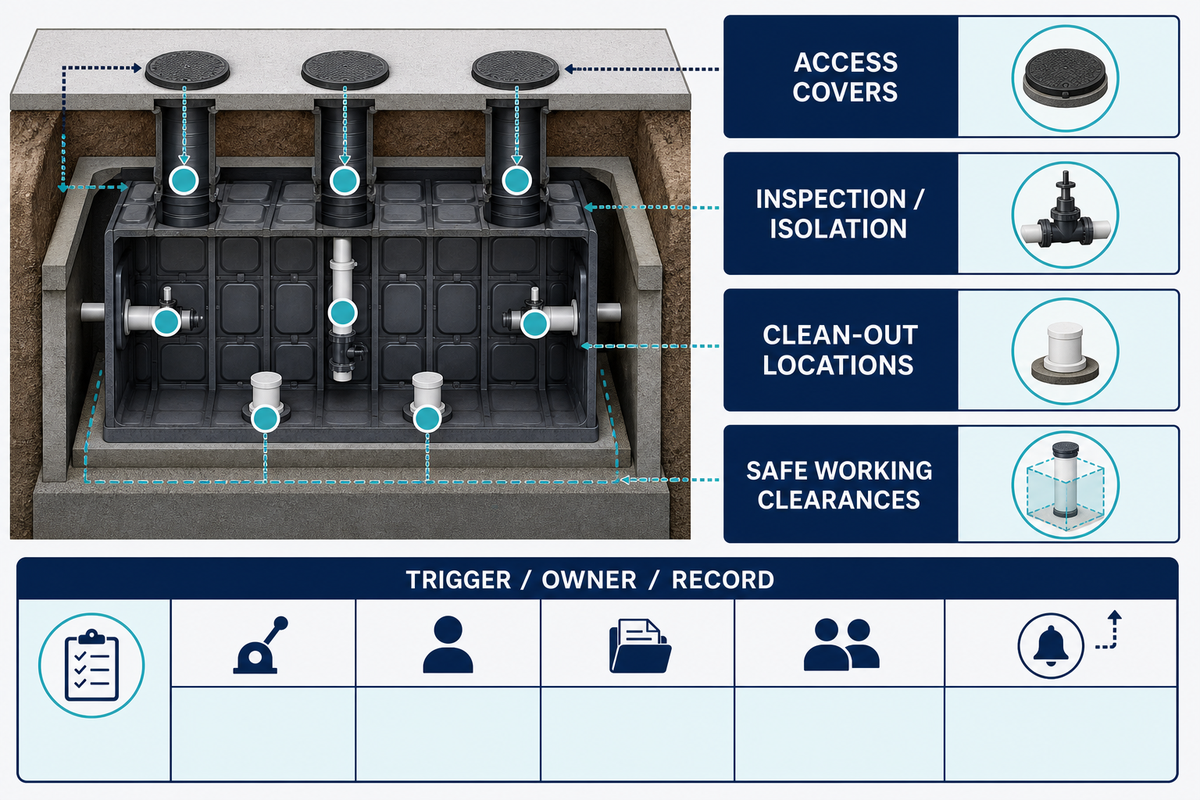
Infrastructure is only manageable if its future operator is able to locate access points, determine the mechanism that triggers the response, and retrieve the appropriate documentation. Provide access covers, inspection and isolation or bypass points, clean-out locations, and safe working clearances. Include an inspection trigger such as sediment in the equipment, surcharging, an inlet blocking, observed surcharge, a scheduled authority inspection, or an alarm level crossing (without applying a universal triggering interval).
Use a three-record operations handoff: The combined register is the Stormwater Handover Ledger. Supplier evidence should retain the stated 30 machines, 2 shifts, 24 h operation, and 15-year export experience as bounded records, not design criteria. For a format check only, the same register can show a 1 m cover, a 5 L/s release check, and a 24 h response target as placeholders; replace each with approved project data.
- As-built record: Final coordinate values and level values, connectors and cover. As-built record: Load assumptions, photographs and approved drawing deviations.
- Inspection record: Date, event, observation, measurement, photo, action, and responsible personnel.
- Response record: The trigger, the action, work order, former clean out and/or replacement evidence, and closing reviewer.
A supplier may provide product documents, batch inspection records, packing and loading supervision, remote factory inspections, and agreed-upon test videos. Aqua’s defined boundary is supply and product-related support; it doesn’t act as the project installation contractor, nor undertake the full installation construction. Place the installation contractor, designer, owner, and supplier in the handover matrix.
Use the 2025–2026 trend signal without chasing a buzzword
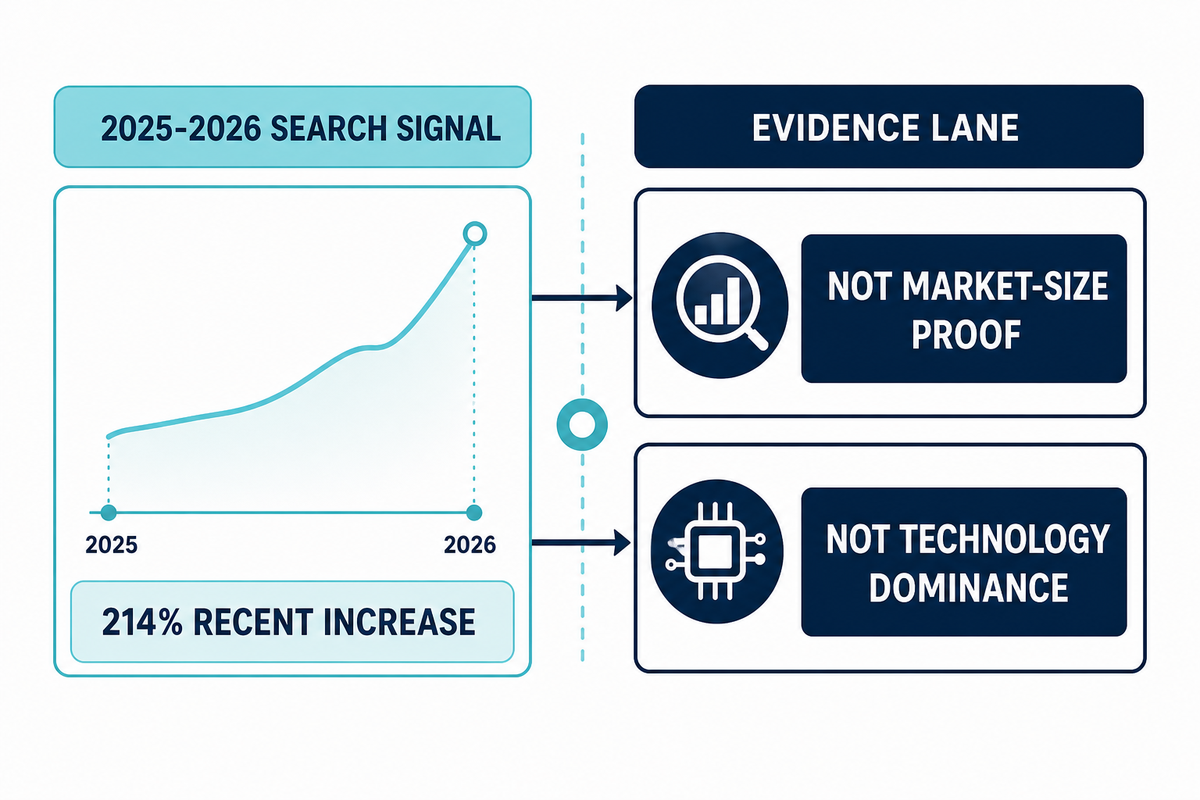
The current-run search history for the focus phrase is increasing, with a 214% recent compared to prior. This is a search interest indication and not proof of market size estimation or confirmation of the dominant technology. The appropriate response is to provide a more complete buyer brief; connect flow control, water quality, source control, climate assumptions, maintain access, and evidence ownership.
The strongest signal isn’t the new mandated label. The strongest signal is the connection that public guidance is making between design and operation. The 2026 Seattle update integrates flow control, pollutant control, source control, construction runoff, and housekeeping. Use that as a prompt to review your own authority’s current documents, this isn’t an invitation to copy and paste the Seattle requirements to another location.
Avoid making claims about trends that can’t be verified. Don’t reference a market forecast found on an unverified vendor page, don’t guarantee climate performance for lack of project inputs, and don’t use the term “future-proof” to describe a proprietary configuration without stating how it was examined or under what circumstances it may break.
Prepare a stormwater management solutions brief for supplier and design review
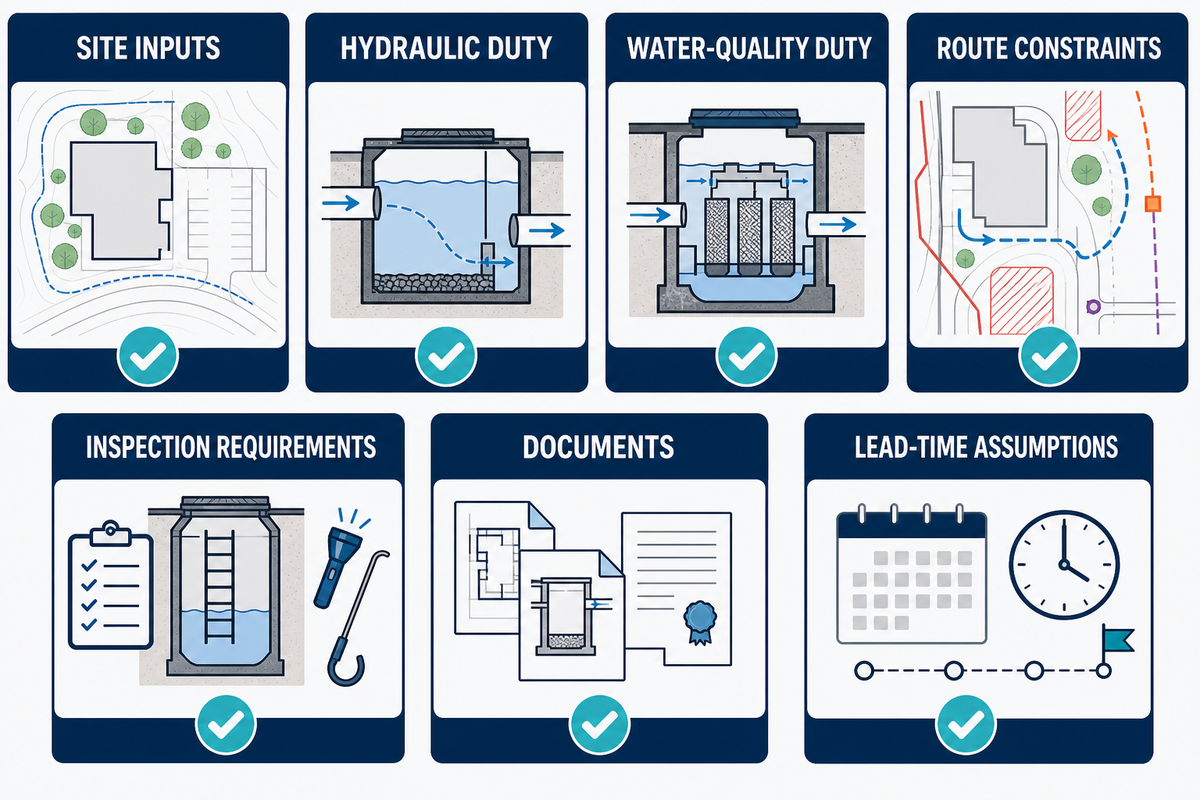
A good brief will help competitors submit comparable quotes and reduce the number of clarification requests. Before requesting a quote, please submit the following information: See the commercial solutions page when the brief is ready for configuration review.
Worked-format example only: record a 1 m cover depth, a 5 L/s release check, and a 24 h response target in the brief, then replace each placeholder with the approved project value.
If a pressure field is part of the project record, show a 50 kPa placeholder in the same format and replace it with the approved value before design sign-off.
A separate worked-format row may show 200 kPa ground pressure and a 48 h close-out time as placeholders; the project team must replace both with approved values.
A 12 hours response window may also be shown as a placeholder when the authority specifies a time-based trigger; replace it with the approved requirement.
| Evidence source | Scope | Decision it supports |
|---|---|---|
| Catchment plan | Boundaries, levels, inlets | Source and conveyance |
| Rainfall scenario | Event and runoff assumptions | Quantity duty |
| Outfall approval | Invert and allowable discharge | Release route |
| Soil and groundwater record | Infiltration, buoyancy and utilities | Route feasibility |
| Water-quality note | Pollutant duty and pretreatment | Water-quality control |
| Load and cover note | Structural case and construction sequence | Configuration boundary |
| Access plan | Covers, clean-outs and safe clearance | Maintenance visibility |
| Test record | Method, date and scope | Evidence fit |
| Loading record | Packing, seal and photographs | Handover completeness |
| Brief section | Minimum content | Why it protects the project |
|---|---|---|
| Duty | Attenuation, detention, infiltration, reuse, conveyance, pollutant control, or a defined combination | Prevents a volume-only quotation |
| Site | Plan, levels, soil, groundwater, utilities, cover, traffic, access, and construction sequence | Makes the configuration conditional on real constraints |
| Evidence | Named tests, load grade, drawings, calculations, certificates, inspection and sampling records | Keeps product evidence separate from approval evidence |
| Delivery | Model, quantity, packing, container plan, loading checks, documents, and lead-time assumptions | Makes logistics and documents part of the controlled supply process |
| Operations | Access, trigger, owner, record, cleaning or replacement path, and escalation | Stops the asset becoming an invisible liability |
According to the factory record, Aqua Rain Water began core moulded-product operations in 2009. Aqua Rain Water’s factory record describes a core moulded-product operation established in 2009, approximately 15 years of export experience, 30 injection-moulding machines, two-shift production, and approximately 1,000 m³ per day of core-module capacity. Core modules have a capacity of approximately 1,000 m³ per day. Annual exports of core modules are approximately 300,000 m³. These figures are owner-confirmed for the core moulded stormwater module range and are subject to model, material preparation, the order mix, and the season. Use these figures to initiate supply discussions. For the next step, use the solutions page for a scoped configuration discussion. Don’t use them to replace an order confirmation or project schedule.
For a planning worksheet, keep the stated units visible: 30 machines, 2 shifts, 24 h operation, 1,000 m3/day core-module capacity, 300,000 m3/year export volume, a 40HQ container in about 2–3 days, up to about 7 days excluding raw-material preparation, and approximately 2% moulded-batch sampling. Each figure is from the factory record and is to be verified for the ordered model and the delivery window.
Ask for a controlled supply process, not a factory headline
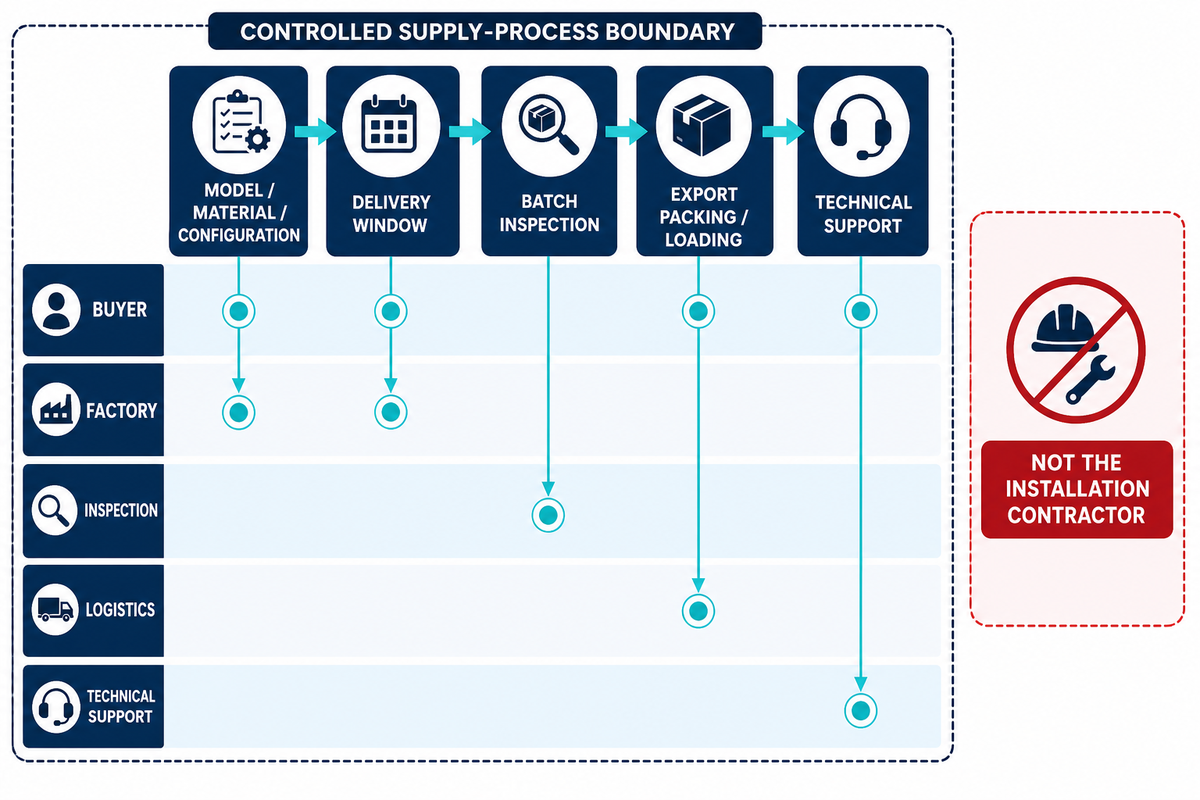
Capacity of the factory can only be assigned a value when it’s linked to a specific model, material, and configuration, and a delivery window. For core moulded modules, the factory record states that there are 30 injection-moulding machines running two shifts that have a capacity of approximately 1,000 m3/day and that annual exports of core modules amount to approximately 300,000 m3/year. A typical 40HQ container can be expected to be ready in approximately 2–3 days, and with the exclusion of the preparation of raw materials, it can take up to about 7 days. These estimates are planning figures for the central range of the order, but they shouldn’t be considered an absolute promise for every order.
The buyer needs to ask five questions. Which model and load grade are covered in the estimate? Is the material prepared, or is preparation included? Does the order mix contain side panels, clips, flange covers, geotextile, geomembrane, or EPDM pond liner that may use a separate sourcing path? What’s the planned status of the inspection prior to loading? What documents will be included in the batch, and which will be required to be agreed independently? The project discussion page can then map those documents to the configuration scope.
The factory record also includes a description of a 2% sampling process for batches of moulded products with respect to dimensions, color, appearance, and compression performed on an internal compression testing machine. Consider that as a defined internal/witnessed inspection process for the moulded range. Don’t consider it a third-party certification for procured geotextile, geomembrane, or EPDM products. If the project requires a witnessed test, request the agreed method, specimen, date, result, and signer in advance.
Packing and loading must be precise. Main modular products are generally shipped in full-container loads. Smaller orders may be shipped in LCL or consolidated shipments. Core module bodies and side panels are palletized. Smaller accessories may be shipped in wooden cases or bags. Ask for a packing list, container plan, photos showing the container is secured, a seal record, and a statement describing the contents of the controlled supply.
A remote video inspection, a two-day audit, or two days of loading supervision can be done before the final confirmation of the agreement and the final scope. None of these actions influence the supplier’s responsibility or approval of the design or the installation. These actions make assist in the monitoring of the product selection, batch, packing, and loading.
Project boundary: Aqua supplies products, supporting materials, and product-related documentation. Project design approval and full installation construction remain outside that supply role.
To progress from a brief to a product conversation, you’ll need to provide additional information.
Provide an indication of what you require in the evidence register and the owner of the handover. The Aqua team will then be able to assist you’ll the configuration of the product and supporting documentation.
Frequently asked questions
What is the best solution for stormwater mitigation?
Read the practical answer
There’s no universal best solution. The right route is the one that meets the approved quantity, quality, pathway, and operations duties under the site’s soil, groundwater, loading, space, discharge, and maintenance conditions. Start with source control and the runoff story, then compare green, grey, and hybrid measures. Ask the authority what evidence is required, and select a configuration only after those inputs are fixed. A product can be suitable for one duty and unsuitable for another without either statement being a contradiction. On a constrained site, the best route may be a sequence: prevent the load, treat the first flush, store the defined volume, control the release, and document the inspection response. On another site, infiltration or reuse may be viable while underground detention isn’t. “Best” is therefore a documented fit, not a product category.
What does stormwater management do?
Read the practical answer
It manages how runoff is prevented, collected, conveyed, stored, treated, released, infiltrated, or reused, while protecting people, property, receiving waters, and the project’s approvals. A complete system also defines inspection, maintenance, records, and ownership. The visible tank, swale, filter, or inlet is only one part of that work. If the design can’t show where water goes during normal, blocked, and exceedance conditions, it isn’t yet a complete stormwater management solution.
Are underground geocellular systems maintenance-free?
Read the practical answer
No. Underground storage can reduce the space used at grade, but it still needs upstream source control, pretreatment where required, access, inspection triggers, and a record owner. Maintenance visibility can be harder after burial, so the access and handover plan should be designed at the same time as the chamber or module layout. The required trigger and interval are project- and authority-specific; don’t copy a generic schedule without checking the approved operation and maintenance plan.
How should a buyer compare stormwater suppliers?
Read the practical answer
Give each supplier the same duty, site, load, hydraulic, water-quality, evidence, delivery, and operations brief. Compare whether each response identifies the product model, configuration, test scope, assumptions, documents, packing, inspection, loading, and exclusions. Ask who supplies supporting materials and who installs the system. A transparent boundary is more useful than a broad promise. For Aqua, core moulded products and supporting materials can be coordinated in one controlled supply process, while full installation construction remains outside the stated supply boundary.
Which documents should be in the handover pack?
Read the practical answer
Include the approved drawings and calculations, as-built records, product configuration, material and test documents, inspection and sampling status, packing and loading photographs, installation records from the responsible contractor, access and maintenance instructions, authority approvals, and a named owner for each recurring action. Keep the edition, date, product, and test scope with every certificate. If a document is unavailable, record the gap rather than implying that another document covers it.
Conclusion
The best solutions to manage stormwater are themselves evidence-based, as opposed to being a stand-alone product. Start with the site’s story regarding runoff. Consider green, grey, and hybrid options and compare them based on duties and constraints. Separate storage from pollutant control. Integrate and maintain all structural, hydraulic, groundwater, approval, logistics, and operations evidence in a single register. Request a configuration to be offered, inspected, delivered, and installed by the contractor of responsibility with no ownership gap.
This process defines the commercial solution page job, while this guide helps a project team land on the right questions before engaging with a specification.
References & Sources
- U.S. Environmental Protection Agency, National Menu of Best Management Practices (BMPs) for Stormwater
- U.S. Environmental Protection Agency, Storm Water Management Model (SWMM)
- American Society of Civil Engineers, Stormwater Infrastructure Report Card
- Philadelphia Water Department, Subsurface Detention Manual
- Seattle Department of Construction and Inspections, Stormwater Code and Manual Update 2026
- Massachusetts Office of Energy and Environmental Affairs, Stormwater Solutions for Homeowners
About the author

Grayden Du
Export Director · AQUA RainWater Solutions
Grayden Du is Export Director at AQUA RainWater Solutions. His work spans geocellular detention systems, underground stormwater storage and subsurface water management. Drawing on more than 16 years of hands-on experience across over 30 country markets, he explains technical principles, system choices and practical project requirements.
About AQUA RainWater Solutions
AQUA RainWater Solutions manufactures geocellular stormwater modules, shallow attenuation systems and ground-reinforcement grids, and coordinates the supply of geomembranes, geotextiles and EPDM pond liners. We help match system interfaces and specifications, with batch inspection for moulded products, product documentation and export-delivery support.
![Ground Grid Applications & Ground Reinforcement [Guide]](https://aquarainwater.com/wp-content/uploads/2026/09/ground-grid-applications-ground-reinforcement-blog-featured-768x512.png)