Get in touch with AQUA Company
Geocellular Tanks
Geocellular Stormwater Tanks for Underground Storage
- ARW-1050 modular system
- 30–60 t/m² active grades
- 95% void ratio
- DN200–DN800 connection options
AQUA supplies ARW-1050 geocellular stormwater tanks for stormwater management projects involving underground attenuation, infiltration and planned reuse. We match the requested height, product grade, connections, inspection records and export packing to the approved order configuration.
Send your storage target, application, site and loading conditions, connection sizes, quantity, destination and required schedule.
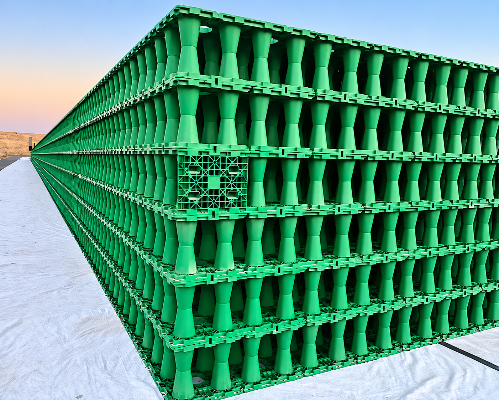
Void ratio
95% in both height configurations
Calculated storage
237.5 L or 190 L per complete unit
Active load grades
30, 40, 45 and 60 t/m²
Complete-unit weight
9.8 kg across active configurations
Connections
Side DN200–DN315; large DN600–DN800
40HQ reference
About 310 m
Underground Storage for Attenuation, Infiltration and Reuse
Choose a subsurface geocellular storage system only after the project team has resolved loading, access and construction conditions beneath roads, car parks, landscaped zones and other planned spaces. Within a sustainable drainage strategy, the wrap, outlet and site review determine whether the complete drainage system releases, infiltrates or routes stored surface water for planned reuse.
Attenuation and detention
Specify an impermeable geomembrane where a geocellular attenuation tank must hold stormwater runoff from roofs, parking lots and other catchments during heavy rainfall. The project designer sets storage volume, peak flow and allowable discharge; the stormwater attenuation tank does not by itself prevent every form of flooding.
Infiltration and soakaways
Choose a permeable geotextile wrap only after the project team confirms suitable soil permeability, groundwater separation and pollutant controls for discharge to ground. An open soakaway crate does not always qualify as an infiltration solution, and multiple soakaway crates still need a site-specific design.
Storage for planned reuse
A lined underground stormwater tank can be integrated into a rainwater harvesting or reuse design with project-specified treatment, pumps and controls. The ARW-1050 module provides storage space; it is not a complete treatment or reuse package.
ARW-1050 Load Grades and Material Options
We supply four active ARW-1050 grades for a configurable geocellular storage tank. Grade selection starts with product values, then moves to complete-system review for long-term loading, burial, cover, surcharge, traffic, construction sequence, soil and groundwater.
The grade and material rows below describe reference configurations. Recycled, blended, virgin and modified PP formulations can be considered for a project; confirm test evidence for the selected material and load grade.
| Grade | Standard material | Minimum vertical ultimate | Working lateral value |
|---|---|---|---|
| ARW-1050-30 | Recycled PP | 30 t/m² (about 294 kN/m²) | 115 kN/m² |
| ARW-1050-40 | Recycled PP | 40 t/m² (about 392 kN/m²) | 118 kN/m² |
| ARW-1050-45 | Recycled PP | 45 t/m² (about 441 kN/m²) | 118.8 kN/m² |
| ARW-1050-60 | Virgin PP | 60 t/m² (about 588 kN/m²) | 185 kN/m² |
The two geocellular tank sizes share the same footprint and complete-unit weight, while the 500 mm and 400 mm heights change usable storage and container-loading references.
Standard 500 mm height
- 1000 × 500 × 500 mm
- 95% void ratio
- 237.5 L calculated usable storage
- 9.8 kg complete-unit weight
- Approx. 1,240 complete 500 mm units per 40 ft container: 310 m³ assembled exterior-volume equivalent and 294.5 m³ nominal void storage. Final loading depends on the ordered components and accessories.
Optional 400 mm height
- 1000 × 500 × 400 mm
- 95% void ratio
- 190 L calculated usable storage
- 9.8 kg complete-unit weight
- About 260 m³ nested-loading equivalent per 40HQ
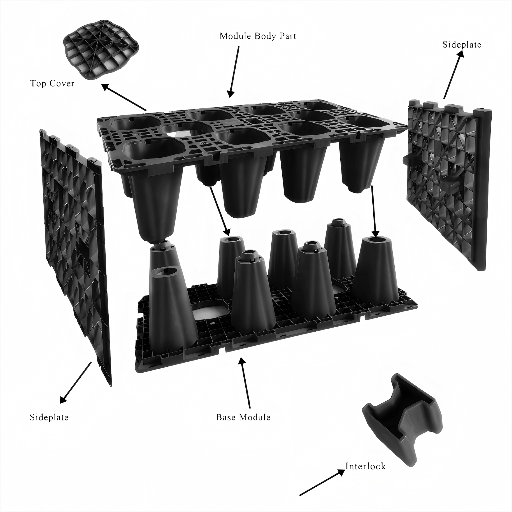
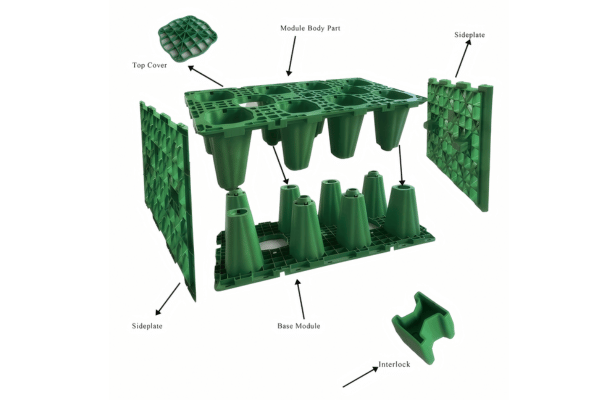
The modular assembly uses two body components, side panels, a top cover and interlocking clips.
Long-term structural review
Product strength could be mistaken for installed-system approval. Polypropylene can deform under sustained load, and short-duration compression data alone does not establish structural integrity. Do not interpret a catalog phrase such as “high load-bearing capacity” as system approval; the project engineer still reviews creep, buckling, load duration, assembly, tolerances and field conditions because the highest grade is not necessarily the correct selection.
Inlet, Outlet and Inspection Connections
We configure the module package around the approved pipe and access schedule. Confirm every inlet, outlet, overflow, inspection point and flange requirement before production so the body, side panels and smaller accessories can be packed as one controlled order.
Interface
Available product range
Order check
Packing method
Side inlet
DN200–DN315
Diameter, elevation and side-panel position
With the configured module package
Large inlet/outlet
DN600–DN800
Diameter, flange/cover and connection direction
Smaller parts in cases or bags
Top inspection access
DN800 accessory and matching pipe connection
Access position, inspection concept and cover interface
Separated and identified for loading
Standard complete-unit bill of materials
- Two 4.9 kg body components
- Six side plates
- One top cover
- Interlocking clips
- Specified flange covers and connection accessories
Connection schedule for quotation
List quantity and size for each interface, identify top access separately, and show the intended wrap and outlet concept. We review product compatibility and packing; the project designer confirms hydraulic capacity, gradients and the complete pipe network.
Dimensions, Storage and Structural Values
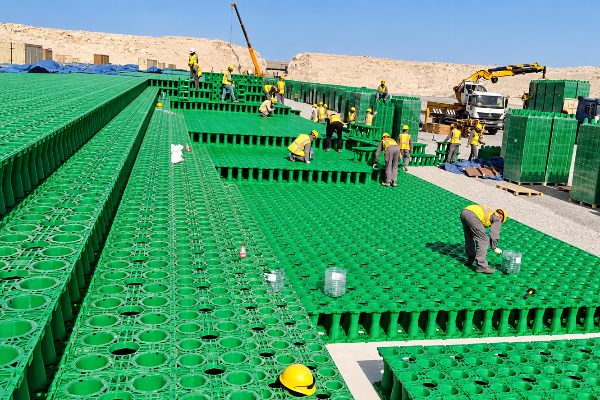
The specification table below is the current public ARW-1050 product record. Calculated storage is based on the stated external volume and 95% void ratio, while kN/m² values are approximate conversions from the primary t/m² grades.
| Specification | ARW-1050 product value |
|---|---|
| Standard dimensions | 1000 × 500 × 500 mm |
| Optional low-height dimensions | 1000 × 500 × 400 mm |
| Void ratio | 95% |
| Calculated usable storage, 500 mm | 237.5 L |
| Calculated usable storage, 400 mm | 190 L |
| Complete-unit weight | 9.8 kg |
| Active minimum vertical ultimate grades | 30 / 40 / 45 / 60 t/m² |
| Approximate vertical conversions | 294 / 392 / 441 / 588 kN/m² |
| Working lateral values | 115 / 118 / 118.8 / 185 kN/m² |
| Standard colours | Black and green; blue and other custom colours available |
Product values do not approve the installed system
These values describe the module and its active grade. Burial depth, cover, traffic class, vehicle surcharge, load combinations, adjacent structures, backfill, construction loads and long-term deformation require a project-specific structural review using actual site inputs and applicable standards.
Quote Inputs, Production Timing and Container Loading
Buyers comparing underground stormwater storage systems’ cost need one defined supply scope. A cost-effective quotation starts with the selected grade and height, module quantity, connection accessories, supporting materials, packing plan, destination and required schedule.
Cost drivers to define before quotation
| Driver | Why it changes the scope | Useful buyer input |
|---|---|---|
| Grade and material | Changes the ARW-1050 product variant and resin basis | Required load cases and preferred grade for review |
| Height and storage target | Changes module count, tank geometry and nested-loading reference | Net storage target and preferred 400 or 500 mm height |
| Connections and access | Changes side panels, flange covers and accessory packing | Pipe schedule and inspection-opening plan |
| Wrap and supporting materials | Changes the supply package for attenuation or infiltration | Approved geotextile, geomembrane and protection-layer specification |
| Quantity and packing | Changes pallet count, accessory cases and consolidation plan | Module quantity and multi-product order list |
| Destination and schedule | Changes routing, consolidation and production planning | Destination, required arrival window and order priority |
Working production and loading references
Core-module production
We normally produce one 40HQ of core modules in approximately 2–3 days. Allow up to about 7 days excluding raw-material preparation when model, material, order mix or seasonal scheduling requires it.
500 mm configuration
The loading references are assembled exterior-volume equivalents: approximately 310 m³ for the 500 mm configuration and 260 m³ for the 400 mm configuration per 40 ft container. These correspond to approximately 294.5 m³ and 247 m³ of nominal storage at 95% void. They are not container interior volumes. Final packing follows the actual bill of materials and accessories.
400 mm configuration
A 40HQ carries approximately 260 m³ of nested-loading equivalent. The lower reference reflects the packing arrangement of this height.
Shipment format
We prefer full-container shipment for the main modular products. Suitable smaller-container or consolidated less-than-container orders can be reviewed, including ordered AQUA products and supporting materials.
Batch Inspection, Compression Testing and Order Documents
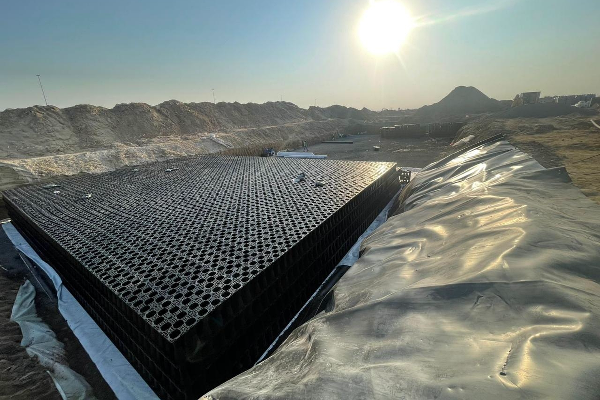
We review the approved product configuration, batch inspection status and packing before loading. For moulded-product batches, the working sampling process covers dimensions, colour, appearance and vertical compression at approximately 2%.
- Confirm the ordered model, grade, height, colour, bill of materials and connection accessories.
- Sample moulded-product batches for dimensions, colour, appearance and vertical compression.
- Record inspection status and resolve any configuration or packing discrepancy before loading.
- Prepare agreed product records, packing evidence and loading photographs for the order.
Scope the acceptance plan in the order
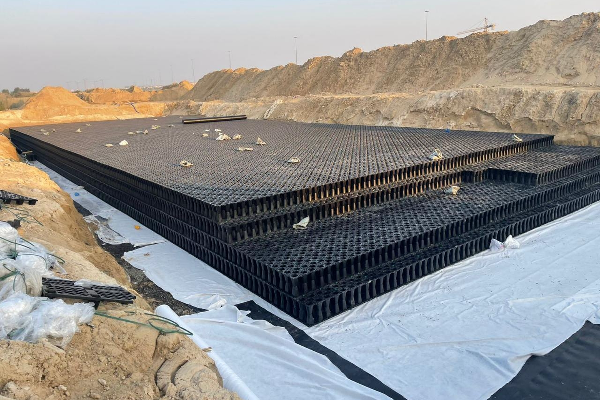
The approximately 2% figure describes AQUA’s working moulded-batch process; it is not a statistical acceptance guarantee on its own. State any project sampling method, acceptance numbers, witness points or independent inspection requirements in the order criteria.3
AQUA application-engineering principle: treat module test values, installed-system calculations and order acceptance criteria as three separate checks.
Factory compression testing
Our factory has a compression testing machine for internal and witnessed testing. Buyers can arrange a factory-witnessed test or request test video when agreed.
Order document set
Batch inspection and compression-test records are available. Selected third-party product test reports and company certificates can be supplied according to the product and order.
Third-party evidence applies to the submitted sample and stated report scope. Internal testing remains factory evidence; third-party certification is issued independently of supplier and buyer interests.4
5-year product warrantySubject to the written contract
50-year design-life basisSubject to complete project design
Witness testingArrange before production or inspection
Loading evidenceInspection, packing, securing and seal records as agreed
Maintenance Note
Maintenance access is considered too late when it is left until the tank is buried. Factory inspection does not replace the operating plan for pretreatment, sediment removal, inspection and maintenance, or cleaning. Record these maintenance considerations before the underground detention system enters service.5
From Project Inputs to Controlled Export Supply
We combine product selection, batch inspection, export packing, loading supervision and technical coordination in one supply process. The following sequence keeps product responsibility clear while the project engineer and contractor retain system-design and construction responsibility.
01
Send project inputs.
Provide the application, storage target, site and loading data, soil and groundwater constraints, pretreatment concept, connection schedule, quantity, destination and required date.
02
Review the product configuration.
We compare height, grade, material, storage, connections, access and supporting-material requirements.
03
Confirm the order scope.
The quotation fixes the approved configuration, commercial terms, packing plan and planned schedule.
04
Produce and inspect.
Core moulded products follow the approved order, with the moulded-batch inspection process recorded.
05
Pack and supervise loading.
We check appearance, dimensions, packing, container securing and sealing when loading supervision is included.
06
Release documents and support.
Agreed records, photographs, remote guidance and technical support follow the shipment.
RFQ input checklist
Hydraulic and site inputs
- Net storage target and application
- Allowable discharge or infiltration intent
- Soil, groundwater and contamination constraints
- Pretreatment, silt control and maintenance access
Product and delivery inputs
- Preferred height and grade for review
- Inlet, outlet and top-access schedule
- Module quantity and supporting materials
- Destination and required schedule
Project responsibility stays visible
Geocellular attenuation tank installation remains a contractor responsibility. The project team confirms hydraulic sizing, geotechnical suitability, groundwater protection, structural calculations, long-term creep, cover, backfill, access, treatment and construction quality. AQUA supplies the ordered products, documents and agreed technical support; we do not undertake full installation construction.
Moulded-Product Capacity and Loading Control
Our factory was established in 2009 and has approximately 15 years of export experience. The core moulded-product operation uses 82 injection-moulding machines on two shifts with 24-hour operation.
Working capacity
We plan approximately 100,000 m³ per month for the core stormwater module range. Actual output depends on model, raw material, order mix and seasonal scheduling.
Annual export volume
Annual export volume is around 1,000,000 m³. Main working regions include the Middle East, Europe, the Americas and Australia.
Audit access
Factory audits are accepted by appointment and normally take one to two days. Remote video inspection can also be arranged.
Loading supervision
- Product appearance and dimension checks
- Production and quality-control review
- Pallet, wooden-case and bag packing review
- Container securing, sealing and photographic reporting
- One-day working window, or two days where the loading schedule requires it
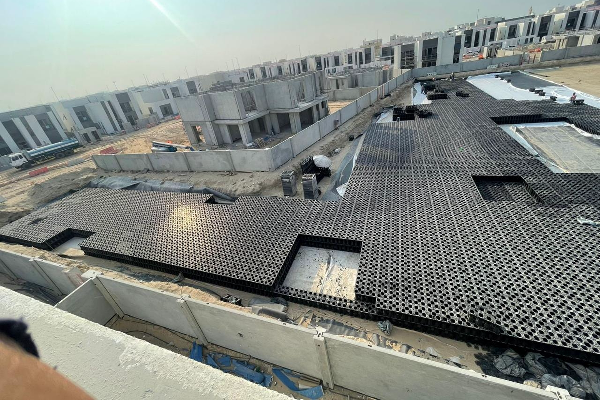
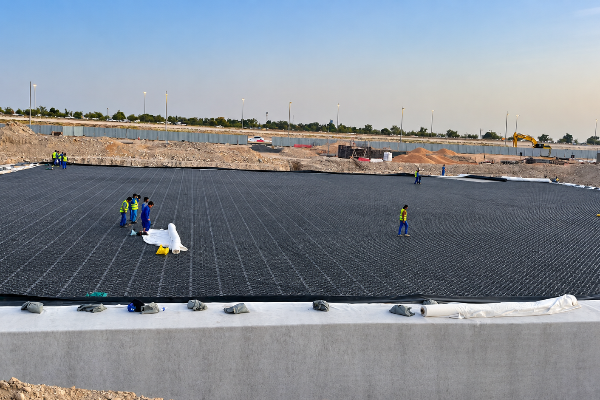
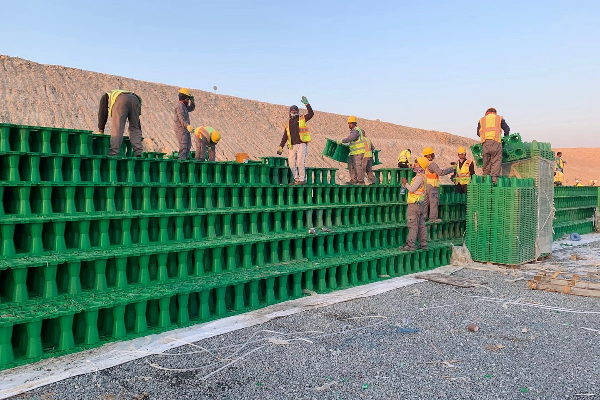
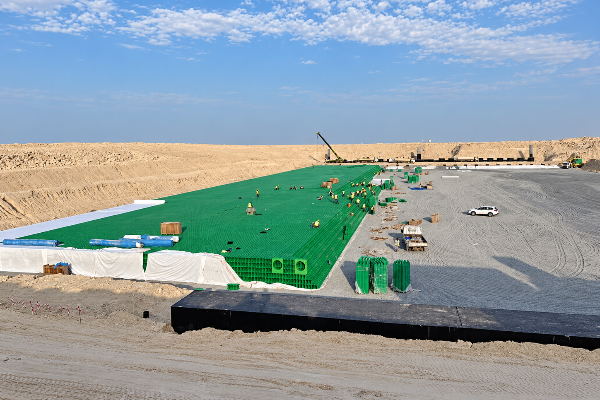
Modular stormwater cells being assembled in a prepared excavation.
Geotextile, geomembrane and EPDM are supporting procured products coordinated through our supply process; they are not produced on the injection-moulding lines. Customer and distributor identities remain confidential unless publication is specifically approved.
Request an ARW-1050 Data PackProject Conditions That Require Separate Design Review
An underground detention system design is not always resolved by selecting a higher module grade. Use the following conditions to route the next decision to the project designer, environmental reviewer or installation contractor.
01
Uncertain infiltration conditions
Low permeability, high groundwater, karst, contaminated runoff or land, nearby wells and other site conditions can make discharge to ground unsuitable.
Practical Route
Complete site and environmental review; consider a lined attenuation/storage system where appropriate.
02
Burial, traffic or construction loads
A product grade does not alone approve cover, vehicle surcharge, irregular loading, backfill, construction sequence or long-term deformation.
Practical Route
Run project-specific structural calculations for the complete modular system, including creep and buckling.
03
Runoff needs treatment
A common assumption is that a high void ratio also provides pollutant removal or automatic sediment control.
Practical Route
Specify a treatment train, pretreatment, silt capture, inspection access and cleaning responsibility.
04
Installation scope is required
Excavation, base preparation, membrane joining, backfill, compaction and site safety belong to construction delivery.
Practical Route
Use a qualified project contractor; request AQUA product documentation and agreed technical support.
Strongest product is not the same as correct system
Do not select ARW-1050-60 simply because it carries the highest listed product values. The correct configuration is the one that satisfies the complete load, site, hydraulic, access and maintenance design without shifting an unresolved risk downstream.
Geocellular Tanks Engineering Tools
Storage Module Quantity Estimator
Estimate whole-module quantity from a project-defined storage target, then review layers, footprint reference and purchasing allowance.
Access ToolARW1050 Grade Comparison
Compare ARW-1050 and ARW-1040 product grade references and carry a candidate into the project brief.
Access ToolContainer Loading Estimator
Estimate 40 ft container loading from the selected module order and review remaining capacity and extra-cargo notes.
Access ToolModule Layout & BOM
Draw rectangular ARW-1050 or ARW-1040 layouts and review installed modules, shared clips, top caps, side panels, wrapping and excavation reference.
Open Layout & BOMRequest an ARW-1050 Project Review
Send the storage volume, application, site and loading conditions, preferred height, connection schedule, quantity, destination and required schedule. We will review the requested product configuration, inspection and document needs, supporting materials and packing plan before confirming the quotation.
-
01
ARW-1050 grade and height shortlist
-
02
Calculated module quantity and storage reference
-
03
Connection and accessory schedule review
-
04
Inspection, witness and document requirements
-
05
Production, packing and container-loading plan
What is a geocellular stormwater tank?
It is an underground storage structure assembled from interconnected plastic cells with a high void space. ARW-1050 modules are configured with side panels, a top cover, clips, connections and the project-specified wrap to form an attenuation tank, infiltration system or lined storage system.
How do attenuation and infiltration configurations differ?
An attenuation tank uses an impermeable lining to store runoff and release it through a controlled outlet. An infiltration or soakaway configuration uses a permeable wrap so water can discharge to suitable ground after the project team confirms soil, groundwater and environmental conditions.
Which ARW-1050 load grade should a project review?
Review ARW-1050-30, -40, -45 or -60 against the complete load case. The product table provides vertical ultimate values from 30 to 60 t/m² and working lateral values from 115 to 185 kN/m², but the project engineer confirms long-term installed-system suitability.
What storage volume does each module provide?
The 1000 × 500 × 500 mm unit provides 237.5 L of calculated usable storage at 95% void. The 1000 × 500 × 400 mm unit provides 190 L with its stated 95% void ratio.
What information is needed for a configuration review?
Start with the net storage target, attenuation or infiltration intent, preferred module height and candidate grade. Then add the complete load case, pipe and inspection schedule, quantity, destination and required date.
- For infiltration: soil permeability, groundwater level, contamination or runoff-pollution constraints and proposed pretreatment
- For long-term operation: inspection access, silt capture, cleaning method and the party responsible for maintenance
These inputs support a product-package review without implying that AQUA has completed the project’s hydraulic, geotechnical or structural design.
Does an open geocellular crate guarantee infiltration?
No. Permeable wrapping, suitable ground, groundwater separation and the approved site design determine infiltration.
Which connection sizes are available?
Side inlet accessories cover DN200–DN315. Large inlet/outlet options cover DN600–DN800, and a DN800 top inspection opening with a matching pipe connection is available.
When are geotextile and geomembrane used around the modules?
A permeable geotextile is associated with an infiltration or soakaway concept, while an impermeable geomembrane is associated with lined attenuation or storage. The approved project specification controls the complete wrap, protection layer, joints and interfaces.
What batch records are available?
Batch inspection and compression-test records are available for the moulded-product workflow. The working process samples approximately 2% for dimensions, colour, appearance and vertical compression, with any additional acceptance plan agreed for the order.
Can buyers witness factory testing or arrange an audit?
Yes. A factory-witnessed compression test or test video can be arranged, and factory or third-party audits are accepted by appointment; a normal audit generally takes one to two days.
How are ARW-1050 modules packed for export?
Module bodies and side panels are palletised. Clips, flange covers and smaller accessories may be packed in wooden cases or bags, with configuration and packing reviewed before loading.
How much volume fits in a 40HQ container?
The loading references are assembled exterior-volume equivalents: approximately 310 m³ for the 500 mm configuration and 260 m³ for the 400 mm configuration per 40 ft container. These correspond to approximately 294.5 m³ and 247 m³ of nominal storage at 95% void. They are not container interior volumes. Final packing follows the actual bill of materials and accessories.
What do the warranty and design-life statements mean?
The product warranty is five years subject to the written contract and its stated scope, exclusions and remedy. The 50-year design-life basis is a project-design input, not a promise that every installation will reach the same service period.
- The project team evaluates grade, sustained and construction loads, creep, buckling, cover, backfill, groundwater, access and installation quality.
- The quotation identifies the applicable written warranty and supporting product documents.
- This separation keeps commercial coverage distinct from the engineer’s service-life assessment.
What controls geocellular attenuation tank maintenance?
Plan pretreatment, silt capture, inspection access, cleaning method, maintenance frequency and a named responsible party. These provisions protect effective storage and should be resolved before a buried system becomes difficult to inspect.
Does AQUA install the underground tank system?
No. AQUA supplies products, documents and agreed technical support; a qualified contractor performs construction.