Get in touch with AQUA Company
Geotextiles Product Guide: Functions, Types and Site Checks
By Grayden Du, AQUA
A geotextiles product is a permeable textile for use in a soil-and-water assembly; the decision should begin with its required function and shouldn’t be based on a known label or roll color. This guide assists procurement, construction, and inspection teams to compare various construction methods, read test reports, and note the items to be checked prior to covering the fabric.
What Geotextiles Do, and What They Cannot Do
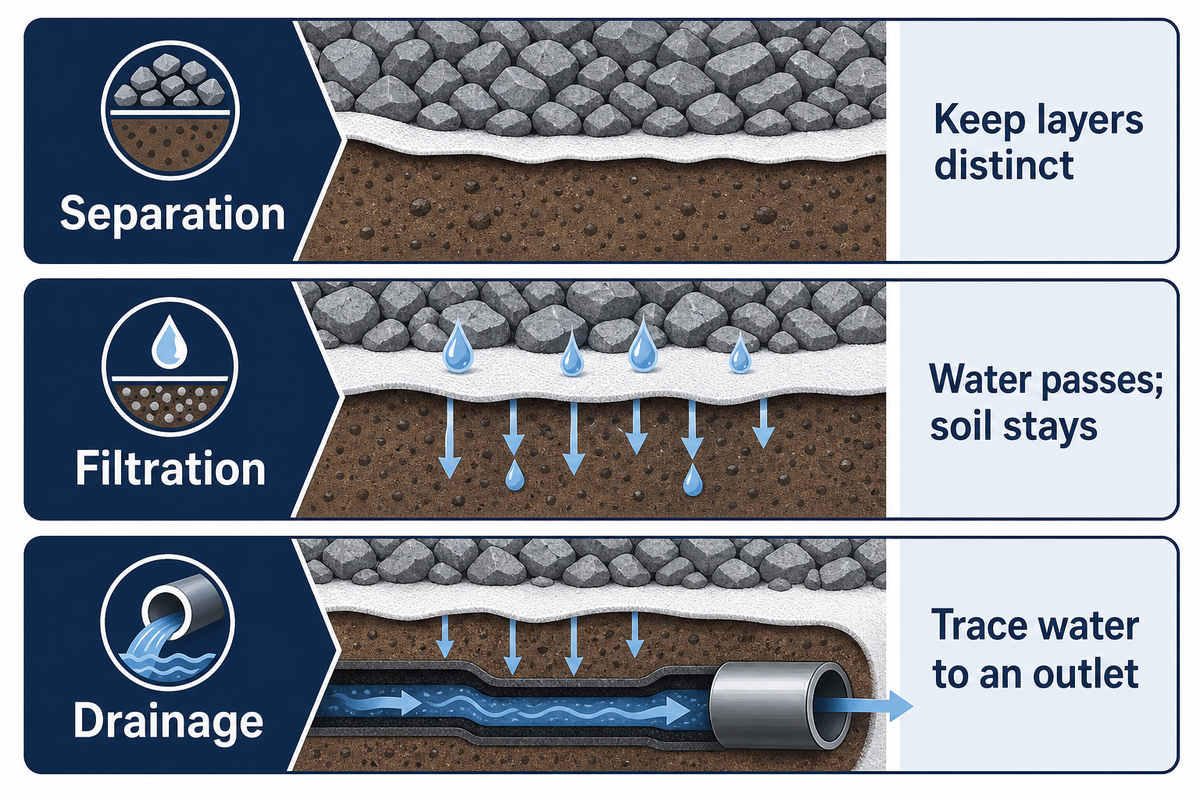
Cover only after the required function, soil compatibility and inspection evidence are clear.
Geotextiles are porous synthetic fabrics used in civil and environmental engineering. Depending on the design, they can be used in separating soil layers, filtering water and retaining selected particles, protecting an adjacent layer, controlling erosion, and assisting in the construction of stabilization and reinforcement.
These functions can’t be substituted. A permeable geotextile isn’t a water-proof membrane, and a fabric used for separation isn’t always a reinforcement layer. The project specifications have to define the soil, the path of the water, the loads, the exposure of the installation and the acceptance tests.
On a weak subgrade, the problem may include loss of aggregate into the soil or unexpected pumping of fine material under traffic. To resolve the pain, one must compare the approved detail to the construction sequence and the soil. The name of the fabric by itself can’t resolve the pain.
Treat geo textile, geo fabric and non woven filter fabric as search terms, not as project acceptance criteria. The approved design, soil data and acceptance tests determine whether the proposed geotextiles are suitable for this application.
Per the EPA official fact sheet, the role of fabric in the control of soil erosion is delineated in a construction site system. As such, the buyer should confirm the adjacent soil and cover detail instead of claiming a general result.
The reason for this delineation is that the ASTM test methods and official direction deal with the measurement of defined characteristics, whereas the project detail will define the actual acceptance criteria. Keep the method, lot and drawing together.
| Function | Question to answer | What the label cannot prove |
|---|---|---|
| Separation | Will the layers remain distinct under the specified traffic or fill? | The label cannot prove that the same fabric is suitable for every subgrade. |
| Filtration | Will water pass while the relevant soil remains in place? | The label cannot prove that “permeable” means compatible with this soil. |
| Drainage | Where does water move, and where does it exit? | The label cannot prove that water will drain without a continuous outlet. |
Types of Geotextiles: Read the Construction Before the Label
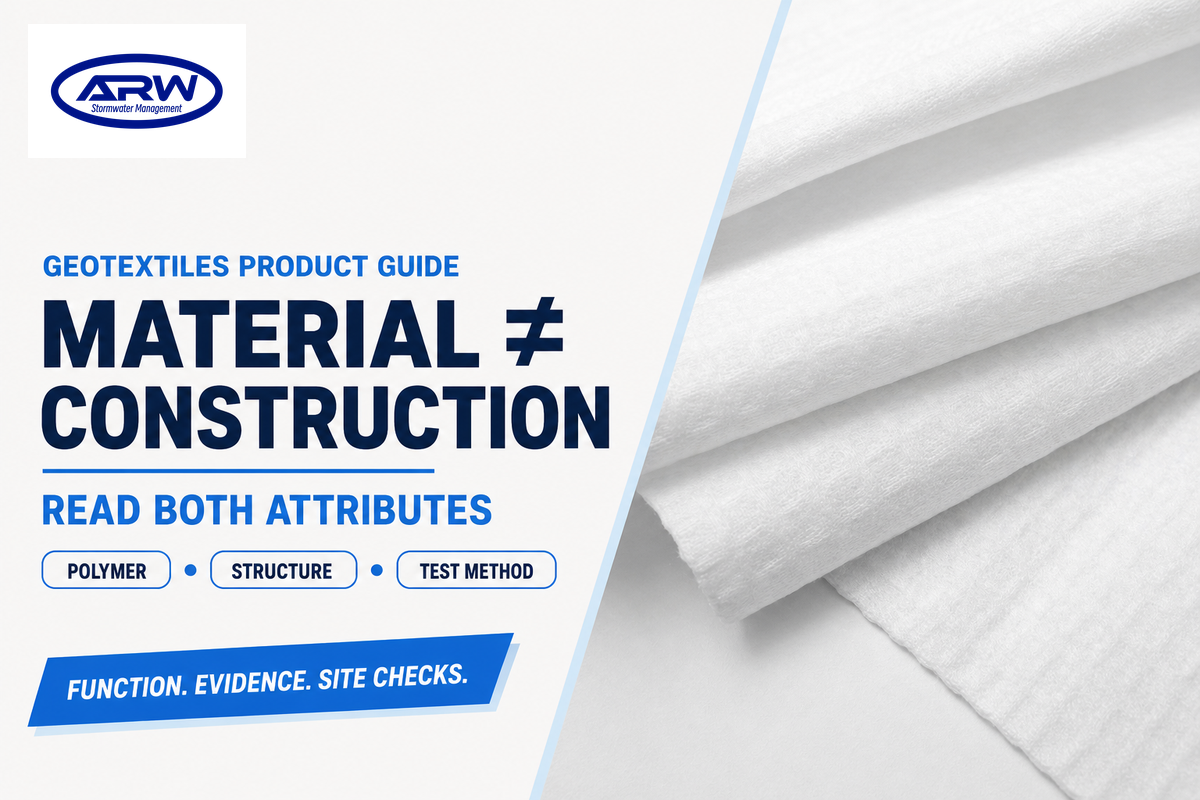
The risk is the disparity between the supplier’s description and the application. Compare the test report to the official project requirement because what looks like a match may not hold in the field.
For example, an ASTM D4751 apparent-opening-size result is one single measurement, and is not a substitute for the project’s complete acceptance criteria.
Woven geotextiles are based on interlaced yarns; non-woven geotextiles include needle-punched and heat-bonded fiber structures. The weave, fiber arrangement and bonding process are important. Monofilament, slit-film and multifilament constructions may behave differently, even with a general “woven” term used in a catalog.
Needle-punched nonwoven fabric and a woven structure may be selected based on different design requirements for tensile, opening and flow behavior. These are construction descriptions, not absolute performance rules. Compare values only after determining the specific test method, direction, specimen, and lot.
Don’t substitute a geomembrane liner, geogrid or retail landscape fabric for the specified geotextile just because it looks similar. Geosynthetics can work together in an adjacent manner, but nevertheless have distinct functions and evidentiary support. Each has its own purpose.
When buying nonwoven geotextiles, buyers should consider if the fibre web and bonding process correspond to the filtration and handling requirement. Aesthetics or mass should never be a proxy for a project test.
Separate material names from construction types
For the construction terms below, the EPA glossary of geotextile terminology defines multifilament yarn and needle punching. This historical source explains how the fabrics are made; its old design values and product prices are not acceptance criteria for a current project.
Geotextiles are made from different polymers and textile structures. Polypropylene or polyester identifies the polymer; woven and non-woven describe the construction. EPA also lists polyethylene among the possible materials. None of these names alone proves that a geotextile material fits a particular exposure or load.
Read a description along both axes. For example, “polyester non-woven geotextile” gives material and structure, while “high-strength fabric” still leaves the test method and acceptance value unresolved. The label decoder below groups overlapping descriptions; it does not present eight mutually exclusive product types.
| Label or type | Attribute being described | Question for the supplier |
|---|---|---|
| Woven monofilament geotextiles | Woven fabrics made with individual filaments. | Which opening-size and hydraulic results apply to these monofilament fabrics? |
| Woven slit-film fabric | Woven construction using tape-like elements. | Does the supplied construction meet the specified function and test criteria? |
| Woven multifilament fabric | Yarns containing multiple filaments. | Which yarn direction was tested, and does it match the comparison? |
| Needle-punched geotextiles | Mechanically entangled nonwoven structure. | What report supports the proposed filtration and drainage applications? |
| Heat-bonded nonwoven | Nonwoven structure joined using heat. | Is this the construction named in the approval, rather than a substituted process? |
| Polypropylene | Polymer name, not a complete fabric specification. | What construction, exposure limits and product documentation accompany it? |
| Polyester | Another polymer used in geotextiles. | Does the project specification accept this material for the stated conditions? |
| Polyethylene | Polymer that can occur in different product forms. | Is the offer a permeable fabric or a barrier sheet? |
Compare the construction labels against published geotextile filter examples and the material list in the EPA fact sheet. These references explain terminology; they do not qualify AQUA’s stock or certify a shipment.
Filtration and Drainage: Follow the Water and the Soil
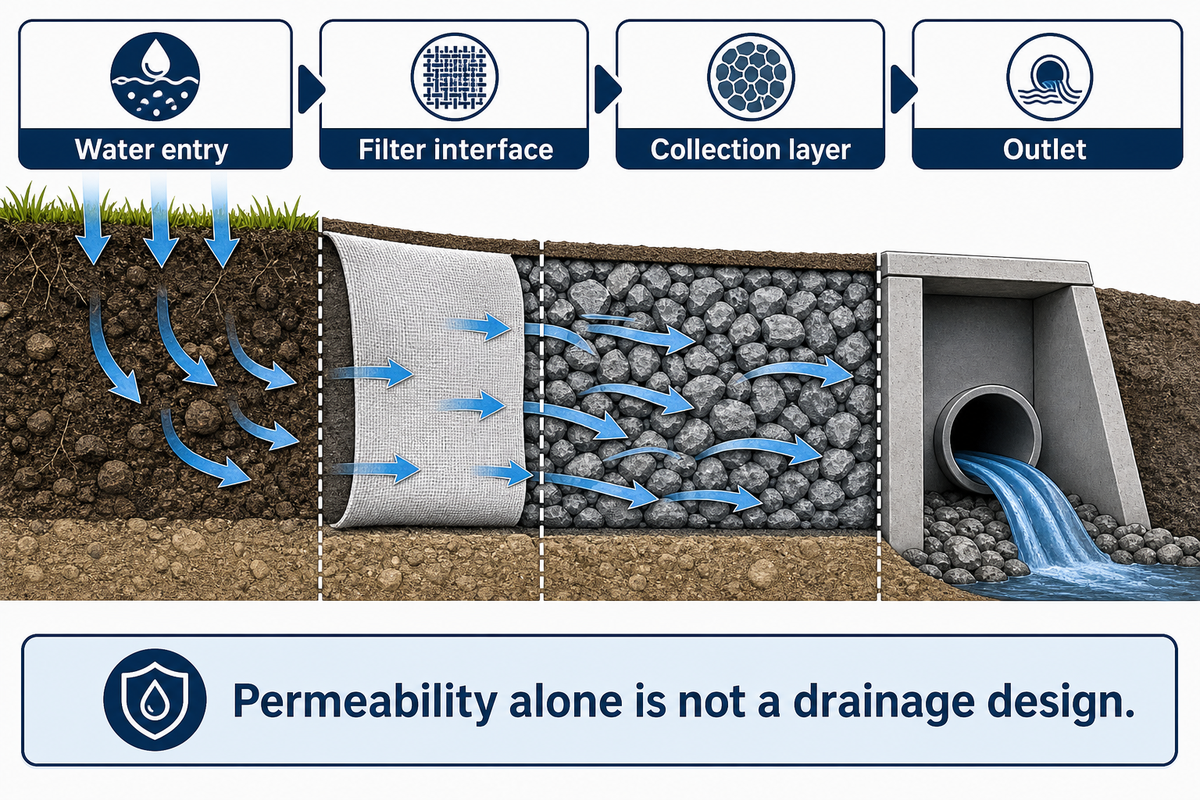
A blocked or interrupted drainage path is one possible cause of failure. In practice, an inspector should note the soil, the outlet, and the direction of the hydraulic flow. Then the responsible engineer should be asked to fix the discrepancy.
Filtration asks if the fabric allows the required flow and if the soil is held. Drainage asks how the water moves along or through the system and if the outlet is open. A sheet can be permeable and fail to provide a working drainage path if the surrounding soil, core, outlet or filter transition is incorrect.
Prior to choosing a geotextile filter, the soil particle range, the hydraulic flow direction, the expected gradient and the consequences of a blockage should be considered. While a product description may show a supply option, this should never be a substitute for the engagement of the responsible engineer or calculations for the project.
Applications of Geotextiles: Check the Detail Around the Fabric
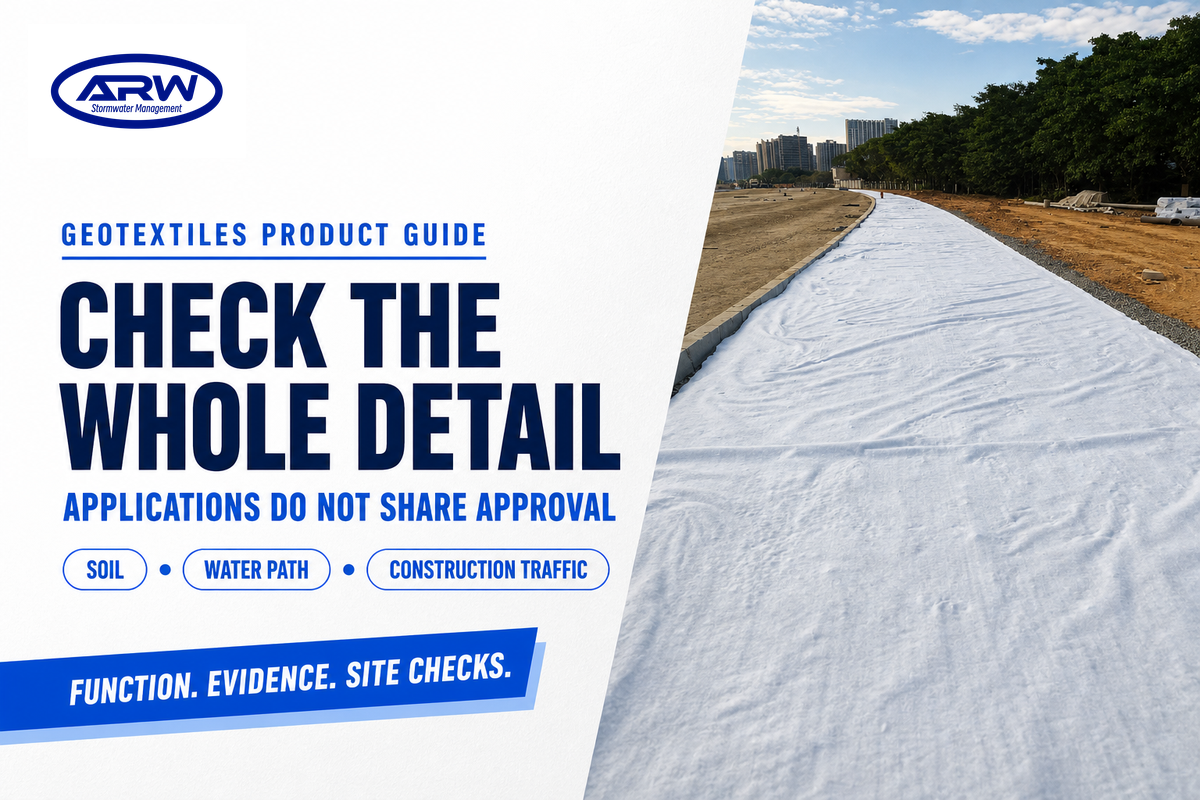
Using details in the wrong civil construction situation exposes the application risk. Before placement, the buyer, supplier, and inspector should cross-check the drawing, specification, and test report.
The same broad material family has diverse functions when used as the subgrade separation, retaining-wall drainage, erosion control, landfill layers and liner protection. In the case of embankment work, the project may require assessment of soil stabilization and reinforcement as well as separation. Assess the adjacent aggregate, drainage core, wall face, slope geometry, construction traffic, and cover.
FHWA guidance indicates why geosynthetics should form part of the overall earthwork construction detail. Don’t simply transpose an overlap, cover depth or traffic measure from one application to another, unless supported by the project document.
In the case of an embankment, drainage, reinforcement and soil stabilization may be distinct design issues. In the context of a retaining wall, also check the design detail of the outlet and filter transition when comparing a heavier roll.
Match the buying language to the civil engineering application
Consider this hypothetical procurement mismatch: the drawing calls for separation beneath aggregate, the quote offers a woven fabric for reinforcement, and the attached report gives only mass per unit area; the buyer still needs evidence that the offered construction satisfies the specified separation criteria for the expected soil and traffic conditions, even when the documents repeat the same general product name.
For road construction, separation concerns the interface between the aggregate and subgrade; reinforcement is a separate design question. A roadway specification therefore needs more than a claim of high tensile strength. “Driveway fabric” is a buying label, not evidence that a product meets the requirements for every traffic condition.
Environmental applications introduce different interfaces. Protection next to landfill liners, erosion-control fabric beneath stone, and a wrap around underground storage should not share an approval by default. Soil can erode beneath a poorly connected or damaged installation even where the material itself passes a laboratory test.
For storage construction projects, use AQUA’s subsurface stormwater system guide to distinguish the supply route for infiltration from lined storage. Geomembranes and geogrids remain distinct components; neither name establishes the function of the neighboring geotextile.
Read Geotextile Test Reports Without Mixing Methods
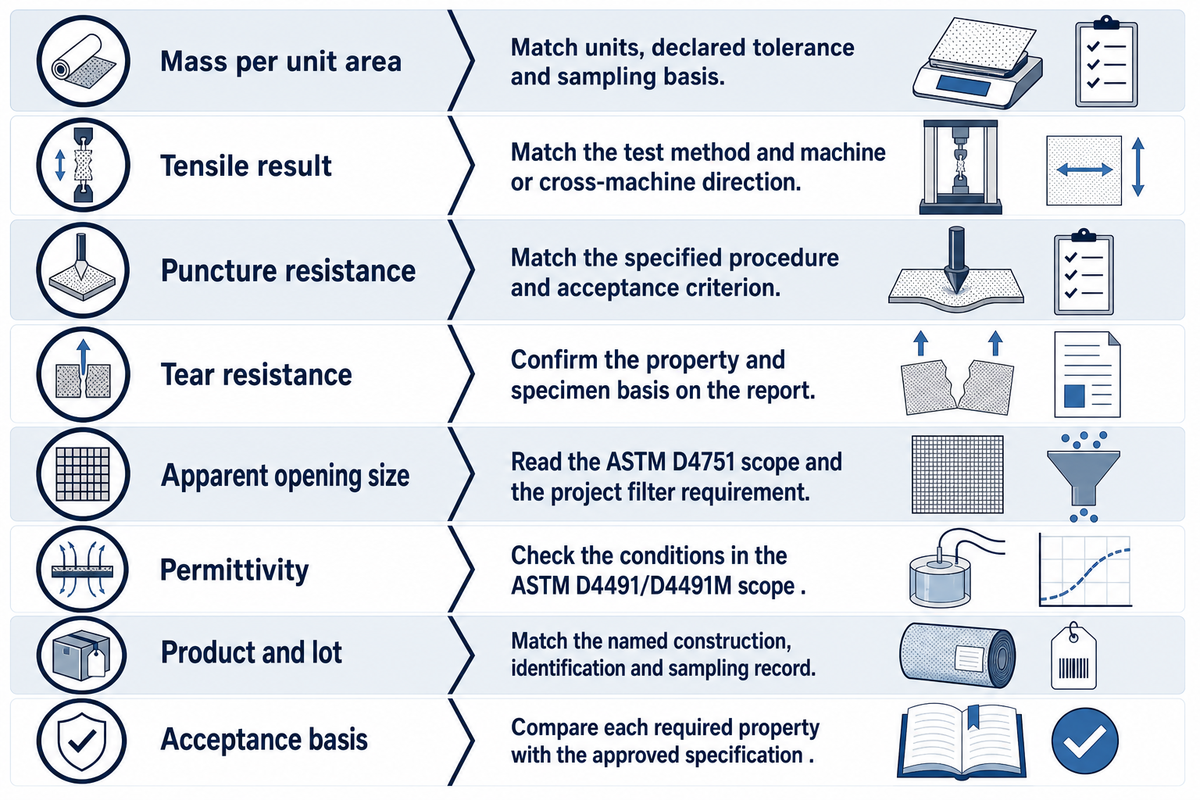
It’s a mistake to compare methods that aren’t the same. Keeping together the laboratory report, acceptance criteria and lot identity allows a traceable decision to be documented by an inspector.
ASTM D4751 refers to apparent opening size, whereas ASTM D4491/D4491M refers to the scope of the hydraulic conductivity or permittivity test. A test-method page refers to what a method measures. It is not a verification for a particular roll or a confirmation that the supplied product meets the project requirement.
As an editorial comparison checklist, review the alignment of product form, test direction, units, specimen conditioning, sampling plan, lot identity and acceptance basis when reports are compared. Separate mass per unit area from tensile strength, puncture resistance, opening size and hydraulic performance. A heavier fabric can still be the wrong fabric.
| Report item | Comparison to make | Limit of the conclusion |
|---|---|---|
| Mass per unit area | Match units, declared tolerance and sampling basis. | Mass does not establish strength or filter compatibility. |
| Tensile result | Match the test method and machine or cross-machine direction. | Results from different methods are not automatically equivalent. |
| Puncture resistance | Match the specified procedure and acceptance criterion. | Laboratory results do not give permission to traffic exposed fabric. |
| Tear resistance | Confirm the property and specimen basis on the report. | Tear results do not replace every other handling criterion. |
| Apparent opening size | Read the ASTM D4751 scope and the project filter requirement. | Opening size alone does not resolve the entire soil-filter design. |
| Permittivity | Check the conditions in the ASTM D4491/D4491M scope. | Uncompressed specimen performance is not a complete drainage-system assessment. |
| Product and lot | Match the named construction, identification and sampling record. | Reports for a different product or sample do not prove this delivery. |
| Acceptance basis | Compare each required property with the approved specification. | Listing standards does not provide a blanket certificate of compliance. |
This worksheet organizes a comparison; the responsible project team sets acceptance. Use the nominal mass and unit converter only for the quantity it calculates. Its fabric-mass result excludes packaging and is not a shipping weight, thickness measurement or performance rating.
Geotextile Installation: Seven Checks Before Covering
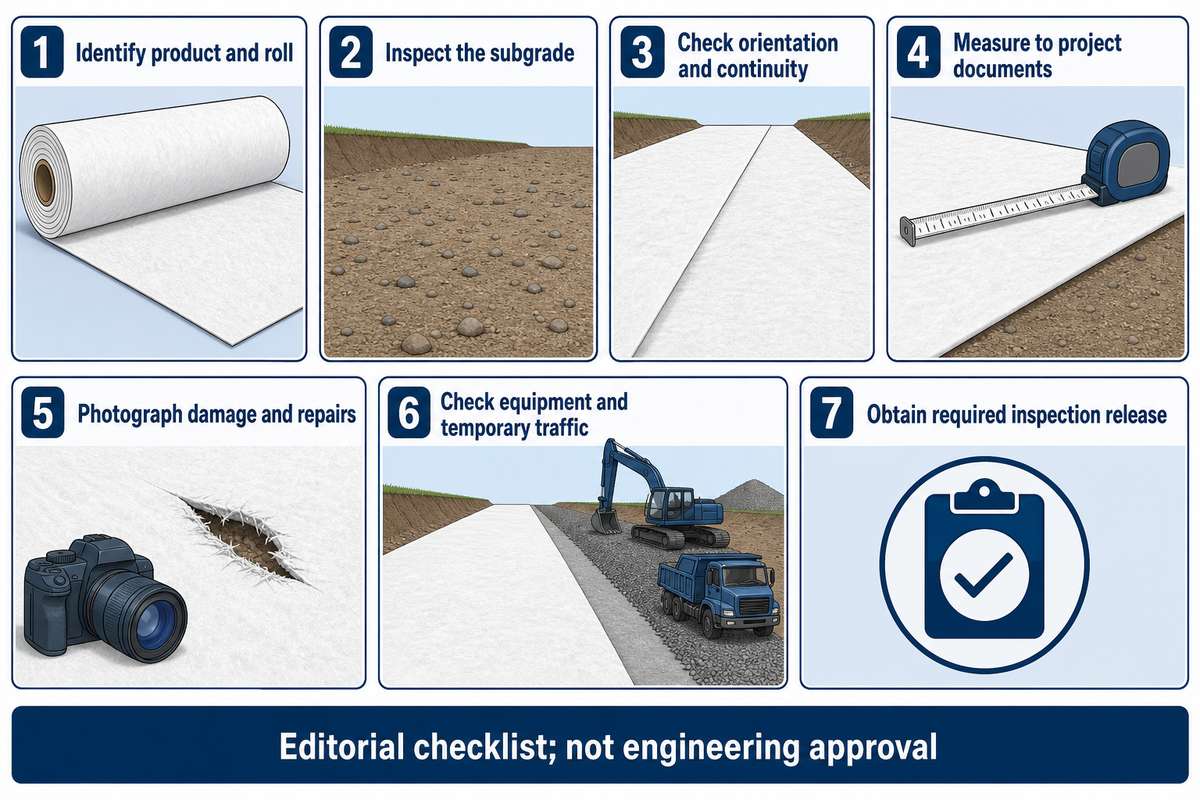
A risk at an inspection hold point is that evidence gets covered. In practice, the contractor and the inspector need to record the condition and take a photo of the defect, then resolve the issue before work progresses.
- Record the approved product name, roll number and delivery documents.
- Confirm the exposed subgrade matches the approved condition and is free of sharp projections.
- Check orientation, continuity and the intended flow direction.
- Measure overlaps, seams and edge details against the project documents; don’t use a universal value.
- Photograph tears, punctures, wrinkles, contamination and repairs before cover.
- Confirm placement equipment and temporary traffic won’t damage the exposed fabric.
- Where the project requires an inspection hold point, obtain the responsible inspector’s release; link photographs to the installation location.
This Cover-or-Hold Inspection Record is an editorial checklist, not a specification or engineering approval; adapt its suggested records and inspections to the project’s approved procedures. If a required field is missing, pause the checklist for further clarification rather than guessing and completing the form; follow the project’s hold-point procedure before covering the installation.
Installation damage can make a water-flow result look better while the fabric has actually been harmed. In a laboratory study by Cheah and colleagues, damaged specimens showed increased permittivity. The authors tested clean samples and noted limits to generalization. The finding is a reason to inspect damage, not an acceptance rule for a torn roll.
The study concerns rock-impact damage relevant to coastal engineering; it does not establish a universal outcome for civil engineering projects. Keep the installation photographs alongside the test report. A report on an undamaged specimen cannot describe the condition of a buried tear.
When Fabric Clogs, Tears or Lets Soil Move
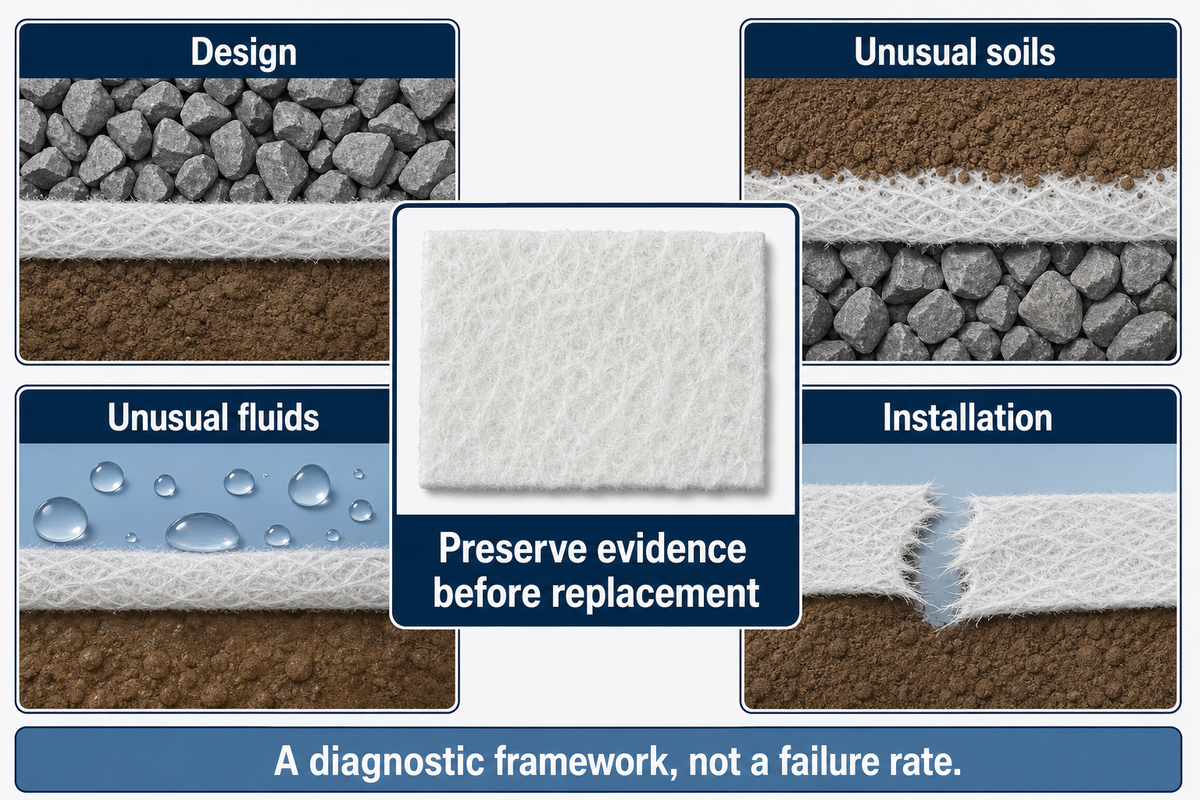
In a hypothetical inspection of a wet trench, finding a clean-looking geotextile at one exposed location does not show that the full drain is open: water still has to cross the soil-filter interface, reach the collection layer and leave through an outlet that may sit beyond the area visible in the inspection photograph.
The symptom of failure creates an impulse to change material. The field response is to preserve evidence, determine the failure cause, and obtain a documented decision before repair. Start with the observed water route and damaged location, then check the outlet and adjacent soil against the approved detail.
A visible pond, muddy discharge or torn sheet is a symptom, not a diagnosis. Check the outlet, soil compatibility, transition layers, damage from the building process, contamination, and whether water is making it to the intended path. Don’t think that changing the fabric to a heavier roll will resolve a blocked outlet or a mismatched soil filter.
The inspector needs to compare the failure case in the field with the approved drawing and the supplier’s test report. This evidence trail is better than a quick assessment based on the color or mass of the fabric.
Preserve photographs, locations, roll identity, weather and the sequence of cover. A qualified project reviewer can then decide whether the issue is repairable, requires removal, or calls for a revised detail.
Koerner and Koerner’s review of filter failures groups the cases under design, unusual soils, unusual fluids and installation. The review provides a diagnostic structure; it is not an industry failure rate. A clog may involve the filter interface or the fluid as well as the fabric, so preserve evidence before choosing a replacement.
Keep a Traceable Geotextile Handover Record
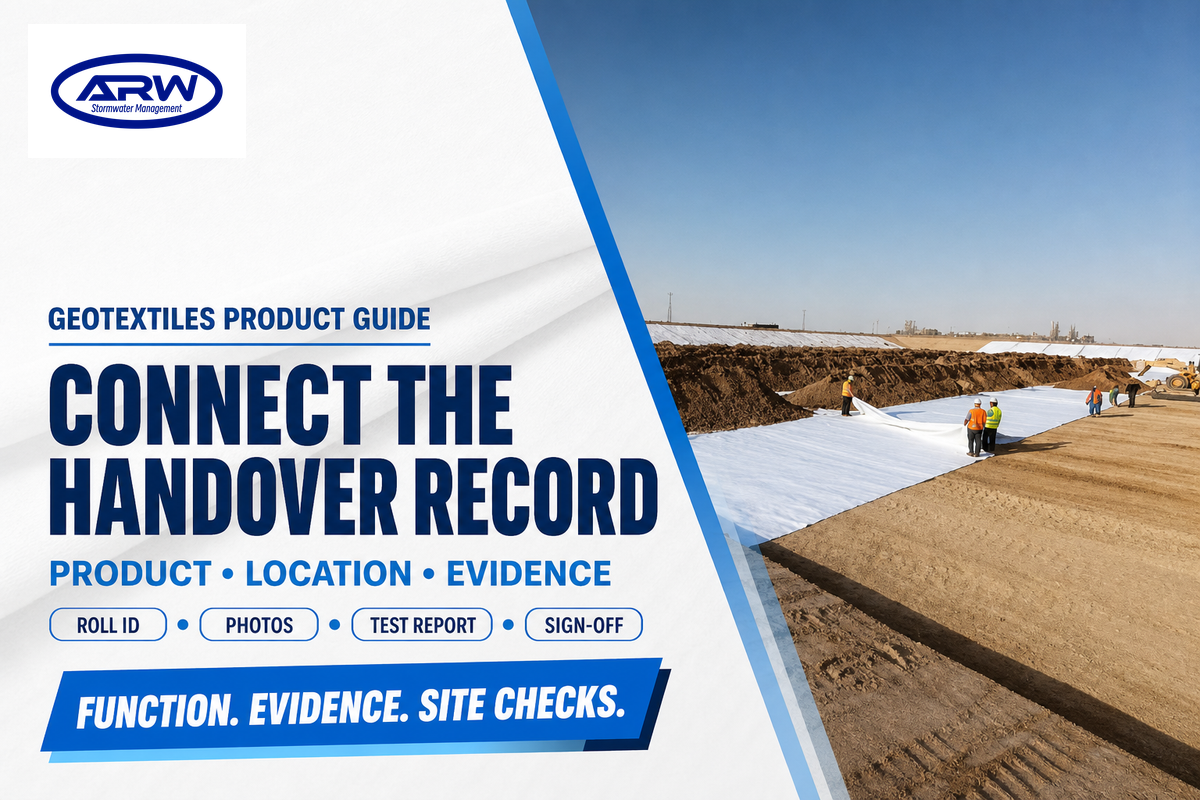
Gaps in records can create issues for procurement and later traceability. The handover should align the supplier, test report, installation zone, and inspector sign-off.
As an editorial handover suggestion, connect the approved material, batch or roll identification, installation zone, inspection photos, repairs, test reports and inspector sign-off. For the AQUA geotextile product page, confirm the available supply. Project documents will provide the requirements for performance and installation.
According to the related ASTM method pages, a test method describes a scope of measurement, not a blanket certification. Ensure that distinction is noted in the procurement file.
Prepare the open questions with AQUA’s geotextile inquiry checklist. It creates an editable summary without submitting it. For material takeoff, the roll area planner uses your specified layout and overlap inputs; it does not recommend overlap values or account for every site detail.
Frequently Asked Questions
What are geotextiles used for?
Geotextiles are used to separate soil, filter water, protect adjacent layers, control erosion or support stabilization when the complete design and evidence support that function. For civil engineering applications, identify the required function first and compare the product with the approved drawing and acceptance criteria.
Can water drain through geotextile fabric?
Often, but the answer depends on construction, soil compatibility, hydraulic direction and a functioning outlet. Permeability alone isn’t a drainage design. Check where the water enters and leaves the system, what soil particles the filter must retain, and whether the specified product and installation detail suit those conditions. A permeable sheet cannot correct a blocked outlet or a missing collection path; those need resolution within the drainage system before the fabric is covered.
Is polypropylene fabric waterproof?
The polymer name doesn’t establish whether a finished sheet is waterproof. A permeable geotextile is different from a continuous barrier liner. Confirm the specified product form and function before ordering; polymer identity alone does not establish water retention or filter performance.
How much do geotextiles cost?
Compare quotations on the same specified product, usable coverage, testing, delivery, placement and repair basis. This guide doesn’t provide a universal price or approve the cheapest substitute. An apparent saving can disappear if the quotation excludes the required documents or uses gross roll area where the layout needs additional material for specified overlaps, returns and cuts. Request those assumptions in writing. Use current supplier quotations for your location and order; historical cost examples cannot establish a present project price.
What are geotextiles used for on an embankment?
Geotextiles may separate, filter, drain or reinforce an embankment when the design identifies the soil, water path and load. The approved project detail controls. Keep reinforcement calculations, filter compatibility and drainage connections as separate checks; approval for one function does not automatically demonstrate the others.
References
References & Sources: official guidance, test-method scopes and the studies discussed above. Historical guidance is used for principles, not as a substitute for the current project specification.
About the author

Grayden Du
Export Director · AQUA RainWater Solutions
Grayden Du is Export Director at AQUA RainWater Solutions. His work spans geocellular detention systems, underground stormwater storage and subsurface water management. Drawing on more than 16 years of hands-on experience across over 30 country markets, he explains technical principles, system choices and practical project requirements.
About AQUA RainWater Solutions
AQUA RainWater Solutions coordinates the supply of geomembranes, geotextiles and EPDM pond liners. We support specification selection, procurement coordination, product documentation, export packing and delivery arrangements.
![Aquavoid System Shallow Surface Drainage [Guide]](https://aquarainwater.com/wp-content/uploads/2026/10/aquavoid-system-shallow-surface-drainage-blog-featured-150x150.png)


