Get in touch with AQUA Company

Updated September 2026
Subsurface stormwater management systems are below-surface systems that manage runoff through collection, treatment, storage, routing, overflow, inspection and maintenance decisions. Nominal tank volume defines a part of the system. It doesn’t define where stormwater runoff goes, if the soil is adequate, how the buried work supports loadings, or who’s able to inspect it later.
This guide gives project owners, civil teams, contractors and buyers a path from intended outcome to evidence, construction hold points, commissioning and operating records. This guide isn’t a neutral design plan for all jurisdictions. This guide does not supersede the project professionals and effective local documents that govern.
A complete subsurface stormwater brief defines seven inputs before product selection: function, inflow, outlet, ground, loads, treatment and access. It then connects hydraulic, ground and structural evidence to installation records and a named maintenance owner.
Intent boundary
This article owns lifecycle education and project-input preparation. Product routes, specifications, commercial planning tools, packing, document offers and quotation belong to AQUA’s separate solution page. Maintaining separate functions is intended to provide a guide without establishing a second commercial destination for the same purpose.
What Subsurface Stormwater Management Systems Actually Do
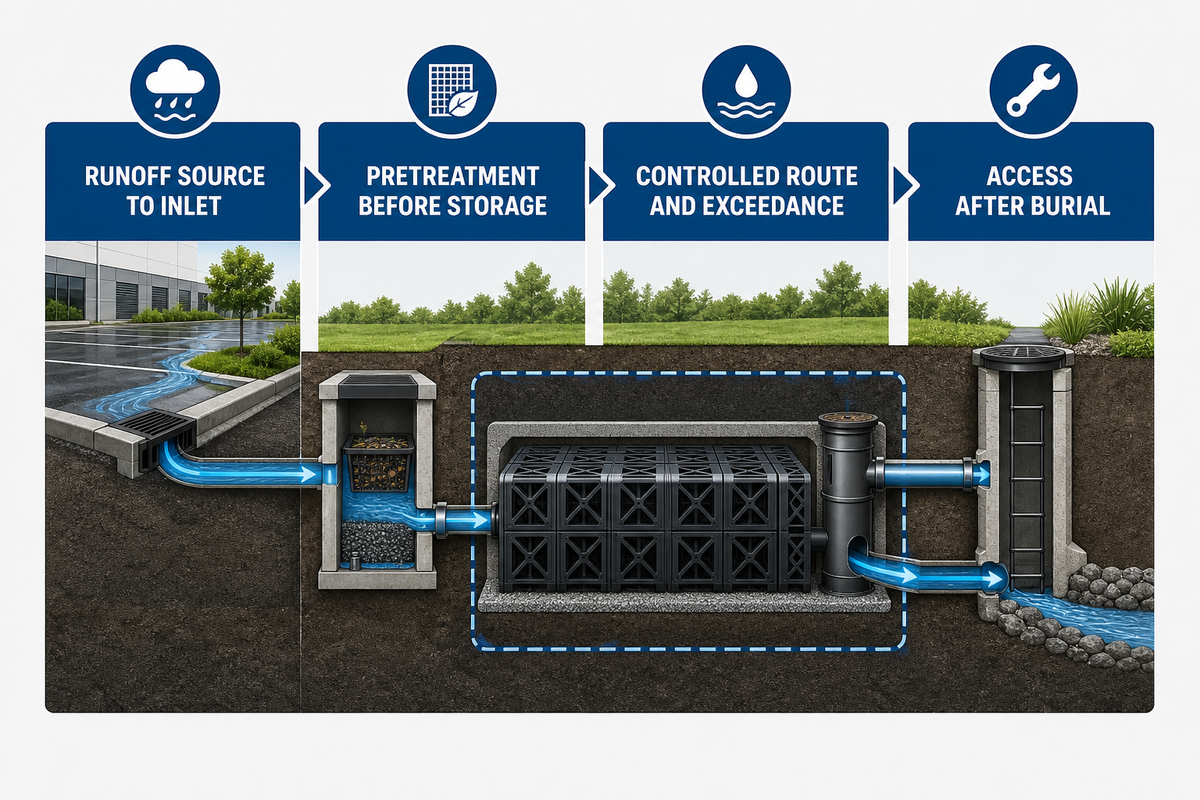
A subsurface stormwater system receives runoff, changes its timing or route, and keeps the necessary controls accessible after burial. Complete installed systems include the catchment connection, inlet, risk-based pretreatment, storage, controlled outlet or infiltration interface, exceedance route and maintenance access. Water storage hardware is only one part of complete stormwater solutions.
Philadelphia’s official manual states that subsurface detention means underground structures that “temporarily detain and release stormwater”. This brief description outlines the hydraulic function, but the same manual also separates pretreatment, inlet control, storage, outlet control, overflow and access. Those interfaces are where responsibilities often split between the designer, supplier, installer and operator.
“temporarily detain and release stormwater.”
| System element type | Decision it carries | Evidence owner | What burial can hide |
|---|---|---|---|
| Catchment | Runoff source and inflow basis | Project hydraulic team | Unrecorded area or surface change |
| Source control | Pollutants kept out of the drainage route | Owner and environmental team | An uncontrolled operational source |
| Inlet | How water enters without damaging the system | Designer and installer | Wrong level, orientation or connection |
| Pretreatment | Sediment, debris or pollutant interception | Water-quality designer | Inaccessible or missing cleaning route |
| Storage | Required volume and temporary water level | Hydraulic and structural teams | Damaged modules, wrapping or void space |
| Outlet control | Discharge rate and downstream route | Hydraulic designer | Blocked, wrong or untestable control |
| Infiltration interface | Whether verified ground can receive water | Geotechnical and environmental teams | Compaction, contamination or wrong boundary |
| Overflow route | Where exceedance flow can travel safely | Project drainage designer | Disconnected or obstructed route |
| Inspection access | How condition and controls are reached | Designer, installer and operator | Ports that cannot be opened or used |
| Operating record | Triggers, tasks, owner and retained history | Asset owner or operator | An asset with no accountable maintainer |
For parking lots and other impervious areas, placing the storage of stormwater below the surface may preserve valuable land for access or vegetation. Design still must integrate catch basins, stormwater flow, overflow and every storm event along a safe pathway. The spelling “storm water” may appear in project records, but subsurface stormwater management solutions don’t eliminate surface interfaces.
Coordination scenario: A buyer is given a storage schedule and assumes a complete package. Later, a civil drawing showed an outlet controlled by another trade, and a landscape drawing directed overflow toward a different low point. What is missing isn’t another tank calculation. It’s a controlled interface record that identifies the receiving route, levels, owners and pre-burial verification.
Evidence capsule: Philadelphia’s local manual uses a 72-hour drain-down limit after a 24-hour storm and requires positive overflow for a stated design event. Those values show why timing and exceedance are separate inputs. They are Philadelphia criteria, not universal figures for another jurisdiction.
Record the Intended Water Route at Concept Stage
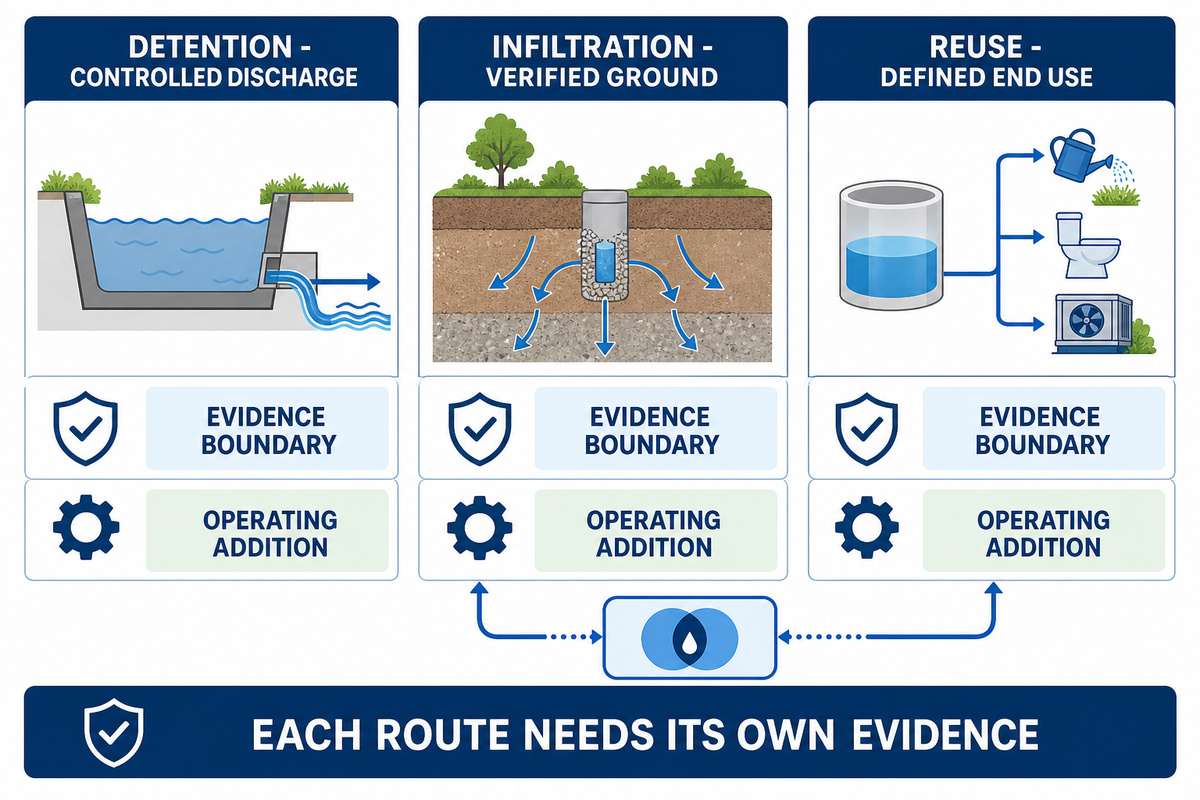
Detention controls when water leaves, and infiltration depends on verified ground receiving it. Reuse defines a beneficial end use after suitable treatment. The EPA end-use resource is the authority link for that route. Reuse can occur along a storage route, so these aren’t mutually exclusive. Each requires its own evidence, controls, and responsibility for operation.
Teams managing stormwater runoff should distinguish stormwater retention from detention and infiltration before they manage stormwater assets through design, construction and operation.
| Decision | Primary outcome | Evidence that cannot be skipped | Operating addition |
|---|---|---|---|
| Detention | Temporary storage and controlled discharge | Inflow, routing, outlet and exceedance | Control and sediment inspection |
| Infiltration | Temporary storage followed by entry into suitable soil | Soil testing, groundwater, contamination and receptors | Clogging and infiltration-performance checks |
| Reuse overlay | Captured water used for a defined non-potable or other approved end use | Source/end-use treatment target and local approval | Pumps, controls, water quality and cross-connection safeguards |
Substitution of a liner or wrapping won’t prove another route is acceptable. Infiltration needs ground and receptor evidence; reuse adds treatment, pathogen-risk and cross-connection review; detention still needs a defined outlet and exceedance route.
Chamber systems and infiltration chambers can hold stormwater, but their shape cannot select a water pathway. Some are built underground; that location does not decide whether the project provides detention and retention, infiltration or reuse. Labels such as “dry retention” and “wet detention” can be ambiguous, so the brief should define the outlet, infiltration interface, permanent pool and overflow instead. A stormwater pond holds water visibly, while an infiltration basin or infiltration trenches allow water into suitable soil only after infiltration-rate and groundwater evidence.
In the United States, the Environmental Protection Agency states that infiltration systems with infiltration-enhancing piping meet the Class V stormwater drainage-well definition. A United States project should evaluate the configuration, inventory duties and permitting authority before construction. That classification shouldn’t be used as a global rule.
Create a Controlled Decision Register Before Procurement
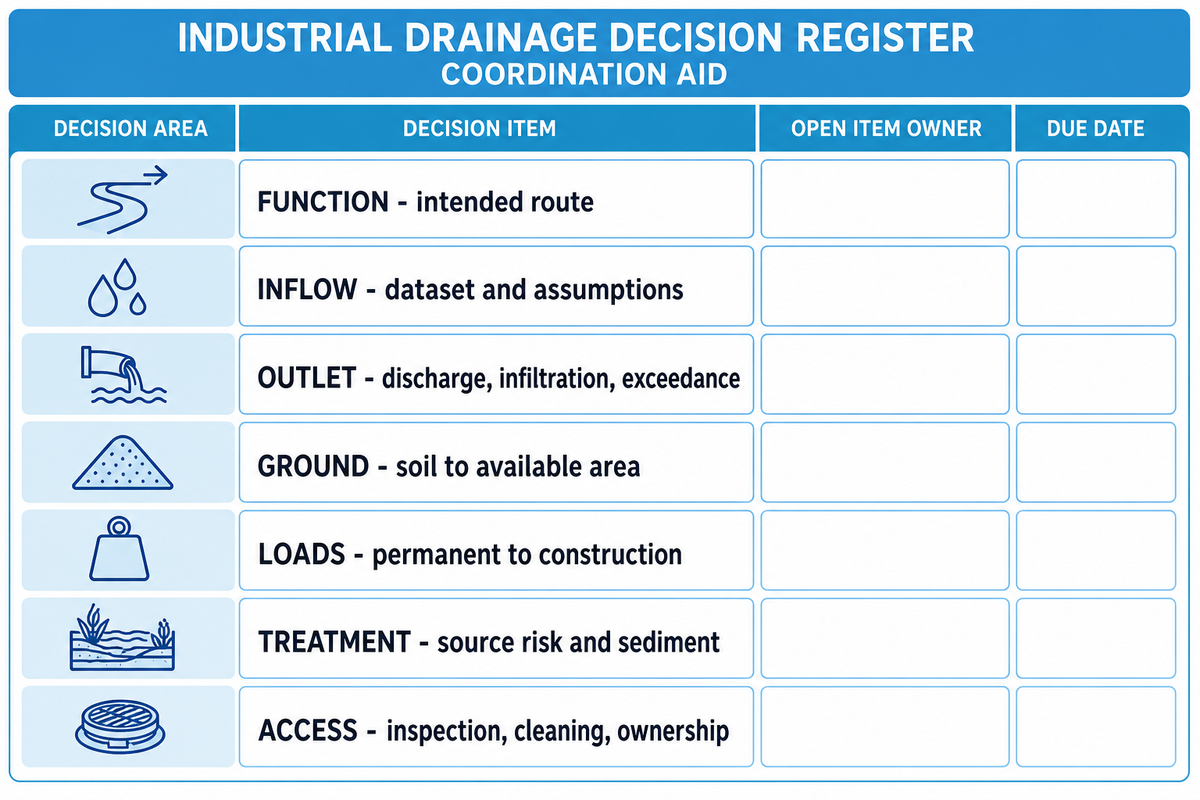
A project decision register places seven connected questions onto one controlled record before a supplier is asked to configure products. It is a coordination aid, not a published design standard. Should one input be missing, assign an owner and due date instead of leaving the gap with a commercial assumption.
- Function – state whether the system is detention, infiltration, supports reuse or a combination.
- Inflow – name the rainfall dataset and version, design horizon, required climate allowance, catchment and runoff assumptions.
- Outlet – define the controlled discharge, infiltration interface and exceedance pathway.
- Ground – define soil, groundwater, contamination, levels, utilities and available area.
- Loads – define permanent, temporary, traffic and construction loads.
- Treatment – identify source risk, pretreatment, sediment control and any downstream process.
- Access – define inspection, cleaning and control, and record the location and maintenance ownership.
Site area and target volume cannot answer these questions. Rainfall information should describe the dataset and the revision because a NOAA-hosted review reports that the commonly used methods for intensity-duration-frequency need revision for nonstationarity due to climate change. The reviewed record is available in the NOAA institutional repository. Project teams must use the required method and design horizon; this article doesn’t create a generic climate forecast.
Fictional form entries only: a training record might show a 2.4 ha catchment, 1,250 m³ modelled storage, 180 L/s discharge, groundwater observed 0.8 m below formation, 45 kPa temporary load, 1.2 m cover, 3,400 m² geotextile, 1.5 mm liner, 600 mm inlet, 225 mm outlet, 450 mm overflow, 12 access ports, a 20 kg sediment trigger, a 24-hour observation, a 6-hour checkpoint, an 8-hour release, a 3-day recheck, a 4-day closure, a 5-day record, 12 kg removed and a 15 mm reading. None is a design recommendation or product limit.
After the hydraulic basis is addressed, AQUA’s storage-quantity planning tool can assist with preliminary commercial planning. It cannot replace local hydrologic design, outlet routing or ground evidence.
Evidence capsule: the decision register separates 1 intended function from 6 connected evidence and operating fields. One controlled sheet may work, but its revision, assumptions and open-item owners matter more than page count. In practice, this register is a coordination method, not a sizing equation.
Connect Hydraulic, Ground and Structural Evidence
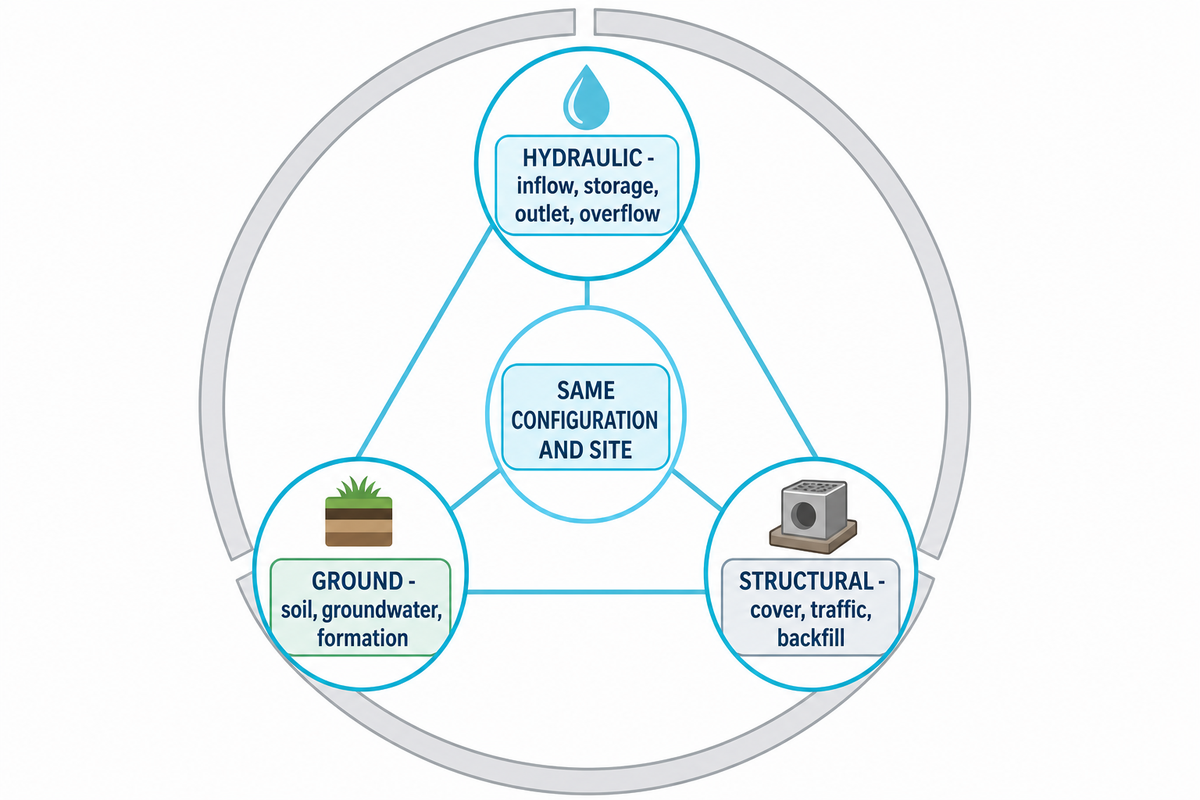
An Evidence Triangle consists of three elements: hydraulic, ground, and structural. Acceptance requires all three for the same configuration and site. Philadelphia’s subsurface-detention manual is the cited public authority for the hydraulic boundary. No conclusion in one element can make up for an element that’s undetermined, since the disciplines focus on answering different failure mechanisms.
Hydraulic
Inflow, storage, water levels, outlet, overflow and treatment route.
Ground
Soil, groundwater, contamination, formation, settlement and infiltration suitability.
Structural
Cover, traffic, backfill, temporary loading, material behaviour and construction sequence.
Review scenario: A modular unit arrives with a factory compression result, so the project team treats the structural corner as closed. However, the geotechnical report refers to another formation level, and the civil model assumes a cover build-up that never reached the supplier. A coordinated project review is the correct answer, NOT a higher grade of the product selected in isolation.
Document control belongs in the triangle. Maryland’s official stormwater page, for example, publishes draft updates dated September 2025 while identifying the official manual as revised in May 2009. This doesn’t establish the requirements for another project. It illustrates the need for teams to indicate draft status, effective revision, and jurisdiction separately.
Using the material-interface route tool can carry a defined project toward commercial review; it should receive verified boundary conditions rather than create them.
Build a Treatment Train, Not Just Storage Volume
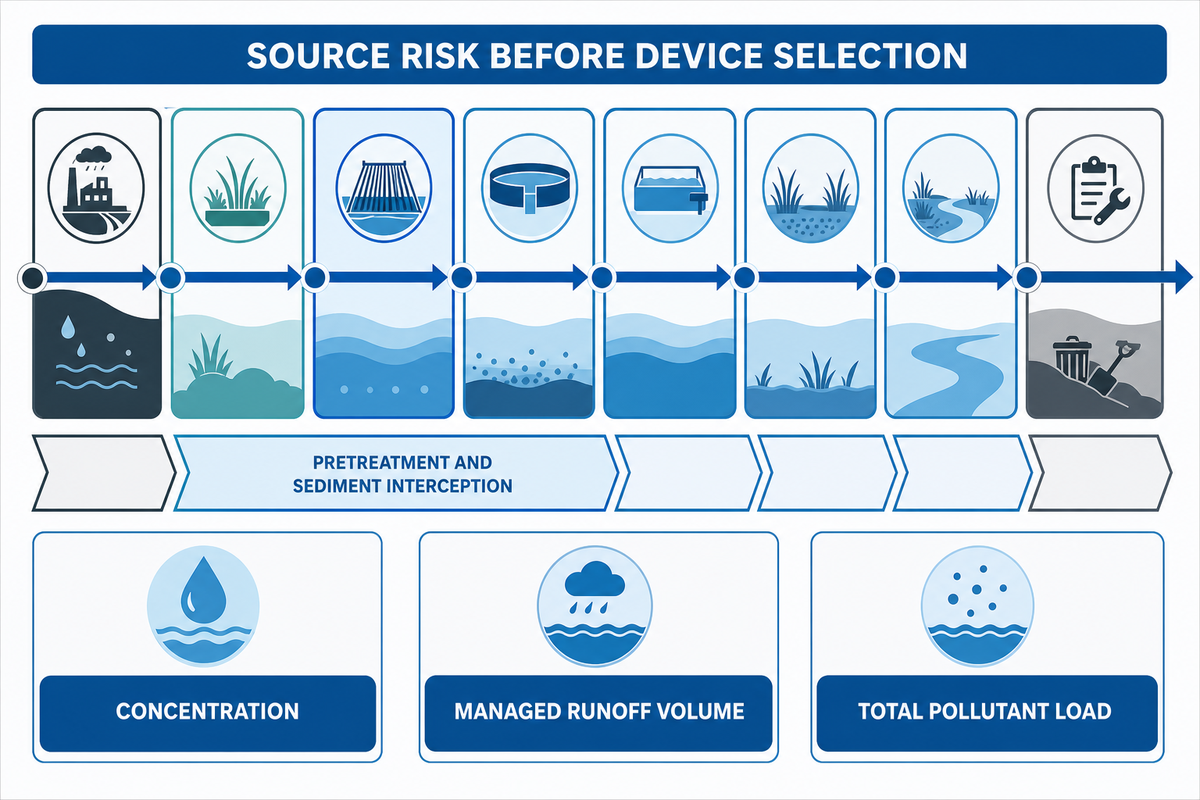
Underground storage doesn’t prove pollutant removal. Water quality depends on the runoff source, pollutants of concern, receiving route, source controls, suitable pretreatment, sediment interception, any downstream process and maintenance. Source controls and pretreatment address pollutants from stormwater before storage or discharge. Risk screening determines how those controls treat stormwater runoff within the overall stormwater plan. Claiming that a defined device is required for every buried system isn’t more justified than treating storage volume alone as treatment.
EPA assesses performance against concentration, controlled volume of managed runoff and total pollutant load. Its Three Keys page is the cited source for these metrics. Each measure responds to a different question. A high percentage removal can, for example, mislead if the influent concentration is low. A concise brief states which metric and receiving outcome matter, and connects monitoring or acceptance to the stated purpose.
Stormwater best management practices within a stormwater management plan can treat stormwater runoff and improve water quality. Applicable stormwater requirements and the risk screen determine whether controls must address pollution, protect surface water, water resources and other water bodies, or remove sediment before storage.
| Assumption | Likely consequence | Question to close |
|---|---|---|
| Void volume equals treatment | Unsupported water-quality claim | Which pollutant and performance metric? |
| Sediment will settle harmlessly | Lost volume or blocked controls | Where can sediment be intercepted and removed? |
| Overflow is outside the treatment brief | Untreated exceedance follows an unknown route | What happens when the design condition is exceeded? |
EPA groundwater guidance allows designers to include pretreatment where appropriate and when pollutant removal is required. Wording matters. Land use, spill potential, contamination, groundwater sensitivity, receiving water and cleaning access should drive the treatment train. Device selection should follow the risk screen, not the other way around.
Evidence capsule: EPA’s 3 performance keys are concentration, managed runoff volume and total load. A result reported as 80% removal would still need its influent basis, volume and monitoring scope before it could support a project claim. Here, 80% is illustrative, not a product result.
Use a 4-Owner Interface Map at Construction Hold Points
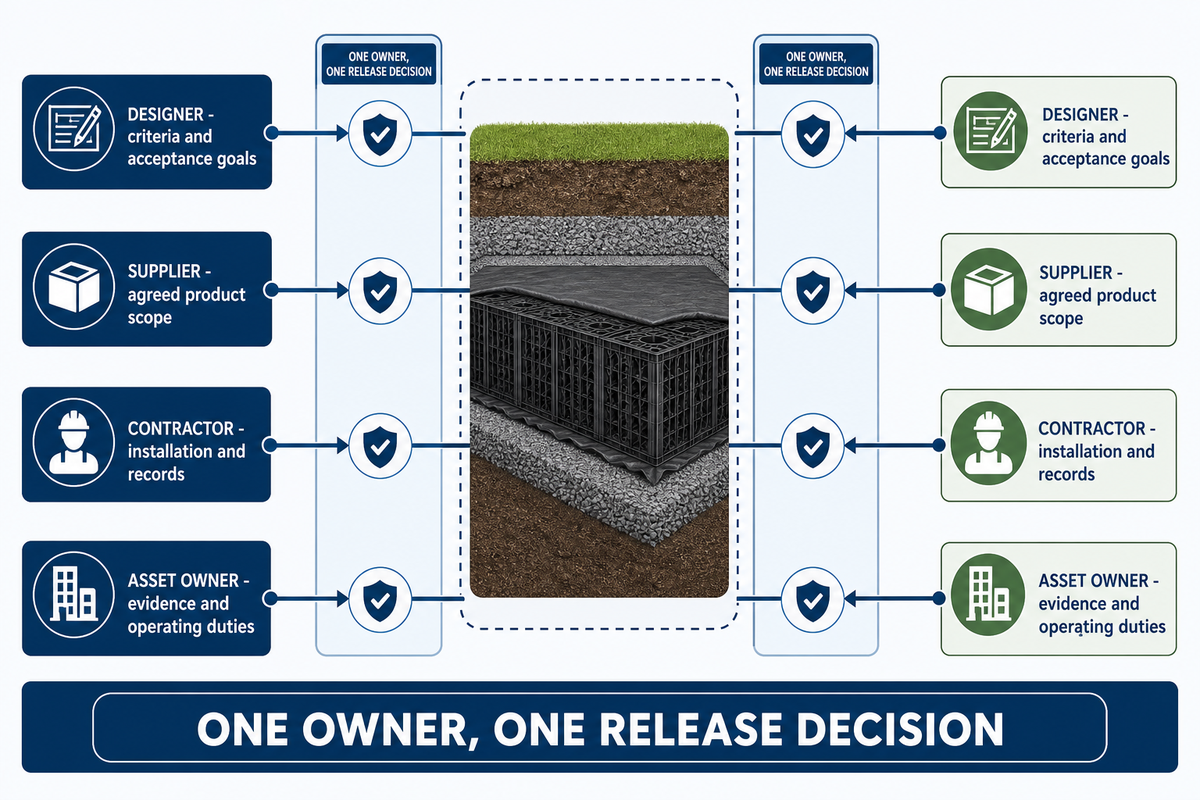
Construction hold points preserve evidence while the work can still be seen and corrected. Philadelphia’s manual is the public reference used here for buried detention components and access. The project should assign acceptance questions for formation, separation layers, lining, module assembly, inlets, outlets, overflow, controls, access and backfill before closure. Whether a route uses modular storage facilities, pipe systems or a metal pipe connection, a post-burial photograph cannot prove every concealed interface or construction condition.
| Hold point | Record before release | Primary owner | Release question |
|---|---|---|---|
| Excavation | Limits, utilities, water and unexpected ground | Contractor with project review | Does the exposed condition match the design basis? |
| Formation | Level, condition and accepted preparation | Geotechnical/civil team | Can the specified build-up begin? |
| Geotextile | Product identity, overlap and damage status | Installer | Is the separation/filter boundary continuous? |
| Geomembrane | Identity, interfaces, seams and protection | Specialist installer | Is the containment boundary accepted? |
| Module assembly | Configuration, orientation and visible damage | Installer and supplier support | Does the assembly match the approved supply record? |
| Inlet connection | Level, detail, seal and flow path | Drainage contractor | Can inflow enter as designed? |
| Outlet/control | Device identity, level, access and setting | Hydraulic contractor/designer | Is the controlled route testable? |
| Overflow | Connection and unobstructed receiving route | Civil team | Can exceedance leave without an unknown path? |
| Access | Ports, clearances and equipment route | Designer and operator | Can inspection and cleaning actually occur? |
| Backfill/cover | Material, sequence, visible condition and as-built level | Contractor with structural review | Can the concealed work be released? |
Designers fix performance criteria and acceptance goals. Suppliers fix the agreed product scope. Contractors own the installation work, their means and methods, and the related records. Asset owners receive the evidence and operating duties. Project contracts can allocate responsibilities differently. Nevertheless, each line still requires one accountable owner and one release decision.
Hold-point scenario: at the end of a shift, the storage body is complete and the backfill crew is expected the following morning. There are three access ports, two outlet interfaces and one overflow connection. A short joint release record can be made and can include identities, levels, photos, and open items. Waiting for cover to be placed will transform a simple check into a time-consuming investigation.
Evidence capsule: an illustrative release could index 12 photographs across 3 access ports, 2 controlled connections and 1 overflow route. Those counts describe record structure, not a universal inspection quantity. Approved design and the inspection plan decide the real hold points and evidence.
Keep Factory Evidence Inside Its Decision Boundary
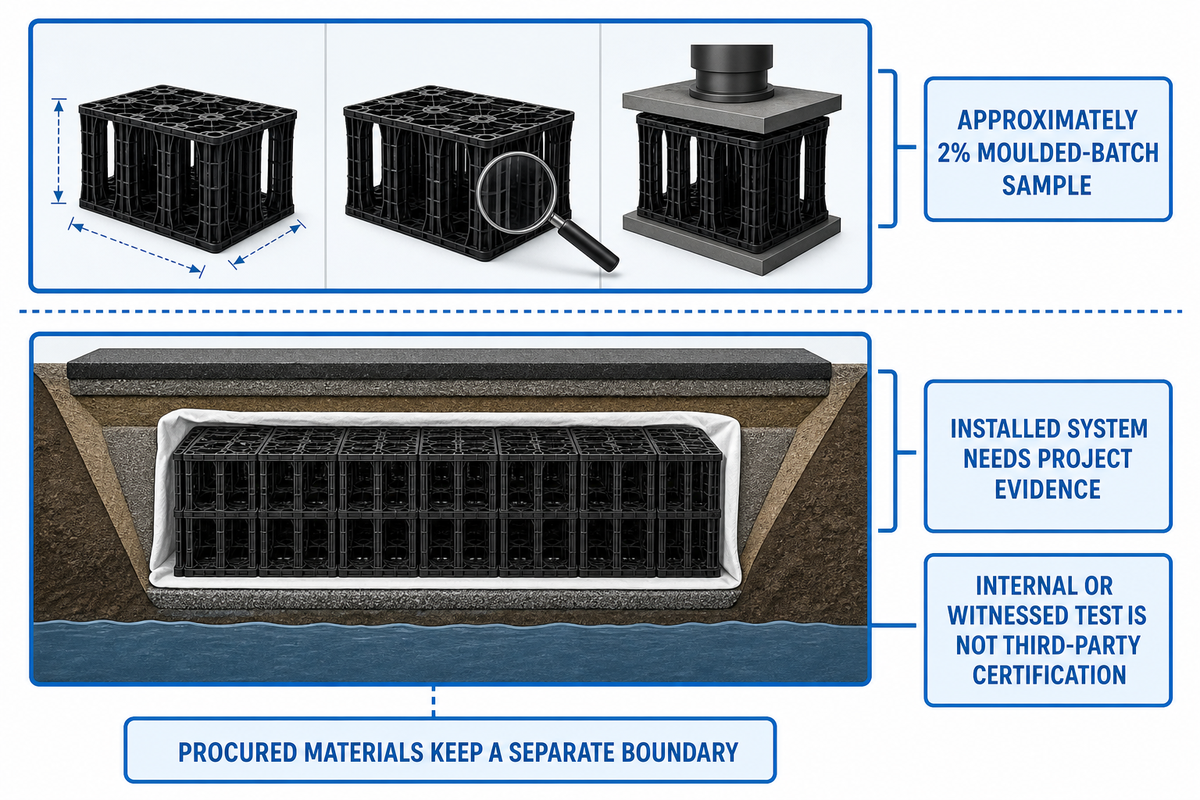
A product/batch test responds to a limited product query. Acceptance of an installed system also includes soil, cover, traffic, groundwater, backfill, interfaces and construction sequence, and the long-term behavior of the system in the actual project. The Caltrans detention guidance is the government reference used for the wider project-system boundary. Treating a compression result as approval of the buried works collapses several evidence layers into one number.
An American Society of Civil Engineers committee case account warns practitioners to treat underground plastic detention systems with caution and discusses creep, buckling and construction conditions. This is an expert case and not a consensus ban. Practically, the case outlines a clear boundary: short-duration component evidence can’t resolve the long-term performance of an installed system.
AQUA’s owner-confirmed workflow uses approximately 2% sampling for moulded-product batches, covering dimensions, colour, appearance and compression. AQUA has an in-house compression testing machine and can arrange witnessed tests or agreed test videos. Internal or witnessed factory testing is not third-party certification, and the moulded-product sampling workflow must not be extended to procured geotextile, geomembrane or EPDM batches.
Ask the evidence to prove
- Which product, batch, configuration and test condition were checked?
- Which project decision uses that result?
- Which ground, load and construction questions remain open?
Do not infer
- Factory test equals installed-system approval.
- Internal test equals independent certification.
- One product-family process covers procured materials.
Evidence capsule: AQUA’s approximately 2% moulded-batch sample and its 30-machine core moulded-product operation are factory-process facts. Neither figure sets project cover, load, life or acceptance. Even with those factory facts, an installed system still needs the 3-corner hydraulic, ground and structural review for its actual site.
Close the Lifecycle With a 3-Record Operations Handoff
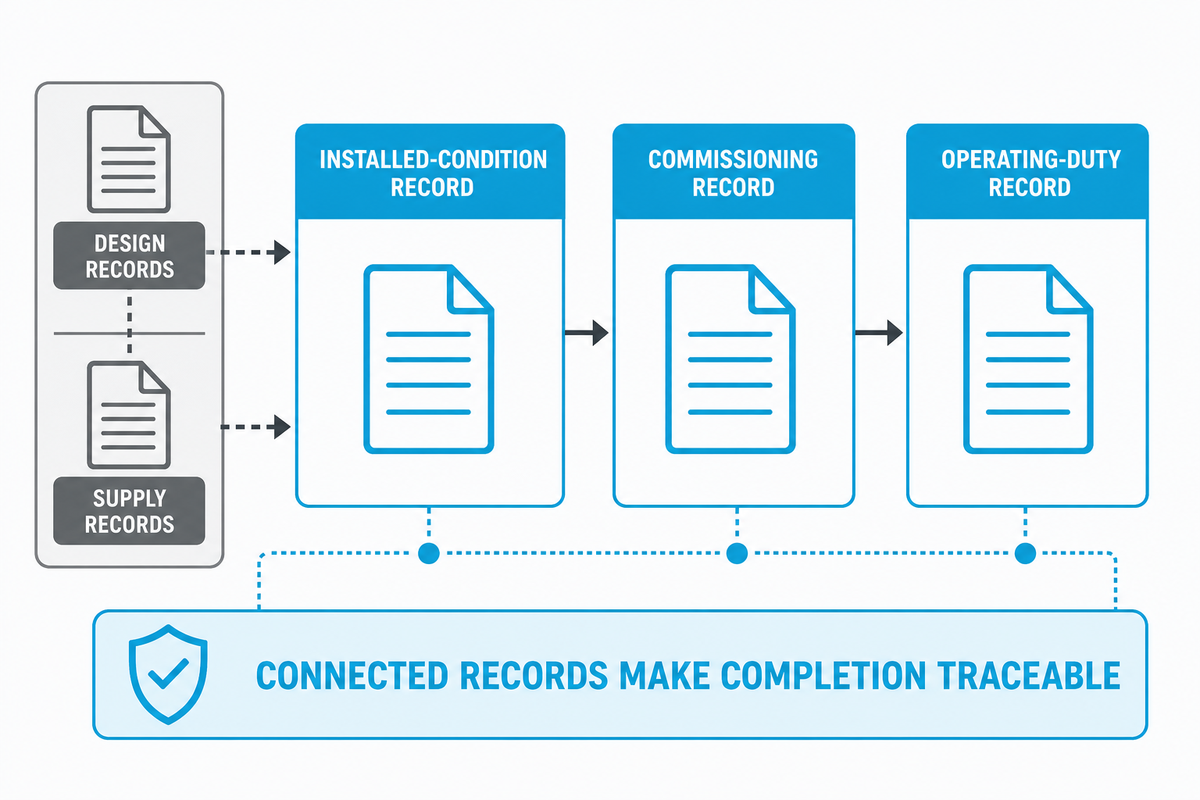
A 3-Record Operations Handoff connects the accepted installed condition, commissioning results and assigned operating duties. Design and supply records remain upstream references, but they can’t replace as-built interfaces, control checks or maintenance ownership. Connected records make completion traceable.
- Installed-condition record — formation, boundaries, connections, assembly, hold-point releases, as-built condition and links to the accepted design and supply references.
- Commissioning record — controls, flow path, access and the agreed functional checks.
- Operating-duty record — inspection triggers, maintenance tasks, responsible party, residual risks and retained history.
AQUA provides products, supporting materials and product-related documentation. Remote guidance, loading supervision and on-site technical support can be arranged. AQUA is not the project installation contractor, so installation acceptance and overall commissioning remain project responsibilities.
Being able to determine the location of missing evidence does not make burial an acceptance test; a good handover package prevents that evidence from becoming expensive to reconstruct. A good handover package should let the operator identify evidence through the installed record, supply identity and design basis without assumptions about which revision applies. The Philadelphia manual is the public systems reference for that installed-record boundary.
Evidence capsule: AQUA says a normal scheduled factory audit can generally take 1–2 days, while loading supervision generally takes 1 day or sometimes 2 days with the loading schedule. Those supplier activities can support upstream supply and installed-condition evidence; they do not replace project commissioning or operating ownership.
Assign the Operator and Access Duties Before Design Freeze
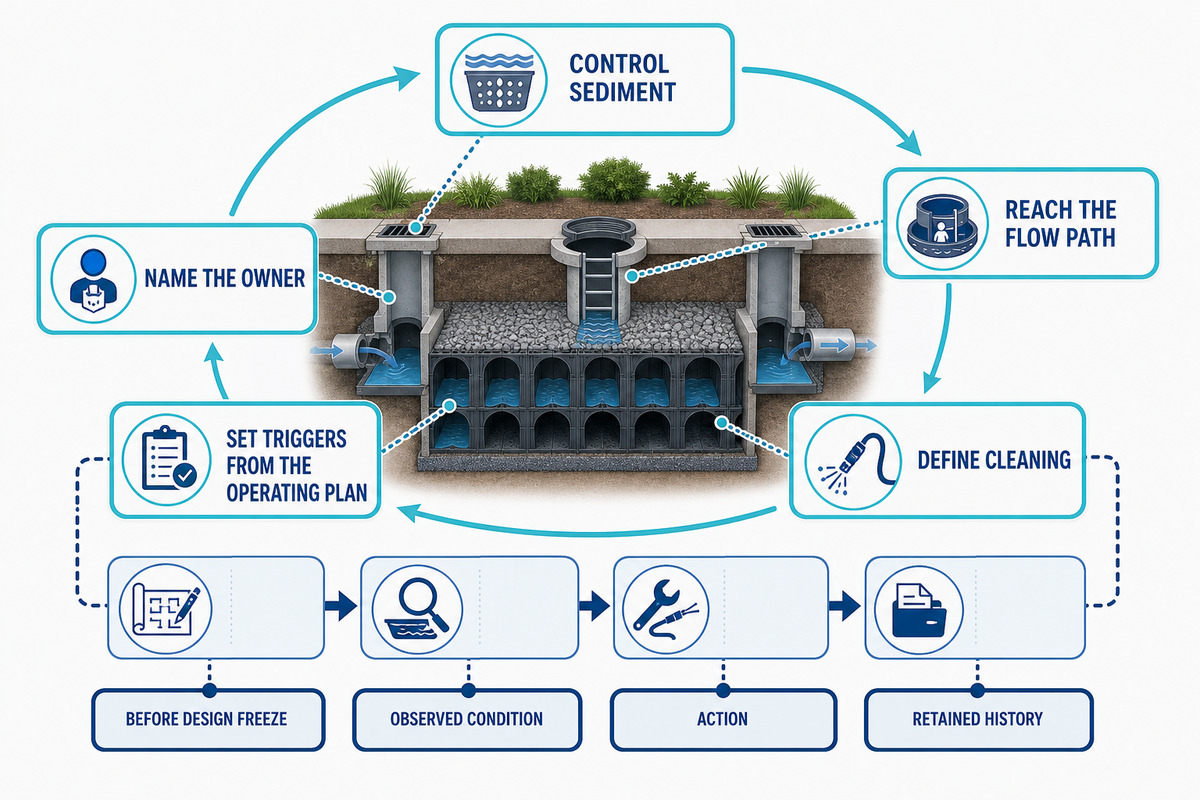
Maintainability is designed through sediment interception, reachable controls, safe access, a cleaning route, inspection triggers, record location and a named responsible party. Deferring those choices until commissioning can leave the operator with ports that cannot be reached, controls that cannot be checked and no practical way to remove accumulated material.
- Control sediment: locate interception, observation, and removal.
- Reach the flow path: Inlet, outlet, overflow and associated controls must be inspectable.
- Define cleaning: align access points to intended equipment and waste path.
- Set triggers: use the approved operating plan, observed condition and local requirements rather than a copied universal interval.
- Name the owner: assign action, escalation and record retention to a role.
Underground systems conceal their own deterioration. Regular inspections are recommended in Philadelphia guidance because signs of maintenance needs aren’t obvious. In contrast, university guidance associates the absence of pretreatment, compaction and clogging with infiltration problems. See the University of Minnesota maintenance guidance for the cited maintenance evidence. Neither guidance provides a service interval for all systems. Without inventing a universal interval, the operating plan is required to specify what condition or event triggers action.
Evidence capsule: a hypothetical record might note 4 ports inspected, 2 ports cleaned, 18 kg of sediment removed and 35 mm of standing water after 24 hours. Those are formatting examples only. Asset-specific triggers, safe access and acceptance limits belong in the approved operating plan.
Let Project Outcomes Drive the Terminology
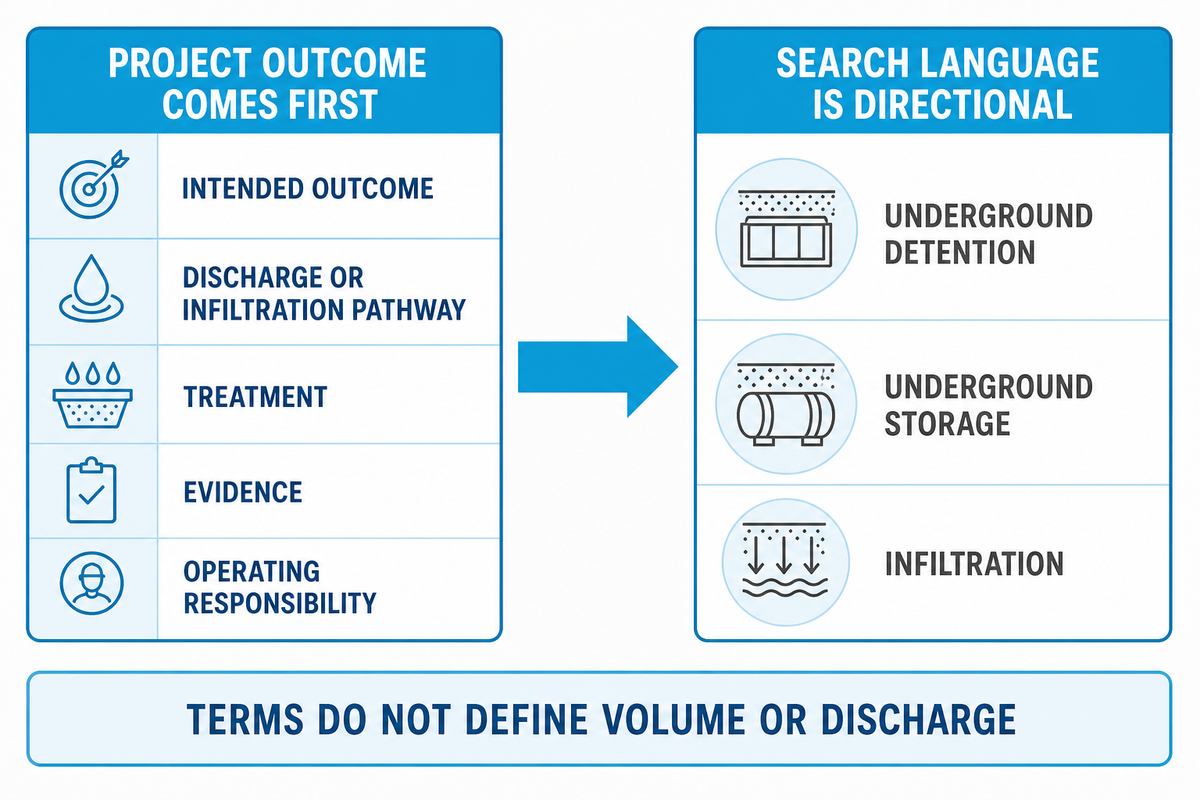
Buyers typically look for an outcome rather than an overarching category, so detention, underground storage and infiltration language contains useful intent data. EPA’s groundwater-protection resource provides the authority boundary for infiltration terminology. Keyword demand still can’t define the engineering route. Project outcomes must come first, after which terminology should clarify the route to designers, suppliers and searchers.
Searchers may also use “underground stormwater management solutions” or “stormwater underground.” Such wording does not establish the amount of stormwater to manage, the discharge route or the evidence needed for a project.
Current US keyword data shows about 480 monthly searches for “underground detention system,” 210 monthly searches for “underground stormwater detention system,” 210 monthly searches for “underground stormwater storage systems,” and 10 monthly searches for the focus phrase. These phrases are directional search-demand indicators; they aren’t estimates for potential market size or sales. Observed related queries also include “underground retention system,” “underground detention system design,” and “underground detention system cost.” These are search-language variants, not engineering routes, cost guidance or commercial promises.
Evidence capsule: September 2026 United States data shows a 48:1 difference between 480 searches/month for “underground detention system” and 10 searches/month for the exact umbrella phrase. That ratio describes search language in one dataset. It does not prove project demand, growth or technical suitability.
Hand the Controlled Brief to AQUA’s Configuration Route
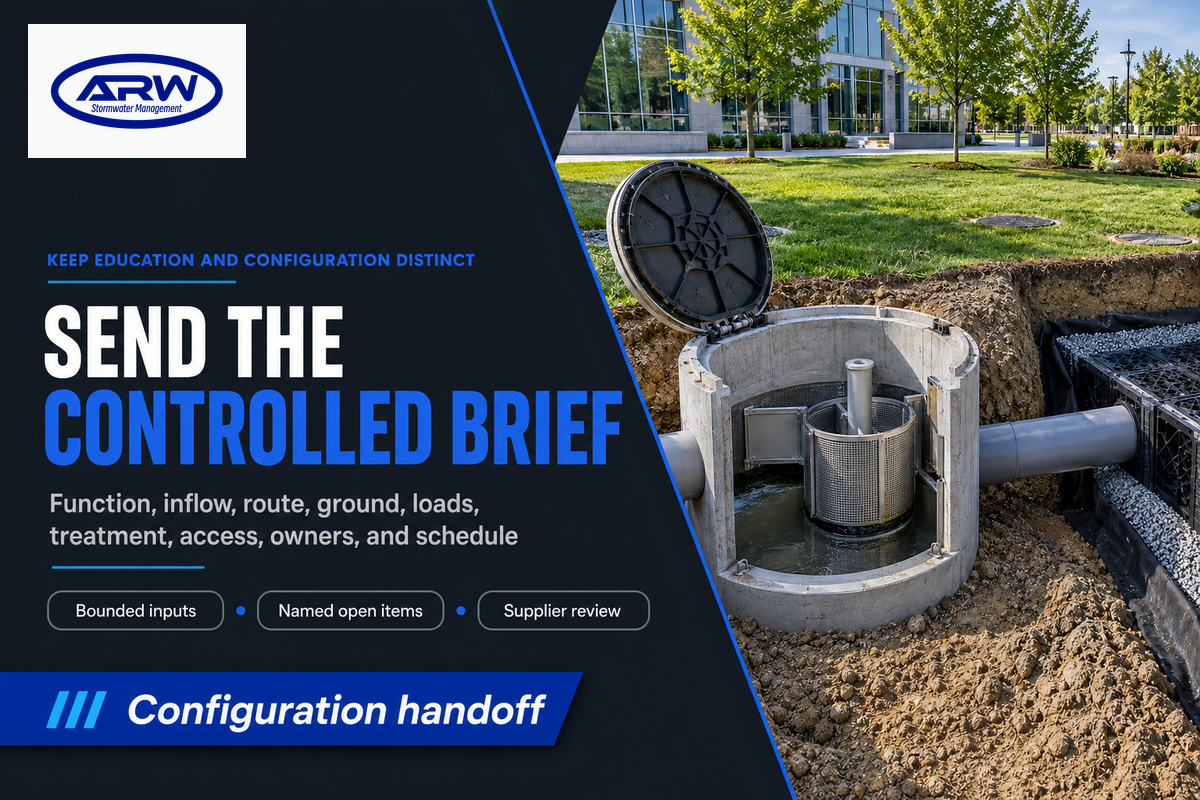
A project is ready for supplier configuration when the intended function, hydraulic basis, outlet or infiltration route, ground conditions, loads, interfaces, treatment needs, access, destination and schedule are bounded. The NOAA repository review is the authority source for the rainfall-dataset qualification in that brief. You can anticipate some unknowns, but each should have an owner, a due date, and a defined consequence rather than being an assumption hidden from the supplier.
Teams can send the defined brief to AQUA’s configuration route for product options and configuration review. Buyers preparing a purchase enquiry can also use the underground storage request checklist. This guide deliberately doesn’t reproduce either destination’s product, packing, cost or quotation modules.
AQUA’s core moulded-product operation uses 30 injection-moulding machines across two shifts and 24 hours, with approximately 15 years of export experience. The owner has confirmed the working capacity is around 1,000 m³/day, with annual exports being around 300,000 m³/year. A typical core-module production 40HQ takes around 2–3 days, though it could take as long as 7 days, not including any raw-material preparation. Preparation of materials, order mix, the season, and model control the real schedule on site.
Ready to check the lifecycle decision register?
Submit the function, inflow basis, route, ground, loads, treatment and access details. Include the schedule for a bounded supplier review.
AQUA Rain Water provides products, supporting materials, and product-related documents. AQUA doesn’t provide full installation/construction services.
Frequently Asked Questions
This provides instructive answers to a few of the many repetitive scope questions while leaving the original project design unscathed. This differentiates the water route, site evidence, treatment, structural review, and retained records and enables the potential buyer to ascertain what remains known, what still remains uncertain, and who retains the responsibility for the next step of the process.
What are the different types of stormwater management systems?
Systems can manage runoff quantity, water quality or both. Routes include basins, swales, bioretention, permeable surfaces, underground detention, subsurface infiltration and storage that supports reuse. Some slow discharge, some send water into verified ground, and some add treatment for a defined end use. Classify the system by that outcome, then document any combined route, overflow path and maintenance duty instead of relying on a product label.
What is a subsurface infiltration system?
It stores runoff below ground and lets it enter verified suitable soil. Evidence is needed for infiltration rate, groundwater, contamination, nearby receptors, pretreatment and access. Unlike lined detention, it depends on the ground receiving water. Projects must also show that water-quality risk is controlled and that the intended route remains maintainable over time.
What is the difference between stormwater detention and infiltration?
Detention stores runoff and releases it at a controlled rate, so it needs outlet and exceedance evidence. Infiltration holds water before it enters suitable ground, so it needs soil, groundwater and water-quality evidence. Both routes need access, sediment control, maintenance ownership and records. A combined project should document each route and the interface between them.
Why do underground stormwater systems need pretreatment?
Pretreatment limits sediment or debris reaching buried storage and controls. Method selection follows source risk, receiving route and cleaning access.
Can a subsurface stormwater system be installed below trafficked areas?
It may be possible after project-specific structural review. Review should cover permanent and transient traffic loads, cover, soil and backfill, groundwater, long-term material behaviour, assembly, temporary construction loads and the intended sequence. Product identity and test scope must match the reviewed configuration. A factory compression value or headline load grade can’t approve a particular car park, yard or road installation on its own.
What documents should be retained at handover?
Retain the controlled design basis and authority list; approved product and component schedule; batch and inspection records; formation, interface, connection, assembly and backfill releases; as-built drawings and photographs; control settings and commissioning results; access and cleaning details; identified residual risks; maintenance plan and triggers; named operator; nonconformity closure; and later inspection history. Each record should identify its revision, date, responsible owner and relationship to the installed configuration so an operator can trace a future observation, isolate the affected interface, find the accepted baseline and assign the next action without reconstructing the project from emails.
References & Sources
This guide uses these government, academic and professional sources to define decision boundaries. Local manuals provide examples of evidence structure, but are not framed as universal requirements. Commercial competitor websites, failed forum scrapes and search snippets are not included as evidence in this guide.
- Philadelphia Water Department, Subsurface Detention
- United States Environmental Protection Agency, Three Keys to Stormwater Practice Performance
- United States Environmental Protection Agency, Green Infrastructure and Groundwater Protection
- United States Environmental Protection Agency, Water Reuse End-Use Applications
- United States Environmental Protection Agency, Stormwater Drainage Wells
- United States Environmental Protection Agency, Onsite Non-Potable Water Reuse Research
- NOAA Institutional Repository, Review of Nonstationary Intensity-Duration-Frequency Methods
- California Department of Transportation, Detention Basins Design Guidance
- Maryland Department of the Environment, Stormwater Design Manual Status
- University of Minnesota Stormwater Treatment Book, Maintenance of Infiltration Practices
- American Society of Civil Engineers, Underground Plastic Stormwater Detention Systems Case Discussion
![Ground Grid Applications & Ground Reinforcement [Guide]](https://aquarainwater.com/wp-content/uploads/2026/09/ground-grid-applications-ground-reinforcement-blog-featured-768x512.png)