Get in touch with AQUA Company
UAE Stormwater Attenuation Project Evidence: Pre-Cover Checks and Handover
Updated September 2026 · Educational project guide from AQUA Rain Water
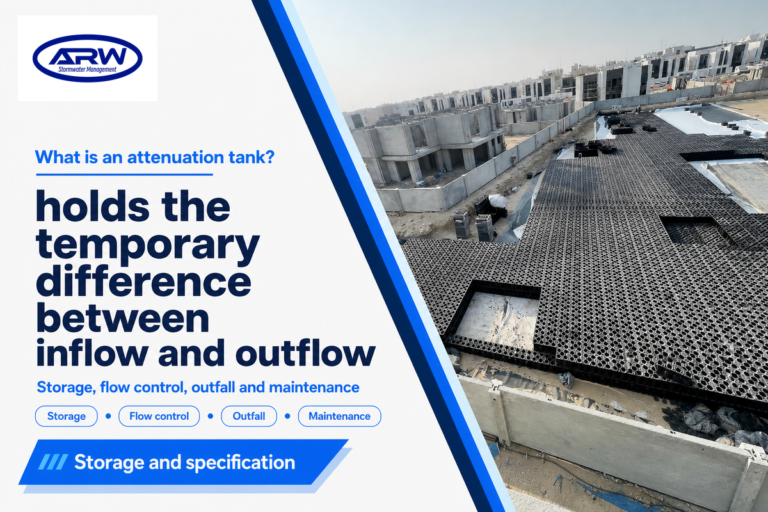
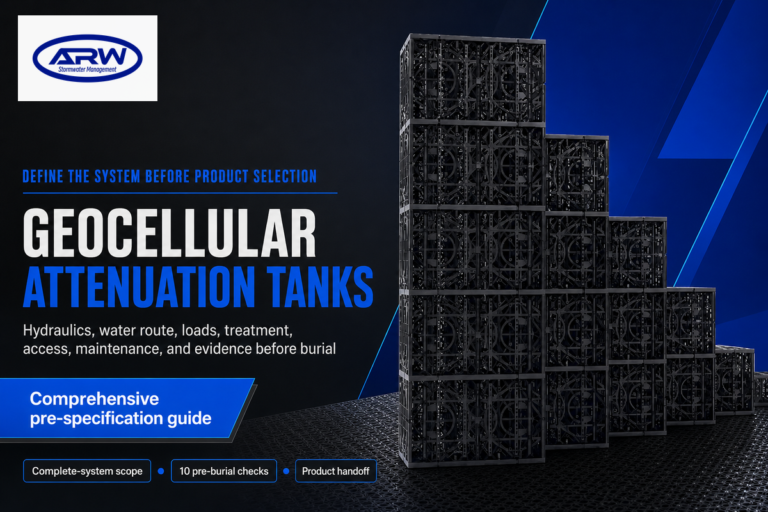
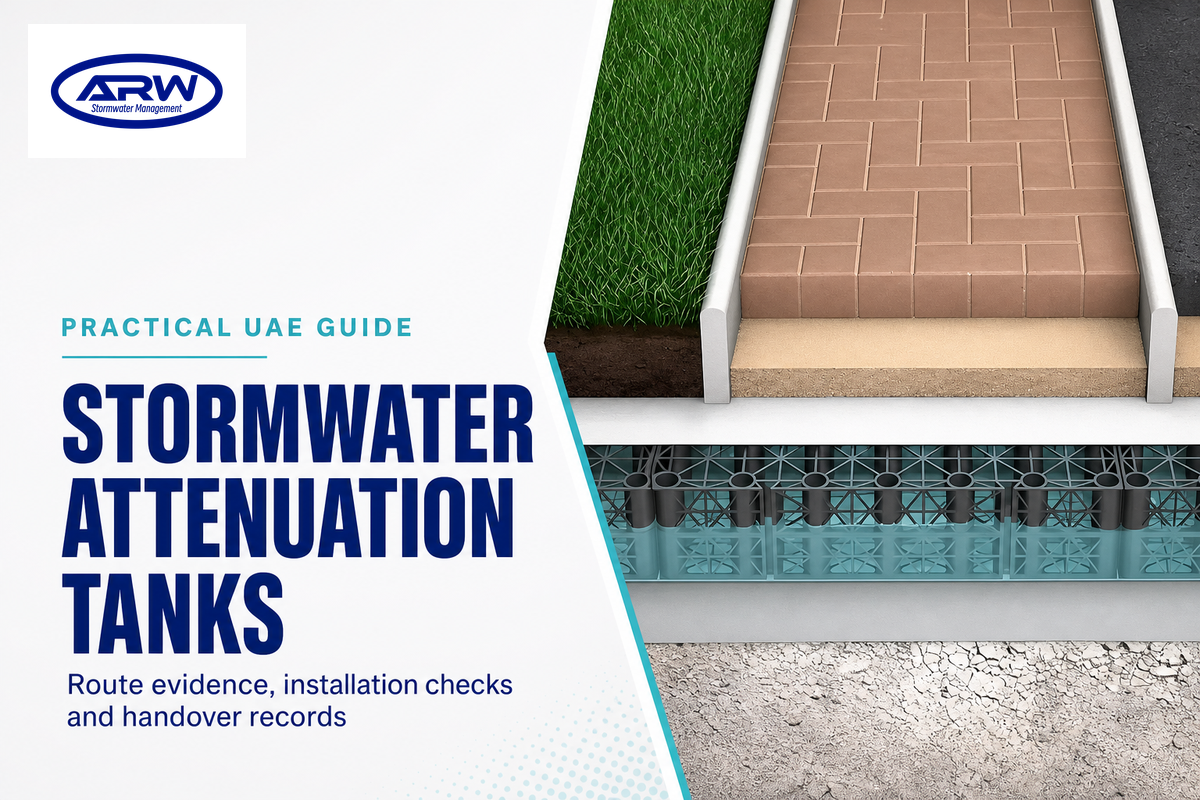
Stormwater Attenuation Tanks UAE refers to buried attenuation systems, where the majority of the interfaces may be buried under fill. In the design information for your system, the volume capacity of each tank shouldn’t be the only consideration. The useful record is the one that shows what was installed, which drawing governed the work, who released each hold point, what changed, and how the operator can inspect the finished system.
Evidence rule: if an interface will be inaccessible after cover, define its record, owner and acceptance decision before the work is concealed.
The short answer
- Confirm the governing emirate, authority, revision and discharge pathway for each inspection record.
- Each of the following should be clearly indicated: Pretreatment, sediment control, inspection access, ownership
- Captured all interfaces and hold points before backfilling conceals your work
- Separate supplier product records from contractor installation and designer acceptance records
- Hand over an indexed pack that connects as-built drawings, photographs, inspection access and maintenance ownership
This guide aims to fill a specific role. The commercial page for Stormwater Attenuation Tanks UAE has the commercial decision. That page has the responsibility for the configuration of the product, review and approval of the capacity/load, and documents and the conversion of a quotation. This article won’t deal with those decisions. Rather, it will provide consultants, contractors, inspectors and owners with a practical means of controlling the evidence prior to burial and of preparing a clear, concise handover record.
These are case records, not standard design data. Terms and nomenclature vary and can be confusing. Use the project’s approved terminology consistently so each record preserves the intended system function.
The approved stormwater management design may address rainfall, surface water run-off, runoff volume, downstream discharge, an impermeable attenuation zone, a soakaway, stored water, flood routing and the risk of flooding within a wider sustainable drainage and water management strategy. This guide won’t analyze the volume of water or the design. Instead, it documents evidence against them.
For this evidence task, the developer should trace each drainage plan revision, heavy rainfall response, excavation hold point, flow rates, storm event, watercourse connection and Tank Maintenance owner.
Start With the System Boundary, Not the Tank Photograph
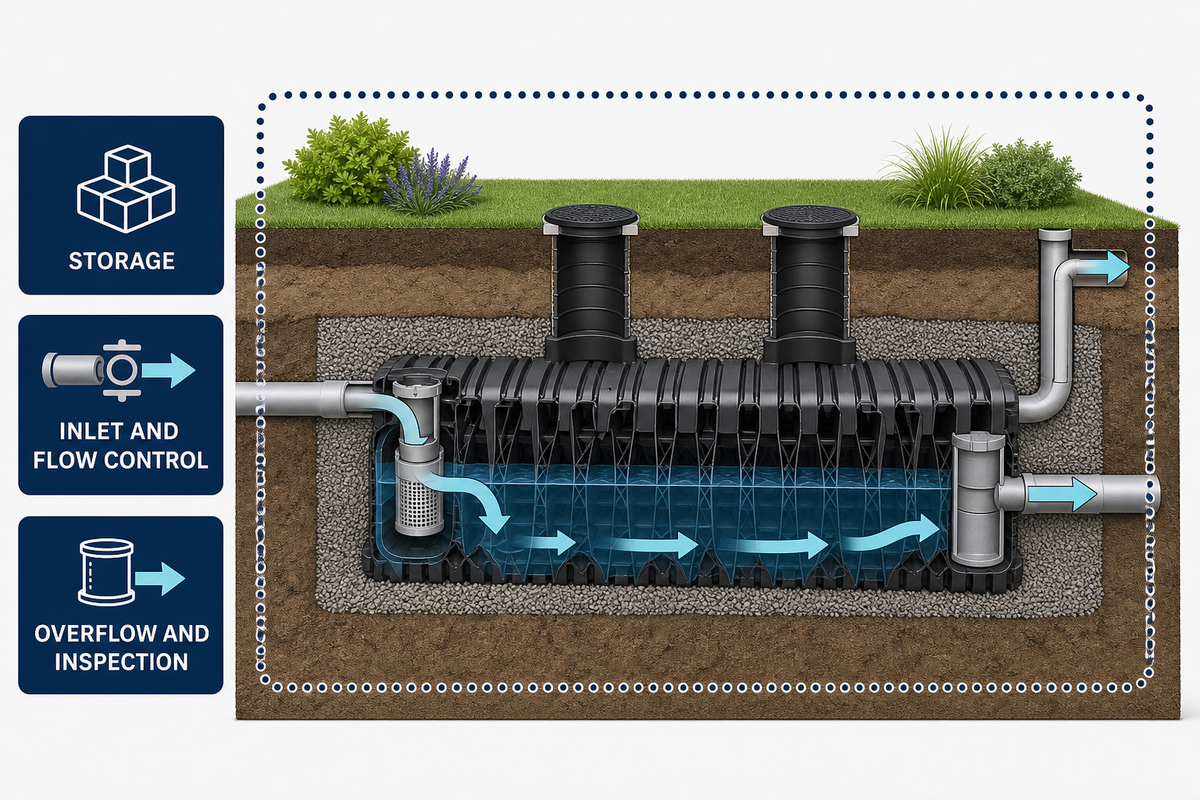
An integrated management system includes temporary stormwater storage. In a more sophisticated stormwater management system, treated and stored water should be distinguished, and surface-water obligations should be maintained. One element of an attenuation system is a tank, chamber or void form. The system should include an inlet, a flow control device, an outlet, an overflow route, access for inspection and an upstream catchment.
Temporarily stored stormwater is an element of an attenuation system. The attenuation system can be used to control the rate of water reaching a sewer or a watercourse, but it does not by itself determine the permitted discharge, size the system for a design storm or remove every pollutant. For stormwater management, a tank can manage the volume and timing of discharge, while treatment, reuse, and compliance with discharge requirements are separate functions.
A drawing should show a water path to depict the complete system. Runoff, sediment capture, filling of the storage, placement of controlled outlets, and the outcome of design case exceedance should be shown. If a drawing is unable to show exceedance, the project has an open hydraulic question. The open hydraulic question isn’t settled and creates a risk of flooding.
The SusDrain geocellular storage overview shows a general system context. The project record must document the applicable UAE authority, approved design, interface owner, and acceptance decision.
Control the Authority, Drawing and Revision Trail
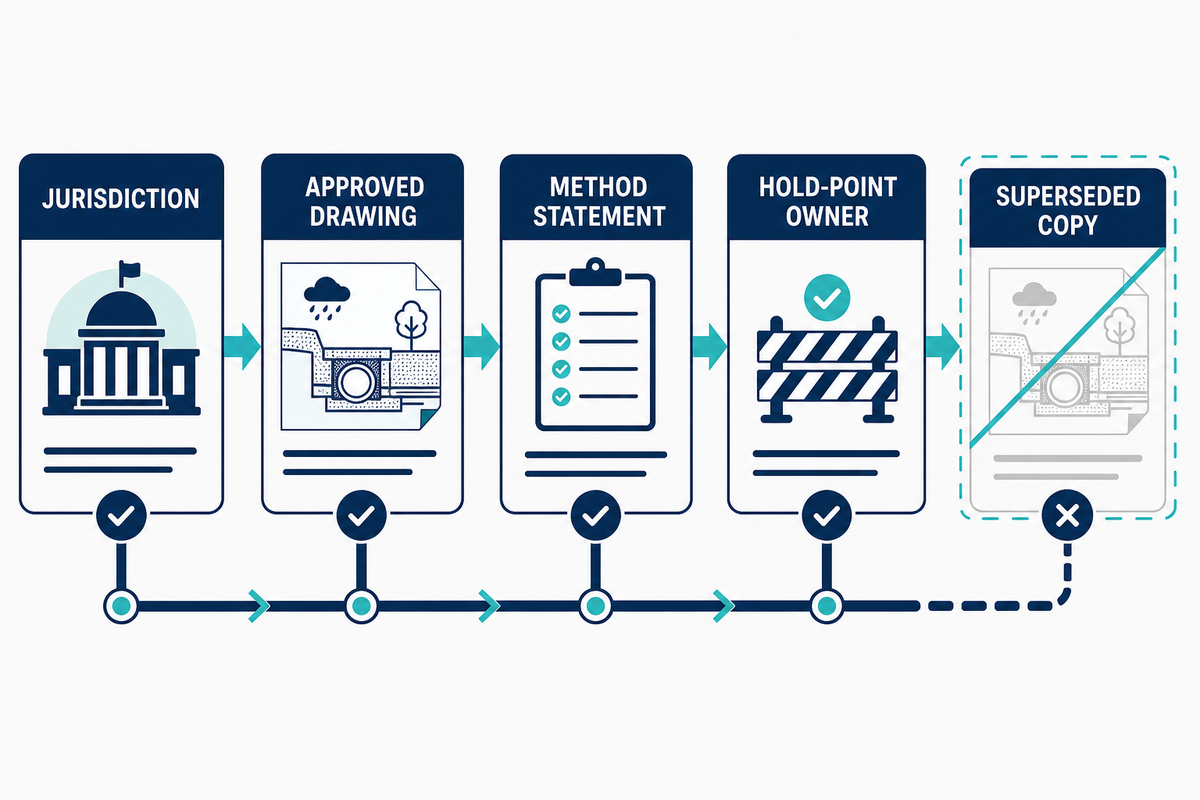
Please state which revision and authority govern this site, and where that is recorded. A missing governing revision creates a mismatch between the inspection record and the drawing used to judge it. Begin the file with a revision log. Record the jurisdiction, authority correspondence, approved drawing number, method-statement revision, inspection and test plan revision, relevant request for information, and the person permitted to release each hold point.
For Dubai works, the project team can use the Dubai Municipality technical-guidelines portal and the Dubai legislation portal as starting points. Record the actual document and revision adopted for the project. Adopt a simple status so that quotations, project commitments, and product data sheets aren’t interpreted as the same document.
Don’t swap the existing drawing in the file folder with the new drawing once a revision is made while the installation is in progress. Keep the old drawing and show the affected areas. Record the disposition and technical reasoning behind the change. Link the change to a new set of installation photos and release. Document the analysis of the decisions made rather than simply providing the final file.
Record Route Assumptions Without Reopening Product Selection
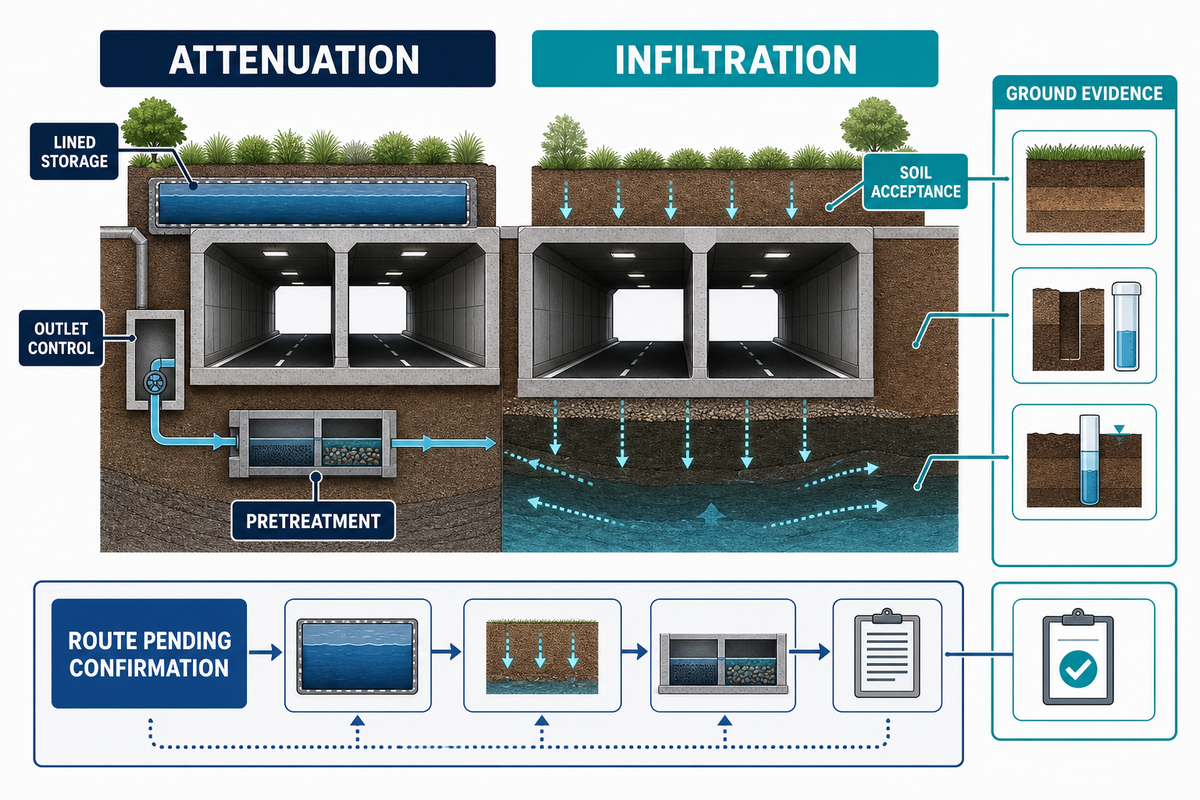
When an approved design assigns a task, the evidence pack needs to state the duty as either lined attenuation, infiltration, or a defined hybrid combination. Some systems incorporate separate zones for storage, treatment, and infiltration. The correct route is the design approved along with its supporting evidence. Record each assumption (if any) and name the staff member who has the approval to verify the assumption.
For an infiltration element, that may include the referenced ground investigation, groundwater observations, contamination review and the designer’s accepted infiltration evidence. For a lined attenuation system, it may incorporate the accepted liner and penetration details, outlet control, and an overflow diagram. Where site evidence confirms the approved route, the correct status for a system should record lined attenuation, infiltration, or a defined hybrid arrangement. This records the soil and groundwater conditions rather than placing a presumed burden on the owner and designer.
The U.S. Environmental Protection Agency groundwater guidance is useful as a general reminder that infiltration decisions can interact with groundwater protection. It isn’t a U.S. or UAE approval source. Its value here is to prompt traceability: show which project evidence supported the approved route and who accepted it.
Photograph Pretreatment, Flow Control and Inspection Access
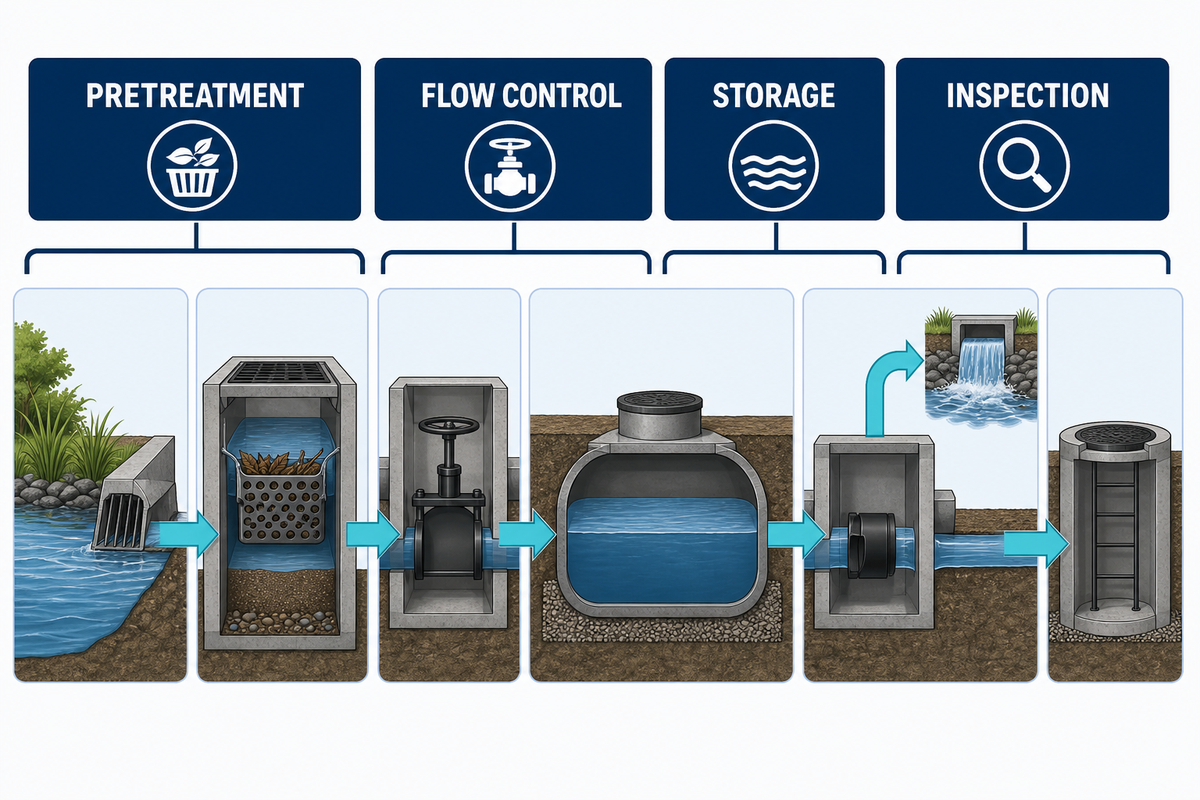
The photographic set should follow the approved water path: runoff source, sediment control, storage, controlled outlet and excess flow path. Show the pretreatment point and indicate who inspects and cleans it and what happens to the solid material. Show the inspection trigger and the responsible party when the outlet needs to be cleaned.
Don’t rely on a wide shot alone. Include an establishing view, a closer interface view and a detail view where the approved arrangement depends on a joint, penetration, seam, invert or access opening. Prior to capturing the detail view, place a reference marker or scale at the location only where the project allows it. Never let a loose marker cover what’s important.
Storage and treatment are different functions. Any treatment claim must name the treatment, the testing or design basis, the method of maintenance and the name of the owner. An internal product inspection, or a supplier’s compression check, can’t be considered an independent treatment certification. The United States Environmental Protection Agency stormwater-drainage material is a non-UAE example of why discharge pathways and subsurface interfaces need to be understood.
Use Pre-Cover Hold Points for Underground Work
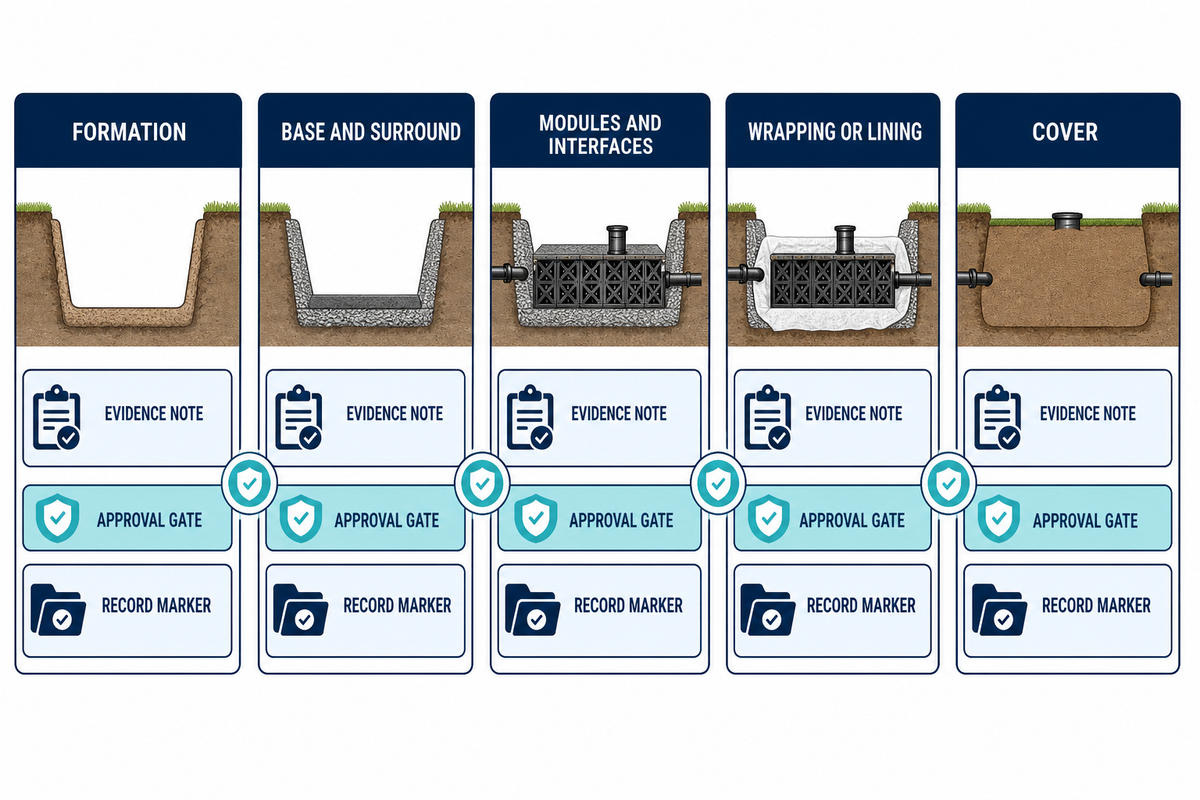
The best evidence for an installation is often created before cover is placed, not after a complaint. Hold points should align with the drawing and methodology statement. A separate public drainage technical guide can outline the importance for construction records to provide a defined location and revision; however, this isn’t a UAE acceptance criterion.
No-Cover Sign-off Sheet
- Formation: level, soft spots, groundwater, utilities, Temporary works and release decision.
- Base and surround: specified material, line, level, separation or drainage, and approver.
- Modules and Interfaces: model, orientation, connections, access openings, inlet, outlet and visible damage.
- Wrapping or lining: continuity, seams, penetrations, protection and repair record (where applicable).
- Fill Method (sequence and compaction) and final cover level.
- Access Cover and sign-off by the appropriate Signatory.
The record should identify the location, date, drawing revision, observer, and decision to close the hold point, not just a bunch of unlabeled photos. If a nonconformity has been accepted, repaired, or left open, the reason must be linked to the affected record and the photograph before the work becomes inaccessible.
Build an Acceptance Pack the Operator Can Use
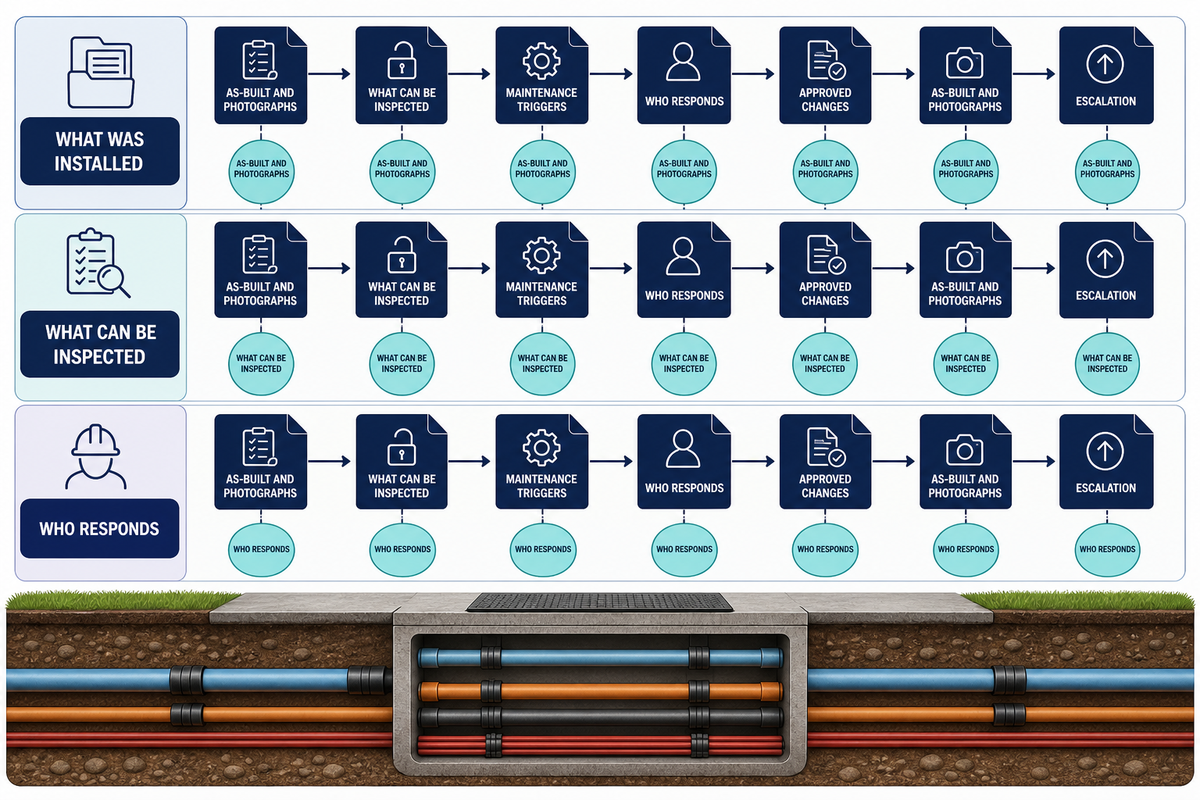
Acceptance has three main aspects. These acceptance questions cover what was put in place, what can be investigated, and who responds when the system behaves differently from its design basis. The final handover pack must contain as-built drawings, inlet and outlet information, details of the pretreatment, route for overflow, restrictions to access, approved changes, photos and the contact in the operations team. The United States Environmental Protection Agency groundwater guidance aims to emphasize that the responsibility for inspection and maintenance isn’t going away; it won’t be considered as a UAE acceptance document.
| Handover item | Owner question | Minimum traceable record |
|---|---|---|
| Inlet and pretreatment | Who checks blockage and removes sediment? | Access detail, trigger, method and record template |
| Flow control and outlet | Who verifies the control and safe discharge route? | Accepted detail, commissioning note and escalation contact |
| Buried asset | What is inaccessible, and what evidence records its condition? | As-built location, dated photographs and hold-point release |
| Change control | What happens if catchment use or loading changes? | Review trigger and named technical decision-maker |
There shouldn’t be a universal maintenance interval or a service-life promise that’s given. After confirming the interval, method, and safety controls for the project and the requirements of the competent authority, the plan should be implemented. The entry “Tank Maintenance” in the Owner’s log shouldn’t be made until the access and response method has been confirmed.
Separate Supplier, Contractor, Designer and Owner Evidence
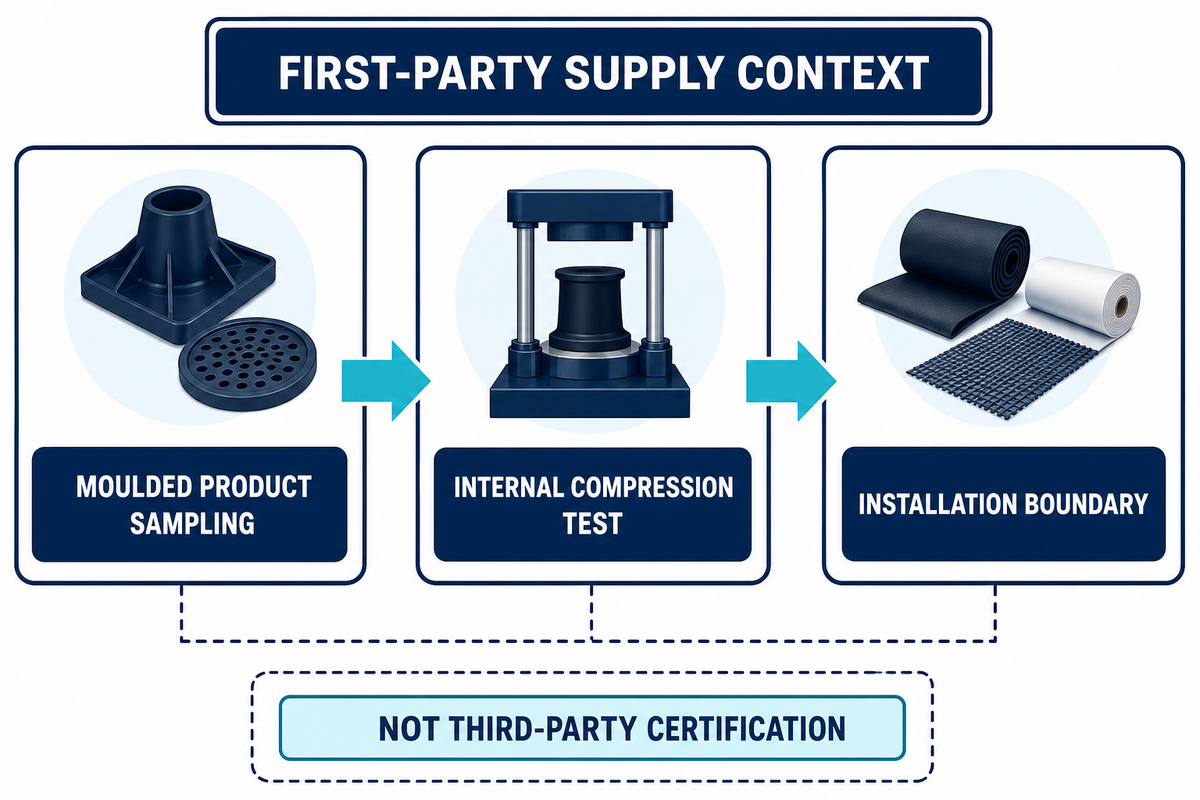
Product and installed-work evidence aren’t the same, but are connected. A supplier documents the ordered product and applicable batch or packing records. Contractors document product delivery, product handling, site installation and product interfaces documentation. The designer or approving engineer accepts or rejects the installed work. The owner receives the accessible asset and maintenance record.
A supplier may give guidance for product handling, supply records and agreed supervision for loading. This doesn’t make the supplier the contractor for project installation and/or the approving engineer. Maintaining the boundaries of design, installation and supply is necessary in order to avoid mistaking a factory inspection for approval of the completed underground installation.
For applicable AQUA moulded-product batches, the factory record describes an approximately two-percent sampling workflow covering dimensions, colour, appearance and compression, supported by an internal compression-testing machine. This is first-party process evidence for the scope of moulded products. It isn’t third-party certification and can’t be extrapolated to the procured geotextile, geomembrane and EPDM batches. It doesn’t confirm the completed underground installation.
AQUA provides products and related documentation, and can provide remote guidance, loading supervision, and technical support. AQUA doesn’t act as the full scope contractor for the installation of the project. Therefore, a supplier-ready request must capture the responsibilities of the project team regarding the design, approval, installation and maintenance.
For a broader context, use the stormwater management overview, subsurface systems guide and geocellular module guide. Keep site acceptance records in this project evidence pack.
Keep a Practical Evidence Register
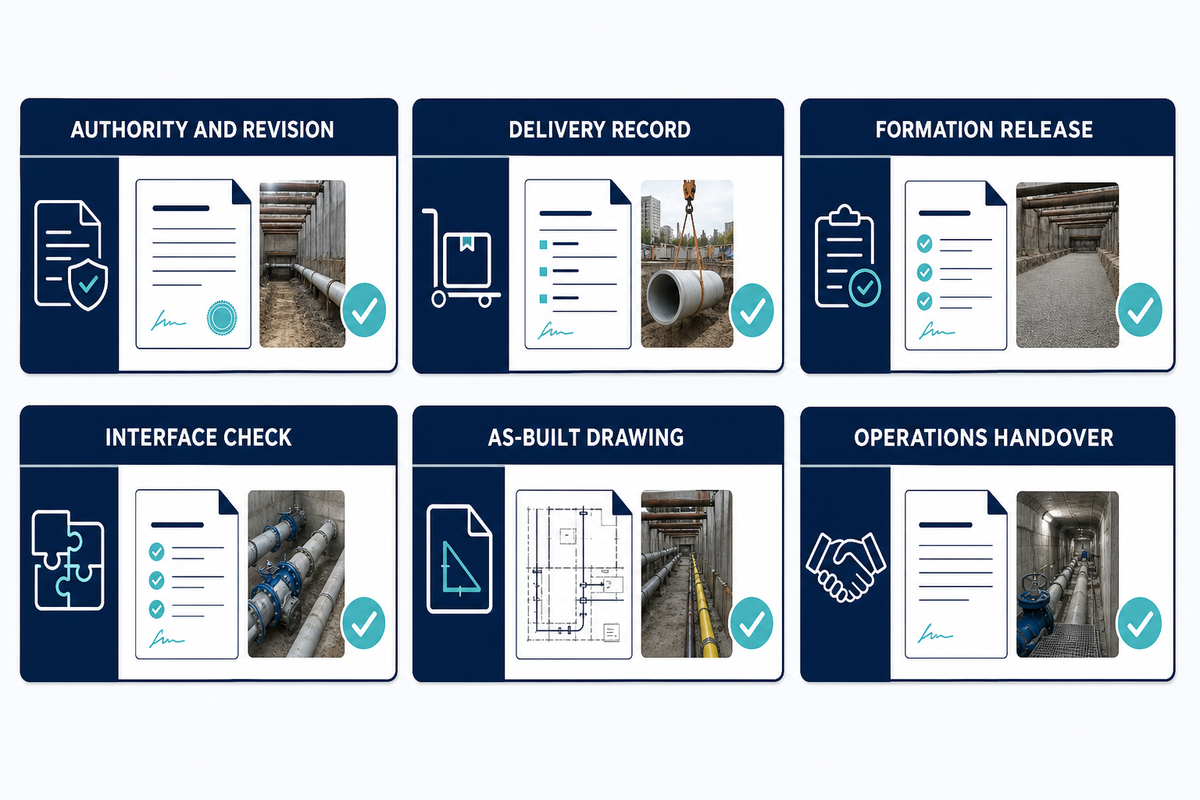
The boundary of responsibilities can be used if a short evidence register is prepared. This register must be sufficient to pass on to subsequent parties. One row per evidence item is more useful than one folder per discipline. Use consistent location identifiers across inspection requests, photographs, survey records, nonconformities and as-built drawings. The public drainage technical guide provides non-UAE context for tying construction records to defined locations and revisions; the project still follows its current UAE authority documents.
| Evidence item | Owner | Required locator | Close-out test |
|---|---|---|---|
| Authority and revision register | Project document controller | Jurisdiction, document, revision and date | Matches the inspection date and accepted design |
| Product delivery record | Supplier and contractor | Batch or delivery reference and site location | Ordered scope reconciled with received items |
| Formation release | Contractor and reviewer | Grid, chainage or asset identifier | Decision recorded before base work |
| Base and surround check | Contractor and reviewer | Drawing detail and photographed location | Line, level and material record accepted |
| Module and interface check | Contractor | Asset zone and connection identifier | Arrangement and damage status visible |
| Wrapping or lining release | Contractor and reviewer | Seam, penetration and repair references | Affected areas closed before concealment |
| Inlet, outlet and overflow | Contractor and designer | Pipe, invert and control identifiers | As-built route reconciled with accepted detail |
| Nonconformity and change log | Project quality lead | Affected location and linked decision | No open item hidden by backfill |
| As-built drawing and survey | Contractor and surveyor | Asset identifier and coordinate basis | Accessible points and buried extents are locatable |
| Operations handover | Owner or operator | Asset register entry and document index | Named owner accepts access and response duties |
Close Common Handover Gaps Before Practical Completion
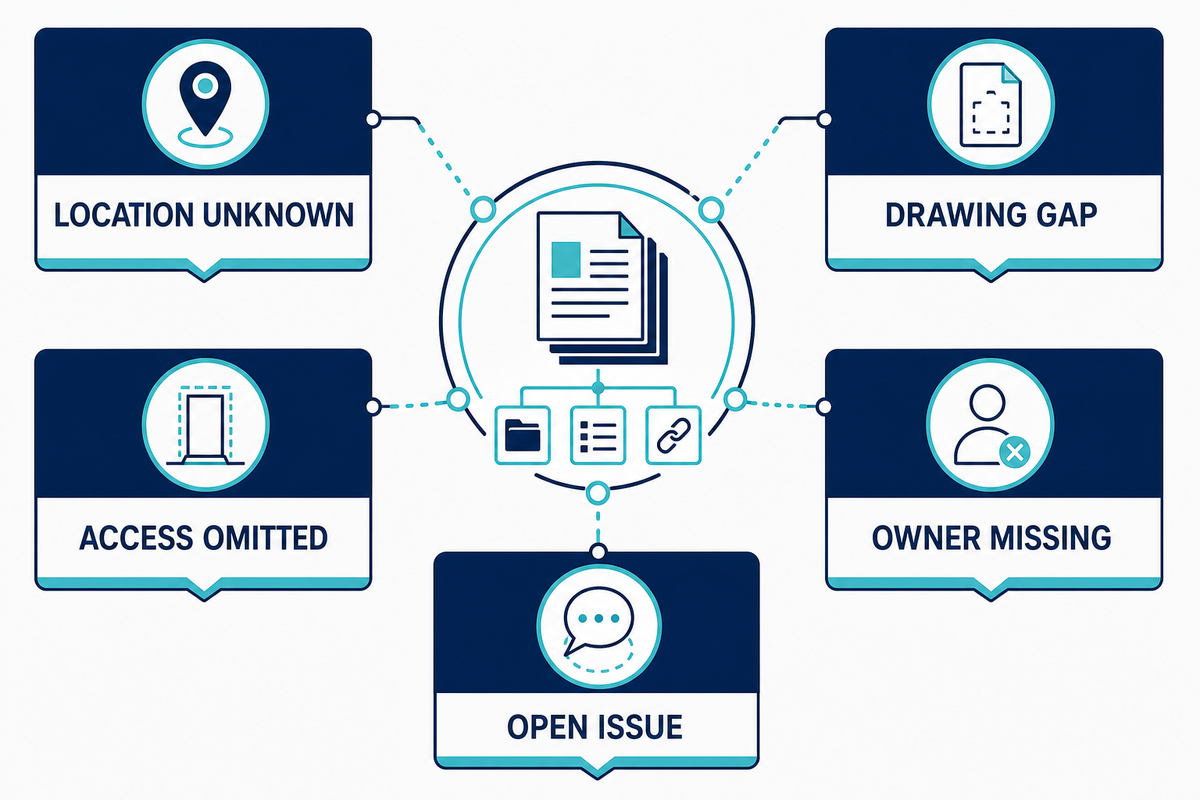
The gaps in one handover are a photograph that can’t be located or be traced to a decision, a final drawing that lacks inspection access, flow control, overflow or an altered connection, and an operations file that describes maintenance, but doesn’t state who performs the maintenance, records the maintenance or escalates the concern.
- Sample several buried locations and locate each one from an approved drawing to a hold-point release, a photograph, a change record and an as-built entry.
- Inspect the accessible inlet, pretreatment, flow control, outlet, overflow, and inspection points with the future operator.
- Confirm that each accepted deviation identifies the technical decision maker and the change(s) made to the drawing or record.
- Make sure supplier records are labeled as product or supply evidence instead of approval of installed work.
- Do not mark backfill complete while an issue remains open; record its disposition and affected location first.
The purpose of this review is to be separate from configuration and quotation. This boundary separates this guide from the commercial solution page.
Need the product and project-review route?
Bring together the authority basis, site inputs, route decision, access plan and evidence requirements. Use the commercial solution page to discuss the appropriate AQUA system configuration and quotation boundaries after this has been done.
References & Sources
The sources listed below provide system-boundary, general groundwater control, record control and related prompts, and don’t substitute for the current review of the UAE authority for a live project.
- Dubai Municipality technical guidelines authority and revision-checking context.
- Dubai legislation portal jurisdiction-specific drainage context.
- SusDrain geocellular storage systems storage, infiltration, treatment and maintenance boundaries.
- United States Environmental Protection Agency groundwater guidance general groundwater evidence prompt, not UAE approval.
- United States Environmental Protection Agency stormwater drainage guidance subsurface pathway context only.
- Public drainage technical guide construction-record context only.
Byline: Grayden Du · Category: Stormwater Attenuation Tanks UAE Blogs · Brand: AQUA RainWater Solutions
About the author

Grayden Du
Export Director · AQUA RainWater Solutions
Grayden Du is Export Director at AQUA RainWater Solutions. His work spans geocellular detention systems, underground stormwater storage and subsurface water management. Drawing on more than 16 years of hands-on experience across over 30 country markets, he explains technical principles, system choices and practical project requirements.
About AQUA RainWater Solutions
AQUA RainWater Solutions manufactures geocellular stormwater modules, shallow attenuation systems and ground-reinforcement grids. We support product configuration, batch inspection, export packing, loading supervision and product-related documentation.