Get in touch with AQUA Company
Stormwater Attenuation Tanks UAE: Project Supply
An ARW-1050 geocellular tank configuration must be selected against the project’s hydraulic, structural and site inputs.
AQUA offers ARW-1050 geocellular tanks as an underground stormwater management system for Dubai, Abu Dhabi, and other areas of the UAE. The modular crate systems manage stormwater runoff below a car park, road or landscape, while the project drainage system controls the release rate to the downstream system.
Project Requirements
For the storage target and allowable discharge, include cover, traffic loading, groundwater, inlets, outlets, access and the documentation required by your consultant.
-
95%void ratio
-
400 / 500 mmheight
-
30-60 t/m²grades
-
Batch recordsavailable
Verified Supply Facts
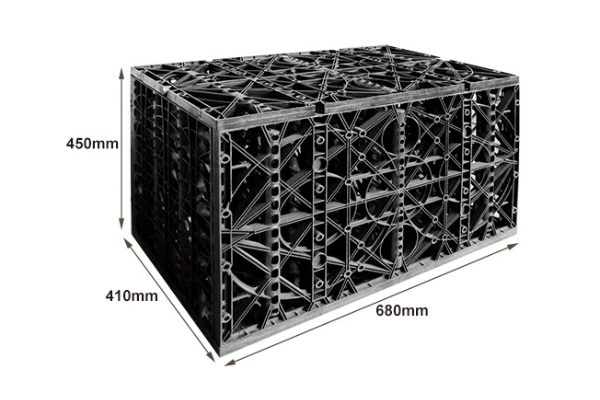
Our record on file is for the molded stormwater core module and associated supply control. Capacity and lead time depend on the model, raw-material preparation, order mix and season.
-
Established
Factory established in 2009
-
Export experience
Approximately 15 years
-
Moulding operation
82 injection-moulding machines, two shifts
-
Core capacity
Approximately 100,000 m³/month
-
Annual export volume
Around 300,000 m³/year
-
Core batch sampling
Approximately 2% for defined moulded-product checks
-
Factory review
On-site or remote video inspection by appointment
-
Witness testing
Factory-witnessed tests or test video when agreed
-
Loading supervision
Appearance, dimensions, packing, securing and photographic reporting
-
Customer confidentiality
Names are published only with specific approval
UAE Project Inputs Before Product Selection
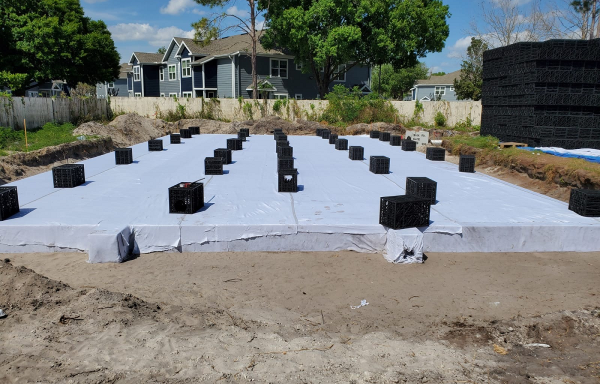
An attenuation tank temporarily stores surface water during rainfall events and releases it at flow rates set by the project drainage design. The design of drainage systems determines how stored water reaches the downstream network and coordinates storage, outlet control and overflow to reduce the risk of flooding.
UAE attenuation project-input matrix
| Project input | How it is used in supply review | Source or decision owner |
|---|---|---|
| Target storage volume | Sets the initial module quantity and tank geometry | Project hydraulic calculation |
| Allowable discharge and outlet control | Defines the attenuation function, outlet and overflow interfaces | Local requirement and drainage design |
| Footprint, levels and available depth | Controls the 400 or 500 mm layer arrangement | Site layout and level drawings |
| Groundwater and ground conditions | Feeds lining, anti-flotation, base and suitability review | Ground investigation and project design |
| Design rainfall and climate allowance | Checks storage, overflow and controlled-discharge basis | Project designer and current local review criteria |
| Cover and traffic loading | Supports grade selection and system structural review | Pavement build-up and load information |
| Inlets, outlets and inspection access | Confirms openings, accessories and maintenance routes | Drainage interface drawings |
| Lining and protection method | Separates watertight storage from an infiltration arrangement | Project specification and method statement |
| Sediment, pollution and pretreatment | Identifies water-quality, blockage and infiltration constraints | Catchment risk and maintenance plan |
| Required reports and submittals | Matches available product evidence to the review list | Consultant and procurement team |
ARW-1050 Product and Material Options
ARW-1050 is offered standard at 500 mm height with an optional 400 mm height module. A low height module is offered for projects where vertical clearance is a constraint, while the project team remains responsible for the structural and cover design.
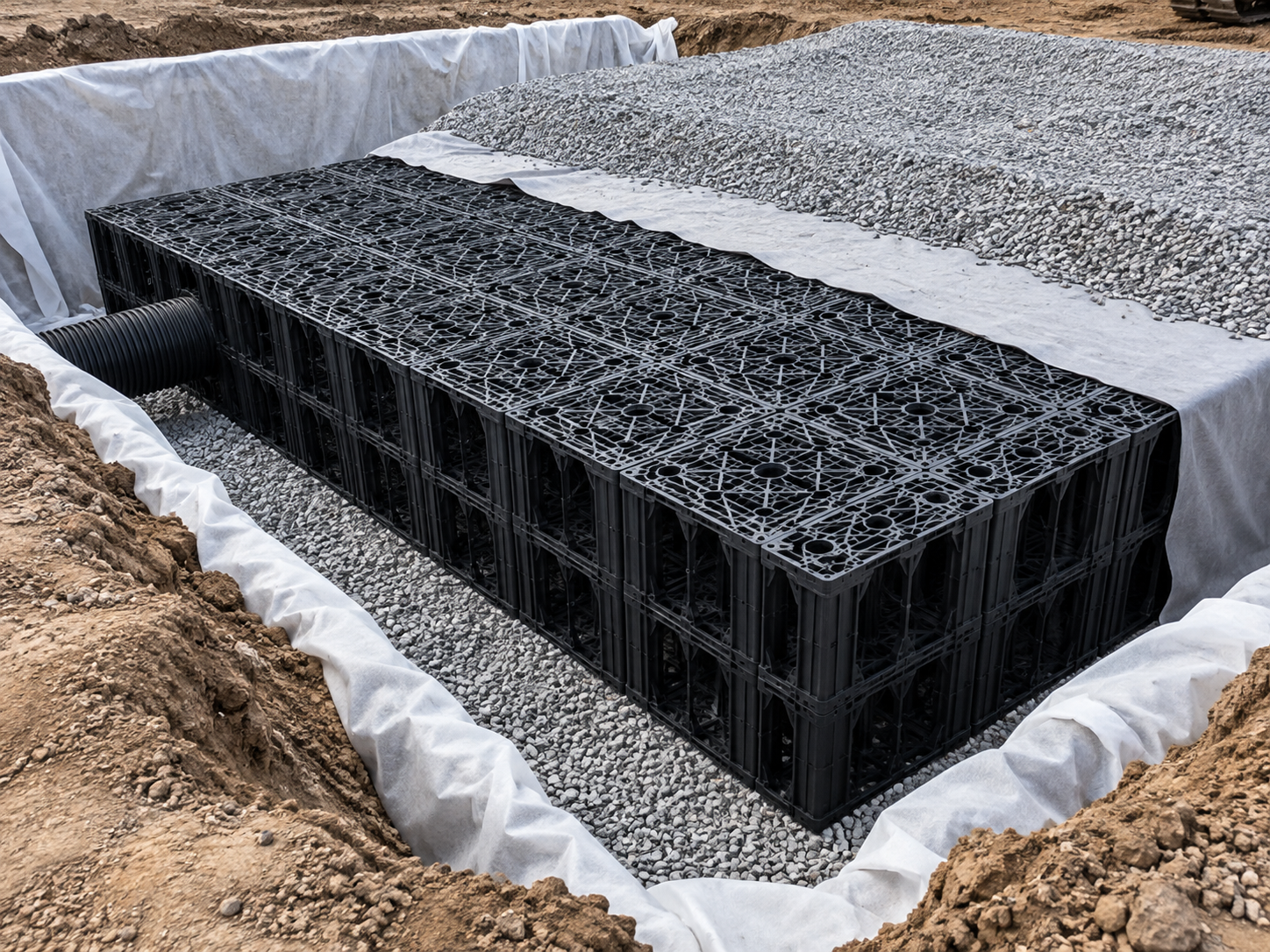
500 mm configuration
- Dimensions 1000 × 500 × 500 mm
- Void ratio 95%
- Calculated usable storage 237.5 L per complete unit
- Complete-unit weight 9.8 kg
400 mm configuration
- Dimensions 1000 × 500 × 400 mm
- Void ratio 95%
- Calculated usable storage 190 L per complete unit
- Complete-unit weight 9.8 kg
Material by active grade
- ARW-1050-30, -40 and -45: recycled PP as standard
- ARW-1050-60: virgin PP as standard
- Standard colours: black and green
- Blue and other colours: project option
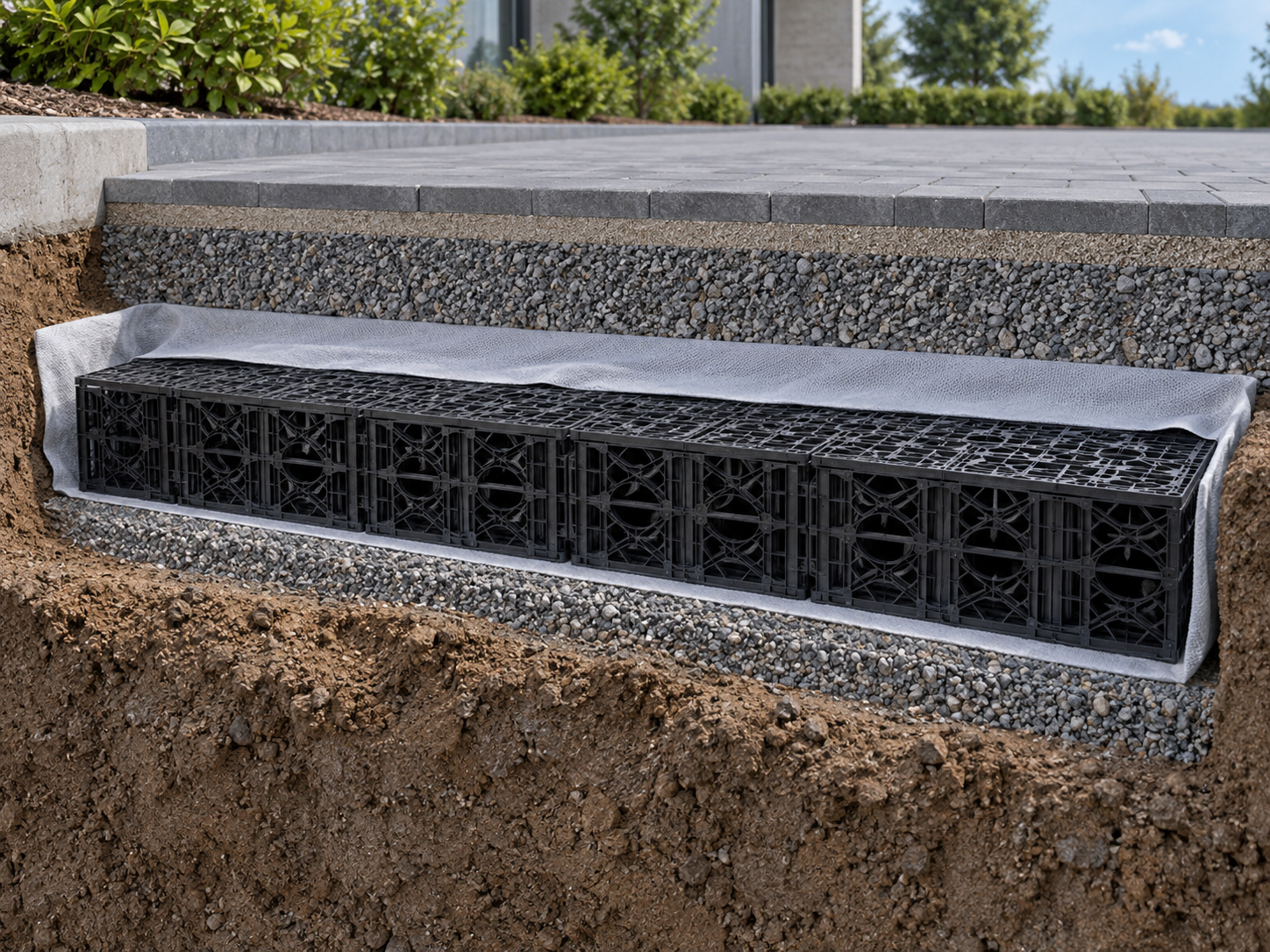
Standard bill of materials
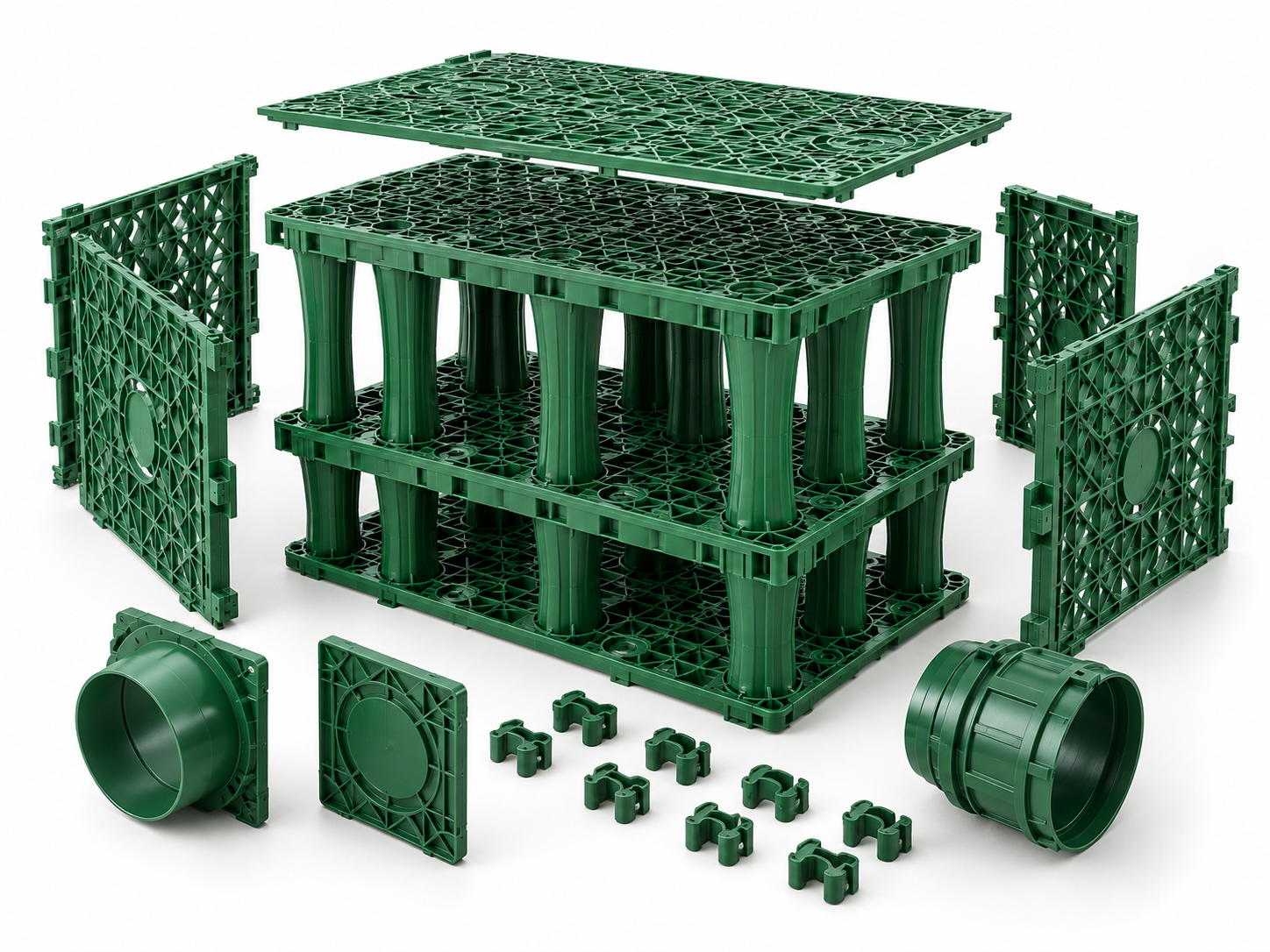
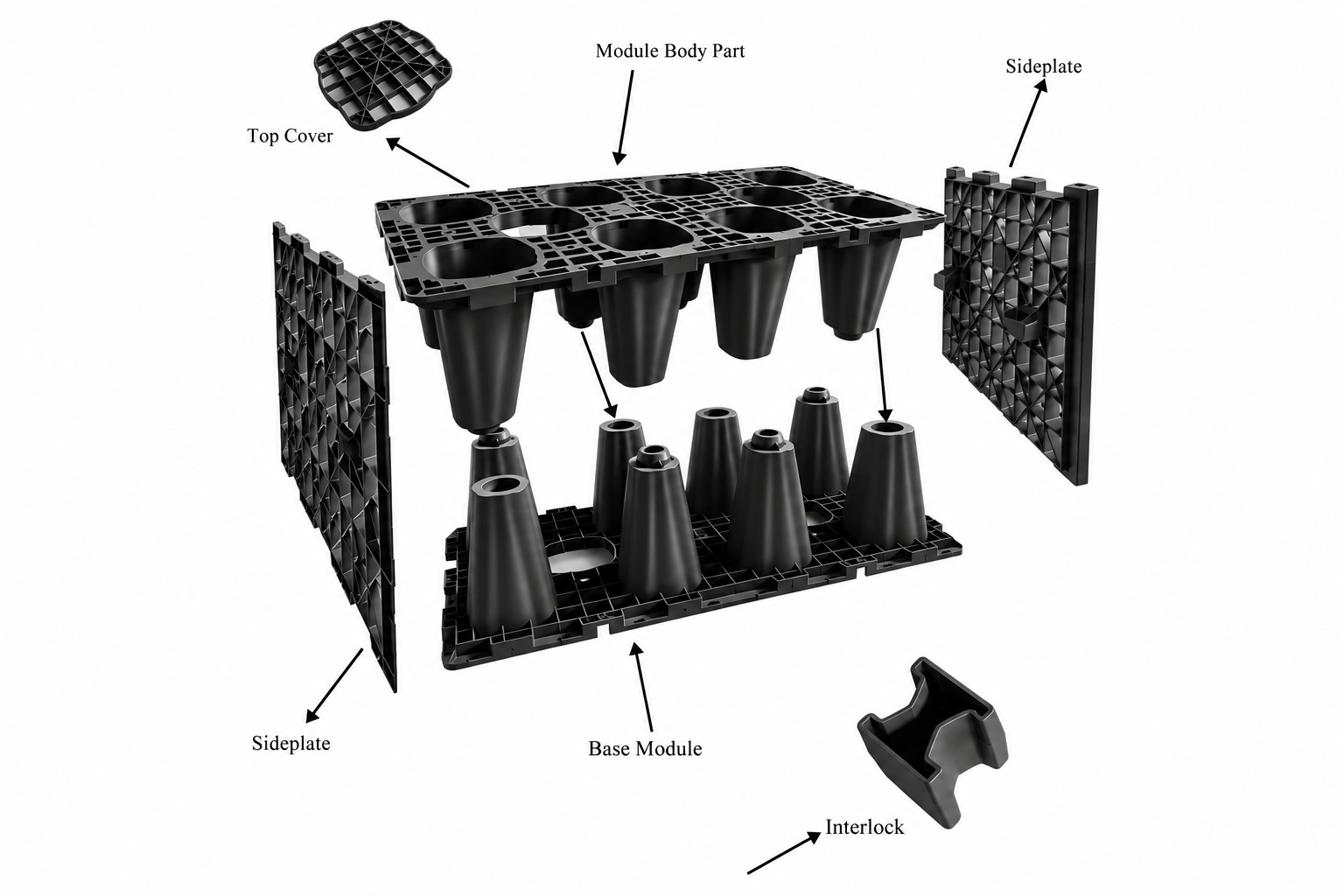
- Two 4.9 kg body components
- Six side plates and one top cover
- Interlocking clips and selected flange covers
- Opening and connection accessories by approved layout
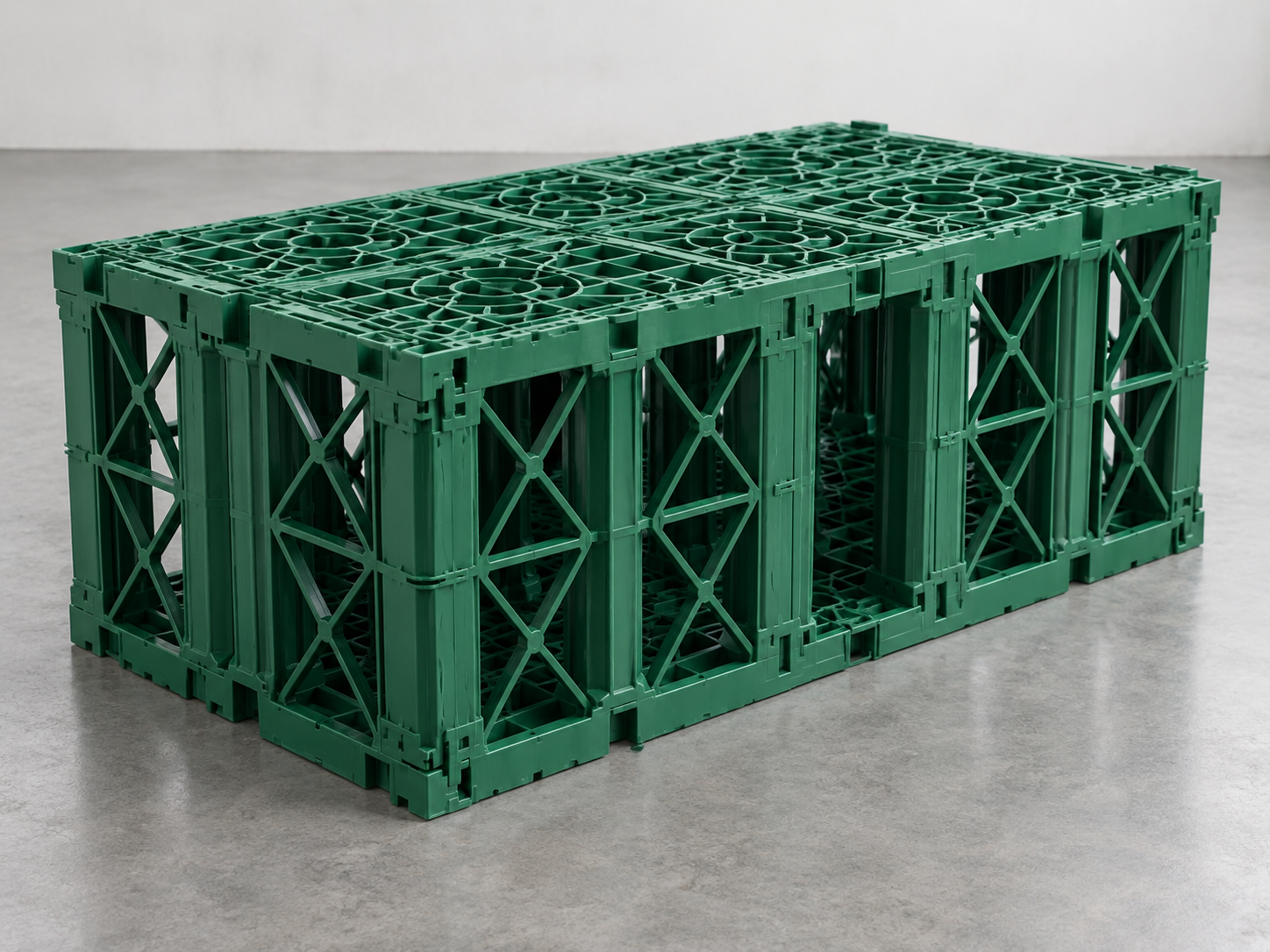
- Side inlet accessories: DN200–DN315
- Large inlet and outlet accessories: DN600–DN800
- Top inspection opening and matching connection option: DN800
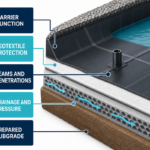
Geotextile and geomembranes can be supplied as a package for the system.
The core-moulded products are manufactured on our injection-moulding machines. Geotextile, geomembrane and EPDM lining products as the supporting materials are sourced through the AQUA supply process.
A modular crate can be arranged around depth, footprint and interface constraints, subject to the full structural and hydraulic review.
A concrete solution may remain the project choice where geometry, structural integration or the approved construction method points to it. Compare the complete system and site method, not a module price alone.
Attenuation, Retention and Infiltration Interfaces
The same modular concept of water management can be applied to attenuation, rainwater harvesting or infiltration, but the lining, outlet and ground conditions cannot be interchanged. Choosing the lining late in the process is the wrong choice since it would change the outlet and ground-evidence package.
System function
Attenuation / detention
System function
Retention / reuse
System function
Infiltration / soakaway
Groundwater
Groundwater level affects infiltration feasibility, lining, anti-flotation and the completed structural design.
Runoff quality
Sediment or polluted runoff may require pretreatment and can rule out direct infiltration without additional review.
Inspection route
Access points, silt control and a cleaning pathway belong in the layout before the tank is buried.
ARW-1050 Main Specification Table
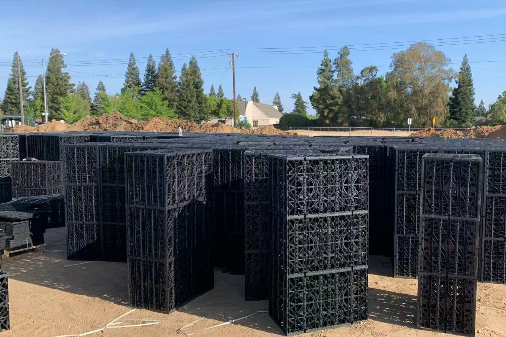
The table contains the active product configurations and the nominal strength for the quotation and technical evaluation. The final assessment of the buried system will depend on the complete assembled system, cover, ground conditions, groundwater, load and the structural assessment of the project.
| Specification | 500 mm option | 400 mm or grade note |
|---|---|---|
| Dimensions | 1000 × 500 × 500 mm | 1000 × 500 × 400 mm |
| Void ratio | 95% | 95% |
| Calculated usable storage | 237.5 L | 190 L |
| Complete-unit weight | 9.8 kg | 9.8 kg |
| ARW-1050-30 vertical ultimate | 30 t/m² | Approximately 294 kN/m² |
| ARW-1050-40 vertical ultimate | 40 t/m² | Approximately 392 kN/m² |
| ARW-1050-45 vertical ultimate | 45 t/m² | Approximately 441 kN/m² |
| ARW-1050-60 vertical ultimate | 60 t/m² | Approximately 588 kN/m² |
| Working lateral values by grade | 115 / 118 / 118.8 / 185 kN/m² | Match the value to the selected grade |
| Side inlet accessory range | DN200–DN315 | Layout and accessory dependent |
| Large inlet/outlet range | DN600–DN800 | Layout and accessory dependent |
| Top inspection opening option | DN800 | Confirm location and matching connection |
| Approximate 40HQ nested-loading equivalent | 335 m³ | 280 m³ for 400 mm height |
A high nominal load value does not enable selection of a buried system under traffic. A higher grade is not the correct answer since the completed system will depend on the basis of the test, long-term behaviour, assembly and non-uniform loads, cover and ground support.
- EN 17152-1 specifies requirements for PP and PVC-U storm water boxes and integrated components.
- EN 17150 addresses short-term compression-strength testing.
- EN 17151 addresses long-term compression-strength testing.
- Project approval and the design of the completed system remain outside of these product and test scopes.
Quotation Inputs and Core Production Timing
Price cannot be determined until the storage quantity, grade of modules, material, lining, packing, shipping and the scope of the documentation are determined. We submit a project specific quote after these are reviewed.
What moves the quotation
| Driver | Why it changes the package | What to send |
|---|---|---|
| Storage and geometry | Changes module count, layer arrangement and footprint | Target volume, plan area and available depth |
| Strength grade | Changes material and product configuration | Cover, pavement and traffic/load information |
| Openings and access | Changes side plates, covers and connection accessories | Inlet, outlet, overflow and access drawings |
| Lining and protection | Changes supporting-material quantities and packing | Attenuation, retention or infiltration method |
| Evidence and inspection | Changes the required review and witness scope | Consultant submittal and test-document list |
| Shipment plan | Changes nested loading, consolidation and handling | Destination, required timing and order mix |
Core moulded-module production
For the core moulded module range, we normally produce one 40HQ in approximately 2–3 days and allow up to about 7 days, excluding raw-material preparation.
Scheduling basis
Model, raw material, order mix and peak-season loading affect the confirmed date. Production and shipment timing for the selected configuration are stated in the quotation and remain subject to the confirmed inputs.
Packing and shipment review
- We normally palletise core module bodies and side panels.
- Clips, flange covers and smaller accessories may use wooden cases or bags.
- We prefer full-container shipment for the main modular products.
- We can look at consolidated, LCL or smaller-container shipments for suitable orders.
Batch Inspection and Product Records
AQUA Rain Water’s moulded-product batch workflow uses owner-confirmed sampling of approximately 2% for dimensions, colour, appearance and compression. A record discrepancy can cause a delay in review as we verify the configuration, inspection status, and packing prior to loading.
“Product configuration, inspection status and packing are reviewed before loading.”
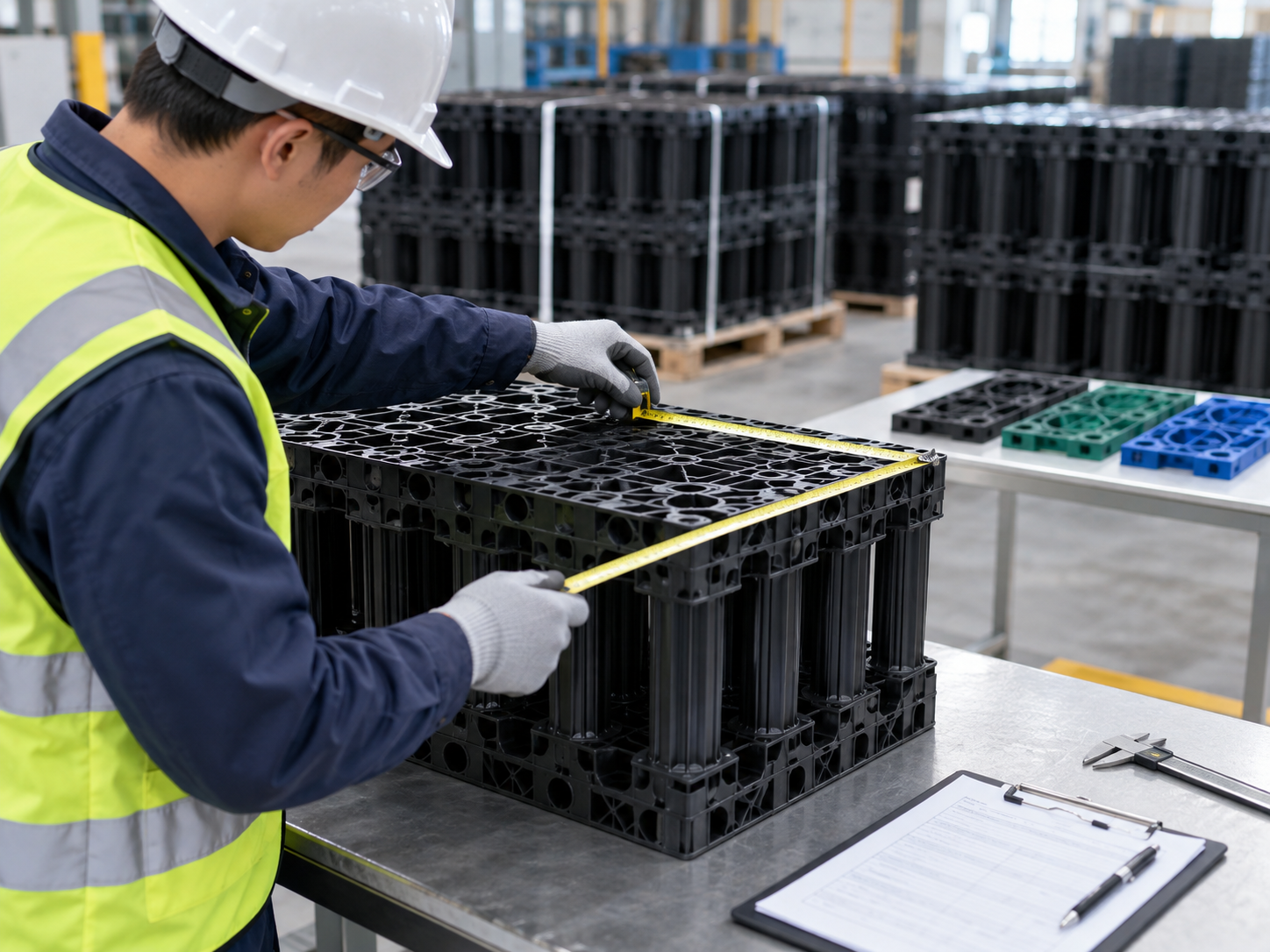
AQUA current factory operating record
Configuration check
Verify the ordered ARW-1050 height, grade, material, color, and accessory list.
Dimension and appearance check
Sample the molded batch for dimensions, color, and appearance.
Compression check
Use the in-house compression testing machine for the agreed batch workflow.
Packing and loading review
Verify pallet, accessory packing, quantity and loading status.
Witness options
We can arrange a factory-witnessed test or provide test video when agreed before production. Customer or third-party factory audits are accepted by appointment.
Available documentation
Selected third-party product test reports and company certificates can be provided according to the product and order. The document list is confirmed against the exact model and requested submission scope.
Match every record to its scope
The order pack sequence is confirmed against the selected model, sample, test method and the requested reporting scope. One should not expect that a single report addresses every order, because internal checks, witnessed tests, and third-party sample reports, etc. are different kinds of evidence.
Controlled Supply Workflow and Responsibility
We coordinate product selection, moulding, supporting materials, batch inspection, export packing, loading supervision and product-related documentation in one supply process. The project consultant and local contractor retain the design, approval and construction responsibilities assigned to them.
01
Project inputs: You provide the hydraulic basis, layout, levels, ground, cover, loading, interfaces and the required documents.
1
02
Configuration check: We review the module height, nominal grade, accessories, and supporting material quantity
2
03
Order verification: The quotation confirms the product scope, packing, evidence, production, and shipment.
3
04
Supply coordination: The core modules are scheduled for moulding and supporting products are coordinated with the order.
4
05
Inspection and packing: defined checks are completed and the load is prepared in line with the packing plan.
5
06
Loading and document handover: Loading, securing and sealing are supervised, with photographs and agreed documents provided for the handover record.
6
Project responsibility matrix
Workstream
AQUA
Project team / consultant
Local contractor
Product and accessory configuration
Recommend and supply
Review and approve
Receive and verify
Hydraulic and structural design
Provide product data
Establish and approve the design
Build to the approved design
Dubai or Abu Dhabi authority route
Provide agreed product documents
Confirm and manage the current route
Support required submissions and inspections
Installation construction
Arrange remote or on-site technical support when ordered
Review method and supervise
Perform excavation, lining, assembly, connection and backfill
Batch checks, packing and loading
Perform or coordinate
Witness when arranged
Not applicable before site receipt
Handover and maintenance plan
Provide product-related information
Set acceptance and maintenance requirements
Deliver the installed records and access route
Factory audit
A normal factory audit can generally be completed in 1–2 days by prior appointment. Remote video factory inspection can also be arranged.
Loading supervision
Loading supervision generally takes 1 day or 2 days depending on the loading schedule. The agreed scope may cover appearance, dimensions, production and quality review, packing, securing, sealing and photographs.
Product, Inspection and Loading Evidence
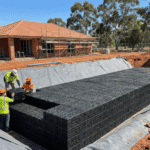
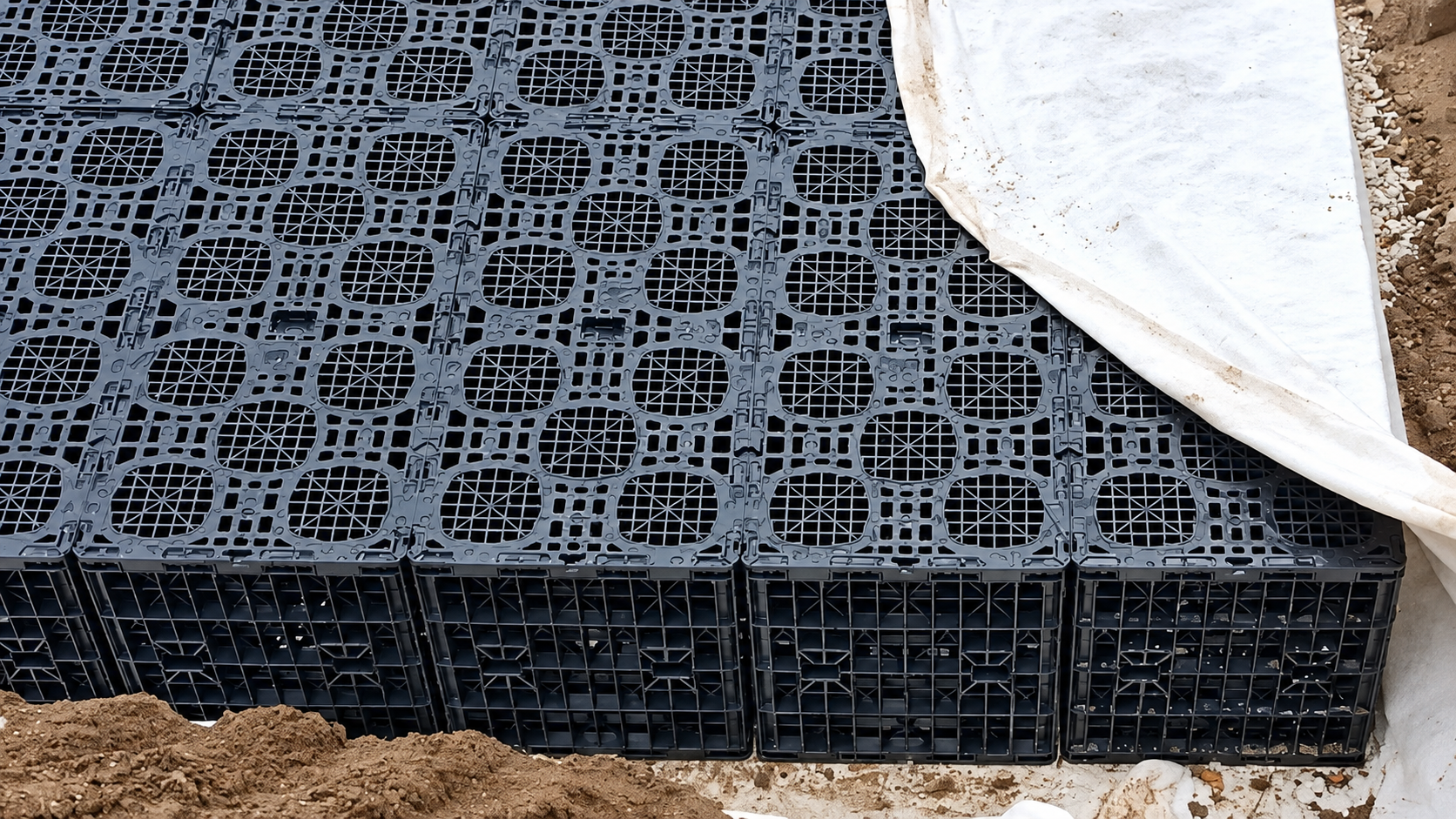
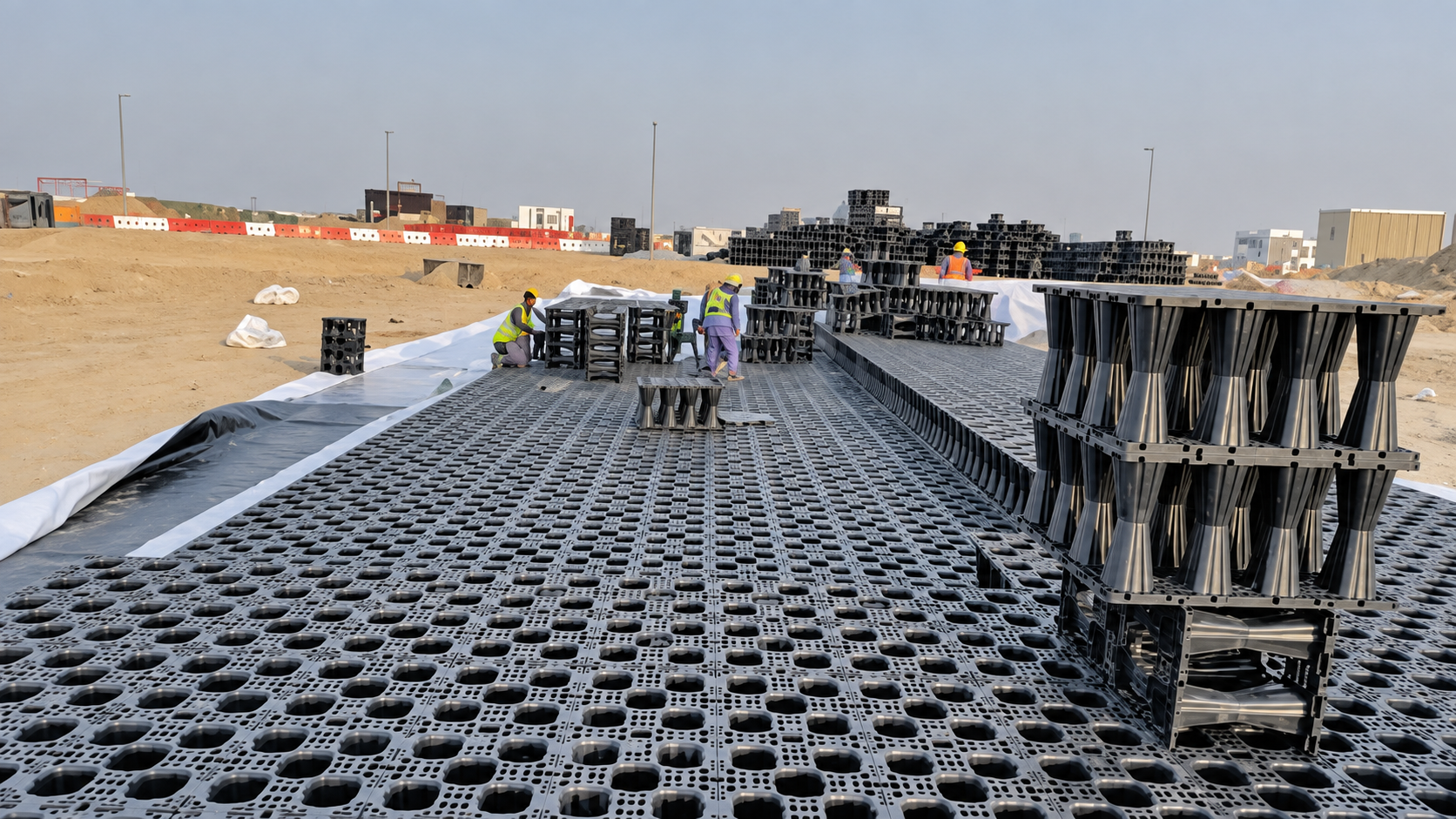
The images which follow are from AQUA’s existing product material and are in the context of module structure and assembly. They are not presented as named UAE projects, customer endorsements or evidence of a specific installed model.
Evidence available around the order
Production visibility
Factory visit or remote video by appointment
Compression capability
In-house machine for agreed internal or witness checks
Packing review
Pallets, accessory cases or bags checked to the order
Loading record
Securing, sealing and photographic reporting when arranged
Confidential project handling
We do not disclose customer or distributor identities to other buyers. Project names, customer names and distributor names are published only when specifically approved.
Discuss the Document Package
Match the requested reports and company records to the selected product and order.
Conditions Requiring Additional Project Review
Early acknowledgment of challenging site conditions means that a geocellular attenuation tank can still be reviewed. Each condition has an associated information path allowing project teams to address the issue before configuration release.
Project Condition Matrix
| Condition | Why it changes the decision | Information needed next |
|---|---|---|
| Groundwater or anti-flotation basis is absent | Watertightness, buoyancy and base design remain unresolved | Ground investigation, design groundwater level and structural approach |
| Cover or traffic load is undefined | A nominal grade cannot be selected responsibly | Pavement build-up, cover, traffic class and design loads |
| Infiltration is not verified | The proposed soakaway function may not operate as intended | Project-accepted infiltration data, groundwater and land-use screening |
| Runoff is polluted or carries high sediment | Silt and debris can reduce usable storage or obstruct interfaces without pretreatment and access | Pretreatment, sediment path, cleaning access and maintenance plan |
| Climate-adjusted hydraulic basis is absent | Storage, overflow and controlled discharge may be mismatched | Design storm, runoff basis, climate allowance and hydraulic calculations |
| Inspection or cleaning route is absent | Buried maintenance access and ownership remain unclear | Access locations, sediment controls, cleaning method and responsible party |
| Opening or interface is non-standard | Site cutting can affect connection detail and local load path | Interface drawing and agreed accessory arrangement |
| Membrane or backfill method is absent | Lining protection and surrounding structural support are incomplete | Approved lining, protection, bedding and backfill method statement |
Stormwater Attenuation Tanks UAE Engineering Tools
Access our professional engineering utilities to estimate tank module quantities, calculate layout capacities, and compare configurations for your UAE stormwater projects.
Stormwater Tank Module Quantity Estimator
Quickly calculate the required number of tank modules based on your specific project volume and site footprint requirements.
Stormwater Tank Layout Capacity Estimator
Determine the exact storage capacity and dimensions of your stormwater tank based on a selected row and column layout.
400 mm vs 500 mm Tank Configuration Comparison
Compare the structural, volumetric, and installation differences between our 400 mm and 500 mm tank module options.
Stormwater Attenuation Tank Questions
What does a stormwater attenuation tank control?
This tank captures runoff during the design event and discharges it at a controlled rate defined by the drainage design. The storage volume, flow control and overflow provisions are coordinated to reduce flooding and avoid overloading downstream systems.
Is an attenuation tank the same as an infiltration system?
No. Attenuation tanks store runoff and release it at a controlled rate, while infiltration relies on verified ground conditions to accept water.
What data is needed before AQUA reviews a UAE tank configuration?
Send target storage, allowable discharge, layout and levels, groundwater, cover and loading, inlets, outlets, access, lining method and required documents. Dubai and Abu Dhabi project specifics should be defined by the appointed project team.
Who establishes the required storage volume and allowable discharge?
The values are established by the hydraulic designer, based on the current drainage criteria and site data. AQUA uses those values to review the number and configuration of modules; the appointed project team retains approval responsibility.
When is the 400 mm ARW-1050 option useful?
When available storage depth is limited, this option is utilized (1000 × 500 × 400 mm). This module provides a calculated storage of 190 L, when filled to a 95% void ratio.
How is the ARW-1050 strength grade selected?
When making a selection, consideration must be given to cover, traffic, or other loads, ground support, groundwater, assembly and long-term structural review. The active vertical grades of 30, 40, 45, and 60 t/m2 require project-specific structural review rather than automatic selection.
Can a geocellular tank be placed below trafficked areas?
A geocellular tank can be placed below trafficked areas when the complete system is structurally adequate for the project conditions. A nominal grade of a module cannot replace assessment of pavement, cover, and buried systems.
What evidence is needed for long-term buried-system performance?
Ask for the applicable product and test basis, short- and long-term compression information, deformation criteria, assembly details and the structural design inputs. EN 17150 and EN 17151 address different compression-test timescales.
Which lining and protection materials should be specified?
This depends on whether the project requires watertight attenuation or retention, or confirmed infiltration. The project specification should identify type and thickness of the geomembrane, protective geotextile, seam treatment and the bedding and backfill interface.
Which inlet, outlet and inspection details are available?
ARW-1050 accessory ranges cover DN200–DN315 side inlets, DN600–DN800 large inlet/outlet and a DN800 top inspection outlet. Submit the interface drawing so opening locations and accessories can be defined.
How should sediment control and cleaning access be planned?
Position the pretreatment, silt collection, inspection and cleaning units prior to the primary storage area. The project handover plan should identify the maintenance ownership and the trigger for inspection or cleaning.
Which inspection and product records can AQUA provide?
Our core moulded-product workflow uses approximately 2% batch sampling for dimensions, colour, appearance and compression. Selected third-party product reports and company certificates are provided according to the product, order and agreed document list.
How long does one 40HQ of core modules take to produce?
We normally produce one 40HQ in approximately 2–3 days and allow up to about 7 days, excluding raw-material preparation. Model, material, order mix and season remain part of the confirmed schedule.
Does AQUA undertake installation or secure project approval in Dubai or Abu Dhabi?
The appointed local contractor performs the installation, while AQUA can arrange remote guidance, loading supervision and on-site technical support. The appointed project team manages the hydraulic and structural design and the applicable Dubai or Abu Dhabi approval route.