
Drainage Crates Explained: Soakaway vs Attenuation vs Storage
Drainage crates are the interlocking modular plastic cells that sit below car parks, driveways and gardens as part of a surface water drainage system, holding storm water underground until it can drain away safely. They show up on both commercial and domestic sites, which is where the confusion starts: one plastic crate gets sold as a soakaway crate, an attenuation crate, and a storm crate, as if these are distinct items. For the vast majority of applications, it’s the same crate filling three distinct roles, the specific job being dictated by the membrane wrapped around the crate, rather than the crate itself. This core concept, which the rest of this guide elaborates upon, is what most online supplier descriptions obscure.
Quick Specs: Drainage Crates UK
- Void ratio: ~90-95% open space vs ~30% for gravel – roughly 3 times the capacity in the same excavation footprint.
- Volume: ~0.19-0.42 m³ per crate (e.g. 1000×500×400 mm = 0.20 m³)
- Crates per 1 m³: ~3–5, size-dependent
- Load bearing: landscaped foot traffic to HGV, dependent on cover depth and crate strength (e.g. AQUA states that selected export models are designed to the AASHTO H-20/HS-25 highway-loading equivalent)
- Membrane selection: permeable geotextile membrane (soakaway), impermeable geomembrane (attenuation), impermeable liner (storage/reuse)
- References: CIRIA SuDS Manual C753, BRE Digest 365, Building Regs Part H, National SuDS standards (2025)
What Is a Drainage Crate?
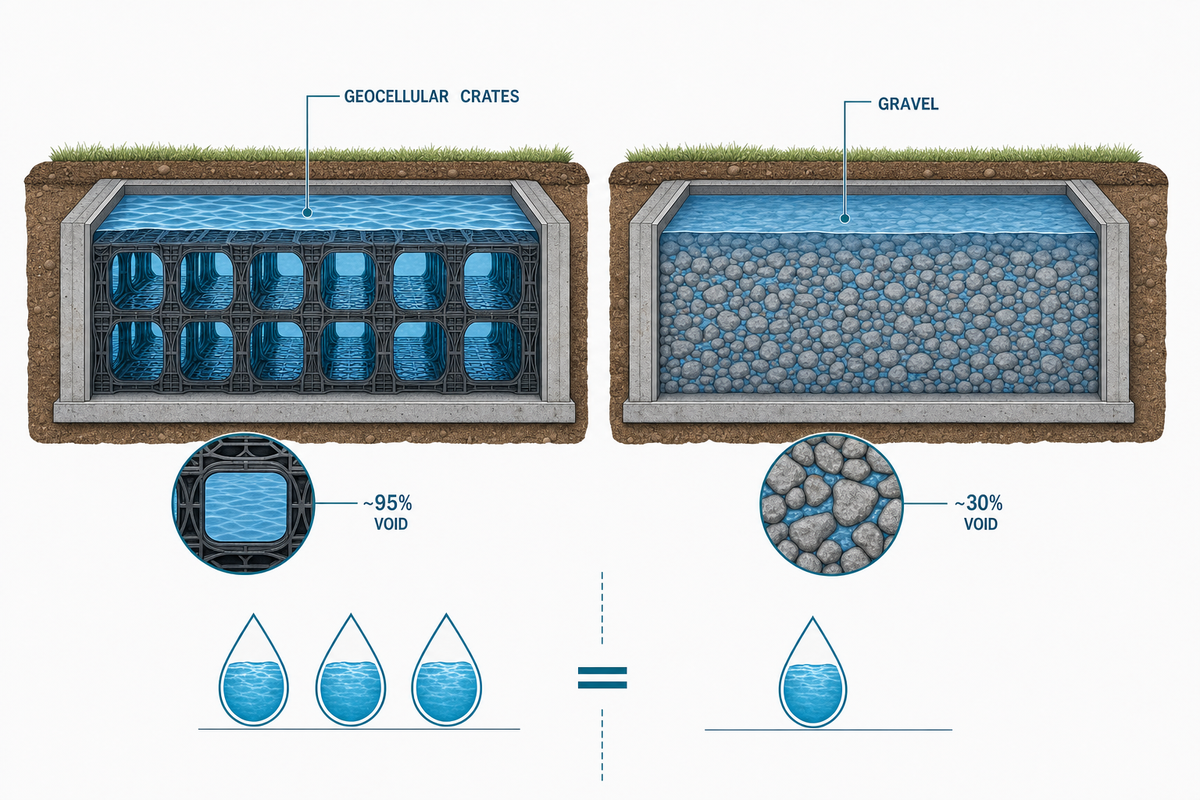
A drainage crate, also called a geocellular crate, is a sturdy, interlocking plastic structure designed to be installed underground. As crates are 90-95% open, they hold around 3 times as much water as an equal volume of gravel (only ~30% open). They deliver high-volume water storage from a relatively small excavation. Crates come in different sizes and clip together to suit the site, unlike a single large excavation.
A traditional alternative – a pit filled with gravel or rubble – performs a similar function, but stones will eventually become clogged with silt, preventing effective drainage. Crates maintain their large void space, have numerous flow pathways that reduce silt blockage, and can be designed to carry vehicle loads above them. Therefore, the concept that a crate is “just a fancier rubble pit” is a useful but incomplete explanation. They serve the same purpose, but are more durable and engineering-ready, a step up from older point solutions such as dry wells, French drains and sump pits, which have a limited life and tend to silt up. The rubble pit’s weakness is blunt: the risk is it silts up and fails over 5–15 years on a busy driveway, whereas a crate keeps its void. You can find out more about sizes and costs by looking at our soakaway crates guide.
Soakaway vs Attenuation vs Storage: The Membrane-Wrap Rule
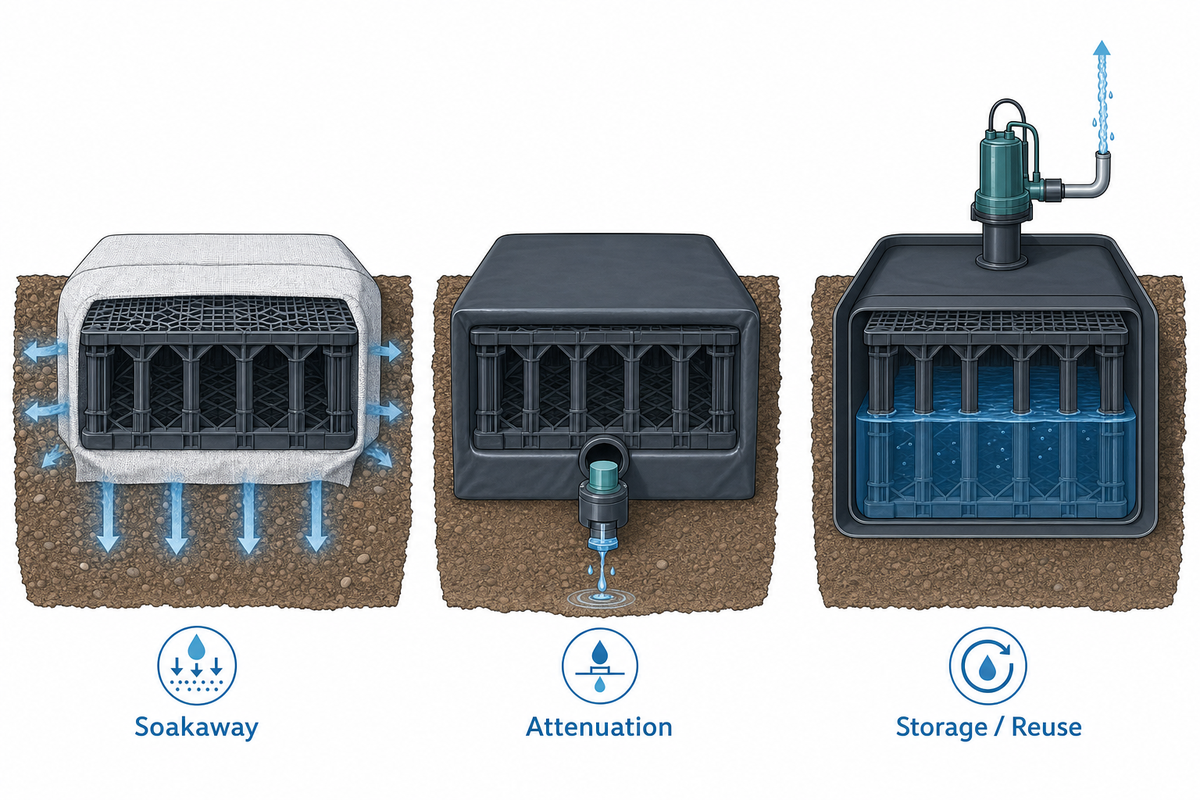
Here’s the fundamental concept that unifies the differing terms used by suppliers: the role of a drainage crate is determined not by the crate itself, but by the type of membrane it’s wrapped with:
- Wrap it in a permeable membrane, such as geotextile, and it becomes a soakaway – allowing the water to filter into the surrounding soil.
- Wrap it in an impermeable geomembrane and add a flow-control device, and water is stored and released slowly to a storm drain, sewer or watercourse – that’s attenuation.
- Seal it in a watertight liner with filtration and a pump, and you capture rainwater to be reused – that’s storage / rainwater harvesting.
One crate, three wraps, three jobs. CIRIA’s susdrain confirms the dual-duty part of this, noting that geocellular systems “can be used…either as a soakaway or as a storage tank.”
But the wrap only decides the crate’s job – the ground decides whether a soakaway is even an option. The British Geological Survey is clear that infiltration depends on the receiving ground accepting and storing water, on the water table being low enough, and on there being no contamination or aquifer-protection risk; pre-treatment is usually needed before water infiltrates, and the gov.uk National Standards set a minimum clearance between the base of an infiltration feature and peak groundwater. In other words, choose the wrap for the job you want, but confirm the ground can do that job first (see the decision section below).
Drainage-Crate Function Spec Sheet
| Decision factor by crate type | Soakaway crate | Attenuation crate | Storage / reuse crate |
|---|---|---|---|
| What happens to the water | Infiltrates into the ground | Stored, released slowly downstream | Stored, pumped back for reuse |
| Membrane wrap | Permeable non-woven geotextile | Impermeable geomembrane | Sealed liner (e.g. EPDM) |
| Outlet & control | None — it soaks away | Flow control (vortex/orifice) at a set rate | Filter + pump draw-off |
| Ground requirement (site investigation) | Must percolate (BRE 365 pass) + water table clear + no contamination risk | Ground permeability not required | Ground not required (sealed) |
| Void ratio | ~90–95% | ~90–95% | ~90–95% |
| Load options | Landscaped → HGV | Landscaped → HGV | Landscaped → HGV |
| Governing reference | CIRIA C753, BRE 365, Building Regs H3 | CIRIA C753, discharge / adoption standard | CIRIA C753 + treatment if non-garden reuse |
| Typical application | Gardens, driveways where the ground drains | Developments capped on discharge rate | Rainwater harvesting buffer |
| What fails if you pick wrong | Water ponds / overflows in clay | Flooding or a consent breach if discharge is unrestricted | Empty tank or contamination without liner/filter |
Infiltrate, Attenuate, Store: The 3 Core Crate Jobs
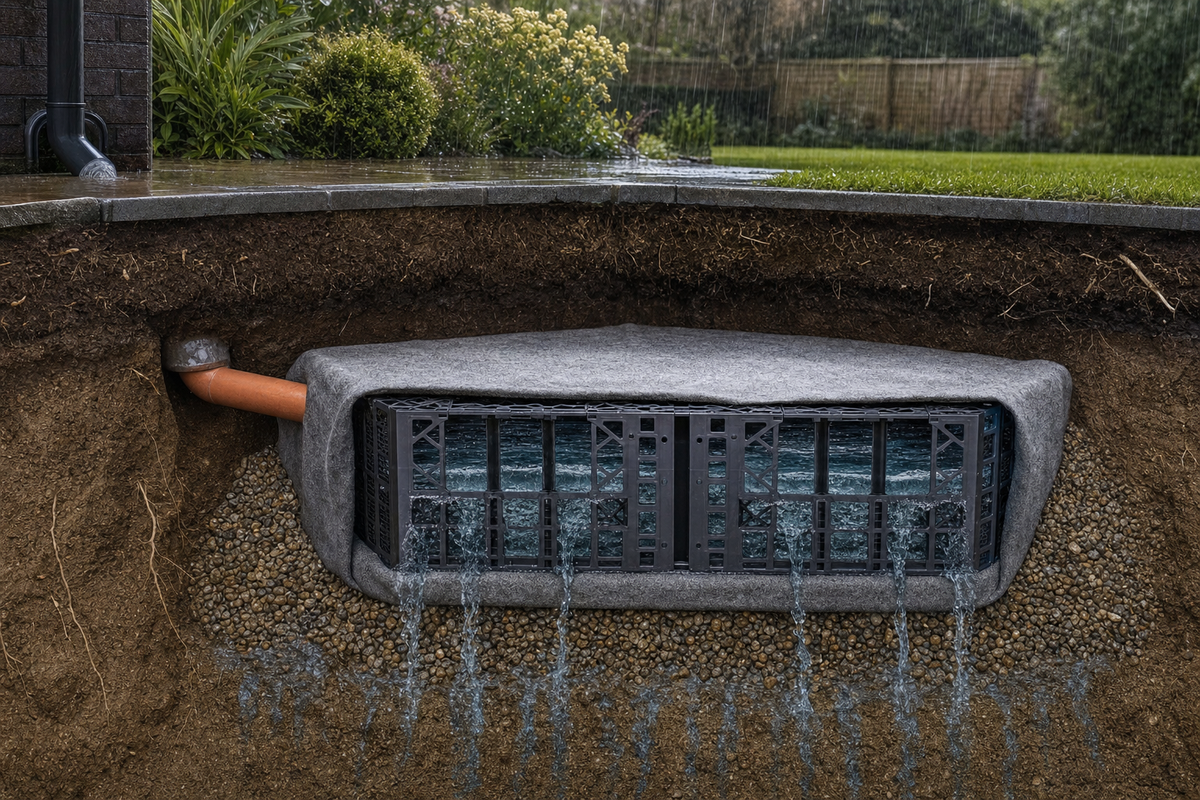
Soakaway (infiltration)
A soakaway crate lets surface water infiltrate into the ground through a permeable, non-woven geotextile that keeps soil out while letting water through. It only works where the ground actually drains, which is why a BRE Digest 365 percolation test is the standard check before you commit.
On clay or where the water table is high, no number of crates will make water disappear – the system simply fills and overflows. Real-world experience is blunt about this: on heavy clay, burying crates without a route out is, as one contractor put it, “just making a pond.” That said, soakaway crates are used in domestic gardens exactly this way, taking roof and driveway run-off clear of the building – the soakaway system depends on water infiltration into free-draining ground, which is why soakaway crate systems are only specified where a percolation test passes. Because soakaway crates are modular, you can scale the number up or down for the plot. Where the ground does drain, this kind of soakaway drainage is the simplest option – see our soakaway crates complete guide.
Attenuation (store and release)
An attenuation crate is wrapped in an impermeable geomembrane so it stores water rather than losing it to the ground, then releases it slowly through a flow-control device – a vortex or orifice control – into a sewer or watercourse at a restricted rate. This is the job when a site can’t discharge freely, which on most new developments means matching the pre-development, greenfield run-off rate. An attenuation system is the standard answer for water attenuation on constrained plots, holding back the volume of surface water leaving a development; suppliers list a whole range of attenuation crates and flow controls for it. It doesn’t need permeable ground, so it works where a soakaway can’t.
The difference between the two is covered in depth in our attenuation tank vs soakaway comparison and our how an attenuation tank works explainer.
Storage / rainwater reuse
In storage, the crate simply provides the void. Reuse, though, needs a sealed liner around the crate block, plus filtration and a pump to draw the stored water back out – and treatment is required before that water is used for anything beyond irrigation. Crates aren’t a harvesting system on their own – an important caveat – because geocellular systems alone offer no water-quality treatment; a silt trap or pre-treatment stage is therefore standard on any properly engineered system. For sealed systems, AQUA uses a 45 mil EPDM pond liner to enclose the crate block. Our geocellular drainage crates range and the honeycomb drainage cells page show both sealed and modular options.
Keep in mind that a drainage crate is part of a larger drainage solution and not the whole solution. Milton Keynes Council’s developer guidance states that geocellular storage crates, without other above-ground components such as swales, filter drains or filter strips, do not on their own deliver the full SuDS treatment train.
Drainage Crate Specs: Void Ratio, Sizes & Materials
How much water does one drainage crate hold?
The typical storage void is 0.19–0.42 m³ for each crate, as most (90-95%) is available as usable space. A standard 1000 × 500 × 400 mm crate gives about 0.20 m³, so about 5 crates will fill 1 m³, with bigger cells requiring fewer. Data from suppliers tends to reflect this — e.g. the StormCrate55 offers a 0.25 m³ capacity with a 95% void ratio.
| Property | Drainage crate | Gravel / rubble soakaway |
|---|---|---|
| Void ratio (usable storage) | ~90–95% | ~30% |
| Storage per 1 m³ excavated | ~900–950 litres | ~300–350 litres |
| Long-term behaviour | Keeps void; many flow paths resist silting | Silts up between stones over time |
| Material | Recycled polypropylene, modular | Aggregate |
Manufactured from high-strength recycled polypropylene, crates are light, easy to handle and quick to connect by hand. That’s the big reason they took over from the more cumbersome stone. Their downside, as noted by the reference bodies, is that they need pre-treatment and are a bit harder to inspect than an open feature – both points to be dealt with in the design in line with UK building guidance (Approved Document H). Buyers comparing drainage crates sizes should look at void volume per crate, not just the box dimensions – because the storage is fixed by the crate count, undersizing the void is a costly mistake that risks flooding downstream, sometimes adding £1,000s to a retrofit.
Load Classes: Landscaped, Trafficked & HGV
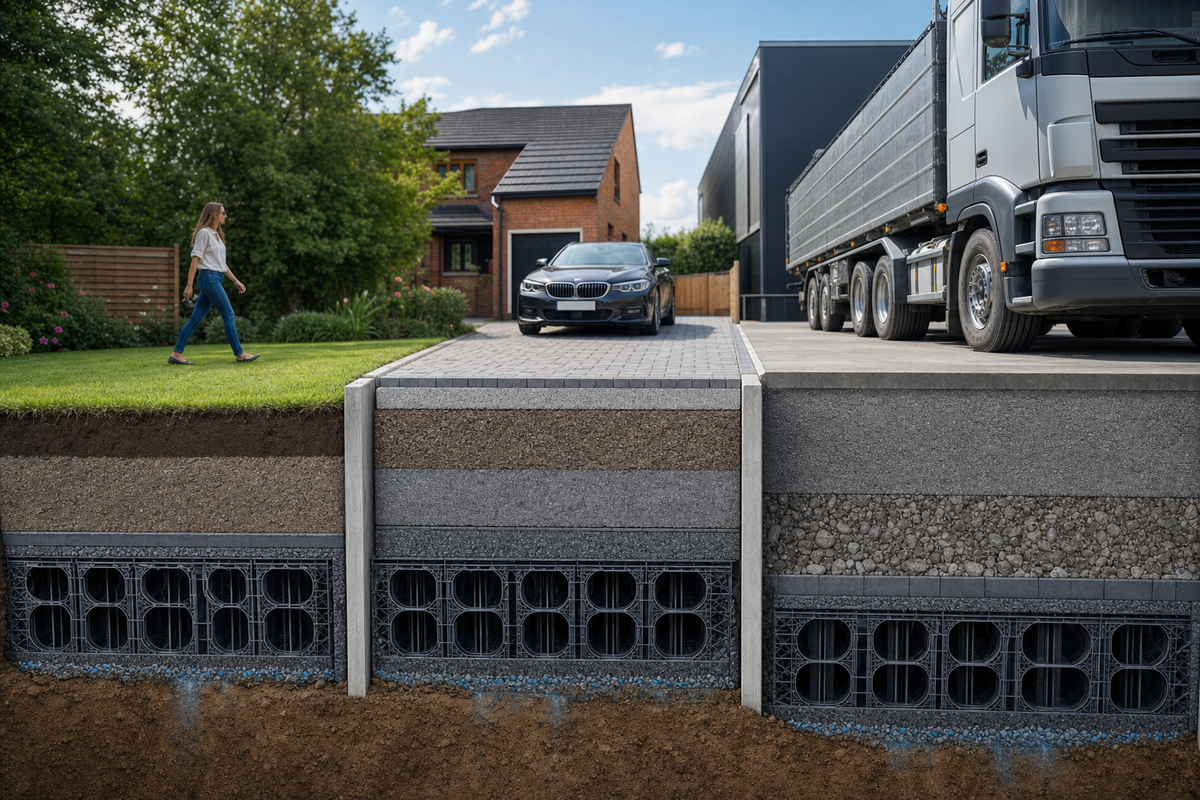
There are varying levels of load capacity on different crates, and choosing the wrong strength is an expensive mistake once it’s buried – because the crate has to resist both crush and the traffic load above, getting it wrong can mean digging the lot back up. UK design codes specify loads on a crate based on its own crush strength and cover depth to resist traffic loading; there is no simple load classification as there is with pipes – it’s a manufacturer-approved load rating for your design.
Crate Load-Class Ladder
| Load band | Typical application | Indicative cover depth | Drive-over? |
|---|---|---|---|
| Landscaped / pedestrian | Gardens, foot paths, patios | ~150–300 mm soil | Foot traffic only |
| Light trafficked | Domestic driveways, car parks | ~500–800 mm | Cars & vans |
| Heavy / HGV | Commercial yards, access roads | ~800–1200 mm, engineered | HGV with engineered cover |
Roughly speaking, light-duty crates are suitable for landscaped and pedestrian areas, whilst heavy-duty crates are rated for trafficked and HGV uses, although each manufacturer uses a different specification for crush ratings (short versus long term, vertical versus lateral), so you want to rely only on the figure quoted in the load table provided with the individual crate, and design it in line with CIRIA Report C737, the structural design guidance for geocellular systems. Rated for trafficked yards, a heavy-duty soakaway crate carries far more than a landscaping cell. According to AQUA, selected models in its export range are designed to the AASHTO H-20/HS-25 highway-loading equivalent for overseas projects. Crate structural design keeps advancing across the industry – newer geocellular units use internal truss geometries to raise compressive strength – so always design to the current load table for the specific crate you buy, and to the cover and loading expectations that UK building control sets out in Approved Document H.
Engineering Note – cover depth: minimum cover protects the crate from direct point loading from surface sources; the maximum burial depth is limited by the crate’s maximum vertical load-carrying capacity plus the load imposed by the backfill and traffic above it. Beneath a domestic driveway, for example, you can expect to bury the crates under 500-800 mm of compacted soil; refer to your crate load table and the intended traffic class for the site to be sure of the excavation depth.
How to Choose: The Runoff-Destination Decision
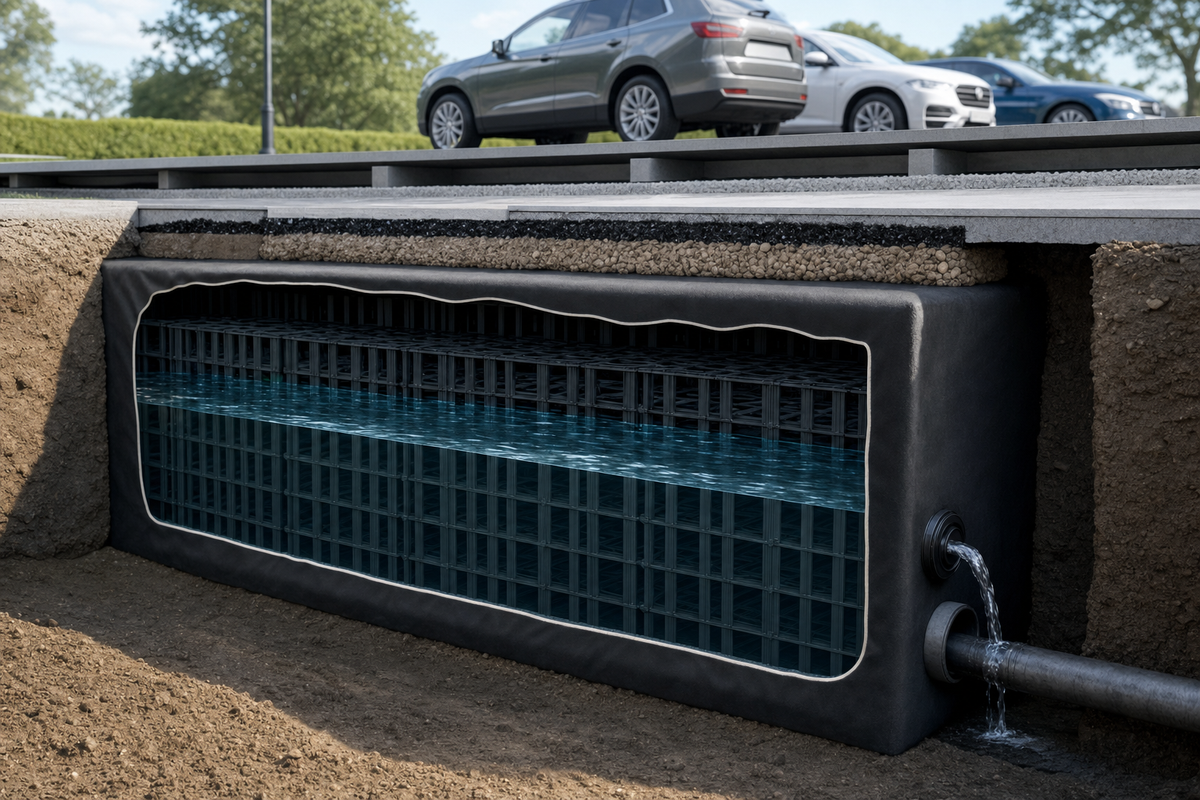
Because the cover material and the pipework all do their bit, the simplest approach to deciding whether to install a soakaway, attenuation, or both is to follow the water from where it enters the system to where it’s going to end up, along the lines of the 2025 National Standards’ new hierarchy: rainwater reuse ranks above infiltration, which in turn ranks above discharge to a watercourse. Choose wrong here and you either flood the plot or breach a discharge consent – a costly mistake to unwind. In practice, on a clay site you lean to attenuation; on free-draining ground, a soakaway.
Runoff-Destination Decision Tree
- Does the ground pass a BRE 365 percolation test, with the water table low enough and no contamination risk? If no, you can’t infiltrate – go to step 2. If yes, a soakaway (permeable geotextile wrap) is your baseline option – now go to step 3.
- Ground can’t infiltrate, or a planning/adoption condition caps your discharge: use attenuation – an impermeable geomembrane crate plus a flow-control device sized to the permitted release rate, discharging slowly to a sewer or watercourse.
- Do you also want to reuse the water on site? If yes, seal the block with a liner and add filtration plus a pump for rainwater harvesting. If no, leave it as the soakaway or attenuation system chosen above – you’re done.
Do I need a soakaway or an attenuation tank?
In short, use a soakaway where the substrate is permeable and there’s no planning/adoption condition limiting your flow rate; use attenuation if the ground isn’t permeable or you’re restricted in the rate at which water may be discharged into a public sewer/watercourse. Clay soils often necessitate an attenuation system, as do sites that have no free outfall for water.
We cover these issues more fully in our soakaway vs attenuation tank guide, and discuss sizing the controlled-release version in our geocellular attenuation tank guide.
CIRIA’s susdrain guidance on geocellular storage notes that these systems offer no water-quality treatment, so silt traps and pre-treatment are required. That is why below-ground attenuation is best designed for its whole service life – not just for the storage volume it holds on day one.
What Drainage Crates Cost: Price per m³ & the Real Drivers
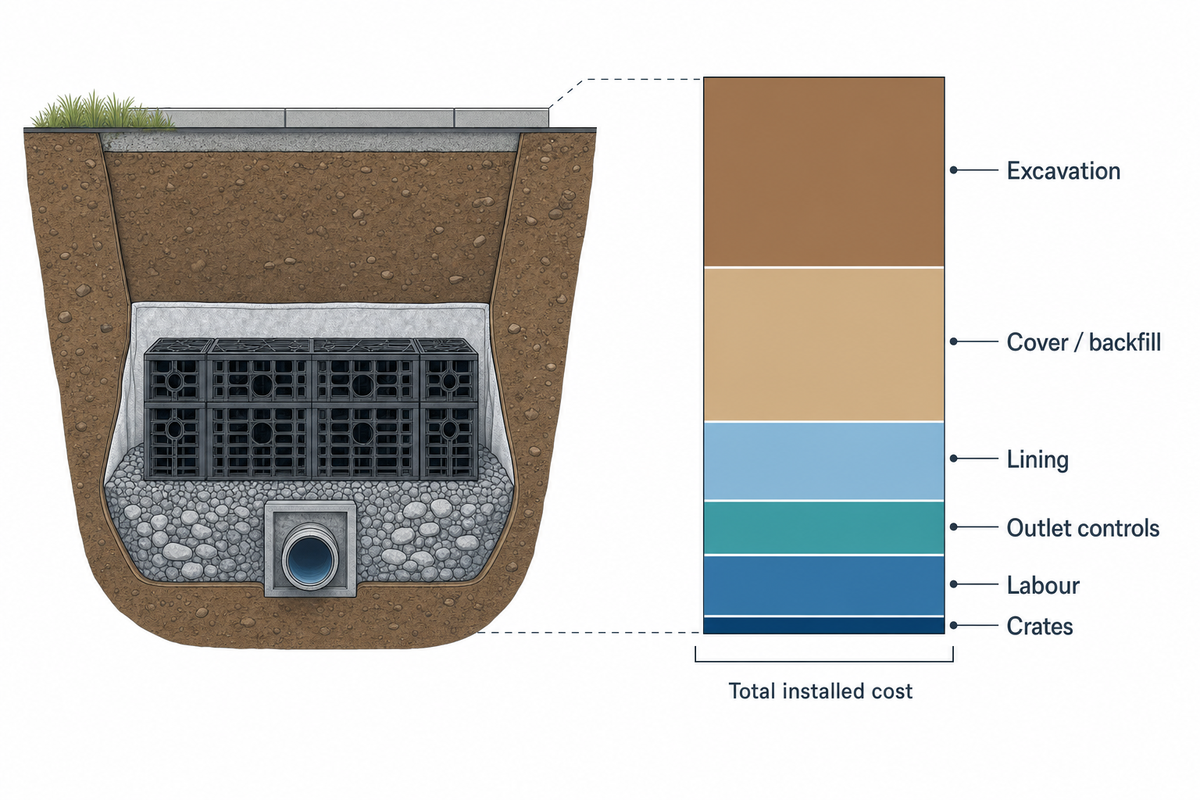
See any price for soakaway or attenuation crates as an outdated reference, not a concrete specification. For individual soakaway/attenuation crates at UK merchant retail (ex VAT, prices as of Jan 2026), they’re between roughly £33 and £77 apiece depending on their load capacity and size. That makes the crate hardware alone approximately £150–£300 per m³ of storage at retail (with cheaper trade and bulk prices).
What’s more helpful to know is that the crate hardware is normally the smaller part of the bill. UK drainage cost data are known to be sparse and poorly characterised, with research on public whole-life costs showing that actual installed cost is dominated by factors like excavation, depth of cover, lining, access, outlet controls, ground conditions, and traffic loading, rather than the storage unit itself. While crates can be cheaper than a below-ground concrete tank of equivalent volume and save land space compared to above-ground storage, the cheapest solution per cubic metre, if space is available, will be a surface pond or basin. A UNH Stormwater Center cost study hosted by the US EPA found the capital cost per unit volume of subsurface chamber storage to be several times that of an open retention or detention pond. Treat that as old and non-UK data but suggestive – crates buy you underground space and a compact footprint, not a cheap unit price. If you’re interested in the controlled-release option, check our attenuation tank cost guide.
Installing & Sizing Drainage Crates: The Basics
How many drainage crates do I need?
First determine the required volume of storage, and then divide by the volume per crate to get the number of crates. Simple illustration: a roof of 100m² receiving 50mm of design rainfall at a storage factor of 1.0 needs 100 × 0.050 = 5 m³ of storage. If each crate has a useful void capacity of about 0.20 m³, then 5 / 0.20 = 25 crates – a small patio soakaway might need just 3 crates.
You can use this logic, inputting your own catchment size, local design rainfall depth, and planned crate volume, to work out your total. The volume for a formal system comes from a drainage calculation based on the appropriate return period, but the sum remains the same.
How deep should drainage crates be buried?
Depth depends on the load band in the table above: you need enough cover to protect the crate from impact, but within its strength capacity. In terms of the planning application process or Building Regulations (Approved Document H3), a traditional soakaway is usually kept at least 5m from a building, and building-control practice typically also keeps it around 2.5m from the property boundary.
However, according to susdrain’s CIRIA factsheet on SuDS close to buildings, the 5m separation distance for a traditional soakaway is often an overly cautious rule of thumb for shallower, modern crate systems, and it may be acceptable to reduce this distance with site-specific analysis.
The install process is the same for all jobs: dig the trench or excavation to depth, place and compact a base, run the drainage pipe to the inlet, wrap the crate block in the correct membrane for the job (permeable geotextile for a soakaway, impermeable geomembrane for attenuation), fit the manhole / silt trap, backfill in lifts and then test. Fitting the flow control accurately matters as much as getting the crates right. When you install soakaway crates, fitting the flow control correctly matters as much as the crates themselves. Dedicated sizing and installation guides will be produced shortly – in the interim, the geocellular stormwater modules and the shallow attenuation tank pages will give you component details, and our subsurface stormwater management systems overview will give you a view of how it all fits together.
| ✔ Advantages | ⚠️ Limitations |
|---|---|
| ~90–95% void vs ~30% for gravel — smaller dig for the same storage | No water-quality treatment on their own — need a silt trap / pre-treatment |
| Lightweight, modular, quick to install by hand | Soakaway version only works where the ground percolates |
| Load-rated for gardens through to HGV areas | Harder to inspect than an open feature |
| Same hardware serves soakaway, attenuation or storage | A surface pond is cheaper per m³ where land is available |
Brands & Alternatives: The UK Crate Landscape
Buyers usually start by comparing leading brands, but the specification that decides the job is the same across all of them: void ratio, load class and membrane. Crates commonly specified in the UK include Polypipe Polystorm and Wavin Aquacell, plus ranges from Graf, Brett Martin and Osma, and models such as the StormCrate range are widely stocked. Polystorm soakaway crates and Aquacell units are specified the same way as any other geocellular crate. Pick the wrong void ratio or load class here and you either overpay or under-drain the site – it can add £100s to a driveway or car park job. In practice, instead of selecting by brand, compare the parameters which really determine the success of the job: the void ratio, crate size, load capacity, and the availability of the corresponding geotextiles and geomembranes from the supplier. Larger projects may find that buying crates direct from the manufacturer offers some cost advantages, provided the loading and membrane specifications are sound. For a technical comparison, our range of geocellular drainage crates and our shallow geocellular drainage system set out the void ratio, load rating and membrane options side by side – a direct brand-by-brand comparison is planned.
What’s Changing: 2025 SuDS Standards & Schedule 3
Demand for crates is being driven by regulatory pressure, rather than the market itself. Defra announced a set of new National Standards for Sustainable Drainage Systems (SuDS) on 19 June 2025 – the first in ten years. These are built around a set of design standards and a clear discharge hierarchy, which promotes reuse or infiltration on site, rather than simply piping to the sewer.
Managing run-off on sites prone to flooding is a particular focus, since reducing the level of surface water reaching downstream drains is the objective – which is exactly what soakaway crates and attenuation crates do, hence the growing demand in new development.
However, the legal framework isn’t uniform across the UK, and it’s important to be clear: Schedule 3 to the Flood and Water Management Act 2010 – which requires SuDS Approving Body sign-off as part of drainage approval – has been implemented in Wales since 7 January 2019 but is, to date (2026), not implemented in England. In early 2025, the Government confirmed that SuDS would continue to be delivered through the planning process and the new standards, rather than Schedule 3; industry bodies such as CIWEM noted the update still stops short of making SuDS mandatory. Scotland has its own regime for SuDS and water environments. Across all three, the key buyer action is the same: consider crate specifications and flow controls with regard to discharge or adoption standards early in the design process, and confirm the load class for adoptable or trafficked areas before placing an order. Which consent route applies depends on where you are building. In England that runs through the planning system, with drainage conditions set by the local planning authority in consultation with the lead local flood authority; in Wales it runs through SuDS Approving Body approval under Schedule 3. Get the consent route wrong and approval can slip – a real risk on a new development – so it is worth establishing early which one applies to your site.
Frequently Asked Questions
What is the difference between a soakaway crate and an attenuation crate?
A soakaway crate and an attenuation crate are usually the very same plastic crate at heart, just finished with a different membrane wrap and a different inlet and outlet arrangement to suit the job. A soakaway crate is wrapped in a permeable geotextile so that the water it holds can seep out into the surrounding soil, which of course has to be genuinely free-draining ground, tested and confirmed, for that route to work at all in practice.
An attenuation crate is wrapped in an impermeable geomembrane and a flow-restriction device is fitted, allowing water to be stored in the tank before being slowly discharged to a sewer or watercourse – useful when infiltration isn’t possible or the permitted discharge rate is too low.
Are drainage crates better than a rubble or gravel soakaway?
Generally, yes, on both capacity and lifespan. At around 90-95% open space, compared to about 30% in gravel, a crate holds nearly 3 times the storage for the same excavation, so the dig – and the spoil you cart away – is much smaller.
There is a durability angle too, and it is the bigger long-term reason professionals switched. The stones in a gravel soakaway gradually silt up and begin to block drainage, so the effective storage falls year on year; a crate keeps its open void, provides numerous flow paths that resist blocking, and can be load-rated to carry traffic above it. The trade-off is that a crate needs a silt trap or other pre-treatment upstream and is harder to inspect once buried, so both points belong in the design from the start rather than as an afterthought later on site.
How many drainage crates do I need?
Work out the storage volume you need, then divide by the usable void per crate. As a rough guide that is about 5 crates per 1 m³, so a 5 m³ system works out at roughly 25 standard crates before you refine it.
For anything formal, calculate your storage from a proper drainage figure based on your project’s required return period and the actual crate size. As a rough sanity check, a 100 m² roof at 50 mm of design rainfall needs about 5 m³ of storage – roughly 25 standard crates.
How deep should drainage crates be buried?
Deep enough that surface loads can’t crush the crate, but not so deep you exceed its crush rating. A domestic driveway typically needs 500-800 mm of cover; HGV areas need much more, properly engineered. Always check the manufacturer’s load table.
Do you fill drainage crates with gravel?
No – the crate replaces the gravel entirely. You wrap the block in geotextile or geomembrane, but the inside stays a hollow void, and that open void is exactly what gives a crate its extra storage over a gravel-filled pit.
Can drainage crates go under a driveway or car park?
Yes, with the right crate and enough cover over it. Driveways and small car parks usually need a vehicle-rated crate under 500-800 mm of compacted cover; HGV traffic needs heavy-duty crates and deeper engineered cover. Always consult the manufacturer’s load table before you order.
Do drainage crates need planning permission or building control sign-off?
For a simple domestic soakaway serving a driveway or a garden you usually do not need planning permission, but the drainage still has to satisfy Building Regulations, and Approved Document H expects surface water to be sent to a soakaway before a sewer wherever the ground actually allows it. On a larger development, surface-water drainage is also secured through the planning system, alongside Building Regulations rather than instead of them.
Which route applies depends on where you build: in England, drainage conditions are set by the local planning authority with the lead local flood authority; in Wales, SuDS Approving Body approval applies under Schedule 3. It always pays to confirm the local position with your authority early on.
Are soakaway crates any good?
A soakaway works when three things line up: the ground passes a BRE 365 infiltration test (and meets any local SuDS guidance); the crate is rated for the load above it; and it is installed with pre-treatment and the correct wrap.
Sites on heavy clay soil or with a high water table won’t accept infiltration efficiently, no matter how many crates you use; in those cases an attenuation tank should be installed instead – not that there’s anything wrong with the crates themselves.
Working out which crate your site needs? Compare void ratio, load class and membrane options across our geocellular drainage crates range, or send us your catchment figures and we’ll help size the system.
References & Sources
- National Standards for Sustainable Drainage Systems (2025) — Department for Environment, Food & Rural Affairs, GOV.UK
- Flood and Water Management Act 2010, Schedule 3 — legislation.gov.uk (implemented in Wales from 7 January 2019; not commenced in England as of July 2026)
- The Building Regulations 2010, Approved Document H: Drainage and Waste Disposal — HM Government
- Geocellular Storage Systems — susdrain, CIRIA
- Surface Water Drainage: Guidance for Developers — Milton Keynes Council
- Evolving Research for Stormwater Management — James Houle, UNH Stormwater Center; undated presentation hosted by the US EPA (posted 2017). Capital cost per BMP storage volume. Non-UK and dated; cited for directional comparison only
Prepared by Grayden Du, Export Director, AQUA RainWater Solutions. Regulatory position as of July 2026 — standard sizes and pricing may change; please verify with your representative.
 English
 Arabic
 French
 Russian
 Spanish