
Flow • Store • Support — Shallow Geocellular Drainage & Sub-base System
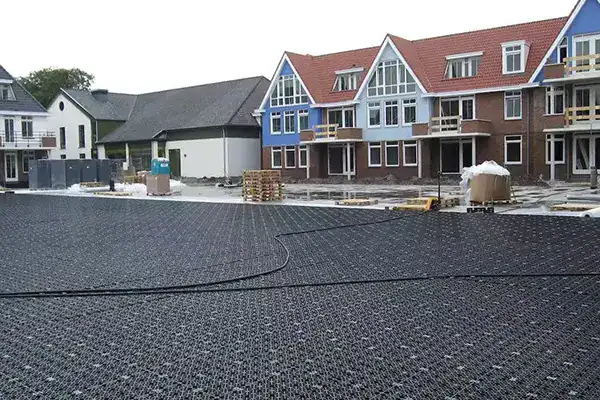
Manage stormwater at the source with ultra-shallow , traffic-rated modules. The high-strength structural alternative to aggregate sub-bases for permeable paving and podiums.
Feature
≤ 30%
Drainage cost saving vs deep trenches
95%
Void ratio (storage & through-flow)
130 t/m²
Max vertical load (Honeycomb)
> 52%
Perforated intake area
50.2 → 94.2
L·s−1·m−2 layer discharge (0% → 2%)
≤ 60%
Irrigation saving via passive capillary
Applications


System Selection Guide: Which Option fits your Site?
Both our systems function as a structural sub-base replacement with a 95% void ratio. They replace traditional aggregate to reduce excavation depth and handle traffic loads. Choose the right module based on your site’s depth and installation speed requirements.
| Selection Criteria | Shallow Attenuation Tank | Honeycomb Drainage Cell |
| Module Height | Variable: 85, 150, 200, 250 mm (Fine-tune to exact invert levels) | Stackable: 82 mm increments (82, 164, 246 mm… Multi-layer capable) |
| Installation Speed | Fast: Hand-lay individual units | Ultra-Fast: Delivered in pre-assembled ≥9m² mats |
| Site Geometry | Flexible: Perfect for irregular shapes, curves, and tight corners. | Efficient: Best for large, open rectangular areas (Podiums/Car parks). |
| Load Capacity | Traffic Rated: Suitable for cars & light trucks. | High Load: Vertical strength ≥800 kN/m² for heavy duty. |
| Key Benefit | Maximum Volume Control in tight spots. | Speed of Installation on large decks. |
| View Tank Details >> | View Tank Details >> |
Design Principles & Performance Advantages
Hydraulic Logic
Structural Performance
Sustainability & Opex
Multi‑dimensional Comparison
| Dimension | Traditional Deep Pipes | Shallow Attenuation Raft |
| Excavation & Utilities | Deep trenches, utility conflicts, dewatering risks | Shallow build, minimal excavation, fewer utility clashes |
| Hydraulic Function | Conveyance‑led; limited on‑site storage | Integrated attenuation beneath surface; throttled discharge |
| Irrigation Capability | Separate systems/pumps required | Inherent passive irrigation via capillary layers |
| Resilience to Cloudbursts | Potential inlet surcharge; slower recovery | Rapid capture at source; 24–48 h repeatability |
| Programme & Cost | Longer programmes; more cart‑away/backfill | Faster install; reduced cart‑away; fewer materials |
| Carbon & Materials | High aggregate import; embodied carbon | Less aggregate; passive energy; lower embodied impacts |
| Retrofit Flexibility | Challenging in built‑up sites | Favourable for streetscapes, plazas, podium decks |
| Regulatory Context | Pipe‑centric; storage often separate | Aligns with SuDS (EU) & LID (US) emphasis on source control |
| Operations & Maintenance | Manholes and deep access requirements | Shallow inspection ports; easier access and flushing |
Why Choose Shallow Attenuation?
- Engineering‑led: design support, hydraulic modelling guidance, and build‑up details for each application.
- SuDS/LID Ready: compatible with European SuDS manuals and North American LID/green infrastructure programs.
- Cost & Programme: shallower excavation, fewer materials, accelerated installation, and predictable outflows.
- Low‑Energy Operation: passive irrigation and gravity‑driven drawdown reduce energy and potable water demand.
- Scalable & Modular: from small tree pits to large plazas and podium landscapes using standardized modules.

System Integration
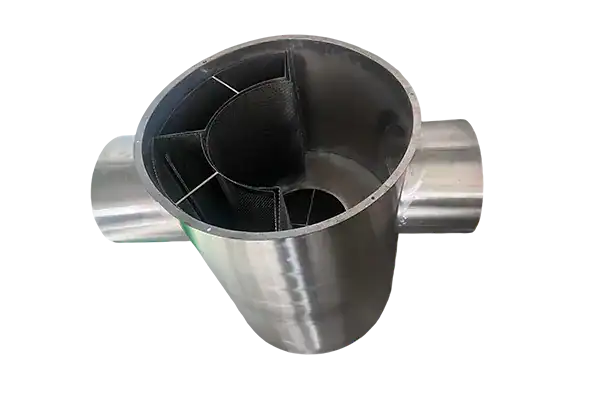
Aqua StormFilter
Cartridge/basket filtration upstream of the shallow raft to capture silt and hydrocarbons.

Geocellular Tanks
High-volume detention modules used as downstream storage with throttled outlet control.

Geocellular Modules
Decentralized soakaway cells linked to the raft for targeted infiltration and recharge.

Stormwater Chambers
Accessible vault providing inspection, flushing and flow control for large catchments.

Geomembrane
Creates detention zones; use welded seams and protection layers per specification.

Geotextile
Filter/separator enabling infiltration while controlling fines (select weight & AOS by soil).
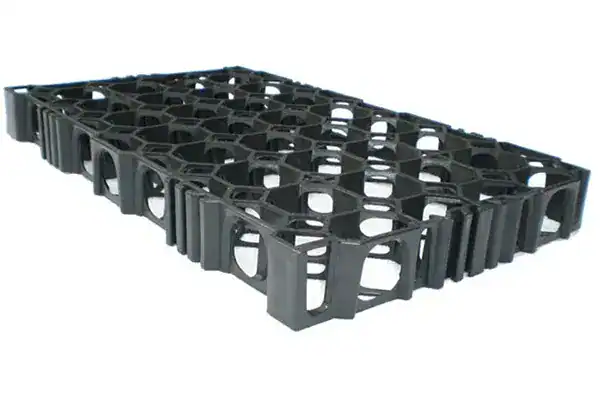
Drainage Cell
Thin-profile drainage panels for planters/podiums; interface with HydraCell for passive irrigation.
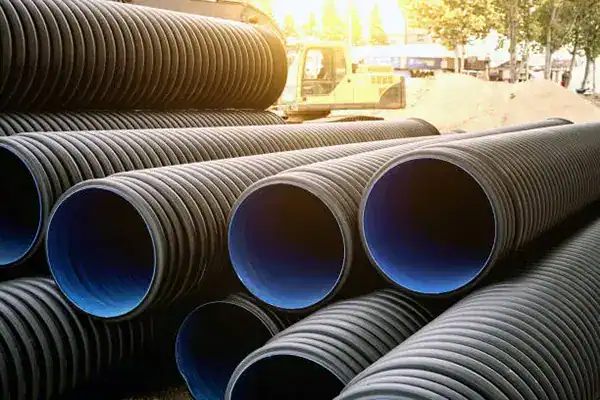
SN8 Pipe
Outlet conveyance or bypass; connect via shallow inspection boxes with throttled discharge.
FAQ
Partner with us. Low input. High return. Full support.
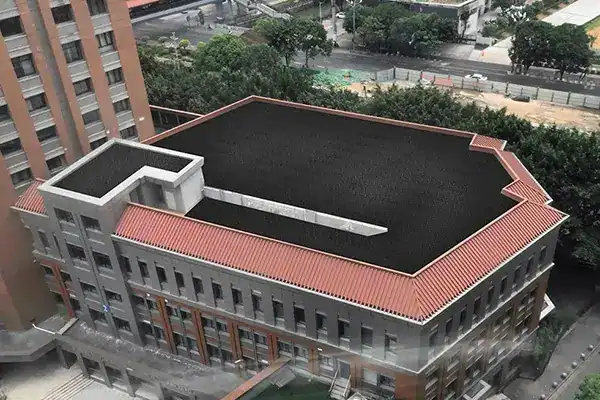
Offer shallow geocellular rafts for depth-constrained sites—parking, streetscapes, and blue-green roofs—with engineer support and export-ready paperwork.
 English
 Arabic
 French
 Russian
 Spanish