Póngase en contacto con AQUA Company
Sistemas subterráneos de detención de aguas pluviales: tipos, dimensionamiento e instalación
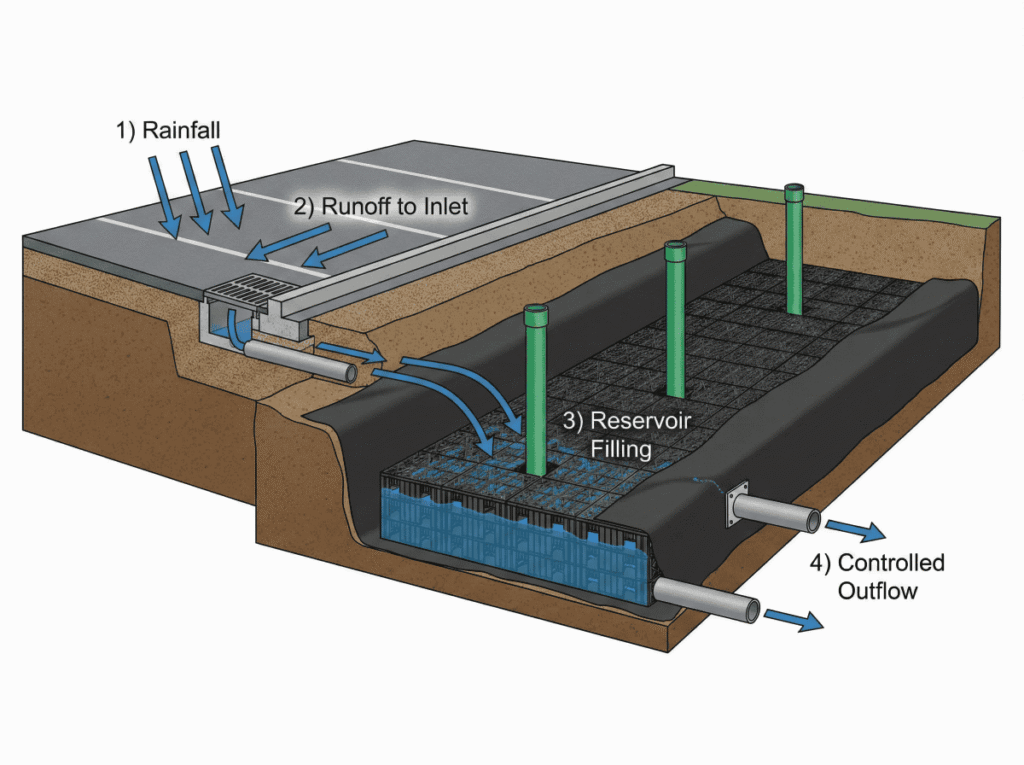
¿Qué son los sistemas subterráneos de detención de aguas pluviales?
Respuesta breve
Los sistemas subterráneos de detención de aguas pluviales captan los picos de escorrentía bajo el nivel del terreno y los descargan a un ritmo controlado. Son la solución necesaria cuando hay poco espacio en la superficie o las normas de zonificación prohíben las estructuras de agua a cielo abierto. La diferencia principal respecto de la retención de aguas pluviales es que la detención almacena el agua temporalmente y luego la descarga, mientras que la retención la almacena de forma permanente.
Los sistemas subterráneos de detención de aguas pluviales captan los picos de escorrentía bajo el nivel del terreno y los descargan a un ritmo controlado. Son la solución necesaria cuando hay poco espacio en la superficie o las normas de zonificación prohíben las estructuras de agua a cielo abierto. La diferencia principal respecto de la retención de aguas pluviales es que la detención almacena el agua temporalmente y luego la descarga, mientras que la retención la almacena de forma permanente.
Un sistema subterráneo de detención de aguas pluviales es una instalación bajo el nivel del terreno, diseñada para captar aguas pluviales durante una tormenta y descargarlas a un ritmo controlado para reducir el riesgo de inundación aguas abajo. Se prefieren cuando la disponibilidad de terreno es limitada o las normas locales de zonificación prohíben almacenar agua en la superficie. Al comparar proveedores, se pueden evaluar las soluciones subterráneas para aguas pluviales de Storm Manage con base en los mismos requisitos de tormenta de diseño, caudal de salida permitido, almacenamiento efectivo y acceso para mantenimiento.
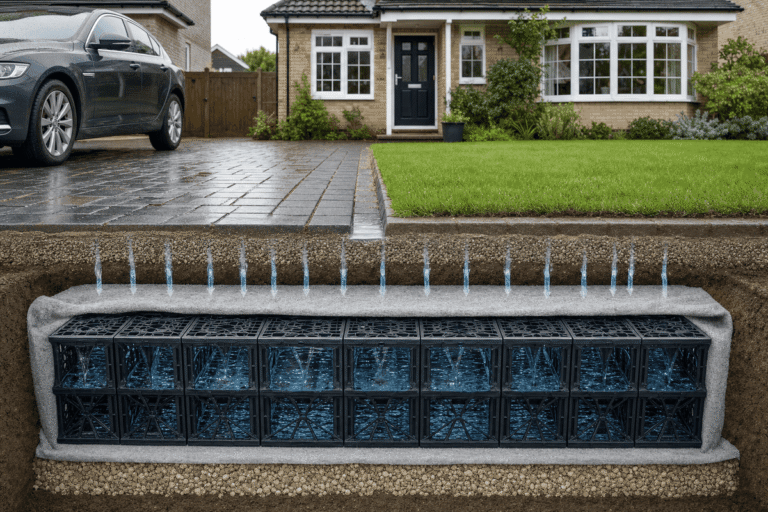
Funcionan de una manera muy específica: cuando llueve, el agua ingresa al sistema más rápido de lo que sale. La salida se dimensiona para descargar las aguas pluviales a un caudal específico, equivalente al caudal de escorrentía previo al desarrollo que el sistema de drenaje aguas abajo fue diseñado para admitir. Cuando pasa la tormenta, las aguas pluviales almacenadas vuelven a descargarse al sistema pluvial al cabo de unas horas. Entonces, el sistema vuelve a quedar «seco». Así se diferencia la detención de la retención de aguas pluviales: en la retención, el agua se almacena permanentemente en un sistema de retención de aguas pluviales, a menudo para infiltrarla o reutilizarla. Para conocer la relación entre los sistemas de detención y otros sistemas similares, puede consultar nuestra página sobre tanques de detención de aguas pluviales, que describe sistemas compuestos por estructuras individuales de detención (tanques), o nuestra página sobre tanques de atenuación, donde se explica la terminología alternativa que se utiliza para estos sistemas en el Reino Unido y Australia.
Función principal: almacenamiento temporal y descarga controlada
El objetivo principal de un sistema subterráneo de detención es atenuar el caudal máximo. Cuando superficies impermeables como techos, caminos y estacionamientos reemplazan la cobertura natural del suelo en un área, el caudal y el volumen de la escorrentía de aguas pluviales aumentan considerablemente durante las lluvias. Los sistemas de detención captan este pico de escorrentía y limitan su descarga a un caudal controlado, comúnmente mediante un orificio o una placa de vertedero, para evitar que el flujo aguas abajo supere la capacidad para la que fue diseñado. Según el Manual de calidad de aguas pluviales de CT, «la detención subterránea es una práctica recomendada de gestión que ha demostrado ser eficaz para gestionar los caudales máximos posteriores al desarrollo».
Detención y retención: por qué importa la diferencia
A menudo se usan estos términos indistintamente, lo cual es desafortunado porque usar el término equivocado suele llevar a instalar el sistema incorrecto. La detención consiste en almacenar temporalmente las aguas pluviales y descargarlas a un caudal controlado, de modo que el sistema de retención de aguas pluviales o el sistema de detención quede seco después de la tormenta. La retención se refiere al almacenamiento permanente de aguas pluviales, generalmente para infiltrarlas en el terreno geológico subyacente o utilizarlas en un sistema de riego paisajístico u otro uso beneficioso, como el suministro de agua para la extinción de incendios o la descarga de inodoros con agua no potable. La mayoría de las cuencas de detención para establecimientos comerciales nuevos o remodelados, incluidos los sistemas subterráneos de detención, se diseñan y construyen como instalaciones de detención porque, en la mayoría de los casos, las autoridades locales exigen controlar el caudal de descarga, pero no eliminarla por completo.
Tipos de sistemas subterráneos de detención
Respuesta breve
La mayoría de los proyectos se resuelven eligiendo entre cuatro tipos de sistemas: bóvedas de concreto para zonas de tráfico pesado, tuberías de metal corrugado para terrenos alargados, tuberías de HDPE para aplicaciones residenciales de baja exigencia y celdas geocelulares modulares para grandes áreas comerciales que necesitan maximizar el almacenamiento por pie cúbico de excavación. La ASCE ha documentado fallas estructurales en sistemas plásticos instalados sin una verificación adecuada de las cargas, por lo que esta decisión afecta tanto la seguridad como el costo.
La mayoría de los proyectos se resuelven eligiendo entre cuatro tipos de sistemas: bóvedas de concreto para zonas de tráfico pesado, tuberías de metal corrugado para terrenos alargados, tuberías de HDPE para aplicaciones residenciales de baja exigencia y celdas geocelulares modulares para grandes áreas comerciales que necesitan maximizar el almacenamiento por pie cúbico de excavación. La ASCE ha documentado fallas estructurales en sistemas plásticos instalados sin una verificación adecuada de las cargas, por lo que esta decisión afecta tanto la seguridad como el costo.
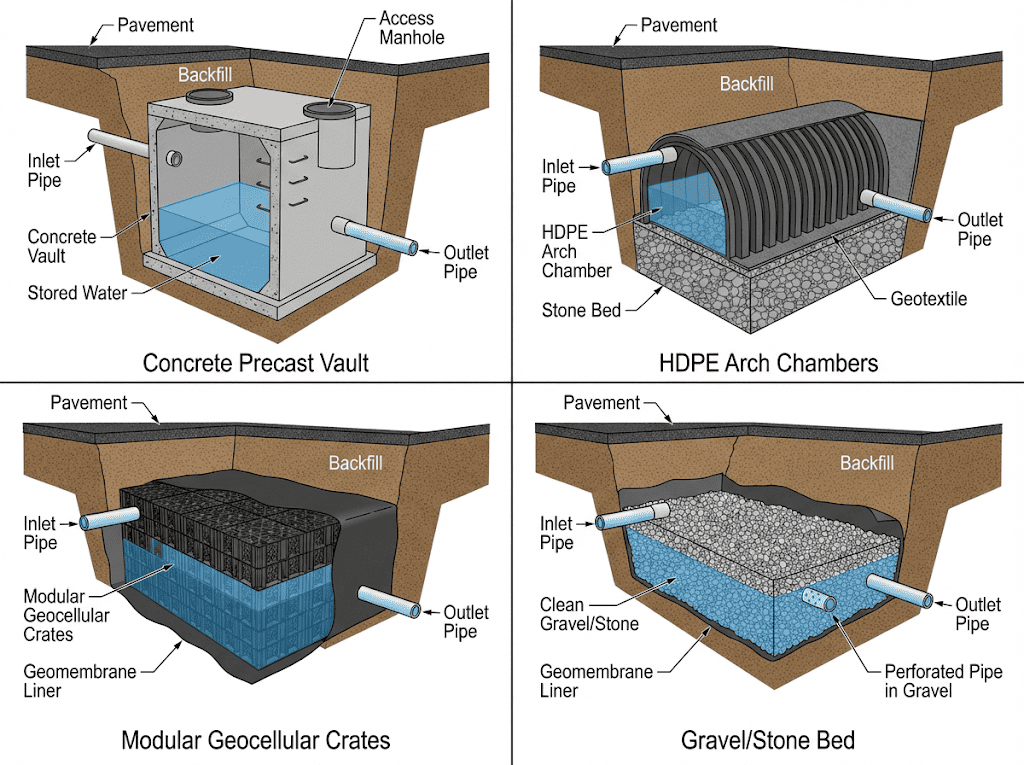
Elegir el sistema subterráneo de detención adecuado exige considerar cuidadosamente el material, las condiciones de carga, los requisitos de almacenamiento y el presupuesto. No se trata simplemente de comparar el costo de los materiales; es una decisión compleja de ingeniería. Por ejemplo, las bóvedas de concreto pueden ofrecer una vida útil superior, pero implican costos elevados de manipulación e instalación. En cambio, los sistemas plásticos livianos suelen requerir una compactación precisa del relleno para alcanzar las capacidades de carga especificadas.
El Manual de calidad de aguas pluviales de CT clasifica los distintos materiales utilizados en la detención subterránea y destaca las características y consideraciones de cada uno. Es importante recordar que la ASCE publicó en 2024 hallazgos sobre fallas de sistemas subterráneos de detención de plástico sometidos a cargas de tráfico. Advirtió que suponer capacidades de carga inadecuadas ha provocado colapsos estructurales en instalaciones reales.
Bóvedas de concreto y alcantarillas de cajón
Las bóvedas de concreto y las alcantarillas de cajón son los materiales más comunes para la detención subterránea gracias a su resistencia y alta capacidad de carga (cargas HS-20 y HS-25). Por lo general, no requieren un diseño estructural adicional y, por eso, suelen elegirse para proyectos bajo calles, estacionamientos y zonas de carga. Según la Asociación de Tuberías de Concreto de Estados Unidos y Canadá, las bóvedas prefabricadas de concreto pueden tener una vida útil de diseño superior a 75 años, según las especificaciones de fabricación y prueba (por ejemplo, ASTM C1577 y C1433). Sin embargo, pueden ser difíciles de maniobrar durante la construcción y suelen tener el costo inicial más alto por pie cúbico de almacenamiento.
Sistemas de tuberías de metal corrugado (CMP)
Los sistemas de tuberías de metal corrugado suelen constar de tramos individuales de tubería de acero galvanizado o aluminizado, con diámetros de 36 a 120 pulgadas. Los tramos se fabrican como un conducto único o se conectan mediante un colector de metal corrugado para unir varios conductos. Estas tuberías se utilizan con frecuencia en proyectos alargados porque se conectan fácilmente en línea recta. También ofrecen un volumen de almacenamiento relativamente económico. La principal consideración para esta tecnología es cuánto tardará en corroerse el material galvanizado dadas las condiciones existentes del agua subterránea. Según el pH del suelo, el nivel freático y otros componentes químicos del suelo, los sistemas de tuberías galvanizadas suelen tener una vida útil de diseño de entre 25 y 50 años antes de volverse susceptibles a fallas. El CMP con recubrimiento de polímero es una opción alternativa para proyectos cuyas condiciones de agua subterránea serían especialmente agresivas para los materiales galvanizados. Estos sistemas prolongan esa vida útil, pero aumentan el costo del material en 15-25%.
Sistemas de tuberías de HDPE
Los sistemas de HDPE suelen construirse con tuberías de polietileno de 12 a 60 pulgadas de diámetro. Se conectan mediante accesorios con juntas para lograr un sello hermético de alta calidad. Su instalación suele ser más sencilla que la de los sistemas CMP, ya que requieren equipos más pequeños y menos personal. El HDPE tiene la ventaja inherente de ser totalmente inmune a los problemas relacionados con el agua subterránea y, por lo general, alcanza la vida útil de diseño más larga, de entre 50 y 100 años, gracias a su resistencia a la corrosión. Para que estos sistemas funcionen a largo plazo, el diseño y la construcción adecuados son fundamentales. Si se elige HDPE para una aplicación de detención, se debe prestar especial atención al diseño estructural. Esto es especialmente pertinente porque la ASCE también emitió advertencias recientes sobre la importancia de cumplir los requisitos mínimos de relleno y de respetar una carga de diseño basada en el tipo de tráfico.
Sistemas modulares de celdas geocelulares
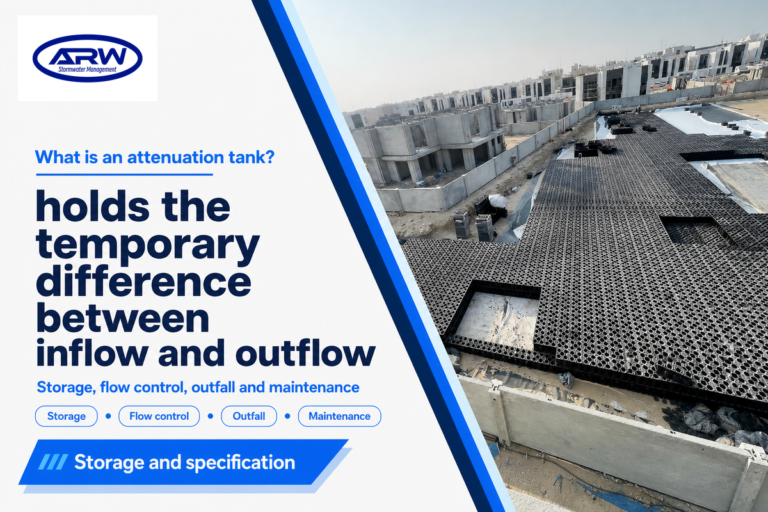
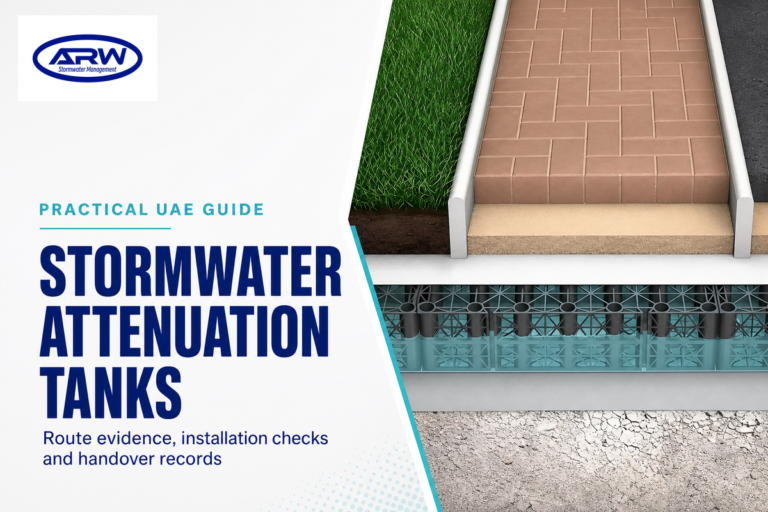
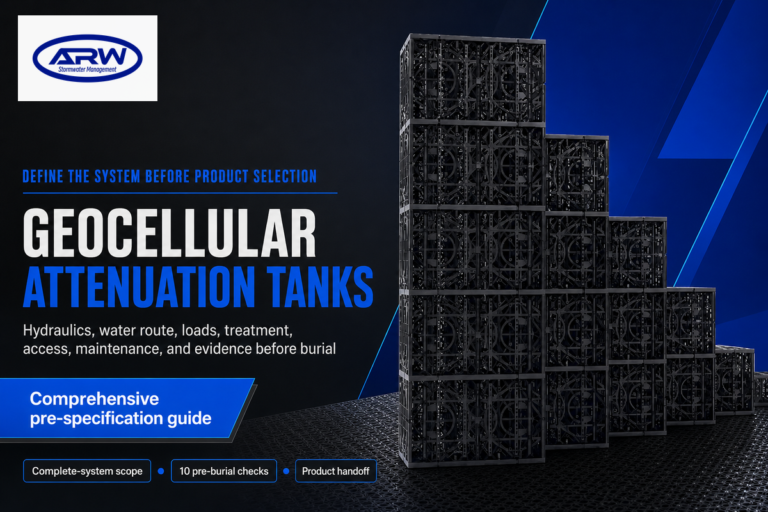
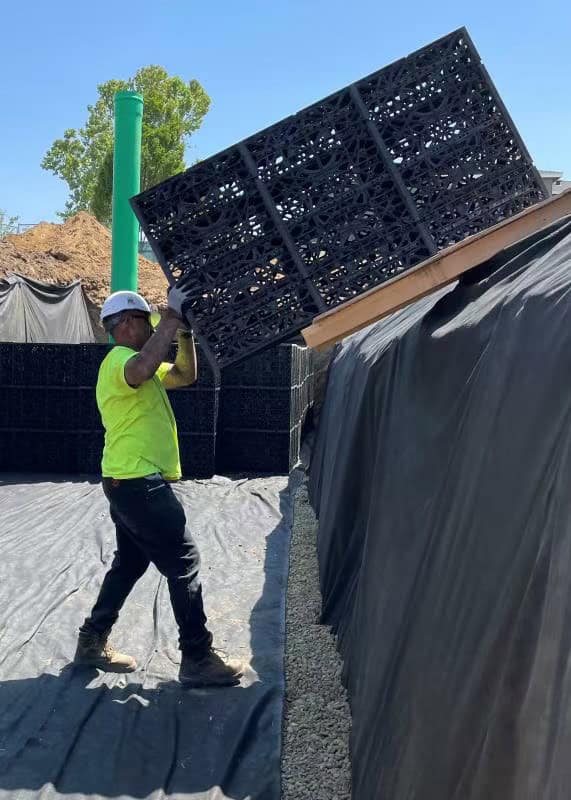
Los sistemas geocelulares constan de módulos tipo celda, modulares, poliméricos y de alta resistencia, que suelen ensamblarse en obra y envolverse con geotextil. Su alto porcentaje de vacíos (en muchos casos superior a 95%) los convierte en una tecnología ideal para proyectos que necesitan maximizar el volumen disponible de almacenamiento de aguas pluviales con una excavación mínima. Algunos ejemplos son los tanques de detención geocelulares (AQUA RainWater) y los módulos geocelulares para aguas pluviales (AQUA RainWater). Su diseño modular permite instalarlos con equipos que maniobran en espacios reducidos, sin necesidad de maquinaria pesada de elevación. Una limitación de esta tecnología es que la capacidad de carga depende de la calidad, el grado y la configuración del material de cada celda, por lo que puede variar considerablemente entre fabricantes. Por eso, los tanques y módulos geocelulares deben contar con una clasificación de carga específica para las condiciones de diseño previstas. AQUA ya no suministra cámaras abovedadas. Para consultar las opciones de productos actuales, vea nuestras soluciones subterráneas de gestión de aguas pluviales.
| Tipo de sistema | Material | Clasificación de carga | Aplicación habitual | Limitación principal |
|---|---|---|---|---|
| Bóveda de concreto | Concreto reforzado prefabricado | HS-20 a HS-25 | Carreteras, estacionamientos y zonas de tráfico pesado | Pesada; requiere instalación con grúa |
| Sistema de detención CMP | Acero galvanizado o aluminizado | HS-20 con recubrimiento adecuado | Terrenos alargados, camellones de autopistas y corredores de redes de servicios enterradas | Corrosión en suelos agresivos (pH < 5 or > 9) |
| Tubería de HDPE | Polietileno de alta densidad | HS-20 con relleno diseñado para la aplicación | Zonas residenciales, comerciales de baja exigencia y de poco tráfico | Requiere una compactación estricta del relleno para cumplir la clasificación de carga |
| Celda geocelular | Unidades modulares de polipropileno | Varía según el fabricante (25-80+ toneladas/m2) | Grandes establecimientos comerciales y excavaciones de poca profundidad | La clasificación de carga varía; verifique los datos de prueba de cada fabricante |
| Cámara arqueada | HDPE o polipropileno | AASHTO H-20 (modelos clasificados) | Terrenos aptos para la infiltración y aplicaciones con base abierta | No es adecuada para una contención hermética sin geomembrana para estanques |
Cómo se dimensionan los sistemas subterráneos de detención
Respuesta breve
El volumen de almacenamiento depende de cinco datos medibles: área de aporte, porcentaje de superficie impermeable, período de retorno de la tormenta de diseño, caudal de descarga permitido e intensidad de lluvia local. Si alguno es incorrecto, el sistema puede fallar durante las tormentas de diseño o generar gastos innecesarios por una capacidad excesiva. El método racional (Q = CiA) sigue siendo el marco de referencia inicial para la mayoría de las jurisdicciones de Estados Unidos.
El volumen de almacenamiento depende de cinco datos medibles: área de aporte, porcentaje de superficie impermeable, período de retorno de la tormenta de diseño, caudal de descarga permitido e intensidad de lluvia local. Si alguno es incorrecto, el sistema puede fallar durante las tormentas de diseño o generar gastos innecesarios por una capacidad excesiva. El método racional (Q = CiA) sigue siendo el marco de referencia inicial para la mayoría de las jurisdicciones de Estados Unidos.
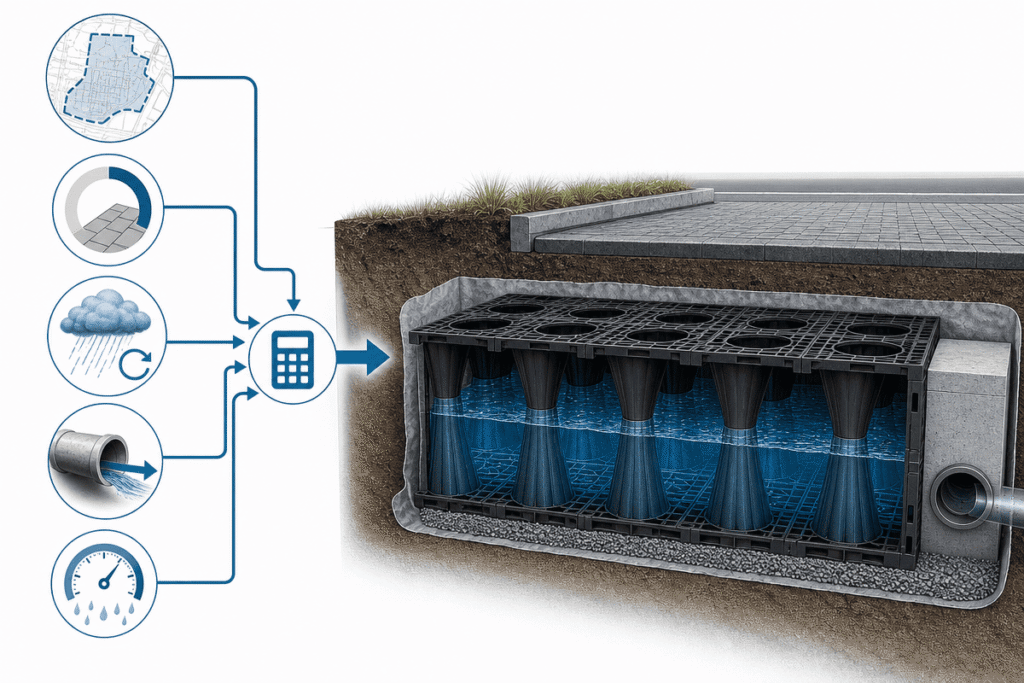
Determinar el volumen de almacenamiento correcto es la tarea de ingeniería más crítica en cualquier proyecto de detención subterránea. Si queda demasiado pequeño, el proyecto incumple las normas y agrava las inundaciones aguas abajo durante las tormentas de diseño. Si queda demasiado grande, se excede el presupuesto y se excava más terreno del necesario. Por suerte, la lógica es sencilla: si conoce los datos clave de diseño, puede verificar fácilmente si la propuesta del contratista es adecuada para el terreno.
En todo Estados Unidos, los requisitos de detención de aguas pluviales casi siempre se basan en una premisa básica: para una tormenta de diseño determinada, el caudal de escorrentía después de la construcción no debe superar el caudal previo al desarrollo. El Manual de calidad de aguas pluviales de CT de Connecticut ofrece instrucciones de diseño paso a paso para calcular este volumen de almacenamiento, desde la delimitación del área de aporte hasta el dimensionamiento. El Manual del Departamento de Agua de Filadelfia presenta un enfoque de diseño comparable. También establece un requisito para dimensionar los sistemas de detención subterránea: se debe gestionar en el terreno del proyecto la primera pulgada de escorrentía de cada superficie impermeable.
Parámetros clave para el dimensionamiento
Cinco parámetros específicos determinan el volumen necesario para dimensionar un sistema de detención subterránea. Antes de iniciar cualquier cálculo, se necesitan valores confiables para cada uno.
| Parámetro | Qué significa | Dónde encontrarlo |
|---|---|---|
| Área de aporte | Área total del terreno que drena hacia el sistema de detención, medida en acres o hectáreas | Levantamiento topográfico del terreno o delimitación de las áreas de drenaje mediante SIG |
| Porcentaje de superficie impermeable | Proporción del área de aporte cubierta por superficies impermeables (techos, pavimento y concreto) | Cálculos del plano del terreno; por lo general, de 60-95% en proyectos comerciales |
| Período de retorno de la tormenta de diseño | Frecuencia de tormenta que el sistema debe manejar (por ejemplo, evento de 2, 10, 25 o 100 años) | Ordenanza local sobre aguas pluviales o requisitos del permiso MS4 |
| Caudal de descarga permitido | Caudal máximo de salida permitido, que suele corresponder al caudal máximo previo al desarrollo | Ordenanza local sobre aguas pluviales; a menudo se expresa en pies cúbicos por segundo (cfs) |
| Intensidad de lluvia | Tasa de lluvia para la duración de la tormenta de diseño, específica de la ubicación del proyecto | Estimaciones de frecuencia de precipitación del Atlas 14 de NOAA para el condado correspondiente |
Para ver cómo se relacionan estos parámetros en un caso real de diseño municipal de aguas pluviales, el Manual de BMP del condado de Hamilton es un excelente ejemplo.
Marco del método racional
El método racional (Q = CiA) es el método más común para dimensionar sistemas de detención en áreas de aporte pequeñas y medianas en Estados Unidos. El caudal de escorrentía (Q) se obtiene multiplicando el coeficiente de escorrentía (C), la intensidad de lluvia (i) y el área de aporte (A). Aunque puede ser inexacto para áreas de aporte grandes o complejas, la mayoría de los cálculos de diseño de sistemas de detención de aguas pluviales comerciales o residenciales lo utilizan como punto de partida habitual.
El coeficiente de escorrentía define qué proporción de la lluvia se convierte en escorrentía. Un área de aporte cubierta de pasto y con suelo permeable puede tener un coeficiente de 0.2 a 0.4. En comparación, un terreno comercial impermeable puede tener uno de 0.85 a 0.95. El cambio de coeficiente entre las condiciones previas y posteriores al desarrollo es lo que determina en última instancia el almacenamiento requerido. Nuestro artículo sobre el funcionamiento de los tanques de atenuación ofrece más información sobre los principios de atenuación del caudal.
Cálculo del volumen de almacenamiento
El almacenamiento requerido se calcula determinando el volumen entre el caudal de entrada del hidrograma posterior al desarrollo y el caudal de salida aceptable durante la tormenta de diseño. Por lo general, los ingenieros utilizan uno de los siguientes métodos de cálculo:
El método simplificado consiste en multiplicar la diferencia entre el caudal máximo posterior al desarrollo y el caudal máximo de salida de diseño por la duración de la tormenta. Esto da una estimación muy aproximada para proyectos pequeños y suele llevar a usar una duración de tormenta de diseño o un área de aporte insuficientes, que podrían tener varios picos.
El método de tránsito calcula una simulación por intervalos de tiempo del caudal de entrada y de salida durante la tormenta. Es un proceso más preciso y la mayoría de los municipios lo exigen para presentar el diseño final. El Manual de diseño de CSPI incluye varios ejemplos resueltos de ambos métodos aplicados a sistemas de detención con tuberías.
📐
Nota de ingeniería: La mayoría de los municipios de Estados Unidos exigen que los sistemas de detención gestionen la diferencia entre los caudales máximos previos y posteriores al desarrollo para una tormenta de diseño específica. El período de retorno de la tormenta de diseño varía según la jurisdicción: puede ser de 2 años para el drenaje habitual y llegar a 100 años para el control de inundaciones. Verifique siempre los requisitos de la ordenanza local antes de finalizar el dimensionamiento de la detención subterránea.
Cuándo se necesita la detención subterránea: requisitos normativos
Respuesta breve
Ninguna ley federal exige la detención subterránea para todos los proyectos de Estados Unidos. Sin embargo, la combinación de permisos NPDES, programas estatales sobre aguas pluviales y ordenanzas locales implica que la mayoría de los proyectos comerciales que agregan una superficie impermeable significativa deberán cumplir requisitos de detención. El requisito casi siempre se activa a nivel local, cuando se superan los umbrales de superficie impermeable.
Ninguna ley federal exige la detención subterránea para todos los proyectos de Estados Unidos. Sin embargo, la combinación de permisos NPDES, programas estatales sobre aguas pluviales y ordenanzas locales implica que la mayoría de los proyectos comerciales que agregan una superficie impermeable significativa deberán cumplir requisitos de detención. El requisito casi siempre se activa a nivel local, cuando se superan los umbrales de superficie impermeable.
Puede sorprenderle saber que actualmente ninguna ley federal de Estados Unidos exige que todos los proyectos instalen sistemas subterráneos de detención de aguas pluviales. Sin embargo, existe un marco que comienza a nivel federal y continúa en los niveles estatal y local, y que puede activar requisitos sobre aguas pluviales y detención según ciertas características del proyecto. El primer paso para determinar si se necesita detención subterránea es comprender qué requisitos puede haber en la localidad y cómo se aplican al proyecto.
La Ley Federal de Agua Limpia (CWA) creó el Sistema Nacional de Eliminación de Descargas de Contaminantes (NPDES), que constituye el marco regulatorio de Estados Unidos para las aguas pluviales. Los permisos NPDES forman parte de la implementación estatal de la CWA y, en general, exigen que los municipios con un permiso del Sistema Municipal Separado de Alcantarillado Pluvial (MS4) gestionen las aguas pluviales posteriores a la construcción que descargan en su MS4, para ayudar a controlar la escorrentía de fuentes difusas procedente de nuevas construcciones y remodelaciones. Este mecanismo impulsa los requisitos de las ordenanzas locales sobre aguas pluviales, que pueden incluir la detención subterránea de aguas pluviales.
Requisitos federales y estatales sobre aguas pluviales
A nivel federal, las normas de aguas pluviales de las Fases I y II de la CWA exigen que los operadores de MS4 controlen las aguas pluviales posteriores a la construcción en proyectos que alteren una o más acres. En general, los requisitos estatales incluyen todos los requisitos para emitir permisos NPDES y permisos MS4, además de las normas estatales. Estas últimas pueden exigir prácticas estructurales recomendadas de gestión, como sistemas subterráneos de detención de aguas pluviales, cuando un proyecto supera ciertos límites estatales de superficie impermeable, entre otros requisitos. Un ejemplo es el Manual de calidad de aguas pluviales de CT (Buenas prácticas de gestión de aguas pluviales), que incluye la detención subterránea de aguas pluviales entre las prácticas recomendadas de gestión y enumera normas específicas de diseño. De forma similar, en Florida, el Distrito de Gestión del Agua del Río St. Johns ofrece orientación a comunidades y asociaciones de propietarios sobre los posibles requisitos para sus sistemas de aguas pluviales, incluida la detención subterránea.
Criterios que activan los requisitos de las ordenanzas locales
En la mayoría de los casos, existe una ordenanza local específica que establece requisitos para las aguas pluviales, incluida la detención subterránea de aguas pluviales u otros requisitos. Hay varias maneras en que la ordenanza municipal sobre aguas pluviales puede determinar si el propietario de un terreno debe instalar un sistema subterráneo de detención de aguas pluviales. Por lo general, se trata de umbrales de superficie impermeable o de área alterada que exigen implementar un sistema de detención en el sitio. Un ejemplo son los requisitos para aguas pluviales del Philadelphia Water Department, que incluyen requisitos de detención subterránea de aguas pluviales para desarrollos comerciales que agregan más de cierta cantidad de superficie impermeable, además de otras normas de diseño que incluyen la detención subterránea de aguas pluviales y el diseño de mejores prácticas de gestión (BMP) para aguas pluviales.
Otra manera en que una ordenanza determina la necesidad de implementar un sistema subterráneo de detención de aguas pluviales es mediante la superficie impermeable que ocupará un desarrollo propuesto. Por lo general, se trata de un desarrollo comercial con más de 5,000 a 10,000 pies cuadrados de superficie impermeable, una remodelación en la que la superficie impermeable existente aumentará más de cierto porcentaje, o un desarrollo nuevo en el que la superficie impermeable propuesta superará cierta área. La detención subterránea de aguas pluviales puede utilizarse cuando el proyecto no permite construir un sistema de retención de aguas pluviales en superficie, no hay suficiente espacio en el terreno para construir una cuenca pluvial en superficie, o las aguas pluviales pueden descargarse mediante un sistema de alcantarillado pluvial debido a los requisitos de retiro de una nueva estructura de estacionamiento o a mejoras del alcantarillado pluvial, entre otros motivos.
💡
Consejo profesional: Consulte la ordenanza local sobre aguas pluviales antes de comenzar el diseño del proyecto. Los umbrales que activan los requisitos de detención subterránea para la gestión de aguas pluviales varían mucho entre jurisdicciones, y determinar los requisitos desde el principio evita costosos rediseños posteriores durante el proceso de permisos.
Proceso de instalación y buenas prácticas
Respuesta rápida
La diferencia entre un sistema de detención que funciona durante décadas y uno que falla en pocos años casi siempre se debe a tres factores de instalación: la calidad de compactación del relleno, el cumplimiento de la profundidad mínima de recubrimiento y el control de la flotación en zonas con nivel freático alto. Cada etapa, desde la excavación hasta el relleno final, afecta directamente la integridad estructural.
La diferencia entre un sistema de detención que funciona durante décadas y uno que falla en pocos años casi siempre se debe a tres factores de instalación: la calidad de compactación del relleno, el cumplimiento de la profundidad mínima de recubrimiento y el control de la flotación en zonas con nivel freático alto. Cada etapa, desde la excavación hasta el relleno final, afecta directamente la integridad estructural.
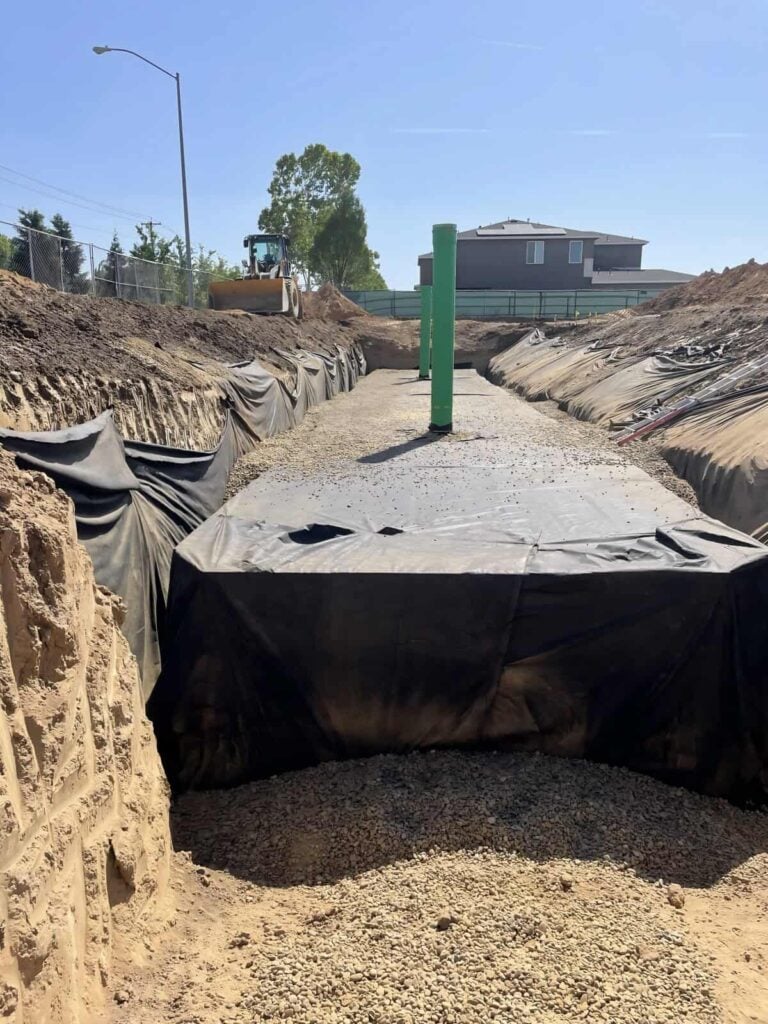
Un diseño sólido de detención subterránea puede quedar completamente invalidado si la instalación no sigue el diseño de ingeniería. La secuencia de etapas, desde la excavación inicial hasta la compactación final del relleno, puede afectar significativamente la integridad de la instalación subterránea de detención y el desempeño hidráulico del sistema a largo plazo. Por ejemplo, la diferencia entre un sistema que funciona durante décadas y otro que presenta problemas en los primeros años casi siempre se debe al control de calidad de la instalación.
Los requisitos y las buenas prácticas de instalación para la detención subterránea están bien documentados en distintos manuales de BMP, como el Hamilton County BMP Manual. En este caso, los requisitos de recubrimiento mínimo, las especificaciones de compactación y los retiros para los sistemas subterráneos de detención corresponden específicamente al condado de Hamilton. En la sección de recursos se mencionan manuales de BMP similares para otras jurisdicciones, aunque los requisitos de su jurisdicción específica podrían variar ligeramente.
Preparación del sitio y excavación
La preparación adecuada del sitio comienza antes de la excavación e incluye verificar que la ubicación y el tamaño de la excavación prevista se ajusten al diseño de ingeniería aprobado y que se hayan localizado todas las redes de servicios enterradas. La instalación correcta de los sistemas subterráneos de detención de aguas pluviales es fundamental. Para ello, los niveles y la ubicación de la excavación deben coincidir con los planos de diseño aprobados, de modo que las cotas de fondo de la entrada y la salida del sistema de detención sean las especificadas y se garantice el desempeño hidráulico adecuado de todo el sistema de drenaje pluvial.
Además, la excavación debe ser al menos 12 pulgadas más ancha que el área en planta del sistema en todos sus lados, para que el contratista pueda conectar las tuberías, compactar y colocar el material de relleno. El terreno de fundación de la excavación debe compactarse hasta alcanzar una densidad mínima especificada, generalmente 95% según la prueba Proctor estándar, y debe verificarse con un densímetro nuclear u otro procedimiento de ensayo adecuado antes de colocar cualquier material de cama de apoyo. Si se necesita abatir el nivel freático para instalar el sistema subterráneo de detención, el abatimiento debe continuar durante toda la instalación y el relleno; no es aceptable instalar un sistema subterráneo de detención de aguas pluviales, compactarlo y rellenar la excavación, y dejar agua estancada en ella al terminar la instalación. La compactación del material de relleno se verá comprometida si se realiza en suelo mojado o con agua, y existe una posibilidad considerable de que se formen vacíos en el suelo alrededor del sistema, lo que puede causar asentamientos y una falla prematura.
Colocación del sistema y relleno
El material de cama de apoyo, que consiste en piedra triturada limpia o relleno granular compactado, proporciona una base firme para el sistema subterráneo de detención de aguas pluviales. El espesor requerido de este material varía según el sistema. Por ejemplo, los sistemas con cámaras de concreto requieren una base granular compactada de al menos 6 pulgadas, mientras que en los sistemas de tuberías puede variar entre 4 y 12 pulgadas, según el diámetro de las tuberías y las condiciones del suelo.
Una vez colocado el sistema en la excavación, el relleno debe ejecutarse cuidadosamente en capas de 6 a 12 pulgadas y compactarse según las especificaciones, dejando que el suelo se asiente antes de colocar más material de relleno. No rellenar y compactar el sistema con cuidado y según las especificaciones es la causa principal de los asentamientos en los sistemas subterráneos de detención después de su instalación. Colocar el sistema en la excavación, descargar de golpe todo el relleno y compactarlo hasta alcanzar la densidad especificada no permite que el suelo se asiente de manera controlada; además, durante la instalación el sistema puede desplazarse, lo que puede provocar fallas en las uniones de las conexiones de las tuberías. Las especificaciones del Philadelphia Water Department para la revisión de planos de sistemas subterráneos de detención lo ilustran claramente. En los sistemas subterráneos de gestión de aguas pluviales con diseños modulares, es fundamental seguir las instrucciones de relleno específicas del fabricante, ya que cada producto tiene mecanismos distintos de transferencia de cargas.
Una vez instalado el sistema de detención de aguas pluviales, las tuberías de entrada y salida deben conectarse de manera que puedan admitir asentamientos menores sin que se formen separaciones ni haya fugas en las tuberías. Las bocas de acceso para inspección y los pozos de registro deben llegar hasta el nivel final del terreno para que el personal de mantenimiento pueda acceder a ellos fácilmente en el futuro.
Errores comunes de instalación que se deben evitar
Tres de las fallas o deficiencias de instalación más comunes observadas en el desempeño de los sistemas subterráneos de detención son la compactación inadecuada del relleno y la profundidad de recubrimiento insuficiente. Ambas pueden presentarse durante la instalación y corregirse antes de terminarla. Es un error suponer que cualquier sistema subterráneo de detención funcionará bien durante muchos años si no se siguen las técnicas de instalación adecuadas.
La deficiencia de instalación más común en los sistemas subterráneos de detención es la compactación inadecuada del material de relleno colocado alrededor del sistema después de ubicarlo en la excavación. Si la cama de apoyo y el material de relleno no se compactan en capas según lo requerido por el diseño, el suelo circundante se asentará de manera desigual con el tiempo y ejercerá cargas desiguales alrededor y sobre la estructura de detención, lo que podría dañarla o causar la falla del sistema subterráneo de detención de aguas pluviales. En los sistemas basados en tuberías, las cargas desiguales pueden provocar que la deflexión de una tubería enterrada supere los límites permitidos. En los sistemas modulares de tipo geocelular, las cargas desiguales pueden deformar las celdas geocelulares o causar su falla parcial. Consulte nuestra guía sobre tanques geocelulares de atenuación para conocer otras buenas prácticas de instalación de sistemas geocelulares para aguas pluviales.
La segunda causa más común de falla de un sistema subterráneo de detención de aguas pluviales es que no se haya proporcionado suficiente profundidad de recubrimiento para instalar correctamente el sistema y permitir que funcione bien durante muchos años. El diseño de todo sistema subterráneo de aguas pluviales especifica una profundidad mínima de recubrimiento sobre la parte superior del sistema, necesaria para que la estructura instalada soporte las cargas de diseño de los vehículos. Si un sistema subterráneo de detención se instala con una profundidad de recubrimiento menor que la mínima requerida, la cobertura insuficiente puede provocar una falla prematura del sistema si las cargas superan la capacidad de diseño. Es posible que el sistema no falle, sobre todo en zonas de tránsito ligero, y que funcione durante años antes de que aparezcan problemas. Sin embargo, es importante instalar el sistema de detención de aguas pluviales con la profundidad mínima de recubrimiento especificada para garantizar que funcione según lo previsto durante muchos años y requiera un mantenimiento mínimo.
⚠️
Advertencia: Verifique siempre los cálculos de flotación en zonas con nivel freático alto. Está documentado que los sistemas subterráneos de detención vacíos pueden flotar cuando sube el nivel freático, lo que puede desplazar estructuras completas. Cuando el nivel freático está por encima de la cota de fondo del sistema, el diseño debe incluir medidas contra la flotación, como losas de anclaje de concreto, correas de sujeción o relleno de lastre.
Muller Engineering describe cómo la mala calidad de instalación de los sistemas de aguas pluviales afecta el desempeño de los sistemas de detención a largo plazo, así como el mantenimiento adicional y los costos que pueden derivarse de una instalación deficiente.
Factores de costo y valor a largo plazo
Respuesta rápida
Por lo general, la detención subterránea cuesta más por pie cúbico que un sistema de retención de aguas pluviales en superficie, pero la comparación económica cambia cuando se toma en cuenta el terreno edificable que se recupera al construir bajo el nivel del suelo. En mercados comerciales donde el terreno se vende a más de $20 por pie cuadrado, el valor recuperado del terreno por sí solo puede superar el costo adicional total de construcción del sistema subterráneo.
Por lo general, la detención subterránea cuesta más por pie cúbico que un sistema de retención de aguas pluviales en superficie, pero la comparación económica cambia cuando se toma en cuenta el terreno edificable que se recupera al construir bajo el nivel del suelo. En mercados comerciales donde el terreno se vende a más de $20 por pie cuadrado, el valor recuperado del terreno por sí solo puede superar el costo adicional total de construcción del sistema subterráneo.
A menudo, las comparaciones de costos de los sistemas subterráneos de detención resultan incompletas porque consideran por separado los costos de los materiales y omiten el valor del terreno que se recupera al construir bajo tierra. Un sistema de retención de aguas pluviales en superficie dentro de un terreno de 10 acres destinado a un desarrollo comercial puede ocupar hasta 15,000 a 25,000 pies cuadrados de área edificable. En desarrollos comerciales donde el precio de mercado del terreno oscila entre $15 y $50 por pie cuadrado, el sistema de retención podría representar entre $225,000 y $1.25 millones en ingresos perdidos por el terreno sin desarrollar, sin contar los costos de construcción del sistema en superficie.
Por esta razón, que a menudo se omite en las comparaciones de costos, la detención subterránea puede costar menos que la detención en superficie si se considera el potencial que se pierde al destinar terreno a un sistema de retención de aguas pluviales en superficie. En el análisis de NAIOP, la detención subterránea se considera una forma eficaz de recuperar la superficie que de otro modo ocuparía un sistema de retención de aguas pluviales en superficie.
Principales factores de costo
Hay cinco factores clave que determinan el costo de un tanque subterráneo de detención de aguas pluviales y generan grandes variaciones en el precio por galón o pie cúbico que puede cotizar cualquier empresa o persona:
Selección de materiales El material elegido será la variable que más influya en el costo unitario del tanque de detención. La cámara de concreto prefabricado es más costosa por pie cúbico que otros materiales, pero puede requerir menos gastos de ingeniería y materiales asociados con el relleno y otros aspectos. El sistema de tuberías de HDPE y celdas geocelulares cuesta menos por pie cúbico, pero puede requerir más gastos de ingeniería y materiales asociados con el relleno y otros aspectos. El CT Stormwater Quality Manual señala que el material elegido influye tanto en el costo inicial como en las consideraciones de mantenimiento.
Requisito de almacenamiento La cantidad de almacenamiento requerida será el segundo factor de mayor impacto en los costos de materiales e instalación. Una mayor capacidad de almacenamiento también puede aumentar el costo de construcción, ya que se necesitarán configuraciones más complejas de tuberías de entrada y salida y cámaras de inspección más grandes para acomodar el mayor número de tuberías y el flujo.
Condiciones del sitio La ubicación específica del sitio, en particular las condiciones del suelo, la profundidad hasta el nivel freático y las redes de servicios enterradas, puede influir en el costo final de una cámara de detención más que la elección del material de almacenamiento. La excavación en roca, los niveles freáticos altos que requieren abatimiento y el traslado de redes de servicios pueden aumentar cada uno el costo en un 20-40% estimado.
Profundidad de instalación Cuanto mayor sea la profundidad de una cámara subterránea de detención, mayor será su costo. Esto se debe a que habrá que excavar más suelo para instalar el tanque y se necesitará más soporte para hacerlo. Si existe una capa poco profunda de roca madre cerca de la superficie, también podría limitar la profundidad de instalación.
Requisitos de acceso Como el sistema requiere mantenimiento, será necesario acceder a la cámara subterránea. Por ello, una mayor cantidad de pozos de registro o bocas de acceso para inspección incrementará el costo total de construcción de la cámara de detención. El municipio o la agencia local establecerá los requisitos de acceso. Cualquier reducción del acceso requerido durante la construcción puede hacer necesarias modificaciones posteriores costosas.
Economía de los sistemas subterráneos frente a los sistemas de retención en superficie
| Factor de costo | Sistema subterráneo | Sistema de retención en superficie |
|---|---|---|
| Ocupación del terreno | Sin ocupación en superficie; terreno edificable encima | Requiere una superficie exclusiva; el terreno no puede desarrollarse |
| Costo de construcción | Más alto por pie cúbico (excavación, materiales, relleno) | Más bajo por pie cúbico (movimiento de tierras, nivelación, estructura de salida) |
| Acceso para mantenimiento | Requiere pozos de registro y protocolos de ingreso a espacios confinados | Acceso abierto; inspección visual desde el nivel del terreno |
| Costo de mantenimiento a largo plazo | Moderado; retiro de sedimentos con camión de succión | Menor costo de rutina; dragado periódico de sedimentos y corte de césped |
| Estética y responsabilidad legal | No es visible; no hay riesgos de seguridad asociados con agua expuesta | Es visible; puede requerir cercas y señalización por responsabilidad legal |
| Recuperación del valor del terreno | Se aprovecha todo el potencial de desarrollo sobre el sistema | Ninguna; el terreno queda destinado permanentemente a la gestión de aguas pluviales |
Para comparar el costo de un sistema de retención en superficie con el de uno subterráneo, debemos considerar el costo total de propiedad de cada opción, no solo el precio inicial. Suele tener sentido económico elegir el sistema subterráneo en zonas urbanas y suburbanas de desarrollo comercial donde el valor del terreno supera los $20 por pie cuadrado. En sitios rurales o menos desarrollados, donde el terreno es abundante y la inversión es menos costosa, un sistema de retención en superficie sigue siendo una opción económica. GreenRise cuenta con costos de proyectos que respaldan que la decisión de construir una estructura subterránea de detención o un sistema de retención en superficie depende de las condiciones y la economía del sitio, y no solo del costo de construcción.
💡
Consejo profesional: La detención subterránea puede recuperar miles de pies cuadrados de terreno edificable en comparación con los sistemas de retención en superficie. Al comparar las opciones, incluya en el análisis de costos el valor local del terreno por pie cuadrado para obtener una imagen económica precisa del proyecto en su conjunto.
¿Listo para evaluar los costos de su proyecto? Solicite una cotización gratuita a nuestro equipo de ingeniería.
¿Listo para evaluar los costos de su proyecto?
Requisitos de mantenimiento e inspección
Respuesta rápida
Los requisitos básicos para todos los sistemas subterráneos de detención son realizar inspecciones anuales y retirar sedimentos cuando su acumulación reduzca el volumen de almacenamiento efectivo. Los sistemas con protocolos de mantenimiento documentados funcionan de forma confiable durante más de 50 años; los que no los tienen se deterioran durante la primera década, cuando los sedimentos reducen la capacidad de almacenamiento por debajo de los umbrales permitidos.
Los requisitos básicos para todos los sistemas subterráneos de detención son realizar inspecciones anuales y retirar sedimentos cuando su acumulación reduzca el volumen de almacenamiento efectivo. Los sistemas con protocolos de mantenimiento documentados funcionan de forma confiable durante más de 50 años; los que no los tienen se deterioran durante la primera década, cuando los sedimentos reducen la capacidad de almacenamiento por debajo de los umbrales permitidos.
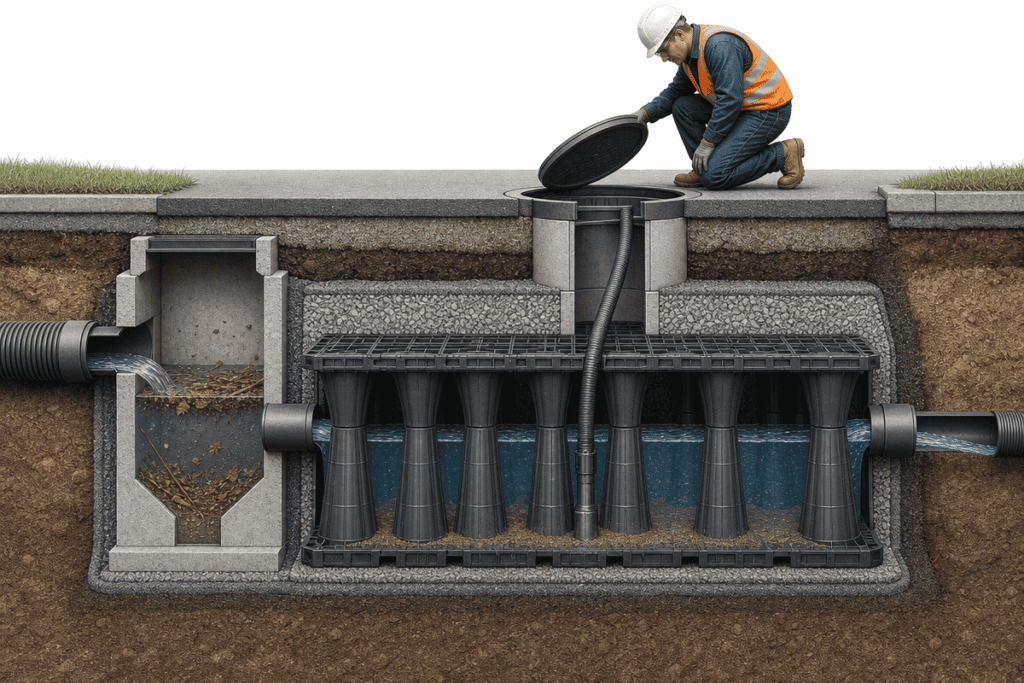
Los sistemas subterráneos de detención deben recibir mantenimiento programado para que sigan funcionando eficazmente durante su vida útil de diseño de más de 50 años. La falta de inspecciones y de retiro de sedimentos es la causa más común de que estos sistemas pierdan capacidad de almacenamiento y, finalmente, no funcionen a la tasa de descarga permitida. Tras más de 15 años de diseñar y mantener sistemas de detención de aguas pluviales para instalaciones comerciales y municipales, queda claro que los sistemas con un protocolo de mantenimiento periódico tienen más probabilidades de funcionar según lo requerido, mientras que los que carecen de él suelen mostrar deterioro durante los primeros 10 años de operación.
El CT Stormwater Quality Manual indica: Las estructuras subterráneas deben inspeccionarse anualmente. Si la acumulación de sedimentos alcanza un nivel que reduce el volumen total de almacenamiento disponible en la estructura, retire el exceso de sedimentos. Esta recomendación no es opcional. Muchos permisos MS4 exigen pruebas de que se ha realizado el mantenimiento.
Programa de inspecciones periódicas
Los sistemas subterráneos de gestión de aguas pluviales deben inspeccionarse anualmente. Una inspección visual es la forma más fácil y económica de vigilar el estado de una medida de control de aguas pluviales. El mejor momento para inspeccionar una instalación es después de que termine la temporada de lluvias y antes de que comience la siguiente. En ese momento, los sedimentos acumulados durante la temporada anterior son fáciles de ver y el personal de mantenimiento puede acceder fácilmente al sistema.
En cada inspección se deben registrar los siguientes aspectos:
- Estado de las estructuras de entrada y salida
- Obstrucciones en las placas de orificio o en las aberturas del vertedero
- Profundidad de los sedimentos en varios puntos del sistema
- Estado y accesibilidad de los pozos de registro, las bocas de inspección y cualquier otro punto de acceso
Muller Engineering utiliza la siguiente lista de verificación para todos sus informes de inspección periódica:
- Estado estructural
- Profundidad de los sedimentos
- Funcionamiento y obstrucciones en la entrada y la salida
- Vegetación en los puntos de inspección y acceso
Todos los sistemas subterráneos de control de aguas pluviales que incluyan tuberías deben someterse a inspecciones con circuito cerrado de televisión cada 3 a 5 años para documentar su estado. Esto es necesario porque el estado interno del sistema no puede evaluarse eficazmente mediante una inspección visual desde los pozos de registro.
Además, se debe inspeccionar el sistema después de tormentas que superen la tormenta de diseño de 10 años. Inspeccionarlo dentro de las 72 horas posteriores a un evento de este tipo permite retirar residuos, evaluar daños en los controles de salida y gestionar los sedimentos. Esto último es importante porque estos eventos pueden arrastrar residuos, dañar los controles de salida o depositar volúmenes de sedimentos que reducen significativamente el almacenamiento disponible antes de la próxima temporada de lluvias.
📐
Nota de ingeniería: Las pautas estatales de BMP recomiendan inspeccionar anualmente las estructuras subterráneas de detención y retirar los sedimentos cuando su acumulación alcance una profundidad que reduzca de manera medible el volumen de almacenamiento efectivo. La mayoría de los permisos MS4 exige documentar cada inspección.
Gestión y retiro de sedimentos
El problema de mantenimiento más frecuente en un sistema subterráneo de detención de aguas pluviales es la acumulación de sedimentos. Cada evento de lluvia arrastra cierta cantidad de sedimentos al sistema en forma de partículas finas y materia orgánica, que en algunos casos incluye basura. Al asentarse dentro del sistema, estos materiales se compactan y reducen el volumen de almacenamiento disponible.
Los métodos para retirar sedimentos dependen, por lo general, del tipo de sistema y del acceso disponible. En los sistemas de tuberías, el método más habitual es usar camiones de succión. Estos cuentan con una manguera larga y flexible que se introduce por un pozo de visita hasta el interior del sistema. Luego, los sedimentos acumulados se extraen en estado líquido. En bóvedas grandes de concreto o instalaciones sin acceso directo para un camión de succión, quizá la única opción sea el ingreso a espacios confinados por parte de personal certificado.
Los sistemas de almacenamiento geocelular presentan otros desafíos de mantenimiento. La estructura de celdas suele dificultar la limpieza con aspiración, ya que los sedimentos pueden asentarse en espacios a los que no se accede directamente desde la superficie. Para reducir al mínimo la acumulación de sedimentos, todo sistema modular debe contar con algún tipo de pretratamiento antes del sistema de detención de aguas pluviales, como una zona de sedimentación o un separador hidrodinámico que capture la mayor parte de los sólidos suspendidos antes de la entrada al sistema.
El kit de herramientas de Lake Superior Streams ofrece orientación para elaborar un programa de mantenimiento y atender las tareas de mantenimiento de sistemas subterráneos de almacenamiento. Según Aqualisco, un contrato de mantenimiento con una empresa especializada en aguas pluviales garantiza inspecciones periódicas y reduce el riesgo de que la acumulación de sedimentos afecte el funcionamiento de la instalación.
Preguntas frecuentes sobre la detención subterránea de aguas pluviales
Esta guía aborda el diseño y la construcción generales de los sistemas subterráneos de detención de aguas pluviales, pero también debe responder las preguntas prácticas que suelen plantear ingenieros, desarrolladores y propietarios al evaluar estos sistemas para sus proyectos. A continuación, respondemos algunas de las preguntas más frecuentes sobre la detención subterránea.
A lo largo de la guía, hemos tratado estos temas de forma similar y citado fuentes como el Manual de calidad de aguas pluviales de CT, el Philadelphia Water Department y el análisis del desempeño de los sistemas de la American Society of Civil Engineers (ASCE). También incluimos información sobre la variedad de requisitos según la jurisdicción y recomendamos verificar los requisitos aplicables al proyecto en la norma local correspondiente.
¿Está comparando opciones de sistemas subterráneos de detención de aguas pluviales para su proyecto?
Referencias
[1] Advertencia: sistemas plásticos subterráneos de detención de aguas pluviales
[2] Detención subterránea – Manual de calidad de aguas pluviales de CT
[3] 4.8 Detención subsuperficial – Servicios de desarrollo
Artículos relacionados
Sobre el autor

Grayden Du
Director de exportación · AQUA RainWater Solutions
Grayden Du es director de exportación en AQUA RainWater Solutions. Su trabajo abarca sistemas modulares de detención pluvial, almacenamiento subterráneo de agua pluvial y gestión del agua bajo la superficie. Con más de 16 años de experiencia práctica en mercados de más de 30 países, explica los principios técnicos, la elección de sistemas y los requisitos prácticos de los proyectos.
Sobre AQUA RainWater Solutions
AQUA RainWater Solutions fabrica módulos pluviales de estructura celular, sistemas de atenuación de poca profundidad y rejillas de refuerzo del suelo, y coordina el suministro de geomembranas, geotextiles y membranas EPDM para estanques. Ayudamos a compatibilizar las conexiones entre sistemas y las especificaciones, con inspección de lotes de los productos moldeados, documentación de los productos y apoyo a las entregas de exportación.