
How an Attenuation Tank Works: Mechanism, Flow Control and UK Sizing
By AQUA Rain Water Solutions | February 17, 2026 | 13 min read

Three months in, the car park is flooded. The drainage had been signed off, the contractor has gone, and the developer has a call from the LLFA asking why surface water is backed up into the highway drain. Usually, the problem is a poorly designed or undersized attenuation tank.
Underneath the ground, an attenuation tank will temporarily store surface water runoff during a heavy storm and then release it slowly at a controlled rate, allowing downstream drains and watercourses to keep up. The UK requirement for new developments — set out in CIRIA C753 (2015) and Building Regulations Approved Document H (2010) — is to limit discharge to a greenfield runoff rate, typically ranging from 2 to 8 litres per second per hectare. That single requirement means the attenuation tank exists in new UK drainage systems, and it’s the reason why getting the design right matters more than getting it cheap.
This guide explains how a stormwater attenuation tank really works: from its three-stage storage mechanism to flow control options and UK sizing, material selection and the common failures that can lead to problems.
If you’re new to the topic, it helps to first understand what an attenuation tank actually is before working through the mechanism in detail.
How Water Flows Through an Attenuation Tank
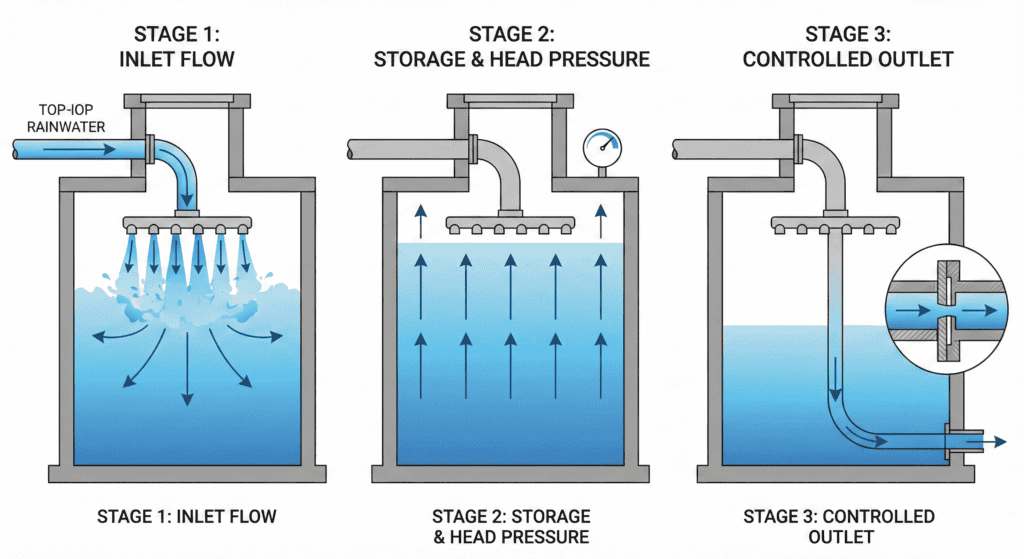
Let’s think of it as a bathtub. The tap is rainfall, whatever rate the sky sends. The drain is the flow control at the outlet, and that dictates how fast water leaves. Inflow > outflow, the bathtub fills. That’s attenuation in a nutshell.
In reality, there are three phases.
Phase 1: Inflow & energy dissipation. Surface water runoff from roofs, car parks, driveways flows into the tank via the pipe network. At the inlet, the incoming flow is slowed by an energy dissipation device (or inlet manifold). Bypass that and the force of the incoming water scours the inside of the geocellular crates, dislodging joints and creating debris that clogs up the system.
Phase 2: Storage & head buildup. The flow control at the outlet limits the discharge to, say, 5 l/s. Water collects in the void space between the geocellular modules, the water level (hydraulic head) rises. There is hydrostatic pressure against the flow control which determines how fast water discharges. With a 95% void ratio, a 100 m³ excavation gives roughly 95 m³ of gross storage — apply a siltation and freeboard deduction in practice.
Phase 3: Controlled release. The storm is over. Inflow drops to zero. The water stored in the void drains out through the flow control, taking longer as head decreases. The tank empties in hours, sometimes days, and is ready for the next rainfall event.
The hydrograph tells it all. An uncontrolled catchment yields a sharp peak flow spike. The attenuation tank spreads that same volume over a longer period, flattening the peak. That’s the goal.
Pro Tip: When modelling in MicroDrainage or similar software, don’t just model the 1-in-100-year storm. Model storms with duration ranging from 15 minutes to 48 hours. Find the critical storm — the duration that yields the maximum storage demand. It’s usually a 6-hour storm that governs the tank size, not the short intense burst most people assume.
Vortex Flow Control vs Orifice Plate for Attenuation Tanks

All attenuation tanks need a flow control device to control the outflow. Two competing technologies dominate the UK market and the choice will affect tank size, maintenance and cost of ownership.
The orifice plate is the old-timer. It’s a metal plate with a hole. The flow rate is proportional to the square root of head — it increases as the tank fills then decreases rapidly as the tank discharges. Simple. But here’s the problem. For low discharges below 5 l/s at burial depths less than 0.6 m, the aperture size will be less than 50 mm. Openings that small get plugged with leaves, grit and construction mud.
The vortex flow control (VFC) — branded products like Hydro-Brake — uses a different principle. At low flow water passes through unimpeded. At high head, the tangential entry forces water into rotation generating an air core at the centre. The fluid brake creates resistance but the outlet is approximately 6x larger than the equivalent orifice for the same design flow rate.
VFC tanks can reduce required storage volume by 15 to 30 per cent. The cost savings is on excavation and geocellular crate quantity.
| Dimension | Orifice Plate | Vortex Flow Control |
|---|---|---|
| Clog risk | Very high (small aperture at low flows) | Low (large aperture, self-cleaning action) |
| Hydraulic performance | Standard, flow decays as head drops | Optimised S-curve, higher average discharge |
| Initial cost | Low (£80 to £200) | Medium to high (£800 to £2,500) |
| Maintenance | Frequent manual clearing required | Passive, mainly inspection-based |
| Storage volume impact | Baseline | Reduces required volume by 15 to 30% |
Pro Tip: For residential schemes less than 5 m³, a simple orifice plate of £80 to £200 is usually sufficient. For commercial schemes over 0.5 ha, a VFC is almost always worth the premium because the storage reduction alone pays for it. See the complete guide to attenuation tanks in the UK for full specification details.
How Does an Attenuation Tank Affect Your Drainage Design?

Step 1: BRE 365 percolation test. Per Part H (2010) of the Building Regulations, there is a drainage hierarchy: infiltration first, watercourse second, and sewer as a last resort. You cannot dismiss infiltration without proving it won’t work. BRE 365 (BRE Digest 365) prescribes a programme: dig a trial pit, fill it, note the drop in water level. Without that test result, LLFAs will send your application back.
Step 2: Greenfield runoff rate. Your attenuation facility can release water no faster than the greenfield runoff rate for the site. Two approaches are available in UK practice. IH124 uses the older WRAP soil maps to compute Qbar. The Flood Estimation Handbook (FEH) uses finer digital soil data (BFIHOST) to compute Qmed. LLFAs increasingly prefer the FEH. In practice a minimum discharge floor of 2 to 3 l/s per hectare applies to keep the flow control aperture reliably large enough.
Step 3: Climate change allowances. Per the Environment Agency’s guidance on climate change allowances (updated 2022), you’re not designing for current rainfall. Storage needs to incorporate uplift factors varying by epoch and sensitivity.
| Epoch | Central Allowance | Upper End Allowance | Typical Application |
|---|---|---|---|
| 2050s (2022 to 2060) | +20% | +35% | Commercial, 30 to 50 year design life |
| 2070s (2061 to 2125) | +25% | +40 to 45% | Residential, 100 year design life |
The drainage hierarchy is set out in full in Building Regulations Approved Document H — a document every drainage engineer working on UK new-build sites should have to hand.
Geocellular vs Concrete Attenuation Tanks Compared

Geocellular modules (PP or PVC) are the choice for around 90% of all UK residential and commercial attenuation tanks. The void ratio is 95 to 97%, modules are lightweight at 7 to 12.5 kg per unit, and they can be hand assembled to any plan geometry.
However — that 95% void ratio? It’s a gross figure. The structural displacement of plastic columns and beams takes up 3 to 5% of the volume. CIRIA C753 (2015) recommends a 10% silt allowance for future sediment build-up. Add in freeboard and you are looking at a net effective void ratio of 82 to 87%. Still great compared to concrete, but not 95%.
Precast concrete is the clear winner at heavy infrastructure sites, HGV yards or where cover depth is restricted to less than 500 mm. Concrete tanks cope with deep burial and high point loads without engineered backfill — but at the expense of cost, weight and careful joint sealing.
For a detailed side-by-side engineering breakdown, see our concrete vs plastic attenuation tank comparison covering structural performance, load ratings and whole-life cost.
| System Type | Material Cost (per m³) | Installed Cost (per m³) | Void Ratio | Best Application |
|---|---|---|---|---|
| Geocellular (PP) | £80 to £150 | £200 to £350 | 95% gross, ~85% net | Standard residential and commercial |
| Precast concrete | £450 to £520 | £400 to £600 | 50 to 65% | HGV areas, shallow cover, deep burial |
| Large diameter pipes | Variable | £300 to £500 | 75 to 85% | Linear projects, highways |
| GRP tanks | £200 to £350 | £300 to £500 | 85 to 90% | Contaminated land, chemical resistance |
What Is the Difference Between an Attenuation Tank and a Soakaway?
This is the question we get asked the most. They both sit in the ground, both deal with surface water and both can use geocellular crates, but they do very different things.
An attenuation tank is a sealed system: surface water runoff is collected, stored and released gradually through a flow control device into a watercourse or sewer. The tank is wrapped in a geomembrane (usually HDPE 0.5 to 1.0 mm) that seals everything except where the outlet pipe exits.
A soakaway is a permeable system: surface water is collected and allowed to permeate into the surrounding ground through infiltration. The crates are wrapped in geotextile, not geomembrane, and there is no flow control device because the ground itself is the drain.
What differentiates them is the BRE 365 decision. If the percolation test indicates adequate infiltration and low groundwater, use a soakaway. If the ground does not absorb enough water, or groundwater is too high, use an attenuation tank with controlled discharge under the Flood and Water Management Act 2010.
For a detailed site-specific comparison — including when each system satisfies LLFA requirements — read the full attenuation tank vs soakaway comparison.
Warning: Pay attention to vent pipes. When water rushes into an attenuation tank, air has to escape. Without a vent pipe to the inlet chamber or the tank top, air will be trapped, pressurise and blow the manhole covers off. An inexpensive insurance against a dangerous failure mode.
Common Attenuation Tank Problems and How to Avoid Them

A great deal of attenuation tank failures are due to installation issues rather than product defects. We’ve supplied geocellular modules to hundreds of UK projects and the failures we see are almost always to do with what occurred on site rather than what left the factory.
Clay Backfill Collapse, West Midlands
A commercial car park project in the West Midlands called for geocellular attenuation crates, 85 m³ storage in total. Three months upon completion, the surface above the tank had sagged 40 mm. We found that the contractor had used as-dug clay for the sidefill instead of appropriate granular materials. The clay expanded when it absorbed water, lost its shear capacity and did not provide the lateral passive earth pressure that geocellular modules require. The modules buckled inward.
Remediation cost: full excavation and backfill replacement. Roughly £18,000 of extra works, on top of a £12,000 original installation. Advice: never backfill around geocellular tanks with clay. Use Type 1 MOT sub-base or 6N graded stone, compacted in 300 mm lifts.
Buoyancy Failure, Southeast England
A residential site in the Maidstone area commissioned an attenuation tank of 40 m³ storage, wrapped in HDPE geomembrane. Heavy overnight rain raised the water table and flooded the surrounding ground. By morning the tank had floated out of the excavation, breaking all pipe connections.
Cause: no buoyancy calculation was carried out. A plastic geocellular chamber wrapped in impermeable membrane is, by definition, a sealed vessel — buoyant in saturated ground. The remedy requires 0.5 to 1 m of overburden weight or suitable mechanical ground anchors.
Pro Tip: Do a buoyancy check before you lock in cover depth. If groundwater can reach the tank at any time of the year, you need anti-flotation measures. This is a SuDS design requirement from CIRIA C753 (2015), section 26.
The step-by-step installation process covers buoyancy calculations, cover depth rules and backfill specification in full — worth reading before any geocellular scheme goes to ground.
How Long Do Attenuation Tanks Really Last
Manufacturers quote design lives of 50 to 100 years. That number comes from accelerated creep tests on the polypropylene and, in the laboratory, it is justified. In practice, it is a different matter.
Siltation kills capacity quicker and earlier than structural failure. An estate in Essex flooded two years after completion. The “silt trap” was actually just an uncleared catchpit. When the attenuation tank was checked, some 60% of the void space was filled with silt — half the storage space lost. The structure was fine. The maintenance programme was non-existent.
Without a maintenance programme, a geocellular attenuation tank will operate for 20 to 25 years before siltation reduces storage capacity below design volumes. That is a management failure, not a product failure. It can easily be avoided by regular inspection and jetting.
Inspectability is vital. Current systems from GRAF (EcoBloc Inspect) and Polypipe (Polystorm Inspect) include dedicated inspection tunnels that match with manholes for jetting and CCTV survey. Early geocellular systems did not have internal access for cleaning. Once full of silt, the only way to fix the system was to excavate the entire tank and rebuild it.
Thermoplastic creep is the other long-lived issue. All polypropylene products will slowly deform under continuous constant load. Reputed manufacturers test to BS EN ISO 899-1 and publish creep data for 50-year duration. If a supplier cannot provide this data, the design life should be questioned.
Pro Tip: Buy upstream pre-treatment. Hydrodynamic separators upstream of the attenuation tank will trap silt, hydrocarbons and debris before they enter the storage volume. It’s the best single investment you can make to prolong the useful life of an attenuation tank.
Our geocellular attenuation tanks page lists the inspection-access variants we supply, along with maintenance interval guidance for adoptable SuDS schemes.
Frequently Asked Questions
An attenuation tank stores surface water runoff from developed sites and releases it at a controlled rate, typically matching greenfield runoff rates of 2 to 8 l/s per hectare. It prevents downstream flooding and sewer surcharging by reducing peak flow from impervious surfaces like roofs and car parks. Under the Flood and Water Management Act 2010, most new UK developments require attenuation as part of their SuDS strategy.
Geocellular attenuation tanks cost between £200 and £350 per cubic metre installed, including excavation, geomembrane, geotextile, backfill, and flow control. Precast concrete systems range from £400 to £600 per m³ installed. A typical residential scheme needing 30 m³ of storage will cost roughly £6,000 to £10,500 for geocellular, or £12,000 to £18,000 for concrete. The flow control device adds £80 to £2,500 depending on type.
Storage volume depends on catchment area, impervious percentage, greenfield runoff rate, and climate change allowance. A 0.25 ha residential site with 70% impervious area and a 2070s upper end climate change allowance (+40%) typically requires 40 to 65 m³ of attenuation storage. You can’t calculate this by hand. Use drainage modelling software like MicroDrainage and run storms from 15 minutes to 48 hours to find the critical storm duration.
Installation follows six stages: excavation to formation level, lay and compact Type 1 sub-base (150 mm minimum), place geotextile separation layer, assemble geocellular modules, wrap in HDPE geomembrane with hot-welded seams, and backfill with granular material compacted in 300 mm lifts. Connect inlet and outlet pipes, install the flow control device, and fit vent pipes. The entire process takes 2 to 5 days for a standard residential system.
The Lead Local Flood Authority (LLFA) approves surface water drainage designs for new developments under the Flood and Water Management Act 2010, Schedule 3. The LLFA checks compliance with local SuDS policy, BS EN 752 (2017) for drain and sewer design, and CIRIA C753 (2015) for SuDS technical standards. For connections to public sewers, you also need Section 106 or Section 104 agreement from the relevant water company.
Next Steps
Getting the design right means specifying the correct tank volume, choosing the appropriate flow control device, using the right backfill, and building in a maintenance plan from day one. An attenuation tank specified to the right volume, with a vortex flow control, inspectable geocellular modules, pre-treatment upstream, and a maintenance plan, can do the job for the whole design life.
If you need us to size an attenuation tank for a new project, just let us know your site area, impervious percent and LLFA discharge requirements. We’ll verify the geocellular module specification, suggest a flow control device and provide your drainage consultant with the technical datasheets they need for submission.
Browse our range of geocellular stormwater modules or explore our subsurface stormwater management systems solution page for technical specifications and project application data.
Disclaimer: Case studies are illustrative examples based on typical project scenarios. Always consult a qualified drainage engineer and your LLFA prior to finalising drainage designs. Cost data reflects industry benchmark ranges and should not be used to estimate project costs without site inspection.
 English
 Arabic
 French
 Russian
 Spanish