
What Is an Attenuation Tank? Purpose, Types and When UK Regulations Require One
By AQUA Rain Water Solutions | February 6, 2026 | 13 min read
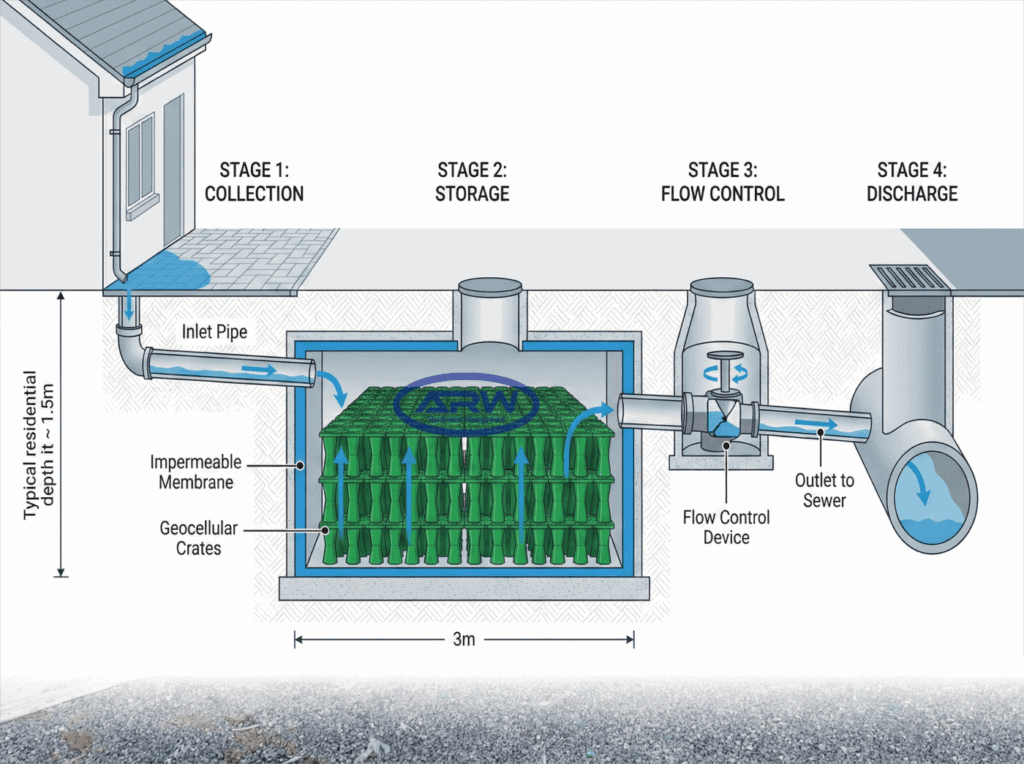
An attenuation tank is a sealed underground storage chamber that temporarily holds stormwater runoff during heavy rainfall and releases it slowly at a controlled rate into drains or watercourses. Unlike a soakaway, which lets water seep into the ground, an attenuation tank is wrapped in an impermeable membrane and discharges to a network — making it suitable for any soil type, including clay.
If you’re planning a new build, extension, or commercial development in the UK, there’s a good chance you’ll need one. Most Lead Local Flood Authorities now require stormwater attenuation as a condition of drainage approval, and that requirement is only getting stricter as Schedule 3 implementation rolls out. We’ve seen this principle make the difference between a £200,000 flood damage claim and a dry ground floor on a housing development in the Midlands — the maths behind it is straightforward, but getting the sizing wrong costs real money.
How Does an Attenuation Tank Work?
The operating sequence follows four stages.
Stage 1 — Collection. Rainwater from roofs, driveways, car parks and paved surfaces flows through drainage pipes into the tank’s inlet.
Stage 2 — Storage. The tank holds water in its sealed chamber. Unlike a soakaway, nothing seeps into the surrounding soil. The impermeable membrane or concrete shell keeps all water contained.
Stage 3 — Flow control. A mechanical device at the outlet restricts the discharge rate. This is typically set to the pre-development greenfield runoff rate — the volume of water that would have drained naturally before the site was built on.
Stage 4 — Discharge. Water releases slowly into the public sewer, watercourse, or designated outfall point. During dry periods, the tank empties completely, ready for the next storm event.
The critical component is that flow control device. Without it, you just have an underground pond. With it, you have a functioning attenuation system that meets regulatory discharge consent.
What Size Attenuation Tank Do I Need?
Tank sizing depends on three variables: your total impermeable catchment area, the local soil percolation rate, and the required storm return period.
For most UK developments, the design standard is a 1-in-100 year storm event plus a 40% climate change allowance. That’s the benchmark set by the Environment Agency and adopted by most Lead Local Flood Authorities (LLFAs).
A rough rule of thumb for residential properties:
| Property Type | Typical Catchment | Estimated Tank Volume |
|---|---|---|
| Semi-detached house | 80–120 m² roof + driveway | 3–6 m³ |
| Detached house | 120–200 m² | 5–10 m³ |
| Small commercial unit | 500–1,000 m² | 15–40 m³ |
| Large car park | 2,000+ m² | 50–150+ m³ |
These are indicative figures only. Proper sizing requires a drainage engineer to run calculations using Micro Drainage, Flow, or equivalent hydraulic modelling software — accounting for local rainfall data, permitted discharge rates, and downstream capacity.
Types of Attenuation Tanks
Two main construction methods dominate the UK market.
Geocellular (Plastic Crate) Systems

Modular plastic crates — sometimes called stormwater cells or geocellular units — clip together to form an underground storage matrix. Each crate typically offers 95% void ratio, meaning almost all the internal volume stores water.
The assembled crate structure gets wrapped in an impermeable geomembrane for attenuation applications (or a permeable geotextile if the design combines attenuation with partial infiltration).
Advantages: Lightweight, fast installation, flexible sizing, suitable for most residential and commercial projects. No crane required.
Limitations: Not suitable for extremely high load-bearing requirements without significant cover depth. Maximum practical depths around 2–3 layers depending on the product specification.
Precast Concrete Tanks
Single-piece or sectional concrete tanks designed for high-load applications. Common on highways projects, commercial developments with HGV traffic, and sites requiring very large single-chamber volumes.
Advantages: High structural strength, long proven track record, suitable for heavy traffic loading. Design life exceeding 100 years.
Limitations: Heavy — requires crane installation. Less flexible on irregular sites. Higher transport costs.
Which Type Suits Your Project?
| Factor | Geocellular Plastic | Precast Concrete |
|---|---|---|
| Load rating | 20–80 tonnes/m² | 40–600+ kN/m² |
| Void ratio | 95%+ | 100% (open chamber) |
| Installation speed | 1–2 days (residential) | 1–3 days + crane |
| Weight per m³ stored | ~35 kg | 800+ kg |
| Flexibility | Modular, any footprint | Fixed dimensions |
| Cost (materials) | £70–150/m³ | £100–300/m³ |
| Best for | Residential, commercial | Highways, high-load sites |
For most residential and light commercial projects across the UK, geocellular crate systems offer the best balance of performance, cost, and installation practicality. We’ve installed thousands of these systems over the past decade and the failure rate is negligible when the design and installation follow manufacturer specifications.
Attenuation Tank vs Soakaway: What’s the Difference?
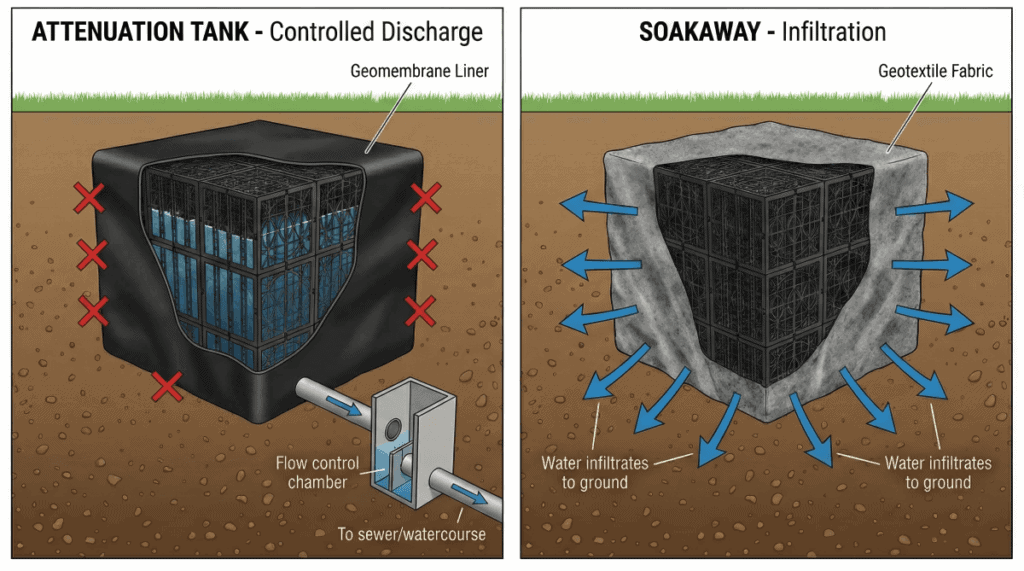
This is the question we get asked most often. The two systems serve fundamentally different drainage strategies:
| Feature | Attenuation Tank | Soakaway |
|---|---|---|
| Function | Stores water, releases to drain/sewer | Stores water, infiltrates into ground |
| Membrane | Impermeable (sealed) | Permeable (allows water through) |
| Discharge point | Public sewer or watercourse | Surrounding soil |
| Soil dependency | Works on any soil type | Requires permeable soil (fails on clay) |
| BRE 365 test needed | No (but discharge consent required) | Yes — percolation test essential |
| Best for | All sites, especially clay/poor drainage | Sandy/gravel soils with good percolation |
The deciding factor is your ground conditions. If a BRE 365 percolation test shows your soil drains well (infiltration rate above 1 × 10⁻⁵ m/s), a soakaway may work. If you’re on London Clay, Oxford Clay, or any heavy clay subsoil — you need attenuation.
Many sites actually use both: attenuation to manage peak flows and protect the sewer network, plus soakaways where ground conditions allow partial infiltration. This hybrid approach is increasingly favoured under SuDS design principles.
→ Related reading: Attenuation Tank vs Soakaway: Which One Do You Need?
When Is an Attenuation Tank Required?
Building Regulations
Under Approved Document H (Drainage and Waste Disposal), surface water must be disposed of in the following priority order:
- Soakaway or other infiltration system
- Watercourse
- Surface water sewer
- Combined sewer (last resort)
If option 1 fails (poor soil percolation), you’ll typically need attenuation to limit discharge rates before connecting to options 2, 3, or 4. Most water authorities and LLFAs now require flow control to greenfield runoff rates as a condition of drainage approval.
SuDS and Schedule 3
Schedule 3 of the Flood and Water Management Act 2010 is being implemented across the UK in stages. In England, the expectation for SuDS compliance continues to tighten through planning policy. Wales already mandates SAB (SuDS Approval Body) sign-off for developments.
For any new build or significant extension, assume you’ll need some form of stormwater management. Attenuation is the backbone of most engineered SuDS schemes.
Common Scenarios Requiring Attenuation
New housing developments (condition of planning approval), extensions that increase impermeable area significantly, commercial and industrial site drainage, car park and hardstanding construction, and any connection to public sewer where the water authority restricts discharge rates — all of these typically require an attenuation system.
Common Problems with Attenuation Tanks
Attenuation systems are mechanically simple, but problems do occur — almost always due to installation errors rather than product failure.
Silt build-up. Without adequate upstream filtration (catch pits, silt traps, filter strips), sediment accumulates inside the tank, reducing effective storage volume. Annual inspection prevents this becoming critical.
Blocked flow control. Debris reaching the flow control device can restrict or block the outlet, causing the tank to overflow. A properly specified silt trap upstream of the tank is essential, not optional.
Inadequate sizing. Undersized tanks overflow during storm events they were supposed to handle. This nearly always traces back to incorrect hydraulic calculations or inadequate climate change allowance in the design.
Membrane damage during installation. Geocellular systems rely on their geomembrane for watertightness. One puncture from a sharp stone or careless backfilling compromises the entire system. Supervision during installation is worth the cost.
Root intrusion. Trees planted too close to the tank assembly can damage membranes and pipe connections over time. Maintain a minimum 3-metre clearance from significant tree planting.
How Long Does an Attenuation Tank Last?
Modern geocellular plastic systems carry design lives of 50+ years when properly installed and maintained. Precast concrete tanks typically claim 100+ years.
In practice, the limiting factor is usually the ancillary components — pipe connections, flow control devices, and inspection chambers — rather than the tank structure itself. Budget for flow control servicing every 2–3 years and a full system inspection annually.
The polypropylene used in geocellular crates resists UV degradation (buried underground, UV exposure is zero), chemical attack from normal soil conditions, and biological breakdown. We’ve excavated systems installed 15+ years ago during site redevelopment and found crate structures in near-original condition.
Project Spotlight

Project Spotlight: Residential Development, Warwickshire
Location: Warwickshire, West Midlands
Challenge: 24-unit housing development on clay subsoil with zero infiltration potential. Local water authority restricted discharge to 5 l/s for the entire site.
Solution: 85 m³ geocellular attenuation tank system using modular crates, wrapped in impermeable liner, with twin vortex flow controls discharging to the surface water sewer.
Result: System managed a 1-in-100 year + 40% CC storm event within design parameters during heavy rainfall in autumn 2025. Zero surface flooding incidents since completion.
Key Learning: Early engagement with the water authority on discharge consent saved 6 weeks on the programme. Getting that flow rate agreed before finalising tank sizing avoided costly redesign.
Frequently Asked Questions
Do I need planning permission for an attenuation tank?
Not typically for the tank itself. Attenuation tanks are usually installed as part of a wider drainage strategy that forms a condition of planning approval. The tank is a means of meeting that condition, not a separate planning matter. However, you will need drainage approval from your LLFA or water authority for the discharge connection.
How much does an attenuation tank cost?
Materials typically range from £70–150 per cubic metre for geocellular systems, with total installed costs varying between £2,000–£8,000 for residential projects depending on tank volume, ground conditions, and access. Concrete tanks cost more per unit but may be cost-effective at very large volumes. → Read our full cost guide
Can I install an attenuation tank myself?
Technically possible for small residential systems, but not recommended without professional drainage design. The hydraulic calculations, flow control specification, and membrane installation all require expertise. Incorrect installation voids product warranties and risks drainage failure that’s expensive to remediate.
What maintenance does an attenuation tank need?
Annual inspection and cleaning of silt traps, catch pits, and flow control devices. The tank chamber itself needs minimal attention if upstream filtration is working correctly. Budget approximately £150–£300 per year for professional maintenance on a residential system.
Summary
An attenuation tank stores stormwater temporarily and releases it at a controlled rate — that’s the core function. Whether you need one depends on your ground conditions, local authority requirements, and the scale of impermeable surfaces draining to your system.
For most UK developments built after 2015, some form of stormwater attenuation is either required or strongly expected. Getting the sizing right, the flow control specified correctly, and the installation supervised properly determines whether the system performs for its full design life — or becomes a costly problem within the first wet winter.
→ Ready to size your system? View our complete attenuation tank guide
→ Need installation guidance? Read our step-by-step installation guide
 English
 Arabic
 French
 Russian
 Spanish