
Attenuation Tank Cost in the UK
Author: AQUA Rain Water Solutions · Published: February 2026 · Reading time: 15 minutes
An attenuation tank is a below-ground stormwater storage system that temporarily holds surface water runoff and releases it at a controlled rate — and in the UK, a fully installed geocellular crate system typically costs between £200 and £350 per cubic metre of storage, while pre-cast concrete tanks range from £400 to £600/m³ and GRP (fibreglass) tanks sit at £300–£500/m³ according to the Environment Agency’s SC080039/R9 cost estimation framework. For a standard residential project needing 3–5 m³ of storage, expect to pay £1,500–£4,000 all-in; larger commercial schemes of 50–100 m³ commonly fall between £15,000 and £50,000 depending on ground conditions and ancillary equipment.
We have specified and supplied attenuation systems for projects ranging from single driveways in Kent to 200-plot housing developments across the Midlands. The most common budgeting mistake we see? Underestimating ancillary costs — flow controls, silt traps, liners and spoil disposal routinely push final invoices 25–40% above initial crate-only quotes. This breakdown covers where your money actually goes, which system type delivers the best value for your specific project, and how to keep costs under control. Whether you are a homeowner facing a SuDS planning condition under Defra’s 2025 National Standards, a self-builder designing drainage from scratch, or a developer costing a multi-plot scheme, these figures reflect verified 2025/2026 UK market pricing.
What Drives Attenuation Tank Costs?
Every attenuation project is different, but the final price comes down to a handful of measurable variables. Understanding them before you request quotes saves both time and money.
Storage Volume Required
Storage volume is the single biggest cost driver. Your required volume depends on three factors: total impermeable catchment area (roofs, driveways, paved surfaces), local rainfall intensity data from the Flood Estimation Handbook (FEH), and the maximum discharge rate permitted by your local authority or water company.
As a practical benchmark, 1 m³ of geocellular crate storage handles runoff from roughly 50 m² of impermeable surface under typical UK rainfall. A 3-bedroom house with 80 m² of roof and a 40 m² driveway might need 2–4 m³ of attenuation storage — though regional variation is significant. A site in Manchester (annual rainfall approximately 870 mm) needs 30–40% more storage than an equivalent site in Cambridge (approximately 560 mm).
Larger systems benefit from economies of scale. We regularly see per-cubic-metre costs drop 15–25% once projects exceed 20 m³, because plant mobilisation and liner fabrication costs spread across a larger volume.
System Type and Material
Three technologies dominate the UK market. Each has a distinct cost profile:
| System Type | Material Cost/m³ | Installed Cost/m³ | Void Ratio | Design Life | Best For |
|---|---|---|---|---|---|
| Geocellular crates (PP) | £80–£150 | £200–£350 | 94–97% | 50+ years | Residential, mid-scale commercial |
| Pre-cast concrete | £450–£520 | £400–£600 | 100% (solid) | 100+ years | Heavy infrastructure, HGV areas |
| GRP (fibreglass) | £200–£350 | £300–£500 | 100% (solid) | 50–80 years | Contaminated runoff, chemical resistance |

Concrete tank costs reference the Environment Agency’s SC080039/R9 cost estimation report (Stovin & Swan, 2007). The wide installed range for concrete reflects the crane hire and heavy plant needed — a 13-tonne excavator minimum versus the 3-tonne machine sufficient for geocellular work.
Geocellular crates dominate the residential and mid-scale commercial market for good reason. They weigh 12–20 kg per unit, arrive flat-packed, need no crane, and their 94–97% void ratio means nearly all excavated volume stores water rather than structure. For a detailed comparison of system types, see our geocellular attenuation tank guide.
Ground Conditions
Ground conditions can double your excavation costs. Here is what we typically see across different soil types:
| Ground Type | Excavation Cost Premium | Additional Requirements |
|---|---|---|
| Free-draining sand/gravel | +£30–£50/m³ (baseline) | Minimal — standard granular bedding |
| Firm clay (summer) | +£50–£80/m³ | Thicker bedding, compaction control |
| Waterlogged clay (winter) | +£80–£120/m³ | Dewatering, possible concrete surround |
| Rocky ground | +£70–£100/m³ | Breakers, slower dig rate |
| High water table | +£60–£100/m³ | Buoyancy anchor straps or concrete surround |
We always recommend a trial pit or percolation test following BRE Digest 365 methodology before committing to any design. It costs a few hundred pounds but routinely saves thousands in avoidable over-engineering. If you are unsure about soil suitability, our soakaway crates guide covers percolation testing in detail.
Excavation and Labour
Labour typically accounts for 30–40% of the total installed cost. Current UK rates for drainage groundwork:
- Operative day rate: £250–£450 per day (varies by region and CSCS certification level)
- Mini excavator hire (3T with operator): £200–£400 per day
- 13-tonne excavator hire: £450–£700 per day
A two-person crew with a 3-tonne mini excavator can install a residential geocellular system (3–5 m³) in a single day. Larger commercial projects might need a 13-tonne machine and three or four operatives working over several days.
Spoil disposal is the line item people consistently forget. Removing clean inert soil costs approximately £30–£50 per tonne at a licensed tip, and excavating 10 m³ of storage generates roughly 15–18 tonnes of spoil. That is £450–£900 just for getting rid of the dirt.
Ancillary Components
The crates or tank are only part of the system. A complete installation requires several additional components that collectively add 20–35% to the material bill:
| Component | Typical Cost | Function |
|---|---|---|
| Geomembrane liner (GT 500 or equivalent) | £8–£15/m² | Wraps crates to form sealed, watertight tank |
| Geotextile fleece (300 gsm non-woven) | £2–£4/m² | Protects liner from stone puncture during backfill |
| Vortex flow control device | £250–£600 each | Regulates discharge rate to permitted l/s |
| Orifice plate flow control | £80–£200 each | Simpler alternative for low-flow applications |
| Silt trap / catchpit (450 mm) | £150–£350 each | Traps debris before it enters the tank |
| Inspection chamber (450 mm) | £100–£250 each | Provides maintenance access to the system |
| Twinwall pipework (150 mm) | £15–£25/m | Connects gutters/gullies to tank inlet |
| Backfill aggregate (Type 1) | £25–£40/tonne | Surrounds crates for load distribution |
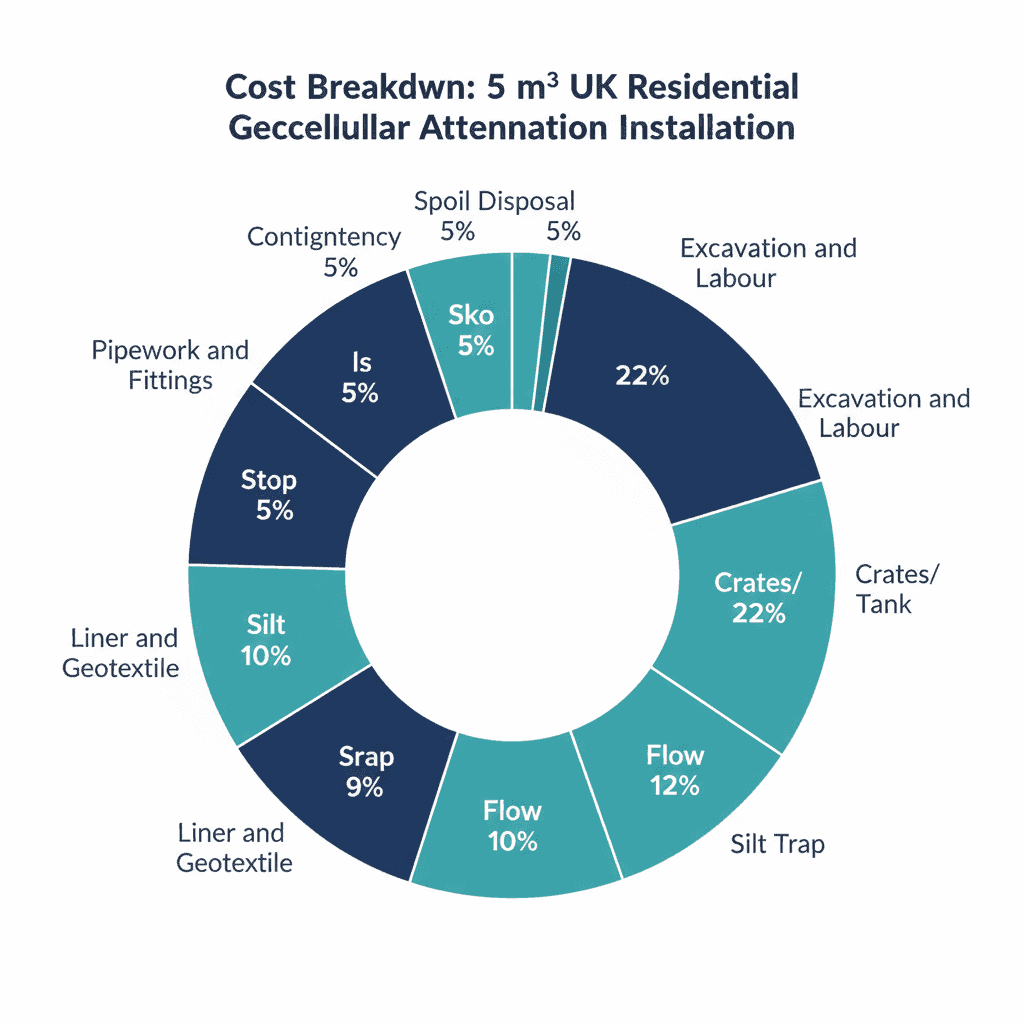
Flow control is not optional. Building Regulations Approved Document H and most local authority conditions require a controlled discharge rate — typically 2–5 l/s for residential and up to 50 l/s for larger schemes. A vortex device (hydrobrake type) delivers more consistent performance across varying head pressures than a simple orifice plate, but costs 3–4 times more.
Full Cost Breakdown by Project Scale
Here is what real-world projects actually cost, based on systems we have specified and supplied between 2024 and early 2026. All prices include VAT at 20%.
Residential Projects
| Scenario | Impermeable Area | Storage Volume | System Type | Installed Cost Range |
|---|---|---|---|---|
| Rear extension | 30–50 m² | 1–2 m³ | Geocellular crates (20T) | £800–£1,800 |
| Driveway replacement | 40–60 m² | 1–3 m³ | Geocellular crates (20T–65T) | £1,000–£2,500 |
| 3-bed new-build | 100–140 m² | 2–4 m³ | Geocellular crates (20T) | £1,500–£3,500 |
| Large detached house | 150–200 m² | 3–6 m³ | Geocellular crates (20T–65T) | £2,000–£4,500 |
| 5-house development | 500–700 m² | 10–20 m³ | Geocellular crates (65T) | £4,000–£10,000 |
The biggest variable in residential work is whether you are retrofitting or building on a greenfield site. Retrofit projects typically cost 20–30% more because of restricted access, hand-digging around existing services, and careful protection of established landscaping.
Commercial Projects
| Scenario | Storage Volume | System Type | Installed Cost Range |
|---|---|---|---|
| Small car park (20 spaces) | 15–30 m³ | Geocellular crates (65T) | £5,000–£12,000 |
| Retail unit with service yard | 30–60 m³ | Geocellular crates (65T) | £10,000–£25,000 |
| Distribution warehouse | 50–150 m³ | Geocellular or concrete | £15,000–£60,000 |
| Housing development (50+ plots) | 100–500 m³ | Geocellular crates (65T) | £25,000–£120,000 |
| Industrial estate | 200–1,000 m³ | Concrete or geocellular | £50,000–£250,000+ |
Commercial projects over 100 m³ benefit most from competitive tendering. We have seen 20–30% price variation between contractors for identical specifications on schemes above £20,000.
How the 2025 SuDS Standards Affect Your Costs
Defra published new National Standards for Sustainable Drainage Systems in June 2025, replacing the narrower 2015 guidance. While these standards are currently non-statutory — Schedule 3 of the Flood and Water Management Act 2010 remains unenacted in England — they set the direction of travel and increasingly influence planning decisions.
The 2025 standards introduce a drainage hierarchy that directly affects attenuation costs:

- Collect for non-potable use (rainwater harvesting — new top priority)
- Infiltrate to ground (soakaways where soil permits)
- Discharge to surface water body (watercourse)
- Discharge to surface water sewer
- Discharge to combined sewer (last resort)
What this means for your budget: if your local planning authority (LPA) follows the 2025 standards closely, you may need to demonstrate why each higher-priority option is not feasible before approval for a piped attenuation system. Some LPAs now require combined rainwater harvesting and attenuation solutions, which adds £500–£2,000 to a residential scheme but can reduce long-term water bills.
The National Planning Policy Framework (NPPF) now expects SuDS on developments of all sizes, not just major schemes. SUSDRAIN, the industry resource maintained by CIRIA, provides a useful overview of the evolving regulatory landscape. For smaller projects that previously avoided SuDS requirements, this means attenuation costs are becoming an unavoidable part of the build budget. Early engagement with your LPA is the single best way to avoid costly design changes later. For background on how attenuation systems fit within SuDS, see our guide to what an attenuation tank is.
Geocellular Crates vs Concrete vs GRP: Which Gives Best Value?
For most UK projects, geocellular crates deliver the best cost-to-performance ratio. Here is why — and where the alternatives win.
Geocellular Crates (Polypropylene)
Installed cost: £200–£350/m³
Crates dominate residential and mid-scale commercial work because:
- No crane needed — a 3-tonne mini excavator handles everything, saving £300–£500/day in plant costs versus concrete
- 94–97% void ratio — you excavate less volume to store the same amount of water
- Flat-pack delivery — cheaper haulage; one pallet typically provides 4–8 m³ of assembled storage
- Load ratings from 20T to 65T — the 20T standard suits gardens and soft landscaping; 65T heavy-duty handles car parks and access roads
Standard 20T crates cost £80–£110/m³ for materials. Heavy-duty 65T crates cost £120–£150/m³. That premium is worth paying for any area that might see vehicle traffic — under-specifying load rating is a false economy that leads to structural failure.
We supply the ARW geocellular tank range which includes both standard and heavy-duty options with 95% void ratios and BBA certification.
Pre-Cast Concrete Tanks
Installed cost: £400–£600/m³
Concrete makes economic sense only for specific conditions:
- Extreme loading — airport taxiways, trunk roads, industrial yards with 40T+ axle loads
- Very long design life — 100+ years with minimal maintenance
- High water table — concrete’s mass resists buoyancy without additional anchoring
The tricky bit? Delivery. A 10 m³ concrete tank weighs roughly 25 tonnes. You need a crane, a low-loader, and sufficient site access — and those logistics alone can add £2,000–£5,000 to a project.
GRP (Glass-Reinforced Plastic) Tanks
Installed cost: £300–£500/m³
GRP occupies a useful middle ground. Factory-sealed joints reduce on-site installation time, and chemical resistance makes GRP the default choice for petrol station forecourts, industrial estates handling contaminated runoff, and sites near sensitive watercourses where a containment-grade tank is specified.
One practical disadvantage: GRP tanks come in fixed sizes. If your required volume falls between standard units, you either over-spec (paying for unused capacity) or combine multiple tanks (adding pipework and chambers).
Hidden Costs That Catch People Out
After specifying hundreds of attenuation systems, we have a clear picture of where budgets blow out. These are the costs that do not appear on the initial crate quote but hit hard at the end:
1. Spoil Disposal (£450–£900 for a typical 10 m³ system)
Excavation creates spoil. Every cubic metre of dig produces roughly 1.5–1.8 tonnes of soil. Most quotes assume “clean inert” spoil at £30–£50/tonne for landfill disposal. If the site has historical contamination — common on brownfield plots — disposal costs can jump to £80–£150/tonne. We have seen a 5 m³ residential project in East London where contaminated spoil disposal cost more than the crates themselves.
Always ask your contractor: “Is spoil disposal included in the quote, and at what rate?”
2. Flow Control Devices (£250–£600)
A vortex flow control (hydrobrake type) or orifice plate is mandatory for discharge to sewers or watercourses. Building Regulations Approved Document H Section 3 and most water company adoption agreements require a controlled discharge rate.
Vortex devices cost more but self-regulate across a wider range of water levels. For residential projects under 5 m³, a simple orifice plate at £80–£200 usually satisfies the discharge condition. Larger schemes almost always need a vortex unit.
3. Geomembrane and Geotextile (£15–£25/m² combined)
An attenuation tank (as opposed to a soakaway) must be sealed to prevent water infiltrating into the ground. The standard approach uses a GT 500 or equivalent HDPE geomembrane liner wrapped in 300 gsm non-woven geotextile fleece. For a 5 m³ crate assembly, the liner and fleece typically cost £300–£500.
Worth knowing: the liner must extend beyond the crate edges by at least 300 mm on all sides, and the top and bottom sheets need a properly sealed overlap. Skimping on this detailing is the number one cause of premature system failure we encounter in warranty inspections.
4. Design and Drainage Calculations (£200–£1,500)
Simple residential projects can use rule-of-thumb sizing (1 m³ per 50 m² of impermeable surface). Anything requiring formal Building Control sign-off or planning conditions typically needs a drainage design with MicroDrainage or similar software. Fees range from £200 for a basic domestic calculation to £1,000–£1,500 for a multi-plot development with phased construction.
5. Connection to Existing Drainage (Variable)
Connecting the attenuation outlet to an existing sewer or watercourse involves pipework, backdrops, manholes and possibly a Section 106 connection agreement with the water company. Connection costs vary wildly — from £200 for a simple garden run to £3,000+ for a deep sewer connection under an adopted road.
Seven Ways to Reduce Your Attenuation Tank Costs

Saving money on attenuation does not mean cutting corners. These strategies work because they reduce waste, simplify logistics, or take advantage of structural efficiencies:
- Get a percolation test first — A BRE 365 test costs £200–£400 and determines whether you can use a soakaway (infiltration) instead of a sealed attenuation tank. Soakaways eliminate the need for a geomembrane liner, flow control device, and sewer connection — saving £500–£1,500 on a residential project. See our attenuation tank vs soakaway comparison for a detailed decision guide.
- Combine rainwater harvesting with attenuation — Under the 2025 SuDS hierarchy, harvesting is priority one. A combined system uses a single excavation for both functions, reducing dig costs by 30–40% compared to separate installations.
- Order flat-pack crates — Assembled crates cost more to deliver because of the volume they occupy on a lorry. Flat-pack crates from suppliers like AQUA Rain Water Solutions reduce haulage costs by up to 75% and take under 15 minutes per cubic metre to assemble on site.
- Right-size your flow control — Overspecifying a vortex device when a simple orifice plate would satisfy the discharge condition wastes £200–£400. Confirm the required discharge rate with your local water company before ordering.
- Coordinate excavation with other groundworks — If you are already digging foundations, trenches or landscaping, scheduling the attenuation installation during the same plant mobilisation avoids a separate £200–£400 excavator day rate.
- Compare at least three contractor quotes — For projects over £5,000, competitive tendering routinely saves 15–25%. Ensure all quotes cover the same specification, especially spoil disposal, flow control, and backfill material.
- Consider phased installation for multi-plot developments — Installing shared attenuation infrastructure early in the build programme spreads costs and avoids retrofitting around completed plots.
Frequently Asked Questions
Geocellular crate systems cost £200–£350/m³ fully installed for residential and commercial projects. Materials alone run £80–£150/m³ depending on load rating. Pre-cast concrete tanks cost £400–£600/m³ installed, and GRP tanks £300–£500/m³.
A typical 3-bedroom house with 100–140 m² of impermeable surface (roof plus driveway) needs 2–4 m³ of attenuation storage. The exact volume depends on your local rainfall data, soil permeability, and the discharge rate permitted by your water company or local authority.
Increasingly, yes. Defra’s 2025 National Standards for SuDS and the updated NPPF now expect sustainable drainage on developments of all sizes, not just major schemes. If your LPA requires a surface water management condition, an attenuation tank is one of the most common solutions — especially on sites with clay soils where soakaways are not feasible.
Geocellular crate systems are the most cost-effective for the majority of UK projects. The combination of low material costs (£80–£150/m³), high void ratio (94–97%), no crane requirement, and fast installation makes them 40–60% cheaper than concrete for residential and mid-scale commercial applications.
Geocellular polypropylene crates have a typical design life of 50+ years with BBA-certified products. Pre-cast concrete tanks can exceed 100 years. GRP tanks typically last 50–80 years. The critical factor for all types is proper installation — particularly correct wrapping with geotextile and geomembrane.
Small residential geocellular systems (1–3 m³) are within the capability of a competent DIYer with access to a mini excavator. You will need crates, geomembrane liner, geotextile fleece, a silt trap, a flow control device, connecting pipework, and backfill aggregate. However, you will still need a drainage design approved by Building Control, and any connection to a public sewer requires water company approval.
Conclusion
Attenuation tank costs in the UK range from £200 to £600 per cubic metre installed, with geocellular crate systems offering the best value at £200–£350/m³ for most residential and commercial projects. The total project cost depends on storage volume, ground conditions, system type, and ancillary components — with ancillaries typically adding 20–35% above the headline crate price.
The most effective way to control costs is to invest in proper site investigation upfront (BRE 365 percolation test, trial pit, drainage calculation) and specify the right system for your conditions rather than defaulting to the cheapest crate price. With Defra’s 2025 SuDS standards pushing sustainable drainage further into mainstream planning requirements, budgeting for attenuation at the earliest design stage is no longer optional — it is the most reliable route to avoiding expensive redesigns and planning delays.
For project-specific pricing, technical specifications, or help with drainage calculations, contact our drainage specialists for guidance tailored to your site conditions and planning requirements.
Disclaimer: All prices reflect UK market conditions as of early 2026 and include VAT at 20% where stated. Actual costs vary by location, ground conditions, contractor rates, and product selection. Always obtain multiple quotes. AQUA Rain Water Solutions recommends consulting a qualified drainage engineer for formal design calculations and Building Control submissions.
 English
 Arabic
 French
 Russian
 Spanish