
SuDS Systems UK: Types, Regulations and Costs for 2026 Projects
By AQUA Rain Water Engineering Team | 15+ years designing UK drainage solutions | Updated March 2026 | 13 min read
In This Guide:
- What Is a SuDS System?
- The Four Pillars of SuDS
- Types of SuDS: A Side-by-Side Comparison
- SuDS Design: From Site Assessment to LLFA Approval
- Are SuDS Mandatory? UK Regulations and Schedule 3
- SuDS in Practice: Project Spotlights
- SuDS Costs vs Traditional Drainage
- Frequently Asked Questions About SuDS
The consultation on England’s SuDS National Standards closed in March 2026. Fifteen years after the Flood and Water Management Act 2010 put Schedule 3 on the books, every major planning application now faces the same question: how will you handle surface water runoff on this site? We have watched LLFAs across the south-east refuse applications three times in a row because the drainage strategy was too vague. The direction is clear. Sustainable drainage systems, or SuDS, are no longer a nice-to-have bolted onto planning submissions. They are the baseline.
SuDS are drainage systems designed to manage surface water runoff close to where rain falls, using techniques like infiltration, attenuation and natural treatment rather than piping water directly into sewers. They mimic natural drainage by slowing flows, filtering pollutants and creating green spaces, reducing flood risk and improving water quality across a development’s lifetime.
This guide covers the types of SuDS, the four pillars framework, UK regulations including Schedule 3, the design and approval process, real project examples and costs for 2026. Whether you are a developer, drainage engineer or planning consultant, the aim here is to give you what you need to design, specify and get SuDS approved on your next project. We focus on England and Wales here. Scotland operates under a separate SEPA-led framework, and Northern Ireland has its own drainage regulations.

What Is a SuDS System ?
A SuDS system is a collection of drainage techniques that manage rainwater as close to the source as possible, reducing flood risk by controlling the volume and rate of surface water runoff leaving a site. Sustainable drainage systems replace the traditional approach of piping all rainfall into sewers with methods like infiltration into the ground, attenuation in storage structures and natural treatment through vegetation and soil.
In practice, the whole thing works through what the industry calls the management train. At the top sits source control, where rain is dealt with right where it lands. Think permeable driveways, green roofs, water butts. Next comes site control, where surface water runoff from multiple sources is collected and managed together through swales, detention basins or underground storage. Finally, regional control handles flows from an entire catchment using large-scale features like wetlands or retention ponds.
Before sustainable drainage systems became standard practice, the default was simple: collect everything in pipes, send it downstream as fast as possible. That worked until cities expanded, impermeable surfaces multiplied and combined sewers started overflowing after every heavy storm.
Under Building Regulations Part H, the drainage hierarchy is straightforward. Discharge to ground through infiltration comes first. If thats not feasible, aim for a watercourse. A surface water sewer is third choice. A combined sewer is the last resort. They provide the mechanism to follow this hierarchy on every project. Thats exactly why they matter for any development in England.
For a deeper look at underground storage options, see our attenuation tank guide.
The Four Pillars of SuDS
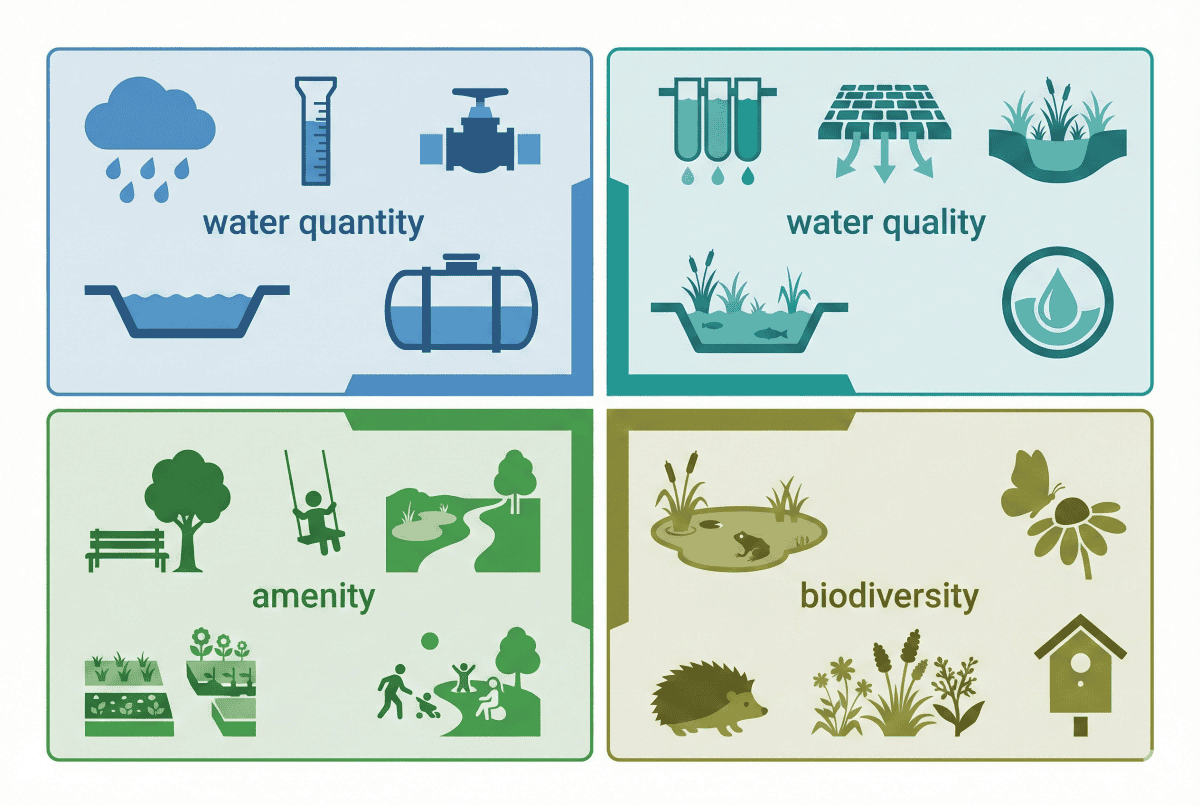
The suds four pillars are water quantity, water quality, amenity and biodiversity. Every SuDS scheme must address all four to meet the design standards set out in CIRIA C753, the SuDS Manual. A design that only handles volume without considering habitat or public benefit will fall short at approval stage.
- Water Quantity controls the volume and peak flow rate of surface water runoff leaving a site. The goal is to match or better the greenfield runoff rate. Attenuation tanks, permeable surfaces and storage basins all contribute. A hydrobrake, a vortex flow control device fitted at the system outlet, restricts discharge to the permitted rate. On a typical residential plot that might be 2 to 5 litres per second.
- Water Quality removes pollutants before they reach watercourses. Rain picks up oil, heavy metals and sediment as it crosses roads and car parks. A treatment train passes water through multiple stages, each removing a different fraction of the pollutant load.
- Amenity creates spaces people want to spend time in. Rain gardens between houses, swales alongside footpaths, ponds in public parks. Done well, SuDS become a visible green asset rather than a buried utility.
- Biodiversity supports habitats and ecological value. Wetlands attract invertebrates, amphibians and birds. Green roofs provide nesting sites. Under the Environment Act 2021, all major developments must deliver a minimum 10% biodiversity net gain, and well-designed SuDS can contribute directly to that target.
Here is the thing about these four pillars. A single well-designed swale can tick all four boxes at once: it slows water, filters pollutants through soil and vegetation, creates a green corridor and provides habitat. Most traditional pipe systems tick one box at best.
Types of SuDS: A Side-by-Side Comparison
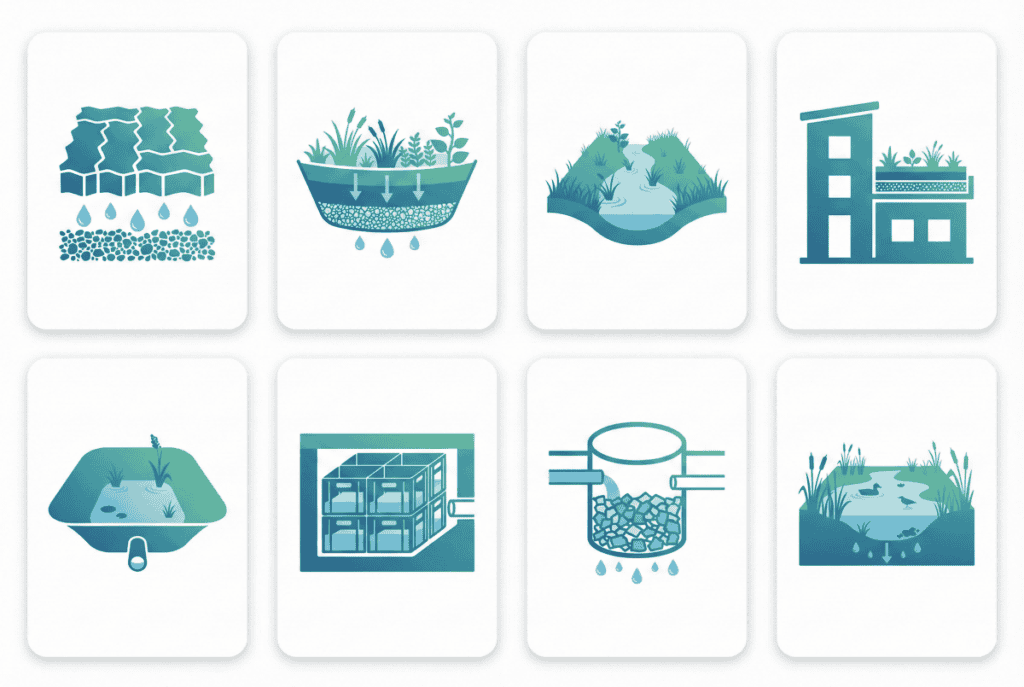
The main types of SuDS fall into three categories based on where they sit in the management train: source control (handling rain where it falls), site control (managing collected flows) and regional control (large-scale catchment features). Most projects combine multiple types into a treatment train. The range includes permeable paving, rain gardens, swales, soakaways, green roofs, detention basins, geocellular systems and wetlands.
At source control level, permeable paving replaces standard hard surfaces with blocks or gravel that let water soak through into a sub-base reservoir. Popular for driveways, car parks and access roads because it doesnt need any extra land. Rain gardens are shallow planted depressions that collect roof and path runoff, allowing infiltration while adding colour and wildlife value. A soakaway, an underground chamber that lets water infiltrate directly into surrounding soil, handles drainage from individual properties. Green roofs intercept rainfall at roof level, slowing it before it reaches ground drainage.
For site control, swales are shallow grass-lined channels that convey and filter water along their length. Good on road verges and open spaces. Detention basins are dry depressions designed to hold water temporarily during storms and drain down afterwards. Geocellular crates, modular plastic units stacked underground to create large attenuation volumes, are increasingly common where space is tight. They store water below car parks, playing fields or access roads without taking up any surface area.
At regional scale, wetlands and retention ponds serve larger catchments with permanent water features that support habitat.
So which types of SuDS work for driveways? Permeable paving is the default answer for most domestic and commercial driveway projects. It replaces standard block paving while handling drainage in the same footprint, making it the go-to drainage solution for driveways.
Most real-world schemes combine three or four types. A housing estate might use permeable paving on roads, rain gardens between plots, a swale along the boundary and geocellular storage under the car park. That layered approach is the treatment train in action. You can browse the full susdrain component library for detailed technical sheets.
| SuDS Type | Primary Pillar | Typical Application | Footprint | Maintenance |
|---|---|---|---|---|
| Permeable paving | Quantity + Quality | Driveways, car parks | Low (replaces paving) | Low |
| Rain garden | Quality + Biodiversity | Residential, streetscapes | Medium | Medium |
| Swale | Quantity + Amenity | Road verges, open space | Medium-High | Low |
| Green roof | Quality + Biodiversity | Commercial roofs | None (uses roof) | Medium |
| Detention basin | Quantity | Large developments | High | Low |
| Geocellular system | Quantity | Under paving/structures | None (underground) | Very low |
| Soakaway | Quantity | Residential, small sites | Low | Low |
| Wetland | All four | Regional, large sites | High | Medium |
SuDS Design: From Site Assessment to LLFA Approval
Designing a sustainable drainage scheme involves five broad steps. Skip any of them and your planning application will stall. Weve seen it happen more times than we can count.
1. Site investigation. Start with a percolation test to BRE 365, the British standard for soakaway testing that measures how quickly water drains through your soil. Dig trial pits, check groundwater levels and review the British Geological Survey mapping for your area. If the percolation test shows the ground drains slower than 1 x 10^-6 m/s, infiltration wont work and you need attenuation with lined storage instead.
2. Drainage strategy. Calculate your greenfield runoff rate, the rate at which the undeveloped site would have drained naturally. This becomes your discharge limit. Then apply climate change allowance, currently a 40% uplift for most developments based on 2026 guidance. The difference between inflow and controlled outflow determines how much attenuation volume you need. On a typical 1-hectare residential site, the greenfield runoff rate sits between 2 and 8 litres per second. Worth getting this number right early because everything else in the suds drainage design flows from it.
3. Component selection. Match site constraints to the drainage types from the table above. Clay site with no infiltration? Lined geocellular attenuation. Permeable gravel subsoil? Soakaways and permeable paving. Most schemes combine three or four components. Reference CIRIA C753, the SuDS Manual, for detailed design calculations.
4. Modelling. Run the design through a hydraulic model for the 1-in-100 year storm plus climate change allowance. The model needs to demonstrate the system copes without surface flooding.
5. LLFA pre-application. Engage your Lead Local Flood Authority before submitting your planning application. Quick tip: most rejections happen because developers submit first and ask questions after. A 30-minute pre-application meeting saves months. Getting LLFA suds approval is the final gate before construction starts, so build that timeline into your programme. For storage sizing calculations, see our guide on what is an attenuation tank.

Are SuDS Mandatory? UK Regulations and Schedule 3
SuDS are not yet fully mandatory in England through primary legislation, but they are required in practice through planning policy. Schedule 3 of the Flood and Water Management Act 2010, which would create a statutory framework with dedicated approval bodies, has been commenced in Wales since 2019 but remains uncommenced in England as of early 2026.
Right, so if Schedule 3 isnt commenced in England, why do developers still need them? Because multiple other mechanisms already require sustainable drainage.
Building Regulations Part H establishes the drainage hierarchy that puts infiltration first and combined sewers last. Any new drainage design must follow this hierarchy, and sustainable drainage is the practical means to do it.
On the planning side, the NPPF (National Planning Policy Framework) requires major developments to include sustainable drainage. Local planning authorities apply this through conditions, meaning your application wont get approved without a drainage strategy. The NPPF also states that development should not increase flood risk elsewhere, which effectively mandates attenuation to greenfield runoff rates.
Schedule 3 of the Flood and Water Management Act 2010 would go further by establishing SuDS Approval Bodies (SABs) within each Lead Local Flood Authority (LLFA). SABs would approve or reject drainage designs independently of the planning system. The suds schedule 3 england situation is tracked in the House of Commons Library briefing.
The suds national standards 2025, published for consultation by GOV.UK, set out minimum design requirements including discharge limits, interception storage and water quality treatment. These align with CIRIA C753 and include requirements around biodiversity and adoption.
Do you need SuDS for your housing development? Yes. For any major development of ten or more homes, your LLFA will require a drainage strategy demonstrating compliance with these standards. Increasingly, LLFAs are requiring the same approach for smaller schemes too, depending on local policy. Not every LLFA interprets the standards the same way, so checking early is always worth it for suds planning permission questions.
The question isnt whether to include SuDS. Its to what standard. And the suds for housing developers bar keeps moving upward.
SuDS in Practice: Project Spotlights
Surrey: 85-Home Residential Development
We worked on an 85-home development in Surrey where the ground investigation threw up the worst combination: London Clay at 1.3 metres depth and a water table sitting at just 1.8 metres below ground level. Infiltration was off the table completely.
Originally, the specification called for precast concrete attenuation tanks. But the site layout was tight, access roads couldnt handle delivery lorries carrying 2.5-tonne concrete sections, and the programme was already behind. The redesigned scheme used a combined drainage approach. Permeable paving went on the access roads and 47 visitor parking bays. Rain gardens were planted between house plots, adding amenity and biodiversity value that the LLFA commented positively on. Below the main car park, geocellular attenuation tanks provided the bulk storage.
The geocellular crates had a 95% void ratio, meaning each cubic metre of installed crate stored 950 litres. The total system held 340 cubic metres wrapped in geotextile and HDPE liner. Installation took six days with a three-person crew. The excavator got stuck twice in the clay and the site was ankle-deep in mud after overnight rain on day three. Not glamorous, but it worked.
Total cost saving against the original concrete specification: 40%. The LLFA signed off within two weeks. Eighteen months on, the system has handled three major storm events without any surcharging.
Manchester: 250-Space Car Park Retrofit
A 250-space car park in Manchester was overwhelming the combined sewer every time it rained. The site sat on potentially contaminated brownfield land, so any drainage had to be fully contained to prevent pollutant migration to groundwater.
Three drainage techniques went into the solution. A lined geocellular system sat under the car park, providing 480 cubic metres of attenuation storage. The geocellular stormwater modules were wrapped in impermeable membrane. Permeable paving replaced the surface, and a planted swale ran along the perimeter for treatment.
The excavation hit old foundations at 1.1 metres, which meant repositioning about a third of the storage cells. That added two days. But the result was a 60% reduction in surface water entering the combined sewer.
On contaminated sites, a lined geocellular tank system with impermeable membrane is often the only drainage option regulators will accept. The void ratio of the geocellular crates determines how much water you store per cubic metre of excavation. Higher ratio means a smaller, shallower dig.
Two different ground conditions, two different configurations, but the same result: geocellular storage outperformed concrete on cost, programme and approval speed. We see that pattern on most projects we work on.
SuDS Costs vs Traditional Drainage
SuDS typically cost between 20 and 40 per cent less than traditional piped drainage over the whole project lifecycle, according to Environment Agency estimates. Upfront capital costs vary by component, but the lifetime savings from reduced pipe runs, lower sewer connection charges and reduced flood damage make SuDS the more cost-effective choice for most schemes.
When people talk about SuDS in construction, the meaning goes beyond environmental compliance. It changes the cost equation for the entire drainage package.
| SuDS Component | Typical Cost Range | Traditional Alternative | Typical Saving |
|---|---|---|---|
| Permeable paving | 40 to 80 pounds per square metre | Standard paving plus drain | 10-20% total |
| Swale | 15 to 30 pounds per linear metre | Piped system | 30-50% |
| Rain garden | 30 to 60 pounds per square metre | Concrete planter plus drain | 15-25% |
| Geocellular crates | 70 to 150 pounds per cubic metre installed | Concrete tank | 30-50% |
| Green roof | 80 to 150 pounds per square metre | Standard roof plus drain | Higher upfront, lower lifecycle |
Costs are indicative ranges for England based on 2024-2025 market data. Actual costs vary by ground conditions, scale and region.
Where the real savings show up is at project level. These systems reduce pipe run lengths because water is managed at source. Sewer connection charges drop because less water enters the public network. Amenity value lifts property prices by 5 to 10 per cent according to CIRIA research. Across the 40-plus geocellular installations our team has completed since 2019, the average cost saving against concrete alternatives has been 35 per cent.
That said, costs vary wildly depending on ground conditions. A scheme on free-draining gravel can rely on simple soakaways and permeable paving at the lower end of these ranges. A clay site with high groundwater needs lined geocellular storage at the upper end. Always get at least three quotes from drainage-experienced contractors.
For a comparison of underground storage options, see our attenuation tank vs soakaway guide.

Frequently Asked Questions About SuDS
The suds maintenance responsibility question comes up on every project. It depends on the adoption arrangement. The developer maintains SuDS until a water company or local authority formally adopts them. Unadopted systems stay with the management company or landowner. Regular tasks include clearing catchpits, removing silt from swales and checking flow control devices. Schedule 3 SABs, when commenced, will clarify the adoption pathway.
For a standard domestic driveway, you dont need a formal SuDS scheme. But planning rules require you to use permeable surfaces or drain rainwater to a lawn or soakaway rather than onto the public highway. If your project covers more than five square metres of previously permeable ground, permitted development rights may not apply without permeable paving.
Schedule 3 is the section of the Flood and Water Management Act 2010 that would create SuDS Approval Bodies to approve drainage designs for new developments independently of planning. It was commenced in Wales in January 2019 but remains uncommenced in England. The suds national standards 2025 consultation is widely expected to precede commencement.
SuDS require careful site assessment, especially on clay soils or sites with high water tables where infiltration wont work. Maintenance is ongoing and adoption pathways remain unclear in some areas. Surface-level systems like swales and basins compete for developable land on tight urban sites, which is why underground geocellular systems are often the preferred route.
Yes. Contaminated brownfield sites need lined systems to prevent pollutant migration to groundwater. Geocellular crates wrapped in impermeable HDPE membrane are the standard approach. Your drainage strategy must account for contamination risk, and the LLFA will want evidence that the design prevents any pathway between contaminated soil and stored water.
Your Next Step
SuDS are a practical requirement for any UK development project in 2026. The regulatory direction is clear even where Schedule 3 remains uncommenced. With the National Standards consultation closed and Schedule 3 commencement on the horizon, the baseline we set out at the start of this guide is only going to get higher. The question has shifted from whether to include sustainable drainage to how to design the most cost-effective system for your site.
Whether you are specifying a drainage strategy for a new housing estate or retrofitting an existing car park, geocellular attenuation systems give you maximum storage in minimum footprint. Get in touch with our drainage team at AQUA Rain Water Solutions to discuss your project, or explore our geocellular stormwater modules for specifications and load ratings.
What started as an environmental aspiration is now engineering standard practice. The sites that get them right from the start save time, money and planning headaches down the line.
Published by AQUA Rain Water Solutions | aquarainwater.com
Disclaimer: This guide is for general information only. Case studies are illustrative examples based on typical project scenarios and do not represent specific completed projects. Always consult a qualified drainage engineer and your Lead Local Flood Authority for site-specific advice. Regulations referenced are current as of March 2026 and may change.
 English
 Arabic
 French
 Russian
 Spanish