
Stormwater Attenuation Tanks in UAE: Modular Geocellular Systems for Dubai & Abu Dhabi Projects
A record-breaking April 2024 storm delivered a year’s rainfall to Dubai in just 12 hours, exposing the limitations of traditional drainage systems in coping with increasingly frequent flash floods.
The UAE government launched the $8.2 billion Tasreef project to upgrade Dubai’s stormwater infrastructure. This creates opportunities for contractors in installation, maintenance, and management, supporting both short-term work and long-term partnerships. More developers and EPC firms across the GCC now choose modular underground stormwater tanks for reliable flood control.
This guide gives you the essential knowledge to select and install geocellular soakaway crates and stormwater detention systems for UAE projects. Discover technical advantages, clear installation steps, cost analysis, and straightforward paths to Dubai Municipality and Abu Dhabi QCC compliance.
What Is a Modular Stormwater Attenuation Tank?
A modular stormwater attenuation tank stores up to 950 liters per cubic meter thanks to its impressive 95% void ratio. This high-performance underground detention system excels at managing heavy runoff during flash floods.
A geocellular attenuation tank is an underground system built from interlocking polypropylene (PP) modules. These modules stack together to create tanks of any size—from small residential soakaway crates to large commercial detention basins.
The table below shows why geocellular stormwater systems are replacing traditional concrete tanks and gravel pits across the Middle East:
| Feature | Geocellular Modules | Concrete Tank | Gravel Pit |
|---|---|---|---|
| Void Ratio | 95% | 100% | 30-35% |
| Weight | Lightweight | Very Heavy | Heavy |
| Installation Time | 3-5 days | 2-4 weeks | 1-2 weeks |
| Flexibility | Any shape/size | Fixed design | Limited |
| Lifespan | 50+ years | 50+ years | 20-30 years |
| Space Efficiency | Excellent | Good | Poor |
A 95% void ratio means the tank holds 95% of its volume in water. A gravel trench stores only about 30%, requiring three times as much excavation for the same storage capacity.

Why Underground Stormwater Storage Systems Work Best in the UAE
UAE drainage faces unique challenges: heavy but rare rainfall events combined with sandy soil that absorbs less than 10mm per hour. These conditions require underground detention systems because traditional infiltration methods fail. Dubai and Abu Dhabi guidelines now specifically address these requirements.
⚡ Flash Floods Hit Hard and Fast
Dubai receives an average of 100mm of rain annually, but rainfall events are often intense and concentrated. In April 2024, 142mm fell in a single day—exceeding the annual average. Traditional surface drainage cannot handle such extreme flow rates.
Underground attenuation tanks protect your project by:
- Capturing peak flows during heavy storms
- Providing secure underground water storage
- Releasing water safely at a controlled rate
This peak flow management approach protects roads, buildings, and infrastructure from flooding without requiring oversized drainage pipes throughout the project.
🏗️ Space Is Money in Dubai and Abu Dhabi
Land is expensive across the GCC. While surface detention ponds work in rural areas, you cannot sacrifice valuable land in planned communities or business districts.
Modular underground tanks install beneath:
- Parking lots and driveways
- Landscaped areas and parks
- Roads and access routes
- Building footprints (before construction)
With tanks installed underground, you retain valuable surface space for parking or facilities while meeting strict stormwater regulations in UAE—a clear win for both compliance and client value.
📋 Dubai Municipality & Abu Dhabi QCC Stormwater Requirements
Dubai and Abu Dhabi have updated their stormwater design guidelines to permit underground storage systems. Projects must follow these requirements for approval.
Key compliance points from the Dubai Municipality Stormwater Guidelines:
| Requirement | What It Means for Your Project |
|---|---|
| Gravity systems preferred | Underground tanks work with gravity flow ✓ |
| Flow attenuation required | Reduce peak discharge rates ✓ |
| Inspection access mandatory | Include manholes and access chambers ✓ |
| 5-25 year design storms | Size your tank for the right return period |
The Abu Dhabi QCC Guidelines follow similar principles, prioritizing cost-effective operation and maintenance. Ensure your designs meet QCC criteria to streamline approval.
AQUA RainWater Geocellular Stormwater Modules: Technical Specifications
Our PP stormwater attenuation crates are engineered for demanding GCC conditions: extreme heat, sandy backfill, and heavy traffic loads. We offer load ratings from 40T to 60T per square meter.
📊 Product Specifications
| Specification | Details |
|---|---|
| Material | Virgin PP or Recycled PP (your choice) |
| Module Size | 1000 × 500 × 500 mm |
| Void Ratio | 95% |
| Load Capacity Options | 40T / 45T / 50T / 60T per sqm |
| Temperature Range | -20°C to +100°C ✓ |
| Design Life | 50+ years |
| Connection | Click-lock interlocking system |
Our modules withstand temperatures up to +100°C—critical since UAE ground temperatures can exceed 50°C in summer. The modules retain full strength and capacity under these extreme conditions.
🔧 Three Functions: Detention, Retention, and Infiltration
The same geocellular modules can be configured for different stormwater management applications:
1. Detention (Attenuation) The most common setup for stormwater detention tanks in Dubai. Water is held temporarily and released slowly through a flow control device. The tank is wrapped in waterproof geomembrane—ideal for UAE’s sandy soil conditions.
2. Retention (Rainwater Harvesting) Store water for reuse in irrigation, toilet flushing, or cooling systems. Also uses waterproof wrapping plus pumping equipment. Growing demand across UAE for sustainability projects.
3. Infiltration (Soakaway) Water soaks into surrounding ground through permeable geotextile wrap. Less common in UAE due to poor soil permeability, but useful in select areas with better drainage.
📥 Download Complete Technical Specifications (PDF)

Where to Install Underground Detention Tanks in GCC Projects
Geocellular attenuation systems work well for many project types. Here are the most common applications across the UAE, Saudi Arabia, and wider Middle East:
🏘️ Residential Communities & Master-Planned Developments
New townships need stormwater management at every development phase. Modular detention tanks can be installed incrementally as the community grows, with each neighborhood having its own system linked to the master drainage plan.
🏭 Industrial Parks, Free Zones & Logistics Centers
Warehouses, factories, and logistics facilities have large paved areas generating significant runoff. Heavy-duty 60T geocellular modules handle truck traffic while the underground tank controls peak water flow.
✈️ Airports, Ports & Critical Infrastructure
Facilities requiring 24/7 operation cannot tolerate flooding disruption. Our geocellular drainage systems are already installed at aviation and maritime facilities across the GCC region.
🏢 Commercial Districts & Retail Developments
Shopping malls, office towers, and mixed-use projects benefit from underground water storage that preserves leasable space. Install tanks beneath parking basements or landscaped areas.

Complete Stormwater Attenuation System Components
A geocellular detention tank is more than plastic modules—it’s a complete system. Here’s what you need for a fully functional underground stormwater storage system:
| Component | Function | AQUA RainWater Supply |
|---|---|---|
| PP Modules | Core water storage structure | ✓ Available |
| Geotextile (300g/m²) | Filter layer, membrane protection | ✓ Available |
| Geomembrane (HDPE 1.0mm+) | Waterproofing for detention tanks | ✓ Available |
| Inspection Chambers | Access for maintenance & cleaning | ✓ Available |
| Silt Trap / Catchpit | Pre-treatment to capture sediment | ✓ Available |
| Flow Control Device | Regulate discharge rate | Specified per project |
| Inlet/Outlet Pipes | Connect to site drainage | Specified per project |
Geotextile vs Geomembrane: Which Do You Need?
For Detention/Attenuation (most UAE projects): Wrap the tank in HDPE geomembrane (minimum 1.0mm thickness) to create a watertight seal. Add geotextile on the outside to protect against sharp stones in the backfill.
For Infiltration/Soakaway: Wrap in geotextile only, allowing water to pass through into surrounding soil. Not common in UAE due to poor soil permeability.

How to Install Geocellular Soakaway Crates: Step-by-Step Guide
One major advantage of modular attenuation tanks is fast installation. A typical 500m³ underground detention tank takes just 3-5 days with a small crew of 4-6 workers.
Installation Sequence for Stormwater Attenuation Tanks
| Step | Activity | Key Points |
|---|---|---|
| 1 | Excavation | Level base, allow 500mm working space around tank |
| 2 | Bedding Layer | 100-150mm compacted sand or Type 1 sub-base |
| 3 | Lay Base Geomembrane | Position carefully, avoid punctures |
| 4 | Assemble PP Modules | Click-lock connection, no tools needed |
| 5 | Install Side Geotextile | Filter protection on all sides |
| 6 | Complete Geomembrane Wrap | Weld all joints, perform leak test |
| 7 | Connect Pipes | Inlet, outlet, overflow connections |
| 8 | Install Inspection Chambers | Minimum 2 access points per tank |
| 9 | Backfill | Granular material, 150mm lifts, compact carefully |
Backfill Requirements for UAE Sandy Conditions
- Use Type 1/Type 2 sub-base material or clean washed sand
- Avoid fine silt that can migrate through geotextile
- Compact in 150mm layers using plate compactor
- Minimum 500mm cover for trafficked areas
- Do NOT use excavated sand directly—it may contain sharp stones
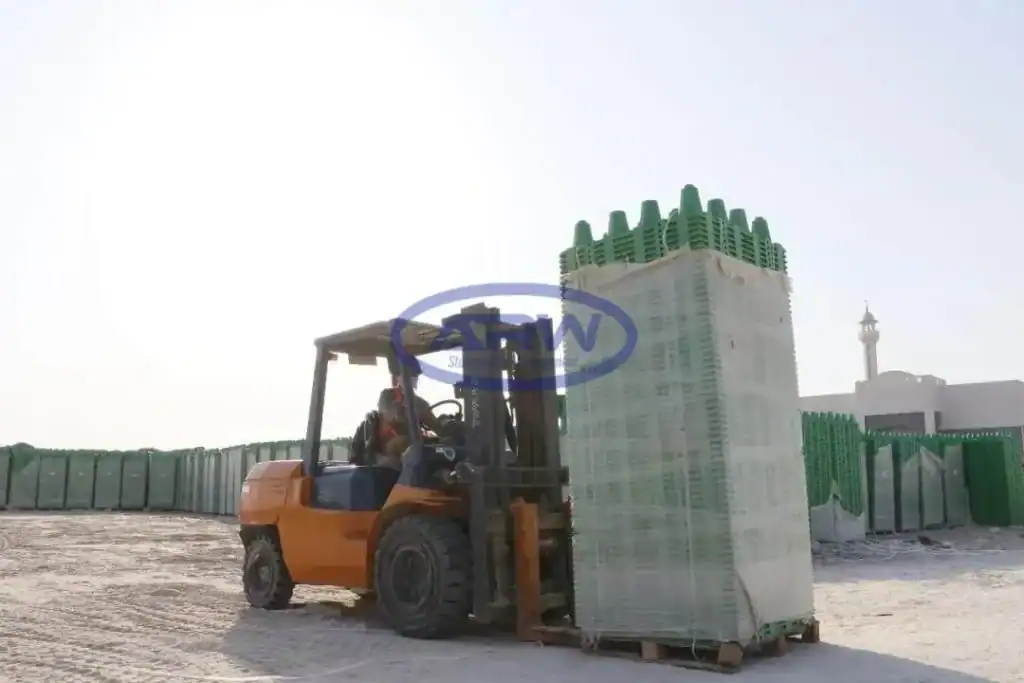
📞 Request Installation Guidance & Technical Support
Pre-Treatment & Maintenance for Underground Stormwater Tanks
Underground attenuation tanks can last 50+ years with proper pre-treatment and regular inspection. In the GCC’s dusty, sandy environment, this is especially important. Annual operation and maintenance typically costs $5-10 per cubic meter of storage.
Without upstream filtration, sand, debris, and trash accumulate inside your tank, reducing storage capacity and potentially blocking outlets. A simple silt trap catches over 80% of incoming solids.
Recommended Pre-Treatment Options
| Option | Best Application | Maintenance Frequency |
|---|---|---|
| Catch Basin with Sump | Small catchments (<1000m²) | Clean annually |
| Silt Trap Chamber | Medium projects | Clean 1-2× yearly |
| Hydrodynamic Separator | High-sediment or oily runoff | Inspect quarterly |
Inspection & Cleaning Schedule
| Period | Activity |
|---|---|
| Year 1 | Inspect after every significant storm |
| Ongoing | Minimum twice-yearly inspection |
| As Needed | Vacuum truck to remove silt from trap |
| Every 5 years | Full tank inspection via access chambers |
If pre-treatment works properly, the main tank rarely needs cleaning. Most maintenance happens at the upstream silt trap, which is easily accessible.
📖 Learn more about stormwater BMP maintenance from the CIRIA SuDS Manual
Quality Assurance & Test Reports for Geocellular Modules
We provide complete documentation for every project:
| Document | What It Proves |
|---|---|
| Compression Test Report | Load capacity verified by third-party lab |
| Creep Test Report | Long-term performance under sustained load |
| Material Certificate | PP specification (virgin or recycled) |
| Temperature Test | Stability from -20°C to +100°C |
All testing follows international standards including BS EN 17152 for geocellular stormwater systems.
📥 Download Test Reports & Certifications
Fast Delivery & Technical Support to UAE and GCC
🚚 Delivery to All GCC Ports
| Detail | Information |
|---|---|
| Production Capacity | 1,500 m³/day |
| Shipping Terms | FOB or CIF available |
| Lead Time | 7-14 days ex-works (typical) |
| Container Loading | ~290m³ per 40’HQ container |
| MOQ | Flexible – project-based |
📐 Free Design Support Included
We provide complete system design assistance:
- Tank sizing calculations based on catchment area
- CAD drawings for contractor submittal and approval
- Load rating selection for your specific traffic conditions
- Layout optimization to fit site constraints
📞 Contact Us for Free Design Assistance
💼 Become a Distribution Partner
Project Gallery: Large-Scale GCC Residential Development
Recent installation at a master-planned community in the Gulf region showcasing our modular stormwater detention system:
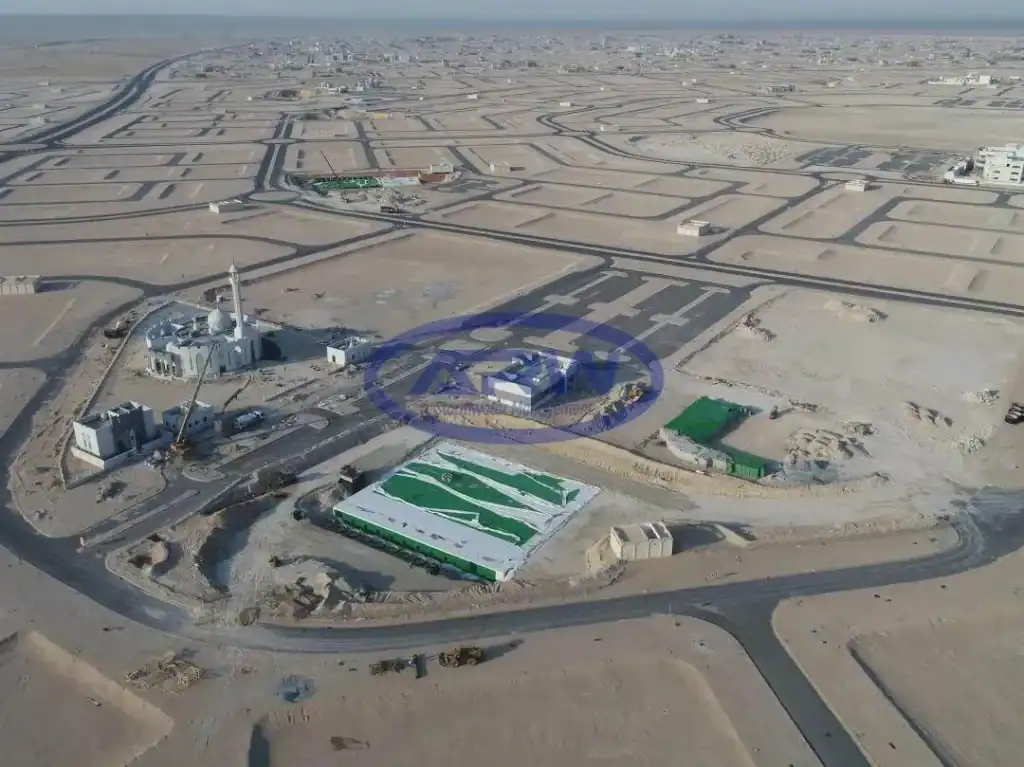
Project Highlights:
- Multiple underground attenuation tanks across development phases
- 40T load rating for residential road traffic
- Full geomembrane wrap for detention function
- Inspection chambers at regular intervals for maintenance access
- Rapid installation completed ahead of schedule
Frequently Asked Questions: Stormwater Attenuation Tanks UAE
What load capacity do I need for my underground stormwater tank in Dubai?
Load capacity depends on surface use above the tank:
| Application | Recommended Load Rating |
|---|---|
| Landscaped areas, gardens | 40T sufficient |
| Car parks (cars only) | 40T sufficient |
| Access roads, light trucks | 50T recommended |
| Heavy truck areas, loading bays | 60T recommended |
Our team helps you select the right geocellular module based on your traffic analysis. Get load rating advice →
Will geocellular crates deform in UAE’s extreme summer heat?
No. Our PP stormwater modules are tested to +100°C and show no deformation, warping, or capacity loss. Since tanks install underground, actual operating temperatures rarely exceed 40°C even in peak summer.
How do I calculate detention tank size for my UAE project?
Basic formula:
Required Volume = Catchment Area × Design Rainfall × Runoff Coefficient
For Dubai, design storms typically range from 30mm to 80mm depending on return period (5-year, 10-year, or 25-year events). Dubai Municipality guidelines provide IDF curves for precise calculations.
Send us your project details for a free tank sizing assessment.
What’s the difference between attenuation tanks, detention tanks, and retention tanks?
| Term | Function | UAE Application |
|---|---|---|
| Attenuation Tank | Hold water temporarily, release slowly | ✓ Most common |
| Detention Tank | Same as attenuation—terms interchangeable | ✓ Most common |
| Retention Tank | Store water for reuse (irrigation, etc.) | Growing demand |
| Infiltration/Soakaway | Water soaks into ground | Rare in UAE soil |
In UAE, detention/attenuation is the primary application because sandy soil typically doesn’t support infiltration.
Can you deliver geocellular modules to Abu Dhabi, Saudi Arabia, Qatar, and other GCC countries?
Yes. We export to all GCC countries:
- 🇦🇪 UAE (Dubai, Abu Dhabi, Sharjah)
- 🇸🇦 Saudi Arabia (Riyadh, Jeddah, Dammam, NEOM)
- 🇶🇦 Qatar (Doha)
- 🇰🇼 Kuwait
- 🇧🇭 Bahrain
- 🇴🇲 Oman (Muscat)
Typical delivery is CIF to your nearest port. Customs clearance support available upon request.
Do you provide installation teams for underground stormwater tanks?
We offer paid installation supervision and detailed technical guidance. Local contractors handle physical installation—straightforward with our step-by-step manuals.
For large projects, our technical engineers can supervise on-site during critical installation phases.
How long do modular stormwater attenuation systems last?
With proper installation and maintenance, our geocellular tanks have a design life of 50+ years. PP material resists:
- Chemical attack from stormwater
- UV degradation (minimal underground exposure)
- Biological growth
- Temperature fluctuations from -20°C to +100°C
What pre-treatment do I need before stormwater enters the detention tank?
At minimum, install a silt trap or catchpit upstream of your attenuation tank. This captures 80%+ of sediment and debris before reaching the main storage area.
For sites with oily runoff (parking areas, industrial sites), add an oil/water separator to prevent contamination.
Are your geocellular crates compliant with Dubai Municipality requirements?
Yes. Our systems meet technical requirements in the Dubai Municipality Stormwater Design Guidelines (2025):
- High void ratio (95%) for efficient storage ✓
- Structural capacity for traffic loads (up to 60T) ✓
- Inspection access provisions ✓
- Compatible with required pre-treatment systems ✓
We provide all necessary documentation for your Dubai Municipality or Abu Dhabi QCC submission.
How much do stormwater attenuation tanks cost in UAE?
Pricing varies by project size, load rating, and accessories required. Factors include:
- Tank volume (m³)
- Load capacity (40T/50T/60T)
- Geomembrane and geotextile requirements
- Inspection chambers and pre-treatment
- Shipping terms (FOB vs CIF)
Request a customized quote with your project specifications.
Get Your Free Stormwater Tank Design & Quote
Request free sizing calculations, CAD drawings, and expert technical support for your UAE stormwater project. Our team responds within 24 hours.
📥 Download Resources
Product Specifications & Test Reports (PDF)
💬 Get in Touch
AQUA RainWater – Professional Stormwater Management Solutions Since 2009
Serving 30+ countries | 16 years export experience | 1,500m³ daily production capacity
 English
 Arabic
 French
 Russian
 Spanish