
Underground Stormwater Detention Systems: The Complete Engineering Guide
If you’ve ever tried to fit a detention pond onto a two-acre commercial site in a metro area, you already know the math doesn’t work. The land alone costs $30 to $80 per square foot, and a surface pond sized for a 100-year storm might eat up 4,000 square feet or more. That’s $120,000 to $320,000 in lost development value before you pour a single yard of concrete. Underground stormwater detention systems solve that problem by moving the storage below grade — beneath parking lots, building pads, or landscaped areas — so the surface keeps earning its keep.
The shift toward underground detention has accelerated sharply since 2020. MS4 permit requirements keep getting stricter under the federal NPDES program. The 2024 and 2025 flood seasons broke records from coast to coast. And urban land prices have made surface ponds look increasingly absurd on any commercially zoned parcel. The result: underground detention has gone from premium upgrade to default approach on most commercial and municipal projects. Whether you’re a civil engineer sizing a system for a submittal package, a developer running cost scenarios, or a municipal reviewer evaluating a stormwater management plan, understanding the options matters. This guide walks through how these systems work, compares the four main types head-to-head, and covers the design, regulatory, and cost factors that drive real project decisions.
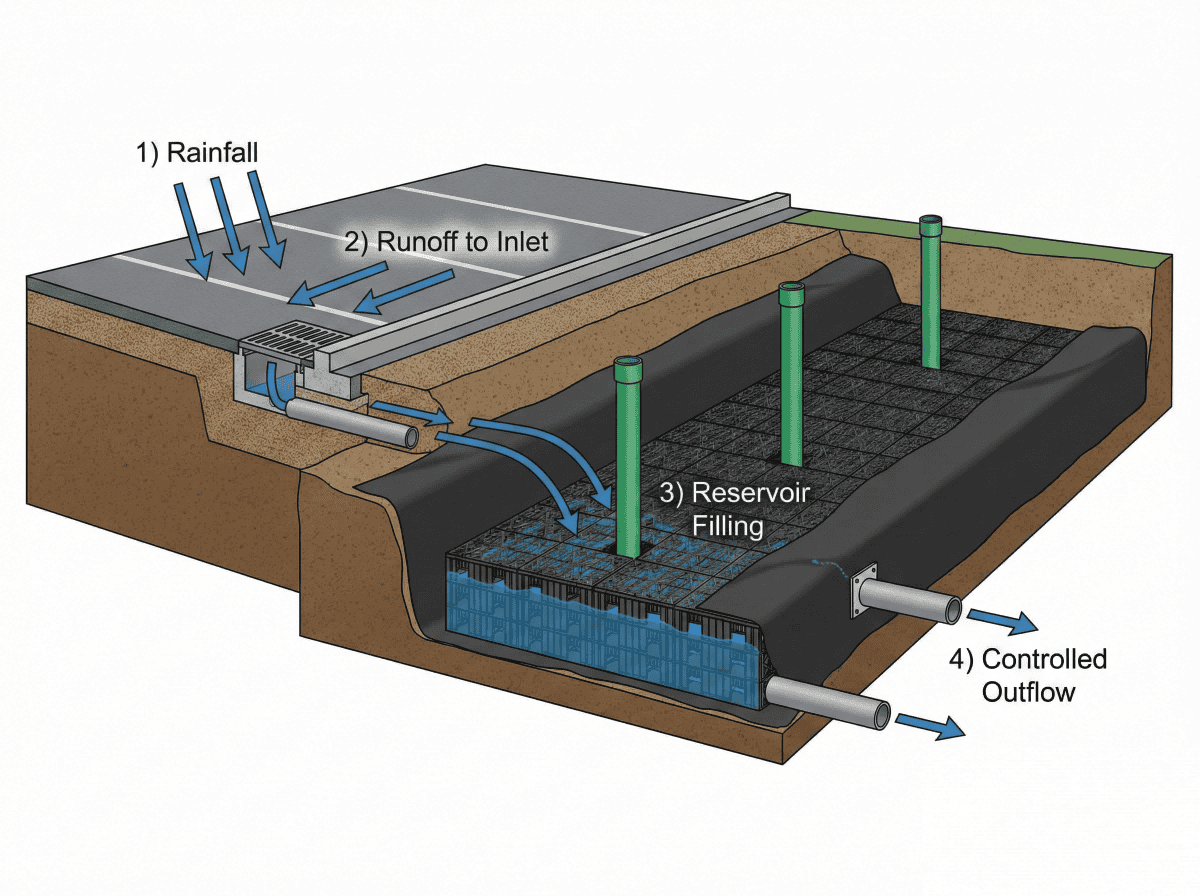
How Underground Stormwater Detention Works
Strip away the jargon, and any underground detention system does three things: catch runoff when it rains, hold it underground for a while, and let it out slowly so the pipes downstream don’t get hammered. You’re not trying to stop runoff — you’re shaving off the spike so your 48-inch trunk line doesn’t see a 25-year flow every time it rains hard for 20 minutes.
Runoff comes in through your standard storm drain inlets, catch basins, or direct pipe connections. Water fills up the underground storage. The part that actually requires engineering is the outlet — a calibrated orifice plate (steel plate with a precisely sized hole) or a vortex valve (a smarter device that throttles discharge based on water depth). Either way, the outflow gets choked down to your target release rate no matter how hard it’s raining up top.
Sizing? That starts with whatever your jurisdiction says about design storms. Most want you to manage the runoff difference between pre-development and post-development for the 2-year, 10-year, 25-year, and 100-year events. The EPA’s National Stormwater Calculator gets you in the ballpark, but real design almost always means hydrograph routing in HydroCAD, StormShed, or PCSWMM.
One thing that still trips people up, even experienced PMs: detention and retention are not the same thing. Detention holds water and lets it go; retention keeps it — for reuse or infiltration. More and more jurisdictions now want both on the same site. If your project involves any infiltration component, the system design changes substantially, and we break down the full detention vs. retention distinction in a separate guide.
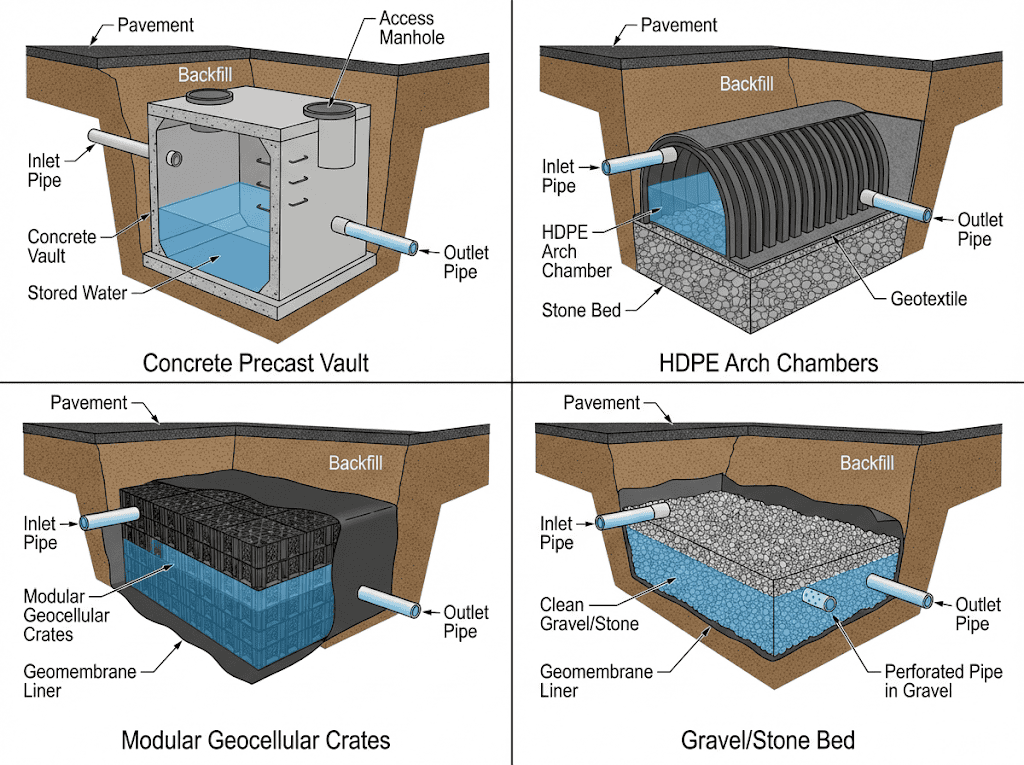
Four Types of Underground Detention Systems Compared
Not all underground detention is the same. Pick the wrong system for your site and you’ll find out in change orders. There are four main approaches out there, each with honest-to-god strengths and trade-offs that matter. Here’s what you’re actually choosing between.
Concrete Detention Vaults
Concrete vaults are the old guard. Precast or cast-in-place reinforced concrete boxes, buried and plumbed into the storm drain network. If you’ve been doing site civil for any length of time, you’ve sized a few of these.
Structurally, they’re built like bunkers. HS-25 rated as standard, so they’ll take anything the highway can throw at them. The Federal Highway Administration has used them under DOT roadways for decades, and they remain the default when the spec says “concrete” and there’s no room for discussion.
Void ratio approaches 100% — you’re using essentially the entire interior volume for storage, minus walls and columns. When you need maximum cubic feet in a tight footprint, that’s hard to argue with.
The downsides? You need a crane to set them, which means flatbed access and a rigging plan. Installation runs three to five days per 1,000 cubic feet. Sizes come in fixed increments, so you usually end up buying more storage than you need to hit the next available module. And you’re looking at $15 to $25 per cubic foot installed — the most expensive option on the table.
So when do concrete vaults still make sense? DOT work, deep-bury applications, and projects where the reviewing agency won’t sign off on anything else. Outside those situations, cost and logistics push most teams toward lighter options.
Arch Chamber Systems
Say “stormwater chambers” to anyone in the US market and they’re picturing arch chambers — those HDPE arched units that sit on a stone bed. ADS (StormTech), Cultec, and Infiltrator pretty much own this category.
Simple concept: each arch creates a void underneath, water fills it during a storm. They’re light — 20 to 40 pounds per unit — so no crane needed, and a crew can bang out 1,000 cubic feet in a day or two. Void ratios sit around 85% to 90%, and most products carry HS-20 ratings.
For straightforward residential subdivisions and parking lot detention, these things have earned their market share. Every distributor stocks them, every plan reviewer has seen them a hundred times, and at $12 to $16 per cubic foot installed, they hit the right price point.
But there’s a conversation happening in the industry that you should know about. In October 2024, ASCE published a warning about thermoplastic creep in plastic detention systems. The concern isn’t academic — thermoplastics genuinely do deform under sustained load over time. If the product wasn’t engineered with realistic long-term creep curves, performance degrades. That’s not us trying to trash the competition; it’s physics.
The open-bottom design also boxes you in. Arch chambers depend on the stone bed underneath for infiltration or flow conveyance, so switching from infiltration to detention-only isn’t as simple as swapping a liner. And because the arches rely on lateral soil confinement to resist vertical load, sloppy backfill compaction during install can haunt you for years.
We dig deeper into the chambers-versus-vaults comparison — including the differences between ADS, Cultec, and Infiltrator products — in a separate piece.
Modular Geocellular Crate Systems
Geocellular crates are a genuinely different approach. Forget arches and boxes — these are interlocking polypropylene (PP) or HDPE modules, rectangular units from about 400mm × 400mm × 400mm up to 800mm × 500mm × 530mm, that click together to build a continuous structural grid. Think LEGO, but load-rated.
Once it’s all clicked together, you wrap the whole assembly — geomembrane for detention, geotextile for infiltration. That wrapping is where the real difference from arch chambers lives. Load travels through the internal cell walls of each module and through 360-degree soil confinement on all six faces. No open bottom. No arch banking on the backfill never shifting. That’s why the ASCE creep concerns don’t land the same way here — the failure mode they’re worried about requires a structural geometry these products simply don’t use.
Here’s what that looks like in practice:
95%+ void ratio — for every cubic foot you dig, you get 95 cents of storage. Arch chambers give you 85 to 90 cents, gravel gives you 30 to 35. On a 5,000 CF detention requirement, that gap means roughly 9,500 fewer cubic feet of excavation. That’s trucks, labor, and disposal you’re not paying for.
HS-20 to HS-25 load ratings, depending on which module you spec and how much cover you’ve got. The higher-rated products handle heavy commercial traffic and fire truck access without blinking.
Half a day to one day per 1,000 cubic feet. Each module weighs 10 to 25 kg, so there’s no crane, no rigging — just people clicking things together. A four-person crew can assemble, wrap, and backfill a residential system before lunch.
Fits weird sites. L-shapes, stepped profiles, split beds around existing utilities — because the modules are all the same size, you just add or remove them. No custom engineering, no waiting on a precast shop to retool a mold.
100+ year service life. PP and HDPE don’t corrode, don’t rot, and don’t see UV once they’re buried. The materials are chemically inert, which means the thing sitting under your parking lot today will still be working when nobody remembers who built the building above it.
All-in installed cost runs $10 to $14 per cubic foot — competitive with arch chambers, cheaper than concrete, and you’re getting better void efficiency and more design flexibility for the money.
If geocellular sounds new, that’s a US blind spot. Engineers in the UK, Europe, and Australia have been putting these in the ground for over twenty years — it’s their go-to the way arch chambers are ours. US adoption has accelerated fast since 2020. More reviewers are seeing them in submittals, more distributors stock them, and domestic supply has finally caught up to demand. For specs and sizing data, check our geocellular tank и stormwater module product pages.
Gravel and Stone Bed Systems
Gravel beds are the brute-force option. Dump crushed stone (#57 or #2 gradation) into a lined hole, and water fills the spaces between the rocks. Every earthwork contractor in the country knows how to build one, and you can source the stone locally anywhere.
The catch: crushed stone only gives you 30% to 35% void space. So if you need 3,000 cubic feet of detention, you’re digging and filling 8,500+ cubic feet. That’s a lot of trucking, a lot of disposal, and a lot of labor that quietly eats the material cost advantage.
Gravel beds can’t take traffic — no parking lots, no drive aisles. Once the stone is in the ground, you can’t really inspect or clean anything without tearing the whole thing out. And sediment gradually fills the void spaces over time, slowly reducing your effective storage with no practical fix short of a full rebuild.
For a small residential job with no traffic and decent native soils? Gravel can still pencil out. For pretty much anything else, the total installed cost — not just the material cost — usually points you toward one of the engineered systems above.
Сравнение бок о бок
| Особенность | Concrete Vault | Arch Chamber | Geocellular Module | Gravel Bed |
|---|---|---|---|---|
| Коэффициент пустотности | ~100% (structural) | 85–90% | 95%+ | 30–35% |
| Номинальная нагрузка AASHTO | HS-25 | HS-20 | HS-20 to HS-25 | Нет |
| Install Time per 1,000 CF | 3–5 days | 1–2 days | 0.5–1 day | 2–3 days |
| Detention Configuration | Да | Ограниченный | Да | Да |
| Infiltration Configuration | Нет | Yes (open bottom) | Yes (geotextile wrap) | Да |
| Design Flexibility | Low (fixed modules) | Средний | High (any geometry) | Низкий |
| Typical Service Life | 50–75 years | 20–50 years (variable) | 100+ years | 15–25 years |
| Installed Cost per CF | $15–25 | $12–16 | $10–14 | $8–12 |
| Heavy Equipment Required | Yes (crane) | Нет | Нет | Yes (excavator) |
| Доступ для технического обслуживания | Умеренный | Ограниченный | Moderate (via access ports) | Нет |
Design Considerations That Actually Drive Decisions
That comparison table is a good starting point, but nobody picks a detention system from a table. The real decision comes down to site-specific stuff that no product brochure covers.
Sizing and Hydraulic Design
First question on every project: how many cubic feet do you actually need? The answer depends on three things, and they all push and pull on each other.
Rainfall data. You’re pulling your design storm depths from NOAA Atlas 14 — that’s the dataset, period. Your jurisdiction tells you which return periods to manage (usually 2-year through 100-year), and those rainfall depths for your zip code drive the whole inflow hydrograph.
Site hydrology. The detention volume you need is basically the gap between what your developed site throws off and what you’re allowed to release, stacked up over the storm duration. Straightforward sites can get away with the Modified Rational Method. Anything with multiple drainage areas, phased construction, or a reviewer who’s going to check your math needs full hydrograph routing.
Outlet sizing. Smaller orifice = slower release = more storage needed. Bigger orifice = faster release = less attenuation. You end up going back and forth between orifice size and storage volume until the peak flow and the drawdown time both check out. It’s iterative. That’s just how it works.
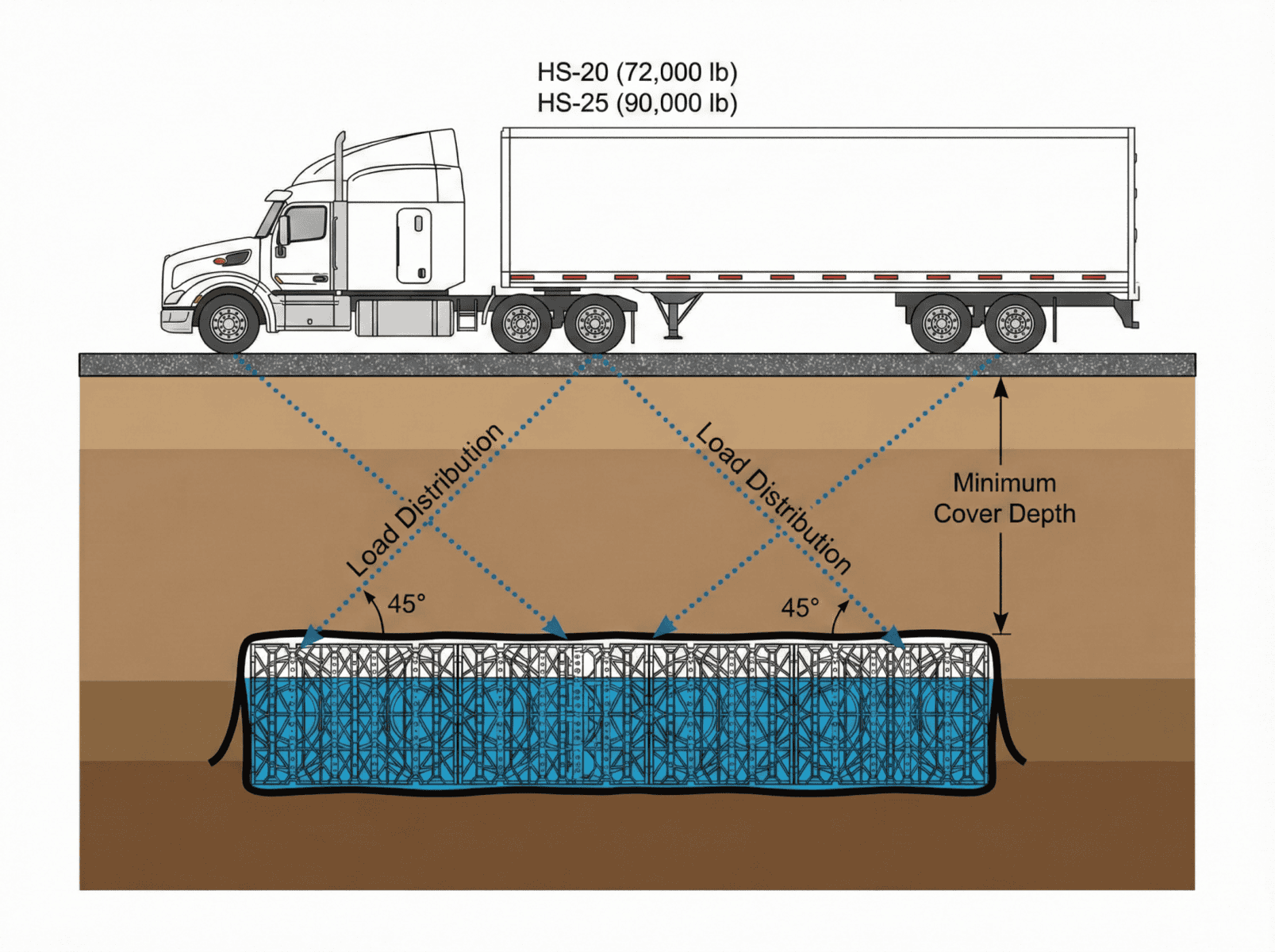
Structural Loading: What AASHTO Ratings Actually Mean
Everybody talks about AASHTO ratings. Not everybody understands what they’re actually saying.
HS-20 means 72,000 pounds — your standard semi. That covers the vast majority of commercial traffic. HS-25 bumps it 25% to 90,000 pounds for heavy industrial and DOT work. So far so good.
Here’s where people get tripped up: the load rating only applies if you’ve got enough cover. Every product has a minimum cover depth — the soil thickness between the top of the system and finished grade. Drop below that minimum and the rating doesn’t hold, no matter how beefy the modules are. We’ve seen submittals where the engineer spec’d HS-20 with 6 inches of cover over a product that needs 18 inches minimum. That’s not going to end well.
Subgrade matters too. The California Bearing Ratio (CBR) of the dirt underneath your system controls how loads spread through the ground. Soft, wet soil with a CBR below 3? You’re probably looking at geotextile reinforcement or lime stabilization before you install anything. Check the geotech report before you commit to a layout.
Detention or Infiltration? (Sometimes Both)
This choice reshapes the entire design, and it comes down to two things: what your soil can handle and what your permit says.
Got sandy or gravelly soils with an infiltration rate above 0.5 inches per hour (confirmed by field perc testing, not guesswork)? And a jurisdiction that’s on board with infiltration? Then you wrap the system in permeable geotextile and let stormwater soak into the ground. You’re recharging groundwater and cutting total runoff volume — not just shaving the peak.
Got clay, silt, or a high water table? Or a permit that says “capture and release at X cfs”? Then you’re wrapping in an impermeable геомембрана and everything leaves through the outlet pipe.
Plenty of projects end up doing both on the same site — one detention bed for peak flow control, one infiltration bed for water quality. Being able to build both from the same modules just by changing the wrapper is one of the practical reasons geocellular beats concrete vaults (which physically can’t infiltrate) and gravel beds (which can’t give you controlled detention without bolting on extra infrastructure). We’ve got a геотекстиль selection guide on the product pages if you’re speccing an infiltration config.

Installation: What It Actually Takes
The details change depending on what you’re installing, but the basic sequence is the same regardless. Here’s how a geocellular system goes in — arch chambers follow a similar flow, concrete vaults branch off at the assembly step (because you’re swinging a crane instead of snapping modules).
Step 1: Dig the hole. Excavate to your design subgrade, accounting for system height plus bedding. Keep your side slopes to geotech recommendations — usually 1:1 or 1.5:1 for temp excavations.
Step 2: Prep the subgrade. Compact to 95% Standard Proctor and verify with CBR or plate load testing if the spec calls for it. A soft spot here turns into a stress riser in the system above. Don’t skip this.
Step 3: Lay the geosynthetic. Roll out your geomembrane or geotextile across the base and up the slopes, with generous overlap at seams. Detention applications need welded or taped seams — if water finds a gap, you don’t have a detention system, you have an expensive infiltration trench.
Step 4: Assemble the modules. Click the crates together on the prepared base. No crane, no excavator arm, just people. A four-person crew can put together 200 to 300 cubic feet per hour — it’s more like building with LEGOs than like setting precast.
Step 5: Connect the pipes. Run your inlet, outlet, and overflow pipes through the wrapper, seal every penetration. Hook up the orifice plate or vortex valve at the outlet.
Step 6: Wrap it up. Fold the geosynthetic over the top, seal all laps and pipe penetrations. For detention, this final seal is everything — it’s the difference between a system that works and an expensive pile of plastic sitting in mud.
Step 7: Backfill. Place and compact in 6- to 12-inch lifts. Compaction quality directly drives long-term structural performance. This is where lazy crews create warranty calls five years later.
Step 8: Restore the surface. Pave it, landscape it, park on it. The detention system disappears. That’s the whole point.
Real-world example: on a housing project in Murrieta, California, the crew hit unexpected utilities that blew up the original detention layout. With a modular crate system, they split the planned rectangular bed into two smaller beds connected by a pipe manifold — reconfigured on the fly, no redesign needed, project stayed on schedule. Try doing that with precast concrete or a gravel bed. For more on the full project lifecycle from initial submittal to final closeout, we’ve got a separate walkthrough.
The Regulatory Side (Yes, You Have to Read This Part)
Nobody gets into civil engineering for the permitting. But the regulatory framework controls what you build, how big you build it, and how much paperwork you file. Let’s get through it.
Federal Requirements
The Clean Water Act, through the EPA’s NPDES program, sets the floor. Phase I MS4 permits hit the big cities; Phase II pulls in smaller urbanized areas. Both require post-construction stormwater management for new development, and both keep getting tighter.
What that means for you: your project needs a stormwater management plan. Underground detention is one of the most widely accepted BMPs for peak flow requirements. You probably already knew that.
State and Local Variations
Here’s where it gets interesting — and by “interesting” I mean “frustrating,” because requirements vary wildly even between neighboring counties.
Штат Вашингтон runs on the Stormwater Management Manual for Western Washington (SWMMWW), 2024 edition. It pushes LID (Low Impact Development) hard — you have to prove LID doesn’t work before you can default to conventional detention. The December 2025 atmospheric rivers that flooded half of Western Washington blew holes in some long-standing design assumptions, particularly around backwater conditions when outlet pipes go underwater during multi-day storms.
Калифорния layers the State Water Board’s Construction General Permit on top of Regional Water Board requirements. You usually need both hydromodification management (match the pre-dev peak flow) and water quality treatment. The Christmas 2024 flooding in Northern California was a painful reminder that “meets minimum code” and “actually works in a real storm” aren’t always the same thing.
Texas, Florida, and the Southeast run on local drainage manuals — detention for the 25-year or 100-year storm, depending on the county. Requirements bounce around a lot between jurisdictions.
Northeast states (Connecticut, New York, New Jersey, Massachusetts) have mature stormwater manuals with growing emphasis on green infrastructure and volume reduction. New Jersey’s BMP Manual is one of the most referenced state-level documents out there and has specific underground detention guidance.
The short version: check your local requirements before you design anything. A system that flies in Houston may not pass review in Portland. Don’t assume.
Cost: What You’re Actually Paying For
We’ve got a full 2026 cost breakdown by the cubic foot — no need to rehash all those numbers here. But a few cost traps are worth calling out, because they bite people on every project.
The quote isn’t the cost. When a manufacturer says “$X per cubic foot,” that’s material. Your actual installed number includes excavation, bedding, geosynthetics, pipe connections, backfill, compaction, and surface restoration. Gravel at $3/CF sounds great until you realize you’re moving three times the dirt. Precast concrete at $12/CF sounds fine until the crane mob and multi-day install labor show up on the invoice.
Think like a developer, not just an engineer. NAIOP frames underground detention as a real estate decision, and they’re right. If your surface land is worth $50/SF and a detention pond eats 3,000 square feet, that’s $150,000 of development value sitting under water and goose poop. Put the detention under the parking lot and that $150K goes back to the project pro forma.
First cost isn’t total cost. A gravel bed is cheaper than a geocellular system on day one. But gravel needs replacing in 15 to 25 years — and the second time around you’re paying for re-excavation, disposal, and reconstruction on top of materials. Concrete starts needing joint repairs and corrosion work in the 30- to 50-year window. Geocellular PP and HDPE? Doesn’t corrode, doesn’t rot, doesn’t fatigue-cycle like rigid structures. You install it once and move on with your life.
The Plastic Detention Debate: Let’s Talk About It
The ASCE’s October 2024 piece about thermoplastic creep in plastic detention systems got a lot of people’s attention — and it should have. Plastic does deform under sustained load over time. That’s not opinion; that’s material behavior. If you haven’t read the article, go read it.
But there’s context that the headline doesn’t give you. ASCE is talking about a specific failure mode in arch-style chambers — products that resist vertical load mainly through soil pushing against the outside of the arch. When soil conditions change, or the backfill settles, or decades of creep soften the plastic, the arch loses its shape and the void space collapses inward.
Geocellular modules don’t rely on that mechanism. Load goes through internal cell walls — a 3D lattice — and then gets confined by compacted soil and geosynthetic wrapping on all six faces. Different geometry, different load path, different failure mode. We’re not saying creep doesn’t exist in polypropylene (it does, in all thermoplastics). We’re saying the structural design accounts for it differently.
That said — and this is important — not all geocellular products are built to the same standard. You should be asking every manufacturer the same questions:
- Independent third-party load testing to ASTM F2418 — the standard test for underground detention structural integrity
- Creep test data under sustained load at elevated temperatures
- Minimum cover depth requirements documented for each load rating
- Installation specs with explicit compaction requirements for bedding and backfill
If a manufacturer can’t hand you the test reports, that’s your answer. Move on.
Часто задаваемые вопросы
Water goes in during a storm, gets held in a buried reservoir (vault, chamber, crate system, or stone bed), and trickles out through a calibrated outlet at whatever rate your permit allows. The system absorbs the spike so the downstream pipe doesn’t.
In 2026, installed costs range from about $8 to $25 per cubic foot: gravel beds at $8-12/CF, geocellular modules at $10-14/CF, arch chambers at $12-16/CF, and concrete vaults at $15-25/CF. The real number depends on your storage volume, site conditions, and local labor rates.
Detention holds water temporarily and lets it go. Retention keeps it — for reuse or infiltration. Most jurisdictions require detention for peak flow control; a growing number also require a retention or water quality volume on top of that.
You get the land back. No drowning hazard, no mosquitoes, no mowing the banks, no dredging sediment every few years. On commercial sites, the value of the recovered land often pays for the underground system by itself.
It depends on what they’re made of. Concrete vaults: 50 to 75 years with maintenance. Arch chambers: 20 to 50 years, highly dependent on material quality and how well the install was done. Geocellular modules (PP or HDPE): 100+ years. The material doesn’t corrode, rot, or degrade underground.
Yes, but far less than a surface pond. Expect periodic inspection of inlets and outlets, cleaning sediment out of upstream pretreatment devices (sediment traps, sumps, or hydrodynamic separators), and making sure the flow control device hasn’t clogged. Most municipalities require a maintenance plan as part of the stormwater permit.
Where Does This Leave You?
Underground detention isn’t a specialty play anymore. It’s the standard. The tech is proven, the cost data is out there, and regulators across the country accept it. That debate is settled.
The real question is which system. And that depends on your site — loading requirements, available depth, soil conditions, maintenance access, budget, how long the owner plans to keep the building. No single product wins every scenario, which is why we wrote this thing as a comparison rather than a sales pitch.
If you’ve got a project in front of you and want to see whether geocellular fits, our engineering team can run the sizing and give you a number. No obligation, no 47-slide PowerPoint. If you’re a contractor or distributor who wants to carry geocellular products, here’s how that works.
And for the bigger picture on where underground stormwater management is heading — lessons from the 2024-2025 flood seasons, emerging practices, what’s changing in the regulatory landscape — we keep that updated in our 2026 stormwater management overview.
 English
 Arabic
 French
 Russian
 Spanish