
OSD Tanks Australia: Complete Guide to On-Site Detention Systems
Planning a development in Sydney, Melbourne, or Brisbane? Your council almost certainly requires an On-Site Detention (OSD) system. These underground tanks temporarily store stormwater runoff and release it slowly, preventing downstream flooding and protecting public drainage infrastructure.
This guide covers everything Australian property developers, builders, and engineers need to know about OSD tanks—from council requirements and sizing calculations to system types and installation considerations.
What is an OSD Tank?
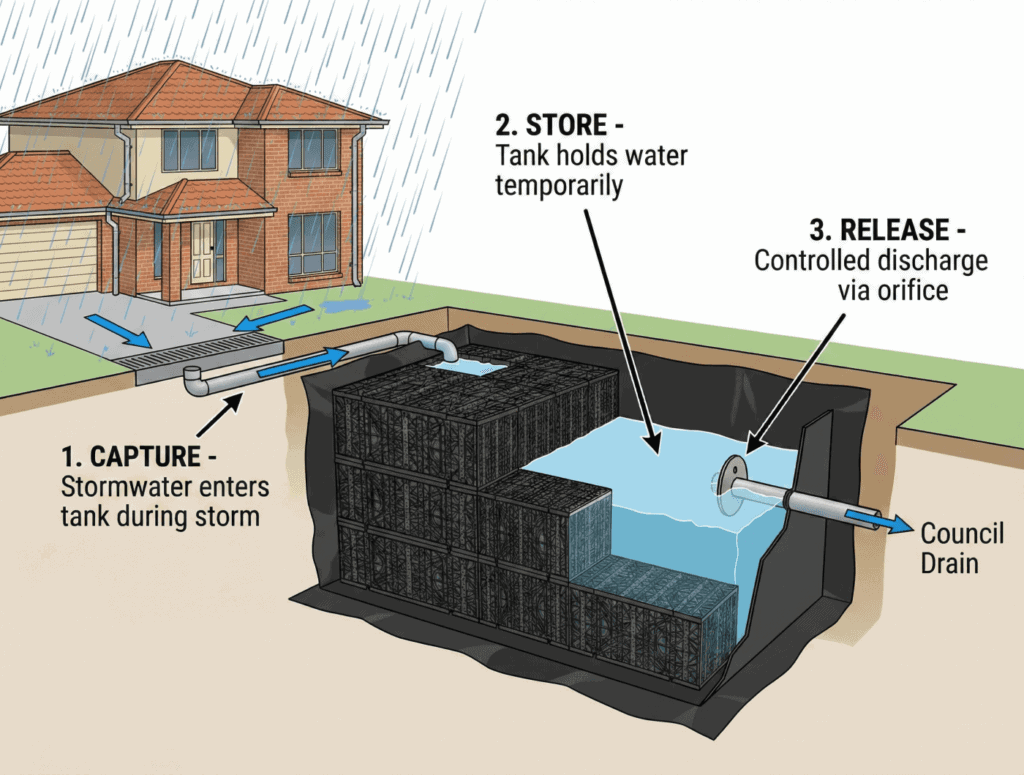
An OSD (On-Site Detention) tank is a stormwater management system that temporarily stores rainwater runoff from your property during storms. Instead of releasing all the water at once into council drains, the tank holds it back and discharges at a controlled rate through an orifice plate or other flow control device.
The concept is simple: capture fast, release slow. When rain hits roofs, driveways, and paved areas, the water flows into the OSD tank. The tank fills during the storm, then gradually empties over several hours after the rain stops. This prevents the cumulative effect of hundreds of properties all discharging simultaneously into the same drainage system.
OSD tanks are known by several names across different regions. In the UK, they are called attenuation tanks. In the US, the term is detention tanks or detention basins. The function is identical—temporary storage with controlled release.
Why Australian Councils Require OSD
Urban development dramatically changes how water moves across land. Natural ground absorbs rainfall and releases it slowly. Concrete, asphalt, and roofing do the opposite—water runs off immediately, concentrating flows and overwhelming drainage systems.
Most NSW councils within the Sydney metropolitan area require OSD for any development that increases impervious surfaces. Similar requirements exist across councils in Victoria, Queensland, and other states. The specific trigger varies by council, but common thresholds include:
- New dwellings on previously undeveloped land
- Knockdown rebuilds in subdivision areas
- Extensions that increase impervious area beyond a threshold (often 40-60m²)
- Commercial and industrial developments of any size
- Multi-unit residential including duplexes and townhouses
The Sydney Water OSD Guidelines apply to properties connecting to Sydney Water stormwater assets. Individual councils maintain their own requirements which may be more stringent.
OSD Design Parameters
Every OSD system must be designed by a qualified engineer and meet two key parameters set by your council:
Permissible Site Discharge (PSD)
The PSD is the maximum rate (in litres per second) at which your site can discharge stormwater. It represents what the downstream system can handle from your property. Typical PSD values range from 20 to 80 L/s/ha depending on your council area and the capacity of downstream infrastructure.
Site Storage Requirement (SSR)
The SSR is the minimum volume (in cubic metres or litres) your OSD tank must hold. This is calculated based on your site’s impervious area, local rainfall intensity data, and the PSD. Common SSR values in Sydney range from 300 to 500 m³ per hectare of site area.
For residential properties, this typically translates to OSD volumes between 5,000 and 25,000 litres depending on lot size and impervious coverage. Your engineer calculates the exact requirement using methods from Australian Rainfall and Runoff (ARR) guidelines.
Rainwater Tank Credits
Many councils allow you to offset part of your OSD requirement with rainwater tank storage. The logic is straightforward: water stored for reuse is water not entering the stormwater system. Credits typically range from 40% to 100% of rainwater tank volume, depending on council policy and whether the tank includes an airspace provision above the normal water level.
Types of OSD Tanks
Several construction methods can achieve the required OSD storage. Each has distinct advantages for different site conditions and budgets.
Concrete OSD Tanks
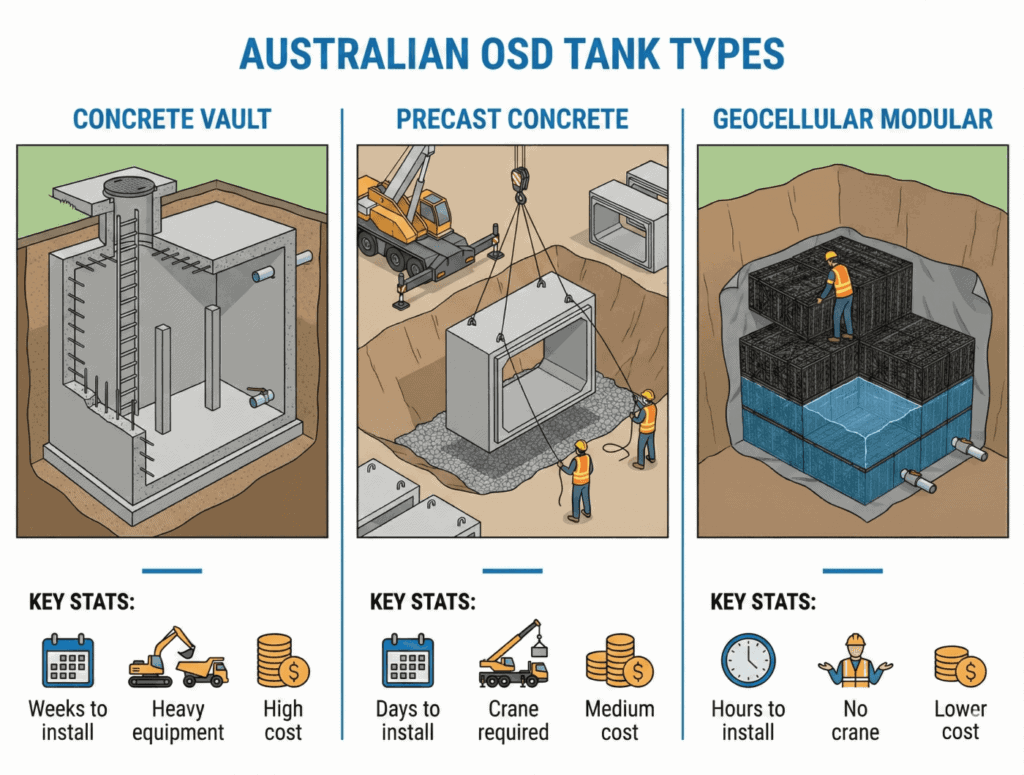
Cast-in-place or precast concrete tanks are the traditional solution. They offer high structural strength and long service life. However, concrete tanks require significant excavation, formwork, curing time, and waterproofing. Installation typically takes weeks rather than days, and costs escalate quickly for larger volumes.
Some councils, including Hills Shire in Sydney, specifically require concrete for underground OSD tanks and do not approve plastic modular systems.
Precast Concrete Vaults
Precast systems arrive on site ready to install, eliminating formwork and curing delays. Large crane lifts are required for placement, adding logistical complexity and cost. Precast vaults suit sites with good access and projects where speed matters more than cost.
Geocellular Modular Systems
Modular plastic geocellular tanks have transformed OSD construction over the past decade. These systems use interlocking plastic crates wrapped in geomembrane to create watertight detention storage.
Key advantages include:
- 95% void ratio compared to 30-35% for gravel-filled systems—same storage in less excavation
- Lightweight modules that workers can carry by hand—no crane required
- Fast installation—a typical residential system installs in one day
- Flexible configurations—build any shape to suit site constraints
- Trafficable—install under driveways and car parks with appropriate load ratings
The ARW geocellular stormwater modules offer 95% void ratio with load ratings suitable for residential and commercial applications. The modular design allows precise sizing to meet exact SSR requirements without oversizing.
Above-Ground Detention Basins
Surface basins use landscaped depressions to temporarily pond water. They cost less than underground systems but consume valuable land area. Many councils prefer underground OSD to maximise developable land, though surface basins may be acceptable in parks or large commercial sites.
Geocellular OSD Tank Specifications
For projects where geocellular systems are permitted, the following specifications apply to ARW stormwater modules:
| Model | Dimensions (mm) | Module Volume | Void Ratio | Load Rating |
|---|---|---|---|---|
| ARW-6841 | 680 × 410 × 450 | 126 litres | 95% | 20-40 tonnes |
| ARW-8053 | 800 × 490 × 530 | 208 litres | 95% | 28-46 tonnes |
| ARW-1050 | 1000 × 500 × 500 | 250 litres | 95% | 30-60 tonnes |
The ARW-1050 geocellular tank is particularly suited to larger OSD applications where maximum storage per module reduces installation time. All models can be stacked vertically and connected horizontally to achieve any required volume.
For watertight detention (required for OSD), modules are wrapped in HDPE or LLDPE geomembrane (typically 1.0mm thickness). The membrane prevents water from infiltrating into surrounding soil, ensuring all stored water discharges through the controlled outlet.
OSD System Components
A complete OSD installation includes several components beyond the storage tank itself:
Inlet Structure
Stormwater enters the OSD through inlet pits connected to the site’s drainage network. All roof, driveway, and paved area runoff must be directed to the OSD. The inlet typically includes a trash screen or silt trap to prevent debris from entering the tank.
Flow Control Device
The outlet incorporates a flow control device—usually an orifice plate—sized to limit discharge to the PSD. The orifice creates a restriction that backs up water into the tank during storms. Once the storm passes, the tank slowly drains through the same orifice.
Overflow
All OSD systems require an overflow for storms exceeding the design capacity. The overflow must connect to the downstream drainage system and be sized to pass the 100-year ARI storm flow.
Access and Inspection
Council requires access points for inspection and maintenance. Underground tanks need risers with trafficable covers at appropriate intervals. The OSD must be accessible for cleaning accumulated sediment and checking the orifice plate function.
Identification Plaque
Most councils require a permanent marker plate identifying the OSD location and providing maintenance instructions. Standard plaques are non-corrosive metal or laminated plastic, fixed to masonry above the expected water surface level.
Installation Process
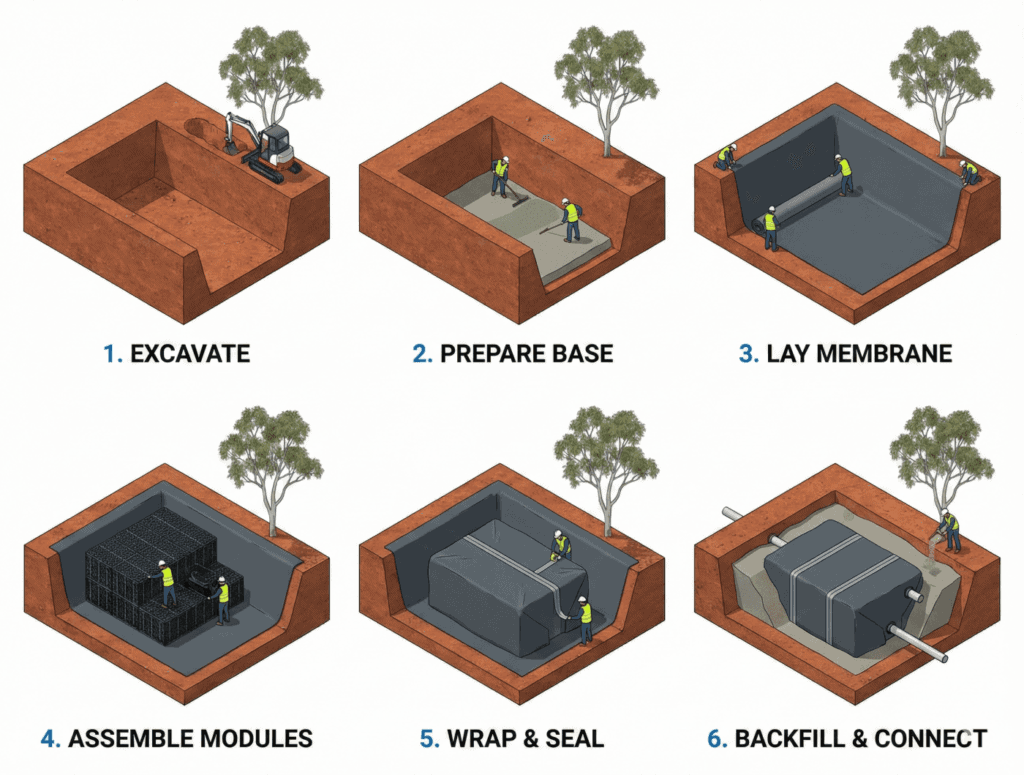
OSD installation follows a standard sequence, though specifics vary by system type:
Step 1: Excavation
Excavate to the required depth plus allowance for bedding material. The base must be level and free of sharp objects that could damage the tank or membrane. For geocellular systems, allow 100-150mm of sand bedding below the modules.
Step 2: Base Preparation
Lay compacted sand or fine aggregate as a bedding layer. For geocellular OSD tanks, lay the geomembrane across the base with sufficient overlap to wrap up the sides and over the top of the modules.
Step 3: Tank Assembly
For concrete tanks, pour or place the structure according to engineering drawings. For geocellular systems, assemble modules according to the layout plan, connecting units with clips or integrated connectors. Install inlet and outlet penetrations through the membrane, sealing with appropriate fittings.
Step 4: Membrane Wrapping
Complete the geomembrane envelope around geocellular modules. Tape all seams with butyl mastic tape for standard applications. For sensitive locations near building footings, welded seams by a qualified plastic welder provide additional assurance.
Step 5: Backfill
Backfill in layers, compacting as specified. For geocellular systems, use 100mm of coarse sand over the top before general fill. Do not use heavy compaction equipment directly over the tank until adequate cover depth is achieved.
Step 6: Connection and Commissioning
Connect inlet and outlet pipework. Install the orifice plate and any required screens. Test the system by filling with water and verifying controlled discharge rate.
OSD Costs in Australia
OSD costs vary significantly based on system type, site conditions, and required volume. The following ranges provide general guidance for budgeting purposes:
| System Type | Cost Range (AUD per 1,000L) | Notes |
|---|---|---|
| Concrete in-situ | $800 – $2,500 | Higher end for difficult access, rock excavation |
| Precast concrete | $600 – $1,500 | Requires crane access |
| Geocellular modular | $400 – $1,000 | Includes membrane and basic fittings |
| Above-ground basin | $200 – $600 | Land cost not included |
For a typical Sydney residential development requiring 15,000 litres of OSD storage, total installed costs might range from $6,000 to $25,000 depending on the system selected and site-specific factors.
Factors that increase costs include rock excavation, high water table requiring dewatering, limited site access for equipment, complex shapes to work around existing structures, and councils requiring concrete construction.
Maintenance Requirements
OSD systems require regular maintenance to function correctly. Neglected systems can fail during storms, potentially causing flooding and property damage. Most councils require annual inspection and cleaning.
Key maintenance tasks include:
- Remove debris from inlet pits, trash screens, and the tank interior
- Check the orifice plate for blockages or damage
- Inspect access covers for security and watertightness
- Verify structural integrity of walls, floor, and roof (for concrete tanks)
- Clean sediment accumulation using vacuum trucks if necessary
If your OSD discharges to Sydney Water infrastructure, you may need a formal service agreement documenting ongoing maintenance responsibilities. Keep records of all inspections and cleaning for council compliance.
Frequently Asked Questions
Is OSD mandatory for all developments?
Requirements vary by council. Most councils in Sydney, Melbourne, and Brisbane metropolitan areas require OSD for new dwellings and significant extensions. Check your specific council’s Development Control Plan (DCP) for triggers and exemptions.
Can I combine OSD with a rainwater tank?
Yes, and many councils encourage this approach. The rainwater tank provides water for garden irrigation and toilet flushing, while also providing partial credit against OSD requirements. Some systems integrate both functions in a single tank with dedicated OSD airspace above the rainwater storage level.
What happens if my OSD fails during a storm?
A blocked or undersized OSD can cause localised flooding on your property and potentially damage neighbouring properties. You may be liable for damages if your system fails due to inadequate maintenance. Regular inspection prevents most failure modes.
How long do OSD tanks last?
Concrete tanks can last 50+ years with proper maintenance. Geocellular systems using quality PP or HDPE materials are designed for 50-year service life. The geomembrane liner may require replacement after 25-30 years depending on conditions.
Can I install OSD under my driveway?
Yes, provided the system is rated for the expected traffic loads. Geocellular modules are available with load ratings suitable for passenger vehicles (residential driveways) through to heavy commercial traffic. Concrete tanks can be designed for any load requirement.
Conclusion
OSD tanks are a fundamental requirement for most Australian urban developments. Understanding your council’s specific requirements—PSD, SSR, and approved system types—is the first step in any project.
Geocellular modular systems offer significant advantages over traditional concrete construction for many applications: faster installation, lower cost, and flexibility to suit constrained sites. However, always verify that your council accepts geocellular OSD before finalising your design.
For projects where geocellular systems are suitable, ARW stormwater modules provide the 95% void ratio and load ratings that Australian OSD applications demand. Combined with appropriate geomembrane liners, these systems deliver compliant detention storage with minimal site disruption.
Contact our team to discuss your OSD requirements and receive technical guidance matched to your project specifications.
 English
 Arabic
 French
 Russian
 Spanish