
How to Take an Underground Stormwater Detention System from Submittal to Closeout
- How to Take an Underground Stormwater Detention System from Submittal to Closeout
- Who This Guide Is For
- Definitions Reviewers Actually Use
- Pre-Design Checklist
- Sizing & Modeling Workflow
- Submittal & Documentation Checklist
- Construction QA/QC Checklist
- As-Built & Closeout Checklist
- Inspection & Maintenance (O&M) + Safety
- Supplier Qualification Checklist
- Quick Spec Template
- What We See on Jobsites
- Orlando Case Study
- Supplier Documentation & Support (ARW)
- Next Steps
- References
- About the Author
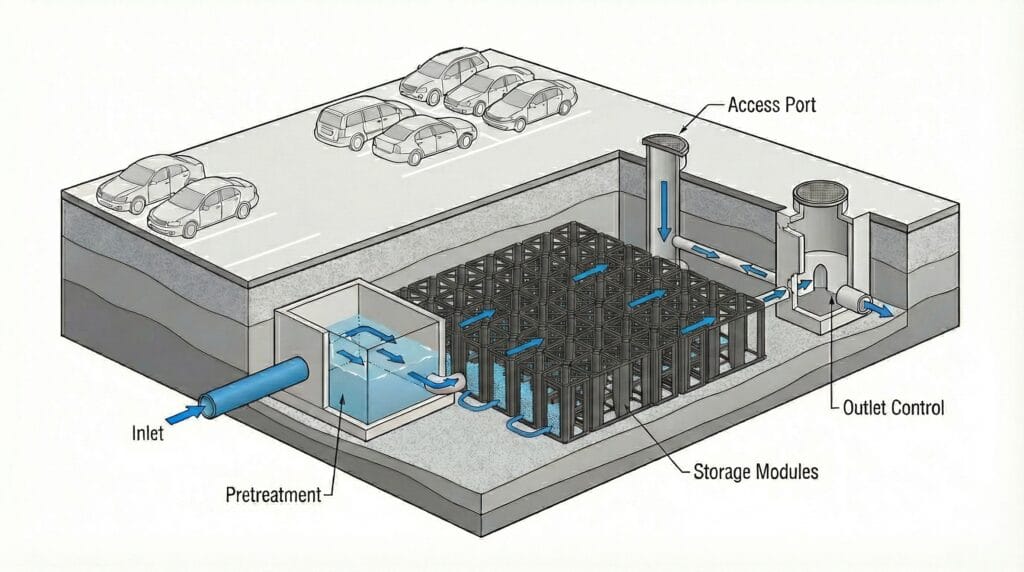
Most project teams understand what an underground stormwater detention system does. Execution is where schedules and documentation typically break down—reviews extend, documentation gaps surface late, field changes fail to reach closeout packages.
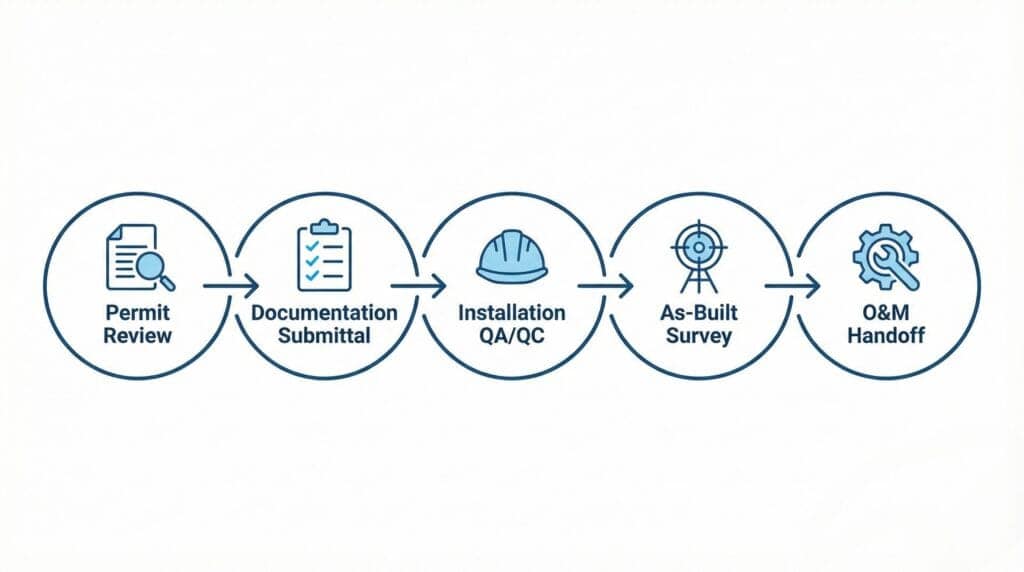
This guide follows the sequence reviewers and inspectors work through: permit review → submittals → installation QA/QC → as-builts → O&M. It is written for wholesalers, contractors, and large-project owners in Florida, the Southeast coastal states, Texas, California, and the Northeast—commercial and municipal work, not residential landscaping.
Scope note: Hydrology, structural design, and backfill specifications require verification by the Engineer of Record (EOR) and licensed PE where applicable. This document addresses packaging and execution, not engineering design. Local requirements vary.
Who This Guide Is For
This guide addresses commercial and municipal underground stormwater detention system projects where schedule, inspections, and long-term maintenance access are primary concerns.
Contractors & Installers
Use this as a pre-construction checklist and field reference: inspection points, photo documentation requirements, and records to capture before backfill.
Distributors & Wholesalers
Use this to qualify products, answer technical questions, and confirm that proposed configurations will pass review. When contractors request modular stormwater crates, this guide clarifies documentation, loading, and access expectations.
Developers & Owners
Use this to understand closeout requirements and avoid long-term liability from missing documentation or inadequate access.
Engineers & Municipal Reviewers
Use this as a consistency reference for terminology, documentation standards, installation assumptions, and maintenance access provisions.
Definitions Reviewers Actually Use
Reviewers apply these terms with specific meanings. Inconsistent usage typically triggers resubmittals.
Detention
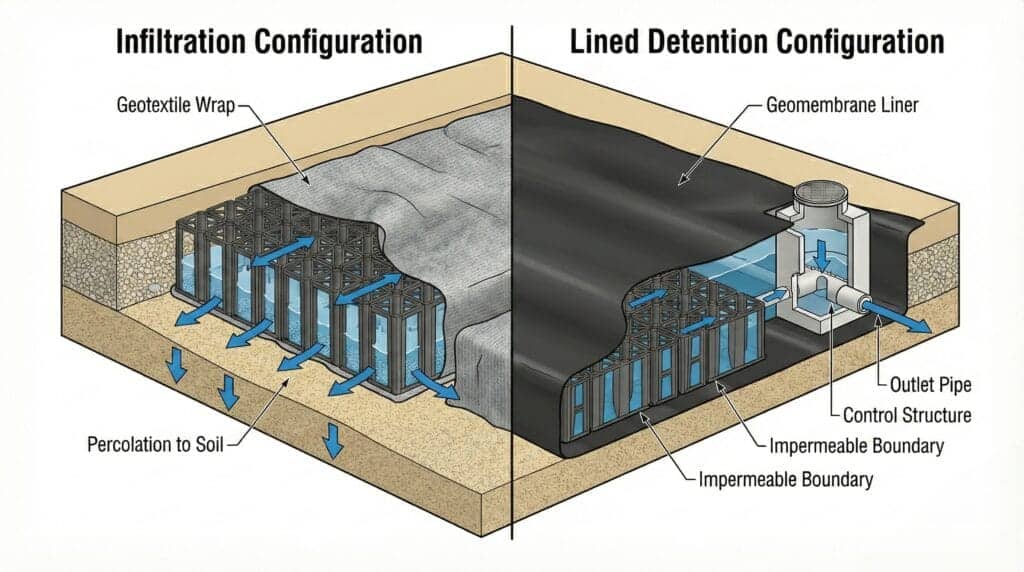
Temporary storage with controlled release. Detention systems may be lined or otherwise configured based on design intent and local review requirements. Modular detention is commonly implemented with an impermeable liner (geomembrane) and outlet control structure to manage discharge rate—but configuration details should follow project drawings and EOR direction.
Retention
Usage varies by jurisdiction. May refer to permanent storage for reuse or infiltration-based management. Confirm the reviewer’s interpretation for the specific jurisdiction.
Infiltration
Water percolates into surrounding soil through a permeable wrap (typically geotextile). Requires confirmed soil permeability and adequate separation from seasonal high groundwater per geotechnical report.
Review implication: Mismatched terminology between drawings and narrative (e.g., labeling a geotextile-wrapped system as “detention”) commonly results in returned submittals. Liner/wrap selection, outlet controls, and geotechnical basis are configuration-specific.
For regulatory background, see the EPA National Menu of BMPs for Post-Construction Stormwater Management and 40 CFR 122.34 (regulated small MS4 permit requirements). The EPA Stormwater Phase II Final Rule fact sheets provide additional context.
Pre-Design Checklist
Most submittal delays trace to site conditions that were not confirmed before system selection, not to storage volume errors.
Site & Soil Conditions
| Item | Required Information | Review Relevance |
|---|---|---|
| Geotechnical report | Soil borings, infiltration/percolation data, seasonal high groundwater | Determines infiltration viability; informs structural/backfill assumptions |
| Utility survey | Water, sewer, gas, electric, telecom | Utility conflicts drive redesign and schedule impacts |
| Site survey | Grades, drainage patterns, outfall constraints | Controls routing, elevations, and constructability |
Regional note (Florida/Southeast coastal): Shallow seasonal groundwater is common. Where infiltration is not supported by geotechnical data, lined detention with outlet control is often selected.
Align geotech and utility information early. An infiltration-based design on paper can shift to lined detention once utility corridors or groundwater elevations are confirmed.
Traffic Loading Requirements
Projects commonly reference H-20, HS-20, HS-25, or HL-93 terminology depending on jurisdiction and application. Use the project’s specified design loading and verify the manufacturer’s rated configuration for the cover depth and backfill section.
Standard modular stormwater crates are commonly configured for H-20/HS-20 applications. For heavier requirements, geocellular tanks for stormwater detention may be specified. Make the rated configuration explicit in the submittal package.
Pretreatment Requirements
Reviewers expect upstream pretreatment (sumped inlets, hydrodynamic separators, filter units, sediment forebays) to protect storage volume and reduce maintenance burden. Submittals showing direct pipe connections to storage without pretreatment are commonly returned.
Access Requirements
O&M problems typically result from access that appears adequate on drawings but does not accommodate real equipment. Access planning should confirm inspector sightlines from surface ports, vacuum hose reach across the full footprint, and maintenance vehicle positioning. Some jurisdictions publish spacing guidance; others do not. Address access as part of system design.
Sizing & Modeling Workflow
This section addresses reviewer expectations for submittal documentation, not hydrology methodology.
What Reviewers Expect
Reviewers generally look for alignment across three elements: the hydrologic method (TR-55, Rational Method, or locally approved approach), the key outputs (pre/post runoff, required storage, allowable discharge at control point, design storm events), and the release strategy (routing and outlet control description consistent with detention requirements).
Volume Calculation Basics
Storage volume = (Footprint area) × (Module height) × (Void ratio)
A 95% void ratio yields usable storage approaching gross volume, compared to 30–40% for aggregate galleries. Modular systems require correct installation and backfill to achieve rated performance.
Cover Depth Considerations
Modules are typically used within cover depths of approximately 2.6 ft to 10 ft (0.8–3 m), depending on traffic rating and backfill conditions per manufacturer documentation. Document the specific configuration for the section being installed. Shallow cover reduces excavation but is less forgiving; deep cover provides structural margin but increases cost and may complicate access.
Submittal & Documentation Checklist
Review comments citing “insufficient information” typically indicate that the package does not clearly establish the rated configuration, wrap/liner approach, and maintenance provisions—not that the design is wrong.
Table 1: Submittal & Documentation Checklist
| Deliverable | Purpose | Who Provides | Common Rejection Reasons |
|---|---|---|---|
| Product data sheets | Dimensions, void ratio, materials, configurations | Manufacturer/supplier | Missing or inconsistent rating references |
| Structural basis | Cover/backfill section + traffic rating assumptions | Engineer of record | Assumptions don’t match site/geotech |
| Load rating evidence | Support for specific rated configuration | Manufacturer | Claims without verifiable documentation |
| Material certifications | Material quality documentation | Manufacturer | Missing third-party evidence |
| Geotextile/geomembrane specs | Wrap/liner matches design intent | Supplier/engineer | Wrong material for application |
| Installation details | Assembly, connections, backfill sequence | Manufacturer + contractor | Generic details not aligned with install |
| O&M plan/manual | Inspection + access + cleanout approach | Owner/engineer + supplier | Boilerplate ignoring access reality |
Configuration clarity matters more than presentation. If drawings show detention but the narrative describes infiltration, resubmittal is likely.
Florida vs. Other States
Florida: An in-state partner can support permitting coordination and source pretreatment, access, and outlet control components.
Other states: Product supply, documentation, and installation guidance are available; local teams lead engineering and permitting.
Wrap/Liner Configuration
State configuration in direct terms: infiltration (geotextile wrap + geotechnical basis for permeability and groundwater separation) or detention (geomembrane liner + outlet control strategy per model). Reference GRI GM13 for geomembrane; AASHTO M288 is a common geotextile benchmark.
Construction QA/QC Checklist
Installation quality determines long-term performance. A sound design can fail if excavation, base preparation, liner handling, or backfill compaction are deficient.
Table 2: Construction QA/QC Checklist
| Inspection Item | Acceptance Criteria | Evidence Type |
|---|---|---|
| Excavation dimensions | Within tolerance; bottom at elevation | Survey; photos |
| Subgrade preparation | Firm, uniform; soft areas corrected | Photos; field notes |
| Bedding material | Gradation/thickness per spec; compacted | Tickets; photos; tests |
| Geotextile/geomembrane | No tears/gaps; seams per manufacturer | Photos; installer record |
| Module assembly | Interlocked; aligned per shop drawings | Photos; installer signoff |
| Pipe connections | Sealed; elevations verified | Photos; elevation shots |
| Backfill placement | Specified material; lifts; no dumping | Tickets; photos |
| Compaction | Lift-by-lift per spec | Test reports; logs |
| Cover depth | Uniform; matches plan | Survey |
| Access structures | Locations/elevations per plan | Photos; survey |
Field Verification Points
Prior to module installation, verify that soft spots have been corrected, subgrade has been proof-rolled where required, bedding meets specification, and groundwater management is addressed if applicable.
Prior to covering the wrap or liner, confirm the correct configuration (detention vs infiltration), verify seams and overlaps meet manufacturer requirements, document penetrations and pipe interfaces, and complete photo coverage of the full footprint. Once backfill begins, access to these elements ends.
Prior to final pavement, confirm lift placement followed specification, compaction documentation is complete, cover depth has been verified at multiple points, and access ports remain accessible after final grading.
Critical QA/QC Points
Base preparation: Soft spots cause differential settlement. If base is inadequate, everything above it is compromised.
Backfill compaction: Settlement typically results from a pattern of rushed lifts and missing documentation, not a single deficient lift.
Liner integrity: For lined systems, inspect for damage and verify seam details before backfill covers the work.
For a rigorous checklist example, see the Delaware Underground Detention Construction Checklist (PDF).
As-Built & Closeout Checklist
Incomplete as-built packages create long-term problems for maintenance teams and future work in the area.
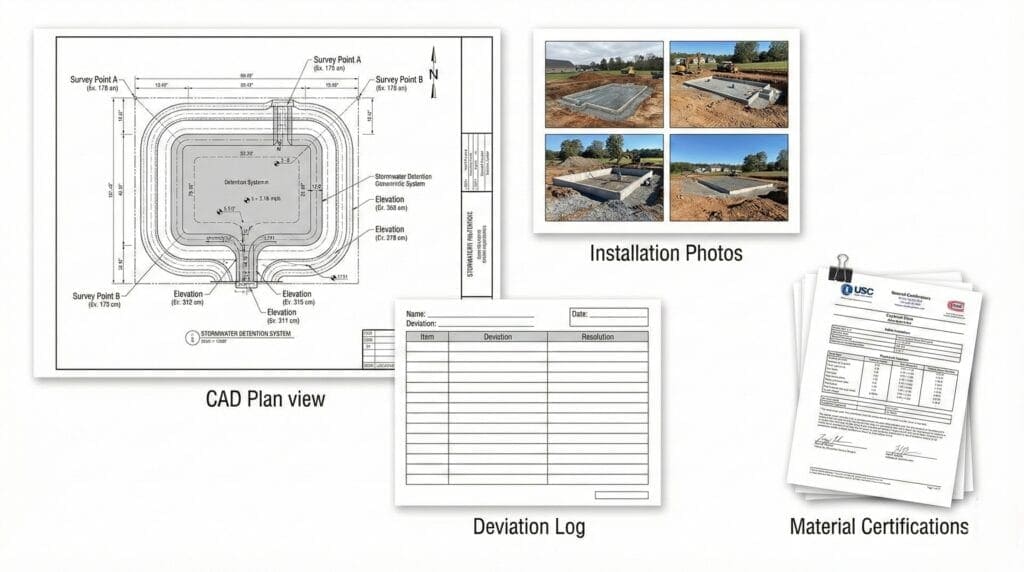
As-Built Requirements
Survey data: Final elevations at inlets, outlets, access points, key corners.
Photographs: Excavation, bedding, wrap/liner, assembled modules, connections, access structures, final grades.
Deviation documentation: Field changes documented and aligned with EOR.
Material + compaction records: Tickets, test reports, installation logs compiled.
O&M Manual Handoff
O&M documentation should be project-specific: system location, access points, inspection procedures, cleanout methods (vacuum/jetting), pretreatment maintenance, and responsible party contacts.
Inspection & Maintenance (O&M) + Safety
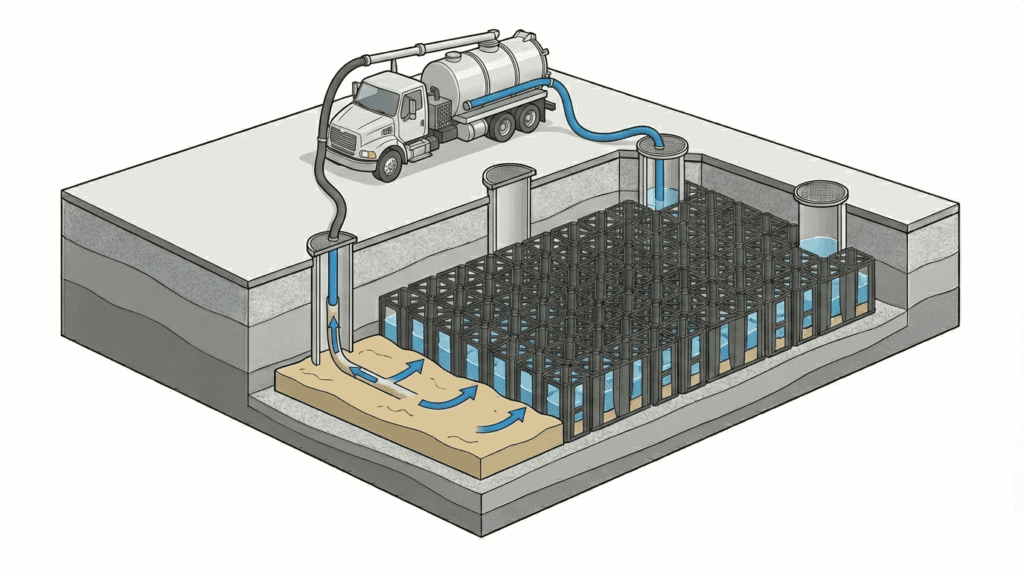
An underground stormwater detention system requires ongoing inspection and maintenance. Pretreatment reduces but does not eliminate sediment accumulation.
Inspection Schedule
Annual (minimum): Visual inspection via access ports; check sediment, inlet/outlet condition, blockage.
Post-event: Post-storm checks for sites with heavy sediment loads or upstream construction activity.
Periodic: CCTV or detailed inspection per jurisdictional requirements and site risk.
Maintenance Procedures
Sediment removal is typically performed via vacuum truck. Jetting mobilizes sediment toward access points. Pretreatment devices require scheduled cleaning appropriate to site conditions.
For a maintenance reference, see the Underground detention inspection and maintenance checklist (PDF).
Confined Space Safety Warning
OSHA note: Underground stormwater systems may be classified as confined spaces. Entry requires proper training, procedures, atmospheric testing, and rescue capability. Perform inspection and maintenance from surface access whenever possible.
Supplier Qualification Checklist
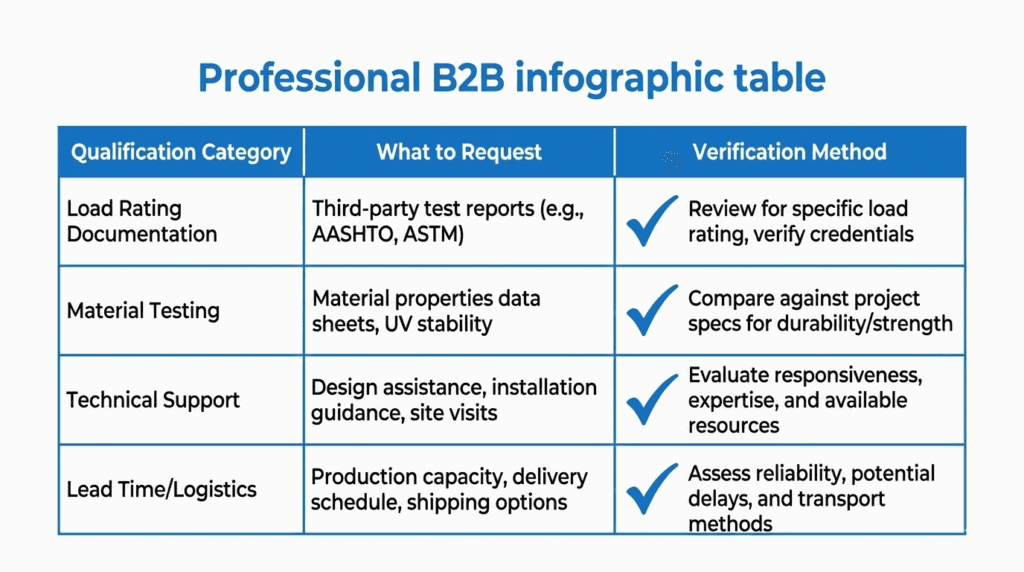
Evaluate suppliers based on documentation, configuration clarity, and maintenance provisions.
What to Demand from Vendors
| Qualification Item | Request | Red Flags |
|---|---|---|
| Load rating evidence | Documentation for specific configuration | Claims without verification |
| Material certifications | Third-party testing scope | No third-party support |
| Void ratio basis | Published value with basis | Vague claims |
| Installation guidance | Sequence + QA/QC requirements | Generic sheets |
| Lead time | Stock/production reality | Unrealistic promises |
| Warranty terms | Written terms per project | Verbal only |
How Buyers Compare Modular Systems (Including “R-Tank Stormwater” Searches)
Buyers commonly search brand terms like “R-Tank stormwater” when comparing systems. Apply consistent evaluation criteria regardless of brand: rated configuration at actual cover depth, supporting documentation, install QA/QC requirements, and inspection/cleaning provisions.
R-Tank is a trademark of its respective owner; mentioned here as a common search term, not an affiliation.
Quick Spec Template
Adapt to project documents and EOR direction.
UNDERGROUND STORMWATER DETENTION SYSTEM
1. General: Modular underground stormwater detention system with geocellular storage modules, geotextile or geomembrane wrap/liner per design, inlet/outlet structures, pretreatment, and access ports per drawings.
2. Storage Modules: PP or HDPE geocellular modules. Minimum void ratio: 95%. Traffic loading per manufacturer documentation for project cover depth and backfill section. For heavier requirements (HS-25 or equivalent), specify geocellular tank modules.
3. Wrap/Liner: Infiltration: Nonwoven geotextile per AASHTO M288 or project requirements. Detention: HDPE geomembrane per GRI GM13, thickness per drawings/EOR.
4. Cover Depth: Per drawings, typically 2.6–10 ft (0.8–3 m) based on loading and structural calculations.
5. Pretreatment: Upstream device sized for design conditions.
6. Access: Inspection/maintenance ports per drawings; traffic-rated covers where required.
7. Documentation: Product data, wrap/liner specs, installation details, rated configuration documentation per project requirements.
8. Installation: Per manufacturer instructions and approved shop drawings. Backfill in lifts per specifications; compact to required density.
For integrated subsurface stormwater management systems, see the solutions overview.
What We See on Jobsites
Common execution gaps, not unusual failures.
The Missing Pretreatment Device
Pretreatment shown on plans gets deleted during construction. Sediment accumulation accelerates. Cleanout responsibility becomes disputed.
The Skipped Proof-Roll
Base appears adequate visually; no loaded verification. Settlement appears over detention footprint after paving.
The Liner Nobody Checked
Small tear during backfill becomes significant problem once buried. Pre-cover photo documentation and inspection prevent this.
The Deleted Access Port
Utility conflict prompts access port deletion. System becomes partially inaccessible for inspection and cleaning.
The Dumped Backfill
Spec requires lift placement; operator dumps full buckets. Modules shift, connections stress, as-built differs from design.
The Undocumented Field Change
Pipe elevations adjusted to clear conflict; no documentation update. As-built record doesn’t match installation; future work encounters unexpected conditions.
Orlando Case Study
Project Overview
Warehouse/logistics facility in the Orlando metro area required stormwater management without reducing usable surface area. Surface detention would have consumed significant footprint needed for parking and truck maneuvering.
Site Constraints
Groundwater: Seasonal conditions typical of Central Florida limited infiltration viability without geotechnical support.
Footprint: Building, truck court, and parking consumed available surface area.
Schedule: Sitework sequencing constraints.
Solution
Lined underground stormwater detention system beneath paved areas with upstream pretreatment and access provisions for inspection and vacuum cleanout. Configuration maintained surface area for operations while meeting discharge requirements.
Result
Closeout proceeded without significant issues. Documentation and access were addressed in project scope: construction photos, compaction records, access locations, and surface-executable O&M plan.
Supplier Documentation & Support (ARW)
Aqua RainWater has manufactured stormwater management products since 2009. Documentation is available upon inquiry.
Product Models
| Model | Dimensions (in) | Dimensions (mm) | Void Ratio |
|---|---|---|---|
| ARW-8053 | 31.5 × 19.3 × 20.9 | 800 × 490 × 530 | 95% |
| ARW-6841 | 26.8 × 16.1 × 17.7 | 680 × 410 × 450 | 95% |
Available Documentation
Product data sheets, rated configuration evidence for H-20/HS-20 applications, third-party material testing (ISO, SGS, TÜV), and factory compressive test documentation are available upon inquiry.
Nonwoven geotextile for stormwater filtration — commonly referenced to AASHTO M288
HDPE geomembrane liner for stormwater detention — commonly aligned with GRI GM13
Support & Logistics
Cover depth: Typically 2.6–10 ft (0.8–3 m) depending on configuration.
Pipe connections: Customized per project.
Florida delivery: Expedited delivery may be available subject to stock and logistics.
MOQ: 1 × 20GP container.
Project support: Quantity take-offs, shop drawing inputs, paid installation guidance per EOR direction.
Florida: Partner team available for permitting coordination and integrated component sourcing.
Other states: Product supply and documentation support; local teams lead engineering/permitting.
Warranty: Available per project; terms provided upon inquiry; excludes misuse/abuse.
Next Steps
For underground stormwater detention system projects, confirm configuration early: detention vs infiltration, traffic rating per drawings, cover depth, pretreatment, and access provisions.
Contractors: Provide footprint, cover depth, traffic rating, and inlet/outlet constraints for take-off and shop drawing support.
Distributors: Contact for terms, MOQ, and documentation packages.
Owners/Engineers: Florida projects can access partner support for permitting coordination. Other regions: product documentation and installation guidance available; local teams lead design/permitting.
Contact: grayden@aquarainwater.com
WhatsApp: +852 67102428 / +86 15345324959
Resources: Stormwater Management FAQs | Become a Distributor
References
- EPA National Menu of BMPs for Post-Construction Stormwater Management
- 40 CFR 122.34 — Regulated Small MS4 Permit Requirements
- EPA Stormwater Phase II Final Rule Fact Sheet Series
- Delaware Underground Detention Construction Checklist (PDF)
- Underground Detention Inspection and Maintenance Checklist (PDF)
- GRI GM13 Standard Specification for HDPE Geomembranes (PDF)
About the Author
Technical Content, Aqua RainWater
ARW has manufactured stormwater management products since 2009, supporting commercial detention, infiltration, and retention projects. This guide reflects field QA/QC patterns and reviewer expectations observed across warehouse, logistics, retail, and municipal work. It is intended as practical guidance—not a substitute for site-specific engineering by a licensed PE.
Contact: grayden@aquarainwater.com | WhatsApp: +852 67102428 / +86 15345324959
 English
 Arabic
 French
 Russian
 Spanish