
Grass Paver Grids for Fire Lanes: Load-Bearing Permeable Solutions
By AQUA Rain Water Solutions | February 8, 2026 | 14 min read
A grass paver grid fire lane is a permeable paving system built from interlocking HDPE or polypropylene cells installed over a compacted aggregate subbase, capable of supporting 75,000 lb+ fire apparatus while maintaining full stormwater permeability and a natural turf appearance. These systems meet AASHTO H-20 and H-25 load ratings with compressive strengths ranging from 233 psi (unfilled) to over 11,000 psi (sand-filled), satisfy International Fire Code Section 503.2.3 requirements for alternative surface materials, and eliminate the site’s impervious cover burden — making them a dual-purpose solution for fire code compliance and stormwater management.
We’ve supplied grass paver grid systems for fire lane projects across North America since 2018, working with landscape architects, civil engineers, and fire marshals who need emergency vehicle access without sacrificing permeable cover or green space aesthetics. The regulatory tension is straightforward: IFC requires fire apparatus access within 150 ft of every building exterior wall, while municipal stormwater codes cap impervious surfaces at 50–70% of total site area. Grass paver fire lanes solve both problems simultaneously — and we’ve learned a few things along the way about what separates a 25-year installation from one that fails in two.
What Is a Grass Paver Grid Fire Lane?
A grass paver grid fire lane is a load-bearing permeable pavement constructed from modular plastic cells filled with soil and turf, engineered to provide emergency vehicle access while functioning as stormwater infrastructure. The grid distributes wheel and outrigger loads across a wide area, prevents soil compaction and rutting, and allows rainfall to infiltrate directly into the ground beneath the fire lane surface.
The concept addresses a specific code conflict. The International Fire Code (IFC) Section 503.2.1 mandates fire apparatus access roads within 150 ft of all exterior walls, designed to support a minimum 75,000 lb imposed load. Meanwhile, EPA Phase II MS4 requirements and local stormwater ordinances limit impervious cover and require post-construction water quality treatment. A 10,000 sq ft asphalt fire lane adds 10,000 sq ft of impervious surface — potentially requiring $40,000–200,000 in additional detention infrastructure. A grass paver fire lane adds zero impervious area and provides natural filtration at the same time.
How the Grid Structure Distributes Load
Each paver unit uses vertical cell walls — either a honeycomb matrix or ring-and-column configuration — to transfer surface loads vertically through the soil fill and laterally across adjacent cells to the compacted aggregate subbase. When a 76,000 lb fire engine tire contacts the surface, the grid prevents point loading by spreading force across 4–6 adjacent cells simultaneously.
Two critical mechanisms make this work. First, the cell walls prevent lateral soil displacement under load, which is what causes rutting on unprotected turf. Without a grid, a single fire truck pass compresses the soil surface to near-zero permeability and leaves 4–6 inch ruts. Second, the interlocking connections between grid panels create a continuous structural mat that bridges localized weak spots in the subbase — acting as a flexible load-distribution membrane rather than a collection of individual units.
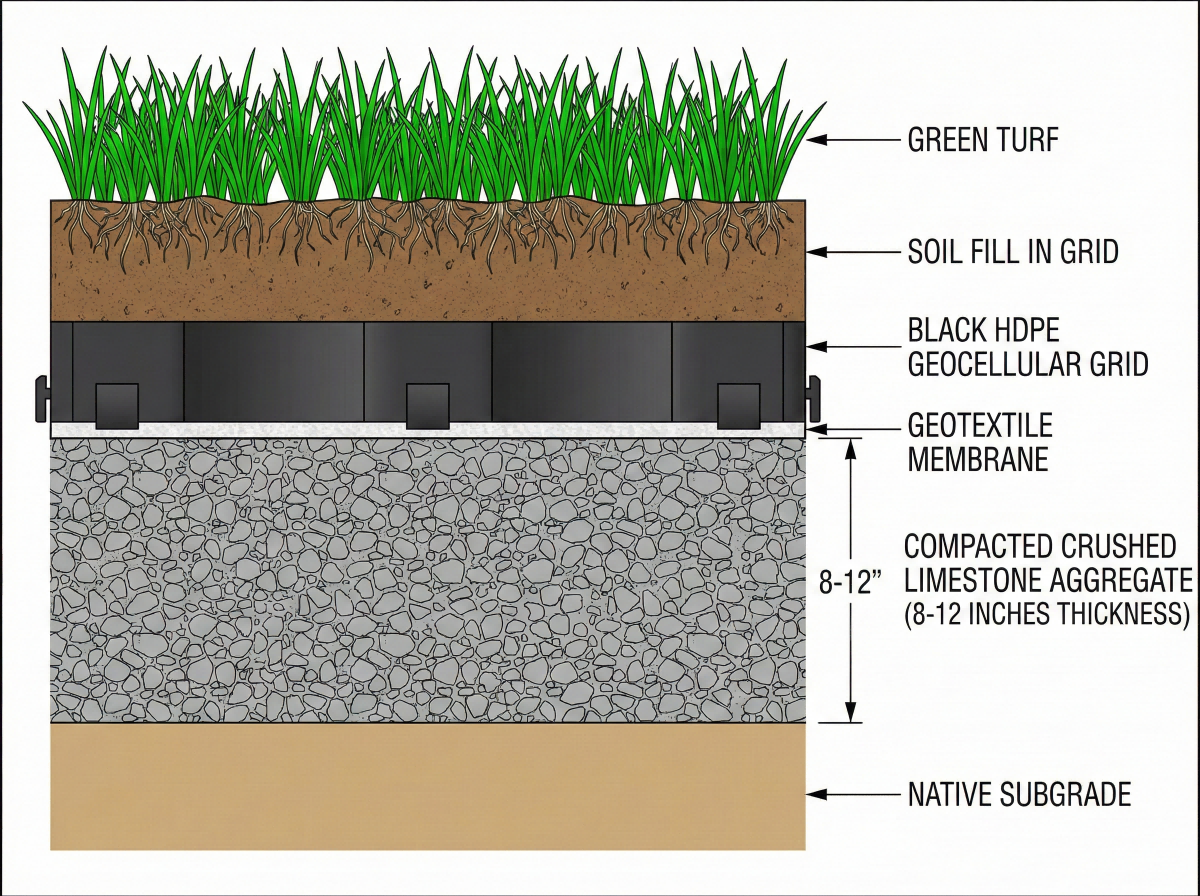
The subbase performs most of the structural work. A typical fire lane subbase consists of 6–12 inches of compacted angular crushed stone (ASTM D 2940 or AASHTO M 147 gradation), achieving a minimum California Bearing Ratio (CBR) of 5%. This aggregate layer provides both structural support and high infiltration capacity — typically 10–50 in/hr, compared to zero for asphalt.
Every grass paver fire lane is essentially a three-layer sandwich: compacted aggregate subbase on the bottom, interlocking grid system in the middle, and turf growing through the top. That middle layer makes the difference between a functioning fire lane and an unusable mud track after the first apparatus test.
IFC Code Requirements for Fire Lane Surfaces
Fire lane compliance in the United States falls under the International Fire Code (IFC), adopted by most jurisdictions, and NFPA 1, used in several states. Both codes permit grass paver systems as alternative surfaces when properly engineered, tested, and approved by the fire code official.
Dimensional Standards
Per IFC Appendix D, Section D103, fire apparatus access roads must maintain minimum 20 ft width for single-direction access (26 ft where aerial apparatus access is required), 13 ft 6 in vertical clearance, 50 ft outside turning radius, and maximum 10% slope. Dead-end turnarounds are required for roads exceeding 150 ft. These dimensional standards apply identically regardless of surface material — a grass paver fire lane meets the exact same width and clearance as asphalt.
Load-Bearing Requirements
IFC Section 503.2.3 requires fire apparatus access roads to support a minimum 75,000 lb imposed load — the weight of a fully loaded pumper truck. Aerial ladder trucks can reach 80,000 lb with outriggers deployed, and many jurisdictions require engineered calculations for the specific apparatus serving the district.
The critical test isn’t static load capacity alone. When a fire engine deploys outriggers, each pad concentrates 20,000–40,000 lb over a contact area of approximately 12 × 12 inches — producing 139–278 psi of sustained, concentrated pressure. The grass paver system and subbase must handle that without permanent deformation.
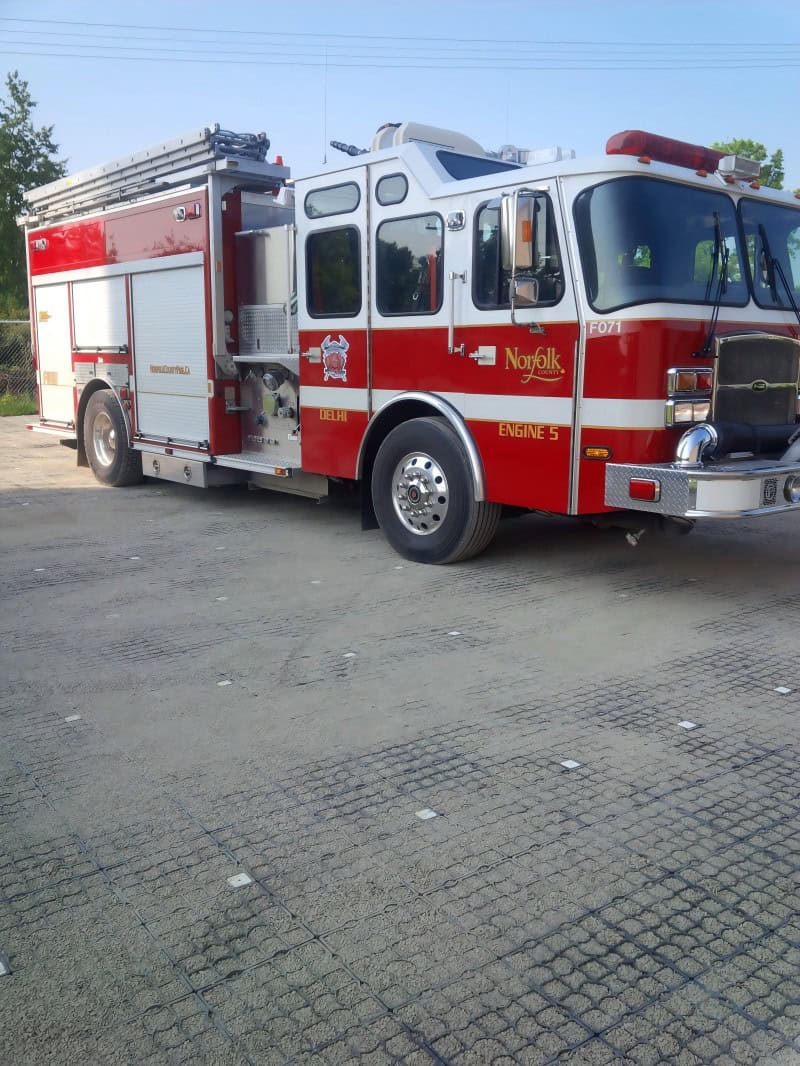
In late 2023, we supplied geocellular grid panels for a fire lane at a corporate campus in Irving, Texas. The local fire marshal required worst-case testing: a 78,000 lb aerial truck backed onto the surface, deployed all four outriggers, and lifted completely off its tires. The grid showed 3/8-inch temporary deflection under each outrigger and returned to grade within 48 hours. The fire marshal signed off without reservation. That installation used our grid panels rated at 5,200 psi sand-filled compressive strength over an 8-inch compacted crushed limestone subbase on clay subgrade.
Marking and Identification Standards
Because a fully vegetated fire lane looks identical to surrounding lawn, fire departments need reliable markers to locate the access route during emergencies — especially at night.
The 2021 IFC Appendix D, Section D102.6 and jurisdictional amendments typically require blue reflective traffic markers on each side at maximum 20 ft spacing, standard red “No Parking — Fire Lane” signage per IFC D103.6, and markings visible above 12 inches of vegetation growth. Many jurisdictions also require concrete curbing along both edges and sealed engineering documents submitted with the building permit.
Budget $2–5 per linear foot for marking, reflectors, and signage beyond the grid and subbase installation. These are non-negotiable items — marking deficiencies are the most common fire marshal inspection failure on grass paver fire lanes.
Types of Grass Paver Grids for Fire Lane Applications
Not every grass grid handles fire apparatus loads. The paver rated for residential driveways at 3,000–5,000 lb will fail catastrophically under a 75,000 lb pumper. Fire lane applications demand grids tested and certified for AASHTO H-20 or H-25 loading.
Flexible Geocellular Grid Systems
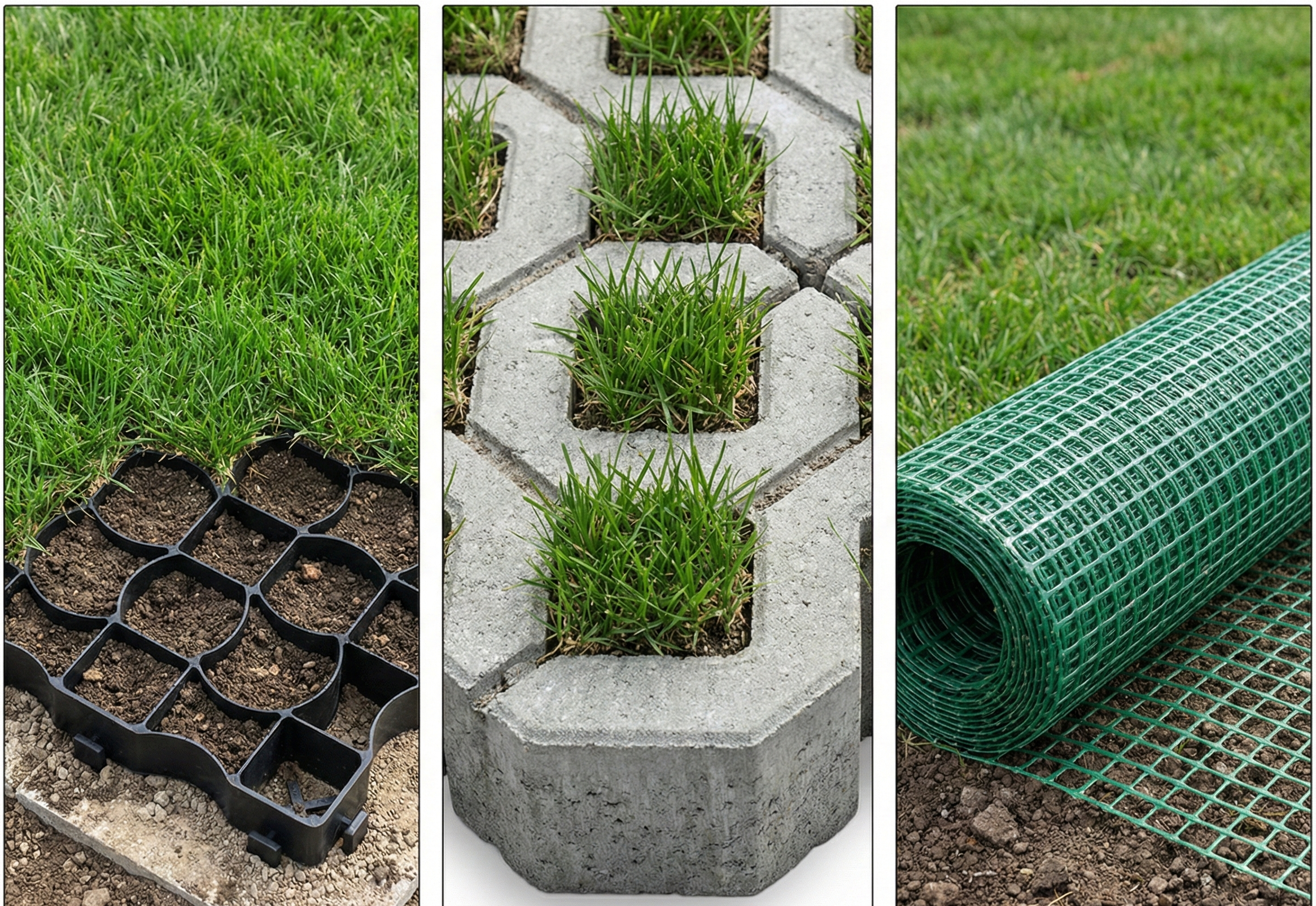
Flexible geocellular grids — including the type we manufacture and supply — use networks of interconnected HDPE or PP cells that flex independently under load. Three characteristics make them the preferred choice for most fire lane projects.
Freeze-thaw resistance is the first advantage. In northern states, ground temperatures cycle above and below 32°F dozens of times each winter. Flexible grids absorb dimensional changes without cracking or heaving at joints, which is a chronic problem with rigid systems in climates from Minnesota to Massachusetts.
Installation speed is the second. Most flexible grid systems ship flat-packed or stacked and interlock without fasteners. A two-person crew can grid a typical 2,000 sq ft fire lane in under 4 hours — compared to 8–12 hours for concrete block pavers requiring individual placement.
Drainage performance rounds out the advantages. Flexible geocellular grids typically achieve 90–95% open surface area, meaning nearly the entire fire lane surface is permeable. Infiltration rates through the turf and soil fill into the subbase below remain consistently high throughout the system’s service life.
The tradeoff is lower absolute point-load ratings compared to concrete — most flexible grids rate between 200–350 psi unfilled and 4,000–7,000 psi sand-filled. With proper subbase engineering, that’s more than adequate for standard pumper trucks, though aerial apparatus staging areas with outrigger deployment may benefit from thicker subbases.
Rigid Concrete Grass Block Pavers
Precast concrete grass pavers — sometimes called grasscrete or turf blocks — offer compressive strength exceeding 8,000 psi but lower permeability (30–50% open area) and greater susceptibility to freeze-thaw joint failure. They work well in stable climates like Texas, Florida, and southern California where ground movement isn’t a factor. We’ve seen concrete block installations in Wisconsin develop edge separation and individual block displacement within 3–4 winter cycles, requiring ongoing repair.
Rolled Mesh Systems
Lightweight polypropylene turf reinforcement mesh exists as a third category, but it generally lacks the structural depth and load-distribution capacity required for 75,000 lb apparatus. Don’t specify mesh systems for fire lanes unless the manufacturer provides AASHTO H-20 certification with subbase details — most can’t.
Flexible geocellular grids represent the best balance for most fire lane projects: adequate strength for standard apparatus, fast installation, excellent stormwater permeability, and long-term freeze-thaw durability.

How to Install a Grass Paver Grid Fire Lane
Installation quality determines whether a grass paver fire lane lasts 25 years or fails in two. We’ve seen projects collapse because contractors skipped subbase compaction or used rounded river gravel instead of angular crushed stone. The grid itself is nearly indestructible — failures almost always trace back to what’s underneath it.
Step 1: Excavation and Subgrade Preparation
Excavate to full depth: 6–12 inches of subbase + 1.5–2 inches of grid height + 1 inch of sand leveling course = 8.5–15 inches total cut. Grade the subgrade to match the finished drainage plan, maintaining minimum 1% cross-slope for sheet flow.
Compact the native subgrade to 95% Standard Proctor density using a vibratory plate compactor. If the native soil CBR falls below 3%, stabilize with geogrid reinforcement or 6 inches of select fill material. Clay subgrades in particular need careful attention — they swell when wet and shrink when dry, and that cyclical movement can compromise subbase integrity if not properly addressed.
Step 2: Geotextile and Subbase Construction
Lay a non-woven geotextile membrane (minimum 4 oz/yd²) over the compacted subgrade. This prevents fines migration from native soil into the aggregate — a gradual contamination process that reduces both structural capacity and permeability over time.
Place aggregate in lifts of 4 inches maximum and compact each lift to 95% Standard Proctor using a vibratory plate compactor (minimum 5,000 lb force). Use ASTM D 2940 or AASHTO M 147 graded aggregate — 3/4-inch minus crushed limestone or recycled concrete aggregate (RCA) works well.
Avoid round river gravel for fire lane subbases. The smooth, round particles don’t interlock under compaction, producing CBR values 30–40% lower than angular crushed stone at the same compaction effort. We learned this one the hard way on a 2019 project in suburban Atlanta where the contractor substituted available river rock. The fire lane passed initial testing but developed 2-inch ruts within 18 months under periodic mowing traffic — well before any fire apparatus ever drove across it. We replaced the subbase with angular #57 crushed limestone and the problem disappeared.
Step 3: Grid Placement and Edge Restraint
Place grass paver grid panels directly on the compacted subbase or over a 1-inch sand leveling course (check manufacturer instructions for your specific product). Start at one corner and work outward, interlocking panels using the tab-and-slot or tongue-and-groove connections built into each unit.
Cut perimeter pieces with a circular saw or reciprocating saw. Secure edge panels with steel landscape edging or concrete curbing anchored with 18-inch rebar stakes at 4 ft centers. Edge restraint is critical — without it, outrigger loads near the fire lane perimeter shift grid panels laterally. We saw exactly this failure on a 2024 project in Gulfport, Mississippi: the outer two rows shifted 2 inches within six months from mowing traffic alone because the contractor had skipped edge anchoring. Budget $3–5 per linear foot for proper edge restraint. It’s non-negotiable.
Step 4: Fill Material and Turf Establishment
Fill grid cells with clean topsoil or a sand-soil blend (70% clean angular sand, 30% topsoil by volume for optimal drainage and root support). Sweep or vibrate material into cells until level with grid tops.
Apply starter fertilizer (balanced NPK such as 10-10-10 at 10 lb per 1,000 sq ft), then install sod or seed. For fire lanes, we strongly recommend sod over seed. A seeded fire lane requires 60–90 days of establishment before it can support apparatus traffic, while a sodded surface is typically approved within 2–3 weeks. That’s 2+ months of project schedule you’re either saving or spending, depending on which you choose.
Step 5: Fire Department Testing and Approval
Schedule a live load test 4–6 weeks after sod installation (90+ days after seeding) to allow root establishment. Most jurisdictions require the local fire department to drive their heaviest apparatus across the surface and, in many cases, deploy outriggers at full load.
Document the test with photographs showing apparatus placement, deflection measurements (if any), and surface recovery over 24–48 hours. Keep these records — you’ll need them for the building occupancy permit and any future fire marshal inspections.
A properly installed grass paver fire lane should last 25+ years with minimal intervention beyond standard turf maintenance. The grid material is UV-stabilized and won’t degrade underground, so longevity hinges entirely on subbase quality and basic lawn care.
Cost Comparison: Grass Paver Fire Lanes vs. Conventional Paving
The financial argument for grass paver fire lanes depends heavily on what you include in the calculation. Material cost alone favors asphalt. But factor in impervious cover credits, stormwater infrastructure savings, and 20-year lifecycle costs, and grass pavers come out even or ahead.
Installed Cost per Square Foot
| Component | Grass Paver Grid | Asphalt | Concrete |
|---|---|---|---|
| Surface material | $3.50–6.00/sq ft | $2.50–4.00/sq ft | $5.00–8.00/sq ft |
| Subbase (6–12 in) | $2.00–4.00/sq ft | $1.50–3.00/sq ft | $2.00–4.00/sq ft |
| Installation labor | $1.50–3.00/sq ft | $1.00–2.00/sq ft | $2.00–3.50/sq ft |
| Edge restraint + marking | $0.50–1.50/sq ft | $0.25–0.50/sq ft | $0.25–0.50/sq ft |
| Total installed | $7.50–14.50/sq ft | $5.25–9.50/sq ft | $9.25–16.00/sq ft |
| Stormwater offset | –$2.00–5.00/sq ft | $0 | $0 |
| Net effective cost | $5.50–9.50/sq ft | $5.25–9.50/sq ft | $9.25–16.00/sq ft |
The stormwater offset is real money. A 10,000 sq ft grass paver fire lane eliminates 10,000 sq ft of impervious surface from the site’s stormwater calculations. At typical detention infrastructure costs of $2–5 per cubic foot, that can eliminate $20,000–50,000 in underground storage requirements.
Twenty-Year Lifecycle Analysis
| Cost Factor | Grass Paver Grid | Asphalt | Concrete |
|---|---|---|---|
| Installation (10,000 sq ft) | $75,000–145,000 | $52,500–95,000 | $92,500–160,000 |
| Annual maintenance | $500–1,000 | $2,000–4,000 | $500–1,500 |
| Resurface/repair (Year 10) | $0 | $15,000–25,000 | $5,000–10,000 |
| Resurface/repair (Year 20) | $0 | $15,000–25,000 | $10,000–20,000 |
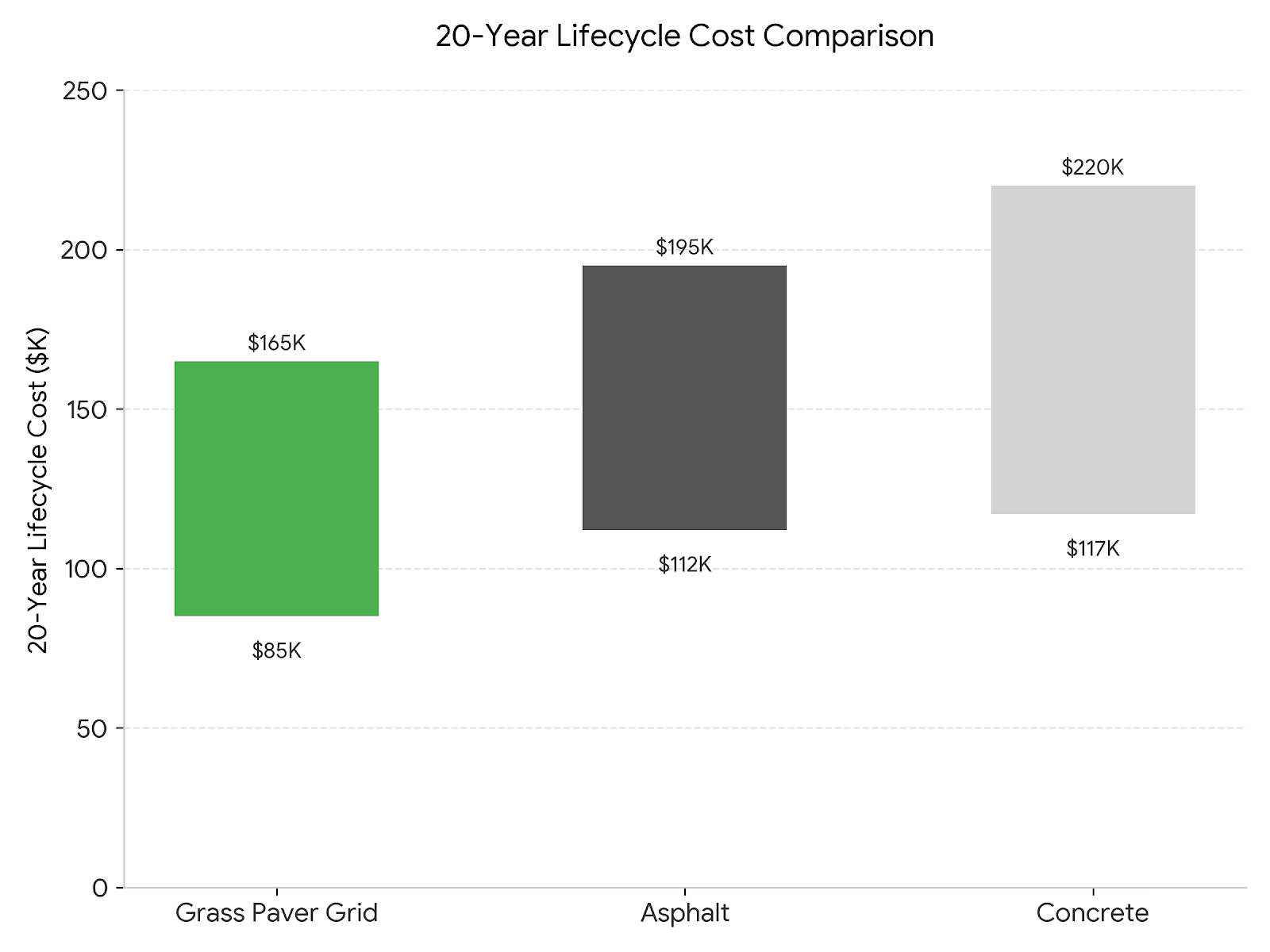
| 20-year total | $85,000–165,000 | $112,500–195,000 | $117,500–220,000 |
Asphalt fire lanes need seal coating every 3–5 years and full resurfacing around year 10–12. Concrete develops joint spalling requiring periodic repair. Grass paver systems need mowing and occasional reflector replacement. That’s the extent of it. The breakeven point where grass pavers become cheaper than asphalt sits around year 7–8 for most installations.
For projects pursuing LEED certification, grass paver fire lanes contribute to SS Credit 6.1 (Stormwater Design: Quantity Control) and SS Credit 6.2 (Quality Control), adding measurable value beyond direct cost savings.
Stormwater Benefits of Permeable Fire Lanes
Grass paver fire lanes aren’t just access routes — they’re functioning stormwater infrastructure that handles rainfall at the source and reduces downstream drainage loads.
Infiltration Performance
A properly built grass paver fire lane achieves infiltration rates of 10–50 in/hr through the turf surface and aggregate subbase. Compare that to asphalt (0 in/hr, 100% runoff), concrete (0 in/hr, 100% runoff), and standard compacted lawn without a grid (0.5–3 in/hr in fire lane applications where repeated traffic has densified the soil).
The engineering metric that matters for stormwater design is the NRCS Curve Number (CN). Grass paver fire lanes typically achieve CN values of 55–65, compared to CN 98 for impervious pavement. For a 10,000 sq ft fire lane receiving a 2-inch rainfall event, that difference translates to approximately 8,000 gallons less runoff entering the storm sewer system per storm event.
Water Quality Filtration
As stormwater percolates through the turf canopy, soil matrix, and aggregate subbase, natural biological and physical filtration removes 85–95% of total suspended solids, 50–70% of total phosphorus, 60–80% of heavy metals (zinc, copper, lead), and 90%+ of petroleum hydrocarbons. These removal rates align with Best Management Practice (BMP) standards published by the EPA’s National Pollutant Discharge Elimination System (NPDES) program and state environmental agencies.
For projects in EPA Phase II MS4 communities, grass paver fire lanes can count toward post-construction stormwater quality requirements — providing dual code compliance from a single infrastructure investment.
Impervious Cover Credits
This is the hidden financial advantage that often tips the project decision. Every square foot of grass paver fire lane that replaces planned impervious surface directly reduces the project’s stormwater detention requirement. On a development where the municipality caps impervious cover at 50–70% of total site area, a 10,000 sq ft permeable fire lane might be the difference between a buildable project and one that requires a costly redesign.
Grass paver fire lanes function as dual-purpose infrastructure: fire code compliance above, stormwater BMP below. That combination is difficult to achieve with any other surface material.
Project Spotlight: Mixed-Use Development Fire Access — Houston Metro
In Q3 2024, a civil engineering firm designing a 45-acre mixed-use development in the Houston metropolitan area needed fire access lanes around two four-story commercial buildings totaling 18,000 sq ft of fire lane surface area. The site’s impervious cover was already at 66% — 4% below the municipality’s 70% cap.
The problem: Adding 18,000 sq ft of conventional asphalt fire lanes would have pushed impervious cover to 74%, exceeding the cap by 4%. The alternatives were either a $420,000 expansion of the underground detention system or eliminating 22 parking spaces to stay under the impervious limit. Neither option was acceptable to the developer.
The solution: We specified our geocellular grass paver grid over a 10-inch subbase of compacted #57 crushed limestone, with non-woven geotextile separation on stabilization geogrid over the native clay subgrade. The grid’s AASHTO H-25 rating provided a safety factor of 1.6× above the minimum 75,000 lb IFC requirement. Total fire lane area covered 18,000 sq ft (3,600 linear ft × 5 ft width on each side of both buildings, with 26-ft-wide sections at aerial apparatus staging points).
The result: The fire marshal approved the system after a live load test with an 80,000 lb aerial truck including outrigger deployment. The grass paver lanes counted as 0% impervious cover, keeping the site at 66% — no detention expansion needed, no parking eliminated. Total installed cost was $198,000 compared to the $420,000 detention alternative. The project earned LEED stormwater credits and maintained the development’s landscaped aesthetic.
Key takeaway: Engage the fire marshal during schematic design, not after construction documents are finalized. This project moved smoothly because the civil engineer and fire marshal agreed on grid specifications, subbase requirements, marking protocols, and test procedures upfront — preventing costly redesign cycles.
Maintenance Requirements for Grass Paver Fire Lanes
Grass paver fire lanes require less maintenance than asphalt or concrete, but they’re not zero-maintenance. The turf growing through the grid is living infrastructure that needs basic care to remain functional and inspection-ready.
Mowing: Maintain the same height and frequency as surrounding lawn — typically 3–4 inches for cool-season turf, 1.5–2.5 inches for warm-season varieties. Fire departments generally require vegetation height below 12 inches to ensure blue reflective markers remain visible. Exceeding this height is the second most common inspection failure (after missing reflectors).
Aeration and overseeding: Core aerate annually in fall (cool-season) or late spring (warm-season) to maintain soil porosity within the grid cells. Traffic compacts fill material over time, even with the grid protecting against full compaction. Overseed thin areas at the same time to maintain consistent turf coverage.
Reflector and signage inspection: Check blue reflectors and fire lane signs quarterly. Replace missing or damaged reflectors immediately — keep a supply on hand ($3–5 each) and inspect after every mowing cycle, since mower blades occasionally clip reflector posts. This is the single most common fire marshal inspection failure on grass paver fire lanes.
Drainage verification: After heavy rain events (2+ inches in 24 hours), walk the fire lane surface and check for standing water. Ponding indicates clogged grid cells (typically from leaf litter or mowing clippings) or localized subbase settlement. Address drainage issues promptly — standing water reduces soil stability and can cause localized failures under apparatus loading.
Consistent basic maintenance ensures your grass paver fire lane passes fire marshal inspections and provides reliable emergency vehicle access for its full 25+ year service life.
Frequently Asked Questions
75,000 lb per IFC Section 503.2.3. This represents a fully loaded pumper truck. Aerial apparatus with outriggers can concentrate 20,000–40,000 lb per pad on a 12 × 12 inch contact area (139–278 psi sustained pressure), so subbase design is equally critical to grid selection. Most commercial-grade geocellular grids exceed this requirement when installed over 6–12 inches of properly compacted angular aggregate.
$7.50–14.50 per square foot installed before stormwater offsets. Net effective cost drops to $5.50–9.50 per square foot when you factor in the eliminated impervious cover and reduced detention infrastructure. Over a 20-year lifecycle, grass paver fire lanes typically cost $85,000–165,000 for a 10,000 sq ft installation — compared to $112,500–195,000 for asphalt and $117,500–220,000 for concrete.
Yes, when properly engineered, marked, and tested. IFC Section 503.2.3 explicitly permits alternative surface materials with fire code official approval. Typical requirements include sealed engineering documents, AASHTO H-20/H-25 rated system, blue reflective markers at 20 ft spacing, standard fire lane signage, and a live load test with the district’s heaviest apparatus. Engaging the fire marshal early in design prevents costly redesign.
Yes, with adequate subbase design. Standard geocellular grids rated at 5,000+ psi sand-filled capacity handle outrigger loading comfortably. The subbase is the critical variable — specify minimum 8–10 inches of compacted angular aggregate at designated apparatus staging areas where outrigger deployment is expected. Tested installations under full 80,000 lb aerial trucks with all four outriggers deployed show only temporary deflection that recovers within 48 hours.
25+ years with proper installation and basic turf maintenance. The HDPE or PP grid material is UV-stabilized (when buried) and resists chemical and biological degradation. Longevity depends almost entirely on subbase quality — well-compacted angular aggregate subbases routinely support installations exceeding 30 years. Compare that to asphalt (resurfacing needed at 10–12 years) and concrete (joint spalling within 15–20 years).
Disclaimer: This article provides general guidance on grass paver grid fire lane design, installation, and code compliance. Specific load requirements, marking standards, and approval processes vary by jurisdiction. Always consult a licensed professional engineer for structural design calculations and your local fire marshal for approval requirements before construction. AQUA Rain Water Solutions provides grass paver grid systems and technical guidance but does not perform engineering design or fire code consulting.
 English
 Arabic
 French
 Russian
 Spanish