
Geocellular Tank — St. Petersburg New City Development
The St. Petersburg New City Development is a major urban expansion designed to deliver modern residential areas, public facilities and green spaces with reliable, sustainable stormwater management. Covering municipal roads, government buildings and public amenities, the project increases drainage capacity, reduces flood risk and preserves valuable surface land.

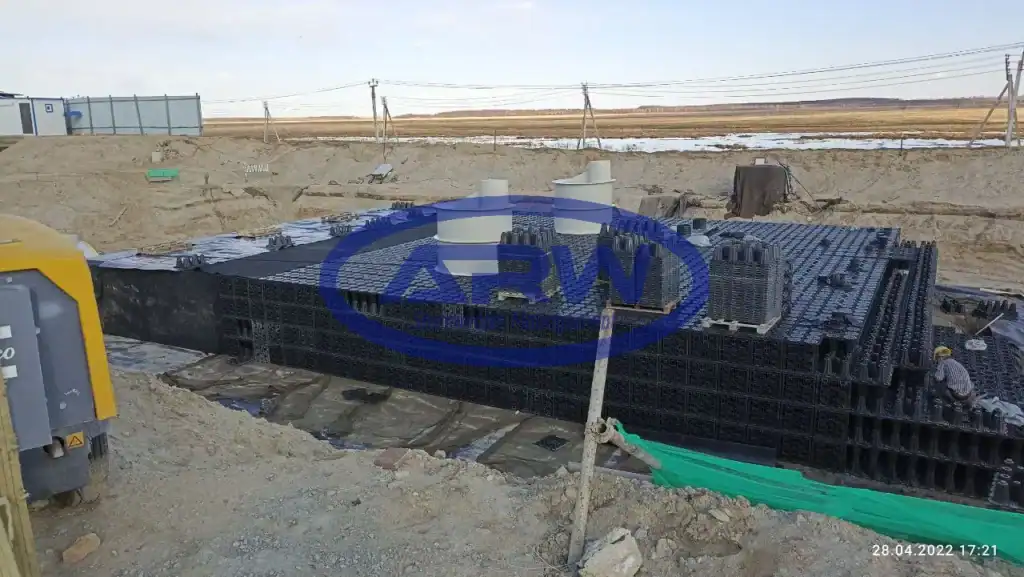
To meet stormwater retention and underground drainage needs, the development incorporates modular geocellular tank systems beneath government facilities, municipal roads, parking areas and parks. This hidden network stores and controls runoff without occupying surface space. We supplied 10,000 m³ of modular geocellular units for these underground systems. Major units are installed beneath government offices and main roads, while secondary units are placed under parking and green areas to form an interconnected retention network. Modular layouts prioritise critical infrastructure, enable phased construction and adapt to traffic or surface loads.

The high-strength polypropylene geocellular crates (≥90 % void ratio) are lightweight, corrosion-resistant and click-fit for quick assembly. They are installed on gravel bases and fully wrapped in geotextile to prevent siltation and ensure long-term hydraulic performance. Reinforced modules under roads and vehicle areas support live loads, with burial depths typically ranging from 1.5 to 5 m depending on conditions. The tanks are linked to the municipal drainage network with control valves, overflow outlets and first-flush sediment traps to intercept pollutants. Access shafts and sediment chambers provide for routine cleaning and extended service life.
This system relieves storm sewer pressure during heavy rain, reduces flood risk and preserves valuable land use while supporting sustainable water management. It also reduces pollutant loads and, when designed as permeable units, helps recharge groundwater. Thanks to its scalable, modular design, the network can be expanded or upgraded in line with long-term drainage planning.
 English
 Arabic
 French
 Russian
 Spanish