
How to Choose the Right Geocellular Attenuation Tank for Your UK Project

Specifying a geocellular attenuation tank sounds straightforward until you’re comparing datasheets from six different manufacturers, each claiming their system is superior. We’ve seen projects delayed by months because the wrong unit was specified—failing structural calculations, not meeting LLFA requirements, or simply being unsuitable for the actual ground conditions.
The geocellular market has expanded significantly over the past decade. More options should mean better choices. Instead, it’s created confusion. Not all systems perform equally, and the differences that matter aren’t always obvious from catalogue specifications.
This guide cuts through the marketing to help you select the right geocellular attenuation system for UK conditions. We’ll cover the selection criteria that actually matter, how to verify manufacturer claims, and the practical considerations that determine whether a system will perform as expected over its design life.
What Makes Geocellular Tanks Different from Other Attenuation Methods
Geocellular attenuation tanks use modular plastic units that interlock to create underground storage chambers. The concept is elegantly simple: stack lightweight modules in an excavation, wrap them in geomembrane for containment, and connect to your drainage network. Water enters during storms, sits temporarily, then releases at a controlled rate.
What distinguishes geocellular systems from concrete tanks, oversized pipes, or traditional stone-filled trenches comes down to three factors: storage efficiency, installation speed, and design flexibility.
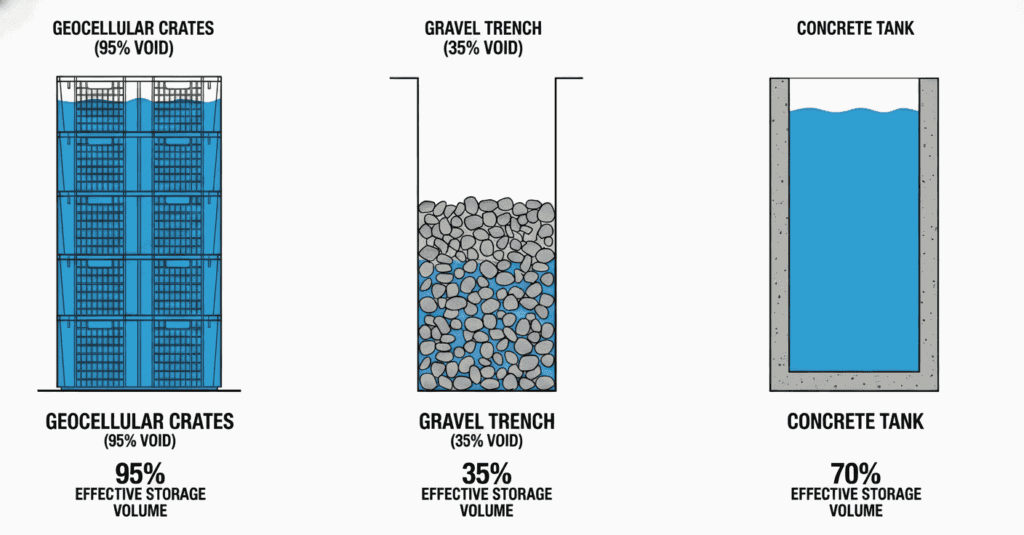
Modern geocellular units achieve void ratios of 95% or higher—meaning 95% of the structure’s volume actually stores water. Compare that to gravel beds at 30-35% void ratio. For the same storage volume, a geocellular system requires roughly 60% less excavation than aggregate alternatives. On tight sites or where disposal costs are significant, this matters enormously.
Installation speed is the other practical advantage. A competent crew can install several hundred cubic metres of geocellular storage in a single day. The same volume in precast concrete might take a week, requiring crane hire and careful sequencing. For contractors managing multiple trades and tight programmes, that difference changes project economics.
For a comprehensive overview of attenuation systems including sizing requirements and regulatory frameworks, see our complete guide to attenuation tanks.
Critical Selection Criteria for UK Projects
When evaluating geocellular systems, focus on these five areas. They determine whether a system will meet LLFA requirements, perform structurally, and last its intended design life.
Structural Load Ratings
Every geocellular unit has load limits. Exceed them, and the system fails—sometimes gradually through creep deformation, sometimes suddenly under exceptional loads. The two critical values are vertical compressive strength and lateral resistance.
For most UK applications, look for these minimum ratings:
| Parameter | Minimum Rating | Notes |
|---|---|---|
| Vertical compressive strength | 400 kN/m² | Suitable for car parks and light traffic |
| Lateral strength | 200 kN/m² | Resists soil pressure and asymmetric loading |
| Heavy vehicle access | 600+ kN/m² | Fire appliance routes, HGV areas |
Don’t just accept catalogue values. Ask for test certificates showing how those figures were derived. CIRIA C680 specifies testing protocols—manufacturers should demonstrate compliance. If they can’t produce test data conducted to recognised standards, that’s a red flag.
Cover depth affects load capacity significantly. Most systems require minimum 300mm cover for pedestrian areas, 600mm for car traffic, and 1000mm or more under heavy vehicle routes. Your structural engineer should verify these requirements against specific site conditions.
Void Ratio and Storage Efficiency
Void ratio directly determines how much excavation you need for a given storage volume. At 95% void ratio, a one-cubic-metre module provides 950 litres of storage. At 90%, you only get 900 litres—and that 5% difference compounds across large installations.
Be cautious of systems claiming very high void ratios but using thin-walled construction. The void ratio means nothing if the structure can’t support required loads or collapses under installation stresses. The best systems balance high void ratio with robust structural performance.
BBA Certification and Third-Party Testing
British Board of Agrément (BBA) certification provides independent verification that a product performs as claimed. While not legally required, many LLFAs specifically request BBA-certified products. Having this certification smooths the approval process considerably.
BBA assessment covers manufacturing quality, structural performance, durability, and installation requirements. The certificate includes validated technical data that your engineer can rely on for design calculations. Without third-party testing, you’re trusting manufacturer claims that may or may not reflect real-world performance.
Even with BBA certification, review the specific certificate conditions. Limitations on burial depth, traffic loading, or ground conditions may apply. The certificate should match your project requirements.
CIRIA C680 and C737 Compliance
CIRIA C680 establishes the structural design framework for geocellular systems. Published in 2008, it remains the definitive guidance for UK practice. C737 (2015) provides planning guidance specifically for SuDS components including geocellular tanks.
When specifying systems, ensure structural calculations follow C680 methodology. This includes proper consideration of soil conditions, groundwater levels, surface loading, and construction sequencing. Your geotechnical engineer should verify that the chosen system suits site-specific conditions.
LLFAs increasingly expect explicit reference to these CIRIA documents in drainage submissions. Systems designed and specified in accordance with C680/C737 demonstrate professional practice and typically face fewer approval queries.
Material Composition and Design Life
Most geocellular units are manufactured from polypropylene (PP) or high-density polyethylene (HDPE). Both materials offer excellent chemical resistance and durability in buried applications. The key consideration is design life—typically 50 years for modern systems.
Design life claims should be backed by accelerated ageing tests or long-term performance data. Ask about UV stabilisation (for storage before installation), resistance to hydrocarbons (for car park applications), and behaviour under sustained loading.
Recycled content is increasingly common and generally acceptable provided structural performance meets requirements. Some manufacturers offer systems with 50%+ recycled material without compromising load ratings.
Installation Considerations That Affect System Choice
The best-specified system can still fail if installation goes wrong. Consider these practical factors when selecting products.

Module Connection Method
Geocellular units connect through various mechanisms: clip systems, interlocking profiles, or simple stacking. Clip connections create rigid assemblies that resist lateral movement during backfilling. Simple stacking relies on confinement from the excavation and wrapping materials.
For larger installations or sites with challenging access, clip-connected systems generally perform better. They maintain alignment during the complex installation sequence of laying geomembrane, placing modules, connecting pipes, and backfilling.
Handling and Site Access
Module weight and dimensions determine handling requirements. Lightweight units can be placed manually, reducing plant requirements and working within confined spaces. Heavier systems may need mechanical handling, which affects programme and cost.
Consider access constraints. Can delivery vehicles reach the installation location? Is there space to stage materials? For constrained urban sites, lightweight modular systems that arrive on pallets often prove more practical than alternatives requiring crane access.
Geomembrane and Geotextile Requirements
Attenuation tanks require impermeable lining—typically HDPE or LLDPE geomembrane. The liner prevents water loss and ensures the tank functions as designed. Geotextile wrapping protects the membrane from damage and filters incoming water.
Specify liners appropriate to the application. HDPE offers excellent chemical resistance and durability. LLDPE provides better flexibility for irregular excavations or sites requiring puncture resistance. Your supplier should recommend appropriate grades based on soil conditions and anticipated exposures.
For detailed installation procedures and best practice guidance, see our attenuation tank installation guide.
Flow Control Integration
Attenuation tanks work by restricting outflow—the flow control device is critical. Ensure your chosen geocellular system accommodates standard flow control equipment. Some manufacturers offer integrated solutions; others require separate specification.
Consider access requirements for flow control maintenance. These devices need periodic inspection and cleaning. Systems should include adequate inspection chambers with clear access to all critical components.
Project Spotlight: Commercial Development, Milton Keynes
A 2.4-hectare distribution centre required 850 cubic metres of stormwater attenuation to meet discharge consent requirements. Site constraints included shallow rock (limiting excavation depth), heavy vehicle loading across the storage area, and tight programme requirements.
Initial designs considered concrete tanks and aggregate-filled systems. Both proved problematic: concrete required deep excavation the site couldn’t accommodate, while aggregate systems needed excessive footprint given the poor void ratio.
The solution used high-strength geocellular modules with 95% void ratio, installed in a shallow-but-wide configuration. Key specifications included vertical compressive strength of 600 kN/m² (accommodating HGV loading with 800mm cover), BBA certification, and CIRIA C680-compliant structural design.
Installation completed in four days with a three-person crew. The system passed adoption inspection first time and has performed without issues through two significant storm seasons.
Comparing System Types: What Suits Your Project
Not all geocellular configurations serve the same purpose. Understanding the variants helps you specify correctly.
| Configuration | Wrapping | Function | Typical Application |
|---|---|---|---|
| Full attenuation tank | Complete geomembrane enclosure | Stores water, releases via flow control | Clay soils, urban sites, brownfield land |
| Combined attenuation/infiltration | Lined sides, permeable base | Primary attenuation with secondary infiltration | Mixed soil conditions, hybrid systems |
| Full infiltration (soakaway) | Geotextile only (no membrane) | Water disperses to surrounding soil | Permeable soils, suitable infiltration rates |
The choice depends on site conditions. Clay soils or contaminated land generally require full attenuation with impermeable lining. Permeable soils may allow infiltration systems that avoid the need for downstream connections. Your drainage engineer should specify based on ground investigation results.
For guidance on when infiltration systems suit your project, see our comparison of attenuation tanks versus soakaways.
Questions to Ask Manufacturers Before Specifying
When evaluating suppliers, these questions help separate robust products from marketing claims.
Reputable manufacturers have independent test data. They should explain how testing was conducted and how results apply to your specific loading conditions.
Look for accelerated ageing test data or reference installations with documented performance history. A 50-year claim needs substantiation.
Check certificate validity and any limitations. Some certificates exclude certain depths, loadings, or installation methods.
Technical guidance, site visits, or installer training can significantly improve installation quality. Some manufacturers offer these services as standard.
Understand warranty terms, particularly installation requirements that must be followed to maintain coverage.
Common Specification Mistakes to Avoid
After reviewing hundreds of drainage submissions, these errors appear repeatedly.
Underestimating cover requirements. Every system has minimum cover depth for various loading scenarios. Squeezing installation into insufficient depth to avoid rock or services creates structural risk. If cover depth is constrained, select a system rated for shallow installation or redesign the layout.
Ignoring groundwater levels. High water tables create buoyancy forces that can lift empty tanks. Structural calculations must account for groundwater, and installation may require dewatering provisions or anti-flotation measures.
Mixing incompatible components. Modules, geomembranes, geotextiles, and flow controls should work together as a system. Mixing products from different manufacturers may create interface issues or void warranties.
Inadequate maintenance access. Systems need inspection throughout their design life. Specify sufficient access chambers to reach all critical components. Cutting costs on access points creates long-term maintenance problems.
Relying solely on catalogue data. Product brochures present best-case scenarios. Request independent test data and have your engineer verify suitability for actual site conditions.
Making Your Final Selection
With technical requirements established, final selection often comes down to availability, support, and total cost of ownership.
Lead times vary significantly between manufacturers. Stock products ship quickly; custom configurations may require weeks. Match procurement timelines to your programme.
Consider the full installation cost, not just material price. A slightly more expensive system that installs faster or requires less excavation may prove more economical overall. Factor in delivery logistics, handling requirements, and any specialist installation needs.
Technical support matters when issues arise. Manufacturers who provide responsive assistance during design and installation reduce project risk. Ask about support availability and typical response times.
Finally, check references. Speak with contractors who’ve installed the system and engineers who’ve specified it. Their experience often reveals practical considerations that don’t appear in technical documentation.
Key Takeaways
Selecting the right geocellular attenuation tank requires balancing structural performance, storage efficiency, regulatory compliance, and practical installation considerations. Focus on verifiable performance data rather than marketing claims, ensure CIRIA C680 compliance, and consider the complete system rather than components in isolation.
For UK projects, systems meeting these criteria typically perform well: 95%+ void ratio, 400 kN/m² vertical strength (minimum), BBA certification, and 50-year design life backed by test data. Specific projects may require higher specifications—consult your engineer for site-specific requirements.
The upfront effort in proper specification pays dividends through smoother LLFA approval, reliable long-term performance, and avoided remediation costs. In a market with many options, informed selection distinguishes projects that succeed from those that struggle.
Related Resources
Explore our other guides to support your stormwater project:
- The Complete Guide to Attenuation Tanks – comprehensive overview of UK requirements
- Attenuation Tank Installation Guide – step-by-step best practice
- Attenuation Tank vs Soakaway – choosing the right approach for your site
- Soakaway Crates Complete Guide – infiltration system options
- Geocellular Attenuation Tanks Overview – general introduction to technology
 English
 Arabic
 French
 Russian
 Spanish