
UK SuDS specification guide
Attenuation Crates: Void Ratio, Load Ratings, Membrane Wrap & Bulk Supply for UK SuDS
Attenuation crates are geocellular stormwater modules used to store surface water below ground and release it at a controlled rate. In a UK SuDS design, the crate must be shown to provide storage volume, structural suitability, method of wrapping, access, flow control and maintainability prior to going into a drainage strategy.
Quick Specs for Attenuation Tanks: What an Attenuation Crate Installation Solution Must Prove Before UK SuDS Approval
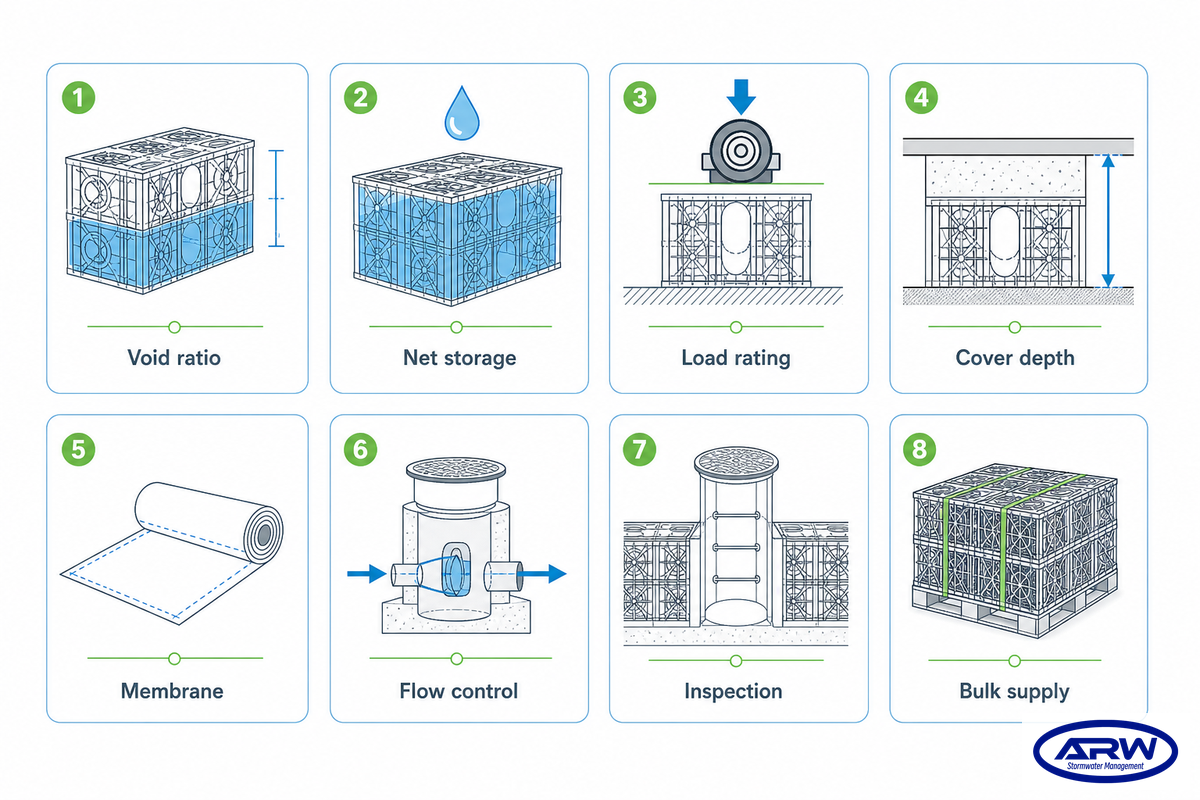
Attenuation crates are a system of geocellular modules used to store surface water underground for slow release. They sit inside the surface water drainage system for UK SuDS and must be specified as storage, flow control and maintenance assets rather than loose crate packs.
What Searchers Call This Same Product A searcher may type any number of terms in for a similar product: stormwater attenuation crate, water attenuation crate, stormwater attenuation system, stormwater management crate or water management crate. While it’s customer specific in phrasing, the underlying need for clarification is the same. Whether the wording is stormwater attenuation or water management, the specifications need to clarify design options regarding attenuation and infiltration, stormwater control methods and the regulation, governing authority or municipal requirement that impacts discharge.
That difference is critical for the 2025 national SuDS standards for England cover new infrastructure, the surface water management systems they serve, and, in doing so, define SuDS as being structured as a hierarchy, a long-term maintenance liability, and as a management train. While a crate schedule can assist it can’t be a proxy for design proof.
Terminology in supplier catalogues is not always consistent. Some buyers ask for types of crates, cellular crates, a stack of modules, an underground storage system, storm water during heavy rainfall, water during heavy rainfall conditions, collected storm water or ground storm water. A practical specification still has to suit the level of surface water, the ground water table, water infiltration limits, infiltration of storm water, covering depth, excess runoff, retention duty and any flood-prone layout. Installing attenuation should be treated as a sustainability and environmental decision because the right package can retain water, promote controlled discharge, improve downstream risk and be beneficial for long-term site management.
| Check | What to ask for | Why it changes the design |
|---|---|---|
| Storage volume | Gross volume, void ratio and net storage per crate | Crate count is based on usable water volume, not outside dimensions. |
| Void ratio | Published percentage and test basis | Most high-capacity geocellular systems sit around 90-95% void space, but the final tank volume still depends on module geometry. |
| Load class | Vertical and lateral strength, cover depth range and allowed surface use | A driveway, car park and HGV route should not share one assumption. |
| Wrap method | Geotextile, geomembrane or both, plus jointing method | The wrap decides whether water infiltrates, is sealed for attenuation, or is protected from fines. |
| Pipe connection | Inlet, outlet, top hat, flange and pipe diameter details | Bad connections create leakage, silt entry and maintenance problems. |
| Flow control | Design discharge rate, control chamber and overflow route | Crates store water; the control device sets the outflow behaviour. |
| Inspection | Access points, silt trap, cleaning route and maintenance interval | Long-term storage capacity can fall when sediment is not managed. |
| Certification | Relevant product tests, material standard references and factory documents | Buyers need proof that the class on the quote matches the project case. |
| Replacement access | Location under open space, road, shared parking or other maintainable area | Several LLFAs ask designers to consider maintenance or replacement access for below-ground attenuation. |
For standard traceability, the ANSI Webstore listing for BS EN 17152-1:2019 storm water boxes is a useful prompt: ask which product standard, test certificate or factory document applies to the proposed crate family rather than relying on a catalogue strength label alone.
Download and integrate this checklist with AQUA RainWater’s UK attenuation tank design guide. For sizing based on product specifics, cross-reference the crate evidence against the AQUA geocellular tank range and geocellular stormwater modules.
Attenuation Crates vs Soakaway Crates: Which Job Is the Crate Actually Doing?
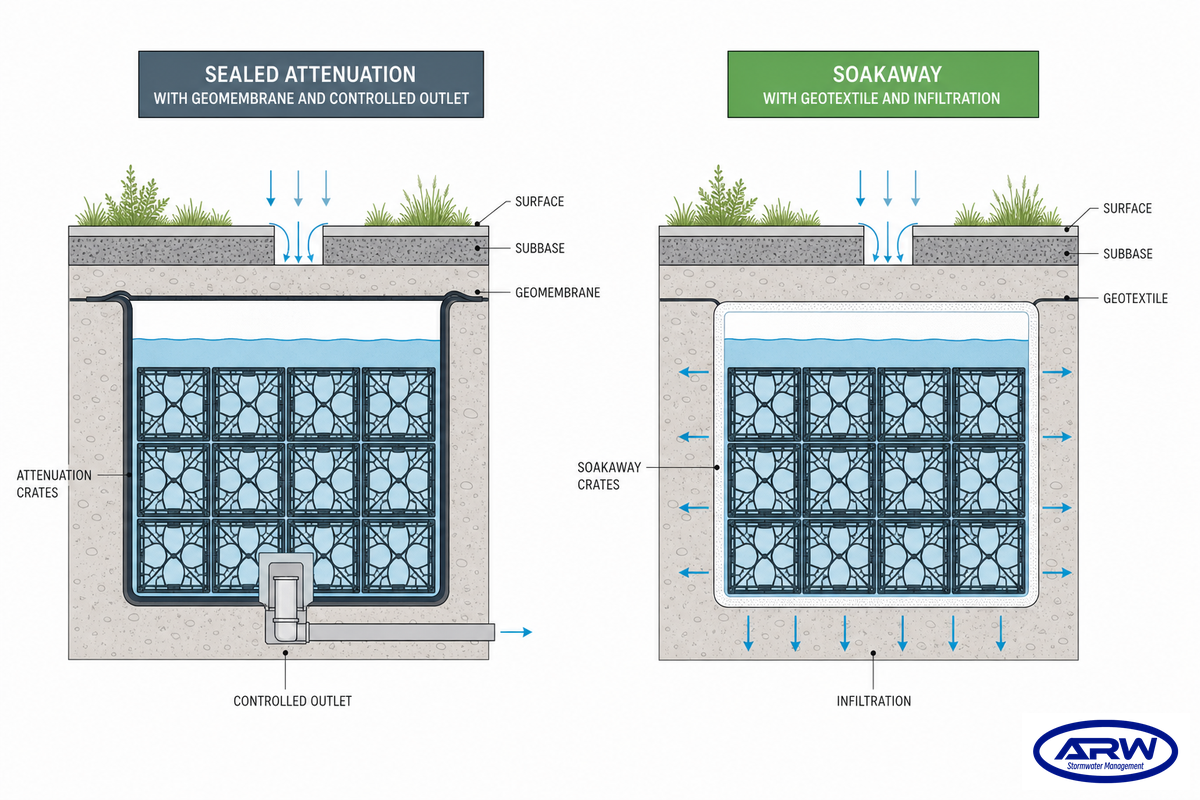
An attenuation crate and a soakaway crate may consist of identical modular units, but the functions they perform are different. A soakaway crate is porous and allows water to soak into the ground. A sealed attenuation crate system is used to hold water and discharge to a sewer, watercourse or other approved location at a specified rate.
This is often where much of the mistake begins. In the UK, large search demand is on “soakaway crates”, but SuDS hierarchy and site constraints could render easy infiltration non-viable. According to the 2025 national standard, infiltration has clear limits: ground conditions must be appropriate, infiltration rates adequate and the bottom of any infiltration must not be within 1m of the max likely groundwater.
On a driveway application or car park use case, the wrong order creates risk because a soakaway package and a sealed attenuation package solve different drainage problems. AQUA RainWater provides geocellular tank and stormwater module evidence, including 95% void space and 1000 mm x 500 mm x 500 mm module data, so buyers can confirm against product facts before a design team commits to one route.
| Design question | Soakaway / infiltration answer | Sealed attenuation answer |
|---|---|---|
| Main purpose | Let surface water disperse into suitable soil | Temporarily store water and control discharge |
| Typical wrap | Permeable non-woven geotextile | Impermeable geomembrane, usually protected by geotextile fleece |
| Ground condition dependency | Very high | Still important, but not for infiltration rate alone |
| Groundwater sensitivity | Critical for infiltration approval | Critical for uplift, leakage and excavation risk |
| Outflow route | Into surrounding ground | Flow control to approved discharge point |
| Pollution risk check | Needs soil and groundwater protection review | Needs treatment train, sediment control and sealed joints |
| Maintenance focus | Prevent clogging at the geotextile/soil interface | Inspect silt, flow control, inlets, outlets and liner condition |
| Best buyer phrase | “Infiltration crate with geotextile” | “Lined attenuation tank with geomembrane” |
| Risk of wrong order | System will not drain or may pollute groundwater | Tank may leak, silt up or fail to control discharge |
The 95 Percent 30-Point Storage Test: Void Ratio, Excavation Volume and Crate Count
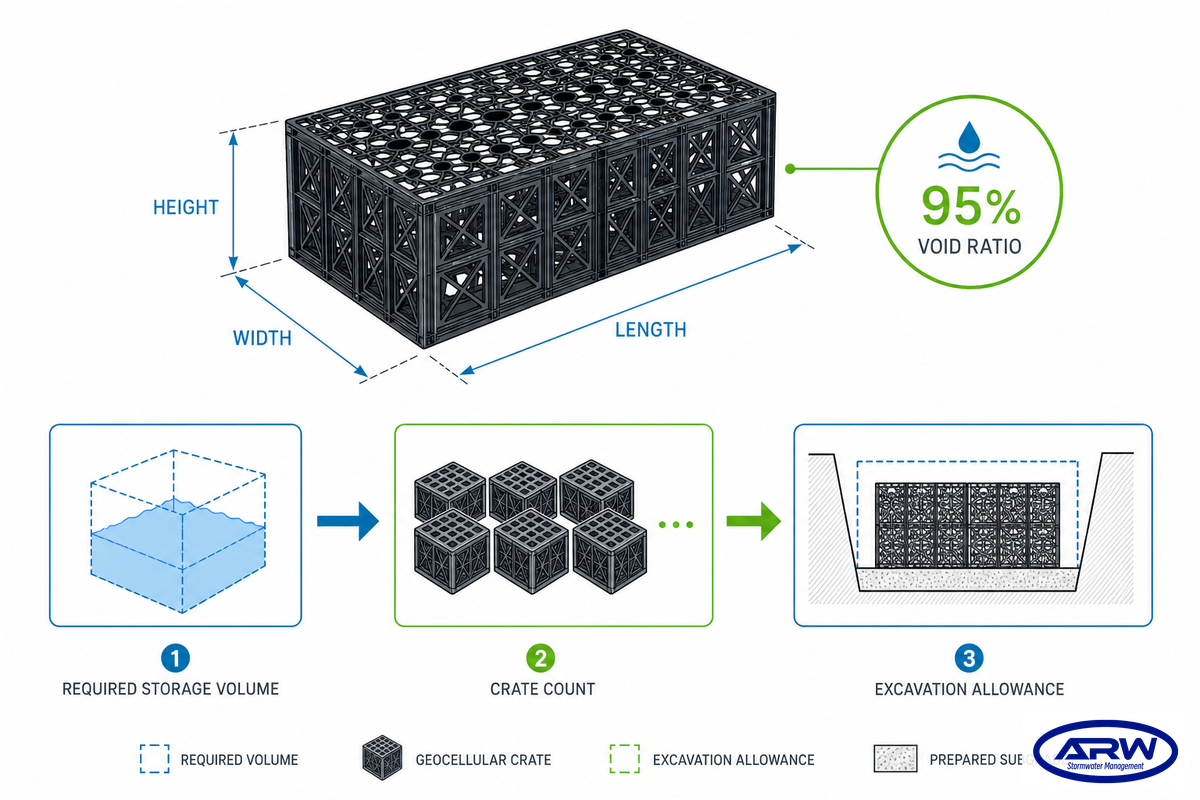
A great initial sanity-check on an attenuation crate quote, this 30-Point Storage Test works as follows; look whether the design is near 95% net void space, then ask whether the nominated load class is realistic for a 30 T/m2 baseline or higher project.
AQUA RainWater’s geocellular tank module is sold in dimensions of 1000mm x 500mm x 500mm, is roughly 95% void, and 95% storage capacity at 0.238m3. That isn’t a substitute for hydraulic design, but it allows the buyer to check crate-count errors before an expensive RFQ.
| Target storage | Basic crate count | What to confirm before ordering |
|---|---|---|
| 5 m3 | 22 crates | Pipe positions and the design margin for silt/tolerance. |
| 10 m3 | 43 crates | Whether the array fits the planned footprint and cover depth. |
| 15 m3 | 64 crates | Layer count, lateral stability and installation access. |
| 20 m3 | 85 crates | Whether the tank remains inspectable after the layout changes. |
| 25 m3 | 106 crates | Delivery packing, handling method and membrane roll sizes. |
| 30 m3 | 127 crates | Flow control chamber sizing and top-hat connection details. |
| 40 m3 | 169 crates | Sequence of excavation, bedding, wrapping and backfill. |
| 50 m3 | 211 crates | Whether multiple cells or inspection corridors are needed. |
| 100 m3 | 421 crates | Bulk supply schedule, container loading, spares and quality documents. |
In this table, the formula is intentionally basic: target storage capacity divided by net module capacity, upscaled to the nearest whole number. It doesn’t make allowances for project differences, freeboard, silt capacity, or unusable space for connections and designers’ safety margins. This formula is primarily intended as a check during purchasing rather than a drainage design tool.
For an RFQ use case, the risk is a crate-count gap because a nominal 10 m3 tank and a real 10 m3 usable storage target are not always the same thing. AQUA RainWater provides the 0.238 m3 net module reference and a supplier-reported, roughly 95% void figure, which gives buyers a practical evidence check before asking for a quote or drawing review.
Load Ratings by Surface Use: Landscape, Driveway, Car Park and HGV Routes
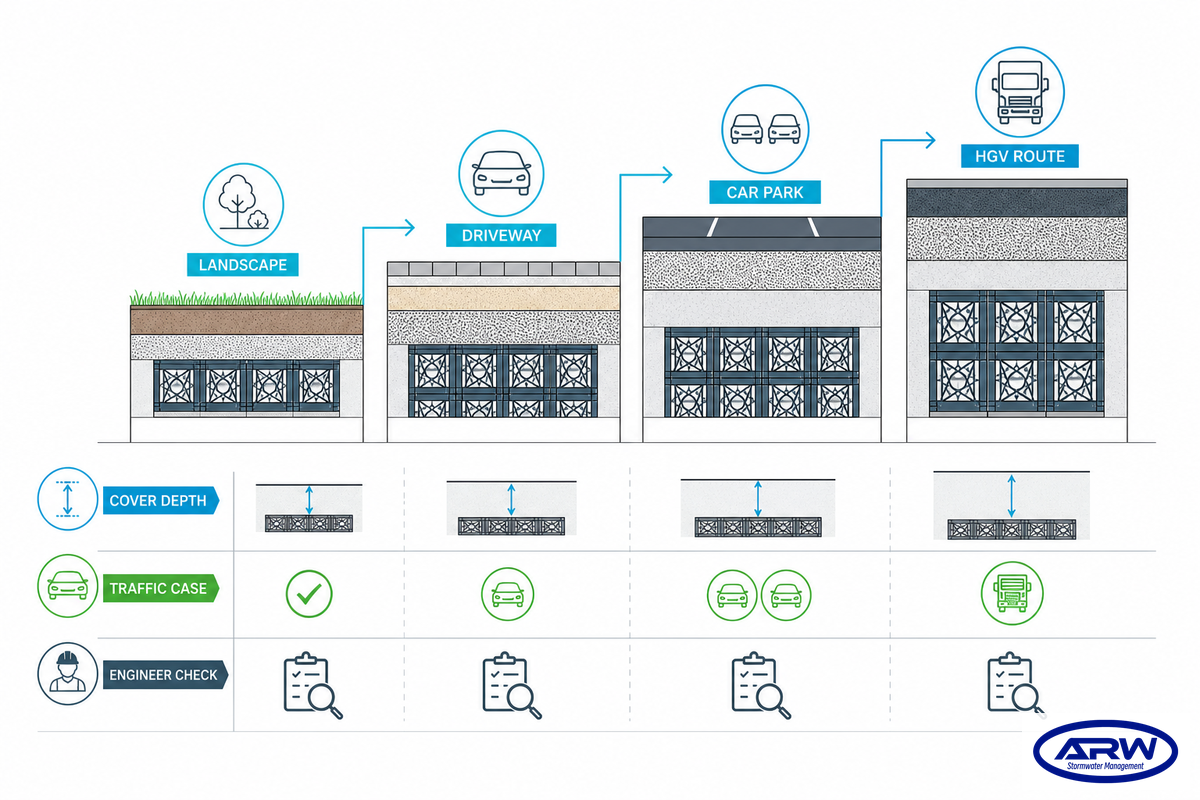
The load rating is probably the most commonly observed where a crate quote appears exact but it needs careful review. ADS Pipe UK state that, “The geocellular structural assessment must consider the short term traffic loading and the long term loading due to cover material and lateral earth loads and comply with the manufacturer’s cover depth limitations and installation conditions.”
AQUA RainWater’s geocellular tank product line is defined as “Standard”, “Heavy” and “Super” for vertical load capacity of 30, 45 and 60 T/m2, respectively.
Their stormwater module product pages distinguish LD, SD, HD and XD duty families. Cite those as your product evidence then have the project engineer review your design cover, pavement build up and loading scenario.
On a domestic driveway, commercial car park or HGV service-yard application, the problem is not the product label alone; the structural risk appears because cover depth, pavement build-up and traffic frequency change the load case. AQUA RainWater provides product class data, while the engineer confirms against 30 T/m2, 45 T/m2 or 60 T/m2 evidence and the site-specific use case.
| Surface or use case | Early selection signal | Evidence to request |
|---|---|---|
| Garden or planted area | Light or standard class may fit | Minimum cover, soil type and replacement access. |
| Pedestrian plaza | Standard class often starts the review | Paving build-up and point-load assumptions. |
| Domestic driveway | Step up from light-duty if vehicles cross the tank | Vehicle load, cover depth and manufacturer installation guide. |
| Shared parking bay | Heavy class should be reviewed | Dynamic loading, compaction method and lateral load data. |
| Commercial car park | Heavy or extra-duty class may be needed | Traffic frequency, bay layout and maintenance access route. |
| Access road | Do not rely on tonne label alone | Eurocode/load case basis and cover depth limits. |
| Fire appliance route | Extra-duty review required | Fire-route loading and local authority requirements. |
| HGV service yard | Extra-duty or alternate tank form may be needed | Axle loads, fatigue, pavement design and structural check. |
| Adoptable or public road area | Needs standards and adopting-body review | Water company/highways requirements and departure evidence if non-standard. |
Geotextile or Geomembrane: The Membrane Wrap Decision That Changes the Whole System
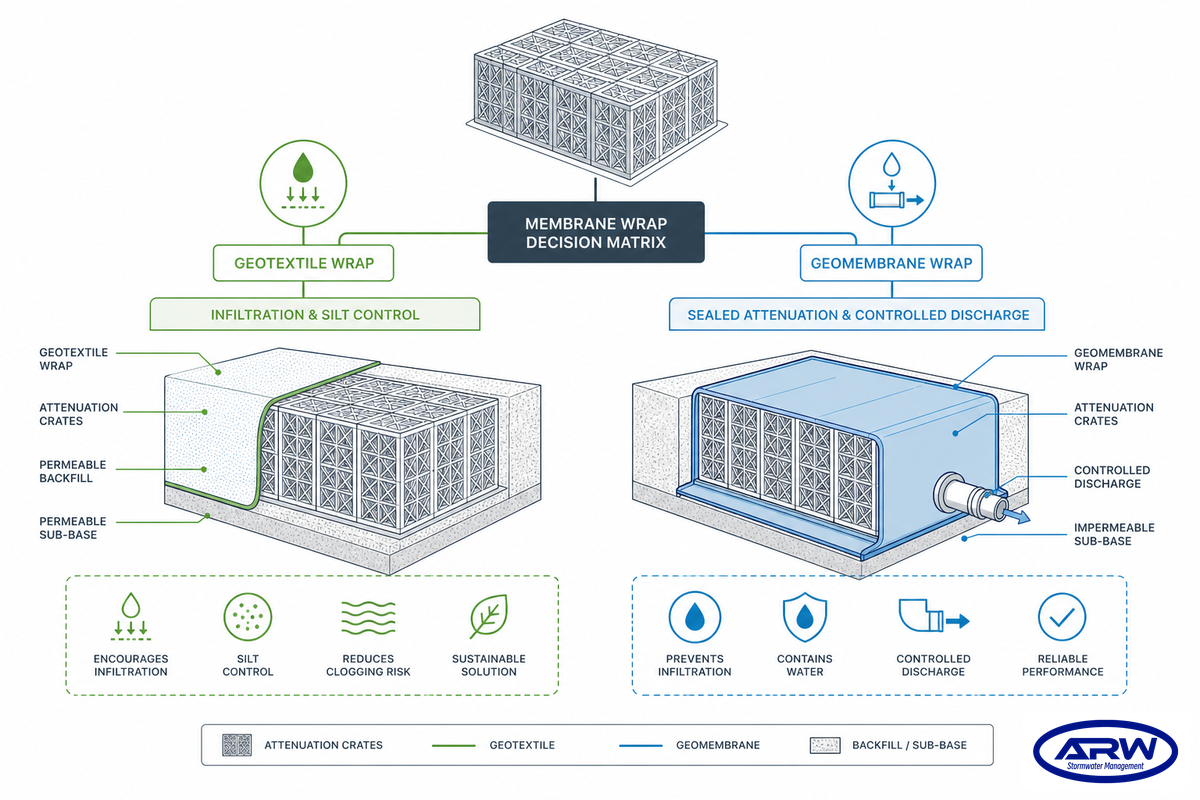
Membrane wrap isn’t an accessory line at the bottom of the quote. It changes the system hydraulics of the attenuation crate.
For infiltration the crate will have a permeable geofabric to keep fines out but let water flow away. For sealed attenuation there will be an impermeable liner with geofabric/fleece protection to prevent the liner from being pierced. AQUA guidance shows the split in its stormwater module where detention uses HDPE/LLDPE geomembrane with fleece protection, while infiltration uses non-woven geotextile.
For a clay-soil site, adoptable drainage route or car park runoff application, the membrane mistake can fail the system because water either needs a controlled discharge route or an infiltration route that the soil can accept. AQUA RainWater provides the detention-versus-infiltration package evidence, and the supplier should confirm against liner protection, geotextile separation and the published roughly 95% storage target.
| Project condition | Likely wrap package | Failure mode if chosen poorly |
|---|---|---|
| Infiltration allowed by soil test | Non-woven geotextile | Clogging if fines are not separated or if upstream silt control is weak. |
| Infiltration not allowed | Geomembrane liner plus protection fleece | Leakage or groundwater ingress if joints are damaged. |
| High groundwater risk | Engineer-led liner and uplift review | Tank uplift, liner stress or seepage pathway. |
| Car park runoff | Wrap plus pre-treatment | Pollution and sediment entering storage volume. |
| Clay soil | Usually sealed attenuation, subject to design | Slow or failed infiltration if treated as a soakaway. |
| Tree planting nearby | Root protection if design allows it | Root damage to liner or geotextile. |
| Bulk tank supply | Crates, clips, liner, geotextile, tape/welding package | Site delays when the membrane package is ordered separately. |
| Inspectable crate design | Wrap method that preserves access and connection seals | No practical cleaning route after silt enters the tank. |
| Adoptable drainage route | Project-specific standard and owner requirements | Rejected submission if product and installation evidence are incomplete. |
Pipe, Flow Control and Access: How the Crate Array Connects to a SuDS Strategy
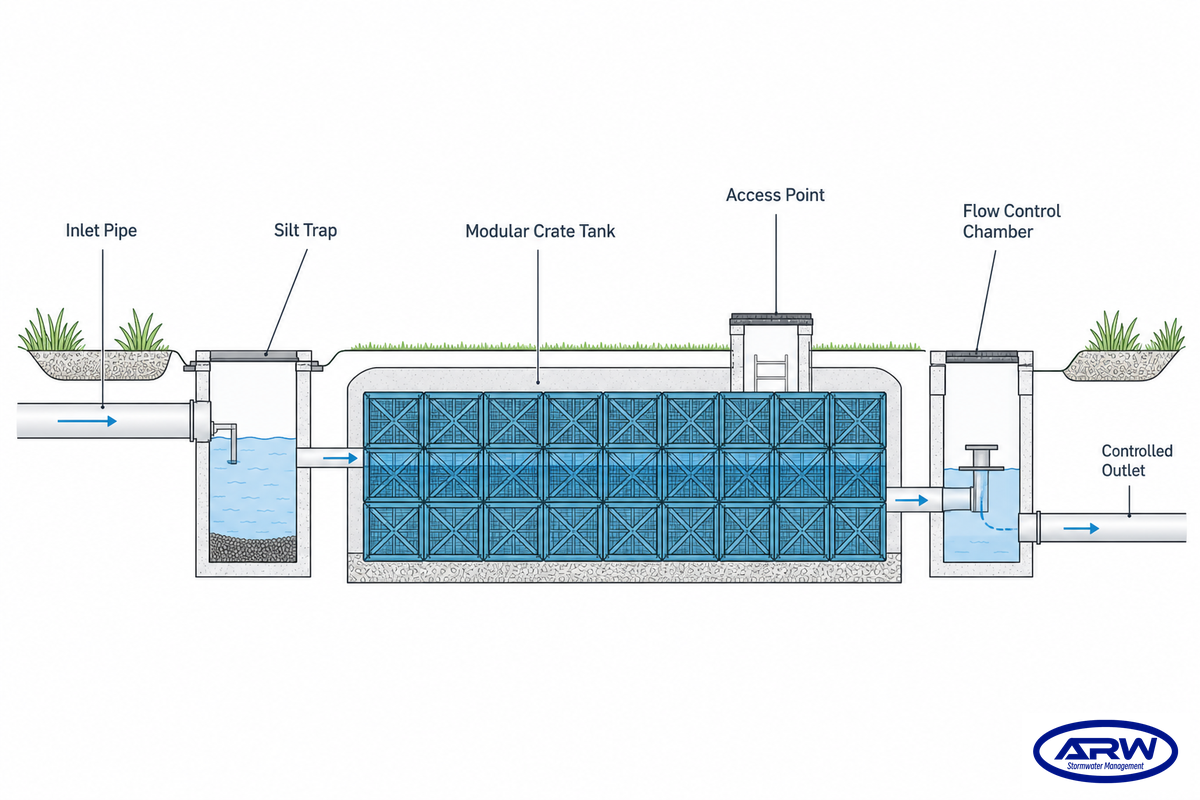
In the UK, the prevailing design philosophy regarding SuDS is that it should be “integrated”. That’s, the array of crates is just one component.
It needs to connect to inlet devices, outlets, flow control devices, pre-treatment measures, exceedance routing, maintenance access, and ultimately a final discharge location, in that order.
The RBWM Local Flood Authority guidelines state, “the attenuation device required to meet the proposed restriction should be clearly specified, and strong justification should be provided if in-ground attenuation devices such as crates, tanks or oversized pipes are proposed.” They also suggest that, “the designer should consider maintenance and eventual replacement over the lifetime of the development.”
When sourcing a supplier this means the buyer shouldn’t simply provide “need 25 m3 of attenuation crates.” It requires them to specify the catchment area, required storage volume, target discharge rate, preferred location, loading condition on surface, cover depth, sizes of incoming/outgoing pipes, and whether the device is to be a sealed attenuation or an infiltration system. That data enable the supplier to quote the most appropriate crate package that a contractor can effectively install and helps demonstrate how the proposed solution will manage heavy rainfall without moving flooding risk further down the road.
During a contractor take-off or planning-condition response, missing pipe data creates a risk because the crate body is only one part of the application. AQUA RainWater can review the storage target, 100 mm or 150 mm pipe entry, flow-control assumption and inspection route, then provide a specification trail that links the product evidence to the drawing.
Bulk Supply and Take-Offs: What UK Buyers Should Confirm Before Ordering
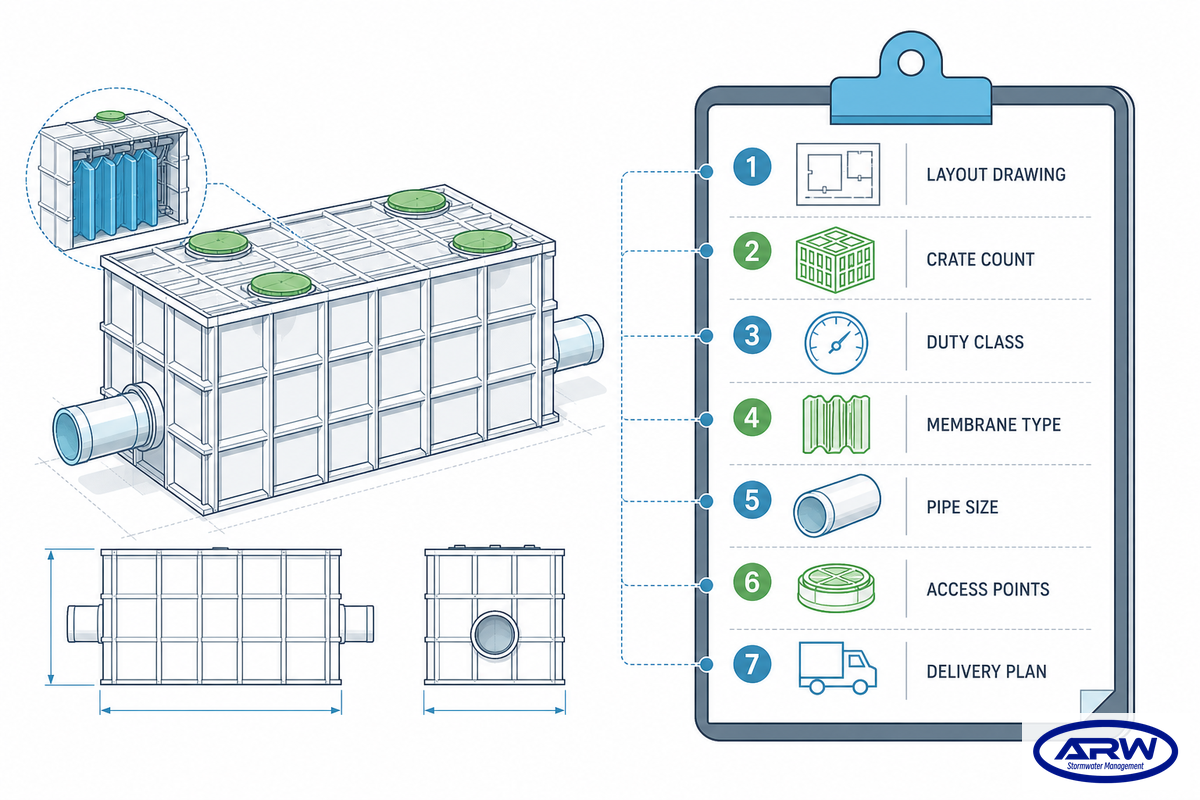
If purchasing the system in bulk, unit price is only a small fraction of the overall risk. The larger risk is that the crates can be appropriate for the required storage volume but still incorrect for the specific load case, the associated membrane specification or piping configuration, and may lack the submission evidence needed for the regulatory authorities.
Ask for supplier details on your 9-Row Wrap Matrix and a unit schedule, before PO issue. Module length at 1000 mm, width at 500 mm and height at 500 mm; supplier-published net void at about 95%; assumed cover at 0.5 m and 2.0 m; pipe entry at 100 mm or 150 mm; vent or inspection allowance at 75 mm, 225 mm or 300 mm; edge clearance at 1.5 m; delivery time at 3 days; unloading time at 24 hr; maintenance review period at 6 months; and design life assumption at 50 years all come in from supplier on an RFQ as evidence, not as generic design limits.
| RFQ line item | Buyer question | Supplier evidence to request |
|---|---|---|
| Crate model | Which model and dimensions are being quoted? | Product datasheet with module dimensions and net storage. |
| Quantity | How many crates are needed, including spares? | Crate-count calculation and packing schedule. |
| Load class | What surface and cover depth does the class assume? | Vertical/lateral strength, cover range and installation guide. |
| Membrane package | Is this infiltration or sealed attenuation? | Geotextile or geomembrane specification, protection fleece and jointing method. |
| Accessories | Are clips, connectors, top hats and inspection parts included? | Bill of materials, not just crate count. |
| Pipe interface | Which pipe diameters and inlet/outlet positions are planned? | Connection drawings and compatible fittings. |
| Certificates | What documents support the product claim? | Factory, material, test and quality documents available for the quoted model. |
| Delivery | How will the crates arrive and be handled? | Container or pallet plan, unloading method and lead time. |
| Design support | Can the supplier review a take-off before production? | Technical consultation route and drawing review scope. |
AQUA RainWater is available to advise on crate take-offs, membrane packages and technical consultations for project buyers. Use the ‘contact page‘ when you know your project’s target storage volume, surface loading, preferred drainage pathway and pipe sizes.
2026 UK Specification Signals: Why Shallow, Traffic-Rated and Inspectable Crates Are Moving Up the Shortlist
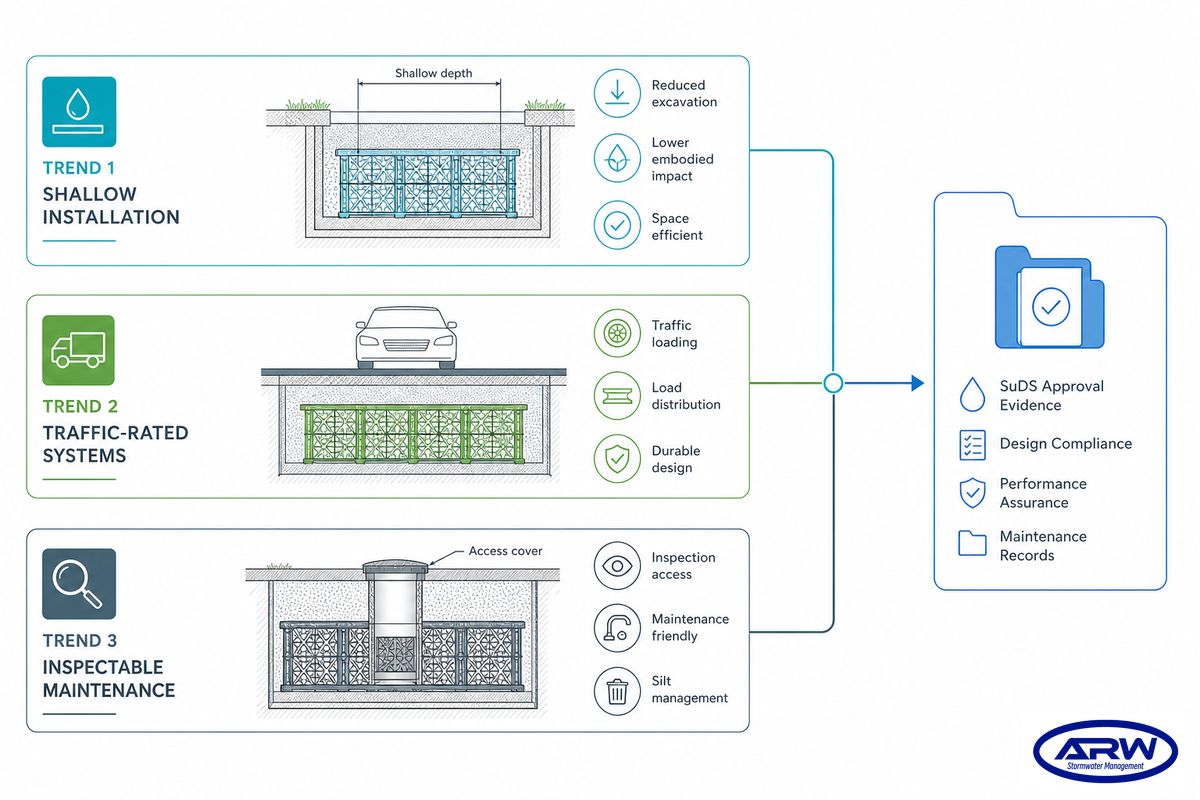
We see three recurring signals across the market research. The new 2025 national SuDS standards mean surface water drainage evidence is becoming far more accessible and transparent for both developers and consenting authorities. Developers are under pressure to attenuate surface water drainage into shallow or constrained sites, or spaces that carry heavy traffic loads. And there’s growing scrutiny around below ground systems, especially regarding maintenance, sediment management and their longevity.
However, this doesn’t mean that all projects demand the highest-specification crate; rather it indicates a shift in design discussions, away from a focus solely on “how many crates will fit in the void,” and towards a project-specific evaluation of which crate, wrap, connection and maintenance solution can effectively function throughout the development’s lifecycle.
Patent records also show why buyers should keep structural details, connection points and maintenance routes in the evidence pack; for example, NZ719565A describes stormwater crate and geocellular module arrangements where the module is only one part of the working assembly.
As a result, a UK buyer will most confidently approach a shortlist of suppliers who aren’t necessarily the cheapest but who can clearly document the interplay of void ratio, load rating, membrane wrap and bulk supply data in a practical evidence package.
Specification signal: the right attenuation crate shortlist is the one that links storage volume, load case, wrap package and maintenance access into a single evidence trail.
In a 2026 procurement application, the problem is shallow land, traffic loading and maintenance access arriving together. Because those risks converge in one tank, AQUA RainWater’s published roughly 95% void ratio, 30/45/60 T/m2 load-class data and membrane-package options give buyers a confirm-against checklist rather than a generic crate list.
FAQ
What is an attenuation crate?
An attenuation crate is a modular geocellular unit used beneath the ground surface to manage stormwater runoff from precipitation, releasing it at a managed flow rate. Each crate provides empty void space; however, a working system comprises the crate, its protective wrap, pipe connections, flow controls, access facilities, and maintenance arrangements. In terms of UK SuDS, the crate is one element within a broader surface water drainage system rather than a standalone design solution.
How many attenuation crates do I need?
First calculate your total required storage volume by dividing it by the net storage volume per crate and rounding up. As an illustration, for a crate with 0.238m3 net storage, 10m3 storage requires 43 crates before any additional design allowances. Note, drainage engineers may include factors like freeboard, unused connection volume, configuration, silt allowance, safety margins, and site-specific constraints to these figures, so use this quick sum for a guide only.
What is the difference between an attenuation tank and a soakaway?
A soakaway allow water to infiltrate directly into the surrounding soil, whereas a sealed attenuation tank holds the water temporarily and discharges it at a regulated flow rate to a designated recipient. While both systems can use identical crates, the choice of wrap, design of the outlet, and compliance evidence will vary. Substituting attenuation crates for a soakaway when infiltration, ground conditions, or contamination aren’t ideal can lead to design complications and compliance issues.
Do attenuation crates need geotextile or geomembrane?
This will depend on the function of the system. Generally, for infiltration, permeable geotextile will be used so water can escape to the ground and fines kept out. For sealed attenuation systems, a geomembrane liner is installed to create a barrier to the ground.
Geotextile or fleece protection will typically be provided on top of the geomembrane in a sealed system to minimise the risk of puncture. Verify the intended system function before specifying the membrane package.
Can attenuation crates go under driveways or HGV areas?
They can do but only when the crate class, cover depth, pavement structure, soil type and traffic loading meet the project requirements and are in accordance with the design parameters of the product.
Don’t accept just the tonne label! Insist on seeing vertical and lateral strength data, manufacturer’s installation limits and an engineer’s assessment for the load case in question.
What should I send to a supplier for a bulk attenuation crate quote?
Supply the target storage volume, location, surface use, cover depth, expected traffic load, required pipe sizes, destination of discharged water, whether sealed attenuation or infiltration system, whether membrane is required and, if available, your project drawings and the specific documentation package required.
Also advise the status of the SuDS drawing – e.g. design phase, planning condition, contractor take-off or value-engineering review. If the tank will carry traffic load over the surface of the cover, detail the surface build up and typical vehicle class. If the tank is in close proximity to boundary walls, trees, utilities or ground water, let your supplier know at the outset.
Although a supplier may be able to quote for a bulk quantity of crates from volume alone, a safer bulk quotation requires further information and the avoiding a further order for the necessary wraps, access equipment or indeed alternative load class of crate.
Sources and Further Reading
- GOV.UK: National standards for sustainable drainage systems (SuDS)
- RBWM: Attenuation design guidance
- ANSI Webstore: BS EN 17152-1:2019 storm water boxes
- Google Patents: stormwater crate and geocellular module patent family
- ADS Pipe UK: Below-ground SuDS attenuation service life
- Susdrain: Sustainable drainage background
- AQUA RainWater: Geocellular tanks
- AQUA RainWater: Geocellular stormwater modules
 English
 Arabic
 French
 Russian
 Spanish