
Rainwater Harvesting System UAE: Complete Guide for MEP Engineers & Developers
By AQUA Rain Water Solutions | March 2026 | 14 min read

This guide has been produced primarily for MEP consultants, EPC contractors, and property developers engaged on commercial and industrial projects in the UAE. The information provided is for the purposes of preliminary design assessment only and must be verified and validated by a chartered civil or structural engineer with further consultation required with Dubai Municipality and/or Abu Dhabi QCC for system design approval.
The system collects, attenuates and reuses stormwater for non-potable applications thereby helping in decreasing the dependence on the energy-intensive process of desalination especially in water-scarce nations like the UAE. The average annual rainfall in the UAE is approximately 78mm (National Center of Meteorology). The capture and re-use of rainwater not only helps in water conservation but it is extremely beneficial in reducing energy consumption. This is especially critical in the UAE where precipitation events are unevenly distributed and showing signs of irregularity and variability. In April 2024, The National Center of Meteorology revealed that the national maximum annual rainfall record for the country was breached at the Khatm Al Shakla station in Al Ain, with 254.8mm being recorded in June, while the Dubai International Airport weather station recorded 142mm of rainfall in a 24hr period triggering flash floods in both Dubai and Abu Dhabi. This was a wake-up call for municipalities as soon as it was announced, and it wasn’t long before the crisis was dealt with, as late June saw Sheikh Mohammed approve a Dh30 billion ($8.2B) infrastructure programme called Tasreef. (Source: Dubai Media Office, June 2024) Engineers and developers are no longer willing to wait for the completion of infrastructure projects from the municipalities. They are incorporating harvesting networks and detention systems as part of the primary infrastructure of the buildings and projects to create sustainable and cost-effective commercial developments that comply with the regulatory framework and are capable of withstanding the climatic challenges.
Why UAE Projects Need Rainwater Harvesting Systems

The reasons for specifying a rainwater harvesting system UAE are far more than an environmental necessity, it has moved on to become a necessity that is regulatory, for resilience of structures, and for the long-term financial viability of any organisation.
The UAE’s Freshwater Deficit
The UAE is one of the most water-stressed countries in the world, as documented by the World Resources Institute. With an economy booming in the name of rapid development — mega projects, real estate and industry — water is a resource that is becoming increasingly scarce, non-renewable and expensive. Ministry of Energy and Infrastructure data shows that 42% of our fresh potable water — water we can drink — is produced using thermal and reverse osmosis (RO) desalination, all the while consuming anywhere between 3.5 and 5 kilowatt hours (kWh) of electricity per cubic metre of water produced. Though an extraordinary feat of engineering, using desalination to produce fresh water is a very carbon and energy intensive and therefore extremely expensive process. Using updated figures, the UAE is spending around $3 billion annually for water infrastructure. Beyond this, the precious groundwater aquifers that were once our main source of water are seeing a tremendous rate of drawdown. The rate at which we are depleting our groundwater is unsustainable — an uncomfortable fact for those planning developments that will be here for generations to come. The UAE Water Security Strategy 2036 — issued by the Ministry of Energy and Infrastructure — aims to reduce per capita water consumption by 25% and is looking to gradually increase the utilisation of alternative sources of water, like reclaimed wastewater and harvested rainwater for meeting the needs of the nation by 2036. Our water consumption on a per capita basis currently stands at a whopping 550 litres per day — more than double the world average per capita consumption, which is 280 litres per day. It is simply not feasible to use expensive DEWA-supplied desalinated seawater for even the most basic of non-potable applications in large real estate projects and developments that can afford to do better.
Flash Floods vs. Chronic Scarcity: A Dual Challenge
Every year in the Middle East, devastating flash floods take lives, destroy property and are a national media catastrophe due to the heavy loss of life. Yet on an average year, civil engineers in the region deal with nothing more complicated than a so-called hydrological paradox or a “dry retention basin filled with water that pours in from a torrent following a short period of intense rainfall”. In general, design and management is based on a chronic or normal dryness level or baseline aridity in the Middle East and surprise rainfall events or floods occur in the form of irregular periodic intense precipitation events. The compaction of arid soils — particularly the calcrete and sabkha formations common across the coastal UAE — severely restricts infiltration to rates far below what would occur in temperate regions. As a result, even moderate rainfall generates rapid surface runoff, which has been a major contributing factor in the severe flash floods which occur from time to time in our urban centres such as Sharjah, Dubai and Ras Al Khaimah.
Wadi systems that exist in the mountainous areas of Fujairah and Ras Al Khaimah are sufficient to cater for the average annual rainfall of 130 to 170mm. This, however, is not the case with heavily impervious urban areas. As witnessed with the April 2024 storm, with the falling depth of rain amounting to more than the annual average in Dubai in a single event, there is a need for re-engineering our drainage infrastructure from designs suitable for occasional return-period events to harvest-and-store principles. This, as observed in the capital following heavy flooding as a result of the storm that caused damages estimated at over AED 1 Billion throughout the UAE, has emphasized the need for enhancing the drainage capacity of the country significantly. The present Tasreef programme of the Ministry of Infrastructure Development aims at increasing the capacity of the drainage system in Dubai by as much as 700% which amounts to increasing the present detention capacity in Dubai by more than 20 million m³. However, the first line of defence for mitigating the flooding arising from the rains and especially in the case of localised flash floods within urban areas, is through constructing geocellular rainwater harvesting systems for the interception of stormwater runoff at the source before it is cascaded into flood-prone drainage systems or causes any damage to properties. For a detailed comparison of detention-only versus harvesting configurations, see our guide to stormwater detention systems in the UAE.
How Rainwater Harvesting Systems Work: From Catchment to Storage

A working knowledge of current stormwater management principles and hydraulic design standards is essential when specifying surface water harvesting systems. Depending on the size of the contributing catchment area and topography of the site different hydraulic configurations are required. Please note that this section is relevant to non-potable, commercial/industrial applications of underground geocellular systems only. Domestic rain barrel systems, agricultural catchment collection and fog harvesting are not covered. Average annual rainfall data is based on the national average. However, data per Emirate varies (Fujairah/RAK 130 – 170 mm/yr, Dubai 78 mm/yr approx).
How Underground Geocellular Harvesting Works
| System Type | Application Environment | Suitability for UAE Market |
|---|---|---|
| Rooftop Collection | Residential villas and mid-rise commercial buildings | Highly suitable; rooftop runoff is generally cleaner and requires less pre-treatment for non-potable reuse |
| Underground Geocellular Tank | Large-scale commercial, industrial hubs, and master-planned infrastructure | Highly suitable, primary B2B application: maximises surface land use while preventing evaporation |
| Wadi Recharge (Subsurface Dam) | Northern Emirates (Fujairah, Ras Al Khaimah) | Suitable primarily for large-scale, government-funded regional aquifer restoration projects |
| Fog Harvesting | High-elevation areas such as the Hajar Mountains | Niche; extremely limited commercial viability for urban developers |
At AQUA RainWater Solutions, our engineering team has specified ground-level geocellular tank systems as the preferred solution for large B2B commercial and industrial catchment areas. The harvesting cycle of the ARW system operates as follows: Catchment: The catchment area is defined as the contributing drainage area which drains into the ARW storage tank. An example of a catchment area is an expansive commercial flat roof, a multi-storey car park or an expansive hardstanding area of a logistics depot. Stormwater runs over the roof, car park or logistics depot and carries all the first flush of pollutants — typically the first 2mm of rainfall per m² of catchment which carries the heaviest concentration of suspended solids and hydrocarbons — to a storage area prior to entry into the main water tank. Prior to entry into the main tank, a pre-filtration stage using hydrodynamic silt traps rated for flows up to 50 L/s or vortex separators is mandatory to remove all sediments, sand and other solid debris. The pre-filtration stage is designed in accordance with BS EN 858-1 (Separator systems for light liquids) to ensure the discharge water quality meets the municipal reuse criteria.
Once the water has been filtered it will be stored under the property in a large underground void, formed by assembling an array of high-strength polypropylene (PP) geocellular modules with a void ratio of 95%. Each ARW-1050 module measures 1050 x 1050 x 400mm and the modules interlock to form a monolithic structure that can span any footprint geometry. The fact that the whole modular structure is completely sealed with a heavy-duty, UV-resistant EPDM geomembrane liner — either 1.0mm or 1.5mm thickness depending on the burial depth and site loading conditions — ensures that the water harvested is safely retained in the ground and does not leach into the surrounding salt-bearing sabkha soils. A non-woven geotextile separation layer (minimum 300 g/m²) is installed between the geocellular modules and the surrounding backfill material to prevent fine particle migration into the void structure.
Specifiers should note the critical distinction between a harvest-and-use system and a subsurface stormwater management system designed for detention only. The flow control device — typically a vortex or orifice-plate valve calibrated to the permitted discharge rate in L/s as stipulated by the municipality — regulates the exact rate of overflow discharge into the municipal storm sewer system to protect against surcharging the municipal lines during high storm events. With a detention system, stormwater is simply temporarily stored to prevent flooding with the intent to ultimately discharge all of the stormwater. In contrast, in a harvest-and-use configuration stormwater is retained and stored indefinitely. A harvest-and-use system (like our advanced geocellular tank systems) can be considered to be a hybrid system comprised of a bottom liner (for retention and reuse such as for cooling towers or irrigation) and an open top (as temporary storage for flood attenuation purposes).
UAE Regulatory Framework: Dubai Municipality, Abu Dhabi QCC and Estidama

In the UAE, installing a rainwater harvesting system is no longer merely a voluntary measure or simply an “eco-friendly” idea, but a statutory requirement for all new building projects imposed by law and the municipal codes of compliance. For MEP consultants and project managers, this is perhaps the most consequential part of the design process.
Dubai Municipality Requirements
The latest edition of Dubai Municipality Stormwater Design Guidelines (applicable post-Tasreef revisions, ref. DM Technical Guideline No. TG-001) govern how surface water should be managed. As per the Municipality Code, any commercial building project with plot area above the specified thresholds must provide attenuation/retention capacity for stormwater management within the site. The developer is required to obtain the No Objection Certificate (NOC) prior to embarking on any construction works. Based on current processing timelines the NOC review typically takes 4 to 8 weeks from the date of submission of a complete application package. Incomplete submissions are returned with a Request for Information (RFI) which can add an additional 2 to 3 weeks to the approval cycle.
The NOC is issued after the presentation of detailed hydraulic design calculations, catchment area analysis and the specification of the geocellular tank, for the Municipality to carry out a full review of the engineering submission, after which the NOC is released. RWH is then accepted as an approved retention system. The hydraulic submission must include IDF curve analysis, catchment runoff calculations and a system capacity verification report signed by the Engineer of Record.
The Municipality has the following requirements for underground storage tanks in Dubai: – Silt traps shall be located upstream of the storage tank to ensure protection of the water quality. – A minimum of two entry points are required in the form of access chambers (minimum 600mm clear opening) for each tank footprint, for future maintenance, and to enable efficient vacuum tanker extraction. The structural modules should be in accordance with recognised international standards. In addition, the guidelines refer to recognised international standards such as BS EN 17152 (Plastics piping systems for non-pressure underground conveyance and storage of non-potable water), for performance of geocellular units with site-specific requirements to be verified through the NOC process.
Abu Dhabi QCC Guidelines
Materials Approval in Abu Dhabi for Infrastructure in the Capital: The Abu Dhabi Quality and Conformity Council (QCC) is responsible for the approval of infrastructure materials in the capital. The QCC requirements for infrastructure material testing are similar and in some cases more stringent than those of Dubai for geocellular underground structures, including mandatory compression testing to BS EN ISO 9863-1 at both ambient (23°C) and elevated temperature (50°C) conditions, and chemical resistance testing per BS EN ISO 175 for the polypropylene modules. Hence, for all projects in Abu Dhabi, a QCC compliance submission has to be undertaken for demonstrating the structural integrity as well as the chemical inertness of the tanks prior to obtaining the building permit from the Department of Municipalities and Transport (DMT). The QCC submission requires a minimum of 5 test specimens per batch with results certified by a UKAS or DAkkS accredited laboratory. In addition, all the plumbing for reclaimed water reuse system for applications such as flushing toilets and cooling water systems require strict adherence to cross-connection controls as per UAE.S GSO 1938 plumbing code requirements, including mandatory reduced pressure zone (RPZ) backflow preventers at all non-potable supply points.
Estidama Pearl Rating and Al Sa’fat Green Building
Water harvesting has become a major scoring component for assessing the sustainability of buildings in the UAE. Rating systems including Estidama and Al Sa’fat currently weight water harvesting heavily in their assessment criteria, with several making it mandatory for high-specification projects.
The Estidama Pearl Rating for Abu Dhabi projects varies from Pearl 1 to Pearl 5. Water Efficiency or W credits includes a credit for a functional rainwater harvesting system – Precious Water (PW) credits. Specifically, credit RE-R1 (Stormwater Management) requires on-site retention for the 90th percentile storm event, while PW-2.1 awards points for reducing potable water consumption through alternative water sources. Many government projects and premium private developments achieve the Pearl Rating through these water recycling credits.
Green Buildings: the Al Sa’fat rating system (Bronze, Silver, Gold, Platinum) contains specific incentives for efficient stormwater management. Achieving the Al Sa’fat rainwater harvesting credit will reduce the building’s calculated municipal water demand footprint hence facilitating the approvals process with Dubai Municipality. Under the Al Sa’fat Platinum tier, a minimum 30% reduction in potable water consumption from baseline must be demonstrated.
Finally, high-efficiency harvesting helps large commercial properties achieve DEWA compliance through reducing metered water consumption to the prescribed limits.
Underground Geocellular Rainwater Harvesting Tanks: Specifications
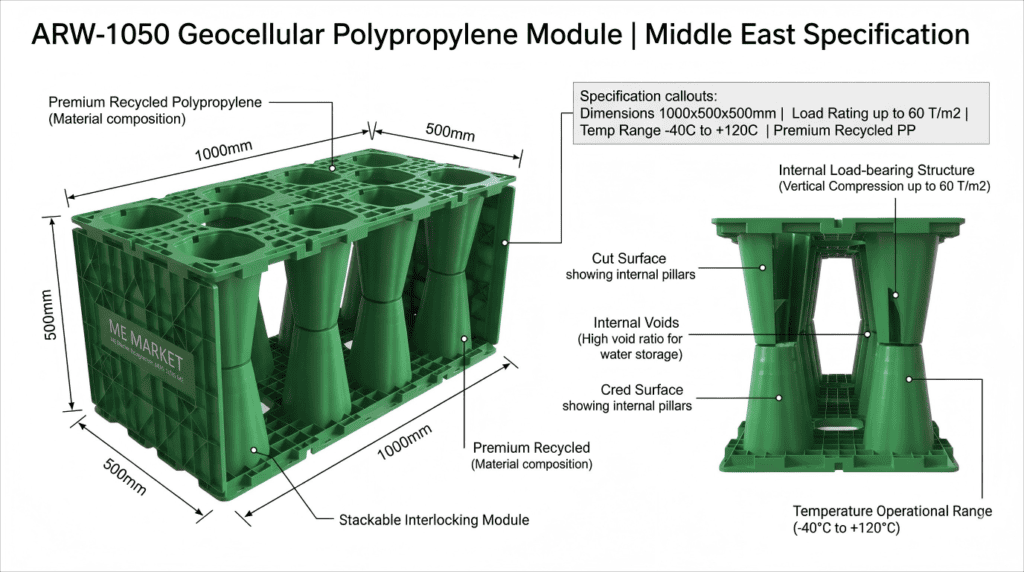
For Procurement Directors and Civil Engineers the choice of geocellular module is a critical specification decision. The standard off-the-shelf European and Asian products are frequently not adequate for the Middle East climate, due to the extreme temperature differentials and structural loading requirements. For detailed product data, download the ARW-1050 technical specifications.
ME Market Notice – Please note that the manufacturer recommends the use of the ARW-1050 module for the ME (Middle East) market. The models ARW-8053 and ARW-6841 are not rated for the ground conditions in ME and are not available for this market.
Why These Specs Matter for UAE Conditions
The harsh climate in the UAE accelerates the degradation of subsurface structures. During the hot summer months, the ambient temperature of the ground beneath the asphalt pavement can easily reach 50°C or more. Softening, creep deformation and brittle failure of PVC or low-grade thermoplastics is a common phenomenon under sustained loading at elevated temperatures. The ARW-1050 modules are constructed from virgin-equivalent recycled PP with a melt flow index (MFI) of 8 to 12 g/10min, heat rated up to 120°C and achieving a compressive strength of ≥400 kN/m² at 5% deflection per BS EN ISO 9863-1. The modules have been independently verified to withstand 10,000-hour creep loading at 50°C without exceeding 2% total strain, confirming long-term structural stability under UAE ground conditions. The modules do not deform structurally under seasonal temperature variation.
The constraints of urban space mean that many harvesting tanks are sited under key trafficable areas such as main logistics loading bays, fire engine routes through yards, and even entrances to multi-storey car parks. The ARW-1050 has a wide load rating range (30 to 60 T/m²). At 60 T/m² it is then possible to accommodate all the dynamic, oscillating loads associated with the passage of fully loaded heavy goods vehicles. The load rating has been determined in accordance with BS EN 1991-1-1 (Actions on structures — general actions) for traffic category F (gross vehicle weight up to 63 tonnes).
In the retained mode, use of EPDM geomembrane liner is mandatory for waterproofing integrity. The EPDM has superior UV resistance properties throughout the duration of the installation process and remains fully chemically inert when in place and buried in the hostile, very saline, high pH soils found in the coastal region of UAE. The EPDM liner conforms to BS 6920 for contact with water intended for non-potable reuse applications.
Sizing: Catchment Area Calculation
Accurate volumetric sizing is critical to the hydraulic performance of the system. The standard rational method formula for preliminary sizing is:
Volume (m³) = Catchment Area (m²) x Design Rainfall (m) x Runoff Coefficient
OPERATIONAL EXAMPLE A commercial warehouse in Dubai has a 5,000 m² roof. Design the quantity of water to be harvested using the annual average rainfall (0.078m), and standard runoff coefficient for an impermeable metal roof (0.9).
Harvestable yield = 5,000 m² x 0.078 m x 0.9 = 351 m³ per annum.
In order to design an optimal stormwater management system, Engineers must also consider the Dubai Municipality IDF (Intensity-Duration-Frequency) curves for a 5-year return period storm event. This design criterion is essential to prevent localised flooding and hence the system is designed to handle 40 to 60mm of design storm depth. For critical infrastructure (hospitals, data centres, civil defence facilities), the Municipality may stipulate a 10-year or 25-year return period, which substantially increases the required detention volume.
Project Applications: Where to Install Harvesting Systems in UAE

| Project Type | Target Application Zones | System Size | Technical Notes |
|---|---|---|---|
| Mixed-Use Developments | Premium master-planned communities and retail districts | 500–2,000 m³ | Mandatory integration required to achieve Estidama and Al Sa’fat green building certifications |
| Industrial Parks | Major Free Zone logistics hubs and manufacturing facilities | 1,000–5,000 m³ | Requires 60 T/m² load ratings to withstand continuous HGV container truck traffic |
| Master-Planned Communities | Mega residential island and coastal developments | Multiple distributed systems | Installed in phases; highly adaptable to high water tables and shifting coastal soil conditions |
| Commercial Buildings | High-rise financial centres and corporate headquarters | 200–800 m³ | Combines rooftop primary catchment channelled down to deep basement or plaza-level geocellular tanks |
| Aviation & Port Terminals | Critical national infrastructure projects | >5,000 m³ | Extreme redundancy required; strict adherence to Municipality Code and BS EN structural standards |
The modularity of geocellular tanks enables site developers to design and construct below-grade storage utilising existing land areas to their full potential, whilst enabling design flexibility to accommodate even the most irregularly shaped sites.
Case Study: Large-Scale Commercial Logistics Park, GCC Region
Anonymous Case Study: Large-Scale Commercial Logistics Park in the Gulf Region
A site for a brand new 1,200 unit Flagship Commercial Development in one of the key free zones in a major GCC nation was met with a requirement from the Municipality that there would be NO SURFACE RUN-OFF DURING A 1-IN-50-YEAR STORM EVENT. Combined with very stringent mandatory water reduction requirements to achieve a 3 star Green Building sustainability rating, this presents a massive challenge in terms of hydraulic design.
The client required an engineered solution for a flood mitigation and water re-use project. The solution involved installing a 1,500 m³ underground geocellular retention system using our high-load ARW-1050 modules under the main HGV staging yard for the building. The system is the point of discharge for stormwater from the 18,000 m² primary catchment area. The stormwater is filtered using a hydrodynamic filtration unit rated at 75 L/s peak throughput and then pumped into the 1,500 m³ EPDM-lined tanks. The system was fully commissioned within 14 weeks of the start of the earthworks phase, including hydrostatic testing at 1.5x design head. This is now used to sustainably top-up the district cooling tower make-up water and for the perimeter building landscape irrigation, displacing an estimated 780 m³/yr of municipal potable water — a 23% reduction in the facility’s annual municipal water purchases since commissioning. The combination of flood mitigation through the subsurface detention mechanics of the system and water re-use allowed for very rapid approval of the final municipal NOC.
Please read our full guide to GCC stormwater management. It discusses the topic of regional infrastructure design in more detail and also has a section on our approach to stormwater management.
Case Study: Mixed-Use Commercial Tower, UAE
Anonymous Case Study: Mixed-Use Commercial Tower, UAE
The project involved an existing mid-rise commercial and retail building in one of the major cities in the UAE. The challenge involved achieving an Estidama Pearl 2 rating which is mandatory for all buildings in Abu Dhabi and in addition obtaining the Abu Dhabi QCC structural approval for underground infrastructure. The site involved the collection of stormwater from ground-level surfaces from the surrounding buildings and the site land area, which comprised 3,200 m² of accessible rooftop area in addition to 1,400 m² of podium-level plaza area.
The engineering team specified 420 m³ of hybrid geocellular system comprising ARW-1050 modules installed at an invert depth of 1.8m below finished ground level. The bottom storage layer being sealed with an EPDM geomembrane is estimated to yield approximately 330 m³ of recoverable water for use throughout the year in the building’s non-potable system to irrigate the landscaped podium and to flush toilets on the retail levels. The upper detention layer allows attenuation of the flood peaks with the stored water being released through a flow control device calibrated to a maximum discharge of 5 L/s in accordance with the regulated discharge rates provided by the municipality. The designers’ successful combination of flood protection via subsurface detention together with recovery of stormwater in this system provided the necessary conditions to obtain the compliance approval from the QCC authorities and to achieve the Precious Water (PW) credit for Estidama rating. The full system was delivered within a 16-week programme from excavation to commissioning handover.
ROI and Water Savings: What to Expect in UAE Climate
This section is written for procurement teams evaluating the Return on Investment (ROI) of rainwater harvesting systems. Water and energy costs for buildings are subject to regulation by DEWA (Dubai) and ADDC (Abu Dhabi). In the UAE, water and electricity regulators have recently introduced revised tariff structures that increase the charges on non-revenue water and also make the cost of non-renewable resources more reflective of true production costs.
The Financial Impact of DEWA Tariffs
| Consumption Tier | Base Rate (AED/m³) | Fuel Surcharge | Total (AED/m³) |
|---|---|---|---|
| Tier 1: 0–45 m³ | 7.70 | 1.10 | 8.80 |
| Tier 2: 45–91 m³ | 8.80 | 1.10 | 9.90 |
| Tier 3: >91 m³ | 10.12 | 1.10 | 11.22 |
In March 2025, DEWA switched over Dubai’s commercial water billing from imperial gallons to a standardised cubic metre (m³) slab tariff. The current commercial/industrial slab rates inclusive of the mandatory monthly fuel surcharge (AED 1.10/m³) range from AED 8.80/m³ at Tier 1 (0-45 m³), to AED 9.90/m³ at Tier 2 (45-91 m³), up to AED 11.22/m³ at Tier 3 (above 91 m³). For comparison, ADDC commercial water rates in Abu Dhabi range from AED 5.84 to AED 10.70/m³ depending on sector classification. Government entities in Abu Dhabi are billed at a subsidised rate of AED 2.09/m³ but are still mandated to achieve water efficiency targets under Estidama.
High-volume commercial buildings (typically consuming well above the Tier 1 threshold) are almost always charged at the Tier 2 or Tier 3 rate. As a result, every cubic metre of harvested rainwater is a direct offset to the most expensive tier of municipal water.
Using the tariffs above, for our base case of 5,000 m² warehouse that harvests 351 m³ of water every year: Revenue from on-site utility sales to occupants from water being billed at the rates above, annually, is AED 3,470+ per annum. For a 10,000 m² roof with an expected yield of around 702 m³ of water annually, this revenue would be in the region of AED 6,940 per annum. Again though, the harvesting potential for water – and therefore also potential for deriving revenue from the water, would both be far greater in an abnormal weather year such as those experienced by the UAE in 2024.
Payback Period
Water is only conserved directly in the reticulation system. On-site non-potable reuse of water is typically around 30-40% of the total volume of water consumed in a commercial building. Water saved through on-site reuse not only eliminates the exposure to the highest municipal tariff slabs, but also reduces the overall volume of potable water required from the municipal system, which in turn reduces the municipal sewerage charges (currently AED 1.65/m³ in Dubai as a fixed percentage of water consumption).
Including the offsets for water charges, reductions in sewerage charges as a result of less wastewater flowing into the sewers and avoided costs from flood damage in specific catchment areas; the payback period for a commercial harvesting system in the UAE can range from between 3 to 7 years. Calculation basis: UAE national average rainfall 78mm/yr; Commercial catchment runoff coefficient of 0.9; DEWA Tier 2 to 3 average blended tariff AED 9 to 11/m³; Installed system cost of AED 1,200 to 1,800/m³; Annual O&M budget of AED 15 to 25 per m³ of installed capacity (covering biannual silt trap servicing, pump maintenance and annual water quality testing). Please note that actual system performance and values will vary from project to project depending on local rainfall, catchment efficiency factors, first flush losses to drain and ongoing O&M charges. The underground harvesting system not only yields Estidama W credits to help lower the municipal consumption rate in order to reduce the cost of attaining the green building rating, the subsurface reservoir provided by the geocellular structure is essential in order to function as the detention vault to prevent flooding in the catchment area. Property insurers in the GCC are increasingly recognising subsurface flood detention capacity as a risk mitigation factor which can reduce commercial property flood insurance premiums by 8 to 15% on the annual policy cost for qualifying assets.
FAQ: Rainwater Harvesting Systems UAE
Costs vary based on the required storage volume, excavation depth, and the load rating of the modules. For B2B commercial underground geocellular systems, material and installation costs generally range from <strong>AED 1,200 to AED 2,500 per cubic metre</strong> of storage capacity, excluding major civil earthworks and advanced pump systems.
Yes. Under the Dubai Municipality Code, any commercial or residential development implementing a stormwater management or harvesting system must submit detailed hydraulic designs to secure a No Objection Certificate (NOC) before site construction can commence.
While academic literature lists up to 7 types (including rain barrels, dry systems, wet systems, green roofs, etc.), for commercial UAE B2B applications, the industry focuses almost exclusively on rooftop collection routed to basement tanks and underground geocellular storage matrices for broad surface runoff.
Yes. Implementing a system that reduces municipal water demand for non-potable uses directly contributes to earning Water Efficiency (W) credits under the Abu Dhabi Estidama framework, which is often mandatory for project approval.
Using the baseline 78mm annual average rainfall, a commercial building with a 5,000 m² roof footprint can harvest approximately <strong>351 cubic metres</strong> (351,000 litres) of water per year, assuming an efficient 90% runoff collection rate.
Absolutely. By using heavy-duty geocellular modules like the ARW-1050 (which offer up to <strong>60 T/m² load ratings</strong>), developers can safely install harvesting systems directly beneath heavily trafficked access roads and multi-story car parks without losing any valuable above-ground real estate.
Water scarcity and tightening municipal regulations dictate that rainwater harvesting is no longer an optional architectural upgrade: it is a baseline infrastructure requirement in the UAE. By capturing surface runoff with ultra-high-strength geocellular modules like the ARW-1050, developers can eliminate the risk of localised flooding, slash DEWA utility costs, and secure vital Estidama and Al Sa’fat green building certifications.
Ready to future-proof your next commercial development? Request a free design consultation with our engineering team today for exact system sizing and expert Dubai Municipality NOC documentation support, or review our detailed technical specifications.
About the Author
This guide was produced by the AQUA Rain Water Solutions Engineering Team, comprising civil engineers and stormwater specialists with extensive project experience across the GCC region. AQUA Rain Water Solutions is a specialist supplier of modular geocellular stormwater management systems, with installations across 30+ countries including the UAE, Saudi Arabia, Qatar, and Kuwait. Our technical team provides free system sizing, hydraulic calculations, and Dubai Municipality NOC documentation support to design consultants and contractors at tender stage.
For technical enquiries, product specifications, or compliance guidance, contact our GCC regional team via aquarainwater.com/contact.
 English
 Arabic
 French
 Russian
 Spanish