
Stormwater Retention vs Detention: What’s the Difference and When to Use Each
Most engineers default to the stormwater system of their last project. On a 12-acre mixed-use site in central Florida, that practice cost one developer $340,000 in redesign fees. The city reviewer wrote a dry detention basin where FAC 62-25 required full infiltration in the retention within 72 hours. The contractor had already graded the outfall.
When choosing between detention and retention for your next project, you’ve likely noticed the two terms are flipped all over the place in permits, plans and even textbooks. That confusion has consequences. Get the wrong system for your soil, your permit jurisdiction, or your client’s maintenance budget, and you’ll be fighting change orders all summer.
By the end of this guide, you’ll know which system your permit requires and what it costs short and long term. You’ll also learn the five site conditions that make the decision obvious.
What Is Stormwater Detention?
📘 Definition
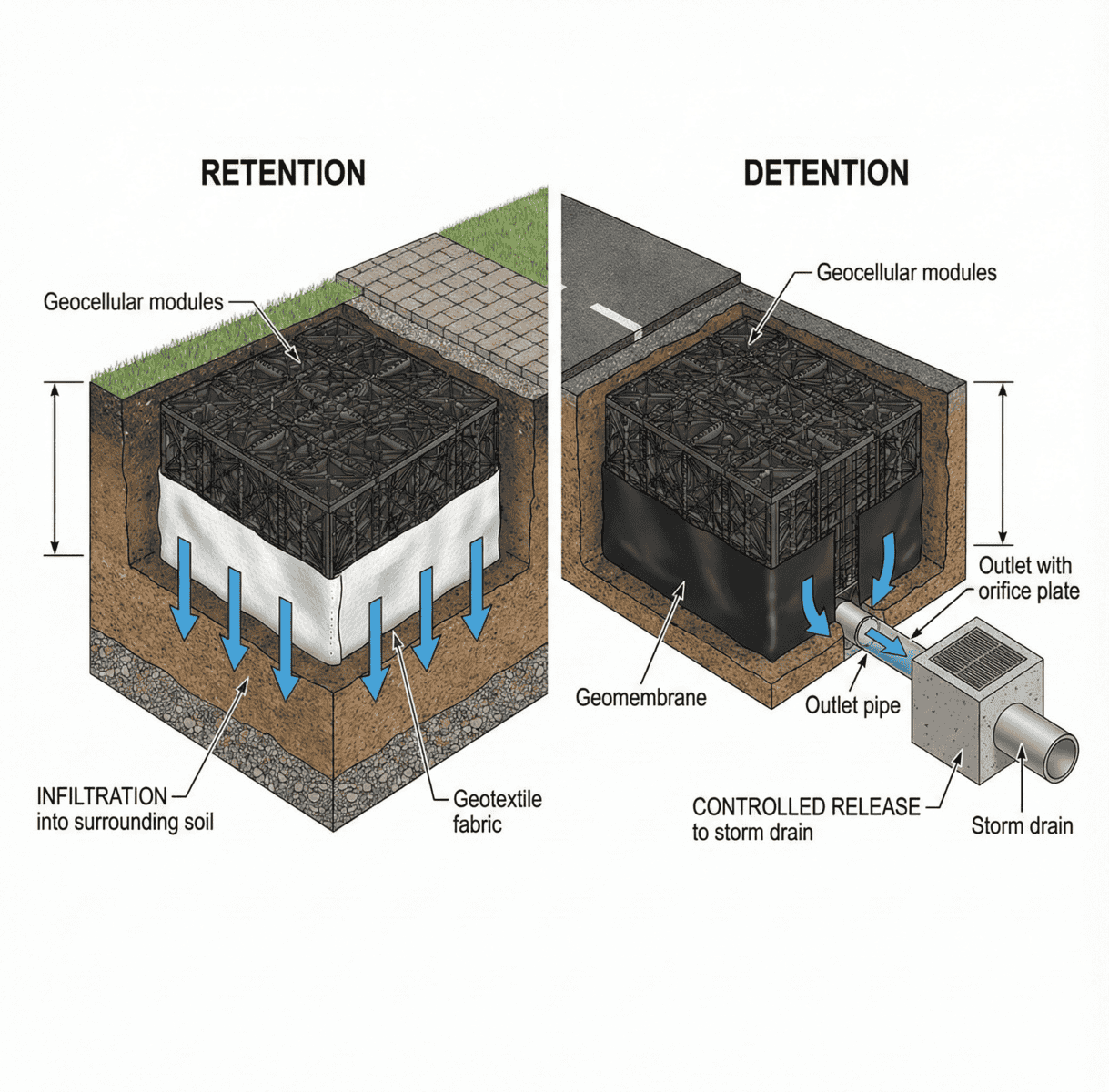
Stormwater detention temporarily stores runoff and releases it through a controlled outlet, while stormwater retention keeps a permanent pool and relies on infiltration and evaporation.
A detention basin stores runoff from a storm event and releases it slowly through a downstream outlet. The outlet is commonly an orifice plate (a metal plate with a sized opening to restrict flow) or a weir (a low wall or notch that restricts discharges). The basin is dry between storms.
Ohio EPA requires full drawdown within 24 hours and less than 50% of the stored volume within 8 hours (Ohio EPA design manual). New Jersey DEP allows 12 to 24 hours of extended detention for TSS removal and 72 hours for full drainage (NJ DEP BMP Manual).
The important point isn’t that a detention basin discharges residual water. It’s that they don’t carry a permanent pool. Stormwater enters, sits long enough for suspended solids to settle out, and then discharges through the outlet structure.
A well-engineered dry detention facility can be a sports field, a dog park, or open green space between storms. That’s why we love it in suburban developments where every acre counts. For a deeper look at basin sizing and outlet design, see our detention basin guide.
Detention excels at peak flow reduction. It chews off the top of a hydrograph and spreads the discharge over a longer period.
The downside is that detention isn’t meant for long-term water quality or nutrient removal. Average TSS removal in a dry detention facility is 40%, which won’t meet any permit in a state that regulates phosphorus or nitrogen.

What Is Stormwater Retention?
A retention pond contains a permanent pool of water. Runoff enters the pond and displaces the existing volume, which infiltrates into the ground or evaporates. There’s no outlet pipe releasing water to a downstream channel. In Florida, retention systems are required to infiltrate the volume captured in 72 hours under FAC 62-25.
Wet retention ponds achieve far better pollutant removal than dry basins. EPA data indicates that wet retention ponds removed 70 to 76 percent of total suspended solids and 38 to 52 percent total phosphorus (EPA BMP wet ponds).
A field study by PMC, comparing 12 detention basins to 8 retention ponds, found that retention removed 66 percent of TSS versus about 40 percent for detention. The permanent pool is basically a settling chamber that never empties, so particles stay in contact with the water column longer.
Retention ponds can become valuable ecological features. A study published in Frontiers in Ecology found that well-managed wet ponds provide high-quality amphibian breeding habitat. This ecological function can support LEED credits or meet local biodiversity requirements. But with the permanent water surface, you can’t mow the bottom or use the footprint for anything else.
Detention vs Retention: Side-by-Side Comparison
Deciding between these systems isn’t a design choice. It’s a regulatory, financial and ecological decision that impacts each phase of the project, from grading plans, to HOA budgets 20 years into the future.
📖 Key Answer
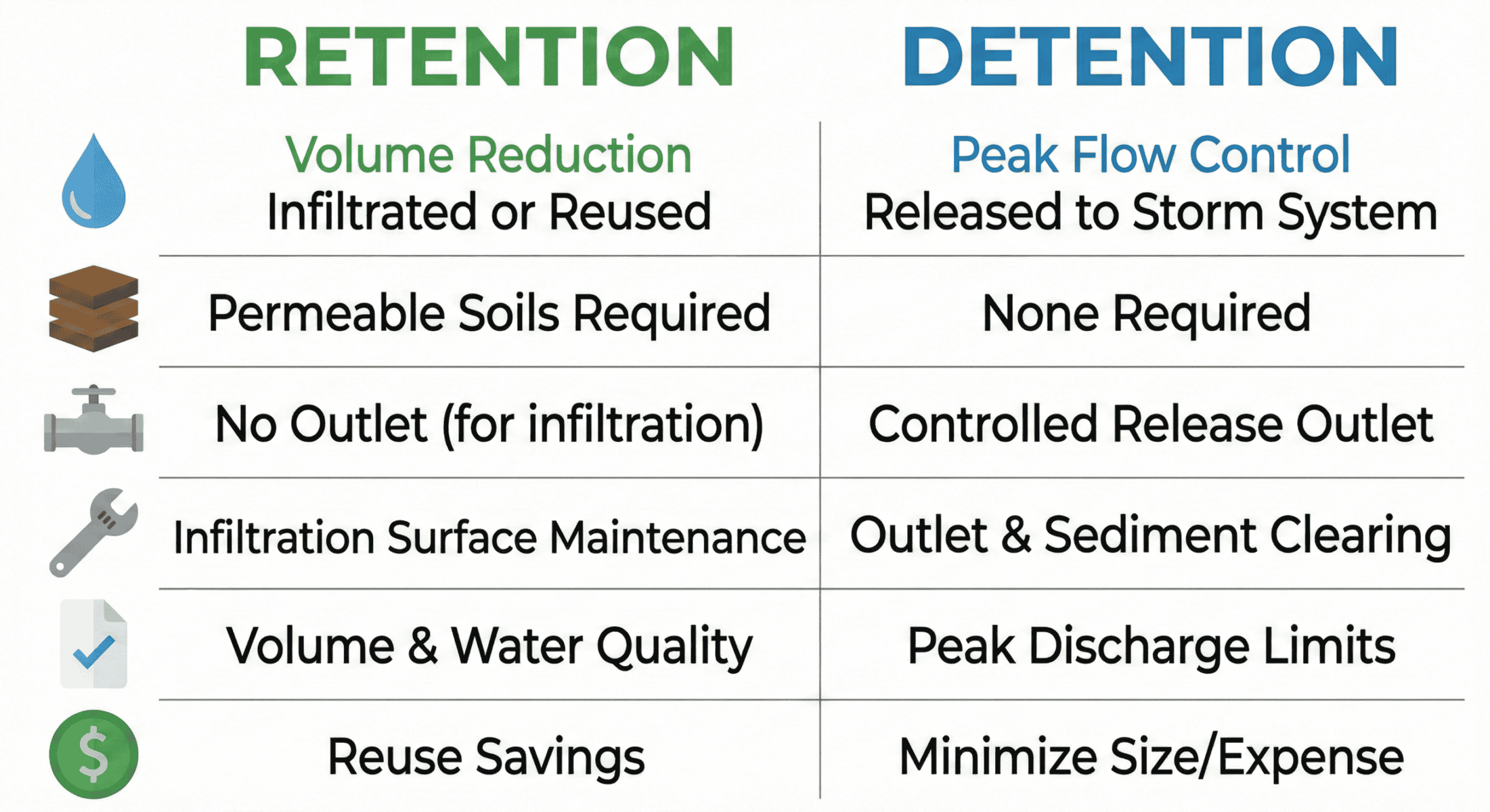
Detention basins are dry between storms and control peak discharge with outlets, while retention ponds maintain a permanent pool for stronger pollutant removal. Detention usually costs less upfront, but retention is often required when permits prioritize water quality treatment.
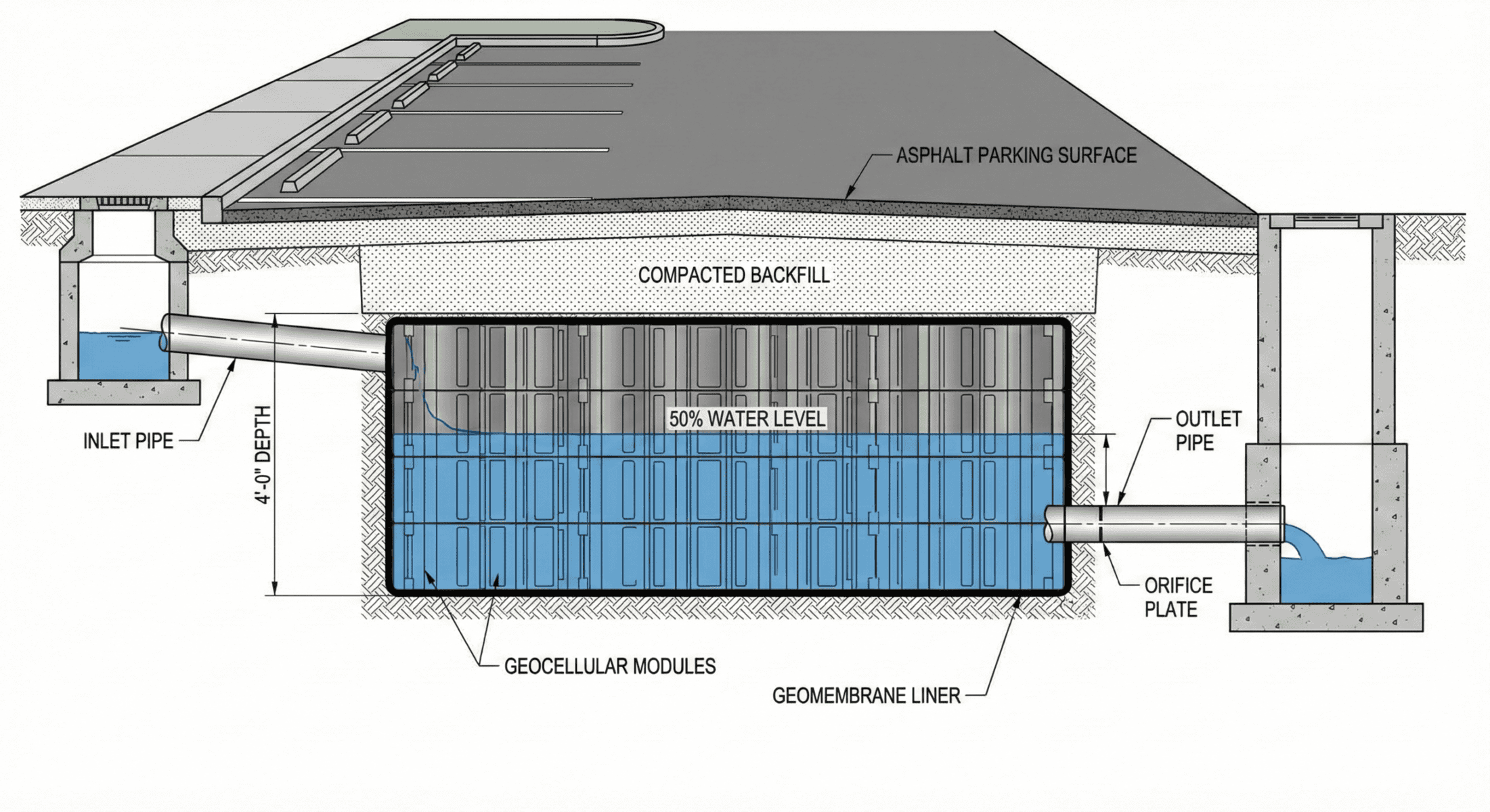
The Outlet Structure Test is the quickest way to differentiate them in-situ. If a pipe, weir, or orifice is draining the basin to downstream conveyance, it’s a detention system. If the basin has no surface outlet and drains via infiltration or evaporation, it’s a retention basin. The system type gets mis-labeled on as-built drawings more often than most engineers will admit, and that creates real liability in property transfers.
| Feature | Detention Basin | Retention Pond |
|---|---|---|
| Permanent pool | No, dry between storms | Yes, holds water year-round |
| Outlet structure | Orifice, weir, or pipe to downstream | None, infiltration or evaporation only |
| Drawdown time | 24-72 hours depending on jurisdiction | Designed to maintain permanent pool level |
| TSS removal | ~40% | 70-76%; ~66% in one comparative study |
| Phosphorus removal | Low, minimal contact time | 38-52% (TP), optimized at 21-day residence |
| Dual use potential | Yes, sports fields, parks, green space | No, permanent water surface |
| Mosquito risk | Low if basin drains within 48 hours | Moderate, but fish stocking controls larvae |
| Land requirement | Flexible, can use underground alternatives | FEMA P-2181: 1-3% of drainage area |
| Typical cost per CF | ~$0.30 | $0.50-$1.00 |
Most people assume retention ponds are always larger. That isn’t always true. A detention basin sized to the 100 year event in high runoff soils can take up as much space as a retention pond sized to the 25 year event in sandy soils. Soil infiltration rate is a higher determinant of retention pond size than drainage area alone.
When to Specify Detention (And When It Falls Short)
The Peak Flow Attenuation Method is the place where detention belongs. When your stormwater permit measures success by pre-development peak discharge rates, a detention basin gives you a direct engineering solution. You size the basin volume to accommodate the difference between pre- and post-development runoff, design your outlet to release at the pre-development rate, and you’re done. It’s about as clean as hydraulic engineering gets.
Detention works best on sites larger than 10 acres where you can grade a surface basin safely. Below 10 acres, basin geometry degrades. It’s often too shallow to perform well or too steep-sided to build safely. For smaller sites, underground detention chambers or bioretention cells are typically more effective underground detention engineering guide.
Take an 18-acre commercial development near Columbus, Ohio with 65% impervious cover. It produces roughly 7.8 acre-feet of runoff from a 25-year, 24-hour storm. If the pre-development discharge rate was 62 cfs and post-development rates jump to 148 cfs, you need to hold the difference in a detention volume. The outlet meters it out at 62 cfs.
Ohio EPA requires total drawdown within 24 hours. At $0.30 per cubic foot, the basin alone comes in at roughly $102,000 (not counting grading, outlet structures, and the emergency spillway).
Detention falls short in three cases. First, when your permit requires nutrient removal to protect receiving waters. A dry basin between storms can’t provide the biological uptake needed for phosphorus and nitrogen.
Second, when soil permeability is so high that water infiltrates before reaching the outlet. That makes your drawdown calculations invalid.
Third, on sites where the downstream permit has declared sediment impairment. A 40% TSS removal rate won’t satisfy a TMDL allocation that requires 65% or more.
If your detention basin isn’t draining within 48 hours, you’re headed for trouble. Female mosquitoes lay eggs in standing water, and larvae take 7 to 10 days to mature. A basin holding water for a week isn’t detention anymore. It’s an unapproved retention pond with none of the features that make retention work.
We’ve seen this play out at scale during Washington state’s December 2025 flood failures, where undersized detention systems backed up across entire subdivisions.
Most engineers default to detention because they know the math. But in practice, undersized outlet structures are more likely to cause noncompliance than over-conservative retention designs.
When Retention Ponds Outperform Detention Systems
You get value from retention ponds when the permit requires water quality treatment, not just peak flow reduction. The numbers tell the story: retention removes 66% TSS versus 40% for detention. Total phosphorus removal runs 40 to 60% in retention, compared to very little in a dry basin.
The catch: optimum P removal occurs with a hydraulic residence time of 21 days. That means the retention pond must have enough permanent volume to hold the runoff for 3 weeks before diffusing.
Florida, Minnesota, plus at least 9 other states (North Carolina, Maryland, and Oregon, among them) have adopted water quality volume requirements that in practice require a retention or mixed system. You build retention, whether you intended to or not, if your permit states “treat the first inch of runoff for water quality.”
Aesthetic and ecology make retention attractive for clients. A pond with a littoral shelf, planted vegetation, and a stable water level is a genuine amenity when it’s monitored and maintained. Leave it unattended and it’s a liability.
Algae blooms, a silted bed, and invasive plants turn that amenity into a complaint magnet. The HOA is legally responsible for maintenance whether it’s detention or retention, and retention takes a lot more work.
Minnesota and North Carolina design standards call for an average pond depth between 3 and 6 feet (MN Stormwater Manual). Shallower ponds lose more water to evaporation and grow more algae. Deeper ponds cost more to excavate and raise safety concerns in residential areas. Most designers settle around 4 to 5 feet as the practical sweet spot.
The Water Quality Volume (WQv) is how most state manuals size a retention pond’s permanent pool. You calculate the runoff volume from a target storm depth (usually the first 1″ across the drainage area), and that volume becomes the minimum permanent pool.
For a 1-acre drainage area with a 1-inch WQv requirement: V = 1 acre x 1 inch = 3,630 cubic feet of permanent pool. At 3 to 6-foot average depth, that’s 605 to 1,210 square feet of surface area.
The math is straightforward, but the site constraints aren’t. Soil type, setback rules, and littoral shelf ratios all enlarge the footprint beyond what the formula suggests.
It’s the outlier that trips up teams. If you have HSG C or D soils (clay look-alikes, permeability <0.06 in/hr), the 72-hour drawdown requirement isn't possible without supplemental underdrains. That addition ups construction cost by $15,000 to $40,000 or more. In our experience, this turns up about once in four retention projects when the geotech report lands after the 30 percent design milestone.
Most engineers expect retention to eat more land. In reality, a detention basin on clay soils infiltrating at 0.3 in/hr can have a larger footprint than a retention pond on sandy soils. The basin needs more freeboard and a larger outlet structure to meet its 24-hour drawdown target.
Soil type isn’t just a system selector. It can flip cost and land assumptions entirely on sites where clay runs deeper than the boring log predicted.

What Each System Costs (2026 US Data)
The only fair way to compare detention vs. retention is lifecycle cost. Upfront construction is only half the story, and bid-day pricing can be misleading.
📖 Key Answer
In 2026 US pricing, dry detention is about $0.30 per cubic foot while wet retention is typically $0.50 to $1.00 per cubic foot. Total cost depends on land value, annual maintenance, and retention dredging cycles.
A dry detention basin looks cheap on the bid sheet at about $0.30 per cubic foot. A wet retention pond costs $0.50 to $1.00 per cubic foot (2026 cost per cubic foot pricing). Those numbers don’t include land, maintenance, or the dredging cycle that hits every retention pond owner sooner or later.
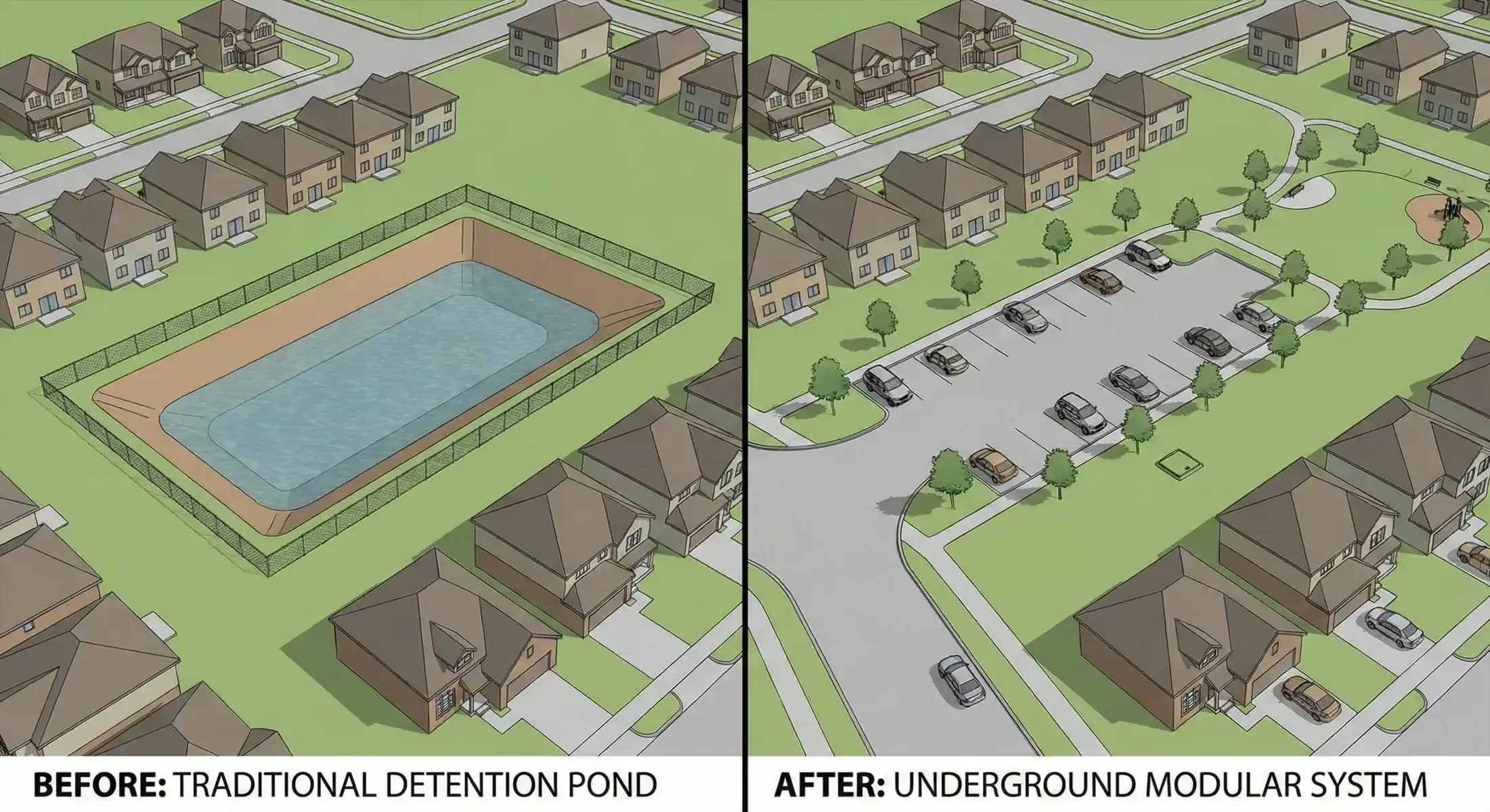
Land cost is a variable that most estimates ignore. A surface pond sized for the 100-year storm can take 4,000 square feet or more. At $30 to $80 per square foot in suburban areas, that’s $120,000 to $320,000 in land alone. Underground detention frees up that footprint and trades it for its own price premium (underground detention cost comparison).
Annual maintenance can cost $2,500 to $7,350 per acre of pond surface. For a 1.5-acre retention pond owned by an HOA, that’s $3,750 to $11,025 per year, forever. HOAs spend 12 to 35% of their total budget on a single pond.
Dredging hits every retention pond roughly on a 5-year cycle. Expect $20 to $60 per cubic yard, and up to $100 per cubic yard when disposal costs are added.
| Cost Category | Dry Detention Basin | Wet Retention Pond |
|---|---|---|
| Construction per cubic foot | ~$0.30 | $0.50-$1.00 |
| Land cost (100-yr sizing) | Lower, can use underground option | $120K-$320K for surface pond |
| Annual maintenance per acre | $2,500-$7,350 | $2,500-$7,350 (plus aquatic mgmt) |
| Dredging (5-year cycle) | Minimal sediment if properly graded | $20-$60/CY, up to $100/CY with disposal |
| HOA budget share | Lower than retention | 12-35% |
| Dual-use offset | Yes, field/park reduces net cost | No, water surface is permanent |
The budget wild card is clay soils. If your retention pond can’t infiltrate fast enough, you’ll need an underdrain or supplemental pump, and the whole retention concept falls apart. Run a perc test before committing to retention. If your infiltration rate is below 0.5 inches per hour, don’t go with retention.
Decision Matrix: Choosing the Right System for Your Site
Don’t choose a system based on what you built last time. Run through these seven site conditions and let the constraints choose for you.
📖 Key Answer
Choose detention when permits focus on peak-flow matching or when clay soils limit infiltration. Choose retention when permits require water-quality volume treatment and soils can infiltrate within design windows. Use hybrid or underground options when land is limited.
| Site Condition | Recommended System | Why |
|---|---|---|
| Permit requires peak flow match only | Detention | Simpler outlet design, lower construction cost |
| Permit requires water quality volume treatment | Retention | 66% TSS vs 40%, phosphorus removal capability |
| Available land is less than 10 acres | Underground detention or bioretention | Surface basins get geometrically impractical |
| Sandy soils with high infiltration rate (>2 in/hr) | Retention | Natural infiltration supports the permanent pool cycle |
| Clay soils with low permeability (<0.5 in/hr) | Detention | Retention won’t drain within 72-hour window |
| HOA will manage long-term maintenance | Either, but budget detention first | Lower annual cost, less specialized maintenance |
| Client values amenity, ecology, or LEED credits | Retention | Wildlife habitat, aesthetic value, property value uplift |
The really hard choice usually reduces to soil. Good infiltration rates in Hydrologic Soil Group A or B means retention can work well and look great. Group C or D soils push you toward detention or a hybrid with underdrains.
Make your soil borings and perc tests before the 30% design review, not afterward. If you discover your “retention pond” site has 6 inches of clay at 3 feet, you’re looking at six-figure change orders.
Where neither pure detention nor retention is a clean fit for your site, try a hybrid: a detention basin with a small permanent pool in the forebay. You get the peak flow benefit of detention and some of the water quality benefit of retention. It’s a compromise, but a good one in most places.
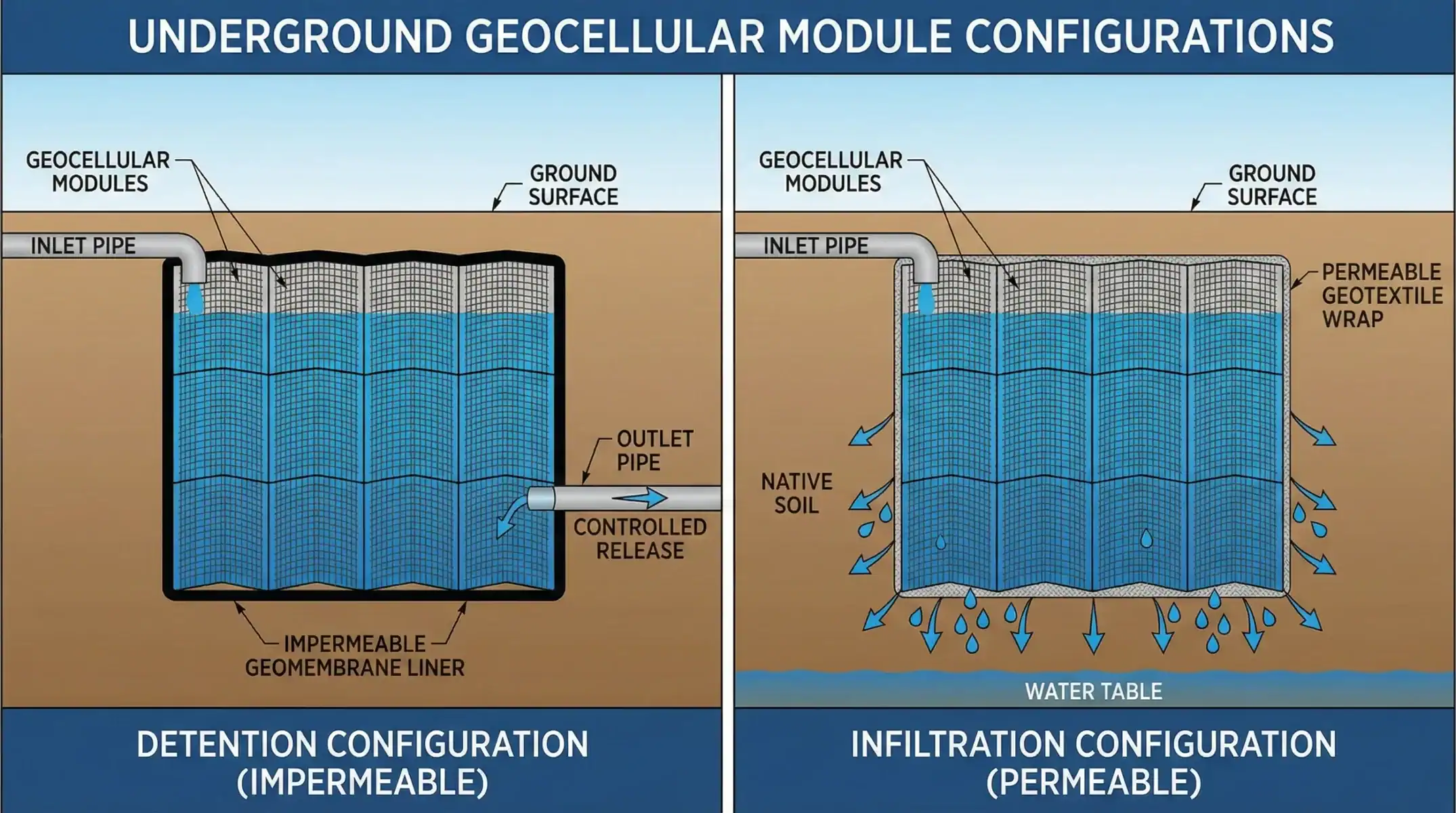
When looking at the underground alternative, the cost comparison between modular crates and gravel chambers can swing the numbers by a wide margin (underground detention cost comparison). States like California are pushing hard for underground solutions where land is scarce (California underground detention systems). Underground systems also complement retention setups that use infiltration crates below grade (soakaway crates for infiltration).
Frequently Asked Questions
The quickest field test: if there’s a pipe or weir draining the basin, it’s detention. If there’s no outlet pipe, you’re looking at a retention system.
Mosquito larvae take about 7 to 10 days of standing water to develop. So any basin with water sitting longer than a week becomes a breeding ground, whether it’s labeled detention or retention.
Over 20 years, detention maintenance usually costs less because it doesn’t need dredging cycles or aeration equipment. On site, we’ve seen 20-year totals run 40% lower for detention than retention on comparable acreage.
Second, standing water past 48 hours creates a mosquito breeding environment that can draw code enforcement complaints fast.
The common culprits are a clogged orifice, sediment buildup on the outlet structure, or a groundwater table higher than what was specified during design. Have a surveyor shoot the invert elevation and compare it to the as-built. If the outlet is working and the basin still holds water, your groundwater table may have risen and you’re looking at a redesign.
What is the main difference between detention and retention ponds?
Detention temporarily holds stormwater and discharges through an outlet structure within 24 to 72 hours. The basin is dry between storms. Retention keeps a permanent pool with no outlet, relying on infiltration to ground or evaporation of collected runoff. The quickest field test: if there’s a pipe or weir draining the basin, it’s detention. If there’s no outlet pipe, you’re looking at a retention system.
Do retention ponds attract mosquitoes?
Not nearly as badly as unattended detention basins. A properly-engineered retention pond with a permanent pool supports fish that feed on mosquito larvae. The real risk comes from detention basins that don’t drain fully in 48 hours. Mosquito larvae take about 7 to 10 days of standing water to develop. So any basin with water sitting longer than a week becomes a breeding ground, whether it’s labeled detention or retention.
Which is cheaper, a detention basin or a retention pond?
While detention costs less upfront at about $0.30 per cubic foot versus $0.50 to $1.00 for retention, lifecycle cost depends on your site. Retention ponds need dredging on a 5-year cycle at $20 to $60 per cubic yard, plus year-round aquatic management. Detention basins need mowing and cleanout, but no dredging bill. Over 20 years, detention maintenance usually costs less because it doesn’t need dredging cycles or aeration equipment. On site, we’ve seen 20-year totals run 40% lower for detention than retention on comparable acreage.
Can a detention basin be used as a park or sports field?
Yes, and that’s one of the biggest selling points for detention. Since the basin is dry most of the time, you can use the area at the bottom as a soccer field, dog park, walking trail, or green space. Few local governments don’t prefer dual-use designs. You’ll need a turf that can cope with periodic flooding and a grading plan that ensures it drains within 24 hours of a typical storm event.
Who is responsible for maintaining a detention or retention pond?
The property owner or HOA is responsible for maintenance of both system types. That includes mowing, sediment removal, outlet structure checks, and erosion control. Retention ponds add aquatic vegetation control and eventual dredging to the list. Annual costs run $2,500 to $7,350 per acre of pond surface, which eats 12 to 35 percent of the HOA budget.
Does a retention pond increase property value?
It can, but only if you commit to upkeep. A clean, well-landscaped retention pond with solid banks and clear water is a waterfront blessing that buyers will pay up for. An under-maintained, algae-filled pond with cattail overgrowth and a breaking shoreline is a waterfront curse. The asset versus liability equation is all about budget and maintenance discipline.
What happens if my detention pond doesn’t drain within 48 hours?
You’ve got two issues to deal with right away. First, you’re probably out of compliance. OH EPA wants full drawdown in 24 hours, and FL’s cutoff is 24 to 48 hours for detention. Second, standing water past 48 hours creates a mosquito breeding environment that can draw code enforcement complaints fast.
About the Author

Grayden Du · Export Director, AQUA RainWater Solutions
Grayden leads global sales and distribution for AQUA RainWater Solutions, a manufacturer specialising in geocellular stormwater modules and subsurface water management systems since 2009. With 16+ years of hands-on experience across 30+ country markets, he has driven underground detention system specifications into municipal and commercial infrastructure projects spanning residential developments to large commercial complexes.
Areas of expertise: Stormwater Management · Geocellular Detention Systems · Underground Stormwater Storage · Subsurface Water Management · Permeable Pavement Systems · Rainwater Harvesting Modules · B2B Distribution (Contractors & Engineering Firms) · Municipal Infrastructure Project Specification
Education: Shandong University of Science and Technology
Connect: All articles by Grayden Du · LinkedIn
 English
 Arabic
 French
 Russian
 Spanish