
Underground Stormwater Management 2026: When Traditional Methods Can’t Fit, Can’t Finish, or Can’t Perform
Two acres of commercial land in Orlando. Building footprint maximized. Parking calculated to the last space. Then the stormwater engineer delivers the requirement: 18,500 cubic feet of detention to meet Florida DEP standards.
The site has 1,850 square feet available between the building setback and property line. Traditional stone aggregate system needs 4,100 square feet—more than double the available area. Surface detention pond? That consumes 5,200 square feet and eliminates 28 parking spaces.
The project stops. Not because of design failure. Because the math doesn’t work.
This scenario repeats across developments in Florida, California, Texas, and every state where urban land values have reached levels that make traditional stormwater approaches spatially impossible or economically unfeasible. The 2022 EPA Construction General Permit and Clean Water Act compliance requirements haven’t changed. Sites are getting smaller. Schedules are getting tighter. Traditional solutions are running into physical limits.
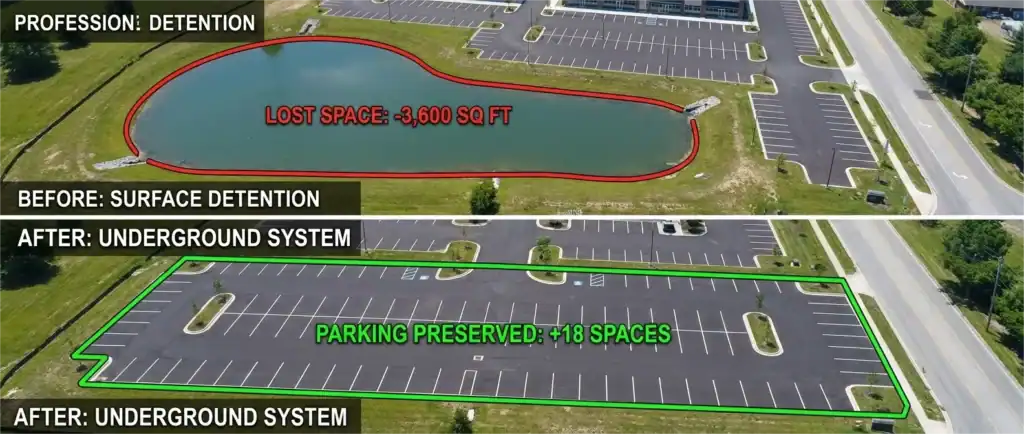
Six methods exist for managing stormwater detention and infiltration on developed sites. Each has spatial requirements, installation timelines, cost structures, and performance characteristics. Understanding which approach fits project constraints determines whether a development moves forward or redesigns from scratch.
This guide examines subsurface stormwater management from a materials perspective—comparing excavation volumes, transport logistics, installation efficiency, and long-term maintenance across traditional and modular approaches. It addresses federal requirements under the National Pollutant Discharge Elimination System (NPDES), state-specific regulations, and real-world project constraints that drive system selection.
Six Stormwater Management Approaches—Comprehensive Comparison
Every detention or infiltration system performs the same function: temporarily store runoff and release it at controlled rates or infiltrate to groundwater. The methods differ dramatically in spatial footprint, installation requirements, and operational characteristics.
Multi-Dimensional System Comparison
| Criteria | Surface Detention Pond | Stone Aggregate Fill | Pipe Chamber System | Precast Concrete Vault | Bioretention / Rain Garden | Modular PP System |
| Void Ratio | 100% (open water) | 40% | 60-75% | 100% | 30-40% | 95-97% |
| Footprint (relative) | 250% | 100% (baseline) | 80% | 40% | 180% | 42% |
| Installation Time | 3-4 weeks | 2-3 weeks | 2-3 weeks | 1-2 weeks | 2-3 weeks | 1-1.5 weeks |
| Truck Deliveries (15k cf) | 60+ (soil only) | 100+ (soil + stone) | 70+ | 25-30 | 65+ | 35 |
| Surface Area Use | Dedicated detention | Underground (multi-use) | Underground (multi-use) | Underground | Landscape feature | Underground (multi-use) |
| Best Application | Rural, large sites | Moderate sites | Linear installations | High-value urban sites | Low-density residential | Space-constrained sites |
| Primary Limitation | Space consumption | Low efficiency | Heavy weight / assembly | High material cost | Space / Seasonal perf. | Initial material cost |

1. Surface Detention Ponds
Open-air impoundments storing runoff at surface level. Typically earth berms with grass slopes, outlet structures, and sometimes permanent water pools.
- Advantages: 100% storage efficiency; visual inspection is immediate; lowest material cost; easy maintenance access.
- Limitations: Large footprint (2-3× underground alternatives); safety concerns (drowning risk); aesthetic impact; mosquito breeding; winter ice formation; eliminates developable land.
Optimal use: Rural or suburban sites with ample open space, land values below $15-20 per square foot, low-density development where surface area isn’t constrained.
2. Stone Aggregate Fill Systems
Excavated basin filled with clean-washed stone (typically AASHTO No. 3 or No. 57). Water fills void spaces between stones.
- Advantages: Proven technology; widely understood; no specialized components; simple design.
- Limitations: 40% void ratio means massive excavation; requires importing hundreds of tons of aggregate; 40-50+ truck deliveries; limited interior access; difficult to rehabilitate.
Optimal use: Sites with good truck access, ample staging area, flexible schedules, moderate land values, and available local aggregate sources.
3. Pipe Chamber Systems
Large-diameter corrugated metal or HDPE pipes placed horizontally, creating storage chambers.
- Advantages: Higher void ratio than stone (60-75%); standardized components; some internal access.
- Limitations: Heavy components require cranes/excavators; pipe joints are weak points; limited chamber height; settlement risks; less space-efficient than modular.
Optimal use: Linear installations (along roadways, parking lot edges), sites where pipe materials are readily available, moderate storage volumes.
4. Precast Concrete Vaults
Factory-manufactured reinforced concrete boxes trucked to site and placed with cranes.
- Advantages: 100% void ratio; high load capacity; 75-100+ year service life; excellent maintenance access.
- Limitations: Highest material cost; heavy units require cranes; delivery timing dependent on production; transport costs increase with distance.
Optimal use: High-value urban sites where space is critical, projects requiring integrated stormwater treatment, locations with permanent heavy vehicle loading.
5. Bioretention Systems and Rain Gardens
Shallow landscaped depressions filled with engineered soil media.
- Advantages: Water quality treatment; aesthetic enhancement; supports LEED credits; lower installation cost tLimitations: Large footprint; seasonal performance variation; plant maintenance required; not suitable for high-traffic areas; slow draw-down.han underground.
- Limitations: Large footprint; seasonal performance variation; plant maintenance required; not suitable for high-traffic areas; slow draw-down.
Optimal use: Residential developments, campus environments, parking lot islands, locations with aesthetic requirements, projects pursuing green building certifications.
6. Modular Polypropylene Systems
Interlocking plastic units forming underground storage chambers. Made from 100% recycled PP.
- Advantages: 95-97% void ratio; minimal transport; rapid hand assembly; excellent maintenance access; adapts to irregular shapes; lightweight; No skilled labor required.
- Limitations: Higher material cost than stone; UV protection needed during storage.
Optimal use: Space-constrained urban/suburban sites, fast-track schedules, restricted truck access, high land values, projects requiring maintenance accessibility.
Storage Efficiency—Why Void Ratio Determines Project Feasibility
Void ratio defines the percentage of excavated volume that actually stores water. A system with 40% void ratio wastes 60% of the excavated space. On constrained sites, this difference determines whether a project is possible.
Excavation Volume Comparison
Project requirement: 15,000 cubic feet storage
Stone Aggregate System (40% void ratio):
- Excavation needed: 37,500 cubic feet
- Wasted space: 22,500 cubic feet (60% of excavation stores nothing)
- Context: Dig a hole 50′ × 50′ × 15′ deep
- Soil to remove: 93 dump truck loads
Modular PP System (95% void ratio):
- Excavation needed: 15,789 cubic feet
- Wasted space: 789 cubic feet (5% structural volume)
- Context: Dig a hole 35′ × 35′ × 13′ deep
- Soil to remove: 39 dump truck loads
You save: 54 dump truck loads of soil removal and disposal.

Footprint Comparison
At 6-foot average installation depth for 15,000 cubic feet storage:
- Stone aggregate footprint: 6,250 square feet
- Modular PP footprint: 2,632 square feet
- Area saved: 3,618 square feet
In commercial development, 3,618 square feet equals:
- 18-22 parking spaces ($63k–$77k annual revenue potential)
- Leasable retail space ($144k–$253k annual revenue)
- 2 additional townhouse units
Real Projects Solving Real Constraints

Orlando, Florida—Commercial Development Overcomes Spatial Limits
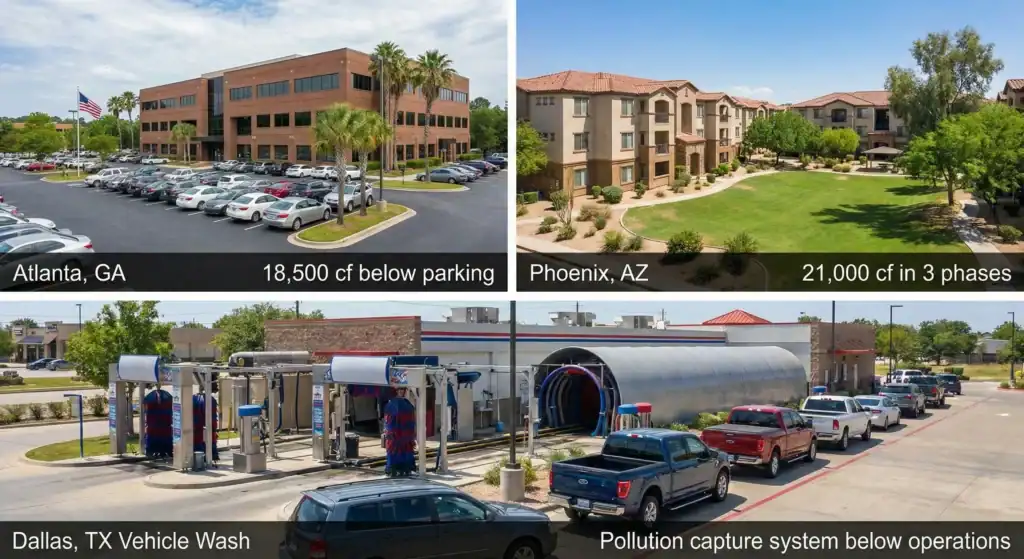
The challenge: Mixed-use development on 2.1 acres in metro Orlando required 18,500 cubic feet detention per Florida Department of Environmental Protection stormwater regulations. Site design maximized building footprint and parking to meet project pro forma. Available area for stormwater infrastructure: approximately 1,900 square feet in setback zones and landscape buffers.
Traditional stone aggregate system at 40% void ratio required 4,100 square feet—more than double available space. Surface detention pond required 5,400 square feet and eliminated 26 parking spaces, destroying project economics.
The solution: Subsurface modular system at 95% void ratio fit within 1,975 square feet footprint at 9.5-foot average depth. System installed beneath landscape islands and perimeter buffer zones.
The result:
- Zero parking spaces lost
- Installation completed in 9 days versus 16-day estimate for stone alternative
- Building construction proceeded on schedule without stormwater delays
- Site maintained required green space ratio while meeting detention requirements
- System passed Florida DEP review and local jurisdiction approval
Project demonstrated how void ratio efficiency converts an impossible requirement into a solved problem—the same storage volume in less than half the space.
Fontana, California—Residential Project Navigates Phased Construction
The challenge: 128-unit apartment complex on 6.8 acres required capturing approximately 157,000 gallons (21,000 cubic feet) of stormwater runoff under California Regional Water Quality Control Board requirements. Site had limited available area after maximizing building density to meet city housing goals.
Construction phasing complicated stormwater installation—buildings erected in three phases over 14 months. Detention system needed to coordinate with constantly changing site access and staging areas.
The solution: Modular PP system divided into three independent sections serving different drainage areas. Material delivered in phases matching construction progress. Local design firm calculated storage volumes and configured layouts. Installation contractor coordinated with general contractor to sequence work between other site activities.
The result:
- System fit within constrained footprint where stone aggregate would exceed available area by 40%
- Phased installation prevented schedule conflicts—each section installed during optimal windows
- General contractor adjusted sequencing without costly redesign when utility conflicts discovered
- Flexible layout adapted to as-found conditions without engineering delays
- All three sections operational before final building occupancy, meeting regulatory requirements
Project highlighted modular system adaptability—not just storage efficiency, but installation flexibility that accommodates real-world construction chaos.
California Vehicle Wash Facility—Pollution Capture Under Operational Constraints
The challenge: Vehicle wash facility generating contaminated runoff (soaps, oils, sediment, cleaning chemicals) discharging toward creek tributary. State water quality regulations under Porter-Cologne Water Quality Control Act required preventing pollutant discharge to surface waters.
Site footprint fully utilized for wash bays, queuing lanes, and equipment. No area available for surface detention. Facility operates 6 days per week—construction had to avoid business disruption.
The solution: Compact underground detention and treatment system installed beneath driveway access area. System included sediment chamber isolating coarse particles and oils, followed by detention chambers providing retention time for settling. Controlled discharge to municipal storm system after treatment.
The result:
- Installation completed during weekend and off-hours work over 11 days
- Business remained operational throughout construction (closed only 1 day for final connections)
- System captured contaminated runoff preventing creek pollution
- Accessible maintenance design allowed quarterly vacuum truck service for sediment removal
- Facility achieved regulatory compliance without site expansion or operational changes
Project demonstrated underground system advantages beyond storage efficiency—the ability to install in active environments where surface construction would halt operations.
When to Use Which System—Decision Framework
No single stormwater management approach fits all projects. Selection depends on site constraints, regulatory requirements, budget parameters, and long-term operational considerations.
Primary Decision Factors
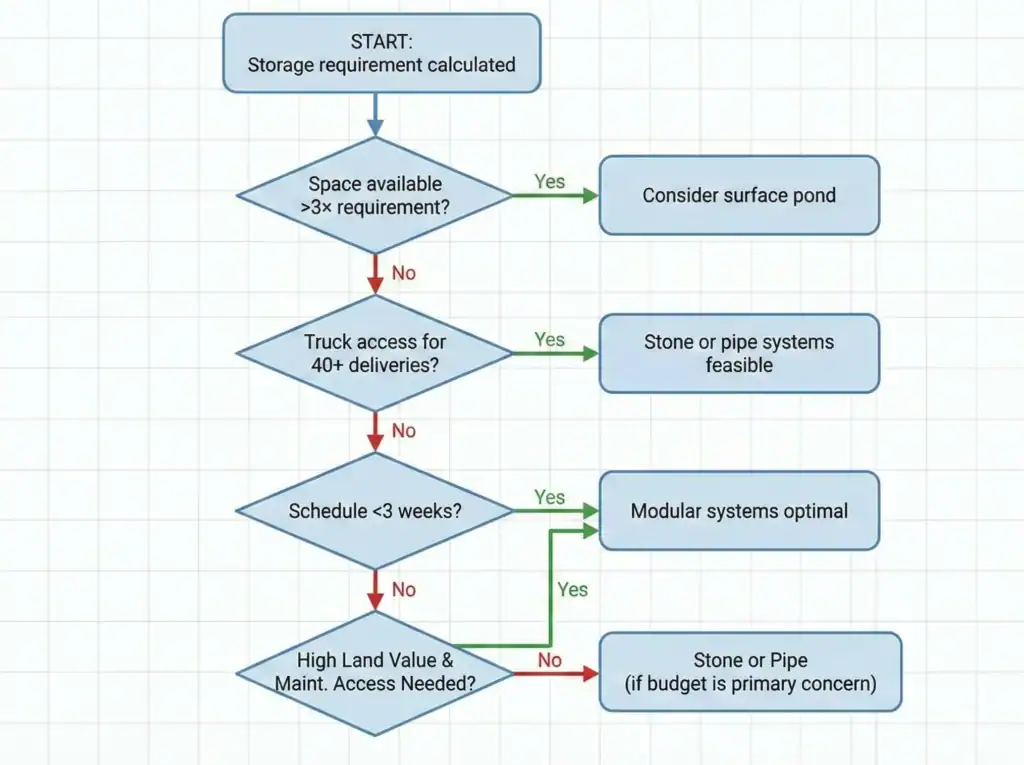
Space availability drives initial feasibility. Calculate available footprint after accounting for buildings, parking, utilities, setbacks, and easements. Compare to required footprint for each system type at your storage volume. If available space is less than required footprint, that option is eliminated.
Access for materials determines installation logistics. Count available truck access points. Assess delivery hour restrictions. Evaluate street width and turning radius for large vehicles. Stone aggregate requiring 40-50 deliveries may be infeasible where modular systems with 2-3 deliveries work.
Construction timeline affects project costs beyond direct installation. Time-sensitive projects (retail with lease commitments, residential with pre-sales, industrial with production start dates) value installation speed. A 7-day installation versus 16-day installation saves schedule and allows earlier revenue generation.
Land value changes economic analysis. On sites where land costs $40-$80 per square foot, footprint efficiency creates value exceeding system cost differences. Preserving 3,000 square feet at $50 per square foot represents $150,000 in developable capacity—far exceeding material cost differentials.
Regulatory requirements vary by jurisdiction. Some municipalities require maintenance access and inspection capability. Others mandate specific treatment methods or infiltration where feasible. Federal Clean Water Act compliance through NPDES permits applies to most development. State programs add layers—California’s Porter-Cologne Act, Florida’s Environmental Resource Permits, Texas Edwards Aquifer rules.
Long-term maintenance capability affects lifecycle costs. Systems with interior access allow inspection and cleaning. Stone aggregate with limited access requires expensive rehabilitation or replacement when performance degrades. Consider maintenance budget and available service contractors when selecting approaches.
System Selection Guide
Use surface detention ponds when:
- Available land area exceeds storage requirement footprint by 3-4×
- Land value under $15-20 per square foot
- Rural or low-density development with ample open space
- Budget constraints require lowest material cost
- Aesthetics allow surface water features
- Use stone aggregate fill when:
- Moderate site constraints with available footprint 2-3× storage requirement
- Good truck access and staging area available
- Standard construction timeline (no schedule pressure)
- Local aggregate sources keep material costs competitive
- Maintenance accessibility isn’t critical
Use pipe chamber systems when:
- Linear installations along roadways or parking edges
- Void ratio improvement over stone needed (60-75% vs. 40%)
- Contractors familiar with pipe installation
- Moderate schedule and spatial constraints
Use pipe chamber systems when:
- Extremely limited footprint requiring 100% void ratio
- Heavy traffic loading exceeds H25 standard
- Budget accommodates higher material costs for space efficiency
- Integrated treatment or pump station functions needed
- Urban sites with high land values justify premium systems
Use bioretention/rain gardens when:
- Water quality treatment primary goal
- Aesthetic green infrastructure desired
- LEED or green building certification pursued
- Low-density residential or campus environments
- Surface area available in landscape zones
Use modular PP systems when:
- Available footprint limited (requires 95%+ void ratio efficiency)
- Fast installation critical (schedule-driven projects)
- Restricted material delivery access (limited truck trips required)
- Maintenance accessibility required for regulatory compliance
- High land values make spatial efficiency economically important
- Site geometry irregular (modular units adapt to odd shapes)
When Modular Systems May Not Be Optimal Choice
Large rural or suburban sites with ample available land (>5 acres total, >50% open space) and land values under $20 per square foot may find surface detention or stone aggregate more cost-effective. If spatial constraints don’t exist, delivery access is excellent, and schedule allows 3-4 weeks for stormwater installation, material cost becomes the primary factor.
Projects in remote areas far from distribution networks may face higher shipping costs that offset material efficiency advantages. Evaluate delivered cost, not catalog pricing.
Extremely deep installations (>15 feet) require excavation and backfill costs that reduce efficiency advantages. At depths beyond 12-15 feet, all underground systems face similar challenges.
Temporary facilities with short service life (<10 years) may not benefit from long-term durability and maintenance advantages. If the system will be removed within a few years, lowest initial cost may drive selection.
Installation and Regulatory Compliance
Typical Installation Sequence for Modular Systems
Site preparation and excavation (Days 1-2): Excavate to design depth and dimensions per engineered drawings. Verify subgrade bearing capacity. Confirm no utility conflicts discovered. Grade bottom to specified elevations (typically level or minimal slope for drainage).
Foundation and fabric placement (Day 3): Install geotextile fabric on bottom and sidewalls. Provide minimum 2-foot overlaps at seams. Fabric prevents soil migration into storage chambers while allowing water flow.
Module assembly and placement (Days 4-6): Off-load palletized modules to staging area. Hand-carry units to excavation. Interlock modules per manufacturer assembly instructions—no tools or fasteners typically required. Build storage array from end working toward inlet. Two workers can position 80-120 modules per day depending on model size.
Piping and structures (Day 7): Install inlet pipes, outlet control structures, overflow provisions, and access manholes. Connect to module system per design. Verify inverts and elevations match drawings.
Wrapping and backfilling (Days 8-9): Fold geotextile over top of module array creating complete encapsulation. Place and compact backfill in 8-12 inch lifts to specified density (typically 95% modified Proctor in structural zones). Work carefully around access structures.
Surface restoration (Day 10): Complete final grading, paving, or landscape restoration per site plans.
Timeline: 8-12 days for typical 15,000-25,000 cubic foot installations depending on site conditions, weather, and coordination with other trades.

Federal and State Regulatory Framework
Federal requirements:
Clean Water Act (CWA) establishes water quality standards and prohibits discharge of pollutants to waters of the United States without permits. Section 402 creates the National Pollutant Discharge Elimination System (NPDES) permit program administered by EPA or delegated state agencies.
2022 EPA Construction General Permit (CGP) covers stormwater discharges from construction sites disturbing one acre or more. Effective February 17, 2022 through February 16, 2027. Modified April 2025 with enhanced dewatering and discharge provisions. Requires:
- Stormwater Pollution Prevention Plan (SWPPP)
- Erosion and sediment controls during construction
- Post-construction stormwater management for permanent facilities
- Surface outlet structures for detention basins
- Inspection and maintenance protocols
Safe Drinking Water Act protects groundwater resources. Infiltration systems in wellhead protection zones or sole-source aquifer areas face restrictions. Underground Injection Control (UIC) program may classify large infiltration systems as Class V injection wells requiring permits.
State and local programs:
Most states operate their own NPDES programs under EPA delegation. State requirements typically exceed federal minimums:
Florida: Department of Environmental Protection administers Environmental Resource Permits (ERP) under Florida Administrative Code Chapter 62-330. Requires water quality treatment (retention/infiltration or proprietary devices) and quantity control (attenuation to predevelopment rates or specific discharge limits). Projects demonstrate compliance through engineering calculations and design submissions.
California: Porter-Cologne Water Quality Control Act gives Regional Water Quality Control Boards authority over stormwater. Nine regional boards administer programs with varying requirements. Many regions require hydromodification management—controlling runoff duration curves, not just peak flows. Low Impact Development provisions favor infiltration and retention where feasible.
Texas: Edwards Aquifer rules apply to projects in recharge and contributing zones. Strict water quality requirements protect groundwater supplying San Antonio and surrounding areas.
Municipal ordinances layer additional requirements: specific design storms, water quality volume calculations, maintenance access standards, recorded maintenance agreements, and financial assurance mechanisms.
Compliance documentation:
Detention and infiltration systems require engineering documentation:
- Hydrology calculations (runoff volumes, peak flows)
- Storage routing analysis (demonstrating detention performance)
- Outlet structure sizing
- Materials specifications
- Maintenance plans
- As-built surveys confirming final elevations and locations
All underground stormwater systems, regardless of material type, must meet the same regulatory performance standards. Stone aggregate, pipe chambers, concrete vaults, and modular PP systems all demonstrate compliance through engineering calculations—not material choice.
Maintenance Access and Long-Term Performance
Stormwater systems operate for decades with minimal attention—if designed for maintenance accessibility. Systems without access degrade invisibly until failure.
Maintenance Requirements and Access Methods
Inspection frequency:
- Semi-annual inspections (spring and fall typical)
- Post-storm inspections after events exceeding 1-inch rainfall
- Annual sediment accumulation measurement
- Outlet structure function verification
Stone aggregate limitations: Interior conditions unknown without excavation. Inspection limited to observation wells showing water levels and rough sediment estimates. Actual sediment distribution, migration patterns, and clogging locations remain invisible.
Cleaning requires high-pressure water jetting through access pipes. Effectiveness varies by sediment type and stone gradation. Heavy sediment loads or clay particles may not respond to jetting. No way to verify cleaning success without excavation.
Modular system advantages: Interior access through manholes and risers allows direct inspection. Lower inspection cameras or personnel (where chamber height permits) to view conditions. Identify specific areas with sediment accumulation.
Cleaning uses vacuum truck equipment. Insert hose through access manholes directly into chambers. Remove accumulated sediment from isolator rows or sediment chambers. Typical service takes 2-4 hours for standard installations. Document removed sediment volume confirming maintenance completion.
Typical maintenance intervals: Systems with proper pre-treatment (sediment forebays, catch basins with sumps) require cleaning every 2-5 years depending on sediment loading. High-sediment sources (construction areas, unpaved surfaces, heavy landscaping) may need annual service.
Outlet structures require annual inspection for blockages, debris, or damage. Clear any obstructions. Verify free-flowing operation.
Material Durability and Service Life
Polypropylene performance characteristics:
- Chemical resistance to hydrocarbons, salts, acids, bases typical in stormwater
- Temperature stability from -40°F to +140°F (suitable all U.S. climate zones)
- No corrosion, rust, or oxidation
- Resistant to biological degradation
- UV stabilized formulations (important during storage before burial)
- No concrete spalling or rebar exposure over time
Expected service life exceeds 75-100 years based on material properties and installed conditions. Underground placement protects from UV exposure and temperature extremes that could accelerate degradation.
Stone aggregate durability: Stone itself doesn’t degrade. Geotextile fabric separating stone from soil eventually clogs from fine particle migration. Performance declines as fabric permeability reduces. No practical method to replace fabric without complete system excavation and reconstruction.
Concrete durability: Reinforced concrete provides 75-100+ year service life if properly designed and constructed. Rebar corrosion from chloride exposure or carbonation can cause spalling in severe conditions. Generally excellent long-term performance.
Stormwater Management and Climate Resilience
Effective stormwater detention and infiltration systems serve functions beyond regulatory compliance. They reduce flooding risk, protect water quality, and contribute to climate adaptation strategies.
Flood Prevention and Peak Flow Reduction
Uncontrolled stormwater runoff from impervious surfaces (pavement, roofs, compacted soils) reaches streams and drainage systems faster and in larger volumes than natural conditions. Peak flows increase flooding downstream.
Detention systems temporarily store runoff, releasing it gradually. This attenuation reduces peak discharge rates—the primary cause of flooding. A properly designed detention basin storing 20,000 cubic feet might reduce peak flow from 45 cubic feet per second (cfs) to 12 cfs, matching predevelopment conditions.
In hurricane-prone regions (Florida Gulf Coast, Atlantic seaboard, Gulf of Mexico states), stormwater systems handle extreme rainfall events. Hurricane rainfall can deliver 6-12 inches in 24 hours, or 15-20 inches in severe events. Detention and infiltration infrastructure reduces flooding that threatens buildings, roads, and emergency access.
Water Quality Protection
Stormwater runoff carries pollutants: sediment, nutrients (nitrogen and phosphorus), heavy metals (zinc, copper, lead from vehicles), hydrocarbons (oils and greases), bacteria, and trash. Discharge to streams, rivers, or coastal waters degrades ecosystems and drinking water sources.
Detention systems provide settling time for particulates. Heavier particles drop from suspension during storage, accumulating in sediment chambers. This removes 40-60% of total suspended solids depending on particle size distribution and retention time.
Infiltration systems recharge groundwater while soil provides filtration. Water percolating through several feet of soil undergoes physical straining, chemical adsorption, and biological uptake removing additional pollutants.
Combined detention-infiltration approaches optimize both functions: infiltrate smaller, frequent storms entirely (providing maximum treatment); detain larger, infrequent storms (providing peak flow control).
Groundwater Recharge and Drought Resilience
Development replaces permeable surfaces with impervious cover. Rainfall that previously infiltrated to groundwater now runs off to drainage systems and surface waters. Groundwater tables decline. Base flow to streams reduces during dry periods.
Infiltration-based stormwater systems restore some groundwater recharge. Water infiltrating from detention chambers percolates to aquifers, maintaining groundwater levels and stream base flows.
In water-stressed regions (California, Southwest, Texas), groundwater recharge from stormwater provides additional water supply benefits. Some jurisdictions offer stormwater fee credits or density bonuses for projects incorporating infiltration.
ARW Global Experience and Regional Service Network
Project Experience and Manufacturing Background
600+ installations globally across commercial, residential, industrial, municipal, and specialty facility applications. 15 years manufacturing experience producing modular polypropylene stormwater management systems.
Projects range from 5,000 cubic foot residential detention to 150,000+ cubic foot commercial and industrial installations. Experience with detention-only, infiltration-only, and combined systems. Applications include:
- Commercial and retail developments (parking lot subsurface detention)
- Multi-family residential (phased installations serving multiple drainage areas)
- Industrial and warehouse facilities (large-volume detention under truck courts and loading areas)
- Automotive service facilities (detention with oil/water separation and treatment)
- Municipal and institutional projects (schools, parks, government buildings)
- Stormwater retrofits and redevelopment (constrained sites with existing utilities)
Material Supply and Product Range
Primary products:
- Multiple configurations for detention and infiltration applications, 95-97% void ratio, H20-H25 load ratings
- High-capacity storage for large-volume requirements
Complementary materials:
- Geotextile fabrics (non-woven separation and filtration textiles)
- Impermeable liners (HDPE and reinforced polyethylene for detention-only systems)
- Surface reinforcement grids (load distribution for trafficked areas)
- Geosynthetic materials (erosion control, soil stabilization, drainage applications)
All systems ship flat-packed on pallets for transport efficiency. Interlocking assembly without specialized tools or fasteners.
Florida Statewide Integrated Services
Comprehensive support throughout Florida:
In Florida, we coordinate complete project delivery from initial evaluation through final installation and startup. Our network includes local engineering, testing, and construction resources providing:
Design support: System sizing calculations, layout optimization, outlet structure design, regulatory submittal preparation. Engineers licensed in Florida prepare calculations and stamp drawings meeting FDEP requirements.
Site evaluation and testing: Soil infiltration testing per ASTM D3385, geotechnical borings, water table monitoring, percolation testing. Field data collection supporting infiltration feasibility analysis and design infiltration rate determination.
Material supply: Modular systems, geotextiles, liners, and complementary products delivered to project sites. Coordination with construction schedules for phased or just-in-time delivery.
Installation oversight: On-site guidance for contractors installing systems for the first time. Training on proper assembly techniques, fabric placement, backfill procedures. Quality verification during construction.
Regulatory coordination: Assistance with FDEP Environmental Resource Permit applications, municipal stormwater reviews, and responding to agency comments.
Florida service area includes all regions: Southeast Florida (Miami, Fort Lauderdale, West Palm Beach), Southwest Florida (Naples, Fort Myers, Sarasota), Central Florida (Orlando, Tampa, St. Petersburg), North Florida (Jacksonville, Tallahassee, Gainesville), and the Panhandle.
North American Distribution and Partnership Opportunities
Material supply through distribution network across North America. Technical support for system selection, sizing, and installation guidance available throughout the United States.
We’re expanding our regional service network and seeking partners in additional states. If you’re a civil engineering firm, site development contractor, stormwater specialty contractor, or materials distributor interested in offering integrated stormwater solutions,
Partnership opportunities include:
- Regional distribution arrangements
- Design-build collaborations
- Installation contractor networks
- Engineering firm alliances
- Our partners receive technical training, design support tools, marketing resources, and project referrals. We’re particularly interested in expanding coverage in Texas, the Mid-Atlantic states, the Pacific Northwest, and the Midwest.
Conclusion
Stormwater detention and infiltration requirements haven’t changed. Federal regulations under the Clean Water Act and NPDES program remain consistent. What’s changed are the conditions under which systems must be installed: smaller sites, tighter schedules, higher land values, more complex utility environments.
Six primary approaches exist: surface ponds, stone aggregate, pipe chambers, concrete vaults, bioretention, and modular PP systems. Each has optimal applications determined by spatial constraints, installation logistics, regulatory requirements, and economic factors.
Void ratio—the percentage of excavated volume storing water—determines system footprint and material transport requirements. Stone aggregate at 40% requires excavating 2.5 cubic feet for every 1 cubic foot of storage. Modular PP at 95% requires excavating 1.05 cubic feet for every 1 cubic foot of storage. This efficiency difference determines whether constrained projects are feasible.
Projects in Orlando, Fontana, and across California demonstrate how storage efficiency, transport logistics, and installation speed convert impossible site constraints into solved engineering problems. Not through different regulatory approaches—all systems meet the same standards. Through material efficiency allowing required storage volumes to fit within available spaces and complete within available timeframes.
System selection depends on site-specific conditions. Large sites with ample space may find surface detention or stone aggregate most cost-effective. Constrained urban and suburban sites benefit from high-efficiency modular approaches. No single solution fits all applications. Understanding the trade-offs allows matching system characteristics to project requirements.
In Florida, integrated services from evaluation through installation provide complete project support. Across North America, material supply and technical guidance help engineers and contractors implement efficient subsurface stormwater management. Partnership opportunities exist for firms seeking to expand service capabilities in this growing market.
The stormwater infrastructure installed today operates for 50-100 years. Select systems based on long-term performance, maintenance accessibility, and actual site constraints—not just initial material cost. Projects need solutions that fit, finish on schedule, and perform across decades of service.

Sources and Regulations Referenced:
- Federal water quality law establishing pollution discharge prohibitions
- Permit program regulating stormwater discharges
- Federal construction stormwater requirements
- Federal groundwater protection provisions
- Environmental Resource Permit rules
- California water quality law
- Infiltration and void ratio standards
About the Author This article was published by the Technical Team at AquaRainWater.com, a leading manufacturer of geosynthetic and modular stormwater solutions. With over 15 years of experience, we help civil engineers and contractors across North America solve complex drainage challenges.
 English
 Arabic
 French
 Russian
 Spanish