
California’s Christmas Flooding Exposed a Hard Truth About Urban Stormwater—Here’s What Actually Works
When the National Weather Service issues a “High Risk” alert—their highest level for excessive rainfall—it means the situation is very serious.
This rating is rare; the NWS issues it on fewer than 4% of days each year nationwide. And yet those days account for over 80% of all flood-related property damage and more than a third of flood-related fatalities nationwide. That’s not a statistic I throw around lightly.
During Christmas week 2025, Southern California experienced this exact scenario. An atmospheric river, known as the “Pineapple Express,” which brings moisture from Hawaii, delivered 4 to 8 inches of rain to the Los Angeles basin. Some southwest-facing slopes in the Transverse Range received 6 to 12 inches, and a few areas nearly reached 16 inches. This event is part of a broader trend identified in NOAA data, showing an increase in the frequency of such atmospheric river events. Understanding this context highlights the importance of building climate resilience as these are not isolated incidents.
To put this in perspective, downtown LA could receive as much as two months to nearly half a year’s worth of rain in just one week.
As I watched evacuation warnings for the Palisades and Eaton fire burn scars, I kept thinking the same thing I always do in these situations: we have known for decades that our stormwater infrastructure cannot handle the impact of these fires. Yet we are still surprised when it fails. To put this into perspective, the damages from the Christmas 2025 floods are estimated to exceed $500 million in repairs and economic losses. In contrast, upgrading our stormwater systems to better handle such extreme weather events would cost significantly less over the long term. For example, installing a geocellular stormwater system could be estimated at about $50 to $100 per cubic foot, which is a fraction of the cost when compared to the potential disaster recovery expenses. These figures highlight the significant economic implications and underscore the pressing need for infrastructure improvements. Furthermore, as demand for modular systems increases, suppliers and wholesalers have new opportunities to expand product lines and develop new sales channels. This growth can stimulate the market for stormwater solutions, offering economic benefits beyond the immediate cost savings of infrastructure upgrades.
To effectively address these challenges, adopting specific upgrade strategies like modular stormwater detention systems and infiltration basins is crucial. Modular systems can increase storage capacity without requiring additional surface space, making them ideal for urban areas. Infiltration basins, on the other hand, help manage runoff by allowing water to percolate into the ground, which is crucial for groundwater recharge. Both approaches can significantly enhance the resilience of our stormwater infrastructure, reducing future flood impacts and associated economic losses. When selecting modular systems, wholesalers should look for features such as high load capacity and compatibility with local hydrologic requirements. Certifications, such as ASTM standards for material durability and ANSI compliance for environmental safety, ensure the systems meet rigorous quality benchmarks. Aligning inventory with these criteria can help suppliers match market demands effectively.

Why Traditional Stormwater Systems Fail During Multi-Day Storms
Here is what actually happens during a long-lasting atmospheric river event. It is not just a matter of too much rain. Problems accumulate over time and trigger a chain reaction of failures.
On the first day, the soil does its job. Rain falls, some runs off hard surfaces, and some soaks into areas that can absorb water. The detention basin collects the water, stores it, and releases it at a controlled rate downstream. The system works as intended.
By the second day, the system starts to struggle. The soil becomes saturated, so less water soaks in and more turns into runoff. The detention basin works harder, fills up faster, and drains more slowly.
By the third day and beyond, the system begins to break down.
At this stage, the ground acts like a parking lot, and every drop of rain becomes surface runoff. Many people overlook that the detention basin can only drain if the downstream system can handle the flow.
If the storm sewer system downstream is already full, causing a ‘traffic jam’ where water can’t flow out because the pipe is at capacity, the upstream basin cannot discharge. Engineers call this a backwater or tailwater condition. The outlet is underwater. Rain continues to fall, no matter what your system can handle, and outflow stops because the laws of physics remain the same.
This is when overflow occurs. The system backs up, basements flood, and streets become rivers.

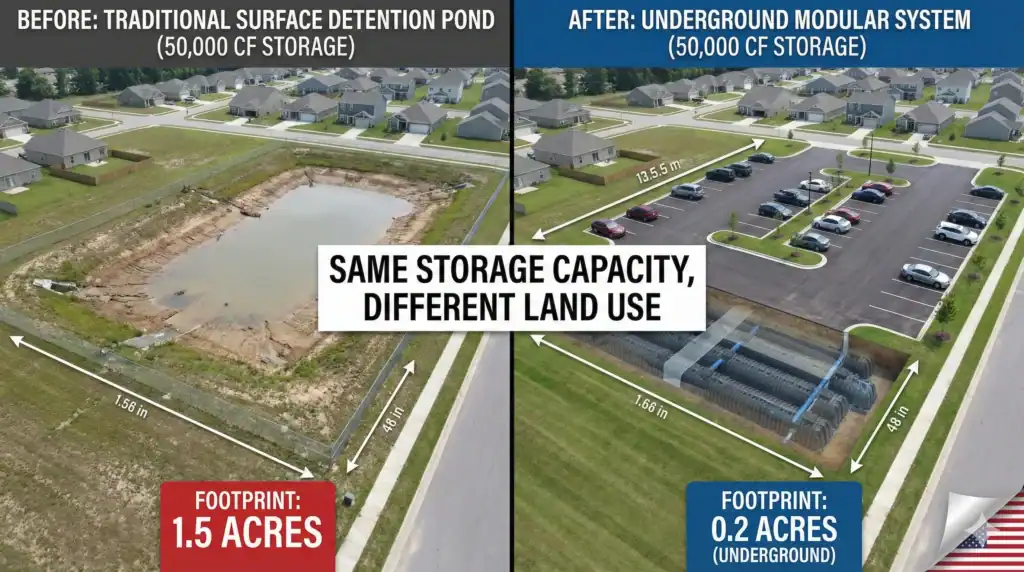
Traditional surface detention ponds have another problem that is often overlooked: they take up valuable land. In urban California, where every square foot is costly, setting aside 5,000 or 10,000 square feet for a pond is not just an engineering decision but also an economic one. During a multi-day storm, the pond may remain full for days and cannot provide the storage needed for additional rain. As a direct response to these land constraints, subsurface alternatives such as modular stormwater systems are emerging as viable solutions. These systems utilize underground space, allowing urban areas to optimize surface land use while effectively managing stormwater. Implementing subsurface options not only addresses the issue of excessive land use but also enhances the infrastructure’s resilience during extended periods of rainfall. However, it is essential to consider site suitability factors such as geotechnical, contamination, or groundwater conditions, as these may limit the feasibility of using subsurface systems. Engineers must assess the subsurface characteristics to ensure the chosen solution is suitable for the site’s specific conditions.
All these factors point to a key question: how reliable are our systems when conditions become increasingly extreme? As California’s weather patterns continue to change, this question is at the heart of our planning discussions.
What California’s Regulations Actually Require
Before we discuss solutions, let’s look at the requirements. In California, stormwater management is not optional; it’s required, and the details differ by region more than many people realize.

When we mapped out regulation intensity across all 50 states, I was surprised by California’s position. The state is not just strict—it also prioritizes different things. The purple color indicates LID/Infiltration Priority, which means on-site retention and groundwater recharge take precedence. Detention, or temporarily holding water before releasing it, comes second.
This order is crucial for the design of a project.
The Statewide Baseline
At minimum, California projects must comply with the NPDES stormwater permit framework administered by the State Water Resources Control Board.This includes:
The Construction General Permit (CGP) for any site disturbing one acre or more, requiring a Stormwater Pollution Prevention Plan (SWPPP) and post-construction BMPs.
The Industrial General Permit (IGP) applies to qualifying facilities with its own monitoring and reporting requirements.
Regional Overlays—Where It Gets Specific
Here’s where it gets complicated. The statewide permits establish a minimum standard, but the Regional Water Quality Control Boards add their own requirements.
Bay Area: The Municipal Regional Stormwater Permit (MRP) includes the well-known C.3 provisions. If your project creates or replaces 5,000 square feet or more of impervious surface, you’re a “Regulated Project” and must implement LID treatment measures on-site. The hierarchy is clear: infiltration first, then evapotranspiration, then biotreatment, then harvest and reuse.CASQA’s SoCal LID Manual provides detailed guidance, though it’s worth noting the MRP framework is Bay Area-specific.
Southern California: The LA Regional Water Quality Control Board operates under MS4 Permit Order No. R4-2021-0105, covering Los Angeles and Ventura counties. Similar LID requirements, different administrative structure.
A key compliance point is that most regulated projects need a recorded Operation and Maintenance covenant. This means the property owner is legally required to maintain stormwater BMPs for as long as the development exists. It’s not a one-time installation, but a long-term responsibility.
Underground Modular Systems: What They Actually Do
Now, let’s look at the solutions available for these challenges. It is essential to clarify the meaning of a “modular stormwater detention system” as it can be interpreted differently by various individuals.
Geocellular stormwater modules are structural plastic units, usually made from high-strength polypropylene, that interlock to form underground chambers. You can think of them as a three-dimensional grid that creates empty space under your site’s surface.
The numbers that matter:
A well-designed geocellular system achieves a void ratio of 95% or higher. That means 95% of the excavated volume is available for water storage. Compare that to traditional crushed stone systems, which have a 30-40% void ratio, and you’re looking at roughly triple the storage capacity for the same excavation footprint.
However, the void ratio is just the start. What truly makes these systems useful in California’s regulatory environment is three engineering details that are often missing from marketing materials. Imagine planning a commercial parking lot in downtown Los Angeles. The key differentiators to remember are load capacity, which ensures the system can hold the necessary weight of heavy vehicles, hydrologic function, which ensures proper water management and groundwater recharge, and serviceability, which addresses long-term maintenance needs. For instance, if the parking lot is expected to support frequent delivery trucks, selecting a system with a high load capacity is crucial; reference the AASHTO HS-20 load rating as a standard. Similarly, hydrologic function is essential in areas prioritizing groundwater recharge. Standards such as ASTM D3385 for soil permeability can guide these choices. Serviceability considerations ensure that, despite urban constraints, maintenance remains feasible, avoiding future costly overhauls. Ensuring compliance with relevant hydrologic modeling standards, such as EPA SWMM for stormwater management, is also vital.
It is essential to note that every underground stormwater system requires regular maintenance. Well-designed geocellular modules incorporate inspection ports at regular intervals, allowing visual assessment and camera inspection of the chamber interior. Isolator rows near inlet points trap sediment before it spreads throughout the system, and these rows can be cleaned independently without requiring access to the entire chamber. Additionally, the structural design is jet-vac compatible, meaning the modules can withstand the pressure from standard municipal vacuum truck cleaning equipment. Addressing maintenance realities upfront builds trust with public works staff and underscores the long-term viability of these systems.

Traffic-Rated Installation Under Pavement and Fire Lanes
This is essential for most commercial projects. The modules must handle HS-20 or H-20 loading, which is the same standard required for fire department emergency access lanes.
In practice, this means you do not have to build around the stormwater system. You can build directly on top of it. The parking lot, fire lane, and loading dock can all be placed above the detention chamber, provided there is proper bedding and cover depth.
For projects where every square foot of land is already planned, this can be the difference between having a workable stormwater solution and needing to redesign the entire site plan.
Detention vs. Infiltration Configuration
There’s an important detail that many people miss: the difference between a detention system and an infiltration system isn’t the module itself, but how it’s wrapped.
Detention configuration: The entire chamber is wrapped in an impermeable geomembrane liner. Water enters, is stored temporarily, and exits through a controlled outlet structure at a rate that doesn’t overwhelm downstream infrastructure. The water never comes into contact with the surrounding soil.
Infiltration configuration: The chamber is wrapped in a permeable geotextile. Water enters, fills the void space, and gradually percolates into the surrounding soil, recharging groundwater. The outlet structure serves as overflow protection, but the primary discharge path is into the ground.
It employs the same structural system and modules, but the hydrological function is entirely different. In California, where regulations focus on infiltration and groundwater recharge, this flexibility is crucial. The setup of your system should be based on soil permeability testing, not just the product you purchase. It is advisable to refer to ASTM D3385 or equivalent local standards for soil permeability testing. These standards provide a clear methodology for determining the rate at which soil can absorb water, which is critical for making informed design decisions.
Maintenance Access Design
It is essential to note that the industry often overlooks an important aspect: every underground stormwater system requires regular maintenance. The real question is whether that maintenance is possible, or if you have installed something that will eventually clog and fail.
Well-designed geocellular modules incorporate:
Inspect the ports at regular intervals to allow for visual assessment and camera inspection of the chamber interior.
Isolator rows near inlet points, which trap sediment before it spreads throughout the system. These rows can be cleaned independently without needing to access the entire chamber.
Jet-vac compatibility in the structural design, meaning the modules can withstand the pressure from standard municipal vacuum truck cleaning equipment.
This is not a “bury it and forget it” type of infrastructure. It is designed for long-term maintenance, which is exactly what California regulations require, due to the O&M covenant discussed earlier.

Where This Matters Most Right Now
Let’s return to the current situation in California, because these applications are not just theoretical.
Post-Fire Burn Scar Reconstruction
The Palisades and Eaton fire burn areas face a compounding problem. Destabilized soil, zero vegetation to slow runoff, and hydrophobic soil layers that actively repel water infiltration. Every significant rain event triggers debris flow warnings and evacuation orders.
Traditional stormwater solutions in these areas can take months to obtain permits and construct. On the other hand, modular detention systems can be designed, manufactured, and installed in just weeks. This expedited process is possible not because corners are cut, but because standardized engineering eliminates the need for concrete curing time. To further support this rapid deployment, the permitting process for modular systems is generally streamlined. Typically, these permits go through an initial site assessment, followed by a design review, and are often approved within a few weeks. However, timelines can vary based on local regulations and site-specific considerations. In burn scar areas, where time is of the essence, such speed is crucial. Municipalities focused on safeguarding downstream communities prioritize effective solutions over ones that are merely elegant.
An important factor for wholesalers is the logistical side of these operations. Considering supply chain and delivery logistics is crucial for ensuring smooth project execution. Lead times for obtaining modular components are typically shorter due to the simplified manufacturing processes. Wholesalers should be aware of inventory management challenges since demand can spike rapidly following emergencies. Ensuring a steady stock and having efficient distribution channels in place can greatly aid in meeting project timelines without causing delays.
Commercial Development Under Space Constraints
Urban infill projects, such as mixed-use developments, adaptive reuse projects, and parking structure retrofits, often lack the space to dedicate to detention ponds.
Underground stormwater detention allows the detention volume to exist beneath otherwise productive space: parking lots, plazas, landscape areas, even building footprints in some configurations. The land serves two purposes simultaneously.
For Bay Area projects that must meet C.3 requirements, or SoCal projects under the LA MS4 permit, the focus on infiltration often makes subsurface infiltration chambers the simplest way to comply.
When soil conditions support infiltration—and a geotechnical investigation confirms adequate permeability—an infiltration-configured modular system checks multiple regulatory boxes simultaneously: volume control, groundwater recharge, and post-construction BMP requirements.
Looking at the Actual Numbers
Theoretical benefits are one thing, but the actual numbers for your site are what truly drive decisions.
For any project, the main comparison is between a traditional surface detention pond and a subsurface modular system. This comparison should consider:
Storage volume required based on your local design storm—whether that’s the 85th percentile storm for water quality, or the 2-year, 10-year, or 100-year event for flood control.
Footprint implications for your site plan. A surface pond requires setbacks, fencing, maintenance access, and often landscaping requirements. A subsurface system requires none of that at the surface level.
Long-term maintenance costs include inspection frequency, sediment removal, and eventual rehabilitation or replacement.
Land value recovery from the ability to use the surface for parking, building, or other productive purposes.
The numbers can vary a lot by project. For example, a 10,000 cubic foot detention requirement might occupy 4,000 square feet as a traditional pond, or have no surface area at all if you use a subsurface system under your parking lot.
In most California markets, those 4,000 square feet have significant value.
So Where Does That Leave Us?
So California’s stormwater regulations are becoming stricter. Atmospheric rivers are intensifying, and urban land is becoming increasingly expensive. getting more expensive.
We need to examine the immense potential of innovative solutions. Imagine a homeowner in the Palisades or a business in the Los Angeles commercial district, once devastated by the Christmas flooding, now securely protected by a state-of-the-art geocellular stormwater system. With this system in place, their properties not only withstand the next atmospheric river but thrive without interruptions or costly repairs. By transforming their outcomes for the better, these systems demonstrate the true value of forward-thinking infrastructure designed to adapt to an unpredictable climate. To address these challenges, engineering solutions must work under long-term stress, not just in ideal conditions. They need to meet infiltration-first regulations and avoid using surface area that could serve other purposes.
Geocellular stormwater modules are not the only solution. However, for many California projects, including commercial, institutional, high-density residential, and post-fire reconstruction, they are often the most practical choice.
What We Can Provide
If you are in the early stages of site planning or considering retrofit options for an existing property, here is what we can provide for your project: Beyond offering tailored layout designs and sizing calculations, we invite wholesalers and suppliers to engage collaboratively with our team or directly with project engineers. Such partnerships can foster joint ventures, creating synergistic solutions that enhance project outcomes and strengthen business relationships.
Concept Layout Drawing showing module placement relative to your site constraints, inlet/outlet locations, and maintenance accesspoints. Storagee Volume vs. Footprint Comparison running the numbers on detention pond versus modular subsurface system for your specific drainage area and design storm requirements.Preliminary Sizing Calculation based on your local jurisdiction’s requirements, whether that’s Bay Area MRP, LA MS4, or another regional framework. Please initiate your request by providing the site details and specific project needs, and we will respond within two business days. There is no obligation and no sales presentation. We provide engineering numbers you can use in your civil package or present to your client.
We encourage wholesalers to reach out for personalized consultations and quotes. You can easily interact with our dedicated team to discuss project needs and receive tailored recommendations. This inclusive approach ensures that every stakeholder, from project owners to suppliers, has access to the information and support required to make informed decisions.
View our geocellular stormwater module specifications or reach out directly to discuss your project requirements.
Additional Resources
For those wanting to dig deeper into California stormwater requirements and BMP performance data:
California State Water Board – Storm Water Program— Statewide permit information and regulatory updates
EPA National Menu of Best Management Practices — Federal BMP guidance and fact sheets
International Stormwater BMP Database — Performance monitoring data from installations nationwide
CASQA – California Stormwater Quality Association — Industry resources, training, and the SoCal LID Manual
EPA Green Infrastructure Research — Ongoing research into stormwater management effectiveness
This article reflects conditions and regulatory frameworks as of December 2025. Stormwater requirements vary by municipality within each state—contact your local stormwater authority for project-specific requirements.
 English
 Arabic
 French
 Russian
 Spanish