
Underground Stormwater Detention: Comparing Gravel, Chambers, and Modular Crates for 2026 Costs
If you’ve worked on drainage projects, you know that digging is usually the biggest expense, not the product itself.
Costs can rise quickly due to excavator rentals, dirt removal, utility work, and groundwater challenges.
In 2025, Washington floods caused over $250 million in damage after some areas saw more than 8 inches of rain. Traditional detention ponds and gravel pits couldn’t handle the runoff. So, is there a better solution?
Yes, there is. The best underground water storage option depends on your site, your budget, and how much excavation you’re willing to do. Understanding your goals and constraints helps you choose the right solution.
Before we dive in, here’s what you’ll find in this guide. We compare traditional gravel, arch chambers, and modular geocellular crates, using real-world cost breakdowns. You’ll see how each option impacts your project budget, helping engineers make informed decisions.
Three Drainage System Types Explained
Gravel Dry Wells and French Drains
This classic method uses a pit filled with crushed stone to let water flow through gaps. It’s proven for small residential jobs where water can easily soak in.
You’ll see these as: NDS Flo-Well, DIY gravel soakaways, and traditional French drains.
Best for: Backyard drainage, budget projects, areas with cheap land, and no traffic loading requirements
Plastic Chamber Systems
Arch chambers are plastic half-pipes buried in rows with stone around them for support and storage. They’re built for 25-year, 24-hour storms and are easy for engineers to specify for permits.
You’ll see these as: ADS StormTech, CULTEC Recharger.
Best for: Commercial parking lots, municipal projects, sites where the engineer already has chamber details in their CAD library
Modular Geocellular Crates
Modular crates are interlocking plastic modules, like large industrial blocks, stacked into any shape needed. No stone fill is used—just structure and water. They work for both detention and retention.
You’ll see these as: AquaRainwater ARW Series, Wavin AquaCell.
Best for: Tight urban sites, high water table conditions, projects where installation speed actually matters, and LID compliance requirements

Why Void Ratio Determines Your Excavation Cost
This is where the real differences show up. Many comparisons skip this step because it involves some math, but it’s where you can save or lose money on any underground drainage project.
Void ratio means the percentage of your excavation that actually holds water, not rock, plastic, or air gaps between stones.
For example, if you dig a 100-cubic-foot hole and fill it with gravel, only about 35 cubic feet will hold water. The rest is just rock taking up space. This directly affects your storage cost per cubic foot.
| System Type | Void Ratio | Translation |
|---|---|---|
| Gravel | 30-40% | More than half your digging holds stone, not water |
| Arch Chambers | ~60% | Better, but still needs serious stone backfill |
| Modular Crates | 95% | Almost every cubic foot you dig is usable storage |
Installed Cost Breakdown: 1,000-Gallon Storage Comparison
Don’t worry about unit prices yet. Instead, let’s look at what it takes to get 1,000 gallons of detention capacity installed:
| Metric | Gravel | Chambers | Modular Crates |
|---|---|---|---|
| Excavation Volume | 445 cu ft | ~220 cu ft | 141 cu ft |
| Stone Required | 445 cu ft (full fill) | ~150 cu ft | ~20 cu ft (bedding only) |
| Truck Loads (spoil removal) | 3-4 loads | 2 loads | 1 load |
| Excavation Cost vs Baseline | 100% | 65% | 32% |
Here’s what this means in simple terms:
Modular crates require 68% less digging than gravel for the same stormwater storage. This is the main way to save costs on projects where excavation is expensive or challenging.
Less digging means:
- Fewer hours on the excavator
- Less fuel burned
- Fewer trucks hauling dirt away
- Lower odds of hitting that unmarked gas line nobody knew about
- Less dewatering headache when you’re working near the water table
The material may cost more per unit, but when you add up all the digging costs, modular crates can be much more affordable. In places where excavation is expensive, stone arch chambers can cost nearly 2.5 times as much as modular crate systems for the same storage volume, at about $4.28 per cubic foot compared to $1.84 per cubic foot. The key takeaway: always consider total installed costs when planning your underground drainage project.

Traffic Load Ratings: H-20, HS-20, and HS-25 Explained
Not everything buried underground can handle a fire truck driving over it. Here’s the breakdown for specifying load-bearing stormwater systems:
| Rating | What It Handles | Real-World Examples |
|---|---|---|
| Landscape Only | Under 5,000 lbs | Garden beds, lawns—no vehicles ever |
| H-10 | 16,000 lbs | Residential driveways, light cars |
| H-20 | 32,000 lbs | Parking lots, fire lanes, standard traffic |
| HS-20 | 36,000 lbs | Highway loading, heavier commercial |
| HS-25 | 45,000 lbs | Truck yards, industrial heavy hauling |
Gravel systems depend on how well the stone is packed and how deep it’s buried. The quality can vary a lot depending on the installer, so results under pavement aren’t always reliable in areas with traffic.
Arch chambers can reach H-20 or higher ratings, but they rely on proper installation of the stone backfill. If there’s a soft spot or the compaction is rushed, you might have settlement problems later.
Modular crates are usually designed to support themselves, and their load rating depends on the product, not the surrounding material. Real-world conditions still matter, so installers should consider the specific site. For heavy-use areas, crates like the ARW-1050 are rated HS-25 and can handle truck loading zones.
Shallow Installation for High Water Table Sites
This is where modular systems really shine. If your project needs stormwater storage at shallow depths or above a high water table, modular crates make it possible and provide a solution where traditional systems often fail. In coastal and flood-prone areas, modular systems are usually the best option.
If you’ve worked in South Florida, coastal Texas, or anywhere along the Gulf, you know that digging down three feet often means hitting water. Traditional dry wells turn into wet wells, and chambers can float if they aren’t anchored. Digging deep to store water just doesn’t work well in these saturated soil conditions.
Modular crates offer a new solution:
- Ultra-shallow profiles: ARW-6841 modules are just 17.7 inches tall (450mm). You can install an entire system above the water table for effective shallow infiltration.
- Sub-base replacement: Shallow modules can also be used as a structural base layer under permeable pavement. With one installation, you get both drainage and pavement support.
- No floating: Properly weighted modular systems stay in place when groundwater rises, unlike empty plastic chambers.
A contractor we work with in Florida put it this way:
“Installation was stupid fast. Guys didn’t need drainage experience—it was just stacking blocks. We finished in half the time we budgeted and moved to the next job.”
This is real feedback from a contractor who relies on efficiency for their income. It shows that installing modular crates can save a lot of time and labor on site.

AquaRainwater Product Specifications
ARW Series Technical Data
| Model | Dimensions (L × W × H) | Storage Capacity | Void Ratio | Load Rating | Application |
|---|---|---|---|---|---|
| ARW-8053 | 31.5″ × 19.3″ × 20.9″ | ~52 gallons | 95% | H-20 / HS-20 | Standard commercial, parking lots, fire lanes |
| ARW-6841 | 26.8″ × 16.1″ × 17.7″ | ~31 gallons | 95% | H-20 / HS-20 | Shallow installs, high water table, residential |
| ARW-1050 | 39.4″ × 19.7″ × 19.7″ | ~63 gallons | 95% | HS-25 | Heavy truck traffic, industrial yards, ports |
Certifications & Testing
- ✓ Third-party structural testing (TR2 certified)
- ✓ SGS raw material verification
- ✓ Creep testing for long-term load performance
- ✓ 50+ year design life
Long-Term Maintenance and System Lifespan
Every system will need maintenance at some point. The real question is whether that maintenance is practical or if you’ll have to replace the entire system.
Gravel systems: Once sediment fills the gaps between stones, that’s it. You can’t flush or clean a gravel pit. You have to dig it out and start over. Typical lifespan before clogging is 10 to 20 years, depending on the amount of debris that washes in from upstream drainage areas.
Arch chambers: These are better. You can use a jet-vac to clean them if you have installed access points. However, the stone backfill collects fine sediment over time, and some of it gets into the chambers. Plan for regular inspections to keep the system working well.
Modular crates: With 95% open space, water flows easily, and there is little sediment buildup inside. You can add isolator rows, which are just a perimeter wrapped in geotextile fabric, to catch sediment before it gets into the main storage. High-pressure flushing through inspection ports removes anything that gets through. The design life is over 50 years. Maintenance is usually needed once every 5 years, with costs ranging from $800 to $1,200 per inspection and cleaning, depending on site access and local labor rates.
Project Case Study: Murrieta, California
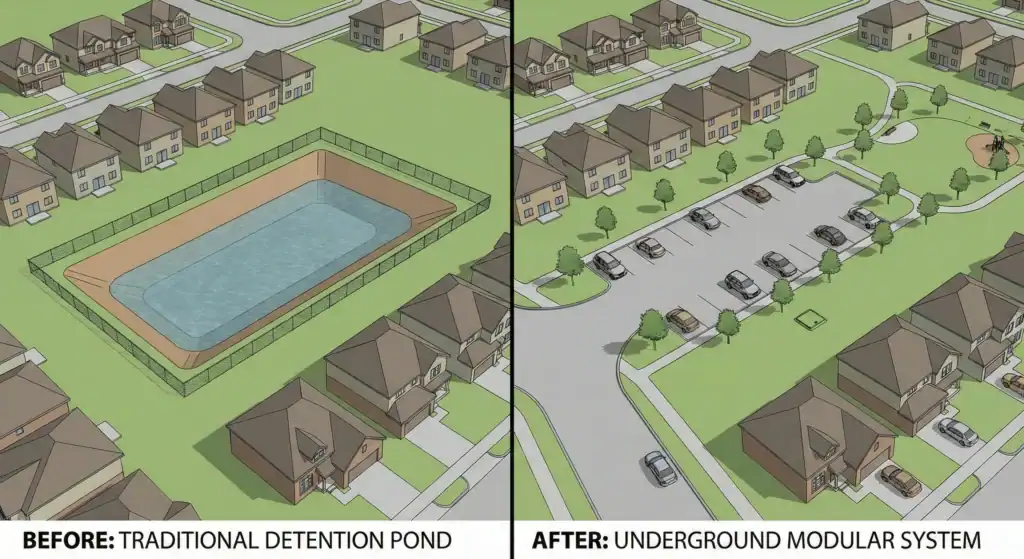
The situation: A residential development needed 30,000 gallons of underground detention to meet local stormwater management requirements. The lot lines were tight, and the clay soils didn’t drain well. The traditional approach would have used up valuable buildable area with a surface pond.
What we did: ARW modular crate system installed beneath planned parking area
Results:
- Excavation was reduced by over 60% compared to the gravel alternative.
- The crew finished ahead of schedule with no specialized drainage experience needed.
- The surface area above the system was converted to paid parking, generating revenue that helped offset project costs.
This is just one of many projects in California and Florida where we’ve supplied over 500,000 cubic feet of modular storage. The results are consistent: less digging, faster installation, and more usable land for development.
Check out more details: Murrieta, CA Installation Case Study
Total Project Cost Analysis
Here’s a straightforward look at where each approach works best, depending on your budget priorities:
| Cost Factor | Gravel | Chambers | Modular Crates |
|---|---|---|---|
| Material cost per gallon | Lowest | Medium | Medium-High |
| Excavation cost | Highest | Medium | Lowest |
| Stone/aggregate cost | Highest | High | Minimal |
| Installation labor | Medium | High (precision needed) | Low (unskilled OK) |
| 30-year maintenance | High (likely replacement) | Medium | Low |
| Land value recovered | None | Some | Maximum |
There’s a hidden return on investment. When you consider the surface area you regain, modular systems often come out ahead on total project costs. In our California and Florida projects, they usually save twice as much surface area compared to traditional detention. You can use that extra space for parking, building, or landscaping that adds value.
Selection Guide: Matching Systems to Site Conditions
Go with gravel when:
- Land is cheap, and you’ve got room to spare
- Budget is the absolute priority, and long-term costs don’t matter
- No vehicle traffic—ever
- You’re okay with replacing it in 15 to 20 years
Go with arch chambers when:
- Your engineer already has them in the spec, making it the path of least resistance
- You have installers who know the system well
- Stone is cheap and easy to source locally
- Standard commercial parking lot application with good soil conditions
Go with modular crates when:
- Space is tight (urban infill, ADU projects, lot line constraints)
- The water table limits how deep you can go
- Fast installation is important, whether due to weather windows or schedule pressure
- You want usable surface area above the system
- Long-term maintenance costs factor into your decision
- Available labor does not need to be specialized in drainage work
State Rebates and Incentive Programs
Many states offer rebates for stormwater systems that reduce runoff and support green infrastructure goals. It’s worth checking before you finalize your budget:
- California (SoCal WaterSmart): Cash rebates for rainwater storage and harvesting systems
- Washington State: LID-first mandates make compliant systems easier to permit
- Pennsylvania (Philadelphia Rain Check): Up to $2,000+ for qualifying installations
- Maryland: Property tax credits up to 10% of installation costs
- Texas: Many local utilities offer monthly stormwater fee reductions for on-site detention
Underground modular systems usually qualify for storage applications when wrapped in a geomembrane liner. Most U.S. permitting agencies accept them for MS4 compliance, though specific approvals can vary by region. Be sure to check local guidelines to avoid any roadblocks in your design process. The EPA’s Soak Up the Rain program offers more resources on regional incentives.
About AquaRainwater
We’ve been making geocellular stormwater modules since 2009, with 16 years of export experience and service in over 30 countries. Our U.S. distribution partner supports projects in Florida, California, and across the country. Compared to other leading brands, ARW modules are competitively priced and stand out for both cost-effectiveness and strength. These modules are widely available through major U.S. distributors, giving engineers a reliable alternative to concrete vaults and traditional chamber systems.
What we bring to the table:
- Third-party tested products (TR2, SGS, creep testing)
- Engineering support and CAD details for submittal packages
- Competitive pricing for distributors and contractors
Our warranty is straightforward. If a product fails because of a manufacturing defect—not from installation damage or misuse—we’ll send a professional to inspect it and cover the replacement cost.
Next Steps
Contractors and engineers: Request spec sheets and CAD details
Distributors: Ask about wholesale pricing and territory
Property owners: Get a project estimate
If you have any questions, our technical team will get back to you within 24 hours.
 English
 Arabic
 French
 Russian
 Spanish