
Soakaway Crates: The Complete UK Guide to Modern Drainage Solutions

Managing surface water effectively is no longer optional for UK property owners. With stricter SuDS regulations and increasingly unpredictable rainfall patterns, traditional rubble-filled soakaways simply cannot keep up. Modern soakaway crates offer a practical, high-performance alternative that stores more water, lasts longer, and installs faster than outdated methods.
This guide covers everything you need to know about soakaway crates, including how they work, sizing calculations, installation requirements, and how to choose the right system for your project.
What Are Soakaway Crates?
Soakaway crates are modular plastic units designed to collect, store, and gradually release rainwater into the surrounding soil. They replace traditional soakaways that relied on pits filled with rubble, gravel, or hardcore, which inevitably clogged with silt and lost effectiveness over time.
Modern crates feature a honeycomb or grid structure that maintains open void space while supporting significant loads from above. When wrapped in geotextile membrane, the system prevents soil infiltration while allowing water to pass through freely.
The key advantage is storage efficiency. While a rubble-filled pit offers roughly 30–35% void space, quality soakaway crates provide 95% or higher void ratios. This means the same excavation volume stores nearly three times more water, dramatically reducing the footprint and excavation costs for any drainage project. For a deeper understanding of how these systems fit into broader water management strategies, see our stormwater drainage system guide.
How Do Soakaway Crates Work?
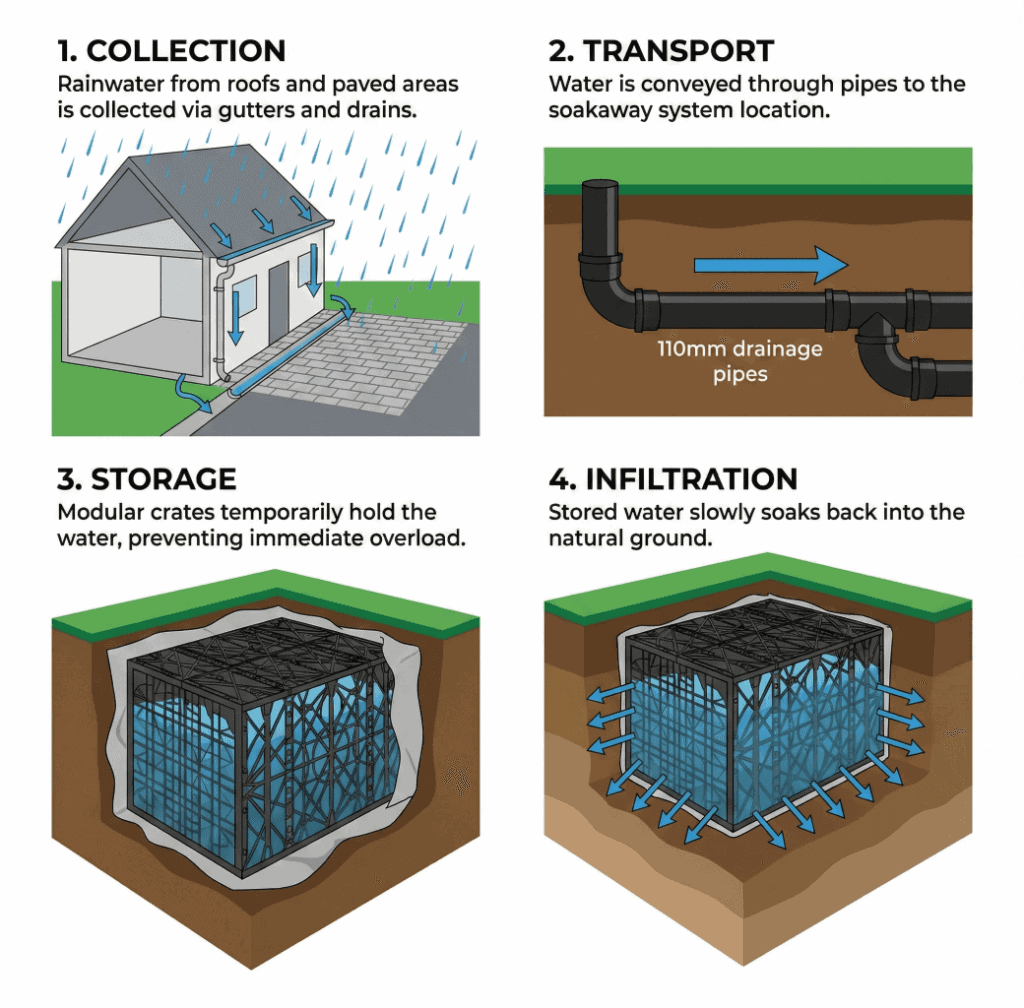
The operating principle is straightforward. Rainwater from roofs, driveways, or paved areas flows through drainage pipes into the crate system. The crates temporarily store this water, then slowly release it into the surrounding soil through natural infiltration.
This process involves four stages:
Collection: Surface water enters the drainage network through gutters, channel drains, or gullies.
Transport: Pipes (typically 110mm diameter) carry water to the soakaway location.
Storage: Crates hold the water during peak rainfall when the volume exceeds the soil’s absorption rate.
Infiltration: Water gradually percolates through the geotextile membrane into the surrounding ground, returning to the natural water table.
The rate of infiltration depends entirely on local soil conditions. Sandy and loamy soils drain quickly, while clay soils may require larger storage volumes or alternative discharge arrangements.
Soakaway Crates vs Traditional Soakaways
Understanding why modern crates outperform traditional methods helps justify the investment. If you’re weighing different water management approaches, our retention vs detention comparison explains the key differences.
Storage Capacity: Rubble soakaways offer 30–35% void space. Geocellular crates deliver 95–97% void ratios. For a 1 cubic metre system, that equates to approximately 950 litres of storage versus 350 litres—nearly three times the capacity.
Longevity: Traditional soakaways gradually fill with silt and soil particles, losing effectiveness within 10–15 years. Properly installed crate systems with geotextile protection maintain performance for 50 years or more.
Installation Speed: Filling a pit with rubble requires multiple deliveries and significant manual labour. Modular crates arrive flat-packed, and two workers can install up to 4,000 cubic feet per day using the snap-lock assembly system.
Maintenance Access: Rubble pits offer no practical inspection or cleaning options. Crate systems can incorporate inspection chambers for monitoring and maintenance access.
Load Bearing: Random rubble provides inconsistent support. Engineered crates carry specific load ratings, with heavy-duty units supporting traffic loads up to 40,000 lbs axle weight.
For most UK projects, the higher upfront cost of crate systems is offset by reduced excavation, faster installation, and dramatically longer service life.
Soakaway Crate Sizes and Specifications
Crate dimensions vary by manufacturer, but most follow standard modular sizes that allow flexible configurations.
Typical Size Options
| Application | Dimensions (mm) | Void Ratio | Load Rating |
|---|---|---|---|
| Garden/Residential | 680 × 410 × 450 | 95–97% | 20 tonnes |
| Driveways/Light Traffic | 800 × 490 × 530 | 95–97% | 40,000 lbs (H-20) |
| Commercial/Heavy Traffic | 1000 × 500 × 500 | 95% | H-20/HS-25 |
The ARW geocellular modules offer configurations suitable for both residential gardens and heavy-traffic commercial applications, with the ARW-8053 and ARW-6841 models designed specifically for projects requiring high storage capacity with minimal excavation.
Choosing the Right Size
For residential garden soakaways, smaller units like the 680 × 410 × 450mm format work well. They are easier to handle manually and fit standard excavator bucket widths.
Driveway and parking area installations require heavier-duty crates with appropriate load ratings. Always verify the manufacturer’s specifications match your expected traffic loads before ordering.
Large commercial projects benefit from bigger modules that reduce the total number of connections and speed up installation. The 1000 × 500 × 500mm geocellular tank format is popular for attenuation systems serving retail parks, distribution centres, and multi-unit developments.
How Many Soakaway Crates Do I Need?
Calculating the correct number of crates requires understanding your catchment area and local soil conditions.
Quick Estimation Method
For sites with reasonably permeable soil (not heavy clay), a common rule of thumb is:
1 cubic metre of crate storage per 50 square metres of impermeable surface
This means a typical house with 100m² of roof area would need approximately 2 cubic metres of soakaway storage.
Detailed Calculation Steps
For Building Regulations approval, you will need a proper drainage calculation based on:
1. Catchment Area: Total impermeable surface draining to the soakaway (roof, paving, drives)
2. Rainfall Intensity: Design storm data for your location (typically 50mm/hour for a 1-in-30-year event)
3. Soil Infiltration Rate: Determined by a percolation test (required for Building Control)
4. Storage Duration: How quickly the soil can absorb stored water
The calculation determines the total storage volume required, which you then divide by the volume per crate to find quantities needed.
Example Calculation
A driveway extension of 60m² in an area with moderate drainage soil:
- Catchment area: 60m²
- Using simplified rule: 60 ÷ 50 = 1.2m³ storage required
- Using crates with 0.2m³ volume each: 1.2 ÷ 0.2 = 6 crates minimum
Always add 10–20% contingency for connection volumes and safety margin.

UK Building Regulations for Soakaways
Any new soakaway installation must comply with Building Regulations Approved Document H (Drainage and Waste Disposal).
Key Requirements
Location: Soakaways must be positioned at least 5 metres from any building and 2.5 metres from site boundaries. This prevents water infiltration from affecting foundations or neighbouring properties.
Percolation Test: Building Control requires a soil percolation test before approving soakaway designs. The test involves digging trial pits, filling with water, and measuring how quickly the level drops. For detailed methodology, refer to BRE Digest 365.
Hierarchy of Discharge: Regulations specify a priority order for surface water disposal:
- Infiltration to ground (soakaway)—preferred option
- Discharge to watercourse
- Discharge to surface water sewer
- Discharge to combined sewer (last resort)
You must demonstrate that higher-priority options are not feasible before using lower-priority methods.
SuDS Compliance: Schedule 3 of the Flood and Water Management Act 2010 requires Sustainable Drainage Systems for new developments. Soakaway crates contribute to SuDS compliance by managing water at source.
Do You Need Planning Permission?
Replacing an existing soakaway within your property boundary generally does not require planning permission. However, new installations for extensions or significant paving work may need Building Regulations approval.
If your soakaway connects to any shared drainage or crosses property boundaries, consult your local planning authority before proceeding.
How to Install Soakaway Crates
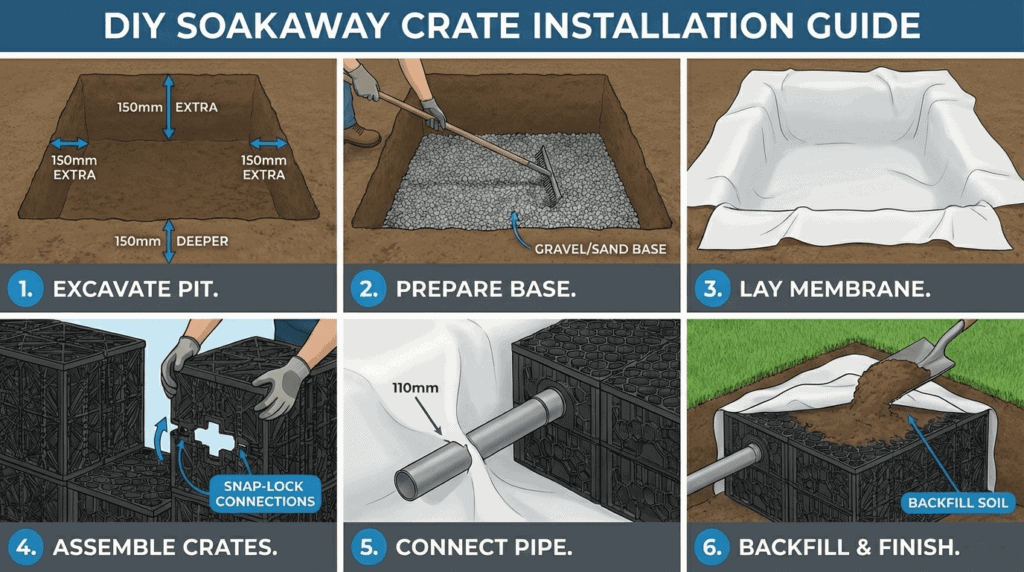
Whilst professional installation is recommended for larger systems, competent DIYers can install garden soakaways following these steps.
Materials Required
- Soakaway crates (quantity per calculation)
- Non-woven geotextile membrane
- 20mm pea shingle or sharp sand
- 110mm drainage pipe and fittings
- Cable ties or manufacturer clips
Step-by-Step Installation
1. Mark Out and Excavate
Dig the pit larger than the final crate assembly by 150mm on all sides and at the base. This allows for bedding material and membrane wrapping. Remove any sharp stones or roots from the excavation.
2. Prepare the Base
Spread a 150mm layer of pea shingle or sharp sand across the pit floor. Level and compact this layer to provide stable, even support for the crates.
3. Lay the Membrane
Drape the geotextile membrane into the pit with sufficient overlap on all sides to eventually wrap over the top of the assembled crates. The membrane prevents soil ingress whilst allowing water to drain through.
4. Assemble the Crates
Connect the crates according to manufacturer instructions. Most systems use a snap-lock or clip mechanism that requires no tools. Build up layers if stacking for deeper installations.
5. Connect the Inlet Pipe
Cut a hole in the membrane and crate wall for the drainage pipe entry. Ensure the pipe penetrates fully into the crate void. Seal around the connection with membrane tape.
6. Wrap and Backfill
Fold the membrane over the top of the crates, overlapping by at least 300mm. Backfill around the sides with pea shingle, then cover with excavated soil. Compact in layers to prevent settlement.
7. Surface Reinstatement
For garden installations, replace topsoil and turf. For trafficked areas, build up appropriate sub-base layers before the final surface.
Cover Depth Requirements
The depth of material above your soakaway crates depends on the expected surface loading.
| Application | Minimum Cover Depth |
|---|---|
| Garden/Lawn (pedestrian only) | 150mm soil |
| Light Vehicle Traffic | 350mm total (gravel + soil) |
| Standard Car Park | 450mm minimum |
| Heavy Vehicle Traffic (up to 40t) | 1000mm minimum |
Always check manufacturer specifications for your specific crate model. Using insufficient cover depth can cause surface settlement or crate damage under load.
Maintenance and Inspection
Properly installed soakaway crates require minimal ongoing maintenance, but periodic checks extend system life.
Twice-Yearly Inspection: Check inlet gullies and channels for debris build-up. Clear leaves and sediment before they enter the soakaway system.
After Heavy Storms: Verify surface water is draining normally. Prolonged standing water may indicate system issues.
Annual Flush: Run clean water through the system to clear any accumulated fine particles from pipe connections.
Inspection Chambers: If your installation includes access points, inspect annually for silt build-up and pump out if necessary.
The geocellular attenuation systems guide covers advanced maintenance procedures for larger commercial installations.
Common Soakaway Problems and Solutions
Even well-designed systems occasionally encounter issues.
Slow Drainage: Usually indicates soil saturation during prolonged wet periods, or gradual silting of the infiltration zone. Allow time for natural drainage, and consider a professional inspection if problems persist.
Surface Ponding: May result from undersized soakaway capacity, blocked inlet pipes, or failed membrane. Check upstream connections first before investigating the crate system.
Ground Settlement: Typically caused by inadequate backfill compaction rather than crate failure. Can usually be remedied by adding topsoil and re-seeding.
System Overflow: If the soakaway cannot handle peak flows, you may need additional storage volume or a secondary overflow connection to prevent flooding.
For persistent drainage problems, consult a qualified drainage engineer who can assess soil conditions and recommend appropriate solutions.
Cost Considerations
Soakaway crate costs vary based on quality, load rating, and supplier.
Typical Price Ranges (UK 2024–2025)
| Component | Price Range |
|---|---|
| Standard crates (20t rating) | £25–40 per crate |
| Heavy-duty crates (40–65t rating) | £45–80 per crate |
| Geotextile membrane | £1–2 per m² |
| Excavation (contractor) | £50–100 per m³ |
| Professional installation | £500–2000 for typical residential |
Cost-Saving Tips:
- Buy direct from manufacturers where possible rather than through merchants
- Calculate quantities accurately to avoid over-ordering
- Combine delivery with other building materials to reduce shipping costs
- Consider DIY installation for simple garden projects
The underground detention cost comparison guide provides detailed analysis of different system options and their long-term value.
Choosing Quality Soakaway Crates
Not all crates are equal. When comparing products, evaluate these factors:
Void Ratio: Higher percentages mean more storage per unit. Look for 95%+ void ratios from reputable manufacturers.
Load Rating: Match the rating to your application. Under-specifying for trafficked areas leads to premature failure.
Material Quality: Virgin polypropylene (PP) offers better long-term durability than recycled materials. Check UV stabilisation for any exposed components.
Connection System: Reliable snap-lock or clip mechanisms speed installation and prevent separation under load.
Warranty: Quality manufacturers offer 25–50 year warranties backed by independent testing certification.
Avoid the cheapest options that lack proper testing data or offer vague specifications. The cost difference is minimal compared to excavating and replacing a failed system.
Ready to Start Your Soakaway Project?
Whether you are managing a simple garden drainage issue or planning a major commercial development, soakaway crates provide an efficient, long-lasting solution that meets modern UK building standards.
For technical specifications, sizing assistance, or competitive pricing on geocellular drainage systems, contact our drainage specialists for expert guidance tailored to your project requirements.
Disclaimer: This guide provides general information about soakaway crate systems. Specific requirements vary by location, soil conditions, and local authority regulations. Always consult qualified professionals and obtain necessary approvals before commencing drainage work. Product specifications mentioned are subject to manufacturer updates.
 English
 Arabic
 French
 Russian
 Spanish