
Stormwater Management in the Middle East: GCC Geocellular Systems Guide
By AQUA Rain Water Solutions | March 7, 2026 | 14 min read
Stormwater Management Guide for the GCC Region (UAE, Saudi Arabia, Qatar, Oman, Bahrain and Kuwait) The following guide is applicable for the six Gulf Cooperation Council (GCC) countries. The following stormwater management guide does not cover the aspects of residential greywater recycling, desalination and wastewater treatment.
Оглавление
- Why Stormwater Management Matters Across the GCC
- Types of Stormwater Attenuation Systems
- Rainwater Harvesting in the Middle East
- UAE Stormwater Regulations
- Saudi Arabia and Bahrain: SBC 701 and Vision 2030
- Qatar, Oman and Kuwait: Emerging Standards
- GCC Regulatory Comparison
- How to Size a Stormwater System for GCC Projects
- Installation, Maintenance and Common Problems
- GCC Product Recommendation Matrix
- ЧАСТО ЗАДАВАЕМЫЕ ВОПРОСЫ
Water management in the Middle East is a significant challenge. An example of this is the AED 30 billion, roughly USD 8 billion of stormwater infrastructure that the government of Dubai invested under the Tasreef program. Engineers in Jeddah on the Red Sea still talk about the flooding disaster that occurred on the 25th of November 2009 and that claimed the lives of over 100 people. The reason the city was flooded so easily is that there is no formal drainage system in the city except for a small part of the old drainage system that was revealed after the heavy flooding that occurred in the city during the months before the flooding disaster. Flash flooding was reported in several residential areas in the north of Oman on Oct. 26, 2021 after Cyclone Shaheen made landfall.
Heavy flooding was reported in various parts of the UAE, Saudi Arabia and Bahrain on Wednesday as the GCC region witnessed heavy rainfall for the third time in two months. The GCC is generally characterised by low levels of rainfall, and the rare occasions when it actually does rain can sometimes result in severe destruction and financial losses.
In the Middle East stormwater management involves the collection, conveyance, storage and disposal of stormwater runoff associated with exceptional storm events. In the GCC region, it primarily involves the design of adequate underground detention system for the collection of stormwater runoff from urban catchments for subsequent slow release into storm sewers thereby averting the risk of flooding and damage to structures and property. This is a reasoning that is completely different from the temperate climate region. In the GCC, even before the advent of urbanisation the attenuation of stormwater through инфильтрация was never considered to be of any significant importance. Primarily due to ground conditions that consist of sandy soils and sabkha land formations. These have not changed even after urbanisation as the urbanisation has largely replaced the few metres of pervious land that existed.
Please check with the relevant authority for the specific stormwater regulation applicable for the GCC country you are working in. Our Guide is based on the current regulations as of 2025 for Dubai Municipality (DM regulation – V2, 2025 version), Abu Dhabi (ADSSC WA-726), Saudi Arabia (SBC 701), and Qatar (QCS 2014 & Ashghal standards). As of our knowledge cut off, there are no regulations applicable for stormwater management in Oman and Kuwait. The Guide summarizes and highlights the key aspects of the existing stormwater regulations in each of the GCC countries and offers alternatives for the attenuation of stormwater using geocellular systems.
Why Stormwater Management Matters Across the GCC
The Flash Flood Problem
Myth #4: Flooding will not occur in the desert Region Soils & Pavements 3rd Edition: Myth Busting Series By Nadeer Naseem, Senior Civil Engineer As-salaamu Alaykum, despite the GCC countries receiving an average annual rainfall of between 60mm to 130mm, the regions do not receive uniform distribution of rainfall throughout the year. Rainfall can sometimes be delivered in large bursts, as was the case when 140mm of rainfall fell in Dubai on 23rd April 2024. Consequently, blockages have occurred in ground drainage and overflows in storm water drains have been observed.
The phrase “drainage to maintain permeability” is often heard in relation to sandy soils. Wrong! at least on the surface. In the Gulf region, there are many sabkha (salt crust) areas that inhibit the absorption of surface water. In addition, during land development and construction works, the soil is often filled and heavily compacted to facilitate the construction of structures and pavements, thereby eliminating any possibility of surface water infiltration into the ground. A number of ground investigations carried out in the Gulf region confirm the generally poor permeability of the soil layers. Thus, assumption of ground water infiltration of surface water from paved urban areas to alleviate flooding is not valid. In fact all six Gulf countries are experiencing unprecedented rates of urbanisation and vast areas of virgin sand are being replaced with concrete and asphalt, leading to immense surface water run-off with no ground absorption whatsoever.
Water in figures Dubai Municipality has allocated AED 30 billion via the Tasreef project to the development of the water sector in Dubai. Qatar has pledged USD 22.3 billion towards infrastructure projects, such as sewer systems and flood protection prior to and following the 2022 World Cup. The plans are to build more than 1,000 water reservoirs to collect about 4 million cubic metres of rainwater each year.
From Reactive to Planned Drainage
Stormwater runoff is not a pressing concern for the cities of the Gulf region. Heavy storms would occasionally cause flash flooding and, apart from pumping out the underpasses with tankers, no major disruption to daily life would take place. “React rather than plan” was long the prevailing philosophy. That all changed with the flooding of Jeddah in 2009 and, more recently, the flooding of Dubai in 2024 and disruption to air and land transport for days on end because of the inundation of Dubai Airport.
Stormwater drainage is now becoming a design requirement for almost all cities and towns in the GCC. The deep tunnel stormwater drainage project in Dubai is proceeding on schedule and the coastal flood protection projects in Abu Dhabi are one of the few examples of municipal urban flood protection measures in the region. Design of stormwater drainage systems in the region is carried out in accordance with BS EN 752 with necessary local modifications and considerations. NOC for drainage connections to the municipal network is required from the authorities in Dubai and Abu Dhabi and the municipalities in Saudi Arabia require an equivalent certificate under SBC 701.
From Emergency Response to Engineered Proactive Stormwater Attenuation We have gone from a world of emergency response and reactive operations to one of engineered proactive stormwater attenuation. In simpler terms this means that stormwater management is now being built into developments prior to land being developed, rather than occurring after the fact following a flood event. Climate change resilience is now also a fully integrated part of the development assessment process as opposed to a discretionary design option.
If you are currently working on a project in the UAE we would like to invite you to read our full guide to stormwater attenuation tanks in the UAE.
Types of Stormwater Attenuation Systems
Geocellular Modular Tanks
The most suitable system for stormwater management in GCC region is geocellular. These are formed by stacking interlocking plastic modules under the earth to form an underground water reservoir to store the stormwater. The коэффициент пустотности of these systems is about 95 to 96% which means almost all the void space of the structure is utilized as storage.
Three configurations work across the region:
Storage/Water Holding (Содержание под стражей – common in GCC) The water entering the storage basin is detained and then slowly released through a flow control device back into the municipal distribution system.
- Удержание (harvesting): water is brought in and stored to be pumped out when required for use in irrigation or cooling systems. Same technology as before but in a different casing.
- Инфильтрация (soakaway): where water is absorbed by the ground. This method is not common in the GCC region, due to the existence of sabkha and high water tables. Although it is used from time to time in the interior regions of Saudi Arabia, where the ground conditions are suitable.
This is important in the Gulf. Almost all car parks, logistics yards and roadways are built above the tops of the modules. So, they should be designed for at least H-20 or HS-25 loading. There have been a few close calls as some of the contractors have attempted to use a lower loading class than what is required. We have had to replace a few failed modules because the client was unaware that the design was incorrect. We have a minimum design life of 50 years. Therefore, getting the SV loading class correct from the beginning is critical.
Check the full product specs on our геоцеллюлярные модули для ливневых вод page.
Concrete vs Geocellular Comparison
Both surface and underground reservoirs contain water beneath the surface of the earth and each will have a unique set of design and engineering considerations based on location. These considerations become increasingly complex and significant in the Gulf Cooperation Council (GCC) region.
Table 1: System Type Comparison
| Параметр | Геосотовые модули | Concrete Tanks | Pipe Systems |
|---|---|---|---|
| Коэффициент пустотности | ~95% | ~100% | ~80% |
| Installation speed | 1-3 days | 2-4 недели | 1-2 недели |
| Вес | ~30 kg/m3 | ~2,400 kg/m3 | ~500 kg/m3 |
| Design life | 50+ лет | 50+ лет | 30-50 years |
| Traffic load capacity | H-20 / HS-25 | Custom structural design | Ограниченный |
| Cost (relative) | Средний | Высокий | Low-Medium |
| Maintenance access | Low (modular) | Medium (confined space) | High (jetting) |
| GCC suitability | Отлично | Хорошо | Справедливый |
Although space and weight considerations are allowed, concrete tanks do provide a slightly larger effective storage volume for the volume of space that is allocated to each cubic meter of storage. They are however 80 times heavier than the weight of the volume of groundwater stored in a геоячеистый резервуар. This becomes a critical factor when dealing with sabkha soils and in the busy construction markets of the Gulf where crane access is at a premium. It would take 5 weeks and 1 day to construct a concrete tank that has a volume of storage equal to that of a 2,800 cubic meter geocellular tank. A crane would be required to be on site for 5 weeks and 1 day, whereas the crane and all of its associated personnel would be off site in less than a weekend.
Технические характеристики
Table 2: ARW Product Specifications
| Параметр | ARW-6841 Module | ARW-8053 Module | ARW-1050 Tank |
|---|---|---|---|
| Размеры (мм) | 680 × 410 × 450 | 800 × 490 × 530 | 1000 × 500 × 500 |
| Коэффициент пустотности | 95% | 95% | 96% |
| Материал | Recycled polypropylene (PP) | Recycled polypropylene (PP) | Recycled PP / Virgin PP (XT) |
| Load capacity | 40 t/m2 (HD) | 80 t/m2 (XD) | 60T (XT variant) |
| Gross volume | 0.1254 m3 | 0.2077 m3 | 0.2604 m3 |
| Design life | 50+ лет | 50+ лет | 50+ лет |
| Max stacking | 6 layers | 6 layers | 4 layers |
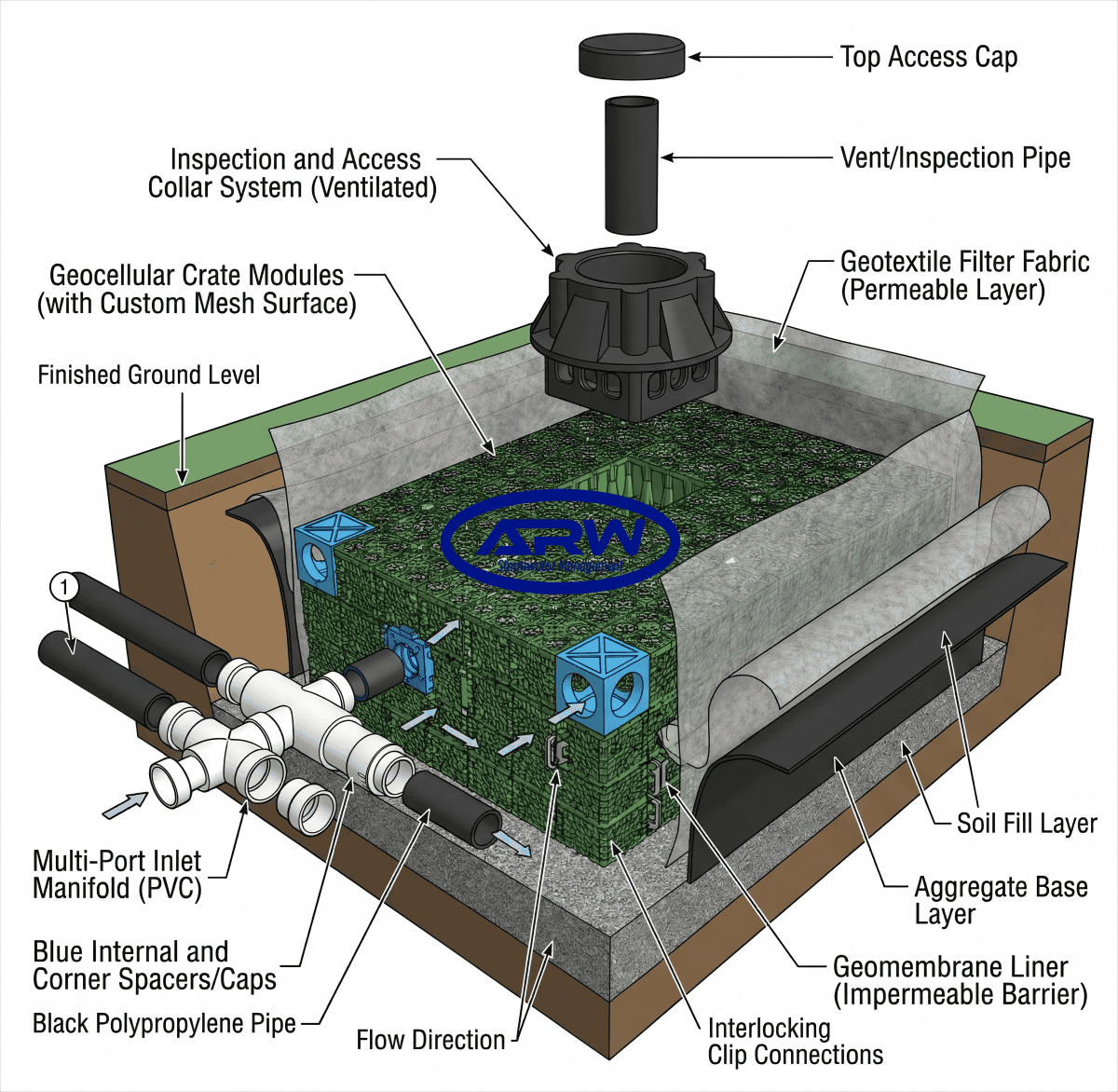
ARW-8053 is load rated for HS-25 and XD duty rating for highway and heavy logistics applications in the GCC region. ARW-1050 High Capacity Geocellular Tank • High void ratio of 96% • Stackable up to 4 layers for standard commercial detention.
Rainwater Harvesting in the Middle East
Why Harvest Rainwater in a Desert?
This cannot be right. A water deficit of 20 billion m3 per annum for the GCC, and desalination costs escalating all the time. 60 to 130 mm is often quoted for annual average rainfall for a project, which I find quite hard to argue with. As I found out recently, 10 hectares in Riyadh will provide 7,000 to 13,000 m3 of rainwater per annum; a more than adequate supply of water for even the most over the top landscape irrigation schemes.
In the Estidama Pearl Rating system launched in Abu Dhabi rainwater harvesting is one of the measures that is rewarded and from which points can be obtained by collecting and reusing the stormwater for the irrigation, toilet flushing and cooling tower makeup use. In Saudi Arabia, it is planned to build more than a thousand water reservoirs or dams in the framework of the national water security program of the Ministry of Environment, Water and Agriculture and increase the annual collection of rainwater by up to 4 million cubic metres.
Geocellular Harvesting Systems
The same geocellular modules are used. The difference is in the packaging of the modules for use in detention vs retention applications. For detention applications, a permeable geotextile is wrapped around the void space in the geocellular structure to allow stormwater to slowly enter the drainage system. For retention applications, an impermeable geomembrane is wrapped around the geocellular structure to hold stormwater in the structure until the water can be removed via pumping.
In the GCC, BW is mainly used for irrigation of landscaped areas, cooling system make-up water and toilet flushing in commercial buildings. In some projects in Dubai and Abu Dhabi, detention and retention ponds are combined to allow part of the harvested stormwater to be re-used while the excess is discharged into the municipal sewer system.
PS: Sustainable drainage is not limited to ground level structures such as geocellular tanks. Permeable pavements, rain gardens, green roofs and blue roofs are all forms of sustainable drainage. However, in the GCC region, subsurface geocellular systems are more prevalent due to the limitations of the above ground green infrastructure solutions in the hot climate and water scarcity conditions.
We have demonstrated all the possible harvesting configurations on the rainwater harvesting systems page.
UAE Stormwater Regulations (Dubai, Abu Dhabi, Northern Emirates)
Dubai Municipality Stormwater Guidelines V2
Stormwater Guidelines V2 – Dubai Municipality – 2025 The following information is an extract from Stormwater Guidelines V2 which was published by Dubai Municipality in 2025. Detention volume shall be designed for the design storm event Post development run-off rates for all commercial developments, land uses and mixed use developments shall not exceed the pre development run-off rates Drainage design for NOC approval shall be carried out prior to commencement of construction.
Standards for drainage in Abu Dhabi will be based on the British Standard for drainage (BS EN 752) with local modifications as appropriate. These modifications will address issues such as minimum pipe size, return periods (for example 10 years for low value drainage and 100 years for major drainage systems) and maintenance access. Currently, a significant part of this network is being established as part of the capital development program, Tasreef Phase 2, an AED 2.5 billion investment. Individual site drainage systems will then drain into this infrastructure.
Abu Dhabi ADSSC WA-726
In Abu Dhabi, design stormwater and subsoil drainage criteria are still derived from the Abu Dhabi Municipalities and Public Buildings Department (AWD) Design Manual Standard WA-726. These criteria are sometimes more stringent than in Dubai. The return periods for stormwater drainage ranges from 5 years for low grade drainage to 100 years for large structures. In addition to providing sufficient storage for the design storm, the drainage system has to be sized to accommodate the high groundwater level, which may coincide with the design storm and is a common characteristic in coastal areas.
The system has a large number of indicators and stormwater is one of the most important. A Pearl 1 rating is required for all new buildings in Abu Dhabi and a Pearl 2 rating is required for all government funded projects. In any case a stormwater management plan is required. Water reuse from stormwater and reduction of pavement area for the building and land plot are some of the points that can be gained for all Pearl 2 and above ratings. In the case of an Estidama rating higher than mandated, stormwater management will also be a major factor in your sustainability scorecard.
Northern Emirates (Sharjah, RAK, Ajman)
Sharjah, Ras Al Khaimah & Ajman follow the DM Drainage standards but with local modifications. For Trakhees areas in Jebel Ali & JAFZA the Trakhees drainage standards shall take preference over / in lieu of the DM Standards.
Stormwater standards are not currently available in the northern emirates. As a basis for design the local practice is generally to use BS EN 752 with local modifications as agreed with the Municipality on a project by project basis.
Project Spotlight: Dubai Logistics Park
Case studies are illustrative examples based on typical project scenarios.
Design and supply of stormwater detention system for new logistics park project at Dubai South. Site area is 45,000m2. The site comprises of compacted fill up to a depth of 900mm of sabkha. EOR requested ARW-6841 Stormwater Modules at the SD rating. Client requested a total detention volume of 2,800 cubic metres to be provided in 3 cells.
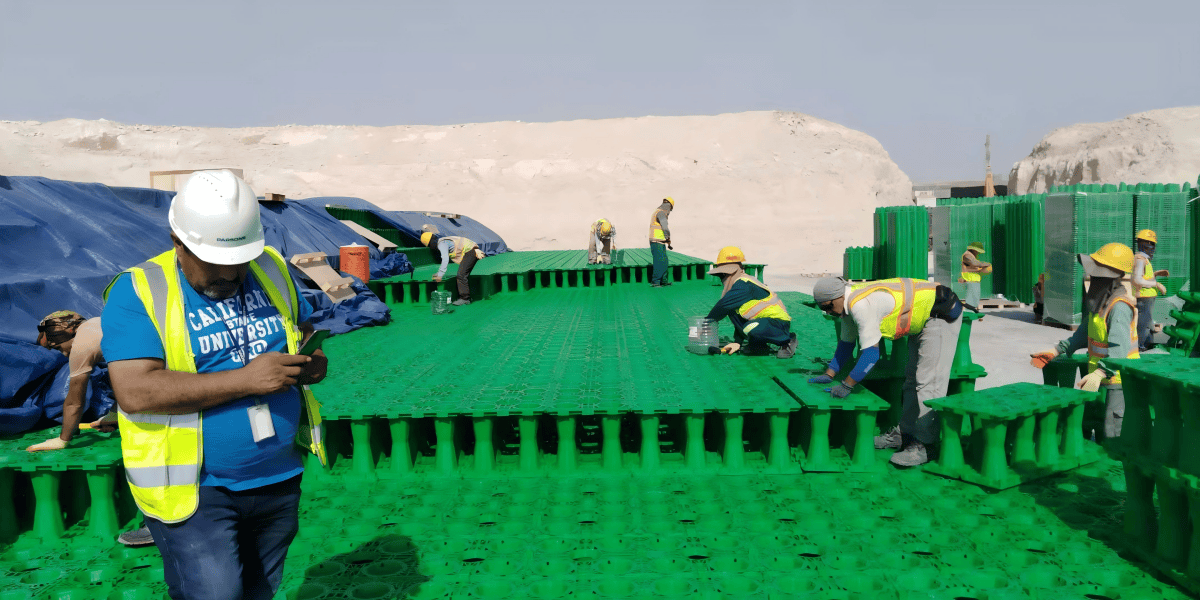
It’s gone in over 6 days. No that isn’t a typo. We have a 12 man labour team and a 2 tonne excavator without a crane. We are getting a concrete quote of 7 weeks for this project. The modules are still within specification and we had a clear DM (Dubai Municipality) inspection on the 1st attempt. The key to this was having the flow control devices and silt traps pre-installed in the tanks before the inspection. The DM were very particular that they had to be fitted after the inspection.
Sand moving through the geotextile at the eastern cell. We have now changed to a heavier non-woven fabric (300 gsm as opposed to 200 gsm).
Case studies are illustrative examples based on typical project scenarios.
External reference: Dubai Municipality Stormwater Guidelines V2
External reference: ADSSC WA-726 Standard
Saudi Arabia and Bahrain: SBC 701 and Vision 2030 Infrastructure
Saudi Building Code SBC 701 (Storm Drainage)
The new Storm Drainage provisions under the Saudi Building Code (SBC) Flood Protection Provisions under the Saudi Building Code SBC 701: Flood Protection has been applicable to new buildings since 2007. The Storm Drainage provisions under Section 1101 to 1105 namely Pipe size, Roof drainage, Site grading and Detention storage are discussed. The Jeddah 2009 flood disaster revealed a number of major inadequacies relating to flood protection of the city and hence these provisions under the SBC 701 were revised accordingly.
The Arid Climate Flash Flood Design Criteria is quite different to many conventional designs in temperate climates. The design storm intensity for design flash flood is obtained from IDF curves for each region in Saudi. Thus what is suitable for Riyadh will not be the same for Jeddah or the Eastern Province. As a result, for this particular design, local rainfall data is required as opposed to BS EN 752 which has a generic design storm for the whole of the UK.
Vision 2030 Mega-Projects
Stormwater infrastructure opportunities exist throughout the GCC but none are as significant as those presented by the mega-projects of Saudi Arabia. Flood ponds and detention basins are plentiful in the region, but where drainage is usually an afterthought, NEOM and The Line are helping set a new benchmark for designing stormwater from the outset rather than years after the fact. Therefore, in this region of the world where drainage is almost an afterthought, geocellular detention systems are being specified at the start of a project rather than being retrofitted many years down the line after drainage has been neglected and subsequently required by the Municipality.
The Qassim region is to spend 550 million SAR on drainage projects. New regulation for industrial projects requires that all design must be in line with Saudi Aramco engineering standards. Facilities larger than 5,000 square metres will need engineered stormwater ponds.
Bahrain
Bahrain is a small country. Small as in 780 square kilometres – roughly the size of Greater Manchester. Quite low lying – very, very low lying – almost entirely urbanised with no mountains or wadis to collect rainfall so instead of running off as run off, the rain just pools.
Stormwater drainage is being designed to the Saudi Standard. Increasingly subsurface detention ponds are being specified. This is because of the high cost of land and also because it is not always feasible to provide land for surface detention ponds. Hence the necessity to provide underground stormwater tanks. Highly developed countries like Bahrain cannot afford to waste even the smallest area of land and in such cases underground water tanks have to be provided.
Project Spotlight: Jeddah Commercial Compound
Case studies are illustrative examples based on typical project scenarios.
A 12,000 m2 land project for commercial use in Al Salamah district, Jeddah. The municipality required detention storage that was not provided by the drainage system proposed by the developer and accordingly was rejected by the municipality in not complying with SBC 701. The required detention storage was made of cast-in-situ concrete. The quantity required was within the budget of the developer. The consulting engineer later suggested replacing the required detention storage with ARW-1050 Геоцеллюлярные резервуары.
Ultimately the advantage was with the structure’s backing contractors. The reduction in materials was 40%, they gained three weeks on the structure of the concrete, and they did not need to use a crane, since, without the attenuation system and the flow control device, they would have had to position a crane for two weeks to pour the main access road. The attenuator system and the flow control device functioned flawlessly during the flash flood of 15th March 2025. The designed flow on site was 850 litres/second. Although necessary, the outflow did not exceed the 200 L/s authorised by the municipality’s drainage system.
The only error in the drain design was the size of the silt trap. It was required that the design be to UK design units. A comparison of the amount of sandy run-off on a typical Saudi construction site and a typical UK site shows a very large increase in sand and silt run-off. The size of the silt trap was increased about a year after commissioning the drainage system.
External reference: Saudi Building Code SBC 701

Qatar, Oman and Kuwait: Emerging Stormwater Standards
Qatar (QCS 2014 + Ashghal)
Until the World Cup 2022, drainage design as per the QCS 2014 has been the reference design. The Drainage Design Manual provided by Ashghal has the details for design return periods for pipes and other design criteria. Everything has changed since the World Cup 2022. There will be no going back to the old days. High capital investments made by the State of Qatar estimated to be over USD 22.3 billion for infrastructure works including drainage and flood resilience works and an on-going capital expenditure will not allow for a retrograde step and future projects will never be designed as they were before.
So drainage design in Doha & the key points to consider when designing drainage assets and obtaining an infrastructure licence from Ashghal: Stormwater management strategy to be incorporated in to all drainage design. This will involve consideration of return periods of storm events ranging from 10 to 100 years dependant on the catchment size associated with each individual asset and the requirement for storage within the drainage structure to account for the low lying topography and the small catchments that exist between structures.
Oman
The Cyclone Shaheen that hit Oman in October 2021 has underscored the need for achieving flood resilience. Heavy rainfall that resulted from the absence of adequate stormwater drainage systems in infrastructure projects flooded a number of villages in the regions of Al Batinah and Muscat. Wadi management is still a major challenge in the country. The reason for this is that the rainfall Oman receives is basically runoff and tends to be concentrated in wadi beds and this in conjunction with the short lead in time between the onset of the rainfall and the occurrence of flooding due to the rapid concentration of the rainfall in the wadi beds results in flash flooding.
Stormwater attenuation is becoming more common on sites in the vicinity of the wadi. It now appears that attenuation is a requirement of the MOP (Minimum Offsite Protection) approval process. We are now finding attenuation required for catchments draining into the wadi. We design, supply and construct attenuation ponds in accordance with BS EN 752 with any necessary amendments as required by the Municipality.
Kuwait
Kuwait has its own peculiar drainage problems. The main portion of the country consists of low land at or near sea level and the drainage of the land is dependent on pumping. Gravity drainage is precluded on account of the low relief of the land. High water is a permanent source of stagnating surface water for varying periods after heavy rainfall in all low lying areas of the country of Kuwait.
The practice of sub surface detention is rapidly emerging as a design option where high land cost is a factor, and where drainage lands cannot be afforded for the construction of open storm water detention ponds. A large amount of land has to be allocated for drainage infrastructure rehabilitation works, and thus it is also essential to explore alternatives to land appropriation. The Kuwait Municipality Code has some basic requirements for stormwater management, but they are less sophisticated than those found in the stormwater management codes in the UAE and Saudi Arabia.
External reference: Ashghal Drainage Design Manual
GCC Regulatory Comparison
Stormwater requirements can be confusing in the GCC (Gulf Cooperation Council) region. The six GCC countries have different regulations and approaches towards managing stormwater runoff. This document is being issued for the first time and consultants often request this information as they work in many of the GCC countries.
Table 3: GCC Stormwater Regulatory Comparison
| Аспект | UAE (Dubai) | UAE (Abu Dhabi) | Saudi Arabia | Qatar | Oman | Kuwait |
|---|---|---|---|---|---|---|
| Primary Code | DM Stormwater Guidelines V2 | ADSSC WA-726 | SBC 701 | QCS 2014 | Building Regulations | Municipality Code |
| Base Standard | BS EN 752 | BS EN 752 | SBC + BS EN | BS EN 752 | BS EN 752 | BS EN 752 |
| Detention Required | Yes (all commercial) | Yes (all developments) | Yes (major projects) | Yes (Ashghal approval) | Emerging | Ограниченный |
| Green Rating | Estidama (voluntary) | Estidama (Pearl 1 all builds, Pearl 2 govt) | Mostadam | GSAS | — | — |
| Design Return Period | 10-100 year | 5-100 year | 10-50 year | 10-100 year | TBD | TBD |
| Approval Body | Dubai Municipality / Trakhees | ADSSC | Municipality | Ashghal | Municipality | Municipality |
| Stormwater Investment | AED 30B (Tasreef) | Part of Estidama framework | Vision 2030 mega-projects | USD 22.3B infra (incl. drainage) | Post-Shaheen upgrading | Infrastructure modernisation |
Our key takeaways: The frameworks of Dubai and Abu Dhabi are more mature. Saudi Arabia is rapidly progressing forward as a result of significant capital expenditure arising from Vision 2030. Qatar has set a new benchmark following the recent events of the FIFA World Cup. Oman and Kuwait are at an earlier stage in the curve of development but on a similar trajectory.
In the GCC the Base standard I refer to is BS EN 752 and any local regulation that may be applicable. I always recommend to verify with the local municipality as each municipality has a different regulation. Although I worked on designs for 2 cities that are 30km apart, but still in the same country the designs were different as they were governed by 2 different municipalities with their different regulation.
How to Size a Stormwater Attenuation System for GCC Projects
Sizing Methodology
The Rational Method & its modifications are commonly used in GCC countries for design of stormwater drainage systems. The formula for computation of peak runoff rate (Q) is given as: Q = C × I × A Where, Q – Peak runoff rate; C – Runoff coefficient; I – Intensity of design rainfall; A – Area of catchment
In the GCC, the design criteria are different from those in the UK and Australia. Higher rainfall intensity values for shorter return periods are common. A 1 in 25 year, 15 minute storm in Dubai has a design intensity of approximately 80 to 100 mm/hr, a factor of 2 higher than the design intensity for London of 40 mm/hr. As a result, detention pond volumes in the GCC are typically 50 to 100% higher for the same catchment area as those required in temperate climates.
GCC-Specific Considerations
Three things catch out engineers who haven’t worked in the Gulf before:
Common reasons for low infiltration rates in sandy soils, but other factors can also prevail including sabkha horizons, highly compacted engineered fill and high water tables. A falling head permeability test is invariably carried out before the design of a soakaway is commenced, and more often than not rules it out as an option. The detention assumption should be adopted and only varied if specified within the soil report. Any credit awarded to the soil should have a reduction factor and safety factor applied.
- Evaporation potential is higher in warmer climates. It is generally accepted that evaporation potential will be higher in warmer climates. An example that clearly demonstrates the large variations in potential from one location to another can be seen when comparing detention basin locations in Dubai and London. Although the evaporation potential between the two basins is significantly different the fill periods between flushes for detention basins are expected to increase, rather than decrease. Hence, evaporation potential is a minor consideration in this respect. On the other hand, it can be an important consideration for catchments of water harvested from the atmosphere in catchments, as we have to account for the lost water.
Rates for this surface are subject to change and differ between Municipalities in the Emirates and between countries. Here are a few examples of rates for this surface: For Dubai the rate for this surface is 5 L/s/ha. For Abu Dhabi the rate is 3 L/s/ha. For Saudi Arabia the rates are usually worked out for each project. The rates are based on the capacity of the trunk mains that serve the municipality. It is always better to check with the Municipality to get the rates that are up to date. They are usually based on a greenfield runoff rate or a QBar.
In civil engineering, attenuation tanks are designed to capture storm events with some allowance for maintenance. So a silt trap that is required to be designed to fill to top down the pipe in 6 months due to very high sand levels in the Gulf region will effectively have a lower capacity. You can also visit the Geocellular Tank Specifications page.
Installation, Maintenance and Common Problems
Процесс установки
For a GCC project, the laying of blocks follows the same procedure as for any other project except for one particular consideration.
- Excavation and formation – Excavate to the required depth + 150mm for bedding. In sabkha soils it may be necessary to over-excavate and backfill with imported granular fill. Obtain geotechnical approval of the formation before constructing any of the modules.
- Laying of geotextile and geomembrane – A. Detention ponds – The geotextile to be a non-woven with a minimum rating of 300 gsm in sandy GCC soils as compared to a minimum rating of 200 gsm required in temperate climates. B. Retention or harvesting ponds – A geomembrane liner to be laid inside the geotextile.
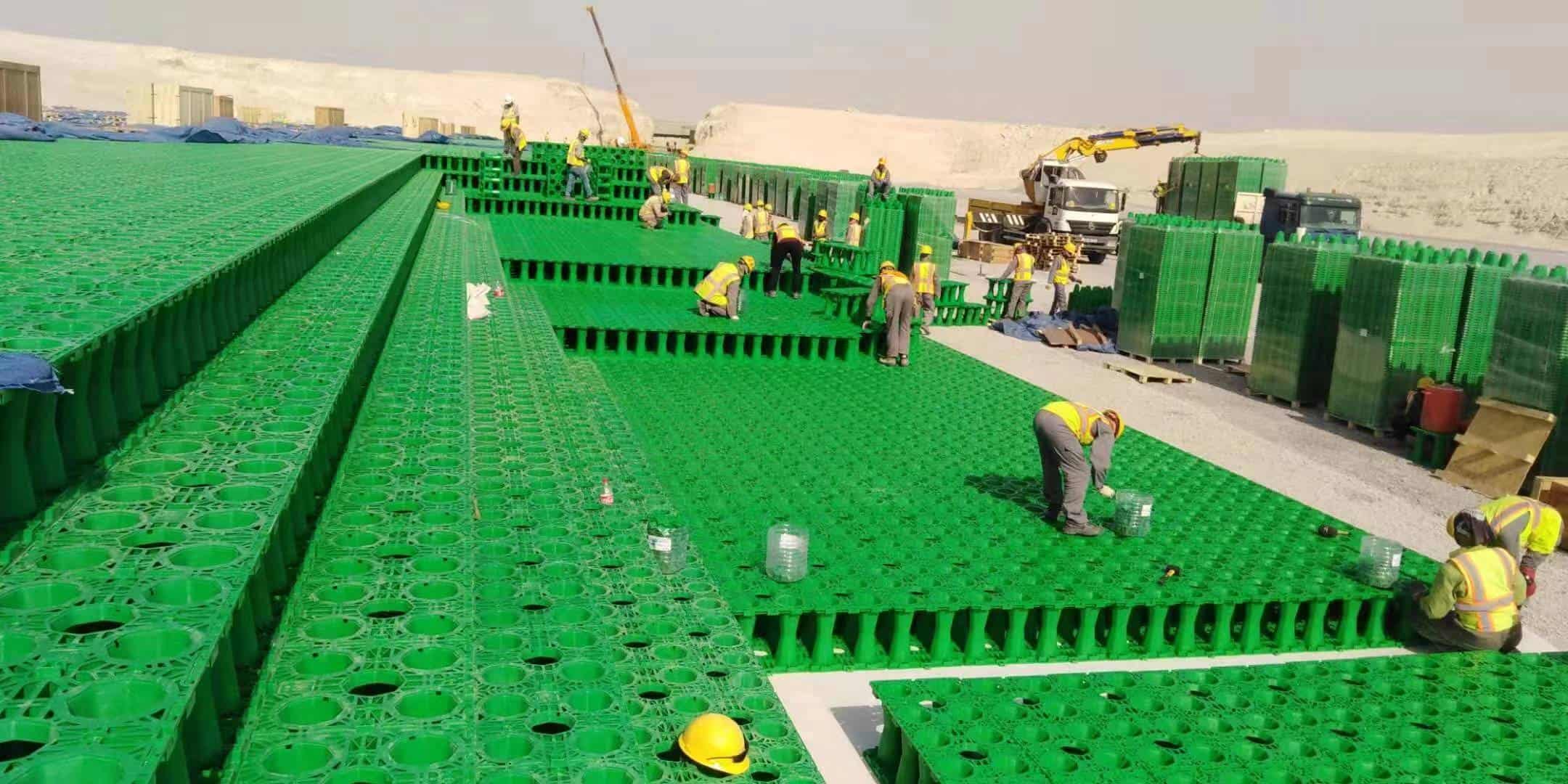
- Module Assembly – Interlocking geocellular modules are easy to assemble. No special tools are required. An 8 to 12 man crew can assemble 1000m3 in 2 to 3 days. No crane is required. A considerable advantage for the construction projects in the Gulf region.
- Backfill and compaction – Backfill the excavated area with clean granular fill material in 300 mm layers and compact. DO NOT REUSE THE SABKHA MATERIAL EXCAVATED FROM THE MODULE BED as it swells considerably and can exert high pressure on the modules that may cause distortion.
- Pre-treatment of the water is important – A silt trap needs to be installed prior to the RO system. Sand and dust entering the system is probably one of the top 5 maintenance issues we experience in the GCC. Without a pre-treatment silt trap the system will require frequent back-flushing – within 18 months of commissioning.
Maintenance Schedule
A geocellular structure becomes part of the soil it is placed in and will remain for its lifetime. However the low maintenance following installation will be very low compared to that required for concrete and pipe products – by very low we mean that it will be extremely low – almost none.
- Quarterly: Clean filter chambers at inlet and outlet sides of system of debris, sand, etc.
- The silt trap needs to be cleaned every year. More frequently in sandy areas like the GCC. Possibly 6 months depending on site conditions.
- Every 5 years CCTV survey of the system to check for any structural deformation of the modules, root growth in penetration holes, sediment build up inside the modules.
- Common issues in the Gulf region include: Silt buildup at the bottom of the sewer system; Roots entering the sewer system from overlanding; damage to regulators due to solids being carried through during high flow events.
For shallower installations, explore our shallow stormwater tanks range.
GCC Product Recommendation Matrix
When selecting a product for an application, it is always important to consider the location, application and level of filling. The matrix shows possible correspondences to products from the ARW product catalogue and the 3 control zones defined in GCC.
Table 4: Product x Zone x Application Matrix
| Приложение | Zone 1 (UAE) | Zone 2 (Saudi + Bahrain) | Zone 3 (Qatar + Oman + Kuwait) |
|---|---|---|---|
| Road / Highway Attenuation | ARW-6841 Stormwater Module (HD/XD) | ARW-6841 Stormwater Module (HD/XD) | ARW-1050 Geocellular Tank (XD/XT) |
| Commercial Detention | ARW-8053 Stormwater Module (SD/HD) | ARW-1050 Geocellular Tank (HD/XD) | ARW-1050 Geocellular Tank (SD/HD) |
| Rainwater Harvesting | ARW-1050 + pump system | ARW-1050 + pump system | ARW-1050 + pump system |
| Shallow Applications (high water table) | Shallow Tank (ST150/ST200) | — | — |
| Landscaping Drainage | Наземная сетка | Наземная сетка | — |
We have a wide variety of products in stock in Zone 1 (UAE) as it is one of the most developed markets and the loads required for projects here are generally the largest. Zone 2 (KSA+BHR) is increasingly using large volume geocellular tanks. Zone 3 being a new market for alternative water storage solutions, so far the ARW-1050 has been the most applicable product for this region.
Ground Grid Systems Ground Grid systems are commonly used in landscaping and car park applications to earth out static charge. We offer a variety of grounding grid systems that can be utilised depending on soil conditions and the design of the system required. If you require further assistance with your particular application, we suggest you contact one of our engineers who can assess your site and make a suitable recommendation.
Get Started
Overview of recent activities and upcoming work in the field of stormwater management of the GCC. Over the next decade stormwater infrastructure expenditure across the GCC is expected to run into billions of dollars annually. Thus, stormwater infrastructure and management will be a major consideration in the land use planning and development of the new distribution centres in Dubai South, new residential projects in Riyadh and new commercial centres in Doha, to name a few. The skills exist to address these needs and all that is required is for competent people to exercise their skills in real life rather than theoretical scenarios.
Once the scope of the project has been determined, it is necessary to identify which materials may be needed. In order to optimize the design of the materials needed for the project, it is necessary to identify which of our products may be applicable to the project. In addition to a successful project, it is also important to check for compliance with the Municipal requirements for the project. The GCC consists of six Arab countries: Bahrain, Kuwait, Oman, Qatar, Saudi Arabia and the United Arab Emirates. We have carried out load bearing capacity tests for a number of our products in the GCC countries. Please refer to the relevant technical data sheets for each of the duty variants in our geocellular attenuation modules and tanks.
Need some assistance with system sizing? Our team of experts will determine the appropriate drainage strategy for your property and will create a system design that is tailored to your unique situation based on the catchment area, soil conditions and municipal effluent standards for disposal. Свяжитесь с нашей командой to discuss your project.
External reference: BS EN 752: Drain and Sewer Systems Outside Buildings
Часто задаваемые вопросы
An attenuation tank or storm tank or flood tank is a reservoir of stormwater in underground conditions during intense rainfall or storm. In most commercial projects in the GCC regions an attenuation tank is compulsory. This is due to the fact that the municipal sewer network cannot carry the peak flows generated from an urban catchment.
Catchment area, site design storm intensity and the required outfall rate from the municipality are the three parameters that determine the size of the required detention basin. For a hypothetical site in Dubai with a catchment area of 10,000 m2, a 1-in-25-year design storm and a municipality required outfall rate of no more than 5 L/s/ha, the required detention basin volume is approximately 400 to 600 m3. It is always recommended to do a quick Rational Method calculation using the local rainfall data on your site.
No. An attenuation tank is a type of detention system and stores water and releases it at a slower rate. A soakaway is a type of infiltration system and allows water to percolate down into the ground. In the GCC, soakaways do not work effectively as sabkha soils and high groundwater tables prevent infiltration and detention is therefore the design philosophy.
There are three main types of attenuation tanks: <strong>Geocellular modular tanks</strong> made from polypropylene with a 95-96% void ratio and which are the fastest to install. <strong>Concrete tanks</strong> with the highest load bearing capacity and therefore the longest construction time. <strong>Pipe storage systems</strong> with a lower void ratio that are only generally suitable for smaller volumes.
Stormwater Guidelines V2 (updated 2025) by Dubai Municipality, and Trakhees regulations for districts falling under their purview, are based on the base standard <strong>BS EN 752</strong>. An NOC is required for drainage connection. The drainage system for the site will connect into the trunk network which is being expanded as part of the Tasreef project.
 English
 Arabic
 French
 Russian
 Spanish