
Beyond 2025: Future-Proofing Cities Against Extreme Weather with Integrated Subsurface Stormwater Systems
Have you noticed how the rain feels different lately?
It is not just your imagination. Across the globe—from the sprawling urban landscapes of the United States to the rapidly developing infrastructure hubs in the Middle East and Australia—our cities are facing a climate reality that we can no longer ignore.
Global warming is intensifying the Urban Heat Island effect, trapping heat in our asphalt and concrete cities. Worse yet, rainfall patterns have shifted dramatically. We are no longer dealing with gentle, predictable showers. We are facing sudden, violent flash floods and runoff volumes that historic records never predicted.
For decades, the construction industry relied on a standard recipe: dig a deep trench, install rigid concrete pipes, and dig a massive open pond to hold the water. At the time, that seemed sufficient. But as we approach 2025, we are discovering the cracks in these old methods. They take up too much valuable land, they clog easily with silt, and frankly, they simply cannot handle the overwhelming volume of modern super-storms.
At Aquarainwater, we believe it is time to stop fighting nature with outdated tools. It is time to embrace a smarter, more resilient approach: The Integrated Subsurface Stormwater Management System.
What is an Integrated Subsurface Stormwater Management System?
This is not just a fancy name for a plastic tank. It is a philosophy of moving the “heavy work” of drainage underground, where it is safe, invisible, and controllable.
Our system uses modular, high-strength geocellular units (often called stormwater crates) to create vast underground voids. Unlike gravel trenches, which are mostly stone and hold very little water (only about 30% void), our Polypropylene (PP) modules offer 95% void space.
This means you can store 3 times more water in the same size hole.
Once you capture the water underground, you have complete control over what happens next. Depending on your local soil conditions and government regulations, you can handle the water in three ways:
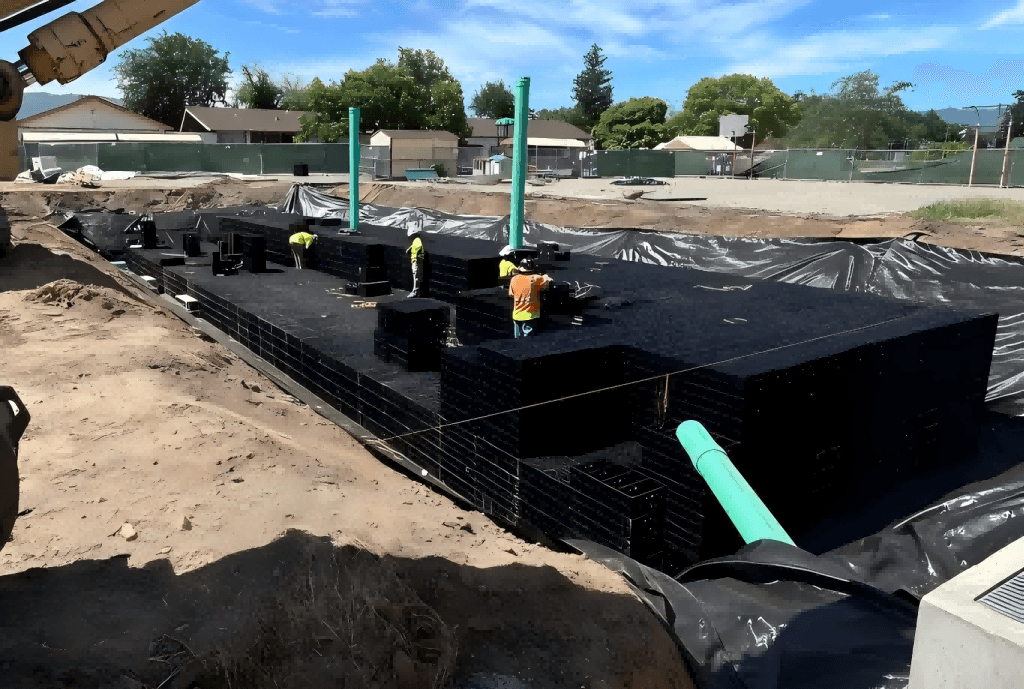
Option 1: Infiltration (Give it Back to Earth)
If your soil is sandy or permeable, this is the most eco-friendly choice. We wrap the tank in a permeable geotextile fabric. The water is filtered and allowed to slowly seep back into the soil. The Benefit: This recharges local groundwater aquifers and prevents land subsidence (sinking) caused by dry soil. It is the preferred method for Low Impact Development (LID) and Sponge City projects.
Option 2: Detention (Hold and Release)
In dense cities with clay soil or overwhelmed sewer networks, you cannot always infiltrate. Instead, the system acts as a massive underground buffer. It holds the floodwater during the peak of the storm and releases it slowly into the city pipes hours later via a flow-control device. The Benefit: This prevents downstream flooding and keeps your project compliant with local municipal discharge limits.
Option 3: Retention and Reuse (Harvesting)
Why pay for water when it falls from the sky for free? By wrapping the tank in a watertight geomembrane liner, you turn it into a secure underground cistern. You can use this water for landscape irrigation, street cleaning, or washing trucks.
Why pay for water when it falls from the sky for free? By wrapping the tank in a watertight geomembrane liner, you turn it into a secure underground cistern. You can use this water for landscape irrigation, street cleaning, or washing trucks.
“Set It and Forget It”: A Simple Workflow
A common fear we hear is: “If I bury this huge system underground, isn’t maintenance a nightmare?”
Actually, it is the opposite. Concrete surfaces are rough; they trap dirt and breed bacteria. Our high-quality Polypropylene (PP) is incredibly smooth. It resists chemical rot and does not encourage bacterial growth.
The workflow for your project is simple:
- Connect: Link your site’s drainage pipes to our system.
- Filter: Install a pre-filtration unit (like a silt trap) at the inlet to catch leaves and sand.
- Protect: For commercial parking lots, we recommend an oil-water separator to keep the water clean.
- Forget: Once buried, the system runs automatically by gravity. No pumps, no daily management.
The Ultimate Combination: Shallow + Deep Systems
One of our most successful strategies, used globally from the UK to the USA, is combining our deep Integrated System with our Shallow Geocellular Drainage System.
This is where engineering meets magic.
The Journey of a Raindrop Imagine a heavy storm hitting your project. Here is how the combination works:

- Surface: Rain hits the ground. Instead of forming puddles, it flows instantly through permeable paving or slot drains.
- Shallow Layer: It drops vertically into the Shallow Geocellular Drainage System sitting right under the pavement. This layer is incredibly strong (rated for AASHTO H-20 traffic loads), so cars and trucks can drive right over it.
- Transport: Because this layer is hollow, water moves horizontally with zero resistance, flowing into pipes that lead down to the deep tank.
- Deep Storage: The massive volume of water is stored safely in the deep Integrated Subsurface System.
The Result: Your ground surface stays dry. No puddles for pedestrians to step in, no muddy mess, and no hydroplaning risk for cars. You can build your outdoor amenities freely, knowing the “heavy lifting” is happening underground.
Unlocking Land Value: Build Above, Store Below
In today’s market, land prices are skyrocketing. The biggest puzzle for designers is how to use every square inch of property.
Traditional open retention ponds are a waste of money—they eat up 10-20% of your developable land. You cannot park cars on a pond.
Our system solves this perfectly. By moving water management underground, you reclaim the surface. You can build a parking lot, a playground, a park, or even a drive-through directly on top of our tanks.
We have communicated with designers from many countries, and they all agree: this is the smartest way to increase the ROI (Return on Investment) of a development. It is a one-time investment for a lifetime of use.

Our Quality Promise: We Don’t Make “Garbage”
Let’s be honest with each other. The construction material market is flooded with cheap recycled plastic options.
But when you are burying something 5 meters underground, “cheap” is dangerous. Poor quality plastic suffers from Creep—it slowly deforms under the weight of the soil over years, eventually leading to ground collapse.
At Aquarainwater, our production standard is simple: Quality is greater than everything. We do not manufacture garbage. We only provide premium solutions.

Customization and The “Site Visit” Guarantee
We understand that a project in snowy Canada has different needs than one in the sandy deserts of Saudi Arabia. We can customize the pressure-bearing capacity (up to HS-25 ratings) to match your specific project needs.
We are so confident in our quality that we offer a bold promise: If you use our materials and find any breakage, collapse, or failure caused by our product quality, we will go to your project site to evaluate it. We will take full responsibility and pay for the damages.
But here is the truth: To this day, we have never had to do this. Why? Because what you see is what you get. The sample you hold in your hand is exactly the quality you will receive in your container. There is no “bait and switch” here.
Conclusion: Building a Partnership
We are writing this because we want to connect with global users who are facing these difficulties. We are dedicated to solving complex drainage challenges, not just selling pieces of plastic.
We do not want a one-time transaction; we are building a reputation. We want to be the partner you call when the project is difficult, when the soil is bad, or when the deadlines are tight.
If you are ready to upgrade your stormwater management strategy and protect your project from the extreme weather of tomorrow, Aquarainwater is ready to help.
Let’s build above, and store below.
 English
 Arabic
 French
 Russian
 Spanish