
Attenuation Tank vs Soakaway: Which Does Your UK Project Need?
Your planning application requires a drainage strategy, but should you specify an attenuation tank or a soakaway? Both systems use similar geocellular crates and sit underground, yet they manage water in fundamentally different ways. Choosing the wrong one can mean planning rejection, compliance failures, or a system that simply does not work on your site.
This guide explains the key differences between attenuation tanks and soakaways, helping you make the right decision for your UK development project.
The Core Difference: Where Does the Water Go?
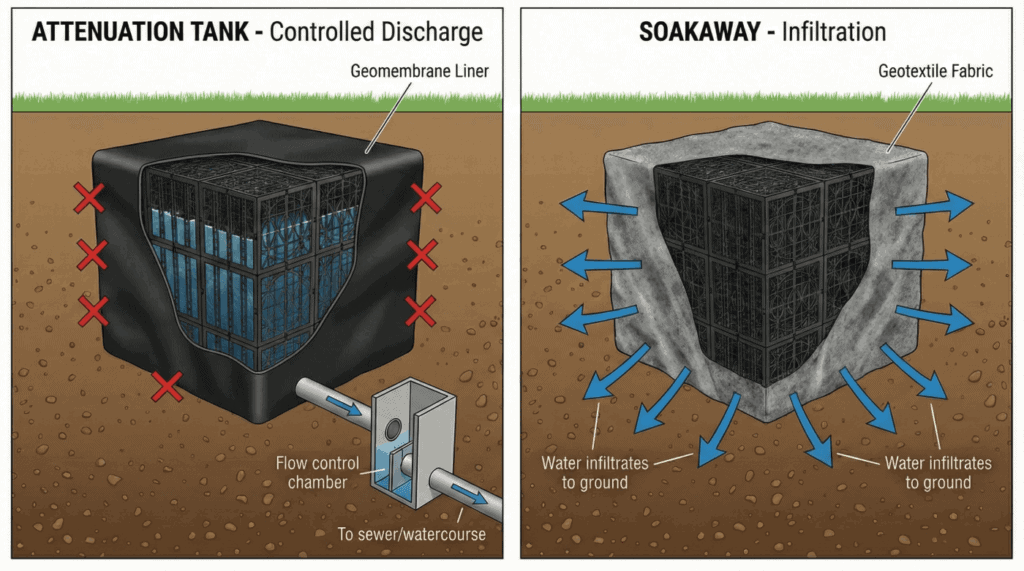
Both attenuation tanks and soakaways use modular geocellular crates to create underground storage. The crates are identical. The critical difference is what happens to the water after it enters the system.
Soakaway: Water infiltrates into the surrounding soil. The crates are wrapped in permeable geotextile that allows water to pass through and soak into the ground naturally. There is no outlet pipe—water leaves by dispersing into the earth.
Attenuation tank: Water is discharged at a controlled rate via an outlet pipe. The crates are wrapped in impermeable geomembrane that seals the storage void completely. A flow control device regulates how quickly water leaves, directing it to a sewer, watercourse, or drainage network.
This distinction drives every other difference between the two systems.
Quick Comparison
| Factor | Soakaway | Attenuation Tank |
|---|---|---|
| Water disposal method | Infiltration to ground | Controlled discharge to sewer/watercourse |
| Membrane type | Permeable geotextile | Impermeable geomembrane (HDPE/LLDPE) |
| Outlet pipe | None | Required (with flow control) |
| Soil requirement | Permeable soil (passes BRE 365 test) | Any soil type |
| Groundwater table | Must be 1m+ below invert | No restriction |
| Connection to sewer | Not required | Required |
| Flow control device | Not needed | Essential (orifice plate, vortex, hydrobrake) |
| Best for | Permeable sites, rural areas, residential gardens | Clay soils, urban sites, commercial developments |
| Typical cost | Lower (simpler system) | Higher (flow control + sewer connection) |
When to Use a Soakaway
Soakaways are the preferred solution under Building Regulations Approved Document H, which establishes infiltration to ground as the first-choice disposal method. Use a soakaway when:
- Soil permeability is adequate — A BRE 365 percolation test confirms acceptable infiltration rates. Sandy, gravelly, or chalk soils typically work well.
- Groundwater is low — The water table must remain at least 1 metre below the soakaway invert year-round.
- The site is not in a Source Protection Zone — Soakaways are restricted in SPZs to protect groundwater quality.
- Sufficient space exists — Soakaways must be positioned at least 5 metres from buildings and 2.5 metres from boundaries.
- No sewer connection is available or desired — Rural sites without nearby drainage infrastructure suit soakaways well.
For detailed guidance on designing soakaway systems, see our complete soakaway crates guide.
Soakaway System Components
A typical soakaway requires geocellular crates wrapped in geotextile membrane, plus inlet pipework from the drainage catchment. The ARW stormwater modules are designed for soakaway applications:
- ARW-6841 (680 × 410 × 450 mm) — 95% void ratio, 20–40 tonnes load rating. Ideal for residential gardens and light-duty applications.
- ARW-8053 (800 × 490 × 530 mm) — 95% void ratio, 28–46 tonnes load rating. Suitable for driveways, car parks, and commercial soakaways.
When to Use an Attenuation Tank
Attenuation tanks are required when infiltration is not viable or when the drainage authority mandates controlled discharge rates. Use an attenuation tank when:
- Soil has poor permeability — Clay soils, made ground, or sites that fail BRE 365 testing cannot support soakaways.
- Groundwater is high — Shallow water tables prevent infiltration systems from functioning correctly.
- The site is in a Source Protection Zone — Contaminated runoff must not infiltrate to ground in SPZ areas.
- Contaminated land is present — Infiltration could mobilise pollutants into groundwater.
- Discharge rate limits apply — The Lead Local Flood Authority (LLFA) or water company requires controlled release, typically at greenfield runoff rates (2–5 l/s/ha).
- SuDS approval requires flow control — Schedule 3 of the Flood and Water Management Act 2010 may mandate attenuation for larger developments.
Attenuation Tank System Components
Attenuation systems require additional components beyond the crates: impermeable geomembrane liner, flow control device (orifice plate, vortex control, or hydrobrake), silt trap upstream, and outlet connection to sewer or watercourse.
The ARW-1050 geocellular tank (1000 × 500 × 500 mm) is designed for large-scale attenuation, with load ratings from 30 to 60 tonnes and 95% void ratio for maximum storage efficiency.
Combined with HDPE or LLDPE geomembrane (typically 1.0 mm thickness), this creates a sealed detention system suitable for commercial and infrastructure projects.
The Decision Framework
Follow this sequence to determine which system your site needs:
Step 1: Check Soil Permeability
Conduct a BRE 365 percolation test. If the soil infiltration rate is acceptable (typically a Vp value below 10⁻⁵ m/s is too slow), a soakaway may be viable. If the soil fails, an attenuation tank is required.
Step 2: Check Groundwater Level
Determine the highest seasonal groundwater level. If it rises within 1 metre of your proposed system invert at any time of year, infiltration will not work reliably. Choose attenuation.
Step 3: Check Source Protection Zones
Consult the Environment Agency’s SPZ maps. Soakaways are typically prohibited in SPZ1 and restricted in SPZ2. Attenuation with discharge to sewer is the compliant option.
Step 4: Check Discharge Requirements
Contact the LLFA or water company. If they specify a maximum discharge rate (common for developments over 10 dwellings or 0.5 hectares), you need attenuation with flow control even if infiltration is theoretically possible.
Step 5: Consider Site Constraints
Limited space near buildings may rule out soakaways (5-metre setback requirement). Urban sites with existing drainage infrastructure often favour attenuation for simpler connection.

Can You Use Both?
Yes. Some sites benefit from hybrid systems that combine infiltration with controlled discharge. For example, a development might use soakaways for garden areas where soil is permeable, while installing an attenuation tank under the car park where clay subsoil prevents infiltration.
The drainage hierarchy in Approved Document H supports this approach—use infiltration where possible and supplement with attenuation where necessary.
Cost Comparison
Soakaways are generally cheaper because they require fewer components and no connection charges:
| Component | Soakaway | Attenuation Tank |
|---|---|---|
| Geocellular crates | £40–80/m³ | £40–80/m³ |
| Membrane | £2–5/m² (geotextile) | £5–15/m² (geomembrane) |
| Flow control device | Not required | £500–3,000+ |
| Silt trap | Optional | Required (£300–1,500) |
| Sewer connection | Not required | Required (variable) |
| BRE 365 testing | Required (£200–500) | Not required |
However, if your site cannot support a soakaway, the cost comparison is irrelevant—attenuation is the only compliant option.
Common Mistakes to Avoid
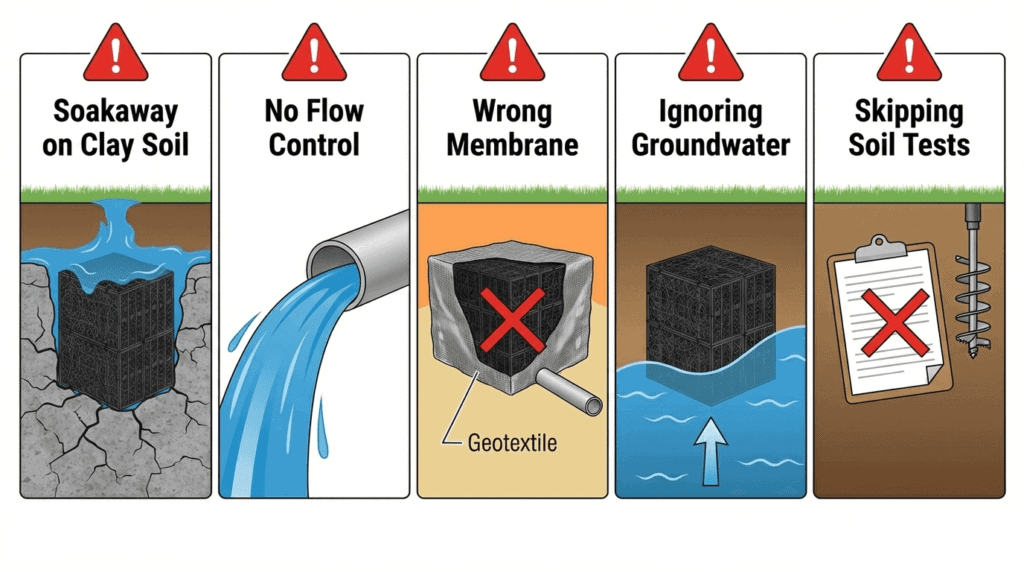
Installing a soakaway on clay soil: No amount of crates will make water infiltrate into impermeable ground. The system will simply fill up and overflow.
Forgetting flow control on attenuation: Without a flow control device, water leaves as fast as it enters, providing no attenuation benefit and potentially breaching discharge consent.
Using permeable membrane on attenuation: The tank must be sealed with impermeable geomembrane. Using geotextile creates a leaky system that fails to control discharge rates.
Ignoring groundwater levels: Seasonal variation matters. A system that works in summer may fail when winter groundwater rises.
Skipping percolation tests: Assuming soil is suitable without testing risks planning refusal or system failure after installation.
Frequently Asked Questions
Can I convert a soakaway to an attenuation tank later?
Not easily. The membrane type is integral to the system design. Converting would require excavation and complete reconstruction with impermeable liner plus flow control installation.
Do both systems need planning permission?
The drainage system itself typically does not require separate permission, but it forms part of the overall development’s drainage strategy that must satisfy planning conditions and Building Control.
Which system lasts longer?
Both have similar design lives (50+ years) when properly installed and maintained. The geocellular crates and membranes do not degrade underground.
Can rainwater harvesting work with either system?
Yes. Both can incorporate a harvesting element where water is drawn off for non-potable use before the remainder infiltrates (soakaway) or discharges (attenuation). Attenuation tanks are more commonly combined with harvesting because they already include pumping infrastructure.
Conclusion
The choice between attenuation tank and soakaway comes down to one question: can your site infiltrate water effectively? If yes, and no regulatory constraints prevent it, a soakaway is simpler and cheaper. If no, an attenuation tank is the compliant solution.
Most UK sites outside sandy or chalky areas end up requiring attenuation because clay soils, high groundwater, or LLFA discharge limits rule out infiltration. Do not assume—test the soil, check the groundwater, and consult the drainage authority before finalising your design.
For projects requiring either solution, ARW stormwater modules and geocellular tanks provide the 95% void ratio and load ratings that UK projects demand. Contact our technical team to discuss your site requirements and receive product recommendations matched to your drainage strategy.
 English
 Arabic
 French
 Russian
 Spanish