
Stormwater Drainage Systems: Choosing the Right Solution for Your Site

Every development project needs a plan for managing rainwater once it hits the ground. The drainage system you pick will affect whether your site stays dependable for years or needs frequent repairs.
This guide covers the main types of stormwater drainage systems, their uses, and how to match them to your site’s needs. We’ll start by explaining how these systems work, then compare the different options.
What a Stormwater Drainage System Actually Does
A stormwater drainage system serves three functions:
Collection means gathering runoff from hard surfaces like roofs, parking lots, and roads before it can cause flooding or erosion.
Conveyance is moving water through pipes, channels, or underground systems to a discharge point or storage area.
Management involves controlling flow rates, removing pollutants, and either releasing water slowly or letting it soak into the ground.
The right system depends on local rules, site conditions, and project costs. It’s important to know the main types of drainage systems and when to use them. For instance, a warehouse in Texas will need a different setup than a mixed-use project in Portland.
Types of Stormwater Drainage Systems
Surface Drainage
Surface systems carry water over the ground to places where it can be collected.
Swales and channels are shallow, planted or lined areas that guide water. They work well for large sites with enough space. Costs usually range from $15 to $40 per foot, depending on the materials and grading needed.
Sheet flow to retention ponds lets runoff spread out over landscaped areas before it gathers in a pond. This approach usually needs 2 to 5 percent of the watershed’s area.
Surface drainage works best for rural or suburban sites where there’s enough land and no strict rules about reducing runoff volume.
Pipe Networks
Conventional pipe networks collect water through drains and move it underground to a discharge point.
Reinforced concrete pipe (RCP) supports heavy loads and large diameters. Installed costs for 24-inch diameter pipes typically range from $80 to $150 per linear foot, with higher costs for larger sizes.
Corrugated metal pipe (CMP) is less expensive but has a shorter service life in corrosive soils. Installed costs typically range from $40 to $80 per linear foot.
HDPE and PVC pipes resist corrosion and are moderately priced. HDPE can flex with ground movement, while PVC is stiffer.
Pipe networks are good for moving water but don’t store or treat it. If you don’t have much surface space, underground detention systems might be a better choice.
Underground Detention Systems
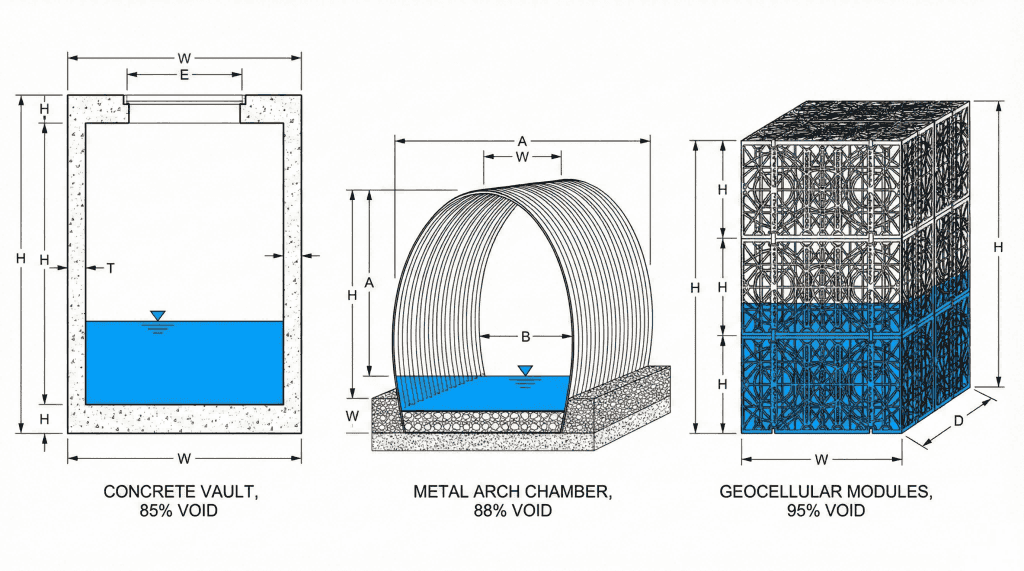
If surface space is tight or costly, underground detention systems store runoff below ground and release it slowly.
Concrete vaults are cast-in-place or precast structures. They are durable but costly, at $20 to $35 per cubic foot of storage, and are slower to install. Concrete is appropriate when vehicle loads must be supported directly above the structure without fill cover.
Corrugated metal chambers nest together to create large storage volumes. Installation is faster than with concrete, but the arch shape reduces storage efficiency, with void ratios typically between 85 and 90 percent. Chamber systems cost $12 to $20 per cubic foot installed.
Geocellular modular systems use stacked plastic modules wrapped in geotextile or geomembrane. Void ratios can reach 95 percent, providing more storage per cubic foot of excavation. Installed costs range from $8 to $15 per cubic foot, depending on depth and load requirements.
See our detailed cost comparison of underground detention systems. Next, we’ll look at systems that focus on infiltration instead of detention.
Infiltration Systems
If the soil is suitable, infiltration systems let stormwater soak back into the ground.
Infiltration trenches are gravel-filled excavations that temporarily store water as it percolates into the surrounding soil. They require permeable native soils (percolation rates above 0.5 inches per hour) and adequate separation from groundwater.
Permeable pavement allows water to pass through the driving surface into a stone reservoir below. Options include porous asphalt, pervious concrete, and permeable interlocking pavers. All require regular maintenance to prevent clogging.
Modular infiltration systems combine high-void storage with permeable wrapping. Water fills the modules and infiltrates through the bottom and sides. These systems support heavier loads than traditional trenches.
Infiltration systems lower the total runoff, not just the peak flow, which many LID and green codes require. Choosing the right system also depends on soil, groundwater depth, expected loads, and available space.
Matching Systems to Site Conditions
Soil Type
How well the soil lets water pass through decides if infiltration is possible:
| Soil Type | Typical Perc Rate | Infiltration Feasible? |
|---|---|---|
| Sand/gravel | >2 in/hr | Yes |
| Sandy loam | 0.5–2 in/hr | Yes, with larger footprint |
| Silt loam | 0.2–0.5 in/hr | Marginal |
| Clay | <0.2 in/hr | No — use detention |
If the site’s soil can’t handle infiltration, use detention with controlled release or send the water to an off-site facility.
Groundwater Depth
Infiltration systems need space between their bottom and the highest groundwater level, usually at least 2 to 4 feet as required by most codes. If groundwater is too close to the surface, lined detention systems are better.
Load Requirements
Think about what will be above the stormwater system and how much weight it needs to support.
For landscaping only, almost any system will work. Most structures need at least 12 inches of cover.
For passenger vehicles, systems should have an H-10 load rating. Most geocellular modules can handle this with 18 to 24 inches of cover.
Fire trucks and heavy vehicles need an H-20 load rating. Good modular systems can handle AASHTO H-20 loads, but chambers and infiltration trenches usually can’t.
Building foundations need engineered solutions. Some modular systems can support buildings directly, but most need load transfer slabs or more distance from the structure.

Available Space
Underground systems make sense when:
- Land costs exceed $50,000 per acre (the breakeven varies by region)
- Zoning or setback requirements limit surface options
- The site needs parking or other uses above the stormwater area
- Surface ponds create safety or aesthetic concerns
A half-acre retention pond might be cheaper to build than an underground system. But if that land is worth $200,000 as parking, the economics look very different.
Design Considerations
Sizing for the Design Storm
Most jurisdictions specify design storm requirements:
- Peak flow control — post-development discharge cannot exceed pre-development rates for a specified storm (often 2-year, 10-year, and 100-year events)
- Volume control — a specified depth of rainfall (commonly 1 inch) must be retained or infiltrated on-site
- Water quality — first flush treatment for pollutant removal
Systems need to be sized to meet all rules. Designing just for peak flow might not meet standards that require volume control.
Maintenance Access
All stormwater systems need regular inspection and cleaning:
Pipe networks require access manholes at grade changes and junctions. Spacing typically 300–500 feet maximum.
Underground detention systems require access risers for visual inspection and vacuum truck access. Design for sediment removal in low-flow areas.
Infiltration systems require pretreatment to prevent clogging. Include sediment forebays or filter strips upstream, and budget for periodic surface restoration.
Plan for maintenance access from the start to avoid expensive changes later. Make sure outlet structures are well designed for good flow control.
Outlet Control
Detention systems need outlet structures that limit discharge to allowable rates. Common approaches:
Orifice plates offer a simple and reliable method for flow restriction. Size the orifice to match the design discharge rate.
Weirs accommodate variable flow rates and are easier to adjust than orifices.
Multi-stage outlets use orifices and weirs to independently control different storm frequencies.
Always add emergency overflows to safely direct extra water away from the system.
Installation Best Practices
No matter which system you choose, good installation is key to long-term performance.
Subgrade Preparation
Compact the subgrade to 95 percent of Standard Proctor density. Soft spots can lead to uneven settling, which might damage pipes, crack liners, or misalign outlet structures.
For infiltration systems, don’t compact the infiltration surface, since this can ruin the soil structure and make it less absorbent.
Pipe Bedding and Backfill
Proper bedding spreads loads evenly around the pipe. Always follow the manufacturer’s instructions for bedding materials and compaction.
Backfill in layers, usually 6 to 12 inches thick, and compact each layer. Avoid large rocks that could cause pressure points or gaps.
Geosynthetic Installation
Handle geotextiles and geomembranes with care.
- Keep rolls off the ground and covered until you’re ready to install them
- Overlap seams according to manufacturer requirements, typically 12 to 18 inches for geotextiles and welded seams for geomembranes
- Don’t drag equipment over installed materials
- Check materials for damage before covering them
For detailed installation guidance, refer to our submittal-to-closeout guide.
Comparing System Costs
Total installed cost depends on your site, but typical price ranges can help with early budgeting.
| System Type | Cost per CF Storage | Pros | Cons |
|---|---|---|---|
| Surface pond | $2–5 | Low cost | Land intensive |
| Gravel detention | $10–18 | Simple | Low void ratio (35%) |
| Concrete vault | $20–35 | Durable, high loads | Expensive, slow install |
| Metal chambers | $12–20 | Fast install | Shape wastes space |
| Modular systems | $8–15 | High void ratio, flexible | Requires proper backfill |

These costs cover excavation, materials, installation, and backfill. Site-specific issues like rock removal, dewatering, or limited access can raise costs a lot.
Regulatory Compliance
Stormwater regulations vary by jurisdiction but follow common patterns:
Federal requirements — NPDES permits require stormwater management for construction sites over 1 acre and certain industrial facilities.
State requirements — Most states have adopted stormwater standards that exceed federal minimums. Many require post-construction BMPs that remain in place permanently.
Local requirements — Cities and counties often impose additional requirements beyond state standards. Some jurisdictions mandate specific approaches (LID, green infrastructure) or limit others.
Check with local authorities, since standards often change. In the end, both regulations and site conditions will guide your final choice.
Making the Final Selection
To pick the right stormwater drainage system, follow these steps:
- Start with the regulations: What does your system need to do? Think about peak flow control, reducing runoff volume, and treating water quality.
- Look at your site: Can it support infiltration? What loads will the system need to handle? How much space do you have?
- Compare your options: Create early designs for two or three possible systems. Factor in construction, land, and long-term maintenance costs.
- Think about future needs: Could requirements change? Can you expand or modify the system later?
The cheapest system isn’t always the best value. Sometimes, spending more upfront to free up land for other uses can pay off in the long run.
Getting Started
If you’re looking at stormwater drainage options for a new project, try these steps:
- Gather site data like soil borings, groundwater depth, and a topographic survey
- Check the rules by contacting your local permitting office
- Develop early options, such as surface or underground systems, and compare detention with infiltration approaches
- Ask for budget pricing on materials and installation
For technical details on modular stormwater systems with H-20 load ratings, check product information or contact our engineering team for advice tailored to your project.
Design requirements vary by jurisdiction. This information is for general guidance only. Consult local regulations and work with a licensed professional engineer for project-specific applications.
 English
 Arabic
 French
 Russian
 Spanish