
Washington’s December 2025 Floods Broke Levees and Exposed a Critical Flaw in Detention System Design
The Green River hadn’t been this high in 60 years.
When the Desimone levee broke near Tukwila on December 15, 2025, the river was running at levels that nobody working in King County stormwater today had ever seen. Fifteen feet of rise in a single week. Over 45,000 people under flash flood warning within hours of the breach.
As I watched the evacuation orders roll out, I kept thinking about every detention basin, underground vault, and flow control structure that discharges into the Green River or its tributaries. None of them could drain. The outlets were underwater. Physics doesn’t negotiate.
The December 2025 Pacific Northwest floods weren’t just a weather event. They stress-tested our entire stormwater infrastructure philosophy. If you design, review, or maintain detention systems anywhere in Western Washington, the results deserve a hard look.
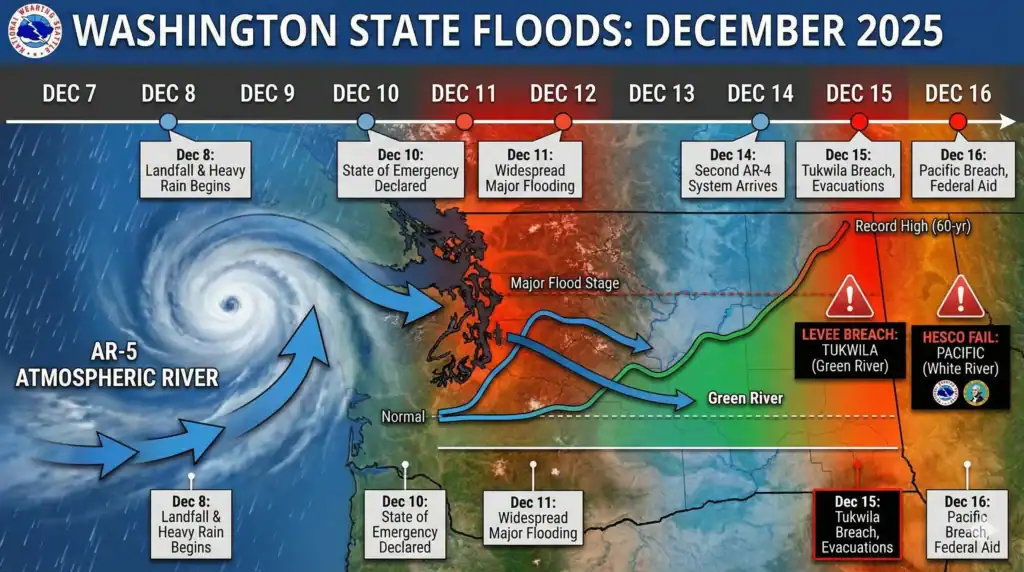
What Actually Happened: A Verified Timeline
The details matter for understanding why the infrastructure responded the way it did.
December 5: The Center for Western Weather and Water Extremes (CW3E) forecasts an incoming atmospheric river at AR-5 intensity—the maximum category on their scale. AR-5 events carry exceptional water vapor transport and high probability of widespread flooding.
December 7: NWS Seattle issues a Flood Watch covering western Washington—Olympic Peninsula, Puget Sound lowlands, Cascade foothills—effective through December 12. The watch warns of sharp rises on rivers draining the Olympics and Cascades, plus elevated debris flow risk in burn scar areas.
December 8: The atmospheric river makes landfall. Rainfall begins in earnest across Western Washington.
December 10: Governor Bob Ferguson declares a statewide emergency and activates the Washington National Guard. By day’s end, over 100 Guard members are deployed; 300 more follow by December 11. Ferguson calls the situation “extremely serious” with “lives at stake in the coming days.”
December 11: The Skagit River and Snohomish River reach record or near-record flood levels. In Stehekin—accessible only by boat or aircraft—debris flows from the 2024 Pioneer Fire burn scar destroy the water treatment plant and sever road access. Seven rivers across the state hit Phase 4 flooding, the highest warning level.
December 12: President Trump approves Washington’s request for federal emergency declaration, unlocking FEMA resources.
December 14: A second atmospheric river arrives—rated AR-4. The region hasn’t recovered from the first system, and rivers that had begun to recede start rising again.
December 15 (Monday afternoon): The Desimone levee breaches along the Green River near Tukwila, just east of Seattle-Tacoma International Airport. The river’s water level is higher than it’s been in 60 years. More than 45,000 people are placed under flash flood warning. Crews complete a temporary repair by evening, but the damage is done.
December 16 (Tuesday, 1:30 AM): HESCO barriers along the White River fail in Pacific, about 30 miles south of Seattle. The breach extends approximately 120 feet. Between 1,300 and 2,100 residents are evacuated in the pre-dawn hours.
December 16: Governor Ferguson amends the emergency proclamation and directs $3.5 million in emergency funds to 14 affected counties. The state reports more than 1,200 rescues and evacuations since flooding began. One fatality confirmed: a 33-year-old man who drove past road closure signs into floodwater in Snohomish County.
The scale: approximately 5 trillion gallons of rainfall over one week. A 49-mile stretch of US-2 closed for months. Up to 100,000 residents facing potential evacuation in the Skagit River area alone.
Sources: Governor.wa.gov official press releases; CNN; NWS Seattle; Washington State Standard; Wikipedia compilation of the 2025 Pacific Northwest floods.
The Engineering Problem: Why Detention Systems Couldn’t Drain
ere’s what most coverage of the floods missed.
Detention systems work on a simple principle: store runoff temporarily, release it at a controlled rate that downstream infrastructure can handle. The outlet structure—orifice, weir, or combination—meters outflow based on the head differential between the water surface inside the basin and the tailwater elevation downstream.
That principle works under normal conditions. It works reasonably well during most storm events.
It stops working when the downstream receiving water rises above your outlet elevation.
Understanding Backwater Conditions
When river levels downstream exceed your detention outlet elevation, you get a backwater condition. The outlet becomes submerged. The head differential that drives flow through your orifice drops toward zero. Your carefully sized outlet structure effectively stops functioning.
During the December 2025 event, the Green River rose 15 feet over one week. When it breached the Desimone levee, it was at its highest level in six decades. Every detention facility discharging to the Green River or its tributaries—every underground vault beneath a parking lot, every flow control structure sized per King County SWDM—was operating with a submerged outlet.
Inflow from continuous rainfall kept coming. Outflow approached zero.

The Failure Chain
The December floods didn’t fail because of any single weakness. They exposed a cascading sequence that builds over multi-day events:
Sustained AR-4 to AR-5 atmospheric river delivers 5 trillion gallons over one week. This isn’t a design storm—it’s multiple design storms back-to-back with no recovery window.
Cascade slopes receive 10+ inches of rainfall. The runoff coefficient approaches 1.0 as soil saturation progresses. By day three or four, the ground is functionally impervious.
Rivers surge to record levels. Green River: 60-year high. Snohomish River: 33 feet with “major levee damage possible” per NWS. Skagit River: record flood levels.
Downstream infrastructure reaches capacity. Storm sewers, culverts, and channels throughout the watershed are running full.
Backwater conditions develop. River elevation exceeds detention outlet elevations across the region.
Upstream detention systems cannot drain. Orifices submerged, head differential eliminated, controlled release impossible.
Levees experience sustained hydraulic pressure. Instead of water cycling through detention and releasing, it accumulates. Pressure builds over hours and days rather than the design duration.
Levee failures occur in sequence. December 15: Desimone levee (Green River). December 16: White River HESCO barriers.
The critical insight: traditional detention design assumes downstream capacity exists to receive the controlled release. When an entire watershed is simultaneously at flood stage for days, that assumption fails everywhere at once.
What Washington Regulations Actually Require
Understanding the failure mechanism is useful. Knowing how to design for it—and what the regulations require in your submittal package—is practical.
One question worth asking: do current regulations explicitly account for multi-day AR-5 events like December 2025? The SWDM requires backwater analysis, but the tailwater assumptions in most analyses weren’t calibrated for 60-year flood levels sustained over a week. That’s a gap worth watching as guidance evolves.
The Statewide Framework: SWMMWW 2024
The Stormwater Management Manual for Western Washington published by Washington Department of Ecology establishes baseline requirements for most projects west of the Cascades. The 2024 edition is current.
Minimum Requirement #5 (On-Site Stormwater Management) establishes LID as the preferred approach. Projects must either implement specific LID BMPs via the “List Approach” or meet the “LID Performance Standard” by matching pre-developed hydrology. If LID is infeasible—due to clay soils, steep slopes, or high groundwater—you document the infeasibility and move to alternative flow control.
Minimum Requirement #7 (Flow Control) governs detention sizing. Storage volume calculations, outlet sizing, and performance modeling live here. The core requirement: limit post-development peak flows to pre-development levels for the range of design storms.
Minimum Requirement #9 (Operation and Maintenance) requires an O&M plan and a recorded covenant that runs with the property. The property owner is legally responsible for maintaining the facility in perpetuity.
One detail that trips people up: MR #5 and MR #7 are independent requirements. Satisfying the LID performance standard doesn’t exempt you from flow control. You may need both infiltration BMPs and detention depending on site conditions and downstream discharge point.
King County Surface Water Design Manual
If your project is in unincorporated King County, the King County Surface Water Design Manual applies. Chapter 5 covers flow control design:
Detention facility types: Ponds (open surface), tanks (underground, typically corrugated metal pipe), and vaults (underground, reinforced concrete). Each has specific design criteria for geometry, access, and maintenance.
Backwater analysis requirement: The SWDM explicitly requires backwater analysis for sizing detention and infiltration facilities. December’s floods raise the question: are the tailwater assumptions in those analyses adequate for extreme events?
Outlet structure design: Orifice sizing, weir configurations, restrictor plates. Detailed guidance on control structure placement and access.
Maintenance access: Vaults require access for inspection and sediment removal. Removable panels (no heavier than 5 tons) or dedicated access roads for County-maintained facilities.
Snohomish County Drainage Requirements
Snohomish County operates under its own Drainage Manual based on SWMMWW, with the 2024-2029 NPDES municipal stormwater permit in effect. Private facility owners are responsible for maintenance under SCC 7.54.
Seattle Stormwater Code
Seattle’s requirements are in SMC Title 22 and the 2021 Seattle Stormwater Manual. An update is scheduled for July 2026—verify which version applies at permit issuance.
Seattle has provisions for combined sewer basins where flow control may not be required, but if downstream drainage is “capacity constrained,” flow control requirements can still apply.
Design-Review-O&M Checklist
For practitioners translating regulations into a submittal package:
Design Phase
- Determine applicable stormwater manual (SWMMWW 2024, King County SWDM, Seattle 2021, Snohomish County)
- Complete MR #5 LID feasibility analysis
- If LID infeasible, document reasons (soil permeability, groundwater separation, slopes, geologic hazards)
- Determine flow control standard per MR #7
- Complete hydrologic modeling using approved software
- Complete backwater analysis with realistic tailwater assumptions—consider using recent flood data rather than historical averages
- Select detention facility type based on site constraints
- Design outlet control structure (orifice sizing, overflow provisions)
- Design maintenance access (inspection ports, access panels or road)
- For underground systems in traffic areas: verify HS-20 load rating
- For infiltration configuration: obtain geotech report confirming soil permeability per ASTM D3385
- For detention configuration: specify impermeable liner/geomembrane
Review/Submittal Phase
- Submit stormwater site plan with Washington PE stamp
- Include water quality treatment BMP selection per MR #6
- Submit O&M plan per MR #9
- Draft O&M covenant using jurisdiction template
- If disturbing >1 acre: obtain DOE Construction Stormwater General Permit coverage
Operations Phase
- Annual visual inspection of inlet/outlet structures (minimum)
- Sediment depth measurement and removal per O&M plan triggers
- Flow control device inspection and cleaning
- Structural integrity inspection (typically 5-year interval)
- Maintain compliance with County/City inspection requirements
The O&M covenant is the piece property owners sometimes underestimate. It’s a recorded document obligating current and future owners to maintain the facility. If the system fails inspection, enforcement follows.
A Real Selection Scenario: Commercial Project in Auburn
Theory is useful. Application is better.
Project Parameters
Location: Auburn, Washington (King County, Green River valley)
Project type: Grocery store with surface parking—approximately 2 acres total
Existing conditions: Previously developed site with existing impervious coverage
Soil conditions: Glacial till over clay; infiltration rate below 0.5 inches per hour
Groundwater: Seasonal high at 3-4 feet below grade
Downstream discharge: Tributary to Green River
Special consideration: Site within area affected by December 2025 flooding
LID Feasibility Analysis
The first question under MR #5: can this site support LID infiltration practices?
Soil permeability: Glacial till with measured infiltration below 0.5 in/hr. SWMMWW requires minimum 0.5 in/hr for infiltration BMPs. Result: Infiltration not viable.
Groundwater separation: Seasonal high at 3-4 feet. SWMMWW requires minimum 3 feet from bottom of infiltration facility to seasonal high groundwater. Result: Marginal at best, likely insufficient.
Documentation: “LID infiltration practices are infeasible due to glacial till soils with infiltration rates below minimum threshold and inadequate separation to seasonal high groundwater per SWMMWW requirements.”
With infiltration ruled out, the project moves to detention for flow control.
Why Underground Modular vs. Surface Pond
For a commercial site in Auburn, the surface pond option faces practical obstacles:
Land value: Commercial property in the Green River valley runs $50-80 per square foot. A surface detention pond sized for this drainage area might consume 3,000-4,000 square feet—$150,000 to $320,000 in land value before construction costs.
Site constraints: A 2-acre grocery store needs parking, drive aisles, loading areas, and building footprint. Dedicating significant area to an open pond competes directly with functional site requirements.
Safety and liability: Open water creates drowning hazard and requires fencing, setbacks, and ongoing vegetation management.
Underground modular detention allows storage beneath the parking lot. The land serves two purposes: parking above, stormwater storage below. The cost of the underground system is often offset by recovered land value.
Configuration: Detention with Impermeable Liner
Given site conditions, the configuration decision is straightforward:
Soil permeability below threshold → Infiltration configuration not viable
High groundwater → Impermeable liner required to prevent buoyancy issues and protect groundwater quality
Discharge to regulated waterway → Controlled release through outlet structure required
The system uses geocellular stormwater modules wrapped in an impermeable geomembrane. Water enters through inlet structures, fills the void space within the modules, and releases at a controlled rate through an orifice-controlled outlet. The water never contacts surrounding soil.

System Specifications
For this Auburn project, the geocellular module system requires:
Void ratio: 95% minimum. Maximizes storage capacity per cubic foot of excavation—critical when building beneath a parking lot where excavation depth is constrained.
Load rating: HS-20 (H-20 equivalent). The system sits beneath parking areas and fire lanes. Modules must handle traffic loading without structural degradation over design life.
Wrapping: Impermeable geomembrane (HDPE 40-mil or equivalent). Full encapsulation for detention function.
Inspection ports: Located per King County SWDM Chapter 5 requirements. Allow visual inspection and camera access without confined space entry.
Isolator row: Positioned at inlet locations to capture sediment before it spreads through the system. Can be cleaned independently via vacuum truck without accessing the full chamber.
Jet-vac compatibility: Module structure must withstand pressure from standard municipal vacuum truck equipment.
Outlet structure: Orifice-controlled with overflow weir for emergency capacity. Sized per flow control standard with consideration for downstream tailwater conditions.
Lessons from December 2025
The floods exposed assumptions worth revisiting in any new design:
Tailwater assumptions: What downstream water surface elevation did the backwater analysis assume? Given that the Green River reached 60-year highs, are historical assumptions still adequate?
Emergency overflow capacity: When the outlet is submerged during extreme events, where does excess water go? Is the overflow path defined and does it avoid critical infrastructure?
Post-event inspection access: After a major flood, can inspectors access the outlet structure to verify it’s clear and functioning? December’s events likely deposited debris throughout the drainage network.
Documentation: The design narrative should explicitly state backwater assumptions and acknowledge limitations. If the system is designed for 100-year conditions but may be overwhelmed during multi-day AR-5 events, that should be documented rather than implicit.
Frequently Asked Questions
Project Support for Western Washington
AQUA RainWater supplies geocellular stormwater modules for detention, infiltration, and retention applications throughout the Pacific Northwest. We work with local civil engineering firms and installation contractors who handle design and construction—our role is providing the hardware and technical specifications.
What We Provide
For projects in design phase:
| Deliverable | Description |
|---|---|
| Concept Layout | Module placement options, inlet/outlet locations, maintenance access points |
| Storage/Footprint Comparison | Surface pond vs. underground modular analysis for your drainage area |
| Preliminary Sizing | Based on King County SWDM, Snohomish County, or Seattle requirements |
| Configuration Guidance | Detention vs. infiltration recommendation based on soil and groundwater conditions |
For projects affected by December 2025 flooding:
| Deliverable | Description |
|---|---|
| Retrofit Assessment | Evaluation of existing system performance and upgrade options |
| Replacement Sizing | Expedited preliminary design for damaged facilities |
Recent Project: Grocery Store Parking, South King County
A regional grocery chain needed stormwater detention for a new location in South King County. The site had typical Puget Sound lowland conditions—glacial till soils with poor infiltration, high seasonal groundwater, and discharge to a Green River tributary.
The civil engineer evaluated surface pond options but the footprint would have eliminated 40+ parking spaces. Underground geocellular modules beneath the parking lot provided equivalent storage while preserving the full parking count.
System details:
- Storage volume: 12,000 cubic feet
- Configuration: Detention with HDPE geomembrane liner
- Load rating: HS-20 for parking and fire lane traffic
- Maintenance: Inspection ports at 50-foot intervals, isolator row at inlet
The system passed King County inspection and has been operational for 18 months. Post-December 2025 inspection confirmed no structural issues, though the outlet was temporarily submerged during peak river levels.
Contact
For projects in Washington, Oregon, or Northern California:
Request a consultation — Provide your project location, approximate site area, and known soil conditions. We’ll connect you with preliminary sizing information and local contractor resources.
Product specifications — Technical data sheets, load ratings, and installation guidance.
Additional Resources
Washington State Regulatory Resources:
- Washington DOE Stormwater Manuals — SWMMWW 2024 and related guidance
- Washington DOE LID Guidance)[] — Low impact development resources
- King County Stormwater Services — Technical guidance and permit information
- King County Flood Warning System — Real-time river levels and flood alerts
- Snohomish County Stormwater Requirements — Current drainage manual and permit requirements
- Seattle Stormwater Code — SMC Title 22 and 2021 manual
December 2025 Flood Information:
- Governor Ferguson Emergency Proclamation — Official state response
- NWS Seattle — Forecasts and flood warnings
- USGS Washington Water Data — River gauge data
This article reflects conditions and regulatory requirements as of December 2025. Stormwater regulations vary by jurisdiction—contact your local permitting authority for project-specific requirements. AQUA RainWater provides stormwater modules and technical support; design and installation services are provided by licensed local contractors.ShareArtifactsDownload allCalifornia stormwater blogDocument · MD Linkedin postDocument · MD Washington flood blog articleDocument · MD Washington flood blog finalDocument · MD Washington flood blog outline v2Document · MD Content
 English
 Arabic
 French
 Russian
 Spanish