
Stormwater Management in the Middle East: How Geocellular Systems Solve Arid-Climate Drainage
By AQUA Rain Water Engineering Team · Updated February 2026 · 18 min read
Stormwater management in the Middle East refers to the engineering discipline of capturing, storing, and controlling rainfall runoff across arid and semi-arid Gulf Cooperation Council (GCC) landscapes — including Kuwait, the UAE, Saudi Arabia, and Qatar — where annual precipitation averages just 70–130 mm yet arrives in intense, short-duration cloudbursts capable of dumping 50 mm or more in under three hours, overwhelming conventional pipe-and-culvert drainage networks and causing flash floods that have paralysed cities from Dubai to Jeddah in recent years. Geocellular infiltration and detention systems, built from interlocking high-density polyethylene (HDPE) or polypropylene (PP) modules with void ratios exceeding 95%, provide the subsurface storage capacity these regions need without consuming valuable surface land.
Our engineering team has supported geocellular stormwater projects across the GCC since 2018, supplying modular crate systems for developments ranging from Kuwait’s 120 km² South Al Mutlaa residential city to mixed-use infrastructure projects in the UAE and Saudi Arabia. The operational data from these installations — covering soil conditions, temperature extremes, installation depths, and long-term structural performance — informs every recommendation in this guide.
Why the Middle East Faces a Unique Stormwater Challenge
The GCC’s stormwater problem is unlike anything engineers encounter in temperate climates. Rainfall is rare but violent. Kuwait receives an average of 115 mm annually, concentrated between November and April. The UAE averages 78 mm. Saudi Arabia’s coastal cities like Jeddah see around 52 mm, though the 2009 Jeddah floods demonstrated what happens when 90 mm falls in four hours on infrastructure designed for gentle, distributed rainfall.
Three factors compound the challenge. First, urbanisation across the Gulf has replaced natural desert surfaces — which actually absorb flash rainfall reasonably well through loose sand and gravel — with impervious concrete, asphalt, and compacted fill. Riyadh’s impervious surface area has grown by an estimated 340% since 1990. Second, native soils across much of the GCC consist of compact sabkha (salt-flat), calcium carbonate hardpan, or clay-rich formations with infiltration rates below 5 mm/hr, making conventional soakaways ineffective without engineered subbase layers. Third, high evaporation rates (2,000–3,500 mm/yr) mean that standing surface water creates public health hazards and structural damage to roads and foundations within hours.
Traditional GCC drainage relied on open channels, wadis, and pipe networks that discharge untreated stormwater directly into the Gulf. Kuwait’s existing storm drainage system, for example, routes runoff through circular concrete pipes and box culverts to coastal outfall locations. This approach fails when rainfall intensity exceeds pipe capacity, which now happens with increasing frequency as climate patterns shift. The January 2024 red rainfall warning in Saudi Arabia’s northern provinces and the April 2024 Dubai superstorm — which dumped 254 mm in 24 hours, the UAE’s highest recorded total — demonstrate that legacy drainage infrastructure is fundamentally inadequate for the region’s emerging climate reality.
How Geocellular Systems Work in Arid Climates
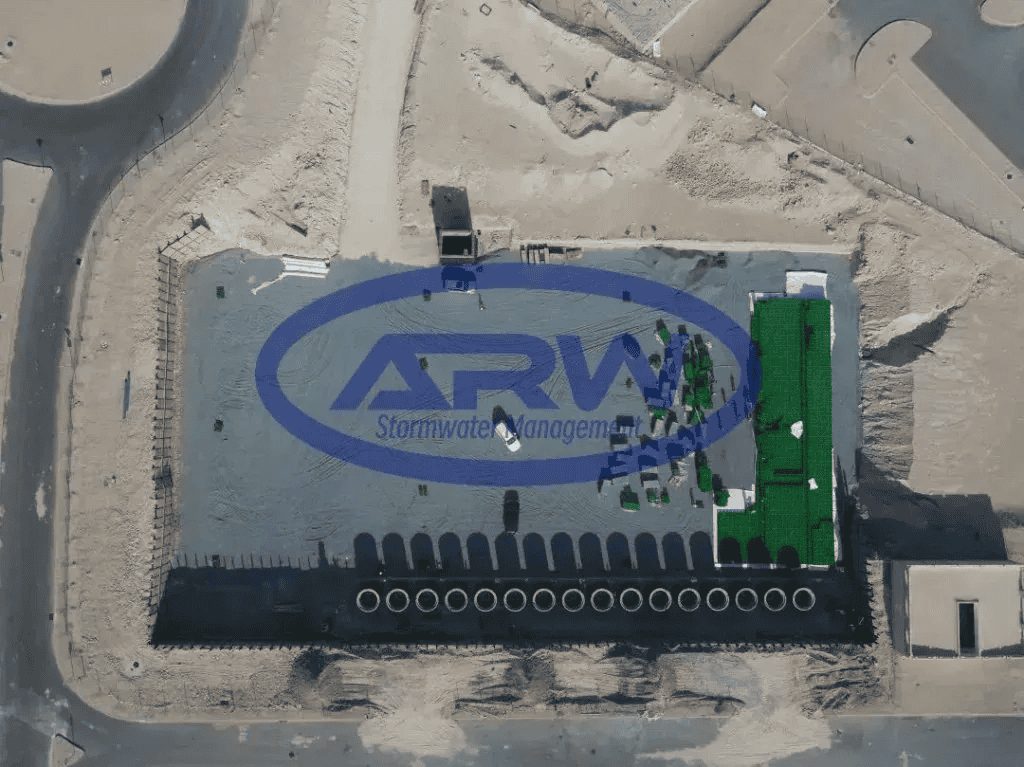
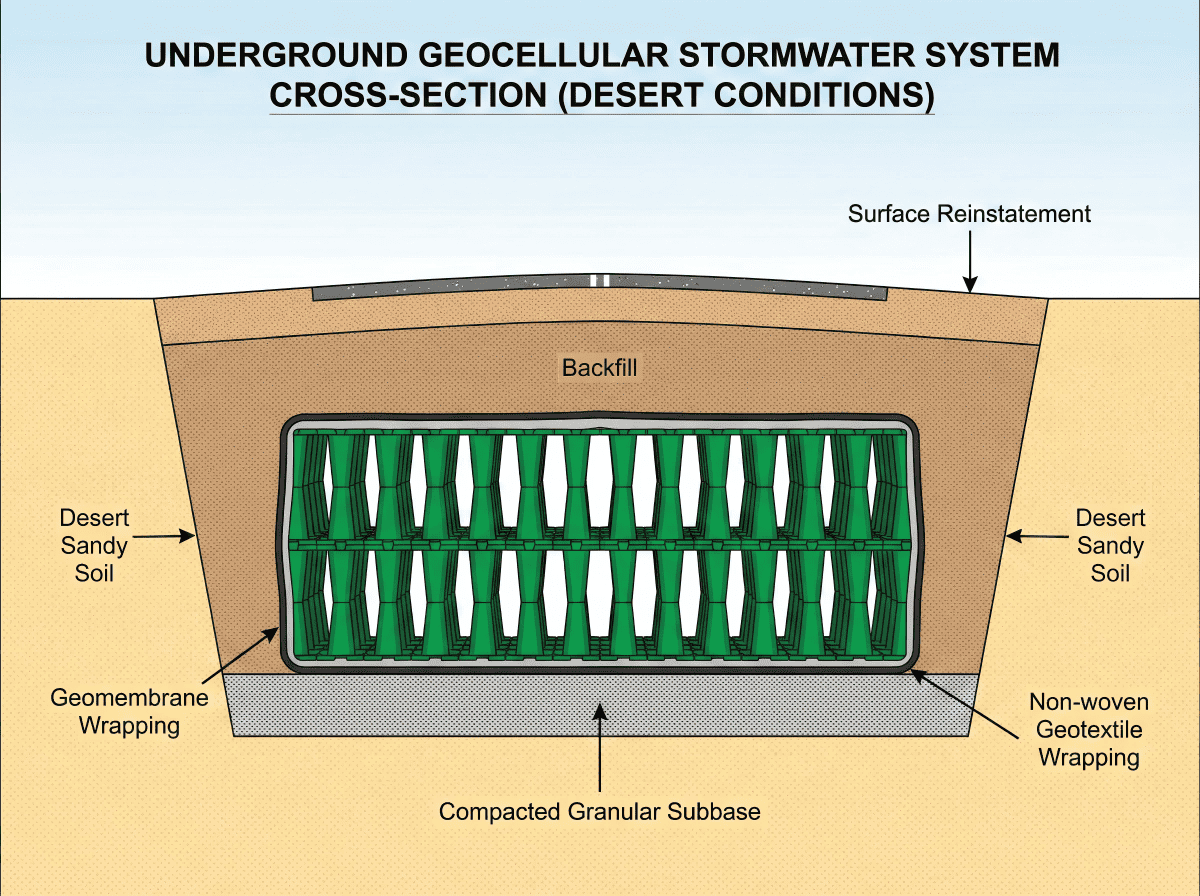
A geocellular stormwater system consists of modular plastic crate units — typically 1000 mm × 500 mm × 500 mm or similar dimensions — that interlock to form a continuous underground reservoir. Each unit provides over 95% void space, meaning a 1 m³ module stores approximately 950 litres of water. Wrapped in geotextile fabric for infiltration applications or impermeable geomembrane for detention, the assembled structure sits beneath roads, parks, car parks, or landscaped areas.
In the Middle East context, these systems operate in two primary configurations. Infiltration mode uses geotextile wrapping and an engineered granular subbase to allow captured stormwater to slowly percolate into surrounding soils where ground conditions permit — typically in areas with sandy substrata and low water tables. Detention mode uses impermeable geomembrane wrapping to contain stormwater temporarily and release it at controlled rates through orifice-controlled outlet structures, protecting downstream infrastructure from peak flow overload.
The engineering sequence for a typical GCC geocellular installation follows a precise protocol adapted for local conditions. Excavation reaches design depth, accounting for the geocellular tank height plus 150–300 mm of granular bedding below and 600 mm or more of compacted cover above, depending on traffic loading requirements. A non-woven geotextile (minimum 300 g/m² for GCC conditions, where angular aggregate and high point loads are common) lines the excavation floor and sides. Compacted granular bedding — typically 150–200 mm of crushed limestone or washed gravel meeting local municipality specifications — provides a level, load-distributing foundation. Geocellular modules are then placed, interlocked, and wrapped with the specified geosynthetic barrier. Inlet and outlet structures, including silt traps and flow control devices, connect the system to the surface drainage network. Backfill and surface reinstatement complete the installation.
Temperature is a critical design factor that engineers in temperate climates rarely consider. Ambient temperatures in Kuwait, the UAE, and Saudi Arabia regularly exceed 50°C during summer months, and ground temperatures at shallow burial depths can reach 60–70°C. Geocellular modules must be manufactured from UV-stabilised, high-temperature-grade HDPE or PP that maintains structural integrity at sustained elevated temperatures. Module compressive strength ratings — typically 20–40 tonnes/m² depending on the product — must account for thermal creep, the gradual deformation of plastic under sustained load at high temperatures. Modules tested only at 23°C (standard laboratory conditions) may perform very differently at 55°C ground temperatures.
Project Spotlight: South Al Mutlaa City, Kuwait — 650,000 m³ of Geocellular Infiltration

South Al Mutlaa City represents the largest geocellular stormwater installation in the Middle East and one of the largest globally. Located in Kuwait’s Jahra District approximately 40 km northwest of Kuwait City, this government mega-project addresses the national housing shortage by constructing 28,363 residential units across a 120 km² master-planned area designed to house 400,000 residents across 12 suburbs.
The stormwater challenge was immense. Kuwait’s compact, nearly impermeable native soils — predominantly sabkha and calcium carbonate formations — required infiltration systems capable of temporarily holding approximately one billion litres of stormwater from the site’s impervious surfaces. Traditional open detention ponds were ruled out: they would consume valuable residential land, create mosquito breeding grounds in Kuwait’s hot climate, and produce unacceptable odour and safety hazards in a residential setting.

The solution involved fifteen separate geocellular infiltration systems with individual capacities ranging from 6,000 m³ to 55,000 m³, totalling approximately 650,000 m³ of underground storage. The systems were installed primarily beneath public parks, where the dual land use — recreational green space above, stormwater storage below — maximised the value of every square metre of the development.
Installation depths were extraordinary. Some systems required earth coverings as deep as 6 metres due to the site’s geological conditions and the need to distribute infiltration across the soil profile below the impermeable surface layers. At these depths, the geocellular modules experience significant sustained earth pressure loads in addition to any surface traffic loading. The engineering documentation required rigorous verification of compressive strength ratings under combined loading conditions, including long-term creep testing at elevated temperatures.
Quality assurance was paramount. Material quality verification included certified in-house inspection standards, external third-party monitoring, and direct review with Kuwait’s Ministry of Public Works. System design followed CIRIA standards (the UK-based Construction Industry Research and Information Association guidelines for geocellular stormwater systems), adapted for local soil conditions and loading requirements. Site logistics required careful coordination: delivering over one million geocellular units to a desert construction site with limited access roads and staging areas demanded phased delivery schedules synchronised with the installation sequence across each of the fifteen subsystems.
Construction began in 2018 with the final infiltration system installed in November 2021. The complete 3,200 km pipeline network serving the development includes 4.6 million m² of asphalt concrete pavement and the 650,000 m³ of rainwater infiltration capacity — demonstrating the scale at which geocellular technology can operate when properly engineered for extreme environments.
Engineering Challenges Specific to GCC Installations
Soil Conditions and Subgrade Preparation
GCC soil profiles vary dramatically across short distances. Coastal sites in Abu Dhabi, Dubai, and Qatar’s Lusail development often encounter sabkha — highly saline, compressible soils with very low bearing capacity and near-zero permeability. Inland sites like South Al Mutlaa face calcium carbonate hardpan interspersed with loose aeolian sand deposits. Jeddah’s eastern developments sit on coral limestone formations with highly variable permeability.
Each condition demands a tailored approach. Sabkha sites typically require full excavation and replacement with engineered fill before any geocellular installation. The geocellular system operates in detention mode (impermeable wrapping) because the surrounding soil cannot accept infiltration. A 2022 project in Abu Dhabi’s Al Reem Island required excavating 2.5 metres of sabkha and replacing it with compacted crushed aggregate before installing a 3,200 m³ geocellular detention tank beneath a commercial car park.
Inland sites with sandy substrata may support infiltration mode, but percolation testing (falling-head tests per ASTM D5084 or BS EN ISO 17892-11) must account for the cementitious crusts that form in arid soils when calcium carbonate precipitates. A percolation rate measured in disturbed laboratory samples may overestimate field performance by 300–500% because the test destroys the in-situ cemented structure.
Temperature and Material Performance
Standard geocellular modules tested at 23°C achieve their published compressive strength ratings. At 55°C — a realistic ground temperature in summer months across the GCC — HDPE and PP experience thermal softening that can reduce effective compressive strength by 15–25% depending on the polymer grade and formulation.
Design engineers must apply appropriate temperature derating factors when specifying geocellular systems for the Middle East. For installations with cover depths below 1 metre (where ground temperatures fluctuate most), a minimum 20% strength derating is recommended. Deeper installations (below 2 metres) experience more stable, lower ground temperatures and may use a 10% derating factor.
UV exposure during storage and installation is another consideration. Modules stored uncovered on a desert construction site for weeks or months before installation experience UV degradation that can compromise long-term structural performance. Best practice requires either covered storage or installation within 30 days of delivery for modules without enhanced UV stabilisation.
Water Quality and Pre-Treatment
GCC stormwater carries a unique pollutant profile. Windblown sand and dust create high total suspended solids (TSS) concentrations — often 2,000–5,000 mg/L in first-flush runoff, compared to 200–500 mg/L in temperate climates. Hydrocarbon contamination from vehicle emissions and road surfaces adds petroleum-based pollutants. In coastal areas, saline intrusion can affect stored water chemistry.
Pre-treatment before water enters the geocellular system is essential. Minimum requirements include grit chambers or hydrodynamic separators sized for the elevated TSS loading, oil-water interceptors on roads and car park catchments, and silt traps with accessible clean-out provisions at each inlet. Without adequate pre-treatment, fine sediment can clog the geotextile wrapping over time, reducing infiltration rates and eventually requiring expensive remediation.
Stormwater Investment Across the GCC: What Engineers Need to Know
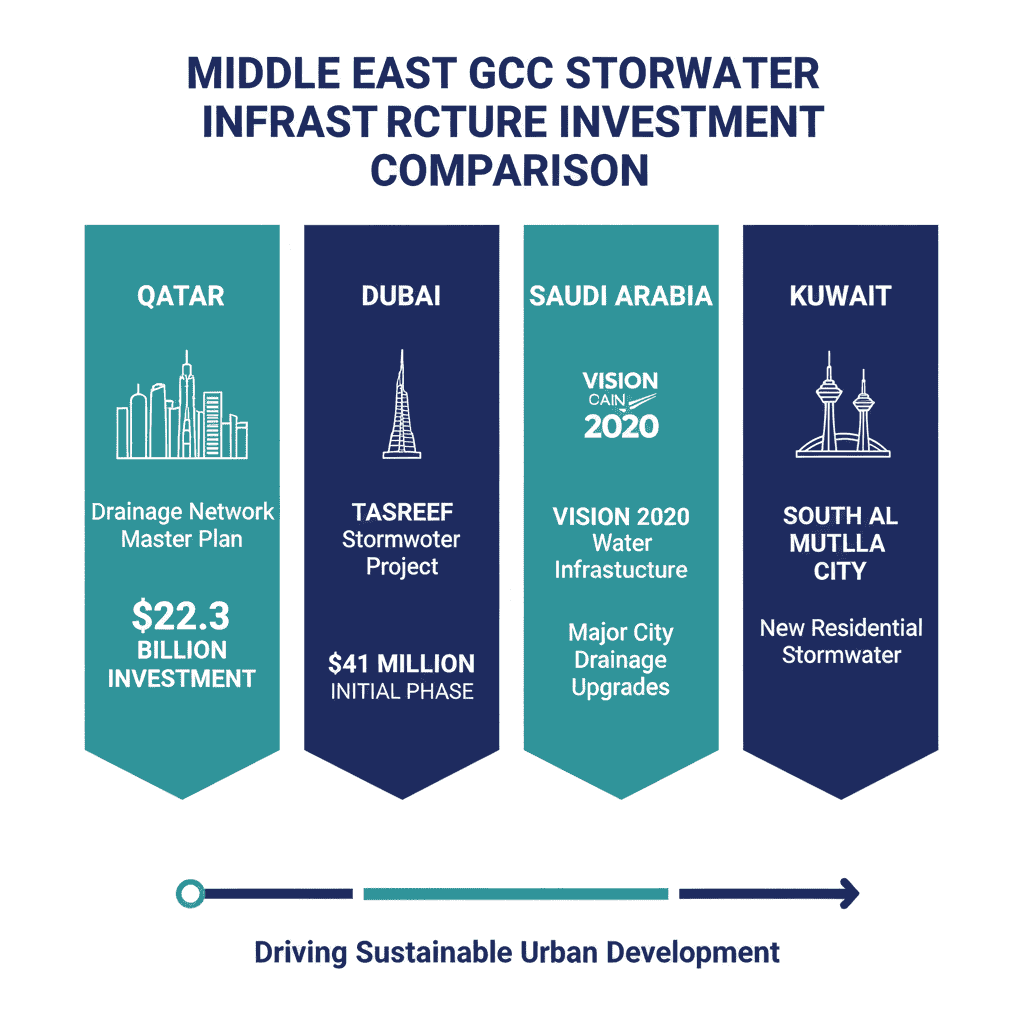
The Middle East is in the midst of an unprecedented infrastructure investment cycle, and stormwater management is receiving attention that would have been unimaginable a decade ago. Qatar has committed $22.3 billion to flood and drainage infrastructure as part of its national development strategy. Dubai’s Tasreef Phase project is investing $41 million in advanced stormwater drainage connecting Dubai South to the deep tunnel network. Saudi Arabia’s Vision 2030 programme includes nationwide flood prevention tunnels, rainwater drainage systems, and sewage network upgrades as part of Ashghal’s five-year infrastructure strategy.
For engineering consultancies and contractors working across the region, geocellular systems offer specific advantages that align with GCC procurement priorities. Speed of installation is critical: modular geocellular systems can be assembled at rates of 200–400 m³ per day with a standard crew, compared to weeks of formwork, rebar, and curing for cast-in-place concrete tanks. Land efficiency matters enormously in markets where urban land values exceed $1,000/m² in prime locations: geocellular systems sit beneath roads, parks, and car parks rather than consuming dedicated surface area. And supply chain flexibility allows shipping containers of flat-packed geocellular stormwater modules to arrive at any GCC port within 4–6 weeks of order confirmation, with no specialist heavy-lift equipment required for unloading or installation.
Design life expectations vary by client. Government mega-projects like South Al Mutlaa specify 50-year design lives, requiring rigorous long-term creep testing data and material warranties backed by independent third-party certification. Commercial developments typically work to 25–30-year design lives. In either case, the absence of corrosion (unlike concrete or steel alternatives), chemical inertness of HDPE/PP in contact with saline or chemically aggressive soils, and the fully encapsulated installation method contribute to long service life with minimal maintenance.
Comparing Geocellular Systems to Alternative Stormwater Solutions

Cast-in-Place Concrete Tanks
Concrete underground tanks have been the default stormwater storage approach in the GCC for decades. They offer high compressive strength, well-understood design methodology, and familiarity with local contractors. However, they require extensive formwork, reinforcement, waterproofing, curing time, and skilled labour. Construction timelines for large concrete tanks can run 3–6 months. Thermal expansion and contraction cycles in GCC climates create joint stress that can lead to cracking and leakage within 10–15 years without ongoing maintenance. For a 10,000 m³ storage requirement, a concrete tank typically costs 40–60% more than a geocellular equivalent when accounting for excavation, construction, waterproofing, and backfill.
Precast Concrete Box Culverts
Box culverts configured as detention storage offer faster installation than cast-in-place concrete but sacrifice volumetric efficiency. The concrete walls, floor, and roof occupy 15–25% of the excavated volume, compared to less than 5% for geocellular modules. For the same storage volume, the excavation footprint is significantly larger, increasing both earthworks cost and land take.
Open Detention Ponds
Surface ponds remain common for large-scale developments where land is cheap and available. In the GCC context, they create significant operational challenges: rapid evaporation concentrates pollutants, standing water attracts mosquitoes (a genuine public health concern in tropical and subtropical climates), safety fencing is mandatory around the perimeter, and the land has no other productive use. For the South Al Mutlaa project, open ponds would have consumed parkland needed for the 400,000-resident community.
Gravel-Filled Trenches and Soakaways
Gravel soakaways provide only 30–35% void ratio compared to 95%+ for geocellular systems, meaning three times the excavation volume for equivalent storage. In the GCC, where excavation in hard ground can cost $15–40/m³, this difference translates directly to project cost. Gravel also provides no inspection access and cannot be cleaned if sediment accumulation reduces performance over time.
Specification Checklist for GCC Geocellular Projects
Engineers specifying geocellular systems for Middle East projects should verify the following parameters, adapted from CIRIA C680/C737 guidance and supplemented by GCC-specific requirements.
Compressive strength must be rated at the design ground temperature, not standard 23°C laboratory conditions. Request creep test data at 40°C and 55°C for shallow installations. Void ratio should exceed 95% to maximise storage volume per unit of excavation. Geosynthetic wrapping must be specified based on function: non-woven geotextile (minimum 300 g/m², with appropriate apparent opening size for local soil gradation) for infiltration, or HDPE geomembrane (minimum 1.0 mm thickness, double-welded seams) for detention. Inlet pre-treatment must be sized for elevated TSS loading typical of GCC first-flush conditions (design for 3,000–5,000 mg/L TSS). Flow control devices must be corrosion-resistant: stainless steel or HDPE orifice plates and vortex flow controls rather than mild steel, which will corrode rapidly in saline GCC groundwater conditions. Backfill specification must account for potential salt attack on exposed geosynthetics: avoid recycled concrete aggregate containing chlorides. Design cover depth must satisfy both structural loading requirements and temperature management: deeper cover reduces ground temperature fluctuation, reducing thermal cycling stress on the geocellular modules.
Frequently Asked Questions
Yes, but they must operate in detention mode with impermeable geomembrane wrapping rather than infiltration mode. Sabkha soils have near-zero permeability and high salinity, making infiltration impossible. The geocellular system stores stormwater temporarily and releases it at controlled rates through engineered outlet structures to downstream drainage networks or treatment facilities. Full excavation and replacement of the sabkha with engineered granular fill is required beneath and around the system.
HDPE and PP modules experience thermal softening at elevated temperatures, reducing effective compressive strength by 15–25% compared to standard 23°C test conditions. Design engineers must apply temperature derating factors: 20% minimum for installations with less than 1 metre of cover, 10% for deeper installations. Specify modules manufactured from high-temperature-grade polymer formulations with verified creep test data at 40°C and 55°C. Avoid storing modules uncovered on site for extended periods, as UV degradation compounds temperature effects.
Primary maintenance involves inspecting and cleaning inlet structures, silt traps, and flow control devices. GCC stormwater carries exceptionally high suspended solids from windblown sand and dust, so silt trap clean-out frequency is typically 2–4 times annually compared to annually in temperate climates. CCTV inspection of the geocellular chamber interior is recommended every 3–5 years to verify structural integrity and check for sediment accumulation. The geocellular modules themselves require no maintenance.
For storage volumes above 500 m³, geocellular systems typically cost 30–40% less than cast-in-place concrete tanks when accounting for total installed cost including excavation, construction, waterproofing, backfill, and reinstatement. The cost advantage increases with scale: the South Al Mutlaa project’s 650,000 m³ geocellular installation would have been economically unfeasible as concrete construction. Installation speed (200–400 m³/day versus weeks for concrete) also reduces programme costs and enables earlier handover of completed infrastructure.
The GCC does not yet have a unified regional standard for geocellular stormwater systems. Most projects reference CIRIA C680 (Design of Underground Geocellular Storage Systems) and CIRIA C737 (SuDS using modular systems) from the UK, adapted for local conditions. Individual emirates, municipalities, and government bodies may impose additional requirements. Kuwait’s Ministry of Public Works required independent third-party verification of material quality and system design for the South Al Mutlaa project. Engineers should confirm applicable standards with the local approving authority during the design phase.
The engineering data and project references in this guide are drawn from AQUA Rain Water’s direct involvement in GCC stormwater projects and from publicly available project documentation. Specific system sizing, soil investigation, and structural design must be performed by qualified engineers for each individual project based on site-specific conditions.
 English
 Arabic
 French
 Russian
 Spanish