
Coût de la rétention des eaux pluviales par pied cube : Ce que les entrepreneurs paieront en 2026
Auteur : L'équipe d'ingénierie des eaux pluviales d'AQUA - Mise à jour : Février 2026 - Temps de lecture : 18 minutes
Coûts de la rétention souterraine des eaux pluviales entre $8.50 et $17.00 par pied cube de stockage lorsqu'il est entièrement installé sur des sites commerciaux aux États-Unis. Cette fourchette dépend de trois facteurs : le type de système (gravier, chambre d'arche ou module géocellulaire), les taux d'excavation régionaux ($18-$55 par mètre cube dans cinq régions des États-Unis) et le taux de vide du système que vous choisissez - la seule variable qui détermine la quantité de sol que vous déplacez réellement. Une tranchée de gravier avec un vide de 38% ne stocke que 38 cents d'eau par dollar de creusement. Un module géocellulaire avec un vide de 95% stocke 95 cents. Cet écart entraîne une différence de coût de plus de $131 000 sur un projet commercial typique de 75 000 pieds cubes.
Nous avons conçu et fourni des systèmes souterrains de stockage temporaire des eaux pluviales pour des projets allant de sites résidentiels de 5 000 CF à des aménagements commerciaux de plus de 200 000 CF dans 14 États américains, au Royaume-Uni et au Moyen-Orient depuis 2017. Cet article détaille chaque composante du coût avec des calculs transparents que vous pouvez vérifier vous-même – formules d'excavation, coefficients liés au taux de vide et données régionales de main-d'œuvre – afin d'établir un budget fiable avant de contacter le moindre entrepreneur. Il s'adresse aux ingénieurs civils, aménageurs et entrepreneurs généraux qui ont besoin de chiffres réels, et non de fourchettes marketing.
Cet article traite des coûts des systèmes souterrains de rétention des eaux pluviales pour les projets commerciaux et municipaux sur le territoire continental des États-Unis. Il ne couvre pas les bassins de rétention de surface (sauf pour une brève comparaison des coûts), les jardins de pluie résidentiels, les infrastructures vertes telles que les biefs, ou les dispositifs de traitement de la qualité des eaux pluviales. Pour des conseils sur les bassins d'atténuation au Royaume-Uni, voir notre Page sur les réservoirs d'atténuation au Royaume-Uni.
Dans cet article
- Pourquoi le coût par pied cube n'est pas la bonne question de départ
- Coût réel du stockage temporaire souterrain : trois types de systèmes
- Les mathématiques de l'excavation pour un projet de 75 000 FC
- Comment les coûts d'excavation varient-ils selon les régions ?
- Étude de cas : Développement à usage mixte à Houston
- Spécifications du module ARW pour votre devis
- Cinq erreurs d'installation qui font exploser les budgets
- Étude de cas : Centre de distribution de l'entrepôt du New Jersey
- Quand chaque système se justifie économiquement
- Comment obtenir une estimation précise des coûts ?
- Évolution du stockage temporaire souterrain
- Questions fréquentes
Pourquoi le coût par pied cube n'est pas la bonne question de départ
Cela semble contre-intuitif pour un article portant ce titre. Mais le coût d'installation par mètre cube de stockage est ce qui importe, et non le coût par mètre cube de l'eau. matériel. Confondre les deux est l'erreur la plus coûteuse dans la budgétisation des eaux pluviales, et nous la constatons dans environ quatre offres de projet sur dix qui arrivent sur notre bureau.
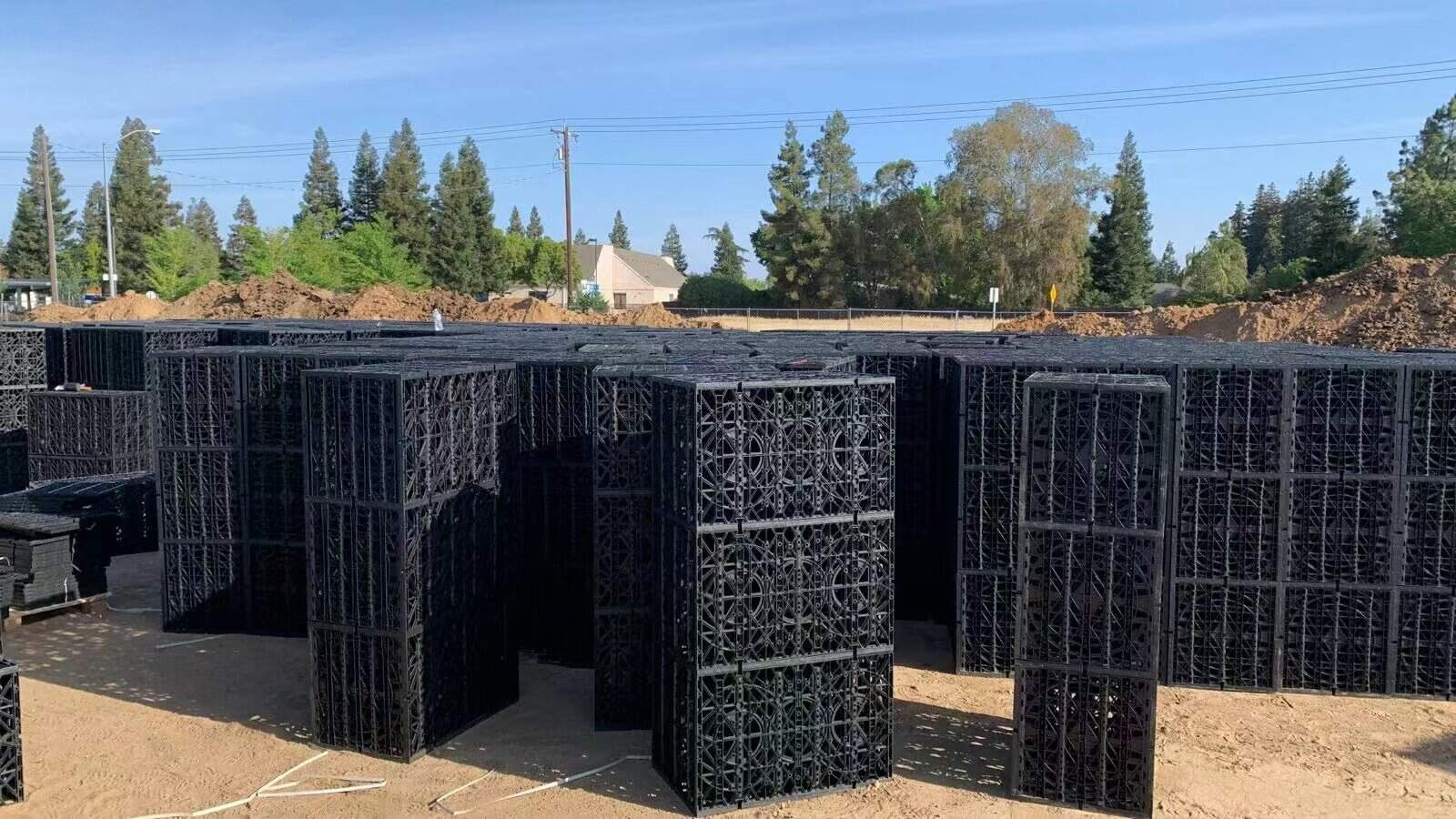
Voici pourquoi. Chaque système souterrain de stockage temporaire comprend un taux de vide - le pourcentage de son volume installé qui retient effectivement l'eau. Le gravier stocke l'eau dans les espaces interstitiels entre les particules d'agrégat, ce qui lui confère un rapport de vide d'environ 35-40%. Les modules géocellulaires (parfois appelés caisses d'eaux pluviales ou unités de détention modulaires) sont des structures légères en polypropylène avec des cellules ouvertes internes, produisant des rapports de vide de 95%. Les Agence américaine de protection de l'environnement (EPA) reconnaît les deux approches comme des pratiques de gestion optimales (PGE) acceptables pour la rétention des eaux pluviales - la différence est purement économique.
- Pour stocker 10 000 FC en utilisant du gravier à 38% vide, vous creusez 26 316 FC du sol.
- Pour stocker 10 000 FC à l'aide de modules géocellulaires à 95% vide, vous creusez 10 526 FC du sol.
Même stockage. Moins de la moitié des travaux d'excavation. Et l'excavation n'est pas bon marché.
Les bases de données nationales sur les coûts de construction indiquent systématiquement que les travaux d'excavation dans les secteurs résidentiel et commercial léger s'élèvent à $2.50 à $15.00 par mètre cube, avec le transport et l'élimination des sols, en ajoutant $8 à $25 par mètre cube. Pour les projets de détention commerciale impliquant des coupes plus profondes, des contraintes d'accès urbain et des remblais techniques, le coût total de l'excavation et de la mise en décharge varie de 1 à 5 millions d'euros. $25 et $55 par mètre cube en fonction de la région et du type de sol. Ces fourchettes apparaissent sur de multiples plateformes indépendantes - rapports d'enquête des entrepreneurs, outils d'estimation professionnels et bases de données de coûts pour les consommateurs - et sont restées stables depuis 2024.
Lorsque l'excavation représente 40-60% de votre coût total d'installation, le système qui minimise l'excavation l'emporte sur le prix - même si le coût du matériau par pied cube est plus élevé. Ce n'est pas de la théorie. C'est de l'arithmétique. Nous le prouvons ci-dessous.
Coût réel du stockage temporaire souterrain : trois types de systèmes
Les fourchettes de coûts suivantes reflètent les données communiquées par les entrepreneurs dans le cadre de projets commerciaux aux États-Unis. Tous les chiffres supposent des conditions de sol standard - pas de roche, pas de contamination, une nappe phréatique saisonnière élevée (SHWT) en dessous de la profondeur d'excavation. Si votre site présente l'une de ces complications, le budget 15-30% sera plus élevé. Les Agence fédérale de gestion des urgences (FEMA) note que les coûts de gestion des eaux pluviales varient considérablement d'un site à l'autre, ce qui renforce la nécessité de procéder à des estimations spécifiques à chaque projet plutôt que d'appliquer des règles empiriques en matière de tarification.
Tranchées de gravier et de pierre
| Élément de coût | Fourchette de prix | Comment nous avons calculé cela |
|---|---|---|
| Matériau en pierre concassée | $3,50–$5,00/CF | Prix des agrégats à l'échelle nationale : $28-$45/tonne livrée ÷ 1,4 tonne/an ÷ 27 CF/an |
| Excavation (à un taux de vide de 38%) | $4.00-$6.00/CF de stockage | $30/CY ÷ 27 CF × 2,63 multiplicateur de volume, plus le travail de compactage et de nivellement |
| Tissu géotextile et main-d'œuvre | $1,50–$2,50/CF | Géotextile non tissé à $0,40-$0,80/SF plus taux de l'équipe à $55-$85/heure |
| Coût total installé | $9.00-$13.50/CF de stockage | Somme des composants dans les conditions standard du site |
Le gravier est le matériau le moins cher par pied cube de remblai. Mais le calcul critique est le suivant : pour chaque pied cube de rétention dont vous avez besoin, vous devez excaver environ 2,6 pieds cubes de sol, car seulement 38% de ce volume contient de l'eau. Le reste est constitué de pierres. Pour un projet de 50 000 pieds cubes, ce multiplicateur de volume transforme un travail d'excavation modéré en une opération de terrassement majeure - 4 870 mètres cubes de terre qui doivent être creusés, chargés sur des camions, transportés jusqu'à une installation d'élimination agréée et mis en décharge au prix de $15-$45 par tonne de redevances de déversement.
Le gravier est rentable sur les sites ruraux où l'excavation est inférieure à $22/CY, où la pierre concassée locale est livrée à moins de $30/tonne, où l'aire de transit est largement ouverte et où votre calendrier prévoit une fenêtre d'installation de 4 à 6 semaines. En dehors de ces conditions, le multiplicateur de volume érode rapidement l'avantage du coût du matériau.
Systèmes de chambres en arc en PEHD
| Élément de coût | Fourchette de prix | Comment nous avons calculé cela |
|---|---|---|
| Unités de chambre | $6,00–$8,00/CF | Prix publiés par le fabricant pour les unités résidentielles et commerciales standard |
| Couche de pierre (6-12 in. requis) | $1,50–$2,00/CF | Agrégat de base à $28-$45/tonne sur une profondeur de 6 à 12 pouces. |
| Excavation (à 40-50% vide) | $3.00-$4.00/CF de stockage | $30/CY milieu de gamme ÷ 27 CF × ~2,2 multiplicateur de volume |
| Main d'œuvre, embouts et raccordements | 2,00 $ à 3,00 $/CF | L'équipe travaille à raison de $55-$85/heure ; 3-4 jours d'installation pour 20 000 CF. |
| Coût total installé | $12.50-$17.00/CF de stockage | Somme des composants dans les conditions standard du site |
Les chambres en arc améliorent le taux de vide du gravier (environ 40-50%), mais nécessitent toujours une couche de fondation en pierre concassée et un nivellement minutieux de la couche de fondation. Elles conviennent bien pour les empreintes linéaires - servitudes, terrains étroits, couloirs de retrait - et pour les projets de moins de 30 000 CF où la conception à fond ouvert permet aux inspecteurs d'avoir un accès visuel direct. La nécessité d'un lit de pierres augmente à la fois le coût des matériaux et le temps d'installation par rapport aux systèmes géocellulaires, qui reposent sur un sol natif compacté ou une fine couche de sable.
Systèmes géocellulaires modulaires
| Élément de coût | Fourchette de prix | Comment nous avons calculé cela |
|---|---|---|
| Unités du module | 4,50 $ à 6,50 $/CF | Prix FOB pour les modules de 30 à 60 tonnes ; varie en fonction de la spécification de résistance à la compression. |
| Enveloppe de géotextile ou de géomembrane | 0,50 $ à 1,00 $/CF | Géotextile non tissé à $0.30-$0.60/SF ou géomembrane HDPE à $0.50-$1.00/SF |
| Excavation (pour un taux de vide de 95%) | $2.00-$3.00/CF de stockage | $30/CY milieu de gamme ÷ 27 CF × 1,05 multiplicateur de volume - ratio creusage/stockage proche de 1:1 |
| Connecteurs et main d'œuvre pour l'installation | $1,50–$2,50/CF | Assemblage par encliquetage ; équipe de 2 personnes pour un débit de 3 000 à 4 000 CF/jour |
| Coût total installé | $8.50-$13.00/CF de stockage | Somme des composants dans les conditions standard du site |
Un rapport de vide de 95% signifie que votre volume d'excavation dépasse à peine votre besoin de stockage - le multiplicateur n'est que de 1,05× contre 2,63× pour le gravier. Pas d'empierrement nécessaire. Pas de grue. Deux ouvriers équipés de modules à verrouillage rapide peuvent installer 3 000 à 4 000 CF par jour. Sur les sites urbains exigus où chaque jour supplémentaire d'excavation à ciel ouvert coûte de l'argent en gestion du trafic, en clôtures temporaires et en conditions générales, cette vitesse compte autant que le prix du matériau.
Pour une comparaison directe des trois systèmes dans le cadre d'un projet unique, voir notre analyse des coûts des graviers, des chambres et des caisses modulaires.
Résultat sur les coûts du système : Le gravier est le moins cher par pied cube de remplissage mais le plus cher par pied cube de stockage sur la plupart des sites commerciaux. Les modules géocellulaires coûtent plus cher par unité mais offrent le prix total installé le plus bas lorsque l'excavation dépasse $22/CY - ce qui couvre environ 70% des marchés commerciaux américains.
Les mathématiques de l'excavation pour un projet de 75 000 FC
Les chiffres figurant sur une fiche technique sont abstraits. Utilisons-les pour un besoin de stockage de 75 000 CF - dimensionnement typique d'un site commercial de 5 acres avec un parking structuré. Nous utilisons $30/CY pour l'excavation et l'élimination, ce qui est tout à fait au milieu de la fourchette $25-$38/CY rapportée pour les régions à coûts modérés comme le sud-est et le corridor du Texas.
Tranchée de gravier : 75 000 CF Stockage
Pour un taux de vide de 38 % : 75 000 ÷ 0,38 = 197 368 CF de remblai de gravier, nécessitant l'excavation de 7 310 mètres cubes du sol.
| Poste | Calcul | Coût |
|---|---|---|
| Excavation + élimination | 7 310 CY × $30/CY | $219,300 |
| Pierre concassée | 197 368 PC × $3,50-$5,00/PC | $691 000–$987 000 |
| Géotextile, main d'œuvre, raccordements | Somme forfaitaire | 40 000 $ – 60 000 $ |
| Total du projet | 950 000 $ – 1 266 000 $ |
Modules géocellulaires : 75 000 CF Stockage
Pour un taux de vide de 95 % : 75 000 ÷ 0,95 = 78.947 CF d'excavation, qui est 2 924 mètres cubes du sol.
| Poste | Calcul | Coût |
|---|---|---|
| Excavation + élimination | 2 924 CY × $30/CY | $87,700 |
| Modules + emballage + connecteurs + main d'œuvre | 75 000 PC × $8.50-$13.00/PC | $637 500–$975 000 |
| Total du projet | 725 000 $ – 1 063 000 $ |
Regardez la ligne d'excavation : $219,300 contre $87,700. Une différence de $131.600 purement due au taux de vide - même volume de stockage, creusement radicalement différent. Si l'on fait le total, le système géocellulaire le plus cher ($1 063 000) coûte toujours moins cher que le système de gravier à son point médian ($1 108 000).
Dans les régions à coûts élevés - le corridor nord-est, la Californie, le nord-ouest du Pacifique - où l'excavation coûte $38-$55/CY, cet écart se creuse jusqu'à $200 000+ pour le même projet de 75 000 CF. Le calcul est linéaire : plus les travaux de terrassement sont coûteux, plus un taux de vide élevé permet de réaliser des économies.
Principaux enseignements : Le taux de vide est le multiplicateur qui relie le choix des matériaux au coût total du projet. Chaque dollar par mètre cube d'excavation est amplifié ou comprimé par ce ratio. Si vous l'ignorez, votre budget est une fiction.
Comment les coûts d'excavation varient-ils selon les régions ?
Les taux d'excavation régionaux sont la plus grande variable externe dans le coût total de votre projet. Les fourchettes ci-dessous proviennent de plusieurs ensembles de données d'enquêtes menées par des entrepreneurs indépendants et couvrant les prix pour 2024-2026 dans cinq régions des États-Unis. Tous les chiffres comprennent le temps de la machine, la main-d'œuvre de l'opérateur, le transport de la terre et les frais d'élimination dans une installation agréée. Les American Association of State Highway and Transportation Officials (AASHTO) (Association américaine des responsables des autoroutes et des transports des États) publie des normes d'évaluation des charges qui déterminent la profondeur minimale de la couverture et les exigences structurelles - qui à leur tour affectent la profondeur de l'excavation et le coût.
| Région | Excavation + élimination ($/CY) | Taux de salaire en vigueur ($/hr) | Impact sur le choix du système |
|---|---|---|---|
| Corridor nord-est (NY, NJ, CT, MA) | $38-$55 | $85-$130 | Les systèmes modulaires sont fortement favorisés - les économies d'excavation sont décisives à ces taux. |
| Californie et nord-ouest du Pacifique | $35-$50 | $80-$120 | Les systèmes modulaires sont fortement favorisés ; les considérations sismiques peuvent ajouter de l'ingénierie. |
| Sud-est et Texas | $25-$38 | $55-$85 | Modularité favorisée pour une meilleure efficacité en termes de délais et de main-d'œuvre par rapport au gravier |
| Le Midwest (OH, IN, IL, MN) | $20-$32 | $50-$75 | Les deux systèmes sont compétitifs - le calendrier du projet est souvent décisif |
| Régions rurales du sud-ouest et des montagnes | $18-$28 | $45-$65 | Gravier compétitif lorsque l'agrégat est local et que l'horaire est flexible |
Trois facteurs expliquent les variations régionales. Premièrement, les marchés du travail : les projets à salaires dominants (Davis-Bacon) dans les États membres de l'Union appliquent des taux de main-d'œuvre 30-50% plus élevés que les travaux en atelier ouvert dans le Sud-Est. Deuxièmement, les conditions du sol : le loam sableux de la côte texane est quatre fois plus rapide à excaver que le till glaciaire et les roches fracturées du Connecticut. Troisièmement, les réglementations en matière d'élimination : les redevances de déversement varient de $15/tonne dans les décharges rurales à $45+/tonne dans les marchés métropolitains à capacité limitée. Même au sein d'un même État, les coûts varient de 40% entre les sites urbains et ruraux.
Les projets avec un accès limité au site, un sol contaminé nécessitant une élimination dangereuse (tests TCLP, suivi des manifestes) ou des nappes phréatiques élevées font grimper les coûts vers le haut de ces fourchettes, quelle que soit la région. Il est important de noter que ces complications se multiplient avec le volume d'excavation. Creusez moins, et chaque complication coûtera moins cher.
Étude de cas : Développement à usage mixte à Houston - 120 000 CF
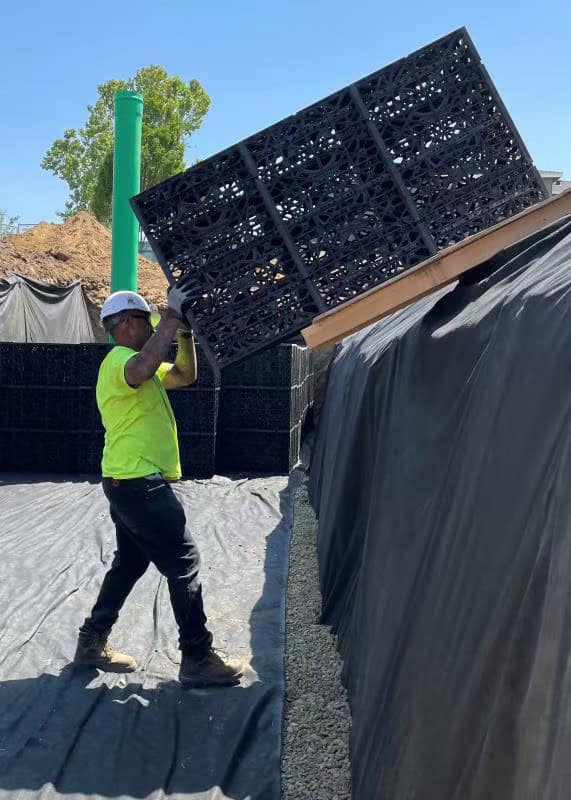
Fin 2024, un promoteur du nord-ouest de Houston nous a contactés au sujet d'un stockage de rétention pour un projet à usage mixte de 7,2 acres : trois sites commerciaux, un parking de 340 places et un besoin de rétention de 120 000 CF selon les réglementations du Harris County Flood Control District (HCFCD). Le site reposait sur de l'argile Beaumont rigide - un matériau lourd et collant qui s'accroche aux godets des excavatrices et ralentit la production de 30-40% par rapport aux sols sablonneux.
Le projet civil initial prévoyait une tranchée remplie de gravier. Nous avons fait les calculs avec leur ingénieur : 120 000 CF ÷ 0,38 vide = 315 789 CF d'excavation (11 696 CY) pour le gravier, contre 120 000 ÷ 0,95 = 126 316 CF (4 679 CY) pour les modules géocellulaires. Au taux d'excavation local de $32/CY pour cette argile, l'excavation de gravier seule a coûté $374,272. Modules : $149 728. Le delta d'excavation était de $224,544.
Mais le véritable problème était le calendrier. L'entrepreneur général disposait de 18 jours de travail pour les services publics souterrains et la retenue combinés. Un système de gravier de 11 696 CY aurait nécessité quatre camions-bennes effectuant des cycles de transport continus - l'entrepreneur a estimé qu'il fallait au moins 22 à 25 jours de travail, ce qui a fait exploser le calendrier d'une semaine entière. Notre système géocellulaire de 4 679 CY a été mis en place en 14 jours ouvrables, y compris l'assemblage des modules, ce qui donne quatre jours de marge par rapport au calendrier. Le développeur a opté pour des modules ARW-8053. Le coût total de l'installation s'est élevé à $11.40/CF de stockage, contre $14.80/CF pour l'estimation du gravier.
Il convient de noter que ce projet ne comportait ni roche ni contamination et que la nappe phréatique se situait à 9 pieds sous le niveau fini, soit des conditions parmi les plus favorables que puisse offrir l'argile de Houston. Sur un site présentant l'une de ces complications, l'écart aurait été plus important.
Spécifications du module ARW pour votre devis
Si vous construisez un devis ou que vous introduisez des comptes d'unités dans une feuille de calcul, vous avez besoin de dimensions et de volumes de stockage exacts. Les deux modèles ci-dessous sont conformes à la norme Spécifications AASHTO LRFD pour la conception des ponts Ils sont fabriqués en résine de polypropylène (PP) vierge avec des stabilisateurs UV pour le stockage extérieur avant l'installation.
ARW-8053 - Applications pour la circulation des poids lourds
| Paramètre | Valeur |
|---|---|
| Dimensions (L × L × H) | 31.5 × 19.3 × 20.9 in (800 × 490 × 530 mm) |
| Stockage net par unité | 5,84 pieds cubes |
| Taux de vide | 95% |
| Capacité de charge | AASHTO HS-25 (camions de pompiers, camions à ordures, véhicules de livraison lourds) |
| Matériau | Polypropylène vierge (PP) |
| Résistance à la compression | > 400 kN/m² (58+ psi) |
| Durée de vie de la conception | 50+ ans (chimiquement inerte dans les sols) |
| Modules pour 1 000 CF de stockage | ~171 unités |
| Couverture minimale (surface pavée) | 18 pouces de remblai compacté |
ARW-6841 - Applications de circulation standard
| Paramètre | Valeur |
|---|---|
| Dimensions (L × L × H) | 26.8 × 16.1 × 17.7 in (680 × 410 × 450 mm) |
| Stockage net par unité | 4,31 pieds cubes |
| Taux de vide | 95% |
| Capacité de charge | AASHTO H-20 (véhicules de tourisme, camionnettes, fourgonnettes) |
| Matériau | Polypropylène vierge (PP) |
| Résistance à la compression | > 300 kN/m² (43+ psi) |
| Durée de vie de la conception | 50 ans et plus |
| Modules pour 1 000 CF de stockage | ~232 unités |
| Couverture minimale (surface pavée) | 12 pouces de remblai compacté |
Les deux modèles utilisent des raccords à emboîtement - pas d'outils, pas d'adhésifs, pas de main-d'œuvre spécialisée. Les modules sont expédiés à plat sur des palettes standard, ce qui réduit les frais de transport d'environ 60% par rapport aux systèmes de chambres préassemblées. Une équipe de deux personnes assemble et place les unités à raison de 3 000 à 4 000 CF par jour. Sur un projet de 75 000 CF, cela se traduit par 12 à 15 jours de travail entre la mise en place du premier module et l'achèvement du remblayage. Pour obtenir des détails sur les produits et des dessins CAO, visitez notre site Web modules géocellulaires pour eaux pluviales page produit.
Cinq erreurs d'installation qui font exploser les budgets
Ce ne sont pas des cas isolés. Nous les observons sur suffisamment de projets pour y voir des tendances, notamment chez les entrepreneurs généraux qui réalisent leur première installation d'un système souterrain de stockage temporaire des eaux pluviales.
1. Soumission sans données géotechniques
Supposer un “sol normal” et se heurter ensuite à de la roche, de l'eau perchée ou des remblais contaminés est la première source d'ordres de modification dans les projets de détention. Un programme de forage géotechnique coûte de $2 000 à $5 000 pour la plupart des sites commerciaux - deux à quatre forages jusqu'à la profondeur d'excavation prévue, plus cinq pieds. Une surprise en milieu de projet coûte dix à vingt fois plus cher en frais d'attente, de réingénierie et d'élimination des déchets dangereux. Il n'y a pas d'exception : tous les projets de gestion des eaux pluviales doivent faire l'objet de sondages avant que l'entrepreneur en terrassement ne fixe un prix.
2. Oublier la déshydratation
Si la profondeur de l'excavation s'approche de la nappe phréatique saisonnière, vous devez faire fonctionner des pompes d'assèchement au point de captage pendant toute la durée de l'installation. L'assèchement d'un projet de retenue commerciale typique ajoute $5 000-$20 000+ en fonction de la perméabilité du sol (conductivité hydraulique), du volume d'écoulement et de la durée de fonctionnement de la pompe. Vérifiez les élévations de la nappe phréatique dans votre rapport géotechnique avant de lancer l'appel d'offres. Si la nappe phréatique se trouve à moins de 24 pouces du fond de l'excavation prévue, spécifiez l'assèchement comme un élément explicite de l'appel d'offres. S'il ne figure pas dans l'offre, il apparaîtra dans l'ordre de modification - à un prix élevé.
3. Oublier la préparation de la litière
Un sol irrégulier crée des concentrations de contraintes qui fissurent les systèmes de chambres rigides et provoquent un tassement différentiel sous l'effet répété de la circulation. Pour tout système souterrain de stockage temporaire des eaux pluviales, il convient de spécifier et de vérifier sur le terrain une couche de 4 à 6 pouces de granulat compacté (généralement de la pierre ASTM n° 57 ou n° 8, ou du sable propre) nivelée avec une tolérance de ±½ pouce. Cette exigence s'applique également aux modules géocellulaires : même s'ils tolèrent mieux les petites irrégularités que les chambres à arches rigides, une assise correctement préparée prolonge leur durée de vie et évite la formation de flaques localisées aux points bas.
4. Profondeur de couverture incorrecte pour le chargement de la circulation
Une couverture insuffisante du sol au-dessus d'un système de rétention entraîne une défaillance structurelle sous l'effet de charges réelles - et les dommages sont catastrophiques, et non graduels. Les exigences minimales en matière de couverture dépendent de la charge nominale et des spécifications du fabricant. Pour les applications AASHTO HS-25 sous les surfaces pavées, les modules ARW-8053 exigent un minimum de 18 pouces de remblai structurel compacté. Si vous vous trompez, ce n'est pas un ragréage que vous faites, mais une excavation de l'ensemble du système, de la chaussée qui le surplombe et de tous les services publics qui le traversent. Nous avons vu une erreur de profondeur de couverture sur le parking d'une épicerie générer une facture de remise en état de $180 000 pour une installation d'origine de $90 000.
5. Comparer le prix des matériaux plutôt que le prix de l'installation
C'est l'erreur que tout cet article vise à éviter. Un système qui coûte $3,50/CF pour le matériel mais qui nécessite 2,63× le volume d'excavation n'est pas moins cher qu'un système à $5,50/CF qui creuse à 1,05×. Avant de choisir un type de système, calculez le coût total de l'installation - excavation, transport, élimination, mise en place, main-d'œuvre, emballage, raccordements et remblai - pour votre site spécifique. L'exemple de 75 000 pieds carrés ci-dessus montre comment une “économie” de matériau de $2,00/CF se transforme en une augmentation du coût du projet de $225 000 lorsque l'excavation est incluse.
Les cinq erreurs ont un point commun : Ils s'échelonnent en fonction du volume d'excavation. Plus vous déplacez de terre, plus chaque erreur coûte cher. Les systèmes à taux de vide élevé réduisent votre exposition à chacun de ces risques en rétrécissant le trou.
Étude de cas : Centre de distribution d'entrepôts du New Jersey - 85 000 CF
Au printemps 2025, une entreprise de logistique du centre du New Jersey avait besoin de 85 000 CF de rétention souterraine pour un entrepôt de distribution de 220 000 SF sur une parcelle de 12 acres. Les règles du Département de la protection de l'environnement du New Jersey (NJDEP) en matière d'eaux pluviales exigeaient la gestion des tempêtes de 2 ans, 10 ans et 100 ans - trois points de conception distincts. Le rapport géotechnique fait état de tills glaciaires denses en dessous de 4 pieds, avec un nombre de coups au test de pénétration standard (SPT) supérieur à 50 - essentiellement du gravier et des galets compactés déposés au cours de la dernière période glaciaire.
Le sous-traitant en terrassement a fixé le prix de l'excavation à $48/CY pour le till glaciaire, soit près du double du taux pour un sol normal dans le même comté. Pour le gravier : 85 000 ÷ 0,38 = 223 684 CF = 8 284 CY à $48/CY = $397.632 pour la seule excavation. Pour les modules géocellulaires : 85.000 ÷ 0,95 = 89.474 CF = 3.314 CY à $48/CY = $159,072. Le delta d'excavation : $238,560.
L'équipe du projet n'avait pas prévu une complication supplémentaire. Le till glaciaire contenait des galets épars pouvant atteindre 8 pouces - trop gros pour les dents d'un godet d'excavateur standard. L'entrepreneur a eu besoin d'un godet à roches, ce qui lui a coûté $1 200 euros par jour en location de matériel. Chaque jour supplémentaire de creusement augmentait ce coût. Le système géocellulaire a nécessité 6 jours d'excavation, contre 14 estimés pour le gravier. Huit jours de moins pour la location d'un godet à roches ont permis d'économiser $9.600 supplémentaires qui n'apparaissent nulle part dans les comparaisons par pied cube.
Coût final de l'installation : 12,80 $/CF pour le système géocellulaire, contre une estimation révisée de 18,60 $/CF pour le gravier dans ce till glaciaire. Le promoteur a économisé environ 493 000 $ sur les travaux souterrains, soit suffisamment pour financer l'ensemble de l'aménagement paysager du site et les noues périphériques de gestion de la qualité des eaux pluviales.
Une limitation mérite d'être notée : les deux études de cas ci-dessus impliquaient des conditions d'eaux souterraines favorables (SHWT bien en dessous de la profondeur d'excavation). Sur les sites nécessitant un assèchement, l'avantage en termes de coûts des systèmes géocellulaires augmente encore, car la durée de l'assèchement suit le volume et le temps d'excavation - mais nous n'avons pas quantifié ce multiplicateur sur un nombre suffisant de projets pour publier une fourchette fiable pour l'instant. Nous le suivons de près.
Quand chaque système se justifie économiquement
Il n'existe pas de “meilleur” système, mais seulement celui qui correspond le mieux aux conditions de votre site, à votre calendrier et à votre budget. Voici le cadre de décision que nous utilisons en interne pour conseiller les équipes de projet :
Choisissez des tranchées de gravier lorsque le coût d'excavation du site est inférieur à $22/CY, l'accès à l'équipement est largement ouvert et il n'y a pas de contraintes d'entreposage, la pierre concassée locale est livrée à un prix inférieur à $30/tonne, votre calendrier prévoit une fenêtre d'installation de 4 à 6 semaines et le stockage requis reste inférieur à 25 000 CF. Le gravier convient également lorsque la juridiction exige spécifiquement des systèmes d'infiltration sans revêtement imperméable - le lit de granulats sert de support d'infiltration dans les sols très perméables (conductivité hydraulique supérieure à 1 × 10-⁴ m/s).
Choisissez les chambres à arc lorsque votre autorité compétente exige un accès physique à l'intérieur du système (conception à fond ouvert), l'empreinte au sol est linéaire (servitudes, terrains étroits, couloirs de services publics), le stockage se situe dans la plage de 10 000 à 30 000 pieds cubes et le matériau d'assise en pierre est disponible localement à un coût raisonnable. Les chambres restent la solution par défaut dans le nombre décroissant de juridictions qui n'ont pas encore approuvé les systèmes géocellulaires - bien que cette liste se réduise d'année en année.
Choisissez les modules géocellulaires lorsque l'excavation est supérieure à $25/CY, le site a des étapes limitées ou un accès restreint à l'équipement, le calendrier est comprimé (1-3 semaines contre 4-6 pour le gravier), le stockage est supérieur à 50 000 CF, vous avez besoin d'une cote de circulation HS-25 avec un empilage multicouche pour maximiser le stockage sous une empreinte au sol fixe, ou le projet nécessite à la fois la détention et l'entreposage d'un matériau. gestion intégrée des eaux pluviales souterraines - le même module remplit les fonctions de détention, de rétention et d'infiltration en ne modifiant que les spécifications de l'enveloppe.
Une exception mérite d'être signalée : les sites extrêmement peu profonds (moins de 36 pouces entre le sol fini et la nappe phréatique saisonnière ou le substratum rocheux) peuvent ne pas être compatibles avec les modules géocellulaires standard. Dans ce cas, les systèmes de chambres à profil peu profond ou la rétention en surface sont les seules options viables - bien que nous fabriquions une variante de module à profil bas exactement pour ce scénario. N'hésitez pas à nous interroger à ce sujet.
Résumé de la décision : Dans les 70% des marchés commerciaux américains où l'excavation dépasse $25/CY, les modules géocellulaires offrent le coût d'installation le plus bas par pied cube de stockage. Dans les 30% restants - sites ruraux avec un sol bon marché, des pierres bon marché et des calendriers ouverts - le gravier reste compétitif du seul point de vue économique.
Comment obtenir une estimation précise du coût de votre projet ?
Les fourchettes présentées dans cet article constituent un cadre budgétaire. Mais chaque site présente des variables - sol, nappe phréatique, accès, charge de trafic, taux régionaux - qui ne peuvent être résolues qu'à l'aide de données spécifiques au site. Voici ce dont vous avez besoin pour établir une estimation fiable :
- Volume de stockage requis en pieds cubes - du rapport hydrologique et hydraulique (H&H) de votre ingénieur civil, basé sur les exigences de l'ordonnance locale sur les eaux pluviales en matière de tempête de conception
- Données géotechniques - la classification des sols (USCS), la profondeur de la roche ou du refus, l'élévation saisonnière de la nappe phréatique et la conductivité hydraulique si l'infiltration fait partie de la conception.
- Classe de charge de trafic - AASHTO H-20, HS-20 ou HS-25, en fonction de ce qui circule sur le réseau enterré (voitures particulières, camions de livraison, engins de lutte contre l'incendie).
- Calendrier du projet - le nombre de jours ouvrables que le chemin critique prévoit pour les travaux souterrains
- Rétention ou infiltration - cela détermine la géomembrane PEHD (rétention étanche) ou le géotextile perméable (infiltration/rétention)
Notre équipe d'ingénieurs modélise vos conditions et fournit une comparaison détaillée des coûts - y compris les calculs de volume d'excavation pour chaque type de système - dans un délai de 48 heures. Envoyez-nous les paramètres de votre projet et nous vous montrons exactement où va chaque dollar.
Comment le stockage temporaire souterrain a évolué – et pourquoi les coûts continuent de baisser
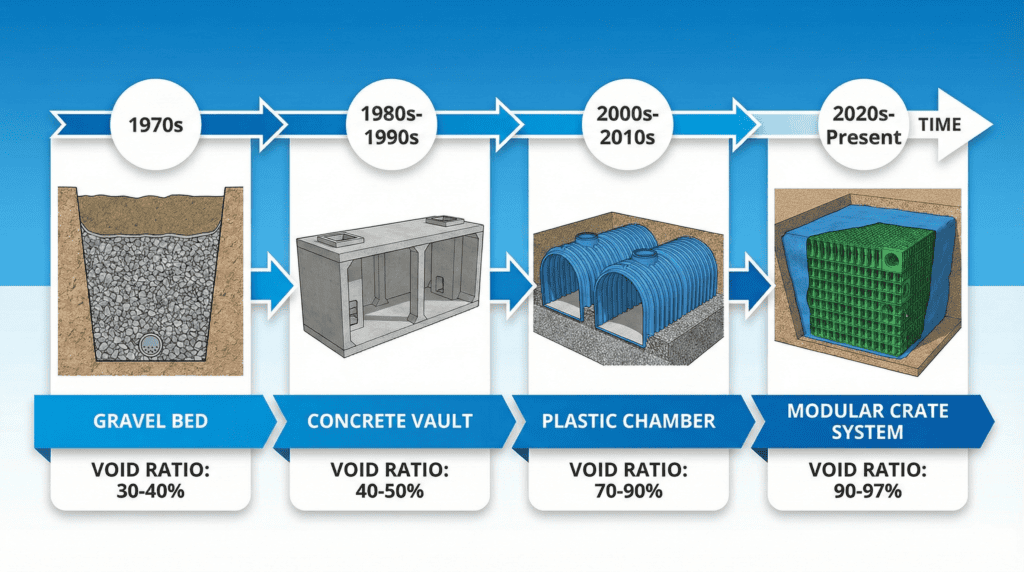
La rétention souterraine des eaux pluviales n'est pas une technologie nouvelle. Les tranchées remplies de gravier sont utilisées depuis les années 1970, lorsque les premiers permis MS4 (Municipal Separate Storm Sewer System) ont été délivrés dans le cadre de la directive sur les eaux pluviales. Système national d'élimination des rejets de polluants (NPDES) de la loi sur l'eau (Clean Water Act) a commencé à exiger des contrôles des eaux pluviales après la construction. Les voûtes en béton préfabriqué sont apparues dans les années 1980. Les chambres à arches en PEHD sont arrivées sur le marché au début des années 1990. Les systèmes modulaires géocellulaires - la catégorie la plus récente - sont apparus en Europe à la fin des années 1990 et ont été largement adoptés aux États-Unis après 2010.
Chaque génération a permis de réduire les coûts d'installation en améliorant le taux de vide et en simplifiant l'installation. Le gravier à 38% de vide a constitué la base de référence. Les chambres ont été poussées jusqu'à 40-50%. Les modules géocellulaires ont atteint 95% - près du plafond pratique, puisque les 5% restants sont le matériau structurel lui-même. La trajectoire des coûts sur trois décennies est claire : la science des matériaux réduit le volume d'excavation, ce qui représente la majeure partie de l'argent.
À l'avenir, deux tendances continueront à faire baisser les coûts du stockage temporaire souterrain. Premièrement, l'industrialisation de la fabrication : comme de plus en plus de juridictions américaines imposent des dispositifs de gestion des eaux pluviales après construction (la règle MS4 proposée par l'EPA en 2024 renforce encore les exigences), les volumes de production augmentent et les coûts unitaires diminuent de 3 à 5 % par an. Deuxièmement, la pénurie de main-d'œuvre : les opérateurs d'excavation qualifiés partent à la retraite plus vite que les remplaçants n'entrent dans le métier. Les systèmes qui réduisent le temps d'excavation – et les heures de main-d'œuvre qualifiée associées – bénéficieront d'un avantage de coût croissant jusqu'à la fin de la décennie.
Questions fréquentes
Attendez-vous <strong>$8,50–$17,00 par pied cube de stockage</strong> entièrement installé sur des sites commerciaux américains. Les systèmes en gravier coûtent $9,00–$13,50/PC, les chambres arquées $12,50–$17,00/PC, et les systèmes géocellulaires modulaires $8,50–$13,00/PC. La plus grande variable est le taux d'excavation régional, qui varie de $18/YC sur les marchés ruraux à $55/YC dans le couloir du Nord-Est. Le taux de vide du système détermine quelle part de ce coût d'excavation impacte votre projet.
Les coûts d'excavation de rétention commerciale varient de <strong>$18 à $55 par yard cube</strong> à travers les États-Unis. Le Nord-Est et la côte Ouest affichent des tarifs de $35 à $55/CY. Le Sud-Est et le Texas se situent entre $25 et $38/CY. Le Midwest et le Sud-Ouest rural varient de $18 à $28/CY. Les tarifs comprennent le temps machine, la main-d'œuvre de l'opérateur, le transport et l'élimination agréée. Sur un projet de 75 000 CF, l'excavation représente <strong>20 à 40% du coût total installé</strong> selon le type de système.
Votre ingénieur civil calcule le volume de rétention requis en utilisant les ordonnances locales sur les eaux pluviales, la surface imperméable totale (toits, parkings, trottoirs), les débits de ruissellement de pointe avant et après aménagement, ainsi que le débit de rejet autorisé fixé par votre municipalité ou l'autorité MS4. La plupart des juridictions exigent la gestion de la <strong>tempête de conception décennale, vicennale ou centennale</strong>. À titre d'estimation approximative, un site commercial de 5 acres avec 70 à 80 % de surface imperméable nécessite généralement entre 50 000 et 100 000 pieds cubes — mais votre chiffre dépend entièrement des données locales d'intensité des précipitations et des normes réglementaires.
Le taux de vides détermine <strong>la quantité de terre que vous déplacez</strong>. Un système géocellulaire à 95 % de vides stocke 2,5 fois plus d'eau par yard cube d'excavation qu'un système de gravier à 38 % de vides. Sur un projet de 75 000 pi³, cela signifie excaver 2 924 yc contre 7 310 yc — une différence de 4 386 yards cubes. À 30 $/yc, cela représente une économie <strong>$131,600</strong>. À 48 $/yc dans un sol difficile, l'économie est de <strong>$210,500</strong>. Chaque coût proportionnel au volume d'excavation — heures d'équipement, main-d'œuvre, transport, élimination — diminue proportionnellement avec un taux de vides plus élevé.
Oui. Les systèmes répondant aux critères de charge <strong>AASHTO H-20 et HS-25</strong> sont acceptés par la grande majorité des juridictions américaines pour la rétention souterraine des eaux pluviales. Ils sont conformes aux exigences des permis MS4, <a href="/fr/%e2%80%9d/gestion-souterraine-des-eaux-pluviales-2026-lorsque-les-methodes-traditionnelles-ne-conviennent-pas-ne-peuvent-etre-menees-a-bien-ou-ne-sont-pas-efficaces/%e2%80%9d/">aux normes de développement à faible impact (LID)</a>, ainsi qu'aux meilleures pratiques de gestion (BMP) des eaux pluviales de l'EPA. Certaines municipalités exigent un examen de soumission spécifique au produit — notre équipe d'ingénierie fournit des calculs de conception certifiés et des détails d'installation pour simplifier l'obtention des permis. Confirmez toujours les exigences auprès de votre autorité locale compétente (AHJ) avant de finaliser la conception.
<strong>Modules géocellulaires en polypropylène</strong> ont une durée de vie de conception de plus de 50 ans — le matériau est chimiquement inerte dans les environnements de sol, insensible aux eaux souterraines, au pH du sol ou à l'activité microbienne. <strong>Béton préfabriqué</strong> les voûtes durent 75 à 100 ans ou plus, mais sont susceptibles de se détériorer au niveau des joints et de se fissurer en raison de tassements différentiels. <strong>Chambres voûtées en PEHD</strong> bénéficient de certifications de 50 ans. Pour tous les types, la durée de vie réelle dépend de la qualité de l'installation — notamment la préparation du lit de pose, le compactage et le maintien de la profondeur de recouvrement spécifiée.
<strong>Rétention temporaire</strong> retient temporairement les eaux pluviales et les libère à un débit contrôlé via un dispositif de régulation de débit (généralement un hydrofrein ou un diaphragme) — elle ralentit les pics de ruissellement mais ne stocke pas l'eau de façon permanente. <strong>Rétention permanente</strong> (infiltration) retient l'eau et lui permet de s'infiltrer dans le sol environnant. La différence de construction : la rétention temporaire nécessite une <strong>géomembrane PEHD imperméable</strong> (30 ou 40 mils), tandis que l'infiltration utilise un <strong>géotextile non tissé perméable</strong>. La géomembrane coûte 2 à 3 fois plus cher que le géotextile, et l'infiltration nécessite des tests de percolation pour confirmer l'aptitude du sol.
Oui — c'est l'une des applications les plus courantes et un avantage principal par rapport aux bassins de surface. Les systèmes sont régulièrement installés sous <strong>les parkings, les voies d'accès, les voies de pompiers, les quais de chargement et les dalles de bâtiments</strong>. Faites correspondre la capacité de charge du système à l'utilisation en surface : <strong>AASHTO H-20</strong> pour les véhicules de tourisme et les camionnettes légères, <strong>HS-25</strong> pour les engins de lutte contre l'incendie, les camions à ordures et les véhicules de livraison lourds. Respectez la profondeur minimale de recouvrement spécifiée par le fabricant — généralement <strong>18 à 24 pouces de remblai structurel compacté</strong> sous les surfaces pavées pour les systèmes homologués HS-25.
Les bassins de surface sont bien moins coûteux à construire — l'EPA estime <strong>$0,50–$1,00 par pied cube</strong> pour les bassins de rétention humides et <strong>$0,15–$0,30/PC</strong> pour les bassins secs. Les systèmes souterrains coûtent <strong>$8,50–$17/PC</strong> installés. Cependant, les bassins de surface consomment du terrain. Sur les sites commerciaux où la valeur foncière dépasse <strong>$15–$25 par pied carré</strong>, le foncier occupé par un bassin de surface coûte plus cher que la construction souterraine. La rétention souterraine élimine également les coûts récurrents : la tonte ($3 000–$8 000/an), les clôtures de sécurité, la lutte contre les moustiques, l'assurance responsabilité civile pour les eaux ouvertes, et l'impact esthétique négatif sur la valeur des propriétés adjacentes.
Les systèmes géocellulaires nécessitent <strong>un entretien courant minimal</strong> — principalement une inspection annuelle des ouvrages d'entrée, le nettoyage des pièges à sédiments et des inspections après les événements orageux dépassant la tempête de conception de période de retour 1 an. Les modules ne comportent aucune pièce mobile, aucun mécanisme de dégradation dans un sol normal, et aucune surface interne nécessitant un nettoyage dans des conditions d'exploitation standard. Prévoir <strong>$500–$2 000 annuellement</strong> pour une installation commerciale typique. Comparez cela aux bassins de surface qui nécessitent $3 000–$8 000/an pour la tonte, le dragage des sédiments, la gestion de la végétation et la réparation de la clôture périphérique.
<a href="/fr/%e2%80%9d/contact/%e2%80%9d/">Contactez notre équipe d'ingénieurs</a> avec quatre éléments : le volume de stockage requis (issu de votre rapport H&H), l'emplacement du projet, la classe de charge de trafic (H-20 ou HS-25), et toutes les données géotechniques disponibles. Nous modélisons les volumes d'excavation spécifiques au site, comparons les options de système avec des détails complets des coûts d'installation, et fournissons une <strong>estimation détaillée en 48 heures</strong>. Sans engagement, sans fourchettes génériques — de vrais chiffres pour votre projet spécifique.
Pour la planification de l'installation et la coordination de l'entrepreneur, voir notre guide sur faire passer un projet de stockage temporaire souterrain du dossier de soumission à la réception.
Conclusion : Où va réellement votre argent
La rétention souterraine des eaux pluviales coûte de $8.50 à $17.00 par pied cube de stockage - mais cette fourchette n'a de sens que si l'on comprend les calculs d'excavation sous-jacents. Le système dont le coût des matériaux est le plus bas est rarement celui dont le coût d'installation est le plus bas, car le taux de vide multiplie chaque dollar d'excavation. Sur un projet de 75 000 pieds cubes, ce multiplicateur crée un écart de $131 600 entre le gravier et les systèmes géocellulaires à des taux modérés, et de $200 000+ dans les régions où les coûts sont élevés.
Trois choses à faire ensuite. Tout d'abord, demandez à votre ingénieur civil le volume de rétention requis - vous ne pouvez pas établir de prix sans ce chiffre. Deuxièmement, obtenez des données géotechniques afin de savoir dans quoi vous creusez. Troisièmement, contacter notre équipe pour obtenir une comparaison des coûts spécifique à votre site qui tienne compte de votre sol, de votre région et de votre calendrier. Nous vous montrons les calculs d'excavation pour chaque type de système afin que vous puissiez prendre une décision en toute connaissance de cause.
Clause de non-responsabilité : tous les coûts indiqués dans cet article sont des estimations basées sur des données nationales relatives aux coûts de construction, des rapports d'enquête sur les entrepreneurs et notre expérience des projets en date de février 2026. Les coûts réels varient en fonction des conditions du site, du type de sol, de la profondeur de la nappe phréatique, des taux de main-d'œuvre régionaux, de la disponibilité des matériaux et des exigences réglementaires locales. Cet article est destiné à l'établissement d'un budget et à des fins éducatives - il ne constitue pas une offre formelle, une garantie ou une recommandation d'ingénierie professionnelle. Il faut toujours obtenir des données géotechniques spécifiques au site et des devis spécifiques au projet avant de prendre des décisions en matière d'approvisionnement. Pour obtenir des conseils d'ingénierie professionnelle, consultez un ingénieur civil agréé dans votre juridiction.
À propos de l'auteur
L'équipe d'ingénieurs de AQUA RainWater - Nous concevons, fabriquons et fournissons des modules géocellulaires d'eaux pluviales pour les systèmes de détention, de rétention et d'infiltration souterrains. Depuis 2017, notre équipe d'ingénieurs a soutenu la conception de projets, les calculs de charge AASHTO et les soumissions réglementaires pour des projets commerciaux, municipaux et d'infrastructure en Amérique du Nord, au Royaume-Uni, en Australie et au Moyen-Orient. Notre équipe comprend des ingénieurs civils, des spécialistes du drainage et des gestionnaires de la construction avec une expérience combinée sur plus de 500 installations d'eaux pluviales souterraines.
 English
 Arabic
 French
 Russian
 Spanish