
Coût de la rétention des eaux pluviales par pied cube : Ce que les entrepreneurs paieront en 2026
Author: AQUA Rain Water Engineering Team · Updated: February 2026 · Reading time: 18 minutes
Underground stormwater detention costs between $8.50 and $17.00 per cubic foot of storage when fully installed on commercial sites in the United States. That range depends on three things: system type (gravel, arch chamber, or geocellular module), regional excavation rates ($18–$55 per cubic yard across five US regions), and the void ratio of the system you choose — the single variable that determines how much soil you actually move. A gravel trench with 38% void stores only 38 cents of water per dollar of digging. A geocellular module at 95% void stores 95 cents. That gap drives a cost difference of $131,000+ on a typical 75,000 cubic foot commercial project.
We have designed and supplied underground detention for projects ranging from 5,000 CF residential sites to 200,000+ CF commercial developments across 14 US states, the UK, and the Middle East since 2017. This article breaks down every cost component with transparent math you can check yourself — excavation formulas, void ratio multipliers, regional labor data — so you can build a reliable budget before calling a single contractor. We wrote it for civil engineers, site developers, and general contractors who need real numbers, not marketing ranges.
This article covers underground stormwater detention system costs for commercial and municipal projects in the continental United States. It does not cover surface detention ponds (except for brief cost comparison), residential rain gardens, green infrastructure such as bioswales, or stormwater quality treatment devices. For UK attenuation tank guidance, see our UK attenuation tank page.
In This Article
- Why Cost Per Cubic Foot Is the Wrong Starting Question
- What Underground Detention Actually Costs: Three System Types
- The Excavation Math on a 75,000 CF Project
- How Excavation Costs Vary by Region
- Case Study: Houston Mixed-Use Development
- ARW Module Specifications for Your Estimate
- Five Installation Mistakes That Blow Up Budgets
- Case Study: New Jersey Warehouse Distribution Center
- Quand chaque système se justifie économiquement
- How to Get an Accurate Cost Estimate
- How Underground Detention Evolved
- Foire aux questions
Why Cost Per Cubic Foot Is the Wrong Starting Question
It sounds counterintuitive for an article with this title. But the installed cost per cubic foot of storage is what matters — not the cost per cubic foot of material. Confusing the two is the most expensive mistake in stormwater budgeting, and we see it on roughly four out of ten project bids that land on our desk.
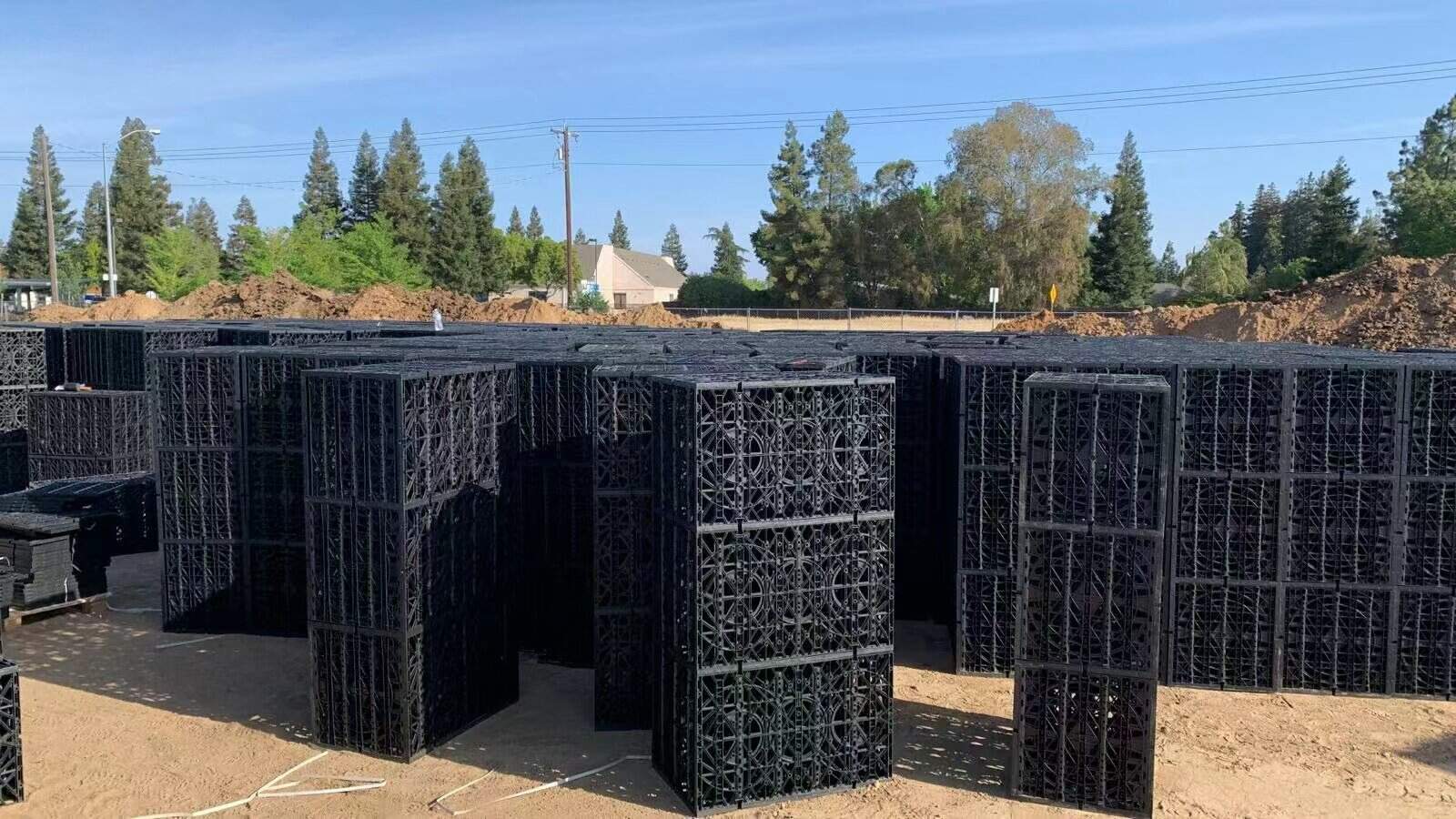
Here is why. Every underground detention system has a void ratio — the percentage of its installed volume that actually holds water. Gravel stores water in the interstitial spaces between aggregate particles, giving it a void ratio of roughly 35–40%. Geocellular modules (sometimes called stormwater crates or modular detention units) are lightweight polypropylene structures with internal open cells, producing void ratios of 95%. The US Environmental Protection Agency (EPA) recognizes both approaches as acceptable best management practices (BMPs) for stormwater detention — the difference is purely economic.
- To store 10,000 CF using gravel at 38% void, you excavate 26,316 CF of soil.
- To store 10,000 CF using geocellular modules at 95% void, you excavate 10,526 CF of soil.
Same storage. Less than half the digging. And excavation is not cheap.
National construction cost databases consistently report residential and light commercial excavation at $2.50 to $15.00 per cubic yard, with soil hauling and disposal adding $8 to $25 per cubic yard. For commercial detention projects involving deeper cuts, urban access constraints, and engineered backfill, total dig-and-dispose costs land between $25 and $55 per cubic yard depending on region and soil type. These ranges appear across multiple independent platforms — contractor survey reports, professional estimating tools, and consumer cost databases — and have held steady since 2024.
When excavation accounts for 40–60% of your total installed cost, the system that minimizes digging wins on price — even if its material cost per cubic foot is higher. Not theory. Arithmetic. We prove it below.
What Underground Detention Actually Costs: Three System Types
The following cost ranges reflect contractor-reported data across commercial projects in the United States. All figures assume standard soil conditions — no rock, no contamination, seasonal high water table (SHWT) below excavation depth. If your site has any of those complications, budget 15–30% higher. The Federal Emergency Management Agency (FEMA) notes that stormwater management costs vary significantly by site, reinforcing the need for project-specific estimates rather than rule-of-thumb pricing.
Gravel and Stone Trenches
| Élément de coût | Fourchette de prix | How We Calculated This |
|---|---|---|
| Crushed stone material | $3.50–$5.00/CF | National aggregate pricing: $28–$45/ton delivered ÷ 1.4 tons/CY ÷ 27 CF/CY |
| Excavation (at 38% void ratio) | $4.00–$6.00/CF of storage | $30/CY ÷ 27 CF × 2.63 volume multiplier, plus compaction and grading labor |
| Geotextile fabric and labor | $1.50–$2.50/CF | Non-woven geotextile at $0.40–$0.80/SF plus crew rates at $55–$85/hour |
| Total installed cost | $9.00–$13.50/CF of storage | Component sum under standard site conditions |
Gravel is the lowest material cost per cubic foot of fill. But the critical math: for every cubic foot of detention storage you need, you excavate roughly 2.6 cubic feet of soil because only 38% of that volume holds water. The rest is stone. On a 50,000 CF project, that volume multiplier transforms a moderate excavation job into a major earthmoving operation — 4,870 cubic yards of soil that has to be dug, loaded onto trucks, hauled to a licensed disposal facility, and dumped at $15–$45 per ton in tipping fees.
Gravel makes economic sense on rural sites where excavation runs under $22/CY, local crushed stone delivers at under $30/ton, staging area is wide open, and your schedule absorbs a 4–6 week installation window. Outside those conditions, the volume multiplier erodes the material cost advantage fast.
HDPE Arch Chamber Systems
| Élément de coût | Fourchette de prix | How We Calculated This |
|---|---|---|
| Unités de chambre | $6.00–$8.00/CF | Manufacturer-published pricing for standard residential and commercial units |
| Stone bedding (6–12 in. required) | $1.50–$2.00/CF | Aggregate base at $28–$45/ton across 6–12 in. depth |
| Excavation (at 40–50% void) | $3.00–$4.00/CF of storage | $30/CY mid-range ÷ 27 CF × ~2.2 volume multiplier |
| Labor, end caps, and connections | $2.00–$3.00/CF | Crew rates at $55–$85/hour; 3–4 day install per 20,000 CF |
| Total installed cost | $12.50–$17.00/CF of storage | Component sum under standard site conditions |
Arch chambers improve on gravel’s void ratio (roughly 40–50%) but still need a crushed stone bedding layer and careful subgrade leveling. They work well for linear footprints — easements, narrow lots, setback corridors — and for projects under 30,000 CF where the open-bottom design gives inspectors direct visual access. The stone bedding requirement adds both material cost and installation time compared to geocellular systems, which sit on compacted native soil or a thin sand layer.
Modular Geocellular Systems
| Élément de coût | Fourchette de prix | How We Calculated This |
|---|---|---|
| Unités du module | $4.50–$6.50/CF | FOB pricing for 30–60 ton load-rated modules; varies by compressive strength specification |
| Geotextile or geomembrane wrap | $0.50–$1.00/CF | Non-woven geotextile at $0.30–$0.60/SF or HDPE geomembrane at $0.50–$1.00/SF |
| Excavation (at 95% void ratio) | $2.00–$3.00/CF of storage | $30/CY mid-range ÷ 27 CF × 1.05 volume multiplier — near 1:1 dig-to-store ratio |
| Connectors and installation labor | $1.50–$2.50/CF | Snap-lock assembly; 2-person crew at 3,000–4,000 CF/day throughput |
| Total installed cost | $8.50–$13.00/CF of storage | Component sum under standard site conditions |
A 95% void ratio means your excavation volume barely exceeds your storage requirement — the multiplier is just 1.05× versus 2.63× for gravel. No stone bedding needed. No cranes. Two workers with snap-lock modules can install 3,000–4,000 CF per day. On tight urban sites where every extra day of open excavation costs money in traffic management, temporary fencing, and general conditions, that speed matters as much as the material price.
For a head-to-head comparison of all three systems on a single project, see our gravel vs chambers vs modular crates cost analysis.
Bottom line on system costs: Gravel is cheapest per cubic foot of fill but most expensive per cubic foot of storage on most commercial sites. Geocellular modules cost more per unit but deliver the lowest total installed price when excavation exceeds $22/CY — which covers roughly 70% of US commercial markets.
The Excavation Math on a 75,000 CF Project
Numbers on a spec sheet are abstract. Let us run them on a 75,000 CF storage requirement — typical sizing for a 5-acre commercial site with structured parking. We use $30/CY for excavation plus disposal, squarely in the middle of the $25–$38/CY range reported for moderate-cost regions like the Southeast and Texas corridor.
Gravel Trench: 75,000 CF Storage
At 38% void ratio: 75,000 ÷ 0.38 = 197,368 CF of gravel fill, requiring excavation of 7,310 cubic yards of soil.
| Line Item | Calculation | Cost |
|---|---|---|
| Excavation + disposal | 7,310 CY × $30/CY | $219,300 |
| Crushed stone | 197,368 CF × $3.50–$5.00/CF | $691,000–$987,000 |
| Geotextile, labor, connections | Lump sum | $40,000–$60,000 |
| Total project | $950,000–$1,266,000 |
Geocellular Modules: 75,000 CF Storage
At 95% void ratio: 75,000 ÷ 0.95 = 78,947 CF of excavation, which is 2,924 cubic yards of soil.
| Line Item | Calculation | Cost |
|---|---|---|
| Excavation + disposal | 2,924 CY × $30/CY | $87,700 |
| Modules + wrap + connectors + labor | 75,000 CF × $8.50–$13.00/CF | $637,500–$975,000 |
| Total project | $725,000–$1,063,000 |
Look at the excavation line: $219,300 versus $87,700. A $131,600 difference driven purely by void ratio — same storage volume, radically different digging. When you total everything, the geocellular system at its most expensive ($1,063,000) still costs less than the gravel system at its midpoint ($1,108,000).
In high-cost regions — the Northeast Corridor, California, Pacific Northwest — where excavation runs $38–$55/CY, that gap widens to $200,000+ on the same 75,000 CF project. The math scales linearly: the more expensive your dirt-moving, the more a high void ratio saves you.
Key takeaway: Void ratio is the multiplier that connects material choice to total project cost. Every dollar per cubic yard of excavation gets amplified or compressed by that ratio. Ignore it, and your budget is fiction.
How Excavation Costs Vary by Region
Regional excavation rates are the single biggest external variable in your total project cost. The ranges below come from multiple independent contractor survey datasets covering 2024–2026 pricing across five US regions. All figures include machine time, operator labor, soil hauling, and disposal fees at a licensed facility. The American Association of State Highway and Transportation Officials (AASHTO) publishes load rating standards that determine minimum cover depth and structural requirements — which in turn affect excavation depth and cost.
| Region | Excavation + Disposal ($/CY) | Prevailing Wage Rate ($/hr) | Impact on System Choice |
|---|---|---|---|
| Northeast Corridor (NY, NJ, CT, MA) | $38–$55 | $85–$130 | Modular systems strongly favored — excavation savings decisive at these rates |
| California & Pacific Northwest | $35–$50 | $80–$120 | Modular systems strongly favored; seismic considerations may add engineering |
| Southeast & Texas | $25–$38 | $55–$85 | Modular favored for timeline and labor efficiency over gravel |
| Midwest (OH, IN, IL, MN) | $20–$32 | $50–$75 | Both systems competitive — project timeline often the tiebreaker |
| Rural Southwest & Mountain States | $18–$28 | $45–$65 | Gravel competitive when aggregate is local and schedule is flexible |
Three factors drive regional variation. First, labor markets: prevailing wage (Davis-Bacon) projects in union states run 30–50% higher labor rates than open-shop work in the Southeast. Second, soil conditions: sandy loam in coastal Texas excavates four times faster than glacial till and fractured rock in Connecticut. Third, disposal regulations: tipping fees range from $15/ton at rural landfills to $45+/ton in metro markets with limited capacity. Even within a single state, costs swing 40% between urban and rural sites.
Projects with constrained site access, contaminated soil requiring hazardous disposal (TCLP testing, manifest tracking), or high water tables push costs toward the top of these ranges regardless of region. Critically, those complications multiply with excavation volume. Dig less, and every complication costs less.
Case Study: Houston Mixed-Use Development — 120,000 CF
In late 2024, a developer in northwest Houston contacted us about detention storage for a 7.2-acre mixed-use project: three commercial pad sites, a 340-space parking structure, and a detention requirement of 120,000 CF per the Harris County Flood Control District (HCFCD) regulations. The site sat on stiff Beaumont Clay — heavy, sticky material that clings to excavator buckets and slows production by 30–40% compared to sandy soils.
The original civil design specified a gravel-filled trench. We ran the numbers alongside their engineer: 120,000 CF ÷ 0.38 void = 315,789 CF of excavation (11,696 CY) for gravel, versus 120,000 ÷ 0.95 = 126,316 CF (4,679 CY) for geocellular modules. At the local excavation rate of $32/CY for that clay, gravel excavation alone cost $374,272. Modules: $149,728. The excavation delta was $224,544.
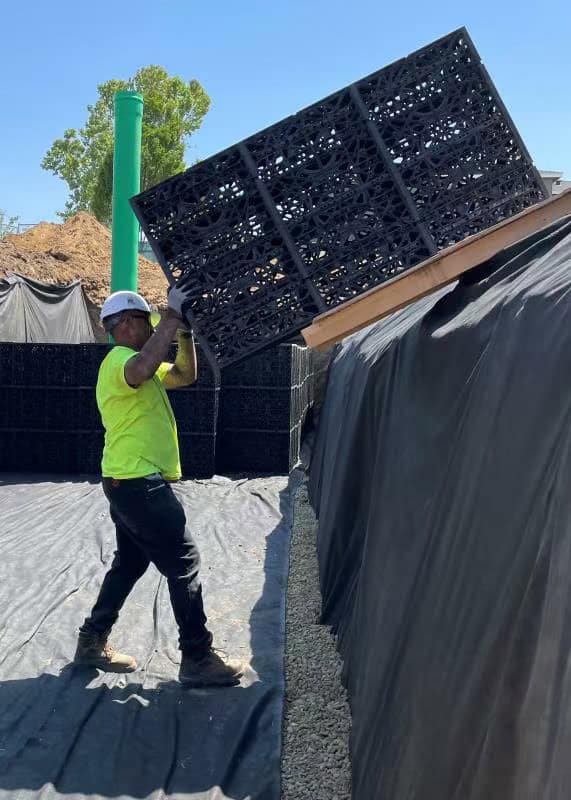
But the real problem was schedule. The general contractor had 18 working days allocated for underground utilities and detention combined. A gravel system at 11,696 CY would need four dump trucks running continuous haul cycles — the contractor estimated 22–25 working days minimum, blowing the schedule by a full week. Our geocellular system at 4,679 CY fit within 14 working days including module assembly, giving four days of schedule float. The developer switched to ARW-8053 modules. Total installed cost came in at $11.40/CF of storage versus the gravel estimate of $14.80/CF.
Worth noting: this project had no rock, no contamination, and groundwater sat 9 feet below finished grade — about as favorable as Houston clay gets. On a site with any of those complications, the gap would have been wider.
ARW Module Specifications for Your Estimate
If you are building a takeoff or feeding unit counts into an estimating spreadsheet, you need exact dimensions and storage volumes. Both models below comply with AASHTO LRFD Bridge Design Specifications for their stated load ratings and are manufactured from virgin polypropylene (PP) resin with UV stabilizers for pre-installation outdoor storage.
ARW-8053 — Heavy-Duty Traffic Applications
| Paramètre | Valeur |
|---|---|
| Dimensions (L × L × H) | 800 × 490 × 530 mm (31,5 × 19,3 × 20,9 pouces) |
| Net storage per unit | 5,84 pieds cubes |
| Taux de vide | 95% |
| Capacité de charge | AASHTO HS-25 (fire trucks, garbage trucks, heavy delivery vehicles) |
| Matériau | Virgin polypropylene (PP) |
| Compressive strength | >400 kN/m² (58+ psi) |
| Design life | 50+ years (chemically inert in soil environments) |
| Modules per 1,000 CF storage | ~171 units |
| Minimum cover (paved surface) | 18 inches compacted fill |
ARW-6841 — Standard Traffic Applications
| Paramètre | Valeur |
|---|---|
| Dimensions (L × L × H) | 680 × 410 × 450 mm |
| Net storage per unit | 4,31 pieds cubes |
| Taux de vide | 95% |
| Capacité de charge | AASHTO H-20 (passenger vehicles, light trucks, service vans) |
| Matériau | Virgin polypropylene (PP) |
| Compressive strength | >300 kN/m² (43+ psi) |
| Design life | 50 ans et plus |
| Modules per 1,000 CF storage | ~232 units |
| Minimum cover (paved surface) | 12 inches compacted fill |
Both models use interlocking snap connections — no tools, no adhesives, no specialized labor. Modules ship flat-packed on standard pallets, reducing freight cost by roughly 60% compared to pre-assembled chamber systems. A two-person crew assembles and places units at 3,000–4,000 CF per day. On a 75,000 CF project, that translates to 12–15 working days from first module placed to backfill complete. For product details and CAD drawings, visit our geocellular stormwater modules product page.
Five Installation Mistakes That Blow Up Budgets
These are not edge cases. We see them on enough projects to call them patterns — particularly from general contractors handling their first underground detention installation.
1. Bidding Without Geotechnical Data
Assuming “normal soil” and then hitting rock, perched water, or contaminated fill is the number one source of change orders on detention projects. A geotechnical boring program costs $2,000–$5,000 for most commercial sites — two to four borings to the planned excavation depth plus five feet. A mid-project surprise costs ten to twenty times that in standby charges, re-engineering, and hazardous disposal surcharges. No exceptions: every stormwater project should have borings completed before the earthwork contractor locks a price.
2. Forgetting Dewatering
If your excavation depth approaches the seasonal high water table (SHWT), you need wellpoint dewatering pumps running throughout the entire installation window. Dewatering on a typical commercial detention project adds $5,000–$20,000+ depending on soil permeability (hydraulic conductivity), flow volume, and pump-run duration. Check groundwater elevations in your geotechnical report before bidding. If the SHWT is within 24 inches of your planned excavation bottom, specify dewatering as an explicit bid line item. If it is not in the bid, it will appear in the change order — at a premium.
3. Skipping Bedding Preparation
An uneven subgrade creates stress concentrations that crack rigid chamber systems and cause differential settlement under repeated traffic loading. For any underground detention system, specify and field-verify 4–6 inches of compacted granular bedding (typically ASTM No. 57 or No. 8 stone, or clean sand) leveled to ±½ inch tolerance. This applies to geocellular modules as well — even though they tolerate minor irregularity better than rigid arch chambers, proper bedding extends service life and prevents localized ponding at low points.
4. Wrong Cover Depth for Traffic Loading
Insufficient soil cover above a detention system leads to structural failure under live loads — and the damage is catastrophic, not gradual. Minimum cover requirements depend on load rating and manufacturer specification. For AASHTO HS-25 applications under paved surfaces, ARW-8053 modules require a minimum of 18 inches of compacted structural fill. Get this wrong and you are not patching — you are excavating the entire system, the pavement above it, and every utility that crosses it. We saw one cover-depth error on a grocery store parking lot generate a $180,000 remediation bill on a $90,000 original installation.
5. Comparing Material Price Instead of Installed Price
This is the mistake this entire article exists to prevent. A system that costs $3.50/CF for material but requires 2.63× the excavation volume is not cheaper than a system at $5.50/CF that digs at 1.05×. Run the full installed cost — excavation, hauling, disposal, bedding, labor, wrap, connections, and backfill — for your specific site before selecting a system type. The 75,000 CF example above shows how a $2.00/CF material “savings” becomes a $225,000 project cost increase when excavation is included.
Common thread across all five mistakes: They each scale with excavation volume. The more dirt you move, the more each mistake costs. High void ratio systems reduce your exposure to every one of these risks by shrinking the hole.
Case Study: New Jersey Warehouse Distribution Center — 85,000 CF
In spring 2025, a logistics company in central New Jersey needed 85,000 CF of underground detention for a 220,000 SF distribution warehouse on a 12-acre parcel. The New Jersey Department of Environmental Protection (NJDEP) stormwater rules required managing the 2-year, 10-year, and 100-year storms — three separate design points. The geotechnical report showed dense glacial till below 4 feet, with Standard Penetration Test (SPT) blow counts exceeding 50 — essentially compacted gravel and cobbles deposited during the last ice age.
The earthwork subcontractor priced excavation at $48/CY for the glacial till — nearly double the rate for normal soil in the same county. For gravel: 85,000 ÷ 0.38 = 223,684 CF = 8,284 CY at $48/CY = $397,632 in excavation alone. For geocellular modules: 85,000 ÷ 0.95 = 89,474 CF = 3,314 CY at $48/CY = $159,072. The excavation delta: $238,560.
There was an additional complication the project team had not anticipated. The glacial till contained scattered cobbles up to 8 inches — too large for standard excavator bucket teeth. The contractor needed a rock bucket attachment, adding $1,200/day in equipment rental. Every extra day of digging magnified that cost. The geocellular system required 6 days of excavation versus an estimated 14 for gravel. Eight fewer days of rock bucket rental saved another $9,600 that showed up nowhere in any per-cubic-foot comparison.
Final installed cost: $12.80/CF for the geocellular system versus a revised estimate of $18.60/CF for gravel in that glacial till. The developer saved approximately $493,000 on the underground work — enough to fund the entire site landscaping package and perimeter stormwater quality swales.
A limitation worth noting: both case studies above involved favorable groundwater conditions (SHWT well below excavation depth). On sites requiring dewatering, the cost advantage of geocellular systems increases further because dewatering duration tracks excavation volume and time — but we have not quantified that multiplier across enough projects to publish a reliable range yet. We are tracking it.
Quand chaque système se justifie économiquement
No single “best” system exists — only the best match for your site conditions, timeline, and budget. Here is the decision framework we use internally when advising project teams:
Choose gravel trenches when site excavation cost is under $22/CY, you have wide-open equipment access with no staging constraints, local crushed stone delivers at under $30/ton, your schedule absorbs a 4–6 week installation window, and required storage stays under 25,000 CF. Gravel also fits where the jurisdiction specifically requires infiltration-only systems with no impermeable liner — the aggregate bed doubles as infiltration media in highly permeable soils (hydraulic conductivity above 1 × 10⁻⁴ m/s).
Choose arch chambers when your permitting authority requires physical inspection access to the system interior (open-bottom design), the footprint is linear (easements, narrow lots, utility corridors), storage falls in the 10,000–30,000 CF range, and stone bedding material is locally available at reasonable cost. Chambers remain the default in the shrinking number of jurisdictions that have not yet approved geocellular systems — though that list gets shorter every year.
Choose geocellular modules when excavation exceeds $25/CY, the site has limited staging or tight equipment access, the schedule is compressed (1–3 weeks versus 4–6 for gravel), storage exceeds 50,000 CF, you need HS-25 traffic ratings with multi-layer stacking to maximize storage under a fixed footprint, or the project requires both detention and integrated subsurface stormwater management — the same module serves detention, retention, and infiltration functions by changing only the wrap specification.
One exception worth flagging: extremely shallow sites (less than 36 inches between finished grade and seasonal high water table or bedrock) may not accommodate standard geocellular modules. In those cases, shallow-profile chamber systems or surface detention are the only viable options — though we manufacture a low-profile module variant for exactly this scenario. Ask us about it.
Decision summary: In the 70% of US commercial markets where excavation exceeds $25/CY, geocellular modules deliver the lowest installed cost per cubic foot of storage. In the remaining 30% — rural sites with cheap soil, cheap stone, and open schedules — gravel remains competitive on economics alone.
How to Get an Accurate Cost Estimate for Your Project
The ranges in this article give you a budgeting framework. But every site has variables — soil, groundwater, access, traffic loading, regional rates — that can only be resolved with site-specific data. Here is what you need to build a reliable estimate:
- Required storage volume in cubic feet — from your civil engineer’s hydrology and hydraulics (H&H) report, based on local stormwater ordinance design storm requirements
- Geotechnical data — soil classification (USCS), depth to rock or refusal, seasonal high groundwater elevation, and hydraulic conductivity if infiltration is part of the design
- Traffic loading class — AASHTO H-20, HS-20, or HS-25, determined by what drives over the buried system (passenger cars, delivery trucks, fire apparatus)
- Project timeline — how many working days the critical path allocates for underground work
- Detention vs. infiltration — this determines HDPE geomembrane (sealed detention) or permeable geotextile (infiltration/retention)
Our engineering team models your conditions and delivers a detailed cost comparison — including excavation volume calculations for each system type — within 48 hours. Send us your project parameters and we show you exactly where every dollar goes.
How Underground Detention Evolved — and Why Costs Keep Dropping
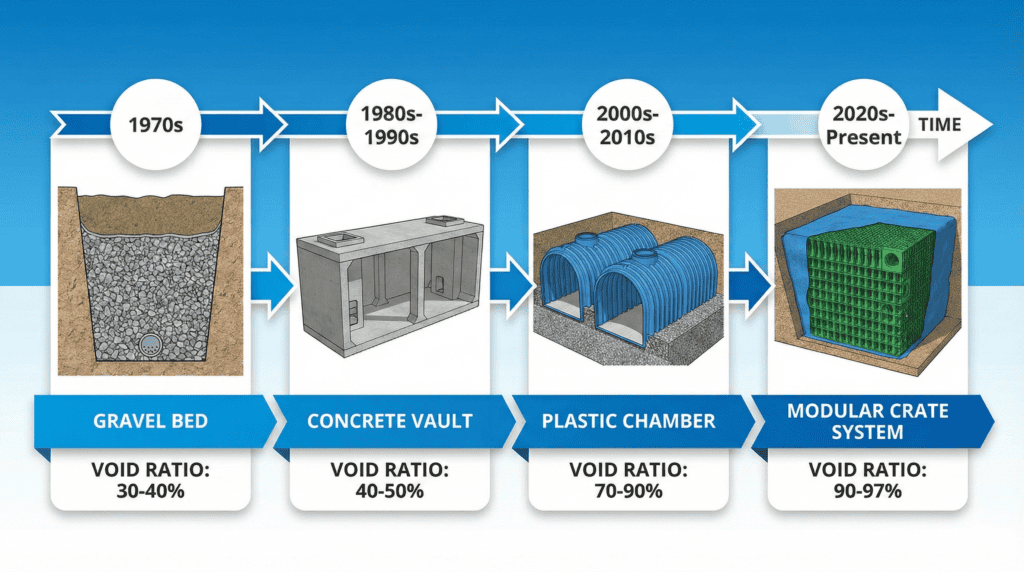
Underground stormwater detention is not new technology. Gravel-filled trenches have been used since the 1970s when the first MS4 (Municipal Separate Storm Sewer System) permits under the Clean Water Act’s National Pollutant Discharge Elimination System (NPDES) started requiring post-construction stormwater controls. Precast concrete vaults appeared in the 1980s. HDPE arch chambers entered the market in the early 1990s. Geocellular modular systems — the newest category — originated in Europe in the late 1990s and gained widespread US adoption after 2010.
Each generation reduced installed cost by improving void ratio and simplifying installation. Gravel at 38% void set the baseline. Chambers pushed to 40–50%. Geocellular modules reached 95% — near the practical ceiling, since the remaining 5% is the structural material itself. The cost trajectory over three decades is clear: material science reduces excavation volume, which is where most of the money goes.
Looking forward, two trends will continue pushing underground detention costs down. First, manufacturing scale: as more US jurisdictions mandate post-construction stormwater controls (the EPA’s 2024 proposed MS4 rule tightens requirements further), module production volumes are growing and unit costs declining 3–5% annually. Second, labor scarcity: skilled excavation operators are aging out of the workforce faster than replacements enter. Systems that minimize dig time — and the skilled labor hours that go with it — will carry an increasing cost advantage through the rest of this decade.
Foire aux questions
Expect <strong>$8.50–$17.00 per cubic foot of storage</strong> fully installed on commercial US sites. Gravel systems run $9.00–$13.50/CF, arch chambers $12.50–$17.00/CF, and modular geocellular systems $8.50–$13.00/CF. The biggest variable is regional excavation rate, which ranges from $18/CY in rural markets to $55/CY in the Northeast Corridor. System void ratio determines how much of that excavation cost hits your project.
Commercial detention excavation ranges from <strong>$18–$55 per cubic yard</strong> across the US. Northeast and West Coast run $35–$55/CY. Southeast and Texas are $25–$38/CY. Midwest and rural Southwest are $18–$28/CY. Rates include machine time, operator labor, hauling, and licensed disposal. On a 75,000 CF project, excavation represents <strong>20–40% of total installed cost</strong> depending on system type.
Your civil engineer calculates required detention volume using local stormwater ordinances, total impervious area (roofs, parking, sidewalks), pre- versus post-development peak runoff rates, and the allowable discharge rate set by your municipality or MS4 authority. Most jurisdictions require managing the <strong>10-year, 25-year, or 100-year design storm</strong>. As a rough benchmark, a 5-acre commercial site with 70–80% impervious cover typically needs 50,000–100,000 CF — but your number depends entirely on local rainfall intensity data and regulatory standards.
Void ratio determines <strong>how much dirt you move</strong>. A 95% void geocellular system stores 2.5× more water per cubic yard of excavation than a 38% void gravel system. On a 75,000 CF project, that means excavating 2,924 CY versus 7,310 CY — a difference of 4,386 cubic yards. At $30/CY, that saves <strong>$131,600</strong>. At $48/CY in tough soil, it saves <strong>$210,500</strong>. Every cost that scales with excavation volume — equipment hours, labor, trucking, disposal — drops proportionally with higher void ratio.
Yes. Systems meeting <strong>AASHTO H-20 and HS-25 load ratings</strong> are accepted by the vast majority of US jurisdictions for underground stormwater detention. They comply with MS4 permit requirements, <a href="/fr/%e2%80%9d/gestion-souterraine-des-eaux-pluviales-2026-lorsque-les-methodes-traditionnelles-ne-conviennent-pas-ne-peuvent-etre-menees-a-bien-ou-ne-sont-pas-efficaces/%e2%80%9d/">low-impact development (LID) standards</a>, and EPA stormwater management BMPs. Some municipalities require a product-specific submittal review — our engineering team provides stamped design calculations and installation details to streamline permitting. Always confirm requirements with your local authority having jurisdiction (AHJ) before finalizing design.
<strong>Polypropylene geocellular modules</strong> carry a 50+ year design life — the material is chemically inert in soil environments, unaffected by groundwater, soil pH, or microbial activity. <strong>Béton préfabriqué</strong> vaults last 75–100+ years but are susceptible to joint deterioration and cracking from differential settlement. <strong>HDPE arch chambers</strong> carry 50-year ratings. For all types, actual service life depends on installation quality — particularly bedding preparation, compaction, and maintaining specified cover depth.
<strong>Détention</strong> temporarily holds stormwater and releases it at a controlled rate through a flow-control device (typically a hydrobrake or orifice plate) — it slows runoff peaks but does not permanently store water. <strong>Rétention</strong> (infiltration) holds water and allows it to percolate into surrounding soil. The construction difference: detention requires an <strong>impermeable HDPE geomembrane</strong> (30-mil or 40-mil), while infiltration uses <strong>permeable non-woven geotextile</strong>. Geomembrane costs 2–3× more than geotextile, and infiltration requires percolation testing to confirm soil suitability.
Yes — this is one of the most common applications and a primary advantage over surface ponds. Systems are routinely installed beneath <strong>parking lots, access roads, fire lanes, loading docks, and building pads</strong>. Match the system’s load rating to surface use: <strong>AASHTO H-20</strong> for passenger vehicles and light trucks, <strong>HS-25</strong> for fire apparatus, garbage trucks, and heavy delivery vehicles. Maintain manufacturer-specified minimum cover depth — typically <strong>18–24 inches of compacted structural fill</strong> under paved surfaces for HS-25 rated systems.
Surface ponds are far cheaper to build — the EPA estimates <strong>$0.50–$1.00 per cubic foot</strong> for wet detention ponds and <strong>$0.15–$0.30/CF</strong> for dry basins. Underground systems cost <strong>$8.50–$17/CF</strong> installed. However, surface ponds consume land. On commercial sites where land value exceeds <strong>$15–$25 per square foot</strong>, the real estate consumed by a surface pond costs more than building underground. Underground detention also eliminates ongoing costs: mowing ($3,000–$8,000/year), security fencing, mosquito abatement, liability insurance for open water, and negative aesthetic impact on adjacent property values.
Geocellular systems need <strong>minimal ongoing maintenance</strong> — primarily annual inspection of inlet structures, sediment trap cleaning, and post-storm inspections after events exceeding the 1-year design storm. The modules have no moving parts, no degradation mechanism in normal soil, and no internal surfaces requiring cleaning under standard operation. Budget <strong>$500–$2,000 annually</strong> for a typical commercial installation. Compare that to surface ponds requiring $3,000–$8,000/year for mowing, sediment dredging, vegetation management, and perimeter fence repair.
<a href="/fr/%e2%80%9d/contact/%e2%80%9d/">Contactez notre équipe d'ingénieurs</a> with four items: required storage volume (from your H&H report), project location, traffic loading class (H-20 or HS-25), and any available geotechnical data. We model site-specific excavation volumes, compare system options with full installed-cost breakdowns, and deliver a <strong>detailed estimate within 48 hours</strong>. No obligation, no generic ranges — real numbers for your specific project.
For installation planning and contractor coordination, see our guide on taking underground detention from submittal to closeout.
Conclusion: Where Your Money Actually Goes
Underground stormwater detention costs $8.50–$17.00 per cubic foot of storage — but that range only makes sense when you understand the excavation math underneath it. The system with the lowest material cost is rarely the system with the lowest installed cost, because void ratio multiplies every excavation dollar. On a 75,000 CF project, that multiplier creates a $131,600 gap between gravel and geocellular systems at moderate rates, and $200,000+ in high-cost regions.
Three things to do next. First, get your required detention volume from your civil engineer — you cannot price anything without that number. Second, pull geotechnical data so you know what you are digging through. Third, contact our team for a site-specific cost comparison that accounts for your soil, your region, and your schedule. We show you the excavation math for each system type so you can make the decision with full visibility into where every dollar goes.
Disclaimer: All cost figures in this article are estimates based on national construction cost data, contractor survey reports, and our project experience as of February 2026. Actual costs vary by site conditions, soil type, groundwater depth, regional labor rates, material availability, and local regulatory requirements. This article is for budgeting and educational purposes — it does not constitute a formal bid, guarantee, or professional engineering recommendation. Always obtain site-specific geotechnical data and project-specific quotes before making procurement decisions. For professional engineering guidance, consult a licensed civil engineer in your jurisdiction.
À propos de l'auteur
AQUA RainWater Engineering Team — We design, manufacture, and supply geocellular stormwater modules for underground detention, retention, and infiltration systems. Since 2017, our engineering team has supported project design, AASHTO load calculations, and regulatory submittals for commercial, municipal, and infrastructure projects across North America, the UK, Australia, and the Middle East. Our team includes civil engineers, drainage specialists, and construction managers with combined experience across 500+ underground stormwater installations.
 English
 Arabic
 French
 Russian
 Spanish